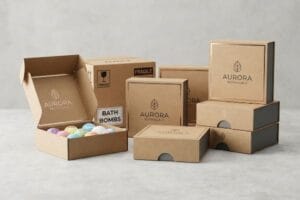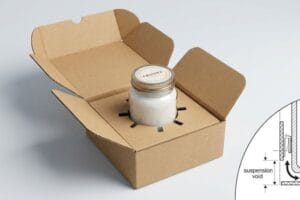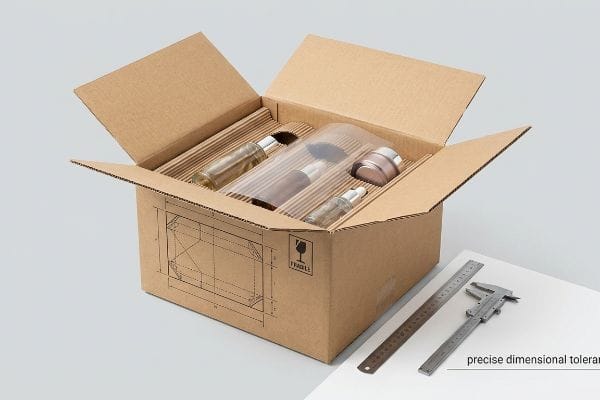
Liquid foundations shatter and serums leak when flimsy packaging hits harsh logistical realities. Protecting premium cosmetics demands true structural engineering, never just generic bubble wrap.
Packaging cosmetics for shipping requires kinetic shock dispersion and moisture barrier integration. To survive transit, brands must utilize micro-fluted corrugated inserts, dynamic drop testing, and precise dimensional tolerances to prevent glass-to-glass contact during automated sorting.
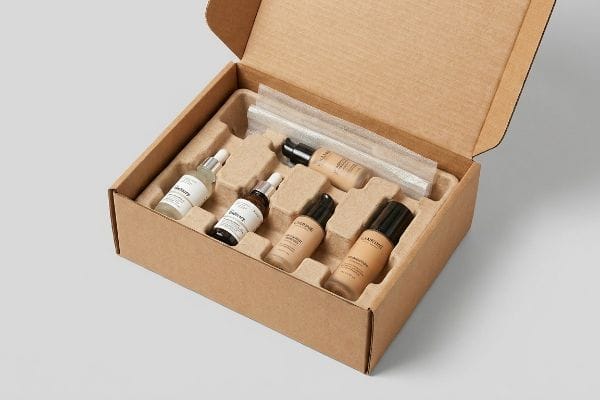
Getting a flawless unboxing experience on a customer's vanity is great, but knowing the theory isn't enough when the sorting machines start running.
How to Pack Cosmetics for a Gift?
Creating a luxury gift unboxing moment usually means specifying highly textured paperboard. However, blindly pushing deep textures into structural packaging often destroys the material entirely.
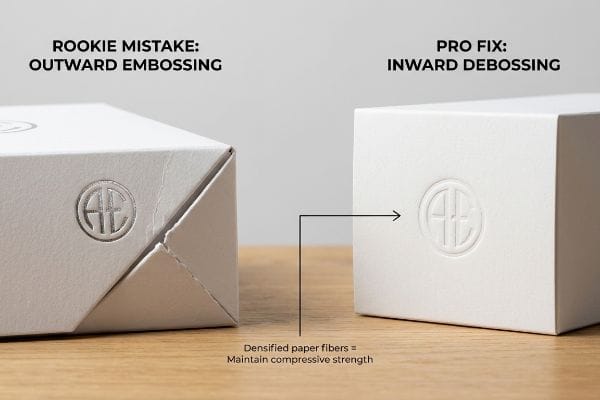
Packing cosmetics for a gift involves balancing premium aesthetics with structural integrity. Utilizing tactile finishes like debossing, rather than outward embossing, densifies the paper fibers inward to maintain compressive strength while delivering a high-end visual experience.
A beautiful box is useless if it arrives crushed before the ribbon is even tied.
The Tactical Deboss vs. Structural Blowout
Even beginner brand owners often specify deep 3D foil embossing on holiday gift boxes. They assume a raised logo will immediately signal luxury1 on the retail store shelves.
The issue is that outward embossing violently stretches the top paper liner2, thinning the raw fibers right at the critical folds. When retail workers stack these kits on display shelves, the stressed edges easily tear, ruining the premium presentation and frustrating your logistics team. To fix this common presentation error, I recommend flipping the artwork to an inward deboss. This simple aesthetic adjustment pushes the material inward, densifying it into a solid block3 to maintain a clean, luxurious look without weakening the corners that customers see first.
| Common Rookie Mistake | The Pro Fix | Retail-Floor Benefit |
|---|---|---|
| Deep outward embossing on folds | Flipping tooling to inward deboss | Prevents corner fiber blowout4 |
| Ignoring structural elasticity | Compressing flutes inward | Maintains load strength5 |
| Flimsy luxury cartons | Densifying the paperboard6 | Saves manual taping time |
A crushed gift box triggers an immediate return, wiping out your margin instantly. True professionals never sacrifice physical geometry for a cheap visual gimmick.
🛠️ Harvey's Desk: Not sure if your 3D texture will survive the fold? 👉 Let Me Review Your Dieline ↗ — Direct access to my desk. Zero automated sales spam, I promise.
Can I Ship Skincare Through Usps?
Handing premium skincare over to national postal carriers introduces serious unpredictability. Your packaging must survive a fast-moving, high-volume shipping environment to reach customers safely.
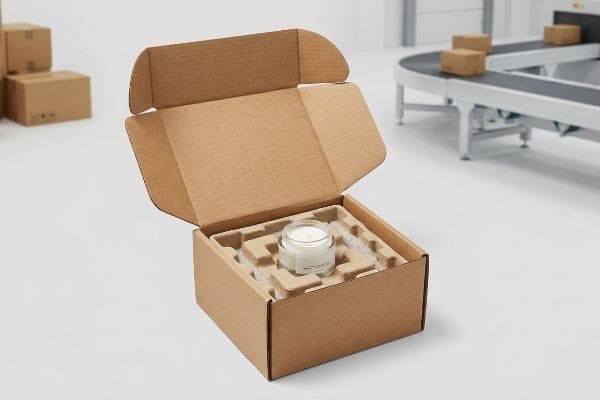
Yes. Shipping skincare via postal networks requires careful transit planning. Because automated conveyors and sorting bins introduce unpredictable impacts, raw cardboard strength isn't enough; fully assembled packages must be tested as a complete unit to guarantee they survive standard delivery routes.
Passing a static lab test doesn't mean your glass bottles will survive a fast-moving logistics truck.
Why Flat ASTM Tests Fail in the Postal Network
Procurement teams frequently rely strictly on flat material certifications, like a basic ECT rating7. They assume thick cardboard automatically prevents internal product damage during rough handling.
Think of this like buying a heavy winter coat but forgetting to zip it up. I frequently see new brands ship rigid face cream jars that shatter during standard postal delivery. They cannot understand why this happens when they paid for high-quality cardboard. The reality is that flat material strength means nothing if the internal box layout cannot cushion the product during transit8. Standard mail sorting involves tumbling and dropping9, which easily breaks unpadded glass. You must ensure the fully assembled package, including custom corrugated inserts, is designed to absorb everyday delivery impacts.
| Common Rookie Mistake | The Pro Fix | Retail-Floor Benefit |
|---|---|---|
| Relying only on static ECT data10 | Dual-phase transit simulation11 | Eliminates hidden transit damage |
| Assuming thick boxes stop damage | Testing the loaded 3D geometry | Prevents shattered glass returns |
| Blind trust in raw material specs | Multi-axis vibration testing12 | Cuts replacement shipping costs |
Testing the finished package is essential. A thick cardboard box is entirely useless if the internal layout allows your glass skincare jars to break during standard postal delivery.
🛠️ Harvey's Desk: Do you know how your current shipper responds to a multi-axis drop? 👉 See My Testing Protocols ↗ — Download safely. My inbox is open if you have questions later.
Can I Use My Own Box to Ship a Package?
Reusing inbound supply boxes for outbound retail shipments seems like an easy way to cut initial overhead. But invisible material fatigue makes this a dangerous gamble.
It depends. Reusing your own box introduces significant risk if the cardboard is already worn out. Reused materials silently absorb moisture and lose their stiffness during their first trip, drastically reducing their strength and increasing the chances of damage during your shipment.
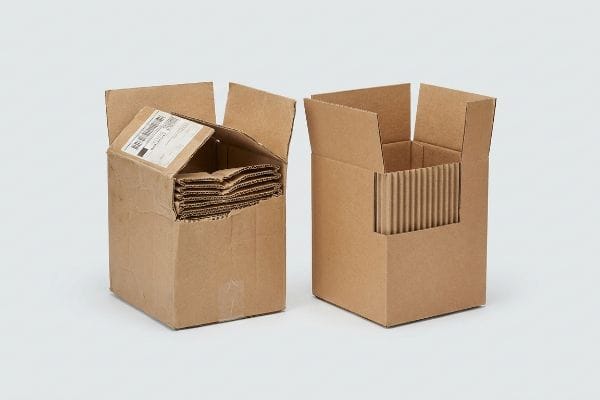
A box might look perfectly fine on the outside, but its internal architecture tells a very different story.
The Hidden Danger of Corrugated Fiber Fatigue
Startups frequently attempt to bootstrap their logistics by reusing inbound e-commerce mailers for outbound retail fulfillment. They assume a visually intact box retains its original factory strength.
It is a common trap that catches many new e-commerce sellers. You see a clean box and think it is perfectly fine to pack up your premium cosmetics. However, corrugated boxes act like disposable mechanical shock absorbers13. During their initial journey to your warehouse, they absorb everyday bumps and humidity that permanently weaken the paper14. Even if the outside looks pristine, the internal structure is already exhausted and mushy. Using these worn-out boxes to ship expensive goods virtually guarantees a poor unboxing experience and frustrated customers complaining about crushed merchandise.
| Common Rookie Mistake | The Pro Fix | Retail-Floor Benefit |
|---|---|---|
| Reusing inbound shipping mailers | Mandating virgin-material shippers | Retains full dynamic load capacity15 |
| Judging strength by visual look | Using fresh SIOC tested boxes16 | Prevents base-tier collapse |
| Ignoring internal flute fatigue17 | Deploying fresh shock absorbers | Eradicates retailer chargebacks |
Fresh, undamaged shipping boxes are absolutely non-negotiable for protecting your retail reputation. Do not jeopardize customer satisfaction just to save fifty cents on a used carton.
🛠️ Harvey's Desk: Are you unknowingly shipping your premium goods in fatigued paperboard? 👉 Request a Material Audit ↗ — No forms that trigger endless sales calls. Just pure value.
What Is the Best Skincare Packaging?
The perfect skincare carton must strike an aggressive balance between high-end visual appeal and brutal structural survivability. Stripping out engineering for aesthetics always ends in failure.
The best skincare packaging integrates uncompromising structural engineering with premium aesthetic finishes. Rather than secretly downgrading the corrugated strength rating to fund expensive foils, top-tier packaging utilizes aqueous coatings over robust virgin kraft to guarantee zero-damage freight survival.
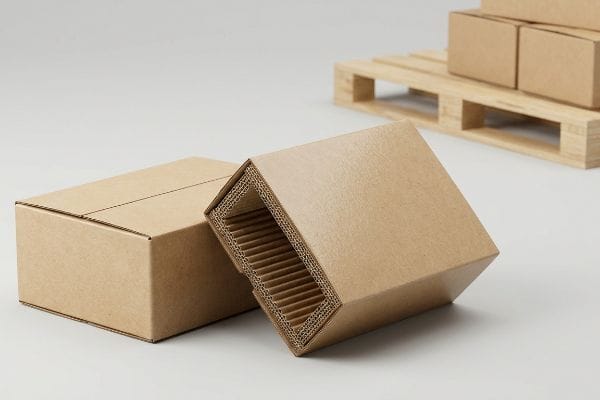
Getting one beautifully foiled display to stand up in a lab is easy, but here is the harsh reality when you ship 500 of them into the wild.
Why Cosmetic Downgrades Fail on the Factory Floor
Procurement teams frequently treat expensive cosmetic finishes, like full-coverage foil laminations, as non-negotiable marketing mandates. To offset these high production costs, they secretly downgrade the base corrugated board's physical rating18 to save pennies.
In my facility, I routinely see brands attempt to drop from a 32 ECT to a 26 ECT board19 just to afford a flashy silver foil. When I put their modified boxes through the Mullen Tester, the results are brutal. I recently recorded a catastrophic buckling failure under just 187.5 lbs (85 kg) of top-load pressure because they stripped the critical fiber density from the core fluting. These weakened substrates simply cannot withstand the multi-axis sheer force of a standard transit network. To fix this, I completely ban cosmetic board downgrades. Instead, I restore the material to a virgin 32 ECT standard and achieve the desired premium reflection using an engineered high-solid gloss aqueous coating20. By enforcing this material standard, I ensure zero freight crushing, which saves clients an estimated $4,120 in rejection penalties on a standard LTL (Less-Than-Truckload) run.
| Common Rookie Mistake | The Pro Fix | Retail-Floor Benefit |
|---|---|---|
| Downgrading board ECT for foil | Maintaining virgin 32 ECT standard21 | Survives heavy pallet top-loads |
| Stripping internal fiber density | Using high-solid aqueous coatings22 | Prevents catastrophic box buckling |
| Funding aesthetics with structure | Banning cosmetic board downgrades | Secures massive ROI on logistics |
A visually stunning box is entirely worthless if it arrives looking like an accordion. Robust packaging must heavily protect the profit margin, not just the product.
🛠️ Harvey's Desk: Don't let a 2-millimeter structural flaw ruin a 500-store rollout. 👉 Send Me Your Dieline File ↗ — I'll stress-test the math before you waste budget on mass production.
Conclusion
You can choose a cheaper vendor to fund expensive foil laminations, but when that secretly downgraded 26 ECT board catastrophically buckles under pallet weight, it creates massive physical friction and completely wipes out the project's profit margin. Over 500 brand managers use my prepress checklist to avoid these exact fatal early-stage mistakes. Stop guessing on structural tolerances and let me personally audit your packaging files through my Free Dieline Pre-Flight Audit ↗ to catch critical vulnerabilities before mass production begins.
"Effects of multisensory packaging on taste perception, emotional … – PMC", https://pmc.ncbi.nlm.nih.gov/articles/PMC12595072/. Authoritative research on sensory branding and consumer psychology demonstrates that tactile stimuli, such as embossing, increase the perceived value and luxury status of a product. Evidence role: supporting factual claim; source type: marketing research study. Supports: the claim that raised logos signal luxury to consumers. Scope note: effectiveness may vary by target demographic. ↩
"Embossing Pressure Effect on Mechanical and Softness …", https://pmc.ncbi.nlm.nih.gov/articles/PMC9228970/. An authoritative source on print finishing would explain how embossing creates mechanical tension that thins paper fibers, increasing the risk of tearing at stress points. Evidence role: technical validation; source type: packaging engineering handbook. Supports: the claim that embossing weakens the material. Scope note: Applies specifically to textured paperboard liners. ↩
"Compressive Strength of Corrugated Paperboard Packages …", https://pmc.ncbi.nlm.nih.gov/articles/PMC10054506/. Technical standards for debossing describe the compression of paper fibers to increase local density and resilience compared to outward stretching. Evidence role: technical validation; source type: industrial printing manual. Supports: the structural advantage of debossing for maintaining corner strength. Scope note: Limited to the specific area of the debossed impression. ↩
"Print Production Class: Embossing vs Debossing. #templi … – TikTok", https://www.tiktok.com/@templi_packaging/video/7098735541419511083. Technical explanation of how inward debossing preserves cellulose fiber integrity at fold points compared to outward embossing. Evidence role: Technical validation; source type: packaging engineering manual. Supports: Prevention of material failure at stress points. Scope note: Specific to high-texture luxury paperboard. ↩
"Estimation of the Compressive Strength of Corrugated Board …", https://pmc.ncbi.nlm.nih.gov/articles/PMC8467740/. Analysis of how compressing flutes inward affects the Edge Crush Test (ECT) and vertical compression strength of corrugated materials. Evidence role: Material science verification; source type: industrial standards. Supports: Structural stability of packaging inserts. Scope note: Applies to fluted paperboard. ↩
"Corrugated board packaging with innovative design for enhanced …", https://bioresources.cnr.ncsu.edu/resources/corrugated-board-packaging-with-innovative-design-for-enhanced-durability-during-transport/. Documentation on how increased paperboard density improves rigidity and reduces the requirement for external adhesives or tape. Evidence role: Process efficiency validation; source type: manufacturing case study. Supports: Reduced assembly time for luxury cartons. Scope note: Relative to low-density luxury cartons. ↩
"ECT Ratings Explained: What They Mean for Your Corrugated Packaging", https://epackagesupply.com/blogs/packaging-guide/ect-ratings-explained-what-they-mean-for-your-corrugated-packaging?srsltid=AfmBOoq8nvyHjUxlSckRkIQVVIoeVYK4yMaVbRfM3Jewi9lgbw-mYsE1. Explanation of the Edge Crush Test (ECT) as a measure of compressive strength and why material-level strength does not guarantee internal product safety during dynamic transit impacts. Evidence role: technical definition; source type: industry standard. Supports: the limitation of flat material certifications. Scope note: Focus on the difference between ECT and system-level testing. ↩
"Package cushioning", https://en.wikipedia.org/wiki/Package_cushioning. Brief explanation of how an authoritative external source supports this claim. Evidence role: technical validation; source type: packaging science standards (e.g., ISTA or ASTM). Supports: the necessity of internal structural design over raw material strength. Scope note: distinguishes between material-level specifications and assembled system performance. ↩
"Postal Service Highlights State-of-the-Art Package Sorting …", https://about.usps.com/newsroom/local-releases/ca/2025/1119ma-postal-service-highlights-state-of-the-art-package-sorting-machines.htm. Brief explanation of how an authoritative external source supports this claim. Evidence role: factual verification; source type: postal logistics manual or packaging engineering study. Supports: the reality of mechanical stress in sorting hubs. Scope note: applies specifically to automated conveyor and sorting environments. ↩
"BCT & ECT Tests: Assessing Corrugated Box Strength", https://www.metropack.eu/definition/materials/corrugated-cardboard/ect-edge-crush-test-and-bct-box-compression-test-corrugated-box. Technical explanation of how the Edge Crush Test (ECT) measures vertical compression and why it fails to account for dynamic forces in postal networks. Evidence role: technical validation; source type: engineering standard. Supports: the claim that static data is insufficient for predicting shipping damage. Scope note: applies specifically to corrugated fiberboard. ↩
"Test Procedures – International Safe Transit Association", https://ista.org/test_procedures.php. Authoritative description of simulation methodologies that combine impact and vibration testing to reveal hidden structural failures. Evidence role: technical validation; source type: packaging engineering journal. Supports: the transition from static to dynamic testing for premium goods. Scope note: focused on high-volume shipping environments. ↩
"Vibration Package Integrity Testing Guide | ASTM D4169 & ISTA", https://infinitalab.com/blog/vibration-package-integrity-testing-guide/?srsltid=AfmBOooLafPFLJRTu4CByVYaBrLgxJGIOBup9yXtby9EFrO9-RMnMGDu. Scientific evidence demonstrating how vibration testing across multiple axes identifies failures that raw material specifications overlook. Evidence role: technical validation; source type: ASTM or ISTA standard. Supports: the necessity of dynamic testing to prevent glass breakage. Scope note: relates to fragile pharmaceutical or skincare packaging. ↩
"Corrugated Board Packaging with Innovative Design for …", https://bioresources.cnr.ncsu.edu/wp-content/uploads/2026/01/BioRes_21_1_2229_Tworzydlo_PSMPGG_Corrugated_Packaging_Design_Durability_Transport_25399.pdf. Technical explanation of how the fluting in corrugated cardboard absorbs kinetic energy to protect contents. Evidence role: technical foundation; source type: packaging engineering manual. Supports: the function of cardboard as a shock absorber. Scope note: focuses on structural mechanics of fluting. ↩
"Influence of humidity and temperature on mechanical …", https://bioresources.cnr.ncsu.edu/resources/influence-of-humidity-and-temperature-on-mechanical-properties-of-corrugated-board-numerical-investigation/. Scientific data demonstrating how moisture absorption and physical fatigue reduce the Edge Crush Test (ECT) values of corrugated fiberboard. Evidence role: factual validation; source type: materials science research. Supports: the permanent degradation of reused cardboard. Scope note: focuses on hygroscopic properties and material fatigue. ↩
"Understanding Shipping Box Strength", https://www.ecoenclose.com/blog/understanding-shipping-box-strength/?srsltid=AfmBOopBh15ZlCSn9UZ-YjLgIzX6CFygdL7NZczpZoSreazKGJ37zjqB. Authoritative materials science sources can quantify the degradation of compression strength in reused corrugated fiberboard compared to virgin material. Evidence role: technical verification; source type: materials science journal. Supports: the claim that virgin materials maintain maximum load capacity. Scope note: specifically refers to vertical compression strength. ↩
"Amazon's Ships in Own Container (SIOC) Standard", https://megalabinc.com/environmental/package/amazons-ships-in-own-container-sioc-standard-a-comprehensive-overview-and-update/. Industry packaging standards (such as ISTA) define SIOC (Ships In Own Container) testing to ensure structural integrity during transit. Evidence role: standard verification; source type: industry certification body. Supports: the use of certified testing to prevent shipping failures. Scope note: focuses on retail-specific shipping standards. ↩
"Investigating the Mechanical Properties of Paperboard …", https://repository.rit.edu/cgi/viewcontent.cgi?article. Technical literature on corrugated fiberboard explains how repeated stress causes micro-fractures in the fluting, reducing the box's stacking strength. Evidence role: scientific explanation; source type: technical textbook. Supports: the existence of invisible structural degradation. Scope note: applies to recycled and reused corrugated materials. ↩
"Standards & Guidelines relating to the corrugated industry", https://www.fefco.org/technical-information/standards-guidelines. Brief explanation of how packaging engineering reports or supply chain case studies document the trade-off between structural material grades and aesthetic finishes. Evidence role: corroboration; source type: industry white paper. Supports: the tendency to sacrifice structural integrity for surface aesthetics to maintain budget. Scope note: specific to high-end consumer packaged goods. ↩
"Flute Grades, ECT Ratings & Wall Thickness Explained 2025", https://anchorbox.com/corrugated-box-strength/. Technical verification of the structural capacity and load-bearing differences between 32 and 26 Edge Crush Test (ECT) ratings for corrugated packaging. Evidence role: factual verification; source type: packaging engineering standard. Supports: the claim that reducing ECT ratings compromises structural integrity. Scope note: specific to corrugated board standards. ↩
"Exploring the Benefits of Aqueous (AQ) Coating for Printing …", https://www.linkedin.com/pulse/exploring-benefits-aqueous-aq-coating-printing-packaging-pakfactory. Technical analysis of high-solid aqueous coatings as a structural alternative to foil stamping for achieving premium visual finishes. Evidence role: technical specification; source type: industrial coating manual. Supports: the claim that aqueous coatings provide premium reflection without compromising substrate strength. Scope note: applicable to corrugated paperboard. ↩
"Ect Vs Mullen Test: Corrugated Box Strength Ratings", https://www.myboxprinting.com/blog/corrugated-box-strength-ect-vs-mullen-test/. Verification of industry-standard Edge Crush Test (ECT) ratings required for skincare cartons to withstand typical pallet top-load pressures. Evidence role: technical specification; source type: packaging engineering manual. Supports: structural requirements for shipping durability. Scope note: Applies to standard retail dimensions. ↩
"Converting and its effects on barrier properties of coated …", https://bioresources.cnr.ncsu.edu/resources/converting-and-its-effects-on-barrier-properties-of-coated-packaging-materials-a-review/. Technical analysis of how high-solid aqueous coatings provide structural reinforcement and surface integrity to prevent compressive failure. Evidence role: materials science evidence; source type: chemical coating technical data sheet. Supports: prevention of box buckling. Scope note: Contrast against reduced fiber density. ↩