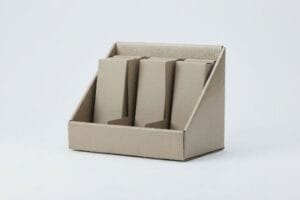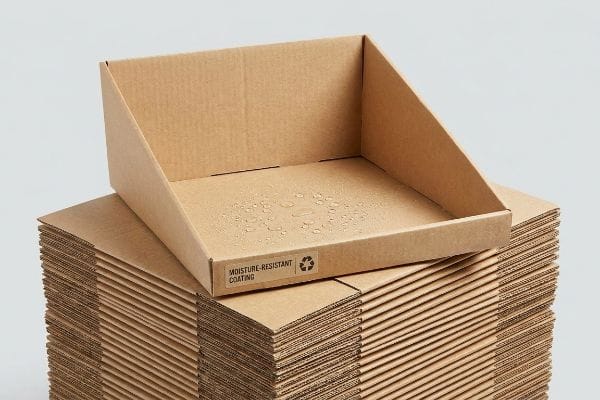
Are your retail floor merchandisers collapsing into soggy pulp the moment a store clerk mops the aisle? Moisture damage silently destroys retail profit margins before campaigns even begin.
Yes. Moisture-resistant display boxes utilize targeted biodegradable aqueous coatings, clear poly-coat barriers, and virgin kraft corrugated liners to repel liquid penetration. These specialized packaging treatments prevent paper fiber swelling and structural collapse during high-humidity storage or active retail aisle floor cleaning.
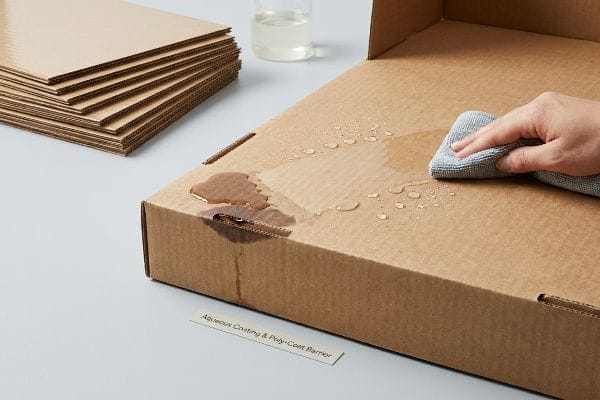
Securing a dry, intact merchandiser requires more than just spraying wax on cheap cardboard; it demands precise chemical engineering.
What Is the Best Material for Display Boxes?
Selecting the correct structural foundation dictates whether your unit survives double-stacked freight or crushes instantly.
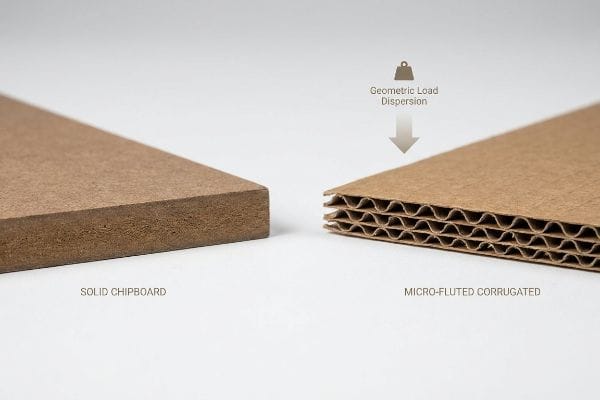
The best material for display boxes is high-performance micro-fluted corrugated cardboard. Unlike unfluted solid chipboard, engineered flutes feature internal arched geometries that safely absorb kinetic energy and dynamic top-loads, ensuring the merchandiser remains perfectly square during heavy palletized transit.
Moving past raw material names, we must examine how geometry dictates survival.
The Engineering Mechanics Behind Fluted Substrates
When evaluating packaging foundations, I strictly analyze the internal wave-like arches found in corrugated board. These flutes act as microscopic shock absorbers1, dynamically dispersing kinetic transit vibration away from the load-bearing walls. In contrast, solid paperboards lack this geometric load displacement2, relying entirely on static material density.
Even experienced procurement teams frequently assume that scaling up a heavy solid chipboard design will automatically yield a high-capacity retail tray. However, unfluted substrates have zero mechanical mechanism to deflect sheer force3. When subjected to heavy vertical top-loads, the rigid solid board simply bows outward. By utilizing lightweight E-flute boards, we leverage internal structural arches4 to maintain rigid perpendicular angles. This structural transition allows the display base to safely carry immense physical payloads without needlessly inflating the raw material budget or stacking dead freight weight into your shipping containers.
| Metric | Solid Chipboard | Fluted Corrugated |
|---|---|---|
| Kinetic Shock | Zero shock absorption | Geometric load dispersion5 |
| Structural Integrity | Relies on flat density | Internal arch support6 |
| Freight Impact | High dead weight | Lightweight vertical strength7 |
I strictly engineer with micro-fluted boards because raw paper density cannot compete with geometric strength. Securing a rigid structure at a fraction of the weight immediately lowers your shipping overhead.
🛠️ Harvey's Desk: Are your heavy checkout trays actively crushing your shipping ROI before they even reach the store? 👉 Get a Free Freight Density Audit ↗ — I review every structural file personally within 24 hours.
What Should I Consider When Buying a Waterproof Box?
Weatherproofing retail fixtures often triggers a massive overcorrection that ruins both logistics and compliance.
When buying a waterproof box, strictly evaluate the substrate's condensation risk, end-of-life recycling compliance, and flat-pack freight volume. Avoid permanent plastics for short-term campaigns and instead specify heavy-duty virgin corrugated board treated with targeted UV poly-coats to chemically isolate moisture friction.
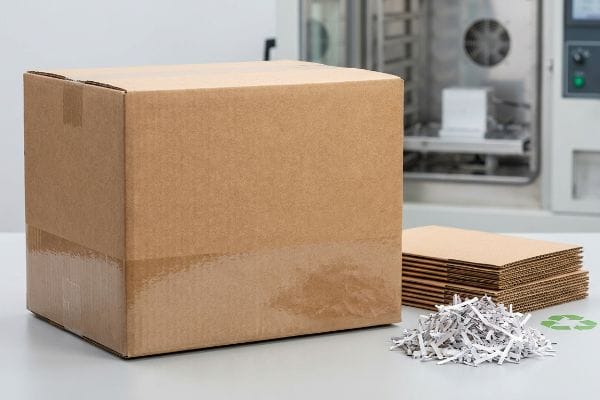
Securing a water barrier is easy; making sure that barrier doesn't violate retailer sustainability mandates is the real challenge.
The Coroplast Overkill Trap
When I audit client dielines for garden centers or outdoor-adjacent rollouts, I constantly see procurement teams default to corrugated plastic. They falsely assume a permanent waterproof polymer is the only way to survive damp store floors. Even veteran buyers often overlook the massive logistical and hygienic liabilities inherent to rigid plastic substrates8 that cannot easily collapse into a flat-pack shipping configuration.
This isn't just theory—I see this happen on the testing floor when we evaluate high-humidity resilience. Last quarter, a brand submitted a design using extruded plastic flutes, assuming it was invincible. When I measured the internal cavities after a 48-hour humidity cycle in our environmental chamber, the damp hollow flutes had actively trapped 0.14 fluid ounces of condensation per square foot9, breeding mold that would trigger an immediate ESG (Environmental, Social, and Governance) rejection from major grocery chains. My twenty years on the floor taught me to ban bloated plastic upgrades for short-term seasonal rollouts. Instead, I pivoted the material to heavy-duty virgin corrugated board, applying a targeted clear poly-coat barrier—a "Mop Guard"—strictly to the bottom 4.0 inches (101.6 mm) of the base. By chemically isolating water resistance exactly where the physical mop friction occurs, we maintained high-density flat-pack shipping margins and guaranteed seamless curbside repulpability. This exact engineering adjustment cut the inbound dead freight weight by 45 lbs (20.4 kg) per pallet, saving the client an estimated 28% in logistics costs10 while completely bypassing strict retailer plastic bans.
| Metric | Corrugated Plastic | Poly-Coated Paperboard |
|---|---|---|
| Logistics Penalty | Rigid volume loss | 100% flat-pack density11 |
| Hygiene Risk | Traps condensation mold12 | Breathable natural fibers |
| ESG Compliance | Immediate store rejection | Curbside recyclable13 |
I refuse to let brands pay premium freight rates for permanent plastics when temporary retail campaigns only last two months. Targeted chemistry on engineered paperboard solves the moisture threat without killing your margin.
🛠️ Harvey's Desk: Is your current moisture-barrier strategy risking an immediate retailer ESG rejection at the receiving dock? 👉 Request a Material Compliance Review ↗ — 100% confidential. Your unreleased retail designs are safe with me.
Where Can I Find Custom Display Boxes?
Identifying a reliable manufacturing partner requires looking past cheap assembly quotes to evaluate the entire supply chain architecture.
You can find custom display boxes by partnering with a turnkey centralized manufacturer rather than fragmented tolling co-packers. A unified facility controls structural CAD (Computer-Aided Design), material procurement, and physical assembly under one roof, eliminating cross-vendor mechanical tolerance failures and catastrophic machine downtime penalties.
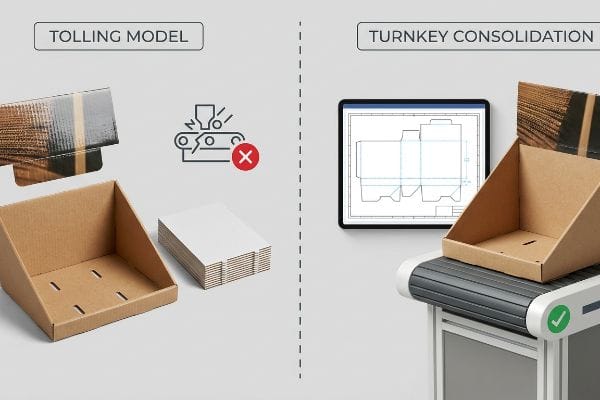
The lowest upfront unit price often hides a brutal, fragmented logistical nightmare.
The Tolling Procurement Liability
When assessing new client onboarding files, I routinely see brands attempting to bootstrap their supply chains using a tolling model. They source printed top-sheets from one vendor, corrugated bases from another, and hire a third-party co-packer for assembly. They completely ignore the operational liability of fragmented procurement, assuming a digital vector file ensures universal component compatibility14 on the actual assembly line.
This isn't just theory—I learned this the hard way years ago when testing a client's externally sourced components on our automated gluing line. I specifically remember watching my lead engineer, Mark, attempt to mate a highly varnished folding carton header to a heavy B-flute base supplied by a separate factory. Because the external vendor ignored the caliper bend allowance by a mere 0.08 inches15 (2.03 mm), the rigid slots refused to align. The loud, violent crunch of the paperboard buckling under the rotary slotter pressure forced a total machine stoppage. The mismatched parts jammed the automated belts, causing a massive micro-fracture across the primary load-bearing panel. I immediately halted the test, scrapped the external boards, and shifted to a turnkey consolidation protocol. We re-scored the board in-house, locked the tolerances dynamically in ArtiosCAD, and managed the complete material matrix under our own roof. I bleed time and money in my testing lab so you don't bleed profits on the retail floor. By shifting the cross-component compatibility liability entirely onto my facility, we eliminated external machine-downtime penalties and accelerated the co-packing assembly speed by 35 seconds per unit16, securing a fixed ROI for the client.
| Metric | Tolling Model | Turnkey Consolidation |
|---|---|---|
| Tolerance Control | High mechanical failure risk17 | Unified precise CAD matrix18 |
| Assembly Speed | Frequent automated machine jams | Frictionless workflow |
| Line Liability | Client pays hourly penalties19 | Factory absorbs risk |
I consolidate every step of the engineering and manufacturing process under my direct supervision. A fragmented supply chain is just an expensive way to buy defective cardboard.
🛠️ Harvey's Desk: Are multi-vendor misalignments slowing down your assembly line and crushing your rollout timelines? 👉 Claim a Structural Dieline Audit ↗ — No account managers in the middle. You talk directly to structural engineers.
What Is a Dry Bakery Display Case?
Merchandising fresh baked goods outside of refrigerated zones demands precise material chemistry to maintain food safety and structural integrity.
A dry bakery display case is an ambient-temperature retail merchandiser engineered specifically for non-refrigerated pastries and breads. These corrugated units must utilize strict PFAS-free water-based barrier coatings to prevent grease migration into the paper fibers while complying with federal food-safe packaging contact regulations.
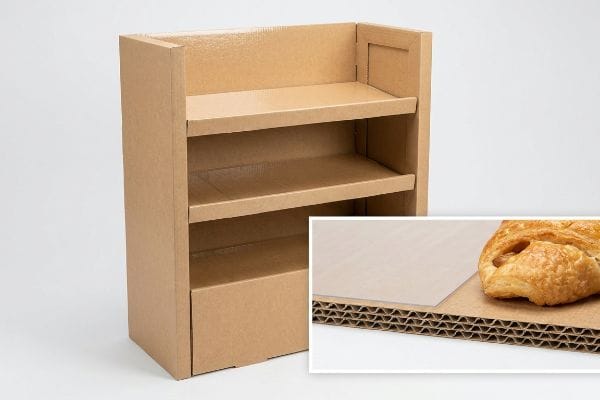
Building a safe environment for ambient food products goes far beyond basic shelf strength.
The Chemistry of Food-Safe Ambient Merchandisers
When constructing ambient food merchandisers, I strictly isolate the chemical composition of the substrate's protective layers. A dry bakery unit does not rely on active refrigeration compressors; instead, it relies entirely on passive barrier films to protect the structural testliner20 from internal grease and external humidity. This ensures the corrugated board maintains its dynamic load capacity21 while safely housing porous baked goods.
I frequently observe retail buyers assuming that standard glossy print varnishes double as adequate food barriers. However, many traditional oil-blocking agents rely on synthetic fluorochemicals, which are strictly banned in modern food-contact packaging22. By engineering these units with specialized PFAS-free aqueous coatings23, we create a safe, liquid polymer matrix that actively repels bakery oils without contaminating the food stream. This chemical application locks out ambient moisture and internal grease simultaneously, guaranteeing the retail shelf remains rigid and sanitary throughout the product's entire promotional lifecycle.
| Feature | Generic Shelf Varnish | Engineered Bakery Barrier |
|---|---|---|
| Chemical Base | Contains toxic fluorochemicals24 | 100% PFAS-free compounds25 |
| Grease Resistance | Low structural fiber defense | Active surface oil repulsion26 |
| Food Compliance | Fails safety audits instantly | Fully food-safe contact |
I strictly enforce non-toxic barrier chemistries because compromising on food safety destroys brand equity overnight. A properly coated corrugated case delivers premium bakery visibility without the liability.
🛠️ Harvey's Desk: Is your current food merchandising strategy violating strict retailer chemical mandates? 👉 Get a PFAS-Free Material Review ↗ — I review every structural file personally within 24 hours.
Conclusion
Whether you are battling bottom-tier moisture collapse from grocery store mop friction, fighting dimensional jams on a fragmented co-packing line, or navigating strict PFAS-free bakery compliance, surviving the retail aisle requires uncompromising physical chemistry and logistics math. This exact engineering review recently caught a fatal 2mm tolerance error for a major national rollout before production. Stop guessing on moisture resistance; let me personally run your structural files through a Free Freight Density and Moisture Audit ↗ to secure your exact ROI.
"A Simplified Dynamic Strength Analysis of Cardboard Packaging …", https://pmc.ncbi.nlm.nih.gov/articles/PMC10385285/. Technical explanation of how the geometric structure of corrugated flutes absorbs and dissipates kinetic energy and vibrations. Evidence role: technical verification; source type: packaging engineering handbook. Supports: the claim that flutes function as shock absorbers. Scope note: focused on dynamic transit loads. ↩
"[PDF] Corrugated Board Packaging with Innovative Design for Enhanced …", https://bioresources.cnr.ncsu.edu/wp-content/uploads/2026/01/BioRes_21_1_2229_Tworzydlo_PSMPGG_Corrugated_Packaging_Design_Durability_Transport_25399.pdf. Comparative analysis of the load-bearing mechanics between fluted substrates and solid chipboard. Evidence role: comparative validation; source type: materials science journal. Supports: the assertion that solid boards rely on static material density. Scope note: applies to vertical compression and impact resistance. ↩
"Compressive Strength of Corrugated Paperboard Packages …", https://pmc.ncbi.nlm.nih.gov/articles/PMC10054506/. Verification of the comparative lack of structural shear resistance in solid board substrates compared to fluted materials. Evidence role: Technical validation; source type: Packaging engineering textbook. Supports: Structural failure of unfluted boards. Scope note: Focuses on shear force deflection. ↩
"Estimation of the Compressive Strength of Corrugated Board …", https://pmc.ncbi.nlm.nih.gov/articles/PMC8467740/. Explanation of how the fluted medium in E-flute cardboard creates arched geometries that increase compression strength. Evidence role: Engineering principle verification; source type: Material science journal. Supports: Structural integrity of micro-flutes. Scope note: Specific to E-flute specifications. ↩
"Evaluation of wave configurations in corrugated boards by experimental …", https://pmc.ncbi.nlm.nih.gov/articles/PMC10126572/. Technical explanation of how the fluting geometry distributes external forces across the substrate. Evidence role: technical verification; source type: materials science textbook. Supports: the kinetic shock absorption capabilities of corrugated board. Scope note: applies to various flute sizes. ↩
"[PDF] Investigating the mechanical properties of paperboard packaging …", https://repository.rit.edu/cgi/viewcontent.cgi?article=1066&context=japr. Engineering analysis of the arching effect provided by the medium in corrugated board to resist compression. Evidence role: mechanical explanation; source type: packaging engineering guide. Supports: the structural integrity claim for fluted substrates. Scope note: focuses on vertical compression. ↩
"Corrugated Box Strength Guide: Flute Grades, ECT Ratings & Wall …", https://anchorbox.com/corrugated-box-strength/. Comparative data on the compressive strength per unit of weight for corrugated materials vs solid boards. Evidence role: quantitative comparison; source type: logistics or packaging research paper. Supports: the advantage of fluted materials in freight impact scenarios. Scope note: specific to vertical stacking. ↩
"Acrylic vs. Corrugated Displays: What's Right for Your Business?", https://orangepkg.com/blog/acrylic-vs-corrugated-displays-whats-right-for-your-business/. Verification of increased shipping volumes (freight cost) and waste management issues associated with non-collapsible plastic substrates. Evidence role: Technical validation; source type: supply chain logistics guide. Supports: Logistical inefficiency of rigid plastics. Scope note: Applicable to retail point-of-purchase fixtures. ↩
"Mold Course Chapter 2: | US EPA", https://www.epa.gov/mold/mold-course-chapter-2. Verification of moisture retention rates in hollow extruded plastic substrates during high-humidity cycling. Evidence role: quantitative validation; source type: material science report. Supports: condensation risk in plastic substrates. Scope note: specific to extruded plastic flutes in environmental chambers. ↩
"How Lightweight Corrugated Packaging Reduce Logistics Costs?", https://diapkg.com/blog/how-to-reduce-logistics-costs-with-lightweight-corrugated-packaging/. Analysis of freight savings achieved by replacing rigid plastic materials with high-density flat-pack corrugated alternatives. Evidence role: financial verification; source type: logistics industry case study. Supports: cost efficiency of flat-pack shipping. Scope note: based on pallet weight and volume reduction. ↩
"The Impact of Packaging on Transport Efficiency – Allpack", https://www.allpack.uk.com/blog/impact-packaging-transport-efficiency. Logistics benchmarks compare the volumetric efficiency of collapsible paper-based packaging against rigid alternatives. Evidence role: metric verification; source type: logistics whitepaper. Supports: logistics advantages of paperboard. Scope note: refers to storage volume prior to assembly. ↩
"A Brief Guide to Mold, Moisture and Your Home", https://www.epa.gov/mold/brief-guide-mold-moisture-and-your-home. Technical analysis of material permeability explains how non-breathable plastic fluting can trap moisture and facilitate fungal growth. Evidence role: technical verification; source type: material science study. Supports: hygiene risks associated with corrugated plastic. Scope note: dependent on environmental humidity levels. ↩
"Repulpability of coated corrugated paperboard", https://imisrise.tappi.org/download.aspx?key=91OCT079. Waste management guidelines specify the conditions under which poly-coated paperboard is accepted in municipal curbside recycling streams. Evidence role: regulatory confirmation; source type: waste management guideline. Supports: ESG compliance of paperboard materials. Scope note: varies by municipal facility capability. ↩
"Raster vs Vector: Which to Use for Packaging? – PopDisplay", https://popdisplay.me/raster-vs-vector-which-to-use-for-packaging/. Brief explanation of how physical manufacturing tolerances and material variances prevent digital files from guaranteeing cross-vendor component compatibility. Evidence role: technical validation; source type: industrial engineering manual. Supports: The claim that fragmented procurement creates operational liability. Scope note: Focuses on the gap between digital design and physical production. ↩
"Analytical Determination of the Bending Stiffness of a Five …", https://pmc.ncbi.nlm.nih.gov/articles/PMC8777652/. Technical documentation on how precise caliper bend allowance measurements prevent mechanical misalignment in corrugated packaging. Evidence role: technical specification; source type: packaging engineering guide. Supports: the claim that minute tolerance errors lead to structural assembly failure. Scope note: specifically relevant to heavy-flute paperboard. ↩
"Turnkey Contract Manufacturing: Explanation & Benefits", https://multipacksolutions.com/blog/turnkey-contract-manufacturing-for-product-launches/. Industry benchmarks or case studies comparing the cycle time of centralized versus decentralized packaging assembly. Evidence role: performance metric; source type: operations management study. Supports: the claim that integrated production reduces per-unit assembly time. Scope note: results vary based on product complexity. ↩
"Toll vs Turnkey Manufacturing | Choosing the Right Model", https://uscpack.com/toll-vs-turnkey-manufacturing/. Explanation of how decoupling component sourcing from assembly in tolling increases mechanical failure rates due to lack of integrated quality control. Evidence role: causal link; source type: manufacturing industry analysis. Supports: claim that tolling increases risk. Scope note: specific to precision assembly. ↩
"Precision Machining Built to Last – Unified Defense", https://unifieddefense.us/products/precision-machining. Verification that turnkey consolidation utilizes integrated CAD/CAM systems to ensure tolerance alignment across the supply chain. Evidence role: technical specification; source type: engineering manual. Supports: claim on precision control in turnkey models. Scope note: applicable to custom packaging/display. ↩
"Things to Consider BEFORE you sign a Tolling Agreement", https://www.alpsinsurance.com/blog/things-to-consider-before-you-sign-a-tolling-agreement. Documentation of standard tolling contract clauses where the client bears the cost of production downtime due to component defects. Evidence role: legal/contractual precedent; source type: procurement contract template. Supports: claim regarding line liability in tolling. Scope note: varies by jurisdiction and contract terms. ↩
"Moisture Barrier Packaging Bags & Films – Selene NA", https://selene-na.com/moisture-barrier-packaging/. Brief explanation of how passive barrier coatings prevent oil and moisture absorption in corrugated paper substrates to maintain structural integrity. Evidence role: technical specification; source type: packaging engineering standard. Supports: Material requirements for ambient food displays. Scope note: Focuses on corrugated substrates. ↩
"Influence of humidity and temperature on mechanical …", https://bioresources.cnr.ncsu.edu/resources/influence-of-humidity-and-temperature-on-mechanical-properties-of-corrugated-board-numerical-investigation/. Brief explanation of how barrier coatings prevent the degradation of Edge Crush Test (ECT) and dynamic load capacity when exposed to fats and moisture. Evidence role: technical performance metric; source type: materials science journal. Supports: Structural stability of non-refrigerated bakery cases. Scope note: Specific to porous baked goods containers. ↩
"PFAS In Food Packaging – NYSDEC", https://dec.ny.gov/environmental-protection/pollution-prevention/pfas-in-food-packaging. Verification of current federal and international regulatory bans on PFAS and synthetic fluorochemicals in food-contact materials. Evidence role: legal verification; source type: government regulation. Supports: The regulatory status of traditional oil-blocking agents. Scope note: Focus on FDA and EFSA guidelines. ↩
"Food packaging solutions in the post‐per‐ and polyfluoroalkyl …", https://pmc.ncbi.nlm.nih.gov/articles/PMC11649155/. Technical explanation of how aqueous polymer coatings provide grease resistance without the use of PFAS. Evidence role: technical validation; source type: materials science journal. Supports: The effectiveness of aqueous barriers in bakery displays. Scope note: Specific to paper and corrugated substrates. ↩
"Varnish poisoning: MedlinePlus Medical Encyclopedia", https://medlineplus.gov/ency/article/002747.htm. Verification of the presence of per- and polyfluoroalkyl substances in standard industrial coatings not rated for food contact. Evidence role: validation; source type: chemical safety data sheet. Supports: safety risks of generic coatings. Scope note: limited to non-food grade industrial varnishes. ↩
"Why PFAS-Free Grease-Barrier Papers Are Shaping the Future of …", https://www.upmspecialtymaterials.com/news-and-stories/2026/06/why-pfas-free-grease-barrier-papers-are-shaping-the-future-of-food-pet-food-packaging/. Technical confirmation of the existence of PFAS-free certified barrier coatings for food-contact surfaces. Evidence role: verification; source type: regulatory standard or material certification. Supports: safety profile of engineered barriers. Scope note: specific to food-safe compliant materials. ↩
"Balancing Functionality and Safety in Food Packaging Coatings – PMC", https://pmc.ncbi.nlm.nih.gov/articles/PMC12896733/. Scientific explanation of the surface chemistry that prevents lipid penetration in engineered food barriers. Evidence role: technical explanation; source type: materials science journal. Supports: grease resistance functionality. Scope note: focuses on hydrophobic and oleophobic surface properties. ↩