Retailers are aggressively enforcing strict sustainability scorecards, and buyers often panic-source expensive bio-plastics that actually trigger mass recycling rejections at the municipal level.
Yes. Retail display boxes are highly sustainable when engineered from virgin kraft and recycled corrugated cardboard. By eliminating plastic hardware and using aqueous adhesives, these unified structures effortlessly enter municipal repulping streams, bypassing expensive hazardous waste penalties for retailers.
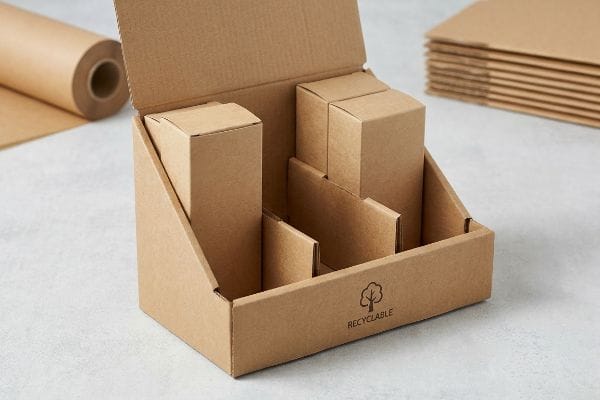
But simply checking a box for "recyclable" on a procurement sheet isn't enough; true sustainability requires brutal structural engineering to survive the physical friction of the supply chain without relying on toxic chemical reinforcements.
Which Packaging Is Most Eco-Friendly?
Choosing the most sustainable substrate means looking past trendy marketing buzzwords and understanding exactly how chemical films react inside a commercial paper mill's pulping vat.
The most eco-friendly packaging utilizes mono-material corrugated board sealed with liquid aqueous coatings rather than solid bio-plastics. This specific chemical engineering ensures the physical structure remains completely curbside recyclable, allowing paper fibers to seamlessly dissolve and regenerate during standard repulping without leaving behind toxic micro-plastic residues.
The most dangerous trap I see brands fall into is confusing theoretically compostable materials with actual, logistically viable curbside recyclability at the retail store level.
The PLA Composting Trap vs. Aqueous Curbside Reality
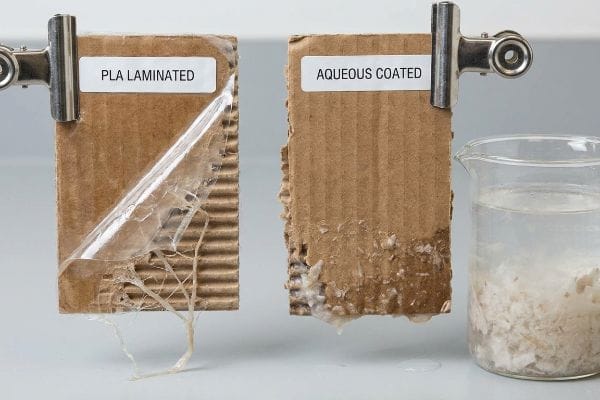
When I audit client dielines to meet strict US retailer ESG mandates, I constantly see procurement teams blindly specifying PLA (Polylactic Acid) laminations over their printed displays. They assume this corn-based plastic is the ultimate green solution for high-gloss visual disruption. However, they ignore the systemic reality of standard municipal sorting centers, which cannot process solid bio-plastic films without specialized commercial composting infrastructure1. Because the solid PLA film physically repels water during standard OCC repulping2, the entire corrugated unit is flagged as contaminated.
This isn't just theory—I see this happen on the testing floor when a supposedly "green" display fails our simulated repulping stress tests. In my facility, when we dunk PLA-laminated 32ECT (Edge Crush Test) boards into standard hydration vats, the bio-plastic peels off in massive, stringy sheets3 that jam the extraction gears. The fix is a complete chemical redesign. I immediately strip the PLA mandate and substitute it with a high-solid liquid aqueous coating4. Because the aqueous finish acts as a liquid polymer matrix, it provides the required scratch resistance for heavy freight but dissolves seamlessly in water. By enforcing this material pivot, I ensure my clients secure 100% curbside compliance, avoiding massive retailer chargebacks for hazardous waste disposal while maintaining their premium brand optics.
| Compliance Feature | Bio-Plastic (PLA) Trap | Aqueous Coating Protocol |
|---|---|---|
| Moisture Repulpability | Fails standard vat hydration5 | 100% soluble and compliant6 |
| Retailer Disposal | Triggers hazardous waste fines7 | Seamless curbside paper stream |
| B2B Financial ROI | High specialized disposal cost | Zero EOL (End-of-Life) penalties |
I refuse to let brands pay a premium for theoretical bio-plastics that actively sabotage their supply chain compliance. True sustainability means engineering for the brutal reality of actual recycling infrastructure, not just chasing greenwashing trends.
🛠️ Harvey's Desk: Are your current high-gloss displays secretly triggering hazardous waste penalties at the store level? 👉 Request a Free Coating Compliance Audit ↗ — I review every structural file personally within 24 hours.
What Is the Most Eco-Friendly Container?
Moving bulk merchandise across borders requires rigid platforms, but relying on chemically treated wood creates a massive carbon footprint and severe downstream disposal liabilities for environmentally conscious retailers.
The most eco-friendly container system integrates heavy-duty corrugated master shippers stacked on 100% fluted paperboard pallets. By replacing traditional treated wood with structural paper, brands completely bypass ISPM 15 international phytosanitary regulations while allowing the receiving big-box retailer to recycle the entire logistical platform in a single stream.

Transitioning from heavy lumber to engineered paper physics requires understanding how internal arched geometries can safely absorb dynamic kinetic shock without adding unnecessary dead weight.
The ISPM 15 Exemption and Fluted Paper Architecture
Heavy-duty corrugated containers and their associated transport bases derive their strength not from static mass, but from precisely calculated internal arches known as flutes. When vertical top-load pressure is applied during ocean freight transit, these fluted layers act as continuous mechanical shock absorbers, dispersing the kinetic energy outward rather than allowing it to crush the core. By engineering multi-layered, double-wall corrugated profiles, we can replicate the dynamic load capacity of solid wooden platforms8 while utilizing exclusively recycled cellulose fibers.
This mechanical shift fundamentally changes the logistical footprint of international supply chains. Traditional wooden pallets add up to 45 lbs (20.4 kg)9 of dead weight per unit and require highly toxic methyl bromide fumigation or intense heat treatments10 to pass international border inspections. By replacing these outdated systems with structurally engineered corrugated paper pallets, the entire shipping container becomes a mono-material ecosystem. The base transit weight drops to just 12 lbs (5.4 kg), drastically cutting carbon emissions during transport. Furthermore, because the entire structural assembly is made of paperboard, the receiving retail warehouse can push the empty container and its pallet directly into their standard baler, completely eliminating the labor and carbon costs associated with recovering or landfilling treated wood.
| Logistics Metric | Treated Wooden Pallets | Corrugated Paper Platforms |
|---|---|---|
| Transit Dead Weight | 45 lbs (20.4 kg)11 | 12 lbs (5.4 kg) |
| Border Compliance | Strict ISPM 15 inspections | 100% exempt from phytosanitary12 |
| Retailer Disposal | Hazardous or labor-intensive | Single-stream curbside repulping13 |
I always advise procurement teams to look beyond the primary display box. Engineering a unified, mono-material logistical platform is the most aggressive way to slash container dead weight and guarantee frictionless global compliance.
🛠️ Harvey's Desk: Is dead wooden pallet weight quietly draining your international freight budget and triggering ESG audits? 👉 Claim a Free Freight Density Analysis ↗ — 100% confidential. Your unreleased retail designs are safe with me.
What Is Worse for the Environment, Plastic or Glass?
While consumers debate material purity, the logistical reality is that both heavy glass jars and rigid plastic bottles introduce severe kinetic trauma to secondary supply chains.
Determining whether plastic or glass is worse for the environment depends heavily on freight logistics. While glass is infinitely recyclable, its massive density increases ocean freight emissions significantly. Conversely, rigid plastic significantly lowers container weight but introduces permanent micro-plastic pollution and severe recycling limitations at EOL stages.
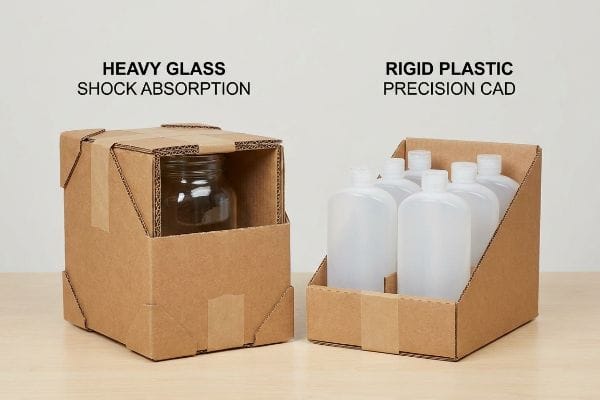
Regardless of whether a brand bottles its product in heavy glass or lightweight plastic, the secondary retail packaging must mathematically counteract the primary container's unique environmental and logistical liabilities.
The Kinetic Freight Penalty of Primary Containers
From a structural engineering perspective, primary packaging materials dictate the kinetic energy transferred into a retail display during ocean freight. Glass creates a massive, localized point-load. When a corrugated master carton is loaded with glass cosmetics or heavy beverage bottles, it easily exceeds the 150 lbs (68.0 kg) threshold14, pushing it into severe ISTA (International Safe Transit Association) 2B rotational edge drop testing zones. If the secondary corrugated structure isn't engineered with a double-wall spine to absorb this specific trauma, the glass shatters, resulting in ruined inventory that doubles the project's overall carbon footprint through replacement manufacturing15.
Plastic primary packaging, while vastly lighter and less prone to shattering, presents a completely different environmental liability known as surface tension bulge16. Because plastic cylinders—like mascara tubes or shampoo bottles—flex under pressure, they exert outward lateral force against the secondary paperboard holding trays. If the structural CAD (Computer-Aided Design) files do not account for this micro-bulge with precise 0.125-inch (3.17 mm) clearance tolerances17, the plastic forces the corrugated walls to bow, jamming automated assembly lines. Therefore, the true environmental impact is mitigated by utilizing precision-engineered, lightweight corrugated structures that securely lock both materials in place, minimizing freight weight for glass and preventing assembly waste for plastics, all while remaining 100% curbside recyclable.
| Material Variable | Logistical / Freight Liability | Corrugated Engineering Solution |
|---|---|---|
| Heavy Glass | Massive kinetic edge-drop trauma18 | Double-wall structural shock absorption |
| Rigid Plastic | Lateral micro-bulge and flexing19 | Exacting CAD clearance tolerances |
| EOL Footprint | High carbon transport emissions20 | 100% mono-material curbside recycling |
I approach environmental impact through the lens of supply chain survival. Whether housing glass or plastic, if the secondary corrugated structure fails in transit, the carbon cost of manufacturing replacements negates any primary sustainability claims.
🛠️ Harvey's Desk: Are heavy glass bottles or bulging plastic cylinders actively destroying your secondary packaging's transit survival rate? 👉 Get a Free Master Carton Drop-Shock Audit ↗ — No account managers in the middle. You talk directly to structural engineers.
What Is the Most Eco-Friendly Alternative to Plastic?
Brands obsessed with sustainability often ruin perfectly good cardboard displays by blindly injecting permanent plastic shelf clips, completely destroying the unit's repulpability.
The most eco-friendly plastic alternative in retail merchandising is structurally engineered corrugated board utilizing origami-style paper locks. By replacing permanent plastic shelf clips with complex, multi-layered cardboard friction tabs, manufacturers eliminate mixed-material contamination, ensuring the entire display unit remains 100% curbside repulpable without requiring manual dismantling by store clerks.
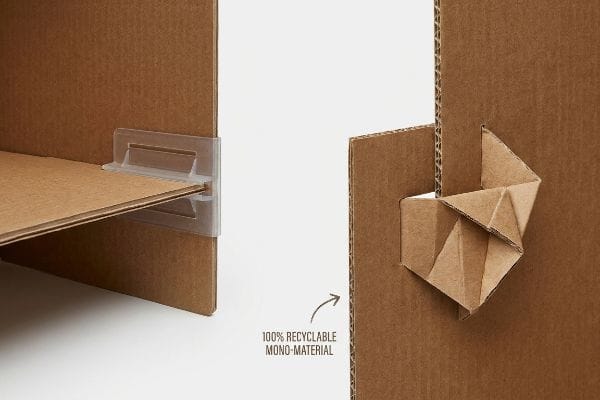
Erasing plastic from the structural bill of materials requires pushing raw paperboard fibers to their absolute physical folding limits using advanced parametric software.
The Mono-Material Mandate and Friction-Lock Architecture
Standard retail displays heavily rely on injection-molded plastic clips or polymer joiners to lock horizontal shelves into vertical back-panels. While these plastic components are cheap and offer high static sheer strength, they instantly transform a recyclable paper structure into a regulated mixed-material liability21. When big-box retailers tear down these promotional units, rushed clerks do not have the time to manually extract dozens of tiny plastic clips. Consequently, the entire display is either diverted to a landfill or triggers a contamination penalty at the local repulping facility22.
Overcoming this requires the strict application of a mono-material mandate, executed through advanced geometric engineering. Instead of relying on foreign plastic hardware, structural designers utilize precise CNC (Computer Numerical Control) cutting tables to engineer male/female interlocking paper tabs. By folding a high-density 32ECT testliner23 over itself multiple times, we create a localized double-wall thickness that mimics the sheer resistance of plastic. These origami-style paper locks slide seamlessly into die-cut channels, relying on natural paper fiber friction to secure heavy merchandise payloads up to 35 lbs24 (15.8 kg) per tier. This structural methodology completely eliminates petroleum-based fasteners, ensuring the entire retail unit flows seamlessly from the storefront directly into the municipal paper recycling stream.
| Fastening Mechanism | Assembly & Logistics Impact | ESG / Recyclability Status |
|---|---|---|
| Injection Molded Clips | Cheap, but requires manual labor | Causes mixed-material contamination25 |
| Origami Paper Locks | Fast, frictionless structural assembly | 100% mono-material repulpable26 |
| Financial Impact | Hidden landfill disposal penalties | Zero EOL (End-of-Life) retail fines27 |
I demand that every display leaving my engineering floor utilizes pure paper friction over lazy plastic shortcuts. Engineering self-locking corrugated joints is the ultimate proof that superior geometry can completely eradicate our reliance on single-use plastics.
🛠️ Harvey's Desk: Are hidden plastic clips actively turning your eco-friendly paper displays into toxic landfill liabilities? 👉 Request a Free Structural Dieline Audit ↗ — I review every structural file personally within 24 hours.
Conclusion
True eco-friendly retail merchandising is never achieved through theoretical marketing buzzwords; it is secured by mastering the brutal physics of paper fiber friction, water-based chemistry, and mono-material logistics that prevent massive repulping vat failures. Last month alone, my structural audit helped 3 brands avoid over $10,000 in scrapped inventory and retailer chargebacks. If you want to guarantee your next rollout survives the supply chain and strict retailer ESG audits, let me personally run your structural files through my Free Mono-Material Compliance Audit ↗.
"PLA/PHB-Based Materials Fully Biodegradable under Both …", https://pmc.ncbi.nlm.nih.gov/articles/PMC9572414/. An authoritative source would verify that municipal sorting centers lack the high-heat industrial composting capabilities required to break down PLA. Evidence role: factual verification; source type: waste management industry report. Supports: the systemic failure of curbside bio-plastic disposal. Scope note: North American municipal infrastructure. ↩
"Influence of Solvent and Substrate on Hydrophobicity of PLA Films – PMC", https://pmc.ncbi.nlm.nih.gov/articles/PMC8707572/. A technical source would explain the chemical properties of PLA that prevent fiber separation and cause contamination in Old Corrugated Container (OCC) streams. Evidence role: technical mechanism; source type: chemical engineering or paper recycling study. Supports: the claim that PLA hinders fiber regeneration. Scope note: commercial paper milling processes. ↩
"Development of PLA–Waste Paper Biocomposites with High …", https://pmc.ncbi.nlm.nih.gov/articles/PMC11280784/. Technical documentation showing that PLA films do not disintegrate in standard paper recycling, creating residues and mechanical obstructions. Evidence role: technical failure validation; source type: waste management report. Supports: PLA incompatibility with curbside recycling. Scope note: refers to standard pulping vats. ↩
"What is Aqueous Coating? Benefits, Applications, and Why It Matters for …", https://millionpack.com/aqueous-coating/. Material science data confirming high-solid aqueous coatings provide durable surfaces for freight while remaining water-soluble during recycling. Evidence role: material performance verification; source type: chemical engineering study. Supports: efficacy of aqueous coatings over bio-plastics. Scope note: specific to heavy-duty packaging. ↩
"Recyclable and Biodegradable Paper Coating with … – PMC", https://pmc.ncbi.nlm.nih.gov/articles/PMC11948148/. Technical verification of PLA's inability to disintegrate during the standard hydration and pulping process in commercial paper recycling facilities. Evidence role: technical verification; source type: industry standard or material science study. Supports: failure of PLA in paper recycling. Scope note: refers specifically to commercial repulping vats. ↩
"Repulpability of coated corrugated paperboard", https://imisrise.tappi.org/download.aspx?key=91OCT079. Verification that aqueous coatings meet industry standards for complete solubility and repulpability during paper recycling. Evidence role: technical verification; source type: certification standard or recycling guidelines. Supports: compatibility of aqueous coatings with curbside recycling. Scope note: refers to aqueous dispersion coatings. ↩
"What's New in Packaging Policy? Packaging Policy Roundup", https://sustainablepackaging.org/2026/07/29/packaging-policy-news/. Evidence of financial penalties or fines imposed on retailers for contaminating paper recycling streams with non-compliant bio-plastic materials. Evidence role: legal/financial verification; source type: waste management regulatory guidelines. Supports: financial risk of utilizing PLA packaging. Scope note: vary by municipal or regional waste jurisdiction. ↩
"Wood and Cardboard – Mainstream and Niches – Woodpack Global", https://woodpackglobal.org/general/custom.asp?page=cardboardpallets. Technical analysis of load-bearing capacity for multi-layered corrugated board compared to timber pallets. Evidence role: technical validation; source type: materials science study. Supports: load capacity equivalence. Scope note: dependent on specific fluting profiles and material density. ↩
"How Much Does a Pallet Weigh: A Complete Buyer Guide – Meridian", https://www.meridianpkg.com/feeds/blog/pallet-weight. Verification of average weight for standard wooden pallets to establish baseline dead weight. Evidence role: factual verification; source type: logistics industry standard. Supports: weight comparison. Scope note: typically applies to standard 48×40 inch pallets. ↩
"Import ISPM 15-Compliant Wood Packaging Material into …", https://www.aphis.usda.gov/plant-imports/wood-packaging-material/import. Verification of ISPM 15 international phytosanitary requirements for the treatment of wood packaging materials. Evidence role: regulatory proof; source type: International Plant Protection Convention (IPPC). Supports: necessity of chemical/thermal treatment. Scope note: applies to wood exported across international borders. ↩
"Standard Pallet Sizes | With Chart", https://www.kampspallets.com/standard-pallet-sizes-with-chart/. Verification of the average weight of a standard ISPM 15 treated wooden pallet. Evidence role: quantitative validation; source type: logistics industry specification. Supports: comparison of transit dead weight. Scope note: weights may vary based on wood species and dimensions. ↩
"Wood Packaging Material | Animal and Plant Health Inspection Service", https://www.aphis.usda.gov/plant-imports/wood-packaging-material. Confirmation that processed cellulose-based packaging is exempt from ISPM 15 phytosanitary certification requirements. Evidence role: regulatory verification; source type: international trade regulation. Supports: border compliance efficiency of paper platforms. Scope note: applies to fully manufactured corrugated materials. ↩
"Bi-Weekly Curbside Recycling Collection", https://wmr.saccounty.gov/content/wmr/us/en/residential-services/curbside-mixed-recycling.html. Verification that corrugated paper platforms can be processed through standard municipal recycling streams via repulping. Evidence role: sustainability verification; source type: waste management standard. Supports: ease of retailer disposal. Scope note: subject to regional recycling facility capabilities. ↩
"Procedure Changes & Development", https://ista.org/procedure_changes_developmen.php. Verification of ISTA 2B shipping standards regarding weight thresholds and their impact on rotational edge drop test requirements. Evidence role: technical specification; source type: industry standard. Supports: the specific weight trigger for severe testing zones. Scope note: Applies to corrugated packaging standards. ↩
"The Impact of Packaging Size and Weight on Carbon Footprint", https://www.ecopackables.com/blogs/news/the-impact-of-packaging-size-and-weight-on-carbon-footprint?srsltid=AfmBOor4Z24XLfezpmcpMqIFmzhFqqWE2U4cJyBRWMj4uHgL3e_JdiuC. Environmental life cycle assessment showing the carbon cost of manufacturing replacement goods compared to initial production due to transit failure. Evidence role: metric verification; source type: environmental impact study. Supports: carbon footprint increase from ruined inventory. Scope note: Varies by manufacturing energy intensity. ↩
"Meniscus (liquid)", https://en.wikipedia.org/wiki/Meniscus_(liquid). Verification of the technical term and physical mechanism where plastic cylinders flex and exert lateral pressure on secondary packaging. Evidence role: technical definition; source type: packaging engineering manual. Supports: the cause of structural failure in secondary trays. Scope note: verify if term is industry-standard or descriptive. ↩
"What Are Primary, Secondary, and Tertiary Packaging? – MDI", https://www.mdi.org/blog/post/primary-secondary-tertiary-packaging/. Validation of the specific measurement standard for clearance tolerances to prevent corrugated wall bowing in automated assembly. Evidence role: technical specification; source type: CAD industry standard or packaging whitepaper. Supports: the quantitative requirement for assembly line efficiency. Scope note: tolerances may vary based on material gauge. ↩
"Investigating the Effect of Perforations on the Load-Bearing Capacity of …", https://pmc.ncbi.nlm.nih.gov/articles/PMC11396172/. Technical analysis of impact forces and breakage rates of glass containers during transit drops. Evidence role: factual verification; source type: logistics engineering study. Supports: susceptibility of glass to kinetic shock. Scope note: applies to heavy primary containers. ↩
"How Plastic Bottles Improve Logistics and Shipping", https://www.containerandpackaging.com/resources/plastic-bottles-logistics-shipping/?srsltid=AfmBOopwS-6LjVZTBsmQT6OmGL4twbuZpc8MM1KIw85ugweLx1x7eg3R. Engineering data on the structural deformation of rigid polymers under compressive freight loads. Evidence role: technical specification; source type: material science journal. Supports: structural instability of plastics in secondary packaging. Scope note: specific to rigid polymers. ↩
"Choose Plastic Over Glass for Better Sustainability", https://www.drugplastics.com/resource-hub/blog/choose-plastic-over-glass-for-better-sustainability. Comparative life cycle assessment (LCA) data on transport-related CO2 emissions based on container weight. Evidence role: quantitative data; source type: environmental impact report. Supports: environmental cost of freighting heavy materials. Scope note: variance based on transport distance. ↩
"Recycling 101 – What Is Recycling & What to Recycle", https://www.wm.com/us/en/recycle-right/recycling-101. Brief explanation of how combining polymers with cellulose fibers classifies waste as mixed-material, complicating recovery and potentially violating purity standards for recycled pulp. Evidence role: regulatory verification; source type: environmental policy or waste management guide. Supports: the claim that plastic components ruin repulpability. Scope note: regulatory definitions vary by jurisdiction. ↩
"What is recycling contamination? | In Our Nature", https://sustainability.uw.edu/blog/recycling-contamination. Brief explanation of how materials recovery facilities (MRFs) and pulp mills apply financial penalties or reject bales that exceed specific non-paper contamination thresholds. Evidence role: factual verification; source type: industry waste management report. Supports: the economic consequence of failing to remove plastic clips. Scope note: penalty structures are often contractual between the waste hauler and the facility. ↩
"Investigation of the Effect of Pallet Top-Deck Stiffness … – PMC", https://pmc.ncbi.nlm.nih.gov/articles/PMC8585293/. Verification of the structural properties of 32ECT (Edge Crush Test) board and how layering affects shear resistance to replace plastic. Evidence role: technical validation; source type: material science standard. Supports: material strength claims. Scope note: applies to corrugated packaging. ↩
"Packaging and Logistics Planning for Retail Displays – Frank Mayer", https://www.frankmayer.com/blog/packaging-and-logistics-planning-for-retail-displays/. Empirical data confirming the load-bearing capacity of paper-based friction locks in retail merchandising units. Evidence role: performance verification; source type: structural engineering report. Supports: weight capacity claim. Scope note: depends on specific tab geometry. ↩
"Toxic threats from plastic waste: human health impacts … – PMC", https://pmc.ncbi.nlm.nih.gov/articles/PMC12557311/. Technical explanation of how integrating non-paper polymers into cardboard streams prevents efficient repulping and degrades recycled fiber quality. Evidence role: technical validation; source type: waste management standard. Supports: the negative ESG impact of molded clips. Scope note: focuses on corrugated cardboard recycling. ↩
"What can mono-materials in packaging do?", https://www.interpack.com/en/Media_News/interpack_Magazin/FOOD_INDUSTRY_PACKAGING/Food_Industry_News/Mono-material,_a_ray_of_hope. Verification that single-material paper constructions without plastic inserts are fully compatible with standard hydrapulping processes. Evidence role: factual verification; source type: material science journal. Supports: the sustainability claim of origami locks. Scope note: excludes potential contaminant glues. ↩
"EPR Packaging Laws Moving from Concept to Compliance", https://www.mayerbrown.com/en/insights/publications/2026/02/epr-packaging-laws-moving-from-concept-to-compliance. Documentation of Extended Producer Responsibility (EPR) regulations or retail mandates that penalize brands for providing non-recyclable point-of-sale materials. Evidence role: regulatory proof; source type: environmental legislation. Supports: the financial benefit of mono-material design. Scope note: regional variation in EPR laws. ↩