Vous passez des semaines à concevoir une campagne publicitaire, pour finalement voir votre présentoir se déchirer et s'affaisser dans les rayons. Le problème ne vient pas des graphismes, mais du choix du support.
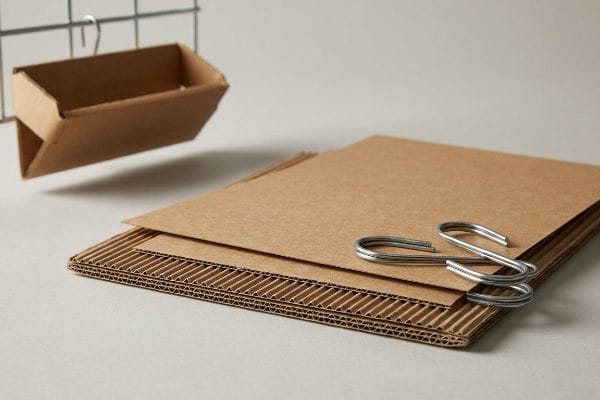
Les supports de présentation Power Wing sont principalement composés de carton ondulé micro-cannelé, de carton kraft vierge et de fixations métalliques en S. Les fabricants du monde entier conçoivent ces présentoirs temporaires pour la vente au détail en utilisant des supports légers et à haute compression pour résister à la suspension, tout en optimisant la visibilité des produits et en minimisant le poids de la structure sur les présentoirs de tête de gondole standard.
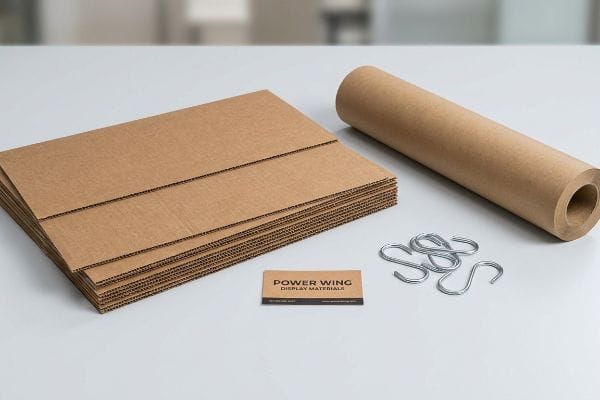
Connaître les ingrédients de base n'est que le début ; le véritable défi consiste à les concevoir pour qu'ils résistent aux environnements à fort trafic des magasins sans se déformer.
Quels matériaux sont utilisés pour les panneaux d'affichage ?
Le choix du bon substrat déterminera si votre unité survivra au transport ou arrivera écrasée.
Les supports de présentation sont principalement composés de carton ondulé testliner et de papier kraft vierge. Les ingénieurs en emballage utilisent des profils de cannelure spécifiques, tels que la cannelure E ou B, pour créer une géométrie interne arquée rigide qui répartit dynamiquement les chocs cinétiques tout en conservant une structure légère et économique pour les campagnes de vente au détail temporaires.
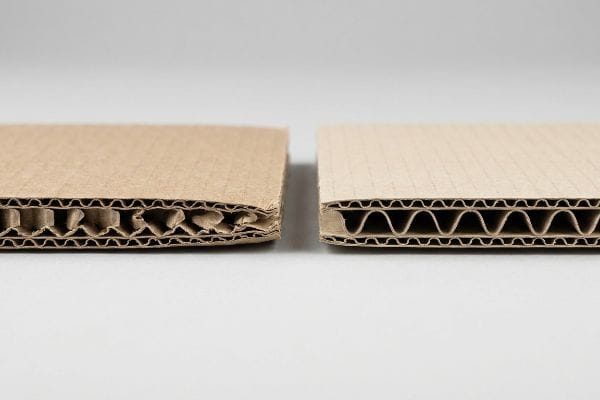
Mais cocher la case « carton ondulé » sur un formulaire d'achat est un piège énorme.
Le risque caché des panneaux d'affichage 100 % recyclés
Les marques soucieuses de développement durable exigent souvent du carton recyclé à 100 % pour leurs présentoirs de grande surface. Elles partent du principe que cette solution écologique possède la même résistance physique que le cartonneuf¹, et s'attendent à ce qu'elle supporte sans problème les produits de grande consommation (PGC) denses, sans aucune fragilisation de sa structure.
Voici la réalité microscopique que j'observe à l'usine : le processus de repulpage du papier raccourcit et épuise les fibres de cellulose après cinq cycles de recyclage².Lorsqu'un vendeur charge précipitamment 11,3 kg de lourds flacons de shampoing sur un plateau entièrement recyclé, on entend le léger craquement sec des cannelures internes épuisées qui s'affaissent instantanément. C'est un angle mort fréquent qui trompe même les équipes d'approvisionnement expérimentées, entraînant un gauchissement important du fond et un refus immédiat du détaillant. Je conçois toujours un mélange hybride, en injectant une proportion précise de 30 % de matériau kraft vierge³directement dans les cannelures porteuses afin de restaurer instantanément la résistance à la compression dynamique.
| Erreurs courantes des débutants | La solution pro | Avantage du magasin |
|---|---|---|
| Spécifier une toile de test 100 % recyclée pour les charges lourdes | Injecter 30 % de kraft vierge dans les cannelures4 | Empêche l'effondrement des étagères |
| Négliger l'épuisement microscopique des fibres5 | Profils de conseil d'administration hybrides de mandat | Résiste à un réapprovisionnement agressif |
| S'appuyant sur des tests théoriques sur feuille plate | Effectuer des essais de charge dynamique assemblés6 | Élimine les refacturations de transport |
Je refuse de dégrader la qualité des panneaux de construction pour me conformer à un critère écologique extrême. L'incorporation de fibres neuves garantit la résistance de vos produits au transport maritime en double empilement, tout en respectant les quotas de développement durable stricts des détaillants.
🛠️ Le bureau d'Harvey : Vous vous demandez si votre carton actuel contient suffisamment de fibres neuves pour supporter votre charge utile ? 👉 Faites auditer vos spécifications de matériaux ↗ — Accès direct à mon bureau. Zéro spam commercial automatisé, promis.
Qu'est-ce qu'un Power Wing Display ?
Pour capter les ventes impulsives en rayon, un placement vertical stratégique est indispensable.
Un présentoir à ailettes motorisées est un présentoir latéral polyvalent, à support métallique ou en carton ondulé, conçu pour être suspendu solidement aux têtes de gondole standard des magasins. Les équipes de merchandising utilisent ces structures compactes, alimentées par gravité ou à plusieurs niveaux, pour promouvoir les achats impulsifs dans des zones secondaires à fort passage, sans empiéter sur l'espace principal.
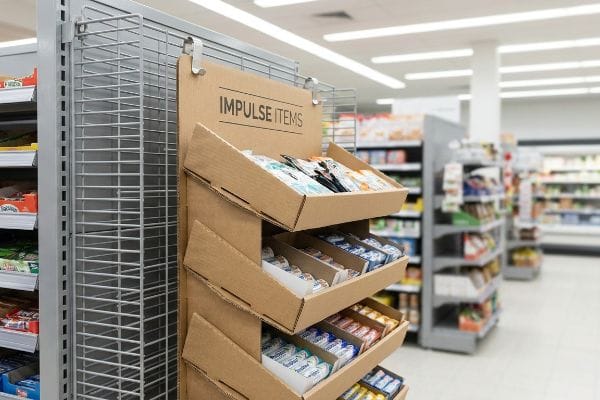
Comprendre leur fonctionnement est simple, mais les intégrer physiquement dans un paysage commercial fragmenté est une autre histoire.
La géométrie de la normalisation Sidekick
Les responsables marketing de nouveaux produits conçoivent souvent des présentoirs d'appoint aux dimensions spécifiques, parfaitement adaptés à leur article. Ils partent du principe que les gérants de magasin ajusteront sans problème leurs grilles métalliques d'extrémité pour accueillir un présentoir suspendu unique et sur mesure.
Lorsqu'on tente de livrer un présentoir de dimensions non standard à une grande chaîne de magasins, l'équipe de réception le jette tout simplement en réserve. J'ai vu des employés peiner à accrocher des présentoirs surdimensionnés sur des étagères métalliques standard, frottant agressivement les clips en S contre les rayonnages jusqu'à ce qu'ils abandonnent. Pour éviter ces problèmes, je standardise rigoureusement l'encombrement de mes présentoirs à une hauteur universelle de 121,9 cm (48 pouces) et une largeur de 35,5 cm (14 pouces). Cette contrainte géométrique précise de 48 × 14 garantit une compatibilité universelle avec la quasi-totalité des grandes enseignes de distribution , éliminant ainsi les pertes de temps de conception et assurant que votre campagne d'achat impulsif quitte bien l'entrepôt.
| Erreurs courantes des débutants | La solution pro | Avantage du magasin |
|---|---|---|
| Conception de hauteurs arbitraires pour les acolytes | Ancrage à la limite verticale de 48 pouces8 | Empêche le rejet en magasin |
| En ignorant les contraintes des grilles métalliques | Standardiser la largeur à 14 pouces9 | Assure une compatibilité universelle avec les embouts |
| Utilisation de languettes de suspension en papier fragile | Intégrer des clips en S métalliques universels10 | Empêche l'unité de se déchirer |
Je conçois mes campagnes en tenant compte d'abord des contraintes physiques du détaillant, puis de votre produit. Un format optimal de 48 x 14 pouces garantit une diffusion fluide et sans accroc de votre campagne dans les zones à fort trafic.
🛠️ Le bureau de Harvey : Vos dimensions d'étagères sont-elles compatibles avec les gabarits standards utilisés par les grandes enseignes ? 👉 Vérifiez la géométrie de votre présentoir ↗ — Téléchargement sécurisé. N'hésitez pas à me contacter si vous avez des questions.
Quels matériaux sont utilisés pour les présentoirs ?
Un présentoir sur pied subit d'énormes contraintes physiques dues au passage fréquent, aux chariots et aux équipes d'entretien.
Les présentoirs sont fabriqués à partir de bases en carton ondulé double cannelure, de cloisons internes robustes et de revêtements barrières résistants à l'humidité. Les usines de production conçoivent ces présentoirs de sol rigides pour supporter des charges dynamiques importantes tout en conservant leur stabilité structurelle face aux aléas quotidiens des commerces et à l'humidité ambiante.

Choisir un panneau épais à double paroi résout le problème de la capacité de charge, mais ignore complètement la réalité humide du sol du magasin.
La vulnérabilité à l'absorption d'humidité des bases ondulées
Les graphistes recouvrent généralement la base d'un présentoir de sol d'un vernis lithographique mat ou brillant standard(11) assorti au reste du visuel. Ils traitent la base de la même manière que le bandeau supérieur, en se concentrant exclusivement sur l'esthétique visuelle et la fidélité des couleurs.
Imaginez du carton ondulé brut comme une éponge sèche posée sur un sol commercial. Dans mon atelier, je vois régulièrement des clients consternés lorsque leurs présentoirs, pourtant impeccables, se détériorent à cause du passage des équipes de nettoyage nocturnes qui frottent les serpillières humides contre leur base. Les fibres du carton brut absorbent immédiatement l'eau sale, gonflant et fragilisant le panneau 32ECT12 jusqu'à ce que le présentoir entier bascule dangereusement. Pour remédier à ce problème, j'applique une couche protectrice transparente spécifique (polymère ou vernis)13 exclusivement sur les 10,1 cm inférieurs de la structure. Cette protection invisible préserve les fibres structurelles de l'humidité, prolongeant ainsi la durée de vie du présentoir de plusieurs semaines sans altérer l'identité visuelle de la marque.
| Erreurs courantes des débutants | La solution pro | Avantage du magasin |
|---|---|---|
| Laisser les bords inférieurs non scellés | Appliquer une barrière Poly-Coat transparente14 | Empêche l'absorption d'eau sale |
| Utilisation d'un vernis cosmétique standard | Obligation d'une barrière anti-humidité épaisse | Empêche le basculement de la base structurelle15 |
| Négliger le nettoyage nocturne des sols | Protéger la zone de frappe inférieure de 10 cm16 | Prolonge la durée de vie de la campagne |
Je ne laisserais jamais une campagne de merchandising de plusieurs milliers de dollars être ruinée par une simple serpillière humide. Une barrière chimique à la base protège l'intégralité de votre investissement structurel.
🛠️ Bureau Harvey : Les bords inférieurs de vos présentoirs de sol sont-ils exposés aux risques liés au nettoyage industriel ? 👉 Demandez une évaluation de votre barrière anti-humidité ↗ — Pas de formulaires intempestifs. Uniquement de la valeur ajoutée.
Quels sont les quatre types d'affichage de base ?
L'exécution en point de vente repose sur quatre architectures de merchandising fondamentales pour capter les consommateurs.
Les quatre types de présentoirs de base sont les présentoirs sur pied, les présentoirs de comptoir, les structures standard sur palettes et les présentoirs suspendus. Les ingénieurs en emballage conçoivent ces formats modulaires spécifiques afin de capter stratégiquement l'attention du consommateur dans différentes zones de vente, en conciliant un encombrement minimal avec une accessibilité dynamique des produits et le respect des réglementations.
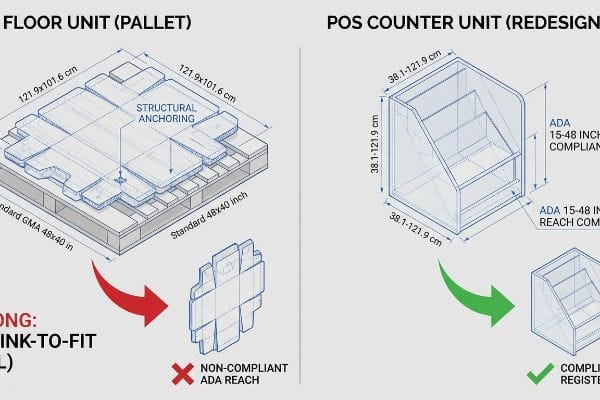
Mais la connaissance de la théorie ne suffit pas lorsque les machines se mettent en marche et que les détaillants exigent un respect strict des distances spatiales.
Pourquoi le « rétrécissement sur mesure » échoue-t-il en usine ?
Les sociétés commerciales proposent souvent un concept adaptable : un grand présentoir de sol PLV (publicité sur le lieu de vente) peut être réduit de moitié grâce à un logiciel de CAO (conception assistée par ordinateur) standard¹⁷pour servir de terminal de point de vente. Elles partent du principe que la réduction des éléments graphiques et des lignes de découpe permet d’obtenir une version miniature parfaitement fonctionnelle de la campagne originale.
Il ne s'agit pas que de théorie : je le constate en situation réelle lorsque des clients tentent de contourner les réglementations strictes en matière d'espace de vente au détail pour réduire leurs coûts d'outillage. Lorsque je compare ces unités réduites aux de conformité , elles échouent immédiatement. Les présentoirs de sol doivent impérativement respecter les dimensions maximales des palettes (121,9 × 101,6 cm) définies par la norme GMApour la logistique d'entrepôt. À l'inverse, les présentoirs de caisse doivent respecter la plage de portée avant (38,1 à 121,9 cm) imposée par la norme ADAEnimposant une séparation stricte entre la géométrie des palettes logistiques et l'ergonomie liée à l'utilisation, je garantis que les unités finales n'entraîneront pas de retours massifs de la part des gérants de magasin qui refusent systématiquement les caisses non conformes. Cette séparation stricte réduit les frictions logistiques et évite à mes clients d'importantes pénalités lors des déploiements en magasin.
| Erreurs courantes des débutants | La solution pro | Avantage du magasin |
|---|---|---|
| Unités de plancher rétractables pour comptoirs | Séparation des pipelines POP et POS | Élimine les rétrofacturations des détaillants |
| Ignorer les contraintes de portée légale | Ancrage selon les règles ADA de 15 à 48 pouces20 | Garantit la conformité au registre |
| Réduction des gabarits principaux | Repenser les mathématiques structurelles à partir de zéro21 | Empêche les mises en page instables |
Je n'accepte pas les réductions d'échelle bâclées dans mon usine. Concevoir des architectures distinctes pour le sol et le comptoir est la seule façon de réussir les audits de réception rigoureux des grandes surfaces.
🛠️ Le bureau de Harvey : Votre gabarit de comptoir de point de vente actuel est-il conforme aux normes de portée avant en vigueur dans le commerce de détail ? 👉 Envoyez-moi votre fichier de gabarit ↗ — Je vérifierai la robustesse des calculs avant que vous n’investissiez votre budget dans une production en série.
Conclusion
Vous pouvez choisir un fournisseur moins cher, mais si votre support en carton ondulé non protégé absorbe l'eau du lave-vaisselle et s'effondre dans l'allée, vous vous exposerez à un refus immédiat du détaillant et à des semaines de retouches manuelles coûteuses. Plus de 500 responsables de marque utilisent ma checklist prépresse pour éviter précisément ces erreurs fatales en début de production. Ne prenez plus de risques avec l'environnement : laissez-moi analyser personnellement vos fichiers de structure grâce à mon Audit de découpe gratuit ↗ afin de détecter ces vulnérabilités critiques avant la production en série.
« [PDF] CARTONS VIERGES VERSUS CARTONS RECYCLÉS Par L. Lisa Zhao Une thèse… », https://vuir.vu.edu.au/18233/1/ZHAO_1993compressed.pdf. Comparaison technique des propriétés mécaniques, de la résistance à la traction et de la capacité de charge du carton Testliner 100 % recyclé par rapport au carton kraft vierge. Rôle de la preuve : validation technique ; type de source : guide en science des matériaux ou en ingénierie de l’emballage. Appui : la différence d’intégrité structurelle entre les substrats recyclés et vierges. Note sur la portée : se concentre sur le carton ondulé utilisé dans les présentoirs de vente au détail .
« [PDF] Que deviennent les fibres cellulosiques lors de la fabrication et du recyclage du papier… », https://bioresources.cnr.ncsu.edu/BioRes_02/BioRes_02_4_739_788_Hubbe_VR_Recycling_Cellulosic_Fibers_Review.pdf. Des recherches faisant autorité en sciences des pâtes et papiers démontrent la réduction de la longueur et de la résistance structurelle des fibres au fil des cycles de recyclage successifs. Rôle de la preuve : vérification factuelle ; type de source : revue à comité de lecture. Appuie : l’impact du recyclage sur l’intégrité structurelle des matériaux. Note de portée : le nombre de cycles peut varier selon le type de fibre .
« Résistance à la compression des emballages en carton ondulé avec… », https://pmc.ncbi.nlm.nih.gov/articles/PMC10054506/ . Les normes techniques relatives aux emballages en carton ondulé spécifient les proportions optimales de fibres vierges et recyclées afin de maintenir la résistance à la compression dynamique. Type de preuve : spécification technique ; source : manuel d’ingénierie industriel. Appuie : l’efficacité des mélanges de matériaux hybrides. Remarque : les proportions peuvent varier en fonction des exigences de charge spécifiques.
« [PDF] Examen comparatif des propriétés physiques du carton recyclé… », https://repository.rit.edu/cgi/viewcontent.cgi?article=1299&context=theses. Données techniques démontrant comment l’ajout de fibres kraft vierges améliore la résistance à la compression verticale des cannelures de carton ondulé par rapport aux revêtements 100 % recyclés. Type de preuve : spécification technique ; source : manuel d’ingénierie de l’emballage. Éléments justificatifs : composition du matériau pour l’intégrité structurelle. Note relative au champ d’application : s’applique aux panneaux d’affichage robustes pour la vente au détail .
« Emballages alimentaires en papier recyclé : aspects chimiques, physiques et optiques… », https://pmc.ncbi.nlm.nih.gov/articles/PMC9576889/. Explication scientifique de la dégradation des fibres de cellulose lors des recyclages répétés, qui réduit la cohésion et la résistance du carton. Type de preuve : explication des propriétés physiques ; type de source : revue scientifique sur les matériaux. Arguments : le risque lié à l’utilisation de matériaux 100 % recyclés. Note sur la portée : analyse de la dégradation des fibres au niveau cellulaire .
« Estimation de la résistance à la compression des boîtes en carton ondulé… », https://pmc.ncbi.nlm.nih.gov/articles/PMC8467740/. Analyse comparative démontrant pourquoi les essais sur structures assemblées sous charges dynamiques sont plus précis que les essais sur feuilles planes pour prédire les défaillances lors du transport. Rôle de la preuve : validation de la méthodologie ; type de source : norme de qualité industrielle. Appuie : la nécessité des essais dynamiques pour la fiabilité du transport. Note sur la portée : spécifique à l’expédition et à la manutention des présentoirs de vente au détail .
« Présentoir Sidekick Cardobard personnalisé, présentoir Powerwing, tête de gondole… », https://grandfly.com/cardboard-display/sidekick-powerwing-display/. Les normes de merchandising en point de vente définissent les dimensions des présentoirs Sidekick afin de garantir leur compatibilité avec les rayonnages métalliques standard de tête de gondole. Rôle de la preuve : vérification technique ; type de source : guide de spécifications sectorielles. Appuie : l’affirmation selon laquelle les dimensions 48 × 14 constituent une norme universelle. Note relative à la portée : limité aux environnements de grande surface standard .
« 14 types de présentoirs de vente au détail | Chicago, IL – Wertheimer Box », https://wertheimerbox.com/types-of-retail-displays/. Vérification des restrictions de hauteur standard du secteur pour les présentoirs à panneaux latéraux motorisés afin de garantir la conformité des magasins. Rôle de la preuve : Spécification technique ; type de source : Guide sectoriel. Supporte : Hauteur verticale maximale des présentoirs à panneaux latéraux. Remarque sur la portée : Peut varier selon les exigences spécifiques du détaillant. ↩
« Présentoirs latéraux Power Wing personnalisés », https://www.creativedisplaysnow.com/display/power-wing-sidekick-displays/. Confirmation de l’exigence de largeur standard pour une installation universelle en bout de gondole dans les points de vente. Rôle de la preuve : Spécification technique ; type de source : Norme de fabrication. Supporte : Largeur universelle pour les présentoirs latéraux. Remarque sur la portée : S’applique à la géométrie Power Wing courante .
« Présentoirs à crochets personnalisés et supports latéraux | Vente en gros – hs packfactory », https://hspackfactory.com/custom-peg-hook-displays-sidekicks/. Validation technique des clips en S comme norme industrielle pour la fixation sécurisée des présentoirs à ailettes sur les rayonnages métalliques. Élément de preuve : Spécifications des matériaux ; type de source : Manuel technique. Contribue au choix des fixations pour la stabilité des présentoirs. Remarque : Spécifique aux systèmes de rayonnages métalliques .
« Présentoirs de sol | Leader Display, fabricant professionnel de présentoirs en carton », https://lddisplay.com/cardboard-display-style/cardboard-floor-display/ . Une source faisant autorité en matière de fabrication de présentoirs PLV confirmerait l’application standard de vernis lithographiques pour la finition esthétique des matériaux ondulés. Rôle de la preuve : spécification technique ; type de source : guide de fabrication industriel. Appuie : l’ utilisation de revêtements spécifiques pour une homogénéité visuelle. Note relative à la portée : concerne le traitement de surface plutôt que le renforcement structurel.
« [PDF] Effets de l’humidité sur la résistance à la compression des boîtes : FBA BCT… », https://renewablebioproducts.gatech.edu/sites/default/files/2025-12/4effects-of-moisture-content-on-box-compression-strength.pdf . Explication technique de la façon dont l’absorption d’humidité réduit la résistance à la compression des bords (ECT) du carton ondulé. Rôle de la preuve : validation technique ; type de source : manuel de science des matériaux. Appuie : l’affirmation selon laquelle l’humidité dégrade l’intégrité du carton (ECT 32). Note sur la portée : s’applique aux emballages en carton ondulé standard.
« Quels revêtements sont les plus adaptés aux emballages en carton ondulé ? », https://popdisplay.me/what-coatings-work-best-for-corrugated-packaging/. Normes industrielles relatives à l’utilisation de revêtements protecteurs pour prévenir l’infiltration d’humidité dans les présentoirs de point de vente (PLV). Niveau de preuve : pratiques industrielles ; type de source : guide d’ingénierie de l’emballage. Appui : utilisation de barrières pour prolonger la durée de vie des présentoirs. Remarque : Spécifique aux présentoirs de sol en magasin .
« Revêtements et finitions pour emballages | Abbott Action | Conception, tests et fabrication… », https://www.abbottaction.com/packaging/box-coating/ . Documentation technique sur les revêtements polymères pour carton ondulé , permettant de vérifier leurs propriétés hydrofuges. Rôle de la preuve : vérification technique ; type de source : fiche technique de science des matériaux. Appuie : l’efficacité du Poly-Coat pour prévenir la remontée d’humidité. Note relative au champ d’application : se concentre sur les supports en carton ondulé.
« CONCEPTION STRUCTURELLE DES PRÉSENTATEURS POUR LE COMMERCE DE DÉTAIL INTERACTIF… », https://www.bcipkg.com/display-structural-design-for-interactive-retail-displays/ . Guides sectoriels sur la stabilité des présentoirs de vente au détail et l'impact de la saturation du support sur leur intégrité structurelle. Niveau de preuve : preuve de causalité ; type de source : manuel de fabrication. Appuie : le lien entre les barrières anti - humidité et la prévention des défaillances structurelles. Note relative au champ d'application : s'applique aux présentoirs en carton sur pied.
« Qu'est-ce que la zone de strike au baseball ? », https://probaseballinsider.com/what-is-the-strike-zone-in-baseball/ . Normes d'entretien des points de vente concernant les éclaboussures lors du nettoyage des sols et la hauteur recommandée pour la protection contre l'humidité des présentoirs PLV. Niveau de preuve : norme industrielle ; type de source : manuel d'exploitation des points de vente. Appuie : la norme de protection de 10 cm (4 pouces) pour une meilleure durabilité des présentoirs. Remarque : se réfère aux hauteurs de lavage standard des sols commerciaux.
« Échelle/proportion – Infographies – Bibliothèque de l’Université de Hull », https://libguides.hull.ac.uk/infographics/scale. Des directives d’ingénierie faisant autorité sur les emballages en carton ondulé expliquent pourquoi la mise à l’échelle proportionnelle ne tient pas compte de l’épaisseur du matériau ni des capacités de charge structurelles. Rôle de la preuve : vérification technique ; type de source : manuel d’ingénierie structurelle. Appuie : l’affirmation selon laquelle la simple mise à l’échelle est une méthode de conception insuffisante pour les transitions d’affichage. Note de portée : spécifique aux matériaux rigides et semi-rigides utilisés dans la vente au détail .
« Palette américaine GMA. Dimensions, types et bien plus encore. », https://acrosslogistics.com/blog/en/american-pallet-gma. Vérification des dimensions standard des palettes de la Grocery Manufacturers Association (GMA) utilisées en logistique nord-américaine. Rôle de la preuve : vérification factuelle ; type de source : norme industrielle. Justifie : l’exigence de conformité des présentoirs de sol aux limites des palettes. Remarque sur le champ d’application : s’applique principalement aux expéditions en Amérique du Nord .
« Normes ADA pour la conception accessible, Titre III, Règlement 28 CFR… », https://www.ada.gov/law-and-regs/design-standards/1991-design-standards/. Vérification des directives de l’Americans with Disabilities Act (ADA) concernant la hauteur et la portée acceptables pour les éléments accessibles. Rôle de la preuve : vérification réglementaire ; type de source : normes d’accessibilité gouvernementales. Applicabilité : exigences spatiales pour les comptoirs de point de vente. Note relative à la portée : spécifique à la loi fédérale américaine .
« Chapitre 3 : Parties utilisables – Access-Board.gov », https://www.access-board.gov/ada/guides/chapter-3-operable-parts/. Vérification des normes de l’Americans with Disabilities Act (ADA) relatives aux zones d’accessibilité dans les commerces de détail. Type de preuve : spécification technique ; source : réglementation gouvernementale. Justifie : contraintes légales d’accessibilité pour la conformité des caisses enregistreuses. Remarque : s’applique aux limites de hauteur d’accès vers l’avant et sur les côtés .
« Éviter les erreurs coûteuses : maîtriser les lignes de découpe dans la conception d’emballages – Cway », https://www.cwaysoftware.com/blog/mastering-die-lines-packaging-design . Explication technique des raisons pour lesquelles la mise à l’échelle proportionnelle des lignes de découpe d’emballage échoue en raison de l’épaisseur du matériau et des lois physiques de la charge, ce qui nécessite de nouveaux calculs structurels. Rôle de la preuve : principe technique ; type de source : manuel d’ingénierie. Contribue à: la prévention des agencements instables. Note sur la portée : se concentre sur les supports d’affichage ondulés et rigides.