Vous perdez des clients si vos produits sont cachés sur des étagères classiques. Les présentoirs de sol en carton offrent une visibilité exceptionnelle, à condition d'être conçus pour résister aux aléas des allées de magasin.
Oui. Les bacs en carton sont très efficaces pour stimuler les achats impulsifs sur le lieu de vente. En plaçant des produits facilement accessibles et non rangés dans les allées à fort passage, ces présentoirs au sol perturbent le parcours des clients et incitent psychologiquement à des achats immédiats et spontanés, sans nécessiter de réapprovisionnement régulier des rayons.
Mais savoir que ces solutions fonctionnent en théorie ne représente que la moitié du travail. Examinons maintenant les aspects pratiques de leur mise en œuvre afin d'éviter des refus coûteux de la part des magasins.
Qu'est-ce qu'un affichage de benne basculante ?
Un présentoir de sol bien placé peut permettre d'écouler les stocks vieillissants en quelques jours, mais jeter des objets lourds dans une boîte non renforcée est une recette pour un désastre matériel.
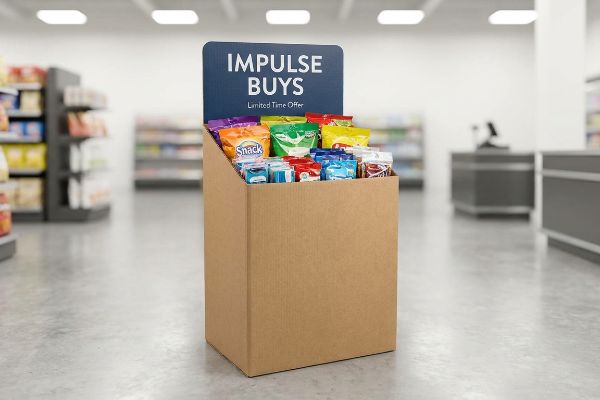
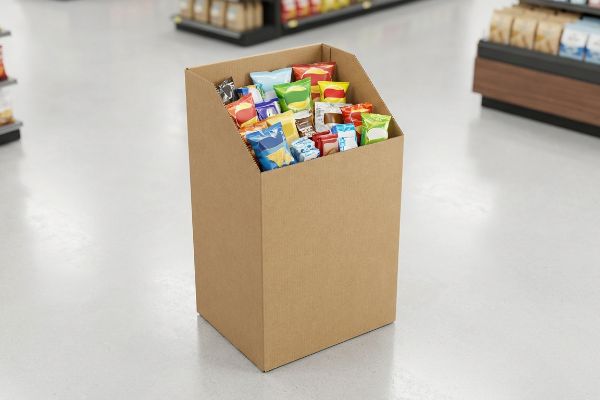
Un présentoir à bacs de présentation est un grand meuble de vente ouvert conçu pour contenir des marchandises en vrac. Contrairement aux étagères empilées traditionnelles, ces structures autoportantes en carton ondulé permettent aux clients de saisir facilement les articles, ce qui les rend idéales pour les promotions importantes, les soldes saisonnières et les produits de grande consommation.
Obtenir l'approbation du design visuel par votre équipe marketing est facile. C'est en assurant la solidité de la structure face aux fortes contraintes du commerce de détail que le véritable défi d'ingénierie commence.
Prévenir le « gonflement du ventre » des conteneurs à déchets de carton
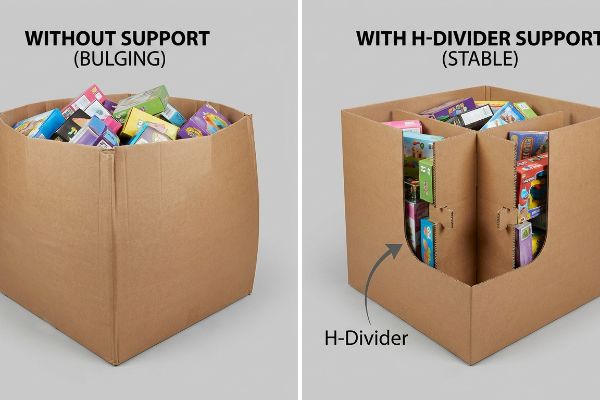
Même les équipes marketing les plus expérimentées partent souvent du principe qu'une grande boîte ouverte conservera naturellement sa forme grâce à son emballage en carton ondulé épais. Elles la traitent comme un simple seau, y déposant directement des articles lourds et irréguliers, tels que des jouets emballés ou des cosmétiques en boîte . Cette approche théorique repose entièrement sur la capacité des parois extérieures à contenir la pression exercée par le déplacement des marchandises¹ .
Je constate constamment ce problème lorsque les marques lancent des articles saisonniers. Lorsqu'on charge 27,2 kg de produit en vrac dans un bac carré non renforcé, la pression cinétique exercée vers l'extérieur provoque une forte déformation des paroislatérales²— un phénomène que j'appelle le « gonflement du bac ». Pour y remédier, je conçois un système de support interne en forme de « H » ou de « bande ventrale » qui relie mathématiquement les parois opposées. La résistance physique de ces ancrages ondulés dissimulés absorbe la contrainte latérale, empêchant ainsi le carton rigide de se déchirer. Cet ajustement structurel garantit une forme parfaitement carrée, évitant un aspect bancal qui entraîne des refus immédiats de la part des détaillants et ralentit la chaîne de conditionnement d'environ 30 %³.
| Erreurs courantes des débutants | La solution pro | Avantage du magasin |
|---|---|---|
| Laisser le vide central complètement creux | Conception d'un support interne pour diviseur en H4 | Élimine le bombement de la paroi vers l'extérieur |
| Utilisation d'un matériau à paroi simple mince pour la base | Passage à une base ondulée à double paroi5 | Résiste aux chocs violents des chariots de supermarché |
| Négliger l'humidité due au lavage quotidien des sols | Application d'une couche de polyuréthane transparente sur les 10,1 cm (4 pouces) inférieurs6 | Empêche le ramollissement et l'affaissement de la base |
Je refuse qu'un affaissement de paroi latérale compromette le déploiement de votre rayonnage. Grâce à l'intégration de séparateurs à tension invisibles, je garantis que votre bac conserve sa géométrie carrée et impeccable, éliminant ainsi tout risque d'affaissement embarrassant au milieu des allées sous de lourdes charges de produits.
🛠️ Le bureau de Harvey : Vos bacs de sol actuels sont-ils bombés ou penchés sous le poids de vos produits ? 👉 Demandez un audit structurel gratuit ↗ — Accès direct à mon bureau. Zéro spam commercial automatisé, promis.
Que signifie l'expression « fille au camion-benne » ?
Il arrive que les tendances de recherche fassent apparaître un jargon inattendu lorsqu'on recherche des équipements commerciaux lourds. Clarifions la terminologie pour garantir le professionnalisme de vos processus d'approvisionnement.
L'expression « fille camion-benne » est un terme d'argot internet désignant une femme aux formes généreuses. Bien que très répandue sur les réseaux sociaux, cette expression familière n'a absolument aucun rapport avec les secteurs de l'emballage, du commerce de détail ou de la fabrication de carton ondulé, où une terminologie technique précise est de rigueur.
Si les réseaux sociaux prospèrent grâce à un langage familier et vague, l'utilisation d'un langage imprécis sur un bon de commande d'usine ruinera rapidement votre campagne de vente au détail.
Pourquoi un jargon vague nuit aux gabarits de découpe du carton ondulé
Les équipes marketing transmettent fréquemment à leurs fournisseurs des demandes de conception informelles, comme celle d'un « bac standard » ou d'une « boîte renforcée », sans préciser les tolérances mathématiques<sup>7</sup>. Elles supposent que l'usine comprendra intuitivement leurs descriptions et générera automatiquement la géométrie structurelle adéquate. Cette confiance en une communication informelle crée d'importants angles morts<sup>8</sup> entre la vision créative et les machines de production industrielle.
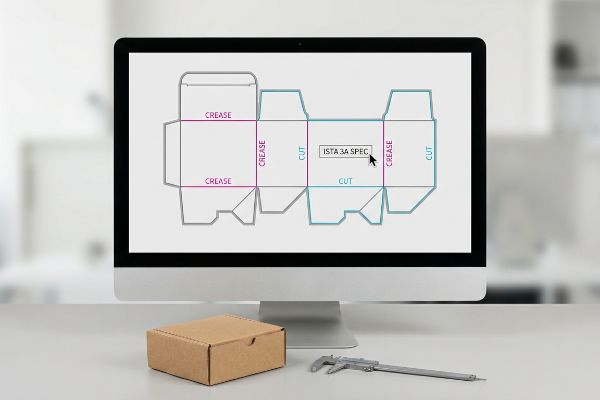
Je constate que ce manque de communication engendre d'importantes difficultés lorsqu'un concepteur soumet un fichier numérique plat avec des lignes vectorielles non calibrées, vaguement étiquetées comme « tracé de découpe ». Les tables de découpe CNC (Commande Numérique par Calculateur) automatisées ne lisent pas les étiquettes approximatives ; elles nécessitent un gabarit de découpe standardisé, programmé avec des couleurs d'accompagnement précises<sup>9</sup>. Lorsqu'un fichier imprécis arrive dans mon logiciel RIP de prépresse, la machine ne peut pas faire la différence entre un visuel imprimé et un impact physique de la lame. J'intercepte physiquement ces fichiers, je sépare les calques et je convertis les lignes de conception approximatives en couleurs d'accompagnement magenta rigides et lisibles par la machine<sup>10</sup>. Cette conversion numérique précise garantit que les lames d'acier tranchantes s'engagent correctement dans le carton, évitant ainsi les plis mal alignés et permettant aux clients d'économiser environ 2 500 $ en matériaux de prototypage gaspillés.
| Erreurs courantes des débutants | La solution pro | Avantage du magasin |
|---|---|---|
| Utilisation de descriptions vagues pour la capacité de charge | Définition de limites de poids dynamiques ISTA 3A strictes 11 | Empêche l'écrasement catastrophique pendant le transport |
| Conception avec des lignes noires CMJN standard | Attribution de couleurs d'accompagnement absolues pour l'outillage12 | Garantit des découpes précises sur machines CNC |
| Estimation des limites de hauteur d'affichage globales | Ancrage aux spécifications strictes du détaillant de 50 pouces (127 cm)13 | Évite les blocages de réception dans les grandes surfaces |
Je ne me fie jamais aux suppositions ni aux descriptions approximatives en production. En appliquant des normes strictes de traçage numérique, j'élimine tout problème de communication, garantissant ainsi que la présentation physique de vos produits corresponde parfaitement à votre épreuve numérique approuvée.
🛠️ Le bureau d'Harvey : Vos fichiers de conception actuels utilisent-ils les couleurs d'accompagnement mécaniques appropriées pour la découpe automatisée en usine, ou seulement des lignes noires standard ? 👉 Consultez nos directives de prépresse ↗ — Téléchargement sécurisé. Ma boîte de réception reste ouverte si vous avez des questions.
Quels sont les 4 types de poubelles ?
Les détaillants procèdent à des audits rigoureux du cycle de vie des présentoirs temporaires en carton. La compréhension des catégories d'élimination standard est la première étape pour satisfaire aux exigences strictes de développement durable des grandes surfaces.
Les quatre types de conteneurs à déchets sont les suivants : ordures ménagères, recyclage, compost organique et déchets dangereux. Dans les commerces, le tri correct des emballages dans ces conteneurs spécifiques garantit le respect des réglementations municipales en matière de gestion des déchets, optimise la récupération des matériaux et prévient la contamination croisée toxique lors du processus de recyclage industriel.
Mais connaître la théorie ne suffit pas lorsque les machines de tri municipales commencent à traiter vos présentoirs de sol.
Le danger caché des films PLA dans le recyclage du carton ondulé
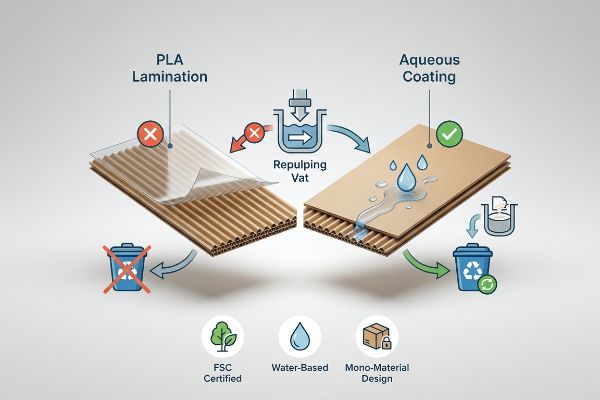
De nombreux responsables de marques soucieux de l'environnement partent du principe que l'application d'un film de lamination bioplastique PLA (acide polylactique) sur leurs présentoirs en carton garantit une conformité environnementale totale. Ils estiment que, puisque le film est commercialisé comme étant « à base de maïs », la structure entière peut être jetée dans un bac de recyclage bleu standard à la fin du cycle promotionnel. Cette hypothèse simpliste ignore la réalité technique du traitement du carton recyclé dans les usines de repulpage locales<sup>14.
Dans mon atelier, je constate régulièrement que des clients exigent ces biofilms, sans se rendre compte des conséquences désastreuses qu'ils engendrent en aval. Lorsque les centres de recyclage municipaux interceptent un film PLA solide lors du tri des cartons ondulés, ce film repousse physiquement l'eau dans les cuves de repulpage<sup>15</sup>. Comme les machines locales ne peuvent pas décomposer ce bioplastique solide sans un compostage spécialisé à haute température<sup>16</sup>, l'ensemble du présentoir de 20,4 kg est rejeté et envoyé directement à la décharge. Pour éviter cela, j'impose un protocole de revêtement aqueux liquide à la place des films solides. Cette matrice polymère à base d'eau se dissout parfaitement dans les cuves standard des papeteries, garantissant un recyclage à 100 % en collecte sélective et protégeant ainsi mes clients des coûts supplémentaires liés aux audits de durabilité des détaillants.
| Erreurs courantes des débutants | La solution pro | Avantage du magasin |
|---|---|---|
| Laminage des présentoirs avec un film PLA solide | Utilisation de revêtements aqueux à base d'eau17 | Réussit les audits rigoureux de développement durable des détaillants |
| Utilisation de matières premières de carton non certifiées | Obligation de tenir des registres de chaîne de contrôle FSC18 | Évite les contraintes environnementales |
| S'appuyant sur des clips en plastique de matériaux mixtes | languettes de verrouillage en papier monomatériau technique19 | Garantit une mise au rebut sans friction en fin de vie |
Je refuse qu'un choix de lamination microscopique nuise à la crédibilité environnementale de votre marque. En concevant des produits strictement compatibles avec le repulpage standard du carton ondulé, je garantis que vos supports publicitaires se décomposent sans danger, transformant ainsi une conception durable en une réalité concrète pour votre chaîne d'approvisionnement.
🛠️ Le bureau d'Harvey : Votre revêtement d'écran actuel est-il physiquement imperméable lors du processus de recyclage municipal ? 👉 Envoyez-moi les spécifications de votre matériau ↗ — Je testerai sa composition chimique avant que vous ne soyez recalé lors d'un audit en magasin.
Conclusion
Vous pouvez choisir un fournisseur moins cher pour la fabrication de vos présentoirs de sol, mais si la paroi centrale non renforcée se déforme sous le poids des produits, ralentissant la chaîne de montage d'environ 30 % et provoquant un refus immédiat du détaillant, votre marge commerciale s'évapore. Plus de 500 responsables de marque utilisent ma checklist prépresse pour éviter précisément ces erreurs fatales en début de production. Ne laissez plus les tolérances structurelles au hasard : laissez-moi auditer personnellement vos plans grâce à mon Évaluation des risques de découpe gratuite ↗ afin de détecter les défaillances catastrophiques avant le lancement de la production en série.
« Estimation de la résistance à la compression des boîtes en carton ondulé… », https://pmc.ncbi.nlm.nih.gov/articles/PMC8467740/ . Explication de la manière dont les contenants en carton ondulé remplis en vrac subissent une pression latérale due à leur contenu, ce qui nécessite un renforcement pour éviter le gonflement. Rôle de la preuve : validation technique ; type de source : analyse structurelle de l’emballage. Appuie : la cause physique du « gonflement ventral » des bacs de vente au détail. Note de portée : spécifiquement pour les présentoirs en carton ondulé à ouverture supérieure.
« [PDF] RISQUES STRUCTURAUX – CONTENEURS EN ACIER – MSHA.gov », https://arlweb.msha.gov/Alerts/structral-bin-hazards080615.pdf . Les guides d'ingénierie faisant autorité sur les emballages en carton ondulé doivent vérifier comment la pression latérale exercée par des articles en vrac provoque une déformation structurelle du carton non renforcé. Rôle de la preuve : validation technique ; type de source : manuel d' ingénierie. Sujet : la physique du « gonflement des conteneurs ». Note sur la portée : spécifiquement pour les structures en carton ondulé.
« Comment l’emballage influence le succès des programmes d’affichage en magasin », https://www.frankmayer.com/blog/how-packaging-shapes-retail-display-program-success/. Les rapports sectoriels ou les études de cas en logistique devraient fournir des données sur la façon dont les présentoirs instables augmentent le temps d’assemblage ou les taux d’erreur dans le conditionnement à façon. Rôle de la preuve : vérification des indicateurs ; type de source : rapport sectoriel en logistique. Appuie : l’affirmation concernant la perte de productivité. Note sur la portée : l’estimation peut varier en fonction du volume de produits .
« Quels types de bacs de réception proposez-vous ? – Carton sur mesure… », https://popdisplay.me/what-types-of-dump-bins-do-you-offer/ . Documentation technique sur l’ingénierie de l’emballage démontrant comment les séparateurs en H répartissent le poids et empêchent la dilatation latérale des parois. Preuve : spécification technique ; type de source : manuel d’ingénierie de l’emballage. Appui : méthodes de renforcement structurel. Remarque : spécifique à la construction en carton ondulé.
« Conception optimale des emballages en carton ondulé double cannelure – PMC », https://pmc.ncbi.nlm.nih.gov/articles/PMC8950760/ . Données scientifiques comparant la résistance à l'écrasement et aux chocs du carton ondulé simple cannelure et du carton ondulé double cannelure. Type de preuve : indicateur de performance des matériaux ; source : norme d'emballage industriel. Appuie : allégations de durabilité de base. Note sur la portée : se concentre sur la résistance à la compression et aux chocs.
« Revêtement barrière pour emballages en papier et carton ondulé », https://global.humanchem.com/resources/barrier-coating-for-paper-and-corrugated-board-packaging.html . Normes de revêtement industriel démontrant l'efficacité des revêtements en polyéthylène pour prévenir l' absorption d'eau par les matériaux cellulosiques. Rôle de la preuve : norme de protection des matériaux ; type de source : fiche technique des revêtements. Avantages : protection contre l'humidité. Note relative au champ d'application : s'applique aux surfaces en contact avec le sol.
« Quel est le lien entre la conception d'emballages et les mathématiques ? », https://newmfgalliance.org/get_real_math_video/what-does-packaging-design-have-to-do-with-math/ . Les normes d'ingénierie relatives aux emballages en carton ondulé stipulent que des tolérances précises sont indispensables pour la compatibilité avec les machines et l'intégrité structurelle. Rôle de la preuve : validation technique ; type de source : norme industrielle. Justifie : la nécessité de tolérances mathématiques dans la conception. Note relative au champ d'application : limité aux emballages industriels.
« Comment détecter et prévenir les erreurs de fabrication – Mar-Kov », https://mar-kov.com/how-to-detect-prevent-errors-in-manufacturing/. Des études de gestion industrielle expliquent comment des transmissions de spécifications imprécises entraînent des erreurs de production et des écarts d'alignement entre la conception et l'exécution. Rôle de la preuve : corroboration ; type de source : revue académique. Appuie : le lien entre une communication imprécise et les erreurs de fabrication. Note de portée : se concentre sur les flux de travail B2B de la conception à la production .
« Qu'est-ce qu'un tracé de découpe en emballage et impression ? – PopDisplay », https://popdisplay.me/what-is-a-dieline-in-packaging-print/ . Des guides de référence sur les flux de production prépresse CNC expliquent la nécessité des couleurs d'accompagnement pour la différenciation des trajectoires d'outils. Niveau de preuve : spécification technique ; type de source : manuel industriel. Sujets abordés : exigences de la découpe CNC. Portée : s'applique à l'impression et à l'emballage professionnels.
« Guide graphique – DeLine Box and Display », https://www.delinebox.com/graphic-guidelines/. Les normes de conception d'emballages spécifient souvent une couleur magenta spécifique pour distinguer les tracés de découpe de l'impression. Niveau de preuve : norme industrielle ; type de source : manuel de conception professionnel. Utilisation recommandée : magenta pour les tracés de découpe. Remarque : peut varier légèrement selon le logiciel .
« [PDF] 3A 2 – Association internationale pour le transport sécurisé », https://ista.org/docs/3Aoverview.pdf. Vérification de la norme ISTA 3A pour la simulation des contraintes dynamiques subies par un colis pendant le transport. Rôle de la preuve : vérification technique ; type de source : documentation normative industrielle. Objectif : prévention de l’écrasement pendant le transport grâce à des limites de poids. Remarque sur le champ d’application : spécifique aux environnements de livraison de colis .
« Que signifie la découpe à l'emporte-pièce ? Le processus de découpe à l'emporte-pièce dans l'impression d'étiquettes », https://www.bluelabelpackaging.com/blog/die-cut-mean/. Explication technique de l'utilisation des couleurs d'accompagnement dans les logiciels de conception pour communiquer des trajectoires de découpe spécifiques aux machines CNC. Rôle de la preuve : vérification du processus ; type de source : guide technique de fabrication. Supporte : la précision des découpes sur machines CNC. Note sur le champ d'application : applicable aux flux de travail de découpe numérique à l'emporte-pièce .
« 14 types de présentoirs de vente au détail | Chicago, IL – Wertheimer Box », https://wertheimerbox.com/types-of-retail-displays/ . Confirmation des restrictions de hauteur maximale courantes pour les présentoirs sur le lieu de vente (PLV) dans les environnements de vente au détail à grande échelle. Rôle de la preuve : référence sectorielle ; type de source : spécifications logistiques de vente au détail. Avantages : Éviter les mises en attente à la réception. Remarque: Les limites peuvent varier selon les chaînes de magasins.
« [PDF] Repulpabilité du carton ondulé couché – TAPPI.org », https://imisrise.tappi.org/download.aspx?key=91OCT079 . Explication technique d'une autorité de recyclage sur la façon dont les plastiques PLA contaminent le processus de repulpage du papier et entravent la récupération des matériaux. Rôle de la preuve : vérification technique ; type de source : manuel de gestion des déchets. Appuie : l'affirmation selon laquelle le carton laminé PLA pose problème pour le recyclage standard. Note de portée : se concentre sur les mécanismes de repulpage industriels.
« Interférence des plastiques biodégradables dans le polypropylène… », https://pubmed.ncbi.nlm.nih.gov/30279367/ . Documentation technique issue de sources en sciences des matériaux expliquant comment l'hydrophobie du PLA empêche la séparation des fibres lors de la fabrication de la pâte à papier. Rôle de la preuve : vérification technique ; type de source : étude en sciences des matériaux. Appui : comportement du PLA dans le recyclage du carton ondulé usagé. Note de portée : se concentre sur le repulpage industriel.
« Matériaux à base de PLA/PHB entièrement biodégradables dans les deux conditions… – PMC », https://pmc.ncbi.nlm.nih.gov/articles/PMC9572414/ . Les normes industrielles telles que l’ASTM D6400 définissent les conditions spécifiques de température et d’humidité élevées requises pour la biodégradation du PLA. Rôle de la preuve : vérification de la norme ; type de source : norme réglementaire. Appui : exigences relatives à la décomposition du PLA. Note de portée : distinction entre compostage industriel et compostage domestique.
« Revêtement de papier recyclable et biodégradable avec des agents fonctionnalisés… », https://pmc.ncbi.nlm.nih.gov/articles/PMC11948148/ . Vérification de la préférence des revêtements aqueux par rapport aux films PLA pour la conformité au recyclage du carton ondulé et les audits des détaillants. Rôle de la preuve : vérification technique ; type de source : norme de durabilité. Argument : préférence pour les revêtements aqueux pour la réussite des audits. Note relative au champ d’application : spécifiquement pour les présentoirs de vente au détail.
« [PDF] Procédures de certification de la chaîne de contrôle du groupe pour la forêt… », https://www.in.gov/dnr/forestry/files/fo-FSC-chain-of-custody-group-entity-manual.pdf. Documentation expliquant comment la certification de la chaîne de contrôle du Forest Stewardship Council (FSC) garantit la durabilité des matières premières et prévient les blocages liés à la conformité. Rôle de la preuve : vérification réglementaire ; type de source : organisme de certification. Apport : lien entre les registres FSC et la conformité. Note relative au champ d’application : s’applique à l’approvisionnement en carton .
« L’avenir des emballages mono-matériaux et multi-matériaux à l’horizon 2028 – Smithers », https://www.smithers.com/services/market-reports/packaging/future-of-mono-vs-multi-material-packaging-to-2028. Ce rapport démontre que la conception mono-matériau simplifie le processus de recyclage et réduit la contamination par rapport aux emballages composés de matériaux mixtes. Rôle de la preuve : validation technique ; type de source : guide de gestion des déchets. Avantages : élimination en fin de vie simplifiée. Précision : ce rapport porte sur les composants d’emballages en carton ondulé .