Acheminer vos produits en magasin en toute sécurité représente un véritable défi logistique. Si votre infrastructure est inadaptée, vos marges s'évaporeront avant même la première vente.
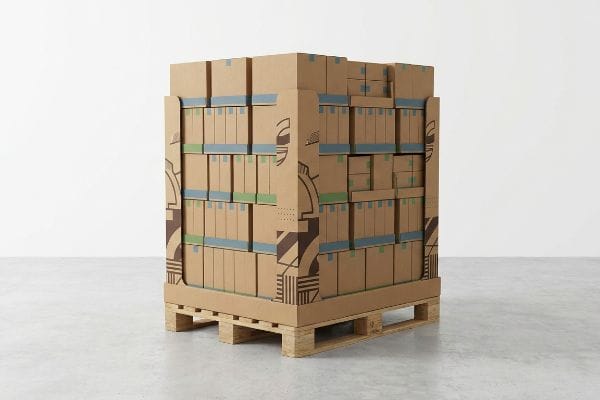
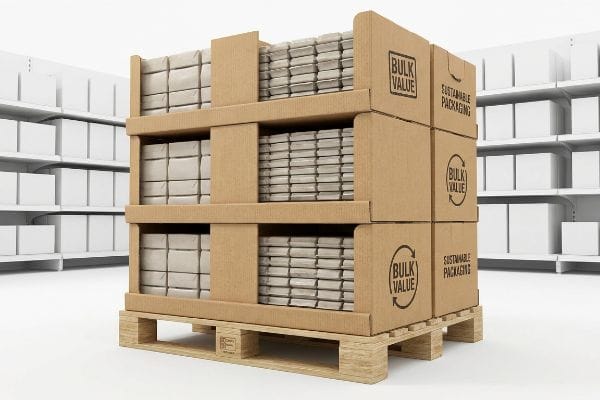
Un présentoir sur palette en carton est un présentoir grand format conçu pour la présentation de produits en vrac directement sur les plateformes de transport. Fabriquées en carton ondulé, ces structures robustes optimisent la visibilité de la marque tout en offrant une capacité de charge dynamique élevée, garantissant ainsi un transport conforme aux normes internationales, économique et facile à recycler en bordure de trottoir.
Comprendre les principes de base de ces structures temporaires n'est que le point de départ. Permettez-moi de vous expliquer comment ces choix d'ingénierie se traduisent concrètement dans les usines et les rayons des magasins.
Quels sont les avantages de l'emballage en carton ?
Votre budget marketing est-il en train de gaspiller sans le savoir des ressources inutilisées pour le fret ?
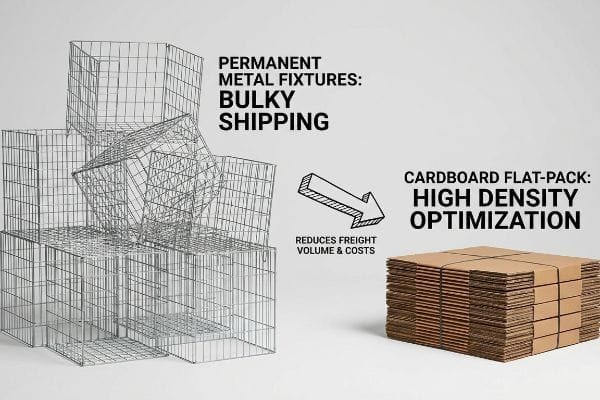
Les avantages des emballages en carton résident dans leur légèreté, leur modularité et leur facilité de transport à plat. Contrairement aux structures métalliques permanentes, les structures temporaires en carton ondulé se compriment fortement pendant le transport. Cette faible densité permet de réduire considérablement le volume d'expédition, la consommation de carburant et d'éliminer les coûteux circuits de retour nécessaires pour les présentoirs de vente au détail plus lourds.
Mais connaître la théorie du conditionnement à plat ne suffit pas lorsqu'on est confronté à un déploiement national massif dans le commerce de détail.
Logistique des emballages plats et retour sur investissement du fret
Même les équipes d'approvisionnement les plus expérimentées privilégient souvent les présentoirs métalliques soudés permanents pour leurs campagnes de vente au détail. Elles partent du principe que l'acier robuste garantit automatiquement un meilleur retour sur investissement¹car il inspire confiance et semble indestructible.
Je sais que vous cherchez à optimiser la valeur perçue de votre déploiement, mais l'utilisation de matériel permanent engendre des coûts logistiques exorbitants. Un conteneur maritime standard ne peut contenir qu'environ 250 rayonnages métalliques soudés, car le transport d'un volume vide par voie maritime représente un surcoût considérable. Le bruit métallique et lourd des rayonnages sur le quai de chargement symbolise la perte de votre marge bénéficiaire absorbée par les frais de transport. En optant pour des présentoirs temporaires en carton ondulé, vous éliminez complètement ce gaspillage. Je conçois des structures démontables qui permettent d'intégrer jusqu'à 1 500 unités dans ce même conteneur. Ce changement stratégique, en abandonnant le métal, supprime la surtaxe de 300 % sur le transport du matériel permanent, tout en répondant aisément aux exigences de charge dynamique élevées des grandes surfaces.
| Erreurs courantes des débutants | La solution pro | Avantage du magasin |
|---|---|---|
| Livraison de supports métalliques entièrement assemblés | Présentoirs en carton ondulé à plat | Réduction de 80 % du volume des expéditions2 |
| Payer le fret pour de l'espace aérien mort | Optimisation des conteneurs haute densité | Baisse des coûts unitaires à destination |
| Frais de retour non inclus | Utilisation de carton recyclable à usage unique | Élimine la manutention du fret inverse3 |
Je ne laisse jamais mes clients payer un fret maritime premium juste pour expédier de l'oxygène vide.
🛠️ Le bureau d'Harvey : Votre stratégie structurelle actuelle vous fait-elle perdre des marges à cause des frais d'expédition ? 👉 Demandez un audit de densité de fret ↗ — Accès direct à mon bureau. Zéro spam commercial automatisé, promis.
Quels sont les avantages de l'utilisation de palettes ?
La base de votre déploiement global en magasin détermine la vitesse à laquelle il se propage dans la chaîne d'approvisionnement.
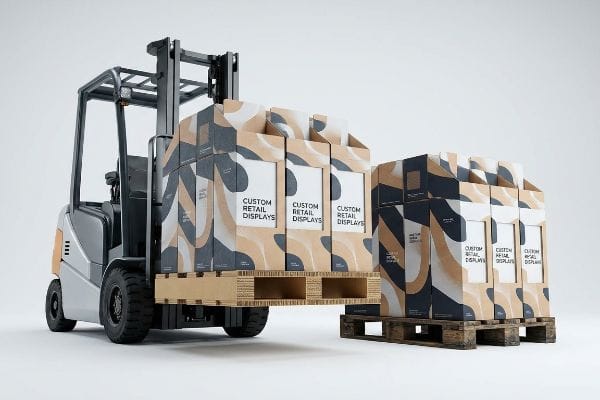
L'utilisation de palettes présente l'avantage d'une manutention fluide et d'une mobilité multi-axes optimale dans l'entrepôt. Ces supports standardisés surélèvent les marchandises lourdes, permettant ainsi aux chariots élévateurs de les soulever, de les trier et de les charger rapidement sans endommager directement l'emballage extérieur.
Cependant, le matériau spécifique que vous choisirez pour cette base peut soit accélérer votre livraison, soit déclencher un véritable cauchemar douanier international.
Contourner les goulots d'étranglement de la chaîne d'approvisionnement grâce aux plateformes ondulées
Les directeurs marketing s'appuient souvent aveuglément sur des plateformes d'exportation en bois massif, partant du principe que le bois traité thermiquement traditionnel est la seule solution conforme aux normes pour transporter des présentoirs de vente lourds à l'international. Ils se concentrent principalement sur les supports imprimés et laissent toute la logistique de base au centre de distribution.
Je comprends parfaitement pourquoi vous pourriez accepter des socles en bois standard, mais ils présentent un inconvénient majeur. Les palettes en bois massif pèsent jusqu'à 20,4 kg par unité et sont soumises à des contrôles douaniers stricts. Le frottement brutal et ébréché du bois bon marché non traité sur un sol lisse en béton d'entrepôt entraîne souvent une retenue en douane. Si le bois ne dispose pas de la documentation relative au traitement thermique conforme aux normes ISPM (Normes internationales pour les mesures phytosanitaires), votre conteneur entier est bloqué. J'évite tous ces problèmes réglementaires en utilisant des palettes en carton ondulé haute résistance. Le passage à une plateforme de transport 100 % carton ondulé réduit le poids mort du conteneur à seulement 5,4 kg. Ce changement permet de contourner totalement les réglementations douanières internationales et garantit un recyclage simple et rapide en bordure de trottoir pour le responsable du magasin destinataire.
| Erreurs courantes des débutants | La solution pro | Avantage du magasin |
|---|---|---|
| Utilisation de lourds socles d'exportation en bois | Passage à des supports en carton ondulé | Réduit le poids mort de 14,9 kg (33 lbs) |
| Risquer les douanes phytosanitaires | Utilisation de plateformes 100% carton | Contourne les délais d'inspection aux frontières4 |
| Laisser aux détaillants des déchets de bois | Garantir le recyclage en flux unique | Diminue les frais d'élimination en aval |
J'élimine les lourdes contraintes liées au bois pour que votre logistique se déroule sans accroc.
🛠️ Le bureau d'Harvey : Les contrôles aux frontières ou les lourds socles en bois ralentissent-ils votre distribution internationale ? 👉 Obtenez les spécifications de mes socles en carton ondulé ↗ — Téléchargement sécurisé. Ma boîte de réception est ouverte si vous avez des questions.
Qu'est-ce qu'un présentoir sur palette ?
La réussite d'une présentation en magasin est mathématiquement dictée par les limites spatiales du détaillant.
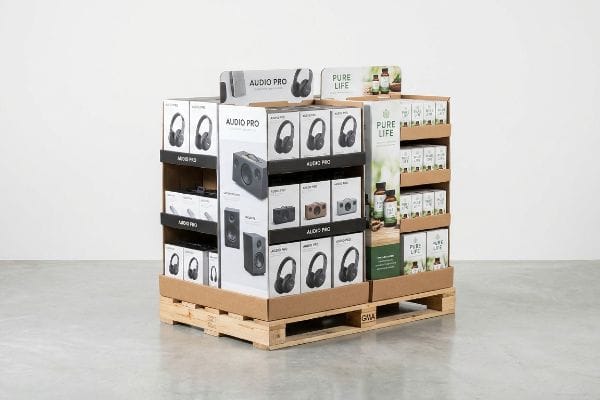
Un présentoir palette est un présentoir autoportant destiné à la vente en vrac, installé directement sur une plateforme logistique standardisée. Conçues pour les zones commerciales à fort trafic, ces structures permettant une présentation à 360 degrés s'affranchissent totalement des rayonnages traditionnels, permettant aux marques de transporter et de vendre immédiatement et en toute sécurité d'importants volumes de produits sur une surface réduite.
Obtenir cet espace commercial de premier choix exige bien plus que de simplement demander un emplacement privilégié à l'acheteur.
Géométrie fractionnaire et densité des surfaces de vente au détail
Les marques émergentes proposent fréquemment aux acheteurs des grandes surfaces des présentoirs de sol GMA (Grocery Manufacturers Association) de taille standard ( 121 x 101 cm) , mais se heurtent systématiquement à un refus. Elles partent du principe que, pour une campagne de marketing physique réussie, il leur faut occuper tout un présentoir en bois afin de donner une impression de professionnalisme.
Considérez l'espace commercial comme un bien immobilier de premier choix ; les acheteurs louent rarement un pâté de maisons entier à un seul locataire. Exiger un présentoir de grande taille pour le lancement d'un produit plus petit crée un encombrement inutile. J'ai vu des vendeurs souffrir du bruit et de la frustration de la déchirure du carton brut lorsqu'ils tentent de forcer un présentoir imposant dans une allée étroite où il n'a manifestement pas sa place. Au lieu de se battre pour un espace démesuré, je conçois les présentoirs avec précision selon des dimensions fractionnaires standard : des demi -palettes de 121 × 50 cm et des quarts de palettes de 60 × 50 cm. Cette subdivision mathématique garantit que votre campagne peut parfaitement partager un même présentoir avec des marques non concurrentes, permettant ainsi aux acheteurs d'optimiser la densité de leur surface de vente.
| Erreurs courantes des débutants | La solution pro | Avantage du magasin |
|---|---|---|
| Nécessitant une empreinte au sol massive de 48×407 | Géométries de quart de palette en ingénierie8 | Garantit un emplacement privilégié dans l'allée |
| Créer des barrages routiers dans les allées | Dimensionnement des écrans pour les plateformes de partage | Permet aux chariots de magasin de se déplacer librement |
| Gaspillage de matériaux de panneaux de construction | Resserrer la grille des produits physiques | Maximise le retour sur investissement du merchandising visuel |
Je conçois des formats compacts pour que votre marque ne soit jamais rejetée pour cause d'encombrement excessif.
🛠️ Le bureau de Harvey : Les acheteurs du secteur de la vente au détail ont-ils des réticences quant à la taille physique de vos présentoirs PLV (publicité sur le lieu de vente) ? 👉 Téléchargez mon guide sur la géométrie fractionnaire ↗ — Pas de formulaires qui déclenchent des appels commerciaux incessants. Uniquement de la valeur ajoutée.
Quels sont les avantages du carton ?
Le choix des matériaux constitue l'élément déterminant entre une campagne réussie et un échec logistique.
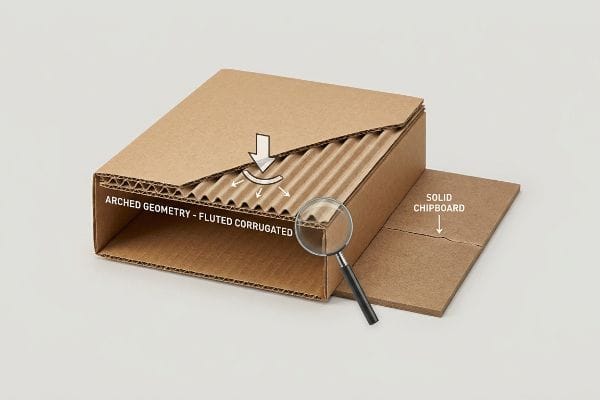
Les avantages du carton proviennent de sa géométrie interne arquée unique, qui répartit efficacement la pression verticale exercée sur le dessus. Contrairement au carton compact, le carton ondulé cannelé Testliner agit comme un amortisseur mécanique, offrant une rigidité structurelle maximale, une résistance exceptionnelle aux chocs cinétiques et une résistance dynamique à l'empilement, sans pour autant augmenter le coût des matières premières.
Mais connaître la théorie ne suffit pas lorsque les machines se mettent en marche et que les palettes se retrouvent empilées par deux dans un entrepôt humide.
Pourquoi les panneaux de particules non cannelés échouent au test cinétique
Dans mon établissement, je vois régulièrement des équipes d'approvisionnement tenter d'adapter des emballages légers en carton compact pour en des plateaux plus lourds, prêts à la vente, afin de réduire les coûts initiaux des matériaux. Elles partent du principe erroné que la densité statique brute d'un carton compact épais correspond à sa capacité de charge dynamiqueune fois entièrement assemblé.
Il ne s'agit pas d'une simple théorie : je le constate en production lors de nos tests de résistance à l'écrasement des bords (test TAPPI T811)<sup>10</sup>. Les supports rigides non cannelés sont dépourvus des arcs internes ondulés présents dans les cartons ondulés de type B ou E. Ils ne possèdent aucun mécanisme permettant de disperser dynamiquement les chocs cinétiques. Lorsque je mesure la déformation sous une charge de 85 kg (187,5 lb), le carton rigide émet un claquement sourd et creux et se courbe fortement vers l'extérieur. La densité statique du matériau ne peut compenser le déplacement géométrique dû à la charge. J'ai relevé les mesures au micromètre et démontré qu'il n'était pas nécessaire d'utiliser des inserts en plastique structurel coûteux pour supporter le poids ; un simple pivot de matériau vers le carton micro-cannelé suffisait. En exploitant la géométrie arquée interne pour absorber l'énergie cinétique en toute sécurité, je maintiens une structure parfaitement carrée sans augmenter le budget des matières premières. Cette correction spécifique du matériau empêche l'éclatement des parois latérales, ce qui permet de réduire le temps d'assemblage en conditionnement de 42 secondes par unité<sup>11</sup>et d'économiser des milliers d'euros en frais de main-d'œuvre pour nos clients sur une production standard.
| Erreurs courantes des débutants | La solution pro | Avantage du magasin |
|---|---|---|
| Production à grande échelle de panneaux de particules massifs non cannelés | Obligation de tôles ondulées micro-cannelées | Empêche le flambage cinétique lors du transport12 |
| En se basant sur la densité statique du matériau | Utilisation d'une géométrie arquée interne | Absorbe des charges verticales massives par le haut13 |
| Ajout de supports en plastique coûteux | Mise à niveau vers un testeur de flûte B14 | Réduit le coût total des matériaux |
J'impose strictement les supports cannelés car l'espoir n'est pas une stratégie valable en ingénierie structurelle.
🛠️ Conseils d'Harvey : Un défaut structurel de 2 millimètres ne doit pas compromettre le déploiement dans 500 magasins. 👉 Envoyez-moi votre fichier de gabarit ↗ — Je vérifierai la robustesse des calculs avant que vous n'investissiez votre budget dans une production de masse.
Conclusion
Vous pouvez choisir un fournisseur qui imprime vos visuels à plat sur du carton lisse bon marché, mais lorsque cette structure rigide se déforme inévitablement sous le poids, provoquant des frottements importants et ralentissant la chaîne de production d'environ 30 %, votre marge bénéficiaire est complètement anéantie. Voici la fiche technique exacte utilisée par mes 10 principaux clients du secteur de la vente au détail pour garantir zéro rejet d'impression et une résistance à toute épreuve pendant le transport. Ne vous fiez plus aux tolérances structurelles : laissez-moi analyser vos fichiers grâce à mon audit de découpe gratuit avant production ↗ afin de détecter les erreurs mécaniques critiques avant le lancement de la production en série.
« 14 types de présentoirs pour points de vente | Chicago, IL – Wertheimer Box », https://wertheimerbox.com/types-of-retail-displays/. Une analyse approfondie des coûts et du cycle de vie des présentoirs permettrait de déterminer si la durabilité de l'acier compense son coût initial et ses frais de livraison plus élevés que ceux du carton. Rôle de la preuve : validation d'une contre-argumentation ; type de source : rapport de marché sectoriel. Argument : l'inefficacité d'un surdimensionnement des matériaux. Note sur la portée : se concentre sur les indicateurs de retour sur investissement du commerce de détail .
« Présentoirs en carton livrés à plat vs présentoirs en carton pré-assemblés : coût, expédition et installation », https://leader-display.com/flat-pack-vs-assembled-cardboard-display/ . Comparaison du poids volumétrique et de l’utilisation de l’espace cubique entre les matériaux en carton ondulé livrés à plat et les présentoirs métalliques pré - assemblés. Type de preuve : validation quantitative ; type de source : référence du secteur de la logistique. Données : pourcentage précis de réduction de volume. Remarque : peut varier selon les dimensions des rayonnages.
« Réutilisabilité vs Recyclage : Le grand débat sur les emballages (et pourquoi…) », https://www.pvpallet.com/news/reusability-vs-recyclability-the-great-packaging-debate-and-why-were-team-reuse. Analyse du rapport coût-bénéfice de l'élimination recyclable par rapport aux coûts de transport et de main-d'œuvre liés au retour des emballages réutilisables. Type de preuve : justification économique ; type de source : étude de gestion de la chaîne d'approvisionnement. Affirmation : que le carton recyclable élimine les besoins de retour. Remarque sur la portée : Applicable aux cycles de matériaux à usage unique .
« Importation de matériaux d'emballage en bois conformes à la norme ISPM 15 aux États-Unis », https://www.aphis.usda.gov/plant-imports/wood-packaging-material/import . Explication de la manière dont les emballages en carton permettent d'exempter les expéditions des exigences de traitement thermique et des retenues douanières prévues par la norme ISPM 15. Rôle de la preuve : confirmation réglementaire ; type de source : agence douanière gouvernementale. Appuie : l'affirmation selon laquelle le carton permet d'éviter les retards d'inspection. Note relative au champ d'application : s'applique à la réglementation du commerce international.
Palettes GMA « 48×40 » | Premier fabricant et fournisseur de palettes, https://www.palletone.com/products/gma-pallets/ . Les normes industrielles de la Grocery Manufacturers Association ( GMA) garantissent les dimensions précises d'une palette standard nord-américaine. Niveau de preuve : spécification technique ; type de source : norme industrielle. Contribue à : la normalisation des dimensions des palettes. Remarque : s'applique spécifiquement à la logistique nord-américaine.
« Demi-palette : définition, dimensions et principales utilisations », https://www.interlakemecalux.com/blog/half-pallet . Vérification des dimensions standard des présentoirs de vente au détail en demi-palette afin de garantir leur exactitude spatiale. Type de preuve : spécification technique ; source : manuel de logistique/merchandising. Supporte : dimensions fractionnaires précises. Remarque : limité aux formats d’expédition standard américains et internationaux.
« Dimensions standard des palettes | Avec tableau », https://www.kampspallets.com/standard-pallet-sizes-with-chart/. Vérification de la norme 48×40 pouces comme référence du secteur pour les palettes GMA de taille standard. Type de preuve : spécification technique ; source : norme industrielle. Concerne : les dimensions standard des palettes. Remarque : s’applique aux normes de vente au détail nord-américaines .
« Aspects d'un présentoir à quarts de palette – PopDisplay », https://popdisplay.me/aspects-of-a-quarter-pallet-display/ . Confirmation technique des dimensions des quarts de palette par rapport aux palettes complètes afin d'optimiser l' espace au sol. Rôle de la preuve : vérification géométrique ; type de source : manuel logistique. Supporte : le dimensionnement des palettes fractionnées. Note de portée : axé sur l'efficacité spatiale.
« Analyse simplifiée de la résistance dynamique des emballages en carton… », https://pmc.ncbi.nlm.nih.gov/articles/PMC10385285/. Comparaison technique démontrant pourquoi la densité du matériau dans le carton compact ne se traduit pas par une capacité de charge dynamique équivalente à celle des structures cannelées. Rôle de la preuve : validation technique ; type de source : manuel de science des matériaux. Appui : la rupture du carton aggloméré lors d’essais cinétiques. Note de portée : axé sur la mécanique structurale du carton .
« Mesures en champ complet lors de l'essai d'écrasement des bords d'un carton ondulé… », https://pmc.ncbi.nlm.nih.gov/articles/PMC8199211/. Vérification de la norme TAPPI T811 comme méthodologie de référence pour la mesure de la capacité de charge des bords de carton ondulé. Rôle de la preuve : validation technique ; type de source : norme industrielle. Appui : Validité de la méthode d'essai utilisée pour comparer les supports pleins et cannelés. Note de portée : La norme s'applique aux cartons ondulés et aux cartons compacts .
« Étude de l’effet des perforations sur la résistance à la charge… », https://pmc.ncbi.nlm.nih.gov/articles/PMC11396172/ . Données empiriques ou références industrielles démontrant qu’une réduction des défauts d’emballage (comme l’éclatement des parois latérales) est directement corrélée à une diminution mesurable du temps d’assemblage unitaire. Type de preuve : indicateur de performance ; type de source : étude de cas opérationnelle. Appuie : l’affirmation selon laquelle la géométrie des matériaux améliore l’efficacité du travail. Remarque : les gains de temps varient selon la complexité du produit.
« Estimation de la résistance à la compression des boîtes en carton ondulé… », https://pmc.ncbi.nlm.nih.gov/articles/PMC8467740/. Analyse technique montrant comment le cannelage confère une rigidité structurelle empêchant le flambage lors du transport. Rôle de la preuve : vérification des propriétés physiques ; type de source : manuel d’ingénierie de l’emballage. Arguments : supériorité du carton ondulé sur le carton gris. Note relative à la portée : spécifique à la dynamique du transport .
« Résistance à la compression des emballages en carton ondulé avec… », https://pmc.ncbi.nlm.nih.gov/articles/PMC10054506/. Données d'ingénierie démontrant comment la structure arquée des cannelures répartit la pression verticale. Rôle de la preuve : démonstration du mécanisme physique ; type de source : étude de génie des structures. Appui : capacité portante de la géométrie arquée. Note sur la portée : s'applique à la compression verticale .
« [PDF] Spécifications du carton ondulé – Fibre Box Association », https://www.fibrebox.org/assets/2025/09/Walmart_Corrugated-Board_Specifications_Automation_Packaging_Standards.pdf . Analyse comparative des coûts et de la résistance du revêtement ondulé de type B par rapport aux supports polymères. Rôle de la preuve : validation du rapport coût-bénéfice ; type de source : fiche technique des matériaux de l’industrie. Avantages : réduction de la nomenclature. Note relative au périmètre : axé sur les spécifications de la cannelure B.