Viele Marken verlieren Tausende von Euro durch beschädigte Fracht, weil sie leichte Faltkartons mit stabilen Wellpappkartons verwechseln. Das Verständnis dieses Materialunterschieds verhindert katastrophale Rückbuchungen im Einzelhandel.
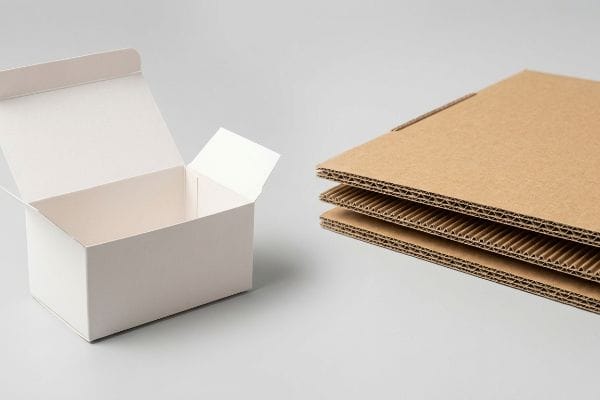
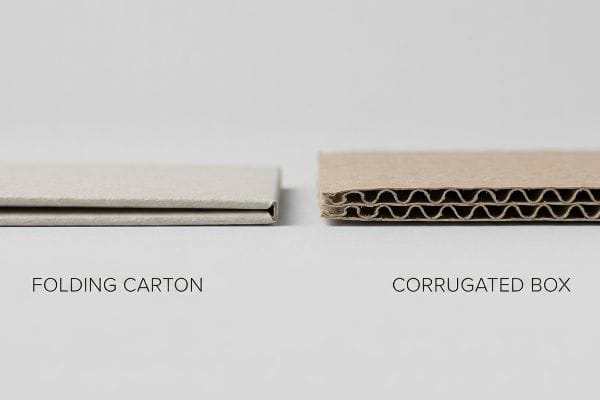
Der Unterschied zwischen einem Karton und einem Wellpappkarton liegt in der inneren Geometrie. Ein Karton besteht aus einer einzigen flachen Papplage, während ein Wellpappkarton eine gewölbte, geriffelte Schicht aufweist, die zwischen zwei flachen Decklagen eingebettet ist. Dies sorgt für eine hervorragende Stoßdämpfung und Stabilität beim Stapeln.
Wenn man von einer theoretischen Verpackungsplanung auf die Verladung massiver 40-Fuß-Container umsteigt, wird die Wahl des richtigen Materials zu einem kniffligen logistischen Rechenproblem. Schauen wir uns die physikalischen Gegebenheiten genauer an.
Sind Wellpappkartons dasselbe wie Kartons?
Die Annahme, diese beiden Substrate seien austauschbar, ist der schnellste Weg, eine Markteinführung im Einzelhandel zum Scheitern zu bringen. Sie erfüllen völlig unterschiedliche Funktionen in der Lieferkette.
Nein. Wellpappkartons sind absolut nicht dasselbe wie Kartons. Während Kartons aus einem flachen, ungeriffelten Trägermaterial bestehen, das sich ideal für die Primärverpackung von Produkten eignet, verfügen Wellpappkartons über ein innenliegendes Wellenbogensystem, das speziell dafür entwickelt wurde, das kinetische Gewicht beim Transport zu verteilen und den Belastungen beim Seetransport in doppelter Stapelung standzuhalten.
Sich auf die Rohmaterialdichte anstatt auf eine durchdachte Geometrie zu verlassen, ist eine Falle, die den ROI einer Kampagne zunichtemacht, noch bevor das Produkt überhaupt im Handel erhältlich ist.
Die ungeriffelte Substratkollapsfalle
Junior-Einkaufsteams versuchen häufig, leichte, massive Kartonverpackungen für den Einzelhandel zu skalieren, um so die Materialkosten zu senken. Sie gehen fälschlicherweise davon aus, dass eine höhere Rohdichte eines dicken, massiven Kartons automatisch zu einer höheren dynamischen Belastbarkeit führt . Selbst erfahrene Designer übersehen diesen blinden Fleck oft und betrachten flachen Karton als strukturellen Ersatz für Wellpappenverpackungen.
In meiner Einrichtung erlebe ich regelmäßig, wie diese theoretische Annahme in der Praxis spektakulär scheitert. Startups bringen mir oft schwere, vorbefüllte Kassendisplays aus massivem, ungewelltem Karton. Wenn ich diese Einheiten unter meine hydraulische Kompressionspresse stelle, um einen 30-tägigen Einzelhandelszyklus zu simulieren, reicht die statische Materialdichte nicht aus, um die kinetische Energie abzubauen. Die starren Wände wölben sich nach außen und knicken heftig ein. Das ist keine bloße Theorie – ich beobachte dieses Phänomen bei einer Belastung von über 6,8 kg. Um dem entgegenzuwirken, setze ich auf leichtere, mikrogewellte Wellpappe, wie z. B. E-Welle2.Durch die Nutzung der inneren Wölbung zur sicheren Dämpfung von Stößen3erhalte ich die ansprechende Optik der Faltschachtel und stelle gleichzeitig sicher, dass die Struktur absolut rechtwinklig bleibt. Diese strukturelle Umstellung reduziert die Montagezeit beim Co-Packing um 45 Sekunden pro Einheit, wodurch manuelle Nachbearbeitungskosten vollständig entfallen und Kunden schätzungsweise 18 % der Kosten für beschädigte Ware ersparen.
| Metrik/Merkmal | Flachkarton | Wellige Realität |
|---|---|---|
| Kerngeometrie | Volle, ungewellte Pappe | Innen gewölbte Kannelierung4 |
| Stoßdämpfung | Statische Dichte versagt | Verdrängt kinetische Energie5 |
| Dynamische Last | Schwache Stapelfestigkeit | Hohe BCT-Überlebensrate6 |
Ich lehne es ab, dass Marken Schwerlasttrays aus flachem Karton herstellen. Nur durch die Verwendung von Mikro-Riffelung kann ich Transportschäden und eine reibungslose Montage im Einzelhandel garantieren.
🛠️ Harveys Schreibtisch: Beeinträchtigen Ihre schweren Kassenbehälter Ihre Versand-ROI bereits, bevor sie überhaupt im Geschäft ankommen? 👉 Fordern Sie eine kostenlose Frachtdichteanalyse an ↗ — Ich prüfe jede Strukturdatei persönlich innerhalb von 24 Stunden.
Sind alle Kartons aus Wellpappe?
„Karton“ ist ein allgemeiner Verbraucherbegriff, der im B2B-Einkauf für große Verwirrung sorgt. Nicht jeder Karton ist mit einer stabilen Wellenstruktur versehen.
Nein. Nicht alle Kartons sind Wellpappe. Der Begriff „Karton“ ist ein weit gefasster Oberbegriff für Verpackungsmaterialien und umfasst sowohl einlagige Faltschachteln als auch mehrlagige Wellpappkartons. In der professionellen Fertigung unterscheiden wir strikt zwischen flachem Karton für leichte Verpackungen und speziell entwickelter Wellpappe für schwere Güter.
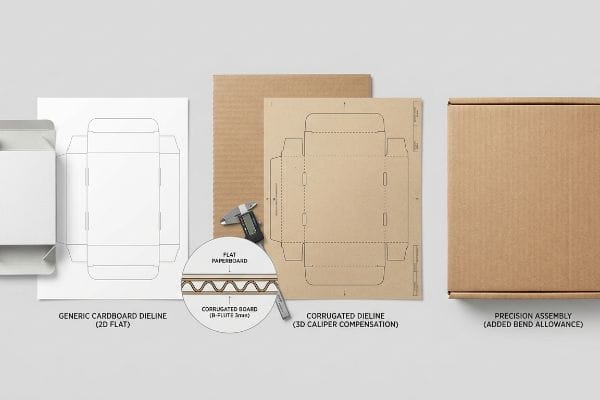
Wenn Designer flache Verpackungskonzepte einreichen, ohne die physikalische Dicke von Wellpappe zu verstehen, kommt die gesamte Produktionslinie zum Erliegen.
Kollisionsdesign mit Bremssattelkompensation
Eine häufige Falle, in die selbst erfahrene Einkaufsteams tappen, ist die Einreichung einer flachen Vektor-CAD-Stanzform, die die Dicke von Wellpappe völlig außer Acht lässt. Sie konstruieren die Verriegelungslaschen genauso wie für einen dünnen Faltschachtelkarton und versäumen es dabei, die Dicke einer gefalteten B-Welle zu berechnen. Wenn eine 3 mm dicke Platteum 90 Grad gefaltet wird, wird zwangsläufig Material verbraucht.
Das ist nicht nur Theorie – ich sehe das immer wieder in der Praxis, wenn wir Rapid Prototyping betreiben. Ein Hersteller schickt mir eine Stanzform für Kartonverpackungen, und beim Laserschneiden des 32ECT-Wellpappmusters (Kantenstauchtest) ist der Aufnahmeschlitz viel zu schmal. Ich sehe dann, wie meine Montagemannschaft versucht, die Teile zusammenzupressen, wobei die Wellen unweigerlich gequetscht und die litholaminierte Deckschicht eingerissen wird. Meine zwanzigjährige Erfahrung in der Produktion hat mir gezeigt, dass man dickes Material nicht ohne mathematische Biegetoleranz biegen kann. Ich korrigiere das, indem ich parametrische Designsoftware verwende, die automatisch einen präzisen Algorithmus zur Kaliberkompensation anwendet und die Schlitze so weitet, dass sie exakt dem gefalteten Außenradius entsprechen. Durch die Einhaltung dieser Toleranz von 3,17 mm (0,125 Zoll) stelle ich sicher, dass sich die vorbefüllten Displays reibungslos montieren lassen. Dadurch entfällt das lästige Verpacken mit Klebeband, und meine Kunden sparen schätzungsweise 35 % der Kosten für manuelles Co-Packing .
| Metrik/Merkmal | Standardkarton | Wellenbremssattel |
|---|---|---|
| Stanzlinienmathematik | Flache 2D-Geometrie | 3D-Radiusberechnung10 |
| Nuttoleranz | Exakte 1:1-Übereinstimmung | Zusätzliche Biegezugabe11 |
| Montagereibung | Hohes Risiko von Rissen | Reibungsloses Einführen |
Ich verlasse mich bei geriffelten Displays niemals auf eine einfache Vektordatei. Durch die mathematische Berechnung der exakten Materialstärke vor der Massenproduktion garantiere ich absolute Präzision bei der Montage.
🛠️ Harveys Schreibtisch: Ist Ihr aktuelles Thekendisplay-Design durch die Belastungen beim Co-Packing im Alltag gefährdet? 👉 Lassen Sie eine Strukturanalyse Ihrer Stanzformen durchführen ↗ – 100 % vertraulich. Ihre unveröffentlichten Designs sind bei mir sicher.
Woran erkennt man, ob Karton Wellpappe ist?
Die visuelle Identifizierung des Materials ist einfach, die eigentliche ingenieurtechnische Herausforderung besteht jedoch darin, zu verstehen, wie sich diese innere Struktur unter industrieller Belastung verhält.
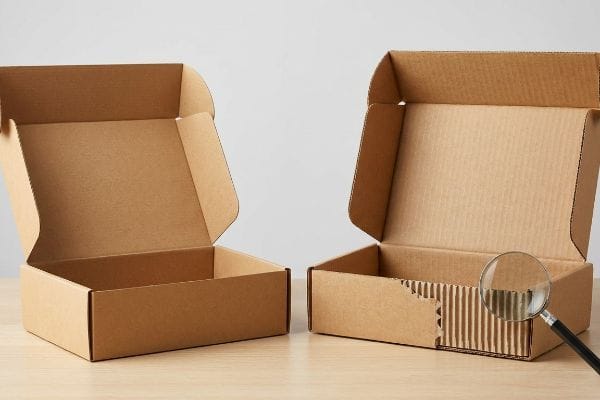
Um festzustellen, ob es sich um Wellpappe handelt, untersuchen Sie das Kantenprofil des Kartons. Befindet sich zwischen zwei flachen Deckschichten eine gewellte, bogenförmige Papierschicht, die sogenannte Wellenkante, handelt es sich um Wellpappe. Ist die Kante hingegen vollständig geschlossen und gleichmäßig, ist es ein Standardkarton.
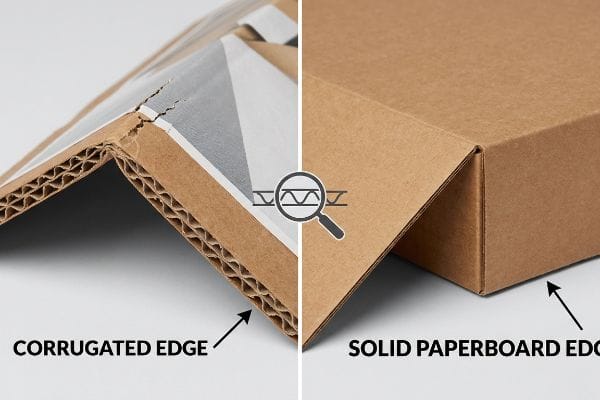
Die inneren Rillen zu sehen ist das eine, aber die Kontrolle darüber, wie sie sich unter dem enormen Maschinendruck verformen und falten, entscheidet darüber, ob Ihre Box den Transport übersteht.
Die Matrixprofilierung Faserbruch
Viele Grafikteams gehen fälschlicherweise davon aus, dass eine einfache Falzlinie automatisch eine perfekte 90-Grad-Faltung erzeugt und behandeln Wellpappe wie dünnen Karton. Beim Prägen einer Stanzform in dicke Wellpappe verformen sich die inneren Wellen jedoch je nach Papierfaserdichte unterschiedlich . Wird der Widerstand der Papierfasern beim Prägen nicht kontrolliert, ist die Stabilität der gesamten Ecke beeinträchtigt .
Das ist nicht nur Theorie – ich habe das letzten Monat auf die harte Tour gelernt, als ich eine robuste Großhandelsschale testete. Ich erinnere mich noch genau, wie mein leitender Ingenieur Mark eine Charge schweren 32ECT-Kraftkartons14 durch unsere Rotationsschlitzmaschine laufen ließ. Wir behandelten ihn wie Standardkarton, aber in dem Moment, als das Stahlmesser aufschlug, hörte ich ein deutliches, trockenes Knacken. Die innere Wellenstruktur hatte sich heftig verformt, das bedruckte Deckblatt war gerissen und hatte einen 2 mm breiten Riss im rohen, braunen Papier direkt an der tragenden Falz freigelegt. Ich stoppte die Maschine sofort. Um den Fehler zu beheben, ritzten wir die B-Welle neu an und veränderten die Stanzlinie, indem wir einen speziellen Rillkanal15 direkt auf die Schneidplatte montierten. Dieser Polymeramboss kontrollierte die Faserdehnung während des Aufpralls präzise. Ich investiere Zeit und Geld in meinem Testlabor, damit Sie im Einzelhandel keine Gewinneinbußen erleiden. Diese Mikrokalibrierung verhinderte nicht nur das Aufbrechen des Lithodrucks; Dadurch wurde die dynamische Tragfähigkeit der Ecke wiederhergestellt, sodass die Tabletts einer doppelten Stapellast von 680 kg im Lager standhalten konnten, ohne einzuknicken.
| Metrik/Merkmal | Sichtprüfung | Strukturelle Realität |
|---|---|---|
| Kantenprofil | Wellige Innenrillen | Vollkarton |
| Faltdynamik | Unkontrolliertes Ausknicken16 | Matrixgesteuerte Falte17 |
| Risiko der obersten Säule | Schwere Litho-Rissbildung18 | Makellose 90-Grad-Faltung |
Ich weiß genau, wie viel Druck eine geriffelte Platte aushält, bevor die Fasern brechen. Perfekte Rillmatrizen sind der unsichtbare Unterschied zwischen einer beeindruckenden Präsentation und einem zerknitterten Warenhaufen.
🛠️ Harveys Schreibtisch: Verlassen Sie sich blind darauf, dass Ihre Stanzteile sauber falten, ohne Ihre teuren Markengrafiken zu beschädigen? 👉 Kostenlose Biegetoleranzkalibrierung anfordern ↗ — Direkter Kontakt zu Statikern – ohne Umwege über Kundenbetreuer.
Ist ein Faltkarton dasselbe wie ein Wellpappkarton?
Die Verwechslung eines Kosmetikfaltkartons mit einem robusten Versandkarton führt bei den Beschaffungsteams oft zu verhängnisvollen Kompromissen beim Material.
Nein. Ein Faltkarton ist nicht dasselbe wie ein Wellpappkarton. Ein Faltkarton besteht aus dünnem, einlagigem Karton und eignet sich ideal für den Einsatz im Einzelhandel. Ein Wellpappkarton hingegen verfügt über einen mehrlagigen Wellenkern, der so konstruiert ist, dass er hohe Palettengewichte tragen und Stöße während des globalen Warentransports abfangen kann.
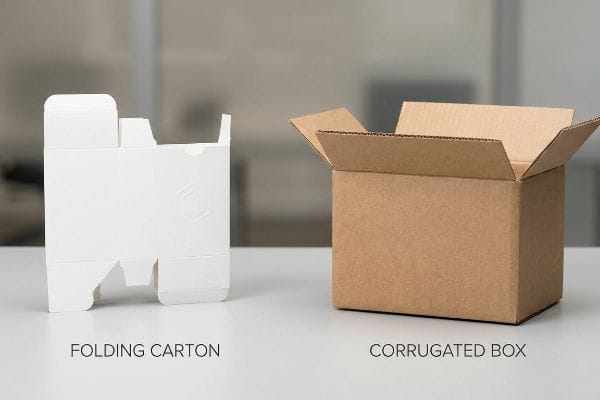
Wenn Marken versuchen, einen schweren Versandkarton so aussehen zu lassen wie einen luxuriösen Faltschachtelkarton, entfernen sie zwangsläufig genau die strukturellen Mechanismen, die ihre Produkte schützen.
Die Abwertungsfalle für kosmetische Substrate
Einkaufsteams betrachten teure Oberflächenveredelungen, wie die bei Faltschachteln übliche vollflächige Folienkaschierung, häufig als unverzichtbare Marketingmaßnahme für großflächige Bodenaufsteller. Um diese hohen Produktionskosten auszugleichen, reduzieren sie die ECT-Werte des Basiskartons19, um ein paar Cent pro Einheit zu sparen. Sie gehen fälschlicherweise davon aus, dass eine glänzende Oberfläche einen schwächeren Kern kompensiert.
In meiner Produktionsstätte erlebe ich diesen gefährlichen Kompromiss regelmäßig in der Angebotsphase. Ein Kunde verlangt beispielsweise einen massiven, 152,4 cm hohen Verkaufsständer mit dicker Folie und reduziert dabei heimlich die Lichtstärke (ECT) der Platten in seiner Excel-Tabelle von 32 ECT auf 26 ECT20. Wenn ich diese geschwächte Spezifikation in der Produktion teste, sind die Ergebnisse katastrophal. Die reduzierte Faserdichte führt dazu, dass die Kernstruktur unter einer Standardlast von 90,7 kg (200 lbs) zusammenbricht und die teuren Folienplatten sich sofort verbiegen. Nachdem mir das Einkaufsteam die Anpassung der Excel-Stückliste erlaubt hatte, erledigte das Material selbst die Hauptarbeit. Ich ermittelte die Mikrometerwerte und konnte nachweisen, dass wir dieselbe hochwertige Reflexion erreichen können, indem wir den ursprünglichen Standard von 32 ECT wiederherstellen und anstelle der aufgeblähten Kunststofffolien eine hochglänzende, wasserbasierte Beschichtung verwenden. Durch den Verzicht auf die schwere Laminierfolie und die Wiederherstellung des strukturellen Kerns konnte ich die Materialkosten um schätzungsweise 12 % senken und das Risiko von Transportschäden unter den hohen Palettenlasten des BCT (Box Compression Test)21.
| Metrik/Merkmal | Standardkarton | Konstruktionswellpappe |
|---|---|---|
| Oberflächenbeschaffenheit | Folienlaminierung22 | Hochfeststoffhaltige wässrige23 |
| Rumpfmuskulatur | Für den Güterverkehr irrelevant | Strenges 32-ECT-Mandat24 |
| Budgetfokus | Rein kosmetisch | Strukturelle Überlebensfähigkeit |
Ich weigere mich, die mechanische Stabilität eines Wellpappkartons zu beeinträchtigen, nur um unnötige optische Aufwertungen zu finanzieren. Wahre Verpackungstechnik vereint luxuriöse Ästhetik mit extremer logistischer Belastbarkeit.
🛠️ Harveys Schreibtisch: Beeinträchtigen Ihre hochwertigen Grafikoberflächen heimlich die Stabilität Ihrer großflächigen Verkaufsdisplays? 👉 Fordern Sie eine Materialausbeuteprüfung an ↗ — Ich prüfe jede Strukturdokumentation persönlich innerhalb von 24 Stunden.
Abschluss
Das Verständnis des entscheidenden physikalischen Unterschieds zwischen flachen Kartons und mikrogewellter Wellpappe verhindert, dass kopflastige Verkaufsverpackungen unter dem Druck des globalen Frachtverkehrs zusammenbrechen. Allein im letzten Monat half meine Strukturanalyse drei Marken, über 10.000 US-Dollar an Ausschuss und Rückbelastungen durch Händler zu vermeiden. Wenn Sie mit beschädigten Lagerbeständen oder komplexen Stanztoleranzen zu kämpfen haben, lasse ich Ihre Strukturdateien persönlich durch meine kostenlose Logistik- und Frachtdichteanalyse führen ↗, um sicherzustellen, dass Ihre nächste Produkteinführung die Lieferkette unbeschadet übersteht.
„[PDF] Untersuchung der mechanischen Eigenschaften von Kartonverpackungen …“, https://repository.rit.edu/cgi/viewcontent.cgi?article=1066&context=japr. Technischer Vergleich der Druckfestigkeit und der strukturellen Integrität von Vollpappen und Wellpappensystemen mit gewellten Bogenstrukturen. Nachweisfunktion: Technische Verifizierung; Quellentyp: Handbuch für Verpackungstechnik. Unterstützt die Aussage, dass die Materialdichte die Struktur der Wellpappe bei tragenden Anwendungen nicht ersetzen kann. Anwendungsbereich: Speziell im Hinblick auf dynamische Transportbelastungen. ↩
„Ein Leitfaden zu E-Welle-Wellpappe: Wofür sie gut ist und …“, https://www.accbox.com/blog/a-guide-to-e-flute-corrugated-what-its-good-for-and-when-to-use-it/. Branchenspezifikationen für E-Welle-Wellpappe, die deren Dicke und die Fähigkeit, hochauflösende Druckästhetik mit struktureller Stabilität zu kombinieren, detailliert beschreiben. Nachweisfunktion: Technische Spezifikation; Quellentyp: Branchenstandard (z. B. FEFCO oder TAPPI). Unterstützt: Die Wirksamkeit von Mikro-Welle für Verkaufsdisplays. Anmerkung zum Anwendungsbereich: Fokus auf das spezifische „E“-Wellenprofil. ↩
„Evaluation von Wellenkonfigurationen in Wellpappe durch experimentelle Untersuchungen …“, https://pmc.ncbi.nlm.nih.gov/articles/PMC10126572/. Technische Erläuterung, wie die Wellenstruktur in Wellpappe einen strukturellen Bogen erzeugt, der die vertikale Druckkraft verteilt und kinetische Energie absorbiert. Nachweisfunktion: Technische Verifizierung; Quellentyp: Handbuch für Verpackungstechnik. Belege: Strukturelle Überlegenheit gewellter Substrate gegenüber Vollpappe. Anwendungsbereich: Speziell für die vertikale Tragfähigkeit und Stoßfestigkeit. ↩
„Entschlüsselung der Geometrie doppelwandiger Wellpappe …“, https://pmc.ncbi.nlm.nih.gov/articles/PMC10974599/. Technische Dokumentation zur Struktur von Wellpappe. Nachweisfunktion: Strukturdefinition; Quellentyp: Industrienorm. Begründet: Der mechanische Unterschied zwischen Wellpappe und Flachkarton. Anwendungsbereich: Allgemeine Materialwissenschaft. ↩
„Untersuchung verschiedener Kartonmaterialien unter Stoßbelastung“, https://bioresources.cnr.ncsu.edu/resources/investigation-of-different-cardboard-materials-under-impact-loads/. Wissenschaftliche Analyse der Stoßkraftabsorption von Wellpappe während des Transports. Nachweisfunktion: Mechanische Validierung; Quellentyp: Ingenieurstudie. Belege: Überlegene Stoßdämpfung von Wellpappe im Vergleich zu Flachkarton. Anwendungsbereich: Dynamische Belastungskontexte. ↩
„Schätzung der Druckfestigkeit von Wellpappe …“, https://pmc.ncbi.nlm.nih.gov/articles/PMC8467740/. Vergleich der Werte des Box Compression Test (BCT) zwischen Wellpappe und nicht gewelltem Karton. Nachweisfunktion: quantitative Messgröße; Quellentyp: Verpackungsindustriestandard. Belege: Überlegene Stapelfestigkeit. Anmerkung zum Anwendungsbereich: Standardisierte Prüfumgebungen. ↩
„Wellpappe und Materialqualitäten – Verpackungsstrategien“, https://www.packagingstrategies.com/articles/96269-corrugated-board-and-material-grades. Überprüfung der branchenüblichen Dicke für B-Welle-Wellpappe zur Bestätigung der technischen Genauigkeit. Nachweisfunktion: Technische Spezifikation; Quellentyp: Verpackungsindustriestandard. Belege: Die angegebene Materialdicke. Anmerkung: Die Dickenangaben können je nach Hersteller leicht variieren. ↩
„Analytische Bestimmung der Biegesteifigkeit einer fünflagigen …“, https://pmc.ncbi.nlm.nih.gov/articles/PMC8777652/. Überprüfung der in der Wellpappenverpackungskonstruktion verwendeten Standardtoleranzen zur Berücksichtigung der Materialstärke und des Biegezuschlags. Nachweisfunktion: Technische Validierung; Quellentyp: Handbuch für Verpackungstechnik. Begründung: Die Verwendung spezifischer Toleranzen zur Gewährleistung einer reibungsfreien Montage. Anmerkung: Die Toleranz kann je nach Wellengröße und Materialgüte variieren. ↩
„Kosteneinsparungen jenseits der Beschaffung: Wellpappenverpackungen“, https://adeptpackaging.com/blog/cost-savings-beyond-sourcing-corrugated-packaging/. Analyse der Kostenreduzierungen bei der Lohnverpackung durch den Einsatz präzisionsgefertigter Toleranzen im Vergleich zur manuellen Montage. Nachweisfunktion: quantitativer Vergleichswert; Quellentyp: Bericht zur industriellen Effizienz. Belege: Die Behauptung, dass Designoptimierung die Kosten für manuelle Arbeit reduziert. Anmerkung zum Umfang: Geschätzter Prozentsatz basierend auf betrieblichen Effizienzgewinnen. ↩
„Was ist eine Stanzform in der Verpackungs- und Druckindustrie? – PopDisplay“, https://popdisplay.me/what-is-a-dieline-in-packaging-print/. Technische Erklärung, warum die Berechnung des Faltradius für Wellpappe notwendig ist, um die Maßgenauigkeit zu gewährleisten. Belegfunktion: Technische Spezifikation; Quellentyp: Handbuch für Verpackungstechnik. Begründung: Die Notwendigkeit der 3D-Geometrie gegenüber der 2D-Geometrie für Stanzformen in Wellpappe. Anwendungsbereich: Speziell für dickwandige Materialien. ↩
„Kartonkonstruktionen: Berechnung des Biegezuschlags 1“, https://www.youtube.com/watch?v=j1n5ojAbAic. Industriestandarddokumentation, die die Hinzufügung von Biegezuschlag zu Schlitzen zur Berücksichtigung der Materialstärke und Kompression beim Falten detailliert beschreibt. Nachweisfunktion: Technischer Standard; Quellentyp: Fertigungsleitfaden. Unterstützt: die Aussage, dass Wellpappenschlitze nicht 1:1 übereinstimmen können. Anwendungsbereich: abhängig von Wellengröße und -stärke. ↩
„Einfluss analoger und digitaler Falzlinien auf die Mechanik … – PMC“, https://pmc.ncbi.nlm.nih.gov/articles/PMC9268991/. Technische Erläuterung, wie die Materialdichte die Verformung und das Ausknicken von Rillen beim Stanzen beeinflusst. Belegfunktion: Mechanische Erläuterung; Quellentyp: Handbuch für Verpackungstechnik. Belege: Der Einfluss der Faserdichte auf das Ausknicken von Rillen. Anwendungsbereich: Fokus auf industrielles Stanzen. ↩
„Druckfestigkeit von Wellpappenverpackungen …“, https://pmc.ncbi.nlm.nih.gov/articles/PMC10054506/. Nachweis des Zusammenhangs zwischen unkontrollierten Stoßkräften und dem mechanischen Versagen von Faltstellen in Wellpappe. Bedeutung des Nachweises: kausaler Zusammenhang; Quellentyp: materialwissenschaftliche Studie. Unterstützt: Verlust der strukturellen Integrität. Anwendungsbereich: Gilt für Eckfalten in Wellpappe. ↩
„Versandkartonfestigkeit verstehen – EcoEnclose“, https://www.ecoenclose.com/blog/understanding-shipping-box-strength/?srsltid=AfmBOorPTpNLLPeDYPtH_7J265dQmgb8YWczVjMgDWEqsE_Aqlfz7eb0. Technische Überprüfung der Kantenstauchfestigkeit (ECT) und der strukturellen Eigenschaften von Wellpappe aus neuem Kraftpapier. Nachweisfunktion: Technische Spezifikation; Quellentyp: Industriestandard. Unterstützte Informationen: Materialfestigkeit und Güteklasse. Anwendungsbereich: Spezifisch für Normen für Wellpappenverpackungen. ↩
„C&T führt Anvil Crease Matrix ein“, https://www.thepackagingportal.com/industry-news/ct-adds-anvil-crease-matrix/. Technische Erklärung, wie die Matrix-Rillkanäle die Faserstreckung kontrollieren und Risse beim Rillen verhindern. Nachweisfunktion: Prozessvalidierung; Quellentyp: Handbuch für Verpackungstechnik. Unterstützt: Mechanismus zur Vermeidung von Litho-Rissen. Anwendungsbereich: Gilt für industrielles Stanzen und Schlitzen. ↩
„Analytisches Nachbeulmodell von Wellpappenplatten …“, https://www.sciencedirect.com/science/article/abs/pii/S0263822313000603. Analyse von Druckspannungen und unkontrollierter Verformung in Wellenprofilen beim Falten. Nachweisfunktion: Strukturvergleich; Quellentyp: Ingenieurlehrbuch. Begründung: Versagen durch Faltdynamik. Anmerkung: Vergleich von Standardwellenprofilen mit profilierten Matrizen. ↩
„Wie und warum hochwertige Faltergebnisse erzielt werden“, https://postpressmag.com/articles/2021/understanding-the-how-and-why-for-quality-creasing-outcomes/. Technische Daten zur Steuerung von Faserbrüchen durch Matrixprofilierung, um vorhersagbare Faltstellen zu gewährleisten. Nachweisfunktion: Technische Validierung; Quellentyp: Materialwissenschaftliches Whitepaper. Unterstützt: Faltdynamik. Fokus: Hochpräzises industrielles Falten. ↩
„Warum reißen Wellpappkartons beim Falten?“, https://www.linkedin.com/pulse/why-do-corrugated-boxes-crack-when-folded-practical-moss-6nqyc. Technische Erklärung, wie lithografische Beschichtungen beim Falten von Wellpappe ohne ordnungsgemäßes Rillen versagen und reißen. Nachweisfunktion: Überprüfung des Versagensmodus; Quellentyp: Spezifikation für industrielle Verpackungen. Unterstützung: Risikoanalyse der Decklage. Anwendungsbereich: Gilt speziell für bedruckte Decklagen. ↩
„Neue Konfiguration des Kantenstauchtests mit flächenhafter Dehnungsmessung …“, https://pmc.ncbi.nlm.nih.gov/articles/PMC8510352/. Anerkannte Quellen im Bereich Verpackungstechnik definieren den Kantenstauchtest (ECT) und erläutern den direkten Zusammenhang zwischen niedrigeren Werten und reduzierter struktureller Integrität/Kosten. Nachweisfunktion: Technische Validierung; Quellentyp: Industriestandard. Unterstützt: Die technische Bedeutung der ECT-Werte bei der Auswahl von Wellpappe. Anwendungsbereich: Fokus auf die strukturelle Tragfähigkeit. ↩
„ECT-Bewertungen erklärt: Was sie für Ihre … bedeuten“, https://epackagesupply.com/blogs/packaging-guide/ect-ratings-explained-what-they-mean-for-your-corrugated-packaging?srsltid=AfmBOoriKOLCHpu7zKS9wCJZKARkJ-T2lFt185YLefhAzep9AqZtuwLn. Die technischen Spezifikationen für die Edge Crush Test (ECT)-Bewertungen liefern die quantitativen Druckfestigkeitswerte für verschiedene Wellpappensorten. Nachweisfunktion: Technische Spezifikation; Quellentyp: Industriestandard. Unterstützt die Behauptung, dass eine Reduzierung der ECT-Bewertung die strukturelle Integrität der Pappe verringert. Anwendungsbereich: Allgemeine Industriestandards für Wellpappe. ↩
„Box Compression Test: Standards, Methods & Calibration | Worldoftest“, https://www.worldoftest.com/articles/box-compression-test-standards-methods-calibration/. Der Box Compression Test (BCT) ist die branchenübliche Methode zur Bestimmung der maximalen Belastung, die ein Wellpapp-Versandkarton vor dem Versagen aushalten kann. Nachweisfunktion: Technischer Standard; Quellentyp: Internationaler Standard (ASTM/ISO). Anwendungsbereich: Der Einsatz des BCT zur Bewertung und Minderung des Risikos von Transportschäden. Anwendungsbereich: Fokus auf Sekundär- und Tertiärverpackungen. ↩
„Verpackungen für Gesundheit und Schönheit | Kosmetikkartons“, https://www.netpak.com/en/packaging-industries/health-beauty-packaging/. Bestätigung, dass die Folienkaschierung ein Standardverfahren zur Veredelung hochwertiger Kosmetikfaltkartons ist. Nachweisfunktion: Branchenpraxis; Quellentyp: Leitfaden für Verpackungsdesign. Trägermaterial: Standardmäßige Kartonoberflächenveredelung. Anwendungsbereich: Speziell für Substrate im Luxuskosmetikbereich. ↩
„Wässrige Beschichtung (AQ) im Verpackungsdruck – PopDisplay“, https://popdisplay.me/aqueous-coating-aq-in-packaging-printing/. Technische Dokumentation von hochfesten, wässrigen Beschichtungen zur Oberflächenbeständigkeit auf Wellpappensubstraten. Nachweisfunktion: Materialspezifikation; Quellentyp: Technisches Datenblatt. Anwendungsbereich: Oberflächenveredelung von technischer Wellpappe. Anmerkung zum Anwendungsbereich: Fokus auf industrielle Beschichtungsanwendungen. ↩
„Verständnis der Festigkeit von Versandkartons“, https://www.ecoenclose.com/blog/understanding-shipping-box-strength/?srsltid=AfmBOor5Nq6WPw9JbhndRpEEEUg2LvRpoI8g0L7sPTXhhIWwqoduKMxm. Überprüfung des 32-Kantenstauchtests (ECT) als gängiger Strukturmaßstab für Wellpappen-Versandkartons. Nachweisfunktion: Technische Spezifikation; Quellentyp: Industriestandard. Unterstützt: Anforderungen an die Kernfestigkeit von Konstruktionswellpappe. Anwendungsbereich: Speziell für ladungstragende Wellpappenmaterialien. ↩