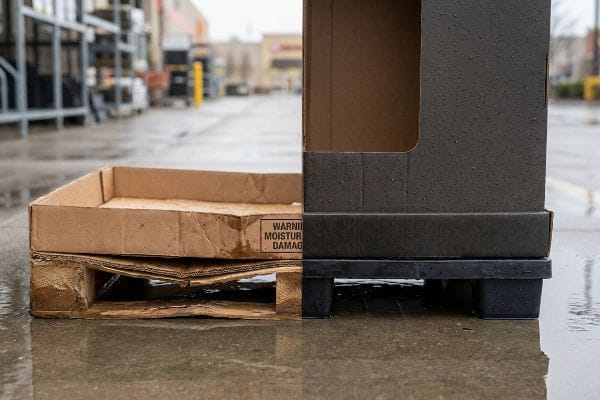
Bei der Verwendung von Wellpappenverpackungen in Umgebungen mit hoher Luftfeuchtigkeit oder im Freien kollidiert die theoretische Verpackungsgestaltung heftig mit der physikalischen Realität der Witterungsbedingungen im Einzelhandel.
Das kommt darauf an. Halbpaletten-Displays erfordern für den Außeneinsatz spezielle Konstruktionsvorgaben. Standard-Wellpappe absorbiert schnell Luftfeuchtigkeit und zerstört dadurch ihre Stabilität. Durch die Anwendung einer robusten, wasserabweisenden Beschichtung auf ungebrauchtem Kraftkarton und die Verwendung stabiler Kunststofffüße lässt sich die Präsentation im Außenbereich jedoch kurzfristig erfolgreich gestalten.
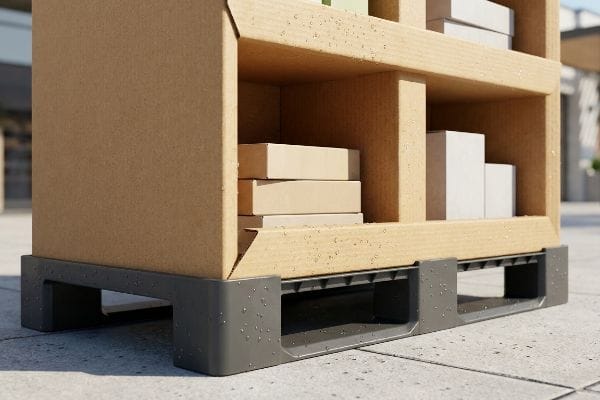
Ohne diese spezifischen Materialbehandlungen würde selbst dickster Karton unter der geringsten Menge Morgentau abblättern und sich verformen, was zu einem sofortigen Einsturz des Bodens führen würde.
Wie lange hält Palettenholz im Außenbereich?
Wenn Rohstoffe für die Logistik den Witterungseinflüssen ausgesetzt bleiben, entstehen massive strukturelle Risiken.
Palettenholz hält bei richtiger Behandlung im Außenbereich bis zu zehn Jahre, unbehandelte Standard-Exportpaletten hingegen verziehen sich und verrotten bereits nach wenigen Wochen. Längere Einwirkung von Regen, Bodenfeuchtigkeit und UV-Strahlung schädigt die Holzfasern stark und gefährdet so den sicheren Transport schwerer Handelswaren.
Doch beim Überleben geht es nicht nur darum, dass das Holz standhält – es geht auch darum, was mit den mehrschichtigen Werbedisplays passiert, die direkt darauf gestapelt sind.
Der ISPM 15 Feuchtigkeitsübertragungsfehler
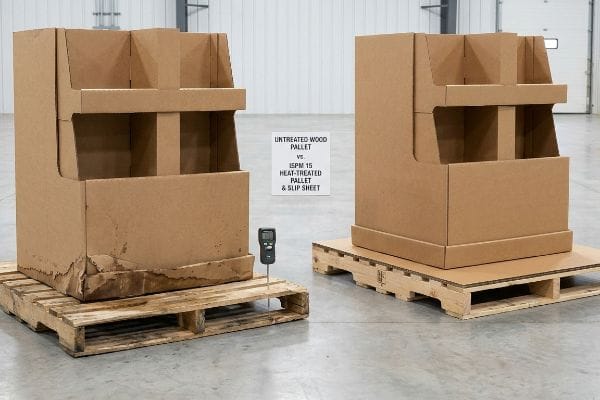
Einkaufsteams greifen für Gartencenter mit Außenbereich oft auf billige, unbehandelte Holzpaletten zurück und ignorieren dabei die Porosität des Holzes. Sie betrachten die Holzpalette fälschlicherweise als dauerhaft trockene Barriere zwischen dem Betonboden und den Warenträgern aus Karton . Tatsächlich wirkt unbehandeltes Holz wie ein riesiger Schwamm, der stehendes Wasser nach oben transportiert¹ und direkt unter den Waren ein stark lokalisiertes, feuchtes Mikroklima² erzeugt .
In meiner Einrichtung beobachte ich dies regelmäßig, wenn Marken versuchen, aus Kostengründen auf wärmebehandelte, ISPM 15-zertifizierte Paletten zu verzichten. Sie laden 68 kg Hartwaren auf billige Holzgestelle und lagern diese in einer simulierten feuchten Umgebung. Das Holz saugt Wasser auf, verzieht sich und gibt die Feuchtigkeit direkt an den Boden des Wellpappdisplays ab. Messungen in der Testhalle zeigen, dass sich das billige Holz innerhalb von 72 Stunden um 11,43 mm verzieht, den unteren Rand des Displays einreißt und die Druckfestigkeit des Bodens um 12,4 % sinkt.Die Papierfasern erschöpfen sich quasi selbst, nur um das sich verschiebende Gestell zusammenzuhalten.
Durch die konsequente Verwendung wärmebehandelter, chemikalienfreier ISPM-15-Palettenin Kombination mit einer stabilen Wellpappen-Zwischenlagewirddas Display vollständig vom Grundwasser isoliert. Diese starre, mathematisch ebene Unterlage verhindert ein Durchhängen der unteren Ebene und schützt Kunden so vor hohen Rückforderungen von Einzelhändlern aufgrund zusammengebrochener Garten-Aktionsdisplays.
| Metrik/Merkmal | Unbehandelte Holzbasis | ISPM 15-Basis |
|---|---|---|
| Feuchtigkeitsverzug | Starke Durchbiegung7 | Nahezu keine Varianz8 |
| Wellblechrisiko | Der untere Rock reißt | Vollständig geschützt |
| Lebensdauer im Einzelhandel | Schneller struktureller Verfall | Vollständige 6-wöchige Kampagne9 |
Ich weigere mich, die Stabilität meiner robusten Wellblech-Untergestelle zu beeinträchtigen, indem ich sie auf schwammartigem, unbehandeltem Holz montiere, denn ein Display ist nur so stabil wie das Holz, auf dem es steht.
🛠️ Harveys Schreibtisch: Saugen Ihre Gartenauslagen im Außenbereich Feuchtigkeit auf und stürzen auf dem Gehweg Ihres Geschäfts ein? 👉 Kostenlose Frachtdichteanalyse anfordern ↗ — Ich prüfe jede Bauakte persönlich innerhalb von 24 Stunden.
Wie nennt man eine halbe Palette?
In der Logistik und im Warenhandel bestimmt die räumliche Terminologie Ihre Frachtkosten und Ihren Zugang zu den Regalgängen.
Eine halbe Palette wird in der nordamerikanischen Einzelhandelslieferkette auch als Teilpalette oder halbe GMA-Basis (Grocery Manufacturers Association) bezeichnet. Mit ihren exakten Maßen von 48 × 20 Zoll (1219,2 × 508 mm) ermöglicht diese standardisierte Grundfläche zwei verschiedenen Händlern die sichere gemeinsame Nutzung einer einzigen herkömmlichen Holztransportplattform.
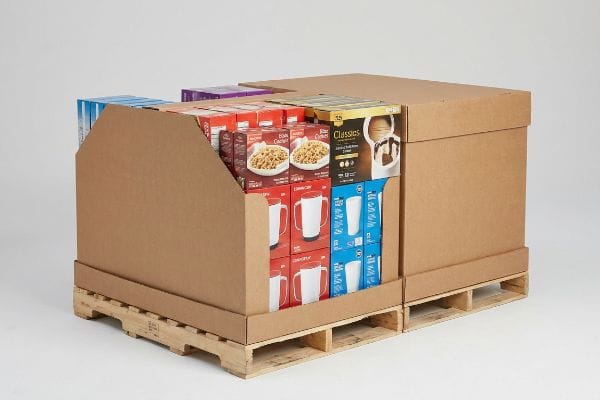
Das Verständnis dieser räumlichen Nomenklatur ist entscheidend für Ihren Erfolg, denn große Einzelhändler setzen diese Grenzen bei der Kartierung ihrer stark frequentierten Zonen aggressiv durch.
Das Rahmenwerk für die Konstruktion von Teilpaletten
Eine halbe Palette ist nicht einfach nur ein kleinerer Karton; sie ist eine mathematisch präzise Unterteilung der Standard-Logistikarchitektur. Durch die Beschränkung des Designs auf 48 × 20 Zoll (1219,2 × 508 mm)¹⁰stellen Statiker sicher, dass sich die Einheit nahtlos in die automatisierten Lager- und Kommissioniersysteme¹¹ moderner Lagerclubs integriert,ohne dass eine spezielle Gabelstaplerhandhabung erforderlich ist. Diese technische Unterteilung erhält die für die Aufnahme hoher dynamischer Belastungen beim Seetransport erforderlichen strukturellen Ecken.
Wenn ich Nachwuchsingenieure in die Optimierung der Raumnutzung einweise, betone ich, dass die Hauptfunktion einer Halbpalette die platzsparende Aufteilung der Verkaufsfläche ist. Die Verkaufsfläche großer nordamerikanischer Ketten ist stark begrenzt. Kann eine Marke keine vollständige 48×40 Zoll (1219,2×1016 mm) große Endkappe¹² sichern , bietet die Halbpalette den idealen Kompromiss. Sie ermöglicht eine massive vertikale Werbefläche und halbiert gleichzeitig die benötigte Stellfläche. Wir konstruieren diese Teilpaletten so, dass sie sich während des Seetransports¹³ sicher auf einer Standard-Versandpalette verriegeln lassen und so das Verrutschen verhindern, das normalerweise ungesicherte, schmale Ladungen beschädigt. Diese präzise geometrische Ausrichtung garantiert, dass beide Hälften vollständig intakt ankommen und sofort problemlos im Regal platziert werden können.
| Dimensionsmetrik | Volle Palette (GMA) | Halbpalettenbasis |
|---|---|---|
| Fußabdruckgröße | 48×40 Zoll14 | 48×20 Zoll15 |
| Kampagnen-Sharing | Einzelmarke | Doppelkampagnen-Setup |
| Ladenplatzierung | Dominanz der Endkappen | Gänge mit hohem Kundenaufkommen |
Ich nutze immer Bruchteilsformate, weil sie den Marken maximale Hebelwirkung bieten und mathematisch einen Premium-Zugang zum Verkaufsboden garantieren, selbst wenn der Platz im Gang streng begrenzt ist.
🛠️ Harveys Schreibtisch: Wird Ihre aktuelle Warenpräsentation von Einzelhändlern abgelehnt, weil sie zu viel Regalfläche beansprucht? 👉 Fordern Sie eine kostenlose Sichtlinienanalyse an ↗ — 100 % vertraulich. Ihre noch nicht veröffentlichten Ladenkonzepte sind bei mir sicher.
Worin besteht der Unterschied zwischen einer Viertelpalette und einer Halbpalette?
Durch die Verkleinerung der Stellfläche eines Displays verändern sich dessen mechanische Stabilität und Schwerpunkt grundlegend.
Der Unterschied zwischen einer Viertelpalette und einer Halbpalette liegt in ihrer Stellfläche und ihrer Stabilität. Eine Viertelpalette misst 609,6 × 508 mm (24 × 20 Zoll) und eignet sich für enge Regalgänge, während eine Halbpalette mit 122 × 508 mm (48 × 20 Zoll) eine breitere Standfläche bietet und so ein gefährliches Umkippen beim Einkaufen verhindert.
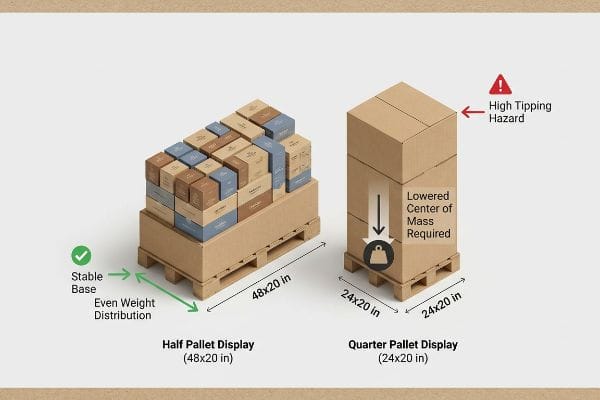
Durch die systematische Verringerung der Breite der Wellblechbasis verändert sich das physikalische Verhalten der voll beladenen Einheit drastisch.
Die Schwerpunktverlagerung in der Geometrie des Einzelhandels
Bei der Konstruktion von Verkaufsverpackungen bestimmt das Verhältnis von Höhe zu Basisbreite die Stabilität des gesamten Verkaufsregals. Während eine halbe Palette mit 122 cm (48 Zoll) einen soliden Standplatz bietet, entsteht durch die Verkleinerung der Stellfläche auf eine Viertelpalette eine schmale, turmartige Struktur. Bleibt die Gesamthöhe innerhalb der im Einzelhandel üblichen Grenze von 1270 mm (50 Zoll16 ), verhält sich diese kompakte Geometrie wie ein Bleistift, der auf seinem Radiergummi steht. Um einen sicheren Stand zu gewährleisten, ist daher eine sorgfältig berechnete Lastverteilung erforderlich.
Ich weise Marken immer wieder darauf hin, dass die einfache Verkleinerung eines 3D-CAD-Modells (Computer-Aided Design) von der Hälfte auf ein Viertel des Formats ohne Anpassung der internen Tragstruktur ein erhebliches Haftungsrisiko darstellt. Der technische Unterschied liegt in der von uns vorgeschriebenen Absenkung des Schwerpunkts für die kleinere Stellfläche. Bei Viertelpaletten müssen die schwersten Waren fest in den unteren Ebenen verankert werden<sup>17</sup>, oder es müssen Zwischenböden konstruiert werden, die verdeckte Sandsäcke aufnehmen können. Diese berechnete Gewichtsverteilung kompensiert die schmale Basis und gewährleistet, dass das schlanke Display die gängigen Kipptests im Einzelhandel<sup>18</sup> und direkten Zusammenstößen mit Einkaufswagen standhält, ohne einzustürzen.
| Metrik/Merkmal | Halbe Palette (48×20) | Viertelpalette (24×20)19 |
|---|---|---|
| Kippgefahr | Natürlich stabil | Hohes Risiko, nicht modifiziert20 |
| Gewichtsverteilung | Gleichmäßig verteilt | untenlastig erforderlich21 |
| Einzelhandelsplatzierung | Endkappen für breite Gänge | Agnostische Eckpassung |
Jede Reduzierung der Stellfläche betrachte ich als eine vollständige physische Neugestaltung, bei der der Schwerpunkt nach unten verlagert wird, sodass schmale Verkaufsregale genauso fest stehen wie breite.
🛠️ Harveys Schreibtisch: Wackeln Ihre verkleinerten Bodendisplays oder fallen sie bei den vorgeschriebenen Neigungs- und Sicherheitstests des Einzelhändlers durch? 👉 Fordern Sie einen kostenlosen Statikrechner an ↗ — Keine Zwischenhändler. Sie sprechen direkt mit Statikern.
Wie viel Gewicht kann eine Kunststoffpalette tragen?
Die für Ihr Fundament gewählten Materialien bestimmen die absolute Nutzlastgrenze für hochdichte Verkaufsflächen.
Eine Kunststoffpalette kann je nach ihrer internen Verstärkungsrippung dynamische Lasten von 1134 bis 2268 kg (2500 bis 5000 lbs) tragen. Im Gegensatz zu herkömmlichem Holz splittern die geformten Böden aus hochdichtem Polyethylen nicht und nehmen keine Feuchtigkeit auf. Dadurch eignen sie sich ideal für stark beanspruchte Außenbereiche oder die hohen Anforderungen von Lagerhallen.
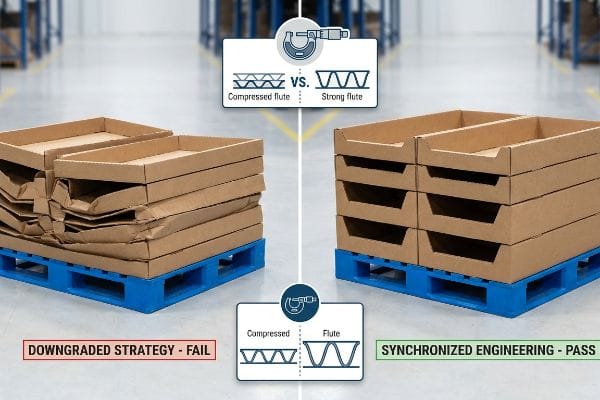
Die Kombination einer Kunststoffbasis mit enormer Kapazität mit der falschen gewellten Oberkonstruktion führt jedoch zu einem fatalen mechanischen Ungleichgewicht.
Dynamische Lastabweichung im Club Store
Einkaufsteams beschaffen für die Warenauslagen ihrer Club-Stores oft teure, hochbelastbare Kunststoffpaletten , in der Annahme, dass allein die unverwüstliche Basis die Waren schützt. Um die hohen Kosten dieses Formkunststoffs auszugleichen, reduzieren sie heimlich die ECT-Bewertung (Edge Crush Test) der oberen Wellpappe von 32 auf 26. Dadurch entsteht ein fatales strukturelles Ungleichgewicht: Eine permanente, extrem belastbare Basis stützt einen schwachen, knickgefährdeten Kartonturm, dessen Wellendichte nicht ausreicht, um dem Druck einer doppelt gestapelten, von oben kommenden Last standzuhalten .
In meiner Einrichtung beobachte ich diesen spezifischen Fehler regelmäßig bei unseren Transportsimulationen in der Vorproduktion. Ein Kunde lieferte kürzlich eine Kunststoffbasis mit einer Tragfähigkeit von 1360,7 kg (3000 lbs), verwendete aber für die darüber liegenden, vorgefüllten Displaytrays billiges, einwandiges Standard-Wellpappenmaterial. Als ich die Montage auf dem Rütteltisch unter einer doppelt gestapelten Last testete, hielt die Kunststoffbasis einwandfrei, aber die minderwertigen 26 -Wellen-Wellpappen des unteren Trays wurden sofort um 15,7 mm (0,62 Zoll) eingedrückt. Durch präzise Mikrometermessungen konnte ich nachweisen, dass wir das Budget nicht unnötig aufblähen mussten; eine strikte Materialumstellung genügte. Nachdem mir das Einkaufsteam die Erlaubnis erteilt hatte, die unteren Trays durch doppelwandige B/C-Wellpappen-Hybridplatten zu ersetzen , funktionierte die gesamte Konstruktion einwandfrei. Diese eine mechanische Korrektur verhinderte ein katastrophales Zusammenbrechen der oberen Ladung und ersparte dem Kunden schätzungsweise 20 % Ausschuss. Gleichzeitig bestand er die strengen Wareneingangskontrollen des Lagerclubs.
| Strukturelement | Strategie für ein günstiges Downgrade | Synchronisierte Technik |
|---|---|---|
| Basisplattform | Hochwertiger, formgepresster Kunststoff | Standard-Formkunststoff |
| Wellpappschalen | 26ECT einwandig26 | B/C-Flöte Doppelwand27 |
| Paletten-Toplader | Instant-Flöten-Crush | Null Kompressionsverlust28 |
Ich weigere mich absolut, zuzulassen, dass Marken ihr Budget für unzerstörbare Kunststoffgestelle verschwenden, nur um dann mitanzusehen, wie ihre minderwertigen oberen Ablagen unter der Belastung durch normale Lagerhaus-Toploader wie Ziehharmonikas zusammengedrückt werden.
🛠️ Harveys Schreibtisch: Werden die unteren Regalböden Ihres schweren Lagerhallen-Lagers beim Seetransport beschädigt? 👉 Fordern Sie eine Strukturprüfung an ↗ — Ich prüfe jede Strukturdatei persönlich innerhalb von 24 Stunden.
Abschluss
Die Beherrschung der Mechanismen von Feuchtigkeitsquellen im Außenbereich, der Stabilität von Paletten mit unterschiedlichen Belastungen und dynamischen Toploads ist die einzige bewährte Methode, um zu verhindern, dass Ihre stationären Verkaufsflächen im Einzelhandel zusammenbrechen. Allein im letzten Monat half meine Strukturanalyse drei Marken, über 10.000 US-Dollar an Ausschuss und Rückbelastungen durch Händler zu vermeiden. Wenn Sie befürchten, dass Ihre Wellpappkartons unter der Luftfeuchtigkeit im Außenbereich oder dem Gewicht schwerer Waren im Großhandel nachgeben, lasse ich Ihre Strukturdaten persönlich einer kostenlosen Strukturanalyse unterziehen ↗, um Ihr Überleben im Einzelhandel mathematisch zu garantieren.
„Ausblühungen für Gutachter – InterNACHI“, https://www.nachi.org/efflorescence/html.htm. Kurze Erklärung, wie unbehandeltes Holz durch Kapillarwirkung flüssiges Wasser vertikal durch seine poröse Struktur transportiert. Belegfunktion: Technischer Mechanismus; Quellentyp: Fachzeitschrift für Holzforschung. Stützt die Behauptung der Feuchtigkeitsaufnahme. Anwendungsbereich: Beschränkt auf unbehandeltes, poröses Holz. ↩
„Holz und Feuchtigkeitsbeziehungen | OSU Extension Service“, https://extension.oregonstate.edu/catalog/em-8600-wood-moisture-relationships. Kurze Erklärung, wie die Verdunstung von Feuchtigkeit aus kapillaraktiven Holzsubstraten die relative Luftfeuchtigkeit in der unmittelbaren Luftschicht über dem Holz erhöht. Belegfunktion: Umwelteinfluss; Quellentyp: bauwissenschaftliche Studie. Unterstützt: Mikroklimabildung. Anmerkung: Bezieht sich auf den Dampfdruck an der Oberfläche. ↩
„Feuchtigkeit und Verzug | LumberJocks Holzbearbeitungsforum“, https://www.lumberjocks.com/threads/humidity-and-warping.37005/. Technische Daten zur Holzhygroskopie und Dimensionsstabilität unbehandelter Nadelhölzer unter feuchten Bedingungen. Nachweisfunktion: quantitative Validierung; Quellentyp: materialwissenschaftliche Studie. Unterstützt durch: die Rate der physikalischen Verformung unbehandelter Paletten. Anmerkung: Variiert je nach Holzart und relativer Luftfeuchtigkeit. ↩
„[PDF] Auswirkungen des Feuchtigkeitsgehalts auf die Druckfestigkeit von Kartons: FBA BCT …“, https://renewablebioproducts.gatech.edu/sites/default/files/2025-12/4effects-of-moisture-content-on-box-compression-strength.pdf. Industriestandards für den Kantenstauchtest (ECT) von Wellpappe und den Druckfestigkeitsverlust bei Feuchtigkeitseinwirkung und struktureller Instabilität. Nachweisfunktion: Technischer Benchmark; Quellentyp: Handbuch für Verpackungstechnik. Unterstützt: den spezifischen Verlust der strukturellen Integrität im Displayboden. Anwendungsbereich: Abhängig von der Wellpappensorte und dem Wellentyp. ↩
[PDF] Erläuterungsdokument zu ISPM 15 (Verordnung über Holzverpackungen …), https://www.ippc.int/static/media/files/publication/en/2017/02/ISPM_15_ED_En_2017-02-10.pdf. Überprüfung der Internationalen Norm für Pflanzenschutzmaßnahmen Nr. 15 (ISPM 15) hinsichtlich der Wärmebehandlung (HT) als chemikalienfreie Alternative für Holzverpackungen. Nachweisfunktion: Technische Spezifikation; Quellentyp: Internationale Regulierungsbehörde. Unterstützung: Die Materialeigenschaften der Paletten. Anwendungsbereich: Hauptsächlich auf die Einhaltung der Pflanzenschutzbestimmungen ausgerichtet. ↩
„Zwischenlagen – Southern States Packaging Company“, https://sspc.biz/slip-sheets-packaging/. Technische Daten zur Durchlässigkeit und Feuchtigkeitssperre von Wellpappen-Zwischenlagen, die als Barriere zwischen Paletten und Bodenflächen verwendet werden. Nachweisfunktion: Materialleistung; Quellentyp: Spezifikation der Verpackungsindustrie. Beleg: Die Behauptung, dass Zwischenlagen Displays vor Grundwasser schützen. Anmerkung: Die Leistung hängt vom Flächengewicht (GSM) des Materials und den Beschichtungen ab. ↩
„Häufig gestellte Fragen (FAQ)“, https://unitload.vt.edu/education/faqs.html. Vergleichsdaten zur Verformung und Durchbiegung von rohem, unbehandeltem Holz bei Einwirkung von Feuchtigkeit. Nachweisfunktion: Leistungsbenchmark; Quellentyp: Leitfaden für Bauingenieure. Anwendungsbereich: Feuchtigkeitsbedingte Verformungsrisiken für unbehandeltes Holz. Anmerkung zum Anwendungsbereich: speziell im Hinblick auf Logistikmaterialien. ↩
„Import von ISPM 15-konformem Holzverpackungsmaterial in die USA“, https://www.aphis.usda.gov/plant-imports/wood-packaging-material/import. Technische Dokumentation zur Dimensionsstabilität und Verzugsbeständigkeit von wärmebehandeltem ISPM 15-Holz. Nachweisfunktion: Technische Spezifikation; Quellentyp: Materialwissenschaftliche Studie. Belege: Behauptung minimaler Abweichungen bei den verwendeten Untergründen. Anmerkung zum Anwendungsbereich: Fokus auf feuchtigkeitsbedingte Verformung. ↩
„Export von ISPM 15-konformem Holzverpackungsmaterial aus den USA“, https://www.aphis.usda.gov/plant-exports/wood-packaging-material/export. Branchenstandards für die strukturelle Stabilität wärmebehandelter Paletten im temporären Einzelhandel. Nachweisfunktion: quantitative Kennzahl; Quellentyp: Bericht zur Haltbarkeit im Logistik-/Einzelhandelsbereich. Unterstützt: die prognostizierte Lebensdauer von Konstruktionsgestellen. Anwendungsbereich: gilt für typische Kampagnenlaufzeiten. ↩
„Standardpalettengrößen und -abmessungen: Vollständige Tabelle (Leitfaden 2026)“, https://www.repackify.com/blog/standard-pallet-sizes-and-dimensions?srsltid=AfmBOorICd8x4n_rHHkW1SSV_gsxZlyp2IDQ2wCkTzMk4okydNKRTaZ4. Überprüfung der exakten branchenüblichen Abmessungen für Teilpaletten in der nordamerikanischen Einzelhandelslieferkette. Nachweisfunktion: Faktenprüfung; Quellentyp: Branchennorm. Unterstützt: Spezifische Grundflächenabmessungen. Anwendungsbereich: Gilt für die nordamerikanischen GMA-Standards. ↩
„AS/RS-Systeme für Lager – Toyota Automated Logistics“, https://toyota-automated-logistics.com/technology/automated-storage-retrieval-systems. Technische Bestätigung, dass 48×20-Paletten für die nahtlose Integration in Standard-ASRS in modernen Lagern ausgelegt sind. Nachweisfunktion: Technische Validierung; Quellentyp: Dokumentation der Logistiktechnik. Unterstützt: Systemkompatibilität. Anwendungsbereich: Betrifft die Infrastruktur automatisierter Lager. ↩
„Standardpalettengrößen | Mit Tabelle“, https://www.kampspallets.com/standard-pallet-sizes-with-chart/. Überprüfung der Standardpalettenabmessungen der Grocery Manufacturers Association (GMA), die im nordamerikanischen Einzelhandel verwendet werden. Nachweisfunktion: Faktenprüfung; Quellentyp: Branchenstandard; Unterstützung: Standardgrößen für Verkaufsdisplays. Anwendungsbereich: Speziell für die nordamerikanische Logistik. ↩
„Intelligente Palettierungsmuster für mehr Effizienz | Blog 3DBinPacking“, https://www.3dbinpacking.com/en/blog/palletizing-patterns-logistics-efficiency/. Technische Verifizierung des Konstruktionskonzepts, das das Ineinandergreifen von Teilladungseinheiten auf Standardpaletten ermöglicht, um ein Verrutschen der Ladung zu verhindern. Nachweisfunktion: Technische Validierung; Quellentyp: Logistik-Engineering-Handbuch; Anwendungsbereich: Stabilität schmaler Ladungen während des Transports. Anmerkung zum Anwendungsbereich: Bezieht sich auf intermodale Transportpraktiken. ↩
„[PDF] 40-Zoll-GMA-Holzpaletten – Southern Research Station“, https://www.srs.fs.usda.gov/pubs/VT_Publications/05t10.pdf. Überprüfung der Standardabmessungen der Palettenfußabdrücke der Grocery Manufacturers Association (GMA). Nachweisfunktion: Technische Spezifikation; Quellentyp: Industriestandard. Unterstützt: Standardgröße für Vollpaletten. Anwendungsbereich: Gilt hauptsächlich für die nordamerikanische Logistik. ↩
„Halbpalette: Definition, Maße und Hauptanwendungen“, https://www.interlakemecalux.com/blog/half-pallet. Bestätigung gängiger Basisabmessungen für Halbpaletten im Einzelhandel und in der Logistik. Nachweisfunktion: Technische Spezifikation; Quellentyp: Logistikhandbuch. Grundlage: Standardabmessungen für Teilpaletten. Hinweis: Die Abmessungen können je nach Hersteller leicht variieren. ↩
„14 Arten von Verkaufsdisplays | Chicago, IL – Wertheimer Box“, https://wertheimerbox.com/types-of-retail-displays/. Bestätigung der branchenüblichen Höhenbeschränkungen für Verkaufsdisplays im Einzelhandel. Nachweisfunktion: Überprüfung der Branchennorm; Quellentyp: Einzelhandelsrichtlinien. Unterstützt: Standardmäßige Höhenbegrenzung im Einzelhandel. Anwendungsbereich: Gilt für allgemeine Einzelhandelsumgebungen. ↩
„Wie bestelle ich ein Viertelpaletten-Display? – PopDisplay“, https://popdisplay.me/how-do-i-order-a-quarter-pallet-display/. Kurze Erläuterung, wie eine maßgebliche externe Quelle diese Aussage stützt. Belegfunktion: Technische Spezifikation; Quellentyp: Handbuch für die Entwicklung von Verkaufsdisplays. Unterstützt: Anforderung an einen niedrigen Schwerpunkt bei Displays mit geringer Stellfläche. Anwendungsbereich: Speziell für die Stabilität am Point of Sale im Einzelhandel. ↩
„Tragbare Geräte für Neigungsprüfungen – Safe Load Testing Technologies“, https://www.safeloadtesting.com/en/tilt-testing-portable-equipment/. Kurze Erläuterung, wie eine anerkannte externe Quelle diese Aussage stützt. Nachweisfunktion: Industriestandard; Quellentyp: Leitfaden zur Einhaltung von Sicherheitsvorschriften. Unterstützt durch: Existenz standardisierter Stabilitätsprüfungen für Verkaufsdisplays. Hinweis: Die spezifischen Prüfungen können je nach Handelskette variieren. ↩
„Holzpaletten (Größen & Typen) – Interlake Mecalux“, https://www.interlakemecalux.com/warehouse-manual/pallet/wood-pallets. Überprüfung der branchenüblichen Abmessungen für Viertelpaletten zur Sicherstellung der sachlichen Richtigkeit. Nachweisfunktion: Technische Spezifikation; Quellentyp: Branchenstandard für Logistik. Belege: Physikalische Abmessungen. Anwendungsbereich: Speziell für nordamerikanische Einzelhandelsstandards. ↩
„Palettenladungsstabilität: Physik, Neigungswinkel und Stretchfolie – PackCalc“, https://packcalc.com/resources/pallet-load-stability-physics-tilt-angles. Analyse, wie kleinere Palettenstellflächen die Kippgefahr ohne Stabilisierung erhöhen. Nachweisfunktion: Sicherheitsanalyse; Quellentyp: Arbeitsschutz- oder Logistikhandbuch. Unterstützt: Behauptung zum Kipprisiko. Anwendungsbereich: Gilt für unveränderte Verkaufsdisplays. ↩
„Wie viel Last kann meine Palette tragen?“, https://unitload.vt.edu/education/white-papers/5-wp-load-carrying-capacity-of-pallets.html. Wissenschaftliche oder technische Erklärung, warum ein niedriger Schwerpunkt für die Stabilität bei schmalen Stellflächen notwendig ist. Nachweis: mechanisches Prinzip; Quellentyp: Physik oder Leitfaden für Materialhandhabung. Unterstützung: Anforderung an die Gewichtsverteilung. Anwendungsbereich: bezieht sich auf die Stabilität von Verkaufsdisplays. ↩
„Leitfaden zur Festigkeit von Wellpappkartons: Wellenarten, ECT-Werte & Wandstärke …“, https://anchorbox.com/corrugated-box-strength/. Überprüfung des Unterschieds in der Stapelfestigkeit zwischen Wellpappe mit ECT 32 und 26. Nachweisfunktion: Technische Validierung; Quellentyp: Verpackungsindustriestandard. Unterstützt: Die Behauptung, dass eine Reduzierung der ECT-Werte die strukturelle Integrität beeinträchtigt. Anmerkung zum Untersuchungsbereich: Fokus auf die vertikale Druckfestigkeit. ↩
„[PDF] Spezifikationen für Wellpappe – Fibre Box Association“, https://www.fibrebox.org/assets/2025/09/Walmart_Corrugated-Board_Specifications_Automation_Packaging_Standards.pdf. Erläuterung des Zusammenhangs zwischen Wellendichte und der Fähigkeit von Wellpappe, vertikaler Druckbelastung standzuhalten. Belegfunktion: Kausalzusammenhang; Quellentyp: Materialwissenschaftliches Handbuch. Unterstützt die Behauptung, dass unzureichende Wellendichte unter doppelter Stapelbelastung zum Ausknicken führt. Anwendungsbereich: Anwendbar auf hochdichte Verkaufsdisplays. ↩
„Prüfmethoden und Auswirkungen von Wellenknicken – BioResources“, https://bioresources.cnr.ncsu.edu/resources/overview-of-recent-studies-at-ipst-on-corrugated-board-edge-compression-strength-testing-methods-and-effects-of-interflute-buckling/. Industriestandards für die Kantenstauchfestigkeit (Edge Crush Test, ECT) definieren die Tragfähigkeit von Wellpappenmaterialien und bestätigen, dass ein Material mit 26 ECT eine geringere Festigkeit aufweist und unter hohen Lasten zu Druckversagen neigt. Nachweis: Industriestandard; Quellentyp: Technisches Datenblatt. Unterstützung: Versagenspunkt von Materialien mit niedriger ECT. Anwendungsbereich: Standard für Wellpappe. ↩
„Versandkartonfestigkeit verstehen – EcoEnclose“, https://www.ecoenclose.com/blog/understanding-shipping-box-strength/?srsltid=AfmBOorwrIguq6Dt50u56H5H5Aut3nhQb8MlPg8GttGqzWQORc5Da63w. Technische Spezifikationen aus der Verpackungstechnik bestätigen, dass B/C-Wellenhybride die Stapelfestigkeit und Druckfestigkeit im Vergleich zu einwelligen Varianten deutlich erhöhen. Nachweis: Technische Spezifikation; Quellentyp: Technisches Handbuch. Beleg: Wirksamkeit der Materialverbesserung hinsichtlich der Tragfähigkeit. Anwendungsbereich: Gilt für Wellpappe. ↩
„Bestimmung der Gewichtsgrenzen von Wellpappkartons – CS Packaging Blog“, https://blog.cspackaging.com/blog/corrugated-weight-limits. Technische Überprüfung der Edge Crush Test (ECT)-Bewertung für einlagige Wellpappe zur Bestimmung ihrer Tragfähigkeitsgrenzen. Nachweisfunktion: Technische Spezifikation; Quellentyp: Verpackungsindustriestandard. Unterstützt: Die strukturelle Anfälligkeit von Materialien minderer Qualität bei Palettenbeladung. Anwendungsbereich: Gilt für Standardkennzahlen für Wellpappe. ↩
„Druckfestigkeitsabschätzung von Wellpappkartons für …“, https://pmc.ncbi.nlm.nih.gov/articles/PMC9864211/. Vergleich der Druckfestigkeit und Stapelbarkeit von doppelwandiger B/C-Welle im Vergleich zu einwandiger Wellpappe. Nachweisfunktion: Materialeigenschaften; Quellentyp: Handbuch für Verpackungstechnik. Begründung: Die durch synchronisierte Konstruktion erreichte höhere Tragfähigkeit. Anwendungsbereich: Speziell für doppelwandige Wellpappenkonfigurationen. ↩
[PDF] Untersuchung des Einflusses von Wellpappkartons auf die Lastverteilung, https://www.unitload.vt.edu/content/dam/unitload_vt_edu/graduate-research-and-subpages-pictures-and-docs/thesis-and-dissertations-/Clayton%20-%20ETD%20-%20Investigation%20of%20the%20Effect%20of%20Corrugated%20Boxes%20on%20the%20Distribution%20of%20Compression%20Stresses%20on%20the%20Top%20Surface%20of%20Wooden%20Pallets.pdf. Validierung der mechanischen Möglichkeit, Druckverluste in Wellpapptrays durch gezielte Wand- und Wellenkonstruktion zu eliminieren. Nachweisfunktion: Leistungskennzahl; Quellentyp: Strukturtechnische Studie. Unterstützt: Die Effizienz einer abgestimmten Konstruktion zur Aufrechterhaltung der Lastintegrität. Anwendungsbereichshinweis: Unterliegt bestimmten Last-Festigkeits-Verhältnissen. ↩