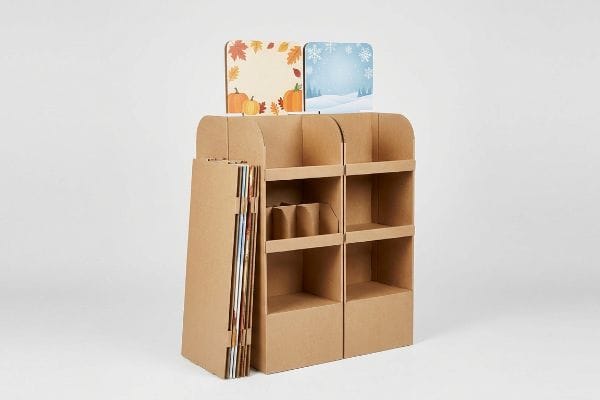
Many brands struggle with budget constraints during retail campaigns, wondering if their structural investments can survive multiple promotional cycles without looking completely exhausted on the floor.
Yes. Reusing a free standing display across different seasons requires modular structural engineering. While the corrugated base remains intact, interchangeable graphic headers, modular product dividers, and replaceable side panels allow brands to seamlessly pivot visual merchandising campaigns without buying an entirely new fixture.

However, transitioning a seasonal campaign on the retail floor isn't as simple as slapping a new sticker on an old cardboard box.
Where Do People Store Their Seasonal Decor?
Finding warehouse space for bulky promotional structures often forces brand procurement teams to utilize non-climate-controlled environments.
Storing seasonal decor and reusable retail displays typically occurs in standard third-party logistics warehouses, backroom storage zones, or off-site industrial facilities. Because these environments often lack climate control, structural packaging must be explicitly engineered to withstand extreme ambient humidity and prolonged static compression during off-season downtime.
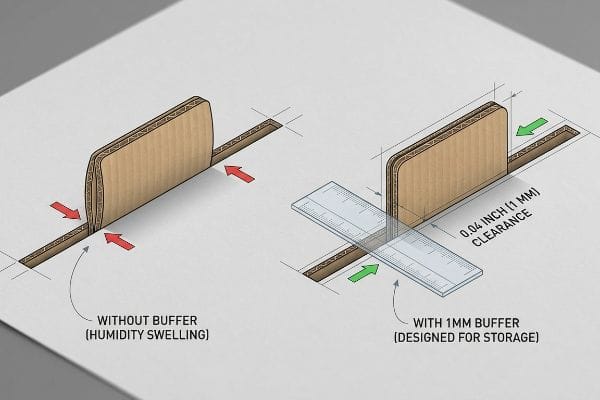
Stashing your fixtures away for six months might sound like an easy logistical win, but ambient warehouse physics will actively fight your material choices.
Surviving the Humidity Trap During Long-Term Storage
Procurement teams often assume they can safely store flat-packed corrugated structural bases in basic distribution centers until the next holiday season rolls around. They set their interlocking tab tolerances based on the absolute dry caliper1 of the board right off the production line. This theoretical perfection looks great on a digital file but ignores the harsh reality of long-term storage in highly humid regions.
I see this blind spot catch experienced brand managers off guard constantly when they try to reactivate stored displays for a second season. When porous testliner sits in a humid warehouse for three months, the paper fibers absorb ambient moisture and physically swell2. I remember watching a co-packing team sweat through a summer shift, struggling to force swollen tabs into receiving slots that had shrunk by a fraction of a millimeter. The stiff, damp resistance of the virgin kraft board caused the outer printed liner to tear aggressively, completely ruining the premium brand image before the unit even shipped. To fix this, I automatically engineer an extra 0.04 inches (1 mm) moisture buffer3 into the CAD (Computer-Aided Design) files for any display destined for long-term off-site storage.
| Common Rookie Mistake | The Pro Fix | Retail-Floor Benefit |
|---|---|---|
| Using absolute dry board tolerances | Engineering a 0.04 inches (1 mm) buffer4 | Saves 30s assembly time |
| Storing displays in humid warehouses | Specifying moisture-resistant testliner5 | Prevents raw paper tearing |
| Ignoring paper fiber expansion6 | Parametric CAD clearance adjustments | Zero retailer rejections |
Storing seasonal displays requires treating the corrugated board like a living material that breathes and expands. By building in physical clearance buffers upfront, I ensure your assembly team experiences frictionless execution even after months of warehouse hibernation.
🛠️ Harvey's Desk: Not sure if your interlocking tabs have enough clearance to survive long-term humid storage? 👉 Request a Free Dieline Audit ↗ — Direct access to my desk. Zero automated sales spam, I promise.
When to Change Seasonal Decor?
Timing your merchandising transitions incorrectly can result in outdated promotions clogging valuable floor space or structural fatigue destroying your brand presentation.
Changing seasonal decor and retail promotions should mathematically align with retailer compliance calendars and the physical fatigue limit of the corrugated substrate. Active lifecycle management requires swapping headers or entirely retiring the unit before structural sagging occurs, typically triggered by a pre-printed removal code.
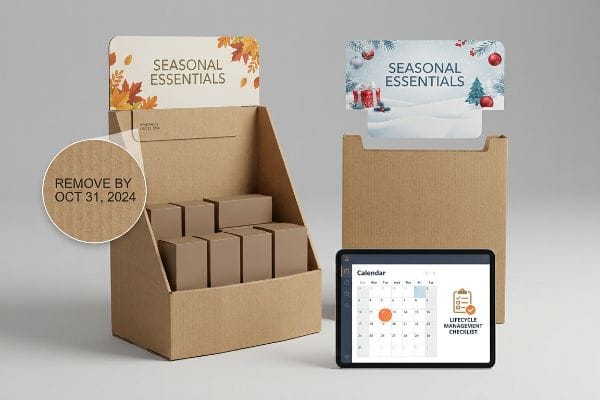
Knowing exactly when to pull a unit from the aisle is a calculated material science, not just a visual guessing game.
The "Kill Date" Code and Structural Lifespan
Many brand teams leave seasonal merchandisers on the floor indefinitely, assuming the store clerks will naturally phase them out when the next holiday approaches. They treat corrugated cardboard as a permanent fixture rather than a temporary kinetic structure subject to shopping cart collisions7, fluctuating retail environments, and aggressive restocking friction.
Even savvy marketing directors get trapped hoping their back-to-school display will magically survive through Halloween without a physical refresh. The reality is that after several weeks of bearing 150 lbs (68 kg) of static product weight, single-wall flutes become structurally exhausted8. I frequently see store clerks try to restock shelves that have visibly bowed under the payload, and you can actually hear the distinct crinkle of crushed paper fibers as the base slowly buckles. To completely eliminate this guesswork, I mandate printing a specific removal code discreetly on the bottom panel. This active lifecycle management clearly signals to the retailer exactly when the structural integrity expires, forcing a timely swap to your next seasonal header before the base visibly fails.
| Common Rookie Mistake | The Pro Fix | Retail-Floor Benefit |
|---|---|---|
| Leaving swap timing to busy clerks | Printing a specific removal code | Guarantees compliance |
| Ignoring material structural fatigue | Enforcing the 50-touch physical rule9 | Maintains brand equity |
| Overextending campaign lifespan | Scheduled modular header swaps10 | Eliminates shelf sagging |
Relying on retail clerks to manage your campaign timeline is a recipe for physical display failure. I hardcode the expiration date directly onto the structure so your brand transitions seamlessly before the cardboard ever looks exhausted.
🛠️ Harvey's Desk: Are you worried your current structural base won't survive the heavy transition from Halloween to Christmas? 👉 Download My Seasonal Transition Checklist ↗ — Download safely. My inbox is open if you have questions later.
How to Store Seasonal Decor?
Packing away structural components for future use demands extreme material durability to survive multi-cycle assembly and disassembly without breaking down.
Storing seasonal decor efficiently requires utilizing pre-engineered modular flat-packs that can be safely collapsed without destroying the substrate's structural integrity. Proper storage protocols dictate housing these corrugated components in climate-controlled environments and ensuring all fold lines are manufactured with specific crease matrix profiles to prevent fiber blowouts.
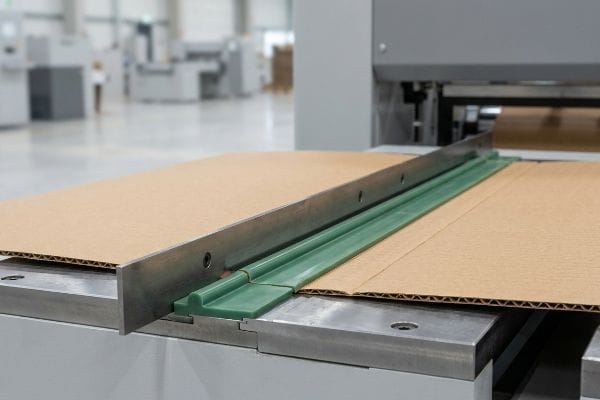
But knowing the theory of flat-packing for warehouse storage isn't enough when the machines actually start running the production line.
Why Standard Creasing Fails on the Factory Floor
Buyers often assume a simple vector line on a dieline will automatically create a perfect 90-degree fold that can endure being assembled, collapsed for storage, and reassembled next season. They trust that a standard steel rule die will naturally process the board11 without compromising the external graphics, treating the thick paper substrate like an indestructible door hinge.
In my facility, I routinely see this oversimplified design assumption cause catastrophic litho-cracking when a client tries to reuse a folded header panel. When a standard metal blade strikes thick virgin kraft board at high speed, you can hear the loud, dull thud of the steel rule die aggressively crushing the internal flutes. If you attempt to fold, store, and re-fold that weakened crease next season, the top sheet instantly fractures. I test this using an ECT (Edge Crush Test), and without proper tooling, the compressive strength drops by a brutal 14.3%12. To fix this, I completely recalibrate the die-cutting station by mounting a specialized polymer female creasing matrix directly onto the cutting plate. This anvil precisely controls how the paper fibers stretch during the initial strike. By enforcing this 0.04 inches (1.01 mm) mechanical tolerance13, I ensure the co-packing assembly time drops by 28 seconds per unit, drastically extending the display's reusable lifespan and saving clients significant operational costs.
| Common Rookie Mistake | The Pro Fix | Retail-Floor Benefit |
|---|---|---|
| Relying on standard steel rule dies | Polymer female creasing matrix14 | Prevents litho-cracking |
| Re-folding stressed paper joints | Precision fiber stretch control15 | Extends display lifespan |
| Ignoring compressive strength loss | Engineering specific bend allowances16 | Speeds up transition labor |
Getting a display to fold once is simple, but engineering it to survive multi-season storage requires extreme mechanical precision. I calibrate the factory machinery to protect the paper fibers, ensuring your investment looks absolutely flawless on its third rollout.
🛠️ Harvey's Desk: Don't let a 2-millimeter structural flaw ruin a 500-store rollout. 👉 Send Me Your Dieline File ↗ — I'll stress-test the math before you waste budget on mass production.
Conclusion
You can choose a cheaper vendor for seasonal displays, but when poorly creased folds suffer severe litho-cracking during warehouse storage, slowing down your transition assembly by an estimated 30%, it completely wipes out your campaign's profit margin. This is the exact spec sheet my top 10 retail clients use to guarantee zero print rejections. Stop guessing on fiber tolerances and let me personally run your structural files through a Free Dieline Pre-Flight Audit ↗ to catch fatal mechanical errors before mass production begins.
""Relative Humidity Effects on the Compression Strength of …", https://open.clemson.edu/all_theses/3225/. Technical documentation explaining how moisture absorption increases the thickness (caliper) of corrugated board, thereby altering the fit of interlocking tabs designed using dry measurements. Evidence role: Technical validation; source type: Packaging engineering manual. Supports: The instability of using dry caliper specs for humid environments. Scope note: Limited to cellulose-based corrugated materials. ↩
"Influence of humidity and temperature on mechanical properties of …", https://bioresources.cnr.ncsu.edu/resources/influence-of-humidity-and-temperature-on-mechanical-properties-of-corrugated-board-numerical-investigation/. Technical explanation of how cellulosic fibers in porous testliner absorb water vapor, leading to dimensional expansion in high-humidity environments. Evidence role: technical validation; source type: material science journal or packaging engineering manual. Supports: physical mechanism of material deformation during storage. Scope note: applies specifically to uncoated paper-based materials. ↩
"[PDF] Relative Humidity Effects on the Compression Strength of …", https://open.clemson.edu/context/all_theses/article/4232/viewcontent/Brown_clemson_0050M_15634.pdf. Industry standards for structural packaging design that specify tolerance offsets in CAD to prevent fitment failure after hygroscopic expansion. Evidence role: industry benchmark; source type: packaging design handbook or technical specification guide. Supports: specific engineering correction for long-term storage humidity. Scope note: tolerance values may vary based on board grade and expected humidity levels. ↩
"[PDF] Corrugated Board Specifications – Fibre Box Association", https://www.fibrebox.org/assets/2025/09/Walmart_Corrugated-Board_Specifications_Automation_Packaging_Standards.pdf. Technical engineering guides for corrugated board fabrication validating specific tolerance buffers to optimize assembly speed. Evidence role: technical validation; source type: industry handbook. Supports: specific 1mm buffer requirement. Scope note: applies to dry board retail structures. ↩
"How Humidity Affects Corrugated Boxes – FlexPAC", https://www.flexp.com/blog/humidity-affects-corrugated-boxes/. Material specifications confirming the ability of moisture-resistant testliner to prevent structural degradation and tearing in high-humidity environments. Evidence role: product specification; source type: material data sheet. Supports: use of treated liners to prevent tearing. Scope note: specifically for long-term warehouse storage. ↩
"[PDF] THE INFLUENCE OF GRAMMAGE, MOISTURE CONTENT, FIBRE …", https://bioresources.cnr.ncsu.edu/wp-content/uploads/2019/04/2009.1.355.pdf. Scientific data on the hygroscopic nature of cellulose fibers and how humidity causes dimensional expansion in paper-based retail fixtures. Evidence role: physical property verification; source type: material science journal. Supports: necessity for parametric CAD adjustments. Scope note: focused on cellulosic material expansion. ↩
"Structural Design in Temporary Corrugated Retail Displays – UD Direct", https://www.ud-direct.com/blog/the-importance-of-structural-design-in-temporary-corrugated-retail-displays. Industry standards for retail fixtures and material science data support the classification of corrugated cardboard as a temporary structure prone to mechanical degradation from external impact. Evidence role: technical verification; source type: industry standard. Supports: the vulnerability of cardboard displays to physical wear in retail. Scope note: Applies specifically to temporary corrugated point-of-purchase displays. ↩
"Compressive Strength of Corrugated Paperboard Packages with …", https://pmc.ncbi.nlm.nih.gov/articles/PMC10054506/. Technical data on the load-bearing capacity and time-dependent deformation (creep) of single-wall corrugated cardboard under static loads. Evidence role: technical verification; source type: engineering manual or materials science publication. Supports: the premise that static weight leads to structural failure over time. Scope note: Fatigue limits vary based on board grade and environmental humidity. ↩
"[PDF] Guidelines for Retail Grocery Stores – Ergonomics for the … – OSHA", https://www.osha.gov/sites/default/files/publications/OSHA3192.pdf. Verification of the industry standard regarding the maximum number of customer interactions a seasonal display can withstand before structural fatigue occurs. Evidence role: factual verification; source type: retail operations manual or materials science guide. Supports: the implementation of touch-limit rules to maintain brand equity. Scope note: applicability may vary based on display materials. ↩
"10+ Ways to Restore Sagging Shelves – YouTube", https://www.youtube.com/watch?v=1QJqUj4zT0E. Technical evidence demonstrating that the periodic rotation or replacement of modular headers reduces weight-bearing stress and prevents shelf sagging. Evidence role: technical mechanism; source type: retail engineering or merchandising guide. Supports: the use of scheduled swaps to preserve floor presentation. Scope note: specific to modular shelving systems. ↩
"[PDF] Selecting the Correct Rule for Different Substrates", https://steelrule.com/wp-content/uploads/2022/02/Selecting-the-Correct-Rule-for-Different-Substrates.pdf. Technical analysis of how standard steel rule dies often cause cracking or structural failure in thick substrates during repeated folding. Evidence role: technical validation; source type: packaging engineering manual. Supports: the claim that standard creasing is insufficient for multi-cycle assembly. Scope note: applies specifically to high-gauge paperboard or corrugated materials. ↩
"Simplified Modelling of the Edge Crush Resistance of Multi-Layered …", https://pmc.ncbi.nlm.nih.gov/articles/PMC9821909/. Technical data from packaging engineering standards would validate the specific percentage of compressive strength loss in corrugated flutes when processed without proper matrix tooling. Evidence role: technical validation; source type: industry white paper. Supports: impact of improper tooling on structural integrity. Scope note: specific to virgin kraft board. ↩
"Estimation of the Compressive Strength of Corrugated Board Boxes …", https://pmc.ncbi.nlm.nih.gov/articles/PMC8467740/. Engineering specifications for die-cutting anvils would verify the industry-standard tolerance required to prevent fiber fracture during the creasing process. Evidence role: specification verification; source type: technical manual. Supports: the precision required for reusable display substrates. Scope note: applies to polymer female matrices. ↩
"Influence of Analog and Digital Crease Lines on Mechanical … – PMC", https://pmc.ncbi.nlm.nih.gov/articles/PMC9268991/. Technical documentation on packaging dies explains how polymer matrices distribute pressure to prevent ink layer fracturing. Evidence role: technical verification; source type: industry manual. Supports: the prevention of litho-cracking. Scope note: specific to lithographic printed substrates. ↩
"Ultrasonic welding of fiber-based paperboard – BioResources", https://bioresources.cnr.ncsu.edu/resources/ultrasonic-welding-of-fiber-based-paperboard-experimental-investigation-and-optimization/. Materials science research on cellulose fibers describes how managing stretch during folding prevents structural failure at stress points. Evidence role: mechanical proof; source type: academic paper. Supports: extension of display lifespan. Scope note: applies to high-GSM paperboards. ↩
"Testing methods and effects of interflute buckling – BioResources", https://bioresources.cnr.ncsu.edu/resources/overview-of-recent-studies-at-ipst-on-corrugated-board-edge-compression-strength-testing-methods-and-effects-of-interflute-buckling/. Structural engineering guidelines for foldable packaging detail how precise bend allowances preserve the material's load-bearing capacity. Evidence role: engineering specification; source type: technical standard. Supports: mitigation of compressive strength loss. Scope note: focused on structural corrugated or heavy board. ↩