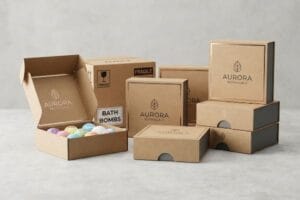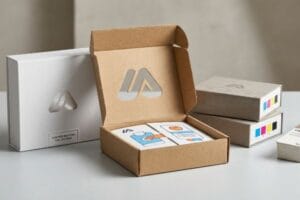
Retail spaces are battlegrounds where brands fight for consumer attention. Winning that shelf space requires more than a good product; it demands a flawlessly executed structural merchandiser.
Yes. Cardboard POP (Point of Purchase) displays are highly suitable for high-traffic retail environments. They offer cost-effective, sustainable, and highly customizable merchandising solutions that actively drive impulse purchases. When engineered with durable corrugated materials, these fixtures easily survive rigorous supply chains and stringent big-box compliance standards worldwide.
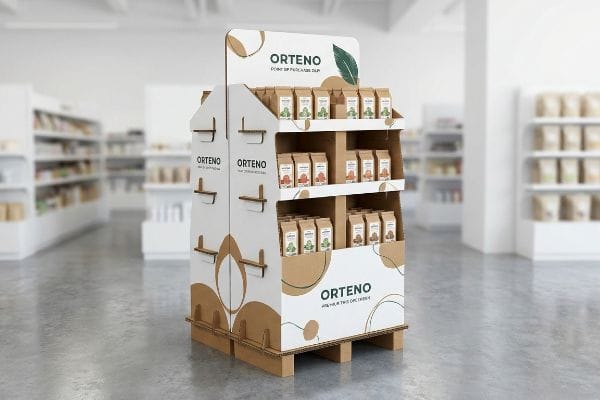
However, transforming a flat piece of paperboard into a high-performing sales engine requires navigating a minefield of structural and logistical hurdles.
What Makes a Good Retail Display?
A visually stunning graphic means nothing if shoppers never stop walking. Effective physical merchandising relies on calculated spatial disruption that forces a psychological pause.
A good retail display strategically intercepts store traffic by utilizing targeted spatial engagement zones. It must visually disrupt the aisle from thirty feet away, communicate immediate brand value at three feet, and guarantee frictionless product accessibility during the final three-inch physical conversion phase on the floor.
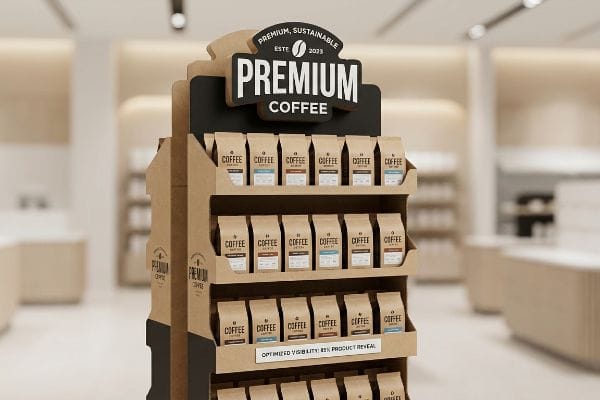
Grabbing attention is only the first step; keeping the display structurally functional under actual retail conditions is where most designs fail.
Why the 3-3-3 Spatial Engagement Strategy Outperforms Flat Graphics
Junior marketing teams frequently design retail merchandisers strictly for up-close viewing on backlit computer monitors. They assume that dense, text-heavy graphics will naturally entice shoppers to stop and read the brand's entire backstory. This ignores the physical reality of how rushed consumers navigate big-box aisles1, resulting in a unit that simply blends into the background.
The core fix is the 3-3-3 Rule2, a foundational concept that divides shopper engagement into thirty feet, three feet, and three inches. A common trap that catches even experienced procurement teams is ignoring the final three-inch tactile zone. I see this firsthand when checking pre-filled trays on the floor: the designer makes the front retaining lip too high, effectively walling off the product. I once watched a frustrated store clerk rip the raw, brown paperboard lip off entirely just so shoppers could reach the item, completely destroying the brand's premium aesthetic with jagged tears. To fix this, I mandate a strict 85% product visibility rule on the front lip, ensuring immediate, frictionless access that protects the corrugated structure.
| Common Rookie Mistake | The Pro Fix | Retail-Floor Benefit |
|---|---|---|
| High retaining lips hiding products | Cutting lip for 85% visibility3 | Increases impulse grab rate |
| Tiny fonts readable only up close | High-contrast 3D die-cut headers | Pulls traffic from 30 feet4 |
| Flat and boxy structural symmetry | Aggressive curvy structural shapes5 | Creates immediate visual disruption |
I never let an unoptimized front lip sabotage a campaign. By mathematically anchoring the shelf ergonomics to the human strike zone, I ensure the structural design actively facilitates the final sale rather than physically blocking the customer's hand.
🛠️ Harvey's Desk: Are your retaining lips physically hiding your best-selling items from the shopper? 👉 Request a Free Visibility Audit ↗ — Direct access to my desk. Zero automated sales spam, I promise.
What Are the Disadvantages of POP Displays?
While paper-based merchandisers are cost-effective, they are inherently vulnerable to environmental physics. Ignoring how raw substrates react to supply chain climates leads to rapid structural degradation.
The main disadvantages of POP displays include their vulnerability to extreme humidity, mechanical transit fatigue, and potential for rapid cosmetic wear. Because corrugated paper fibers actively absorb ambient moisture, improper engineering can lead to severe structural swelling, compromised load capacities, and catastrophic base crushing during extended warehouse storage.
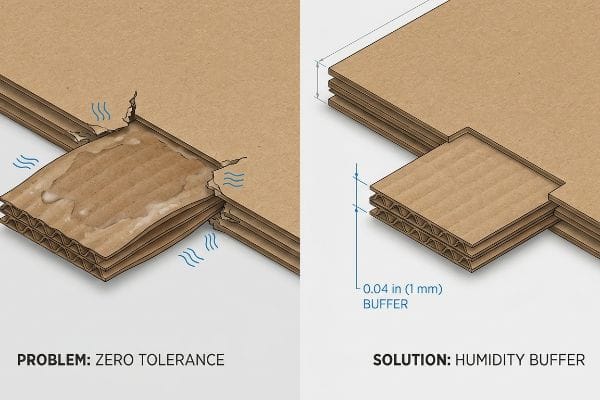
These environmental vulnerabilities aren't dealbreakers, but they require proactive structural math to prevent massive supply chain failures.
Preventing the Moisture Swelling Trap During Ocean Transit
Many brand teams assume that a perfectly calculated dieline in a climate-controlled design office will behave exactly the same way months later in a humid distribution center. They approve tight structural slots based strictly on the absolute dry caliper of the board, completely ignoring the porous nature of recycled paper substrates6.
Corrugated boards act like massive sponges when exposed to ocean freight or high-humidity coastal regions. A common struggle I see happens on the co-packing assembly line when a 32ECT (Edge Crush Test) testliner absorbs moisture and physically swells7. I have heard the terrible tearing sound of the printed top sheet as a frustrated assembly worker tries to force a swollen locking tab into a slot that was mathematically perfect a month ago. To solve this, I engineer a microscopic humidity buffer into my CAD (Computer-Aided Design) files, adding an extra 0.04 inches (1 mm) of clearance8 specifically to the receiving slots to absorb that environmental expansion.
| Common Rookie Mistake | The Pro Fix | Retail-Floor Benefit |
|---|---|---|
| Zero moisture tolerance in slots | Adding a 0.04-inch humidity buffer9 | Prevents tabs from tearing |
| Assuming dry caliper stays constant10 | Engineering for worst-case swelling | Speeds up co-packing assembly |
| Forcing tight swollen parts together | Frictionless male/female locks | Maintains pristine graphic presentation |
I refuse to let atmospheric moisture derail an assembly line. By systematically injecting humidity buffers into every interlocking mechanism, I eliminate the friction that slows down co-packers, ensuring a flawless, zero-tear setup regardless of the warehouse climate.
🛠️ Harvey's Desk: Do your displays tear and buckle when assembled in humid coastal warehouses? 👉 Get Your Dieline Tolerance Checked ↗ — Download safely. My inbox is open if you have questions later.
What Are the Trends in Retail Displays?
The modern merchandising landscape is aggressively pivoting toward absolute sustainability. Retail buyers now demand zero-waste, fully recyclable materials without sacrificing premium structural aesthetics or heavy load capacities.
Current trends in retail displays strongly emphasize hyper-sustainable designs, plastic-free structural components, and high-speed digital printing integration. Brands are actively transitioning to mono-material corrugated solutions, prioritizing fully curbside recyclable structures, water-based inks, and lightweight micro-flutes to align with strict big-box environmental scorecards and consumer eco-demands.
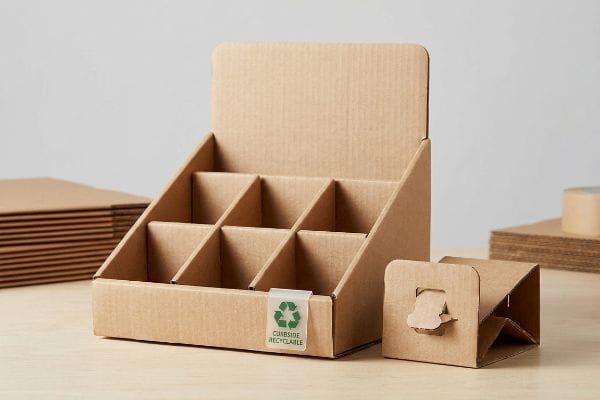
However, blindly chasing sustainability buzzwords often leads brands into chemical traps that ruin their display's actual recyclability.
Navigating the PLA Composting Trap in Sustainable Merchandising
In the rush to meet big-box environmental mandates, brand managers frequently request PLA (Polylactic Acid) bio-plastic films11 for their display laminations. They assume that because this clear coating is marketed as "corn-based," it automatically ensures complete eco-compliance while providing a premium, water-resistant gloss finish12.
This is a subtle greenwashing trap that quietly ruins entire recycling batches. Think of PLA like a tight plastic raincoat over a paper sweater; it repels water beautifully but creates a nightmare at the mill. When standard municipal recycling centers intercept this bio-plastic film during sorting, the solid residue will not break down in the repulping vats13, and I have seen massive OCC (Old Corrugated Containers) bales rejected and sent straight to a landfill. To maintain a shiny finish while staying fully curbside recyclable, I swap the solid bio-film for a liquid aqueous coating, which feels smooth to the touch but dissolves seamlessly in standard paper mill water14 without leaving plastic waste.
| Common Rookie Mistake | The Pro Fix | Retail-Floor Benefit |
|---|---|---|
| Using PLA bio-plastic laminations | Liquid aqueous coating application15 | Guarantees curbside recycling approval |
| Mixing non-soluble plastic clips | Mono-material origami paper locks16 | Passes strict retailer sustainability audits |
| Ignoring repulping realities | Specifying OCC-friendly surface finishes17 | Eliminates landfill diversion fees |
I aggressively audit incoming specifications to strip out hidden plastics. By utilizing liquid aqueous coatings instead of solid bio-films, I guarantee the packaging remains completely frictionless for paper mills while keeping your brand off the retailer's sustainability blacklist.
🛠️ Harvey's Desk: Are hidden bio-plastics secretly disqualifying your current campaign from big-box recycling programs? 👉 Claim Your Material Safety Review ↗ — No forms that trigger endless sales calls. Just pure value.
What Is the Rule of Three in Retail?
Merchandising psychology dictates how consumers process visual information. Utilizing specific numerical groupings drastically influences whether a rushing shopper ignores a shelf or reaches out to grab a product.
The Rule of Three in retail is a visual merchandising strategy that groups products into asymmetrical, odd-numbered clusters. This technique actively creates psychological tension, breaking up monotonous visual grids to immediately draw the human eye, thereby increasing shopper engagement and boosting impulse purchase conversion rates on the floor.
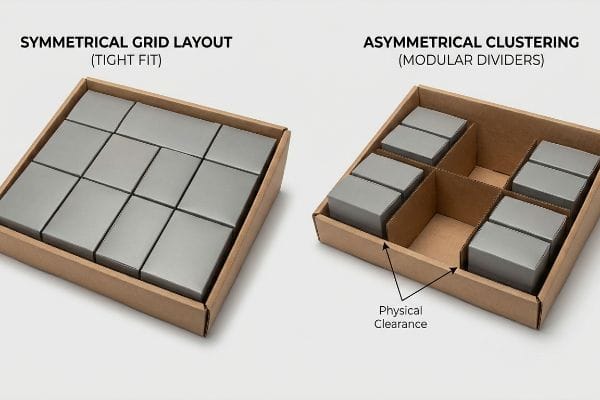
But knowing the theory isn't enough when the machines start running and clerks are tasked with physically loading hundreds of these clustered units.
Why Standard Symmetrical Grid Layouts Fail on the Factory Floor
Junior designers frequently attempt to flat-pack a dense, perfectly symmetrical grid of products onto a single display shelf, assuming maximum physical density naturally yields higher sales18. They engineer tight, edge-to-edge configurations that look incredibly efficient on a computer screen but completely ignore the kinetic reality of rapid in-store restocking and material thickness19.
In my facility, I routinely see symmetrical overcrowding cause massive physical friction during the pre-fill assembly stage. When there is zero lateral clearance between heavy items, the 3-5-7 Asymmetry Rule20 isn't just about visual psychology—it becomes a mechanical necessity. I test this using standard B-flute trays, and if the items are packed too tightly in a flat grid, the stiff resistance of the virgin kraft board21 causes the retaining lip to violently pop open when a clerk forcefully yanks an item out. By engineering dedicated modular dividers to group items into distinct clusters of three or five, I intentionally inject a precise 0.25-inch (6.35 mm) physical clearance gap between groupings. This micro-adjustment drops co-packing assembly time by an estimated 15 seconds per unit, drastically cutting labor fees while completely eliminating raw paperboard tearing on the retail floor.
| Common Rookie Mistake | The Pro Fix | Retail-Floor Benefit |
|---|---|---|
| Edge-to-edge symmetrical packing | 3-5-7 asymmetrical item clustering22 | Eliminates paperboard tearing during restocking |
| Zero lateral clearance gaps | Adding a 0.25-inch physical buffer23 | Cuts co-packing time per tray |
| Flat and unbroken product walls | Modular floating divider systems | Creates visual tension to boost sales24 |
I never let dense packing grids compromise structural integrity. By mathematically enforcing asymmetrical dividers, I bridge the gap between psychological merchandising and factory-floor physics, ensuring the display looks visually compelling while remaining completely frictionless to restock.
🛠️ Harvey's Desk: Are your dense product grids secretly causing expensive micro-tears during the co-packing process? 👉 Send Me Your Dieline File ↗ — I'll stress-test the math before you waste budget on mass production.
Conclusion
You can choose a cheaper vendor, but when that tightly nested tray expands in a humid warehouse and causes the virgin kraft retaining lip to tear during unboxing, you trigger an immediate retailer rejection and weeks of costly manual rework. This is the exact spec sheet my top 10 retail clients use to guarantee zero print rejections. Stop guessing on environmental tolerances and let me personally run your structural files through my Free Dieline Pre-Flight Audit ↗ to catch these fatal friction points before mass production begins.
"Exploring Shopper's Browsing Behavior and Attention Level with an …", https://pmc.ncbi.nlm.nih.gov/articles/PMC6895988/. Analysis of consumer psychology and movement patterns in large-scale retail environments verifies how transit speed affects visual engagement. Evidence role: validation of behavioral claim; source type: retail psychology research. Supports: The necessity for spatial disruption over dense text. Scope note: Applies specifically to high-traffic retail settings. ↩
"AG 1091A: Retail Merchandise Displays in the Frontage Zone", https://www.seattle.gov/transportation/permits-and-services/permits/applicant-guides/ag-1091a. Validation of the 3-3-3 Rule as a recognized industry standard for dividing shopper engagement into specific distance-based zones. Evidence role: conceptual verification; source type: retail design guidelines or merchandising textbooks. Supports: the foundational logic of spatial engagement. Scope note: applies primarily to physical store environments. ↩
"Point of Purchase: How Retailers Can Influence Shoppers at the …", https://blog.intouch.com/posts/points-of-purchase-displays. An authoritative merchandising guide or retail design study explaining how reducing structural obstructions to achieve specific visibility thresholds increases impulse purchases. Evidence role: technical specification; source type: industry standard. Supports: The correlation between product visibility and grab rate. Scope note: Specific percentages may vary by product dimensions. ↩
"Sign Lettering Size Chart and Distance Visibility Guidelines", https://signsny.com/resources/distance-visibility/. Visual merchandising research detailing the effective distance at which high-contrast 3D elements attract consumer attention compared to 2D graphics. Evidence role: metric verification; source type: design guideline. Supports: The effectiveness of 3D headers in capturing long-distance traffic. Scope note: Distance is contingent upon font size and ambient lighting. ↩
"POINT-OF-PURCHASE INSIGHTS: THE IMPACT OF RETAIL POP …", https://www.bcipkg.com/point-of-purchase-insights-the-impact-of-retail-pop-displays-on-consumer-behavior/. Environmental psychology studies on how non-linear, curvilinear forms in retail spaces disrupt automatic walking patterns to create a 'psychological pause'. Evidence role: psychological principle; source type: academic journal. Supports: The use of asymmetrical shapes to create visual disruption. Scope note: Impact varies based on the surrounding store geometry. ↩
"Influence of humidity and temperature on mechanical properties of …", https://bioresources.cnr.ncsu.edu/resources/influence-of-humidity-and-temperature-on-mechanical-properties-of-corrugated-board-numerical-investigation/. Technical explanation of how the cellular structure of recycled paper fibers allows for moisture ingress and swelling. Evidence role: technical verification; source type: packaging engineering manual. Supports: the claim that recycled substrates are susceptible to humidity-driven structural changes. Scope note: relates specifically to corrugated board. ↩
"[PDF] Effects of Moisture content on Box Compression Strength : FBA BCT …", https://renewablebioproducts.gatech.edu/sites/default/files/2025-12/4effects-of-moisture-content-on-box-compression-strength.pdf. A technical specification or material science guide on corrugated cardboard properties would verify the hygroscopic nature of 32ECT boards. Evidence role: technical validation; source type: material science specification. Supports: the structural vulnerability of 32ECT to humidity. Scope note: specific to Edge Crush Test ratings. ↩
"[PDF] Relative Humidity Effects on the Compression Strength of …", https://open.clemson.edu/context/all_theses/article/4232/viewcontent/Brown_clemson_0050M_15634.pdf. Packaging engineering handbooks provide standard tolerances to account for material expansion due to environmental humidity. Evidence role: industry standard verification; source type: engineering manual. Supports: the use of specific clearance buffers in CAD for moisture. Scope note: relates to environmental expansion tolerances. ↩
"How Humidity and Temperature Affect Boxes", https://www.packagingcorp.com/resource-hub/industry-insights/humidity-and-temperature/. Technical validation of specific dimensional tolerances used in corrugated design to compensate for moisture-induced expansion. Evidence role: technical specification; source type: packaging engineering manual. Supports: the use of a specific measurement to prevent structural failure. Scope note: specific to paper-based substrates. ↩
""Relative Humidity Effects on the Compression Strength of …", https://open.clemson.edu/all_theses/3225/. Scientific explanation of how hygroscopic materials like paperboard experience dimensional changes in thickness (caliper) due to moisture absorption. Evidence role: material science principle; source type: technical datasheet or material study. Supports: the claim that dry measurements are unreliable in high-humidity transit. Scope note: applies to cellulose-based substrates. ↩
"Comparison of Properties of Poly(Lactic Acid) Composites Prepared …", https://pmc.ncbi.nlm.nih.gov/articles/PMC9224457/. Verification of PLA's chemical composition as a corn-derived polymer used in sustainable packaging coatings. Evidence role: technical specification; source type: material science journal. Supports: the identification of PLA as a bio-plastic. Scope note: Focus on polymer origins. ↩
"Beyond fossil plastics: next-generation PLA-based bio-packaging for …", https://pmc.ncbi.nlm.nih.gov/articles/PMC13001162/. Technical validation of the hydrophobic properties and optical clarity of PLA films for industrial lamination. Evidence role: performance metric; source type: technical data sheet. Supports: the claim that PLA provides a premium, protective finish. Scope note: Industrial application context. ↩
"Study of PLA pre-treatment, enzymatic and model-compost … – PMC", https://pmc.ncbi.nlm.nih.gov/articles/PMC10110681/. Technical documentation confirming that PLA residues do not decompose during the mechanical pulping process in paper mills. Evidence role: Technical verification; source type: Industrial recycling report. Supports: The claim that bio-plastics interfere with paper recycling. Scope note: Specifically regarding municipal paper recycling streams. ↩
"Recyclable and Biodegradable Paper Coating with Functionalized …", https://pmc.ncbi.nlm.nih.gov/articles/PMC11948148/. Comparative analysis of aqueous coatings and bio-plastic films demonstrating the repulpability of aqueous dispersions. Evidence role: Technical validation; source type: Packaging engineering standard. Supports: The claim that aqueous coatings are a viable recyclable alternative to PLA. Scope note: Standard municipal pulping conditions. ↩
"What is Aqueous Coating for Printing and Packaging? – PopDisplay", https://popdisplay.me/what-is-aqueous-coating-for-printing-and-packaging/. Verification that aqueous coatings are compatible with standard paper recycling streams unlike PLA bio-plastics. Evidence role: technical validation; source type: waste management guideline. Supports: the claim that aqueous coatings enable curbside recycling. Scope note: Recycling capabilities may vary by municipal facility. ↩
"Boost sustainability with mono-material packaging | Business – Shell", https://www.shell.us/business/sectors/shell-polymers/resources-and-insights/boost-sustainability-with-mono-material-packaging.html. Evidence that eliminating mixed-material components in favor of mono-material designs satisfies retail sustainability compliance. Evidence role: compliance verification; source type: industry sustainability standard. Supports: the claim that origami locks pass sustainability audits. Scope note: Focuses on the removal of non-soluble plastic contaminants. ↩
"[PDF] Contamination Charges and Removal of Diversion Discounts Protocol", https://media.api.sf.gov/documents/Contamination_Protocol_2023.pdf. Proof that surface finishes compatible with Old Corrugated Containers (OCC) facilitate repulping and reduce waste disposal costs. Evidence role: material specification; source type: recycling industry report. Supports: the claim that OCC-friendly finishes eliminate landfill diversion fees. Scope note: Applies specifically to corrugated cardboard recycling streams. ↩
"Developing a conversion rate optimization framework for digital …", https://pmc.ncbi.nlm.nih.gov/articles/PMC8864459/. Research into the impact of product density on shopper behavior and the phenomenon of choice overload. Evidence role: empirical study; source type: consumer psychology research. Supports: the debunking of the density-to-sales correlation. Scope note: effects vary by product type. ↩
"Pop Displays – Deluxe Packaging", https://www.deluxepkg.com/custom-packaging/pop-displays/. Industry standards for display engineering regarding restocking ergonomics and substrate tolerances. Evidence role: technical specification; source type: manufacturing guideline. Supports: the claim that high-density grids impede store operations. Scope note: applies to cardboard and plastic retail displays. ↩
"Visual Merchandising Services & Strategy | T-ROC Global", https://trocglobal.com/visual-merchandising/. An industry-standard retail merchandising guide provides a technical definition of the 3-5-7 rule for optimizing product groupings. Evidence role: Definitional; source type: Professional handbook; Supports: The existence and utility of specific odd-numbered grouping rules; Scope note: Often grouped under the general 'Rule of Three'in broader contexts. ↩
"[PDF] Investigating the mechanical properties of paperboard packaging …", https://repository.rit.edu/cgi/viewcontent.cgi?article=1066&context=japr. Packaging engineering literature describes the modulus of elasticity and structural rigidity of virgin kraft paperboard and its impact on assembly tolerances. Evidence role: Technical validation; source type: Material specification sheet; Supports: The mechanical reason for retaining lip failure during high-friction extraction; Scope note: Effects vary based on board grade and B-flute thickness. ↩
"The Rule of Three in Visual Merchandising: A Simple yet Effective …", https://www.linkedin.com/posts/visual-merchandiser_visualmerchandising-retaildesign-vmdisplaytips-activity-7387144667760439296-9fEU. An industry guide on visual merchandising provides the rationale for odd-numbered clustering to prevent visual stagnation and increase engagement. Evidence role: technical standard; source type: professional trade publication. Supports: effectiveness of asymmetrical groupings. Scope note: applicable to shelf-edge displays. ↩
"Retail Packaging & Display Solutions – International Paper", https://www.internationalpaper.com/packaging/retail-packaging-and-display. Logistics specifications for tray packing identify the ideal gap to prevent friction and product damage during restocking. Evidence role: technical specification; source type: industrial engineering manual. Supports: reduction in co-packing time and product damage. Scope note: specific to cardboard tray layouts. ↩
"The Psychology Behind the Sale: Our Visual Merchandising Strategies", https://mcintyredisplays.com/blog/effective-visual-merchandising-strategies/. Psychological studies on consumer behavior explain how asymmetry and visual tension capture attention more effectively than perfect symmetry. Evidence role: theoretical framework; source type: academic journal on consumer psychology. Supports: the link between modular displays and sales growth. Scope note: general merchandising psychology. ↩