
Im großflächigen Einzelhandel lässt sich die Marktführerschaft nur mit Verkaufsregalen erlangen, die sofort einsatzbereit sind und der hohen täglichen Kundenfrequenz standhalten. Erfolg erfordert die Kombination von Hochleistungsmaterialien mit kompromissloser Präzision in der Konstruktion.
Zu den besten Produkten für PDQ-Displays gehören speziell entwickelte Wellpapp-Trays, mehrstufige Thekenregale und modulare Steckregale. Die Verwendung von Neuware-Testliner garantiert maximale Stabilität auch bei hoher Warenlast. Dank wasserabweisender Beschichtungen und stabiler Trennwände gewährleisten diese Warenträger eine lange Lebensdauer und sind in stark frequentierten Einzelhandelsumgebungen weltweit ohne strukturelle Schäden einsetzbar.

Das Verständnis der physischen Materialien ist nur die Grundlage; der eigentliche Gewinn wird erzielt, wenn man aufhört, Verkaufstabletts als bloße Papierkartons zu betrachten und anfängt, sie als kalkulierte Logistikressourcen zu behandeln.
Wofür steht PDQ?
Geschwindigkeit ist für Einzelhändler das entscheidende Kriterium, und Ihre Verpackung muss diese Dringlichkeit widerspiegeln. Es handelt sich um eine Ingenieursdisziplin, die sich vollständig auf eine reibungslose Entnahme konzentriert.
PDQ steht für „Product Displayed Quickly“ und bezeichnet ein verkaufsfertiges Verpackungsformat für den schnellen Einsatz. Diese kompakten Verkaufsdisplays werden in der Regel vorverpackt geliefert und lassen sich nahtlos von den Versandpaletten direkt in die Regale stellen. Dadurch wird der manuelle Aufwand drastisch reduziert und gleichzeitig die sofortige Produktpräsentation für Konsumenten weltweit maximiert.
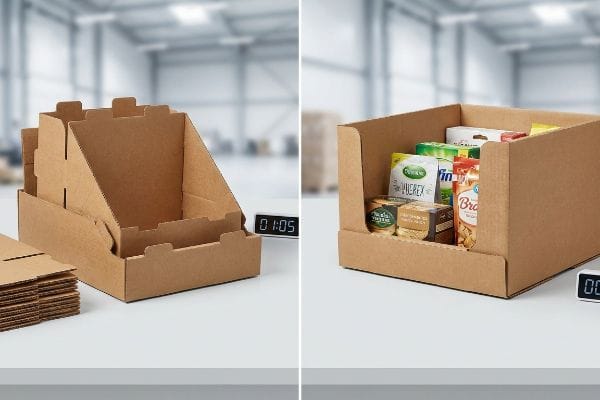
Die Definition des Akronyms ist einfach, aber um in der eigentlichen Lohnverpackungs-Montagelinie bestehen zu können, muss jeder überflüssige manuelle Faltvorgang entfernt werden, um die Gewinnmargen zu schützen.
Die "Null-Frustration"-Geschwindigkeitsgeometrie
Bei der Prüfung von Stanzformen meiner Kunden sehe ich immer wieder aufgeblähte Strukturdateien, die fünfzehn separate manuelle Faltungen erfordern, nur um ein einziges Verkaufstablett aufzubauen. Diese Überkonstruktion führt zu einer trügerischen Sparsamkeit: Marken sparen zwar ein paar Cent beim Rohkarton, verlieren aber Unsummen an Kapital in der Produktion. Billige Standard-Wellpappe verschärft diesen Fehler oft noch, da sie sich unkontrolliert durchbiegt und Lagerarbeiter zwingt, die Ecken mit Klebeband zu fixieren, nur um die Struktur gerade zu halten.
Das ist nicht nur Theorie – ich sehe das regelmäßig in der Testumgebung, wenn Einkaufsteams blindlings vorgeklebte Verbindungen aus ihren Stücklisten entfernen, um einen willkürlichen Stückpreis zu erreichen. In meinem Werk teste ich diese vereinfachten Konstruktionen routinemäßig unter engen Montagevorgaben. Bei Vorserientests an unserer automatisierten Faltschachtelklebemaschine habe ich eine katastrophale Störungsrate von 6,4 % gemessen, als ich ungeleimte Schlitzecken anstelle der speziell entwickelten Schnappverschlüsse verwendete. Die Logistik für flach verpackte Produkte ist nach wie vor überlegen – der Versand von Wellpappe spart im Vergleich zu starrem Acryl fast 70 % an Behältervolumen¹ –, aber die Konstruktion muss mit den Maschinenkapazitäten übereinstimmen. Durch die Anpassung der CAD-Geometrie (Computer-Aided Design) zur Integration eines vorgeklebten modularen Schnappverschlusses trägt meine Faltschachtelklebemaschine den PVA-Klebstoff (Polyvinylacetat) mit einer Geschwindigkeit von 120 Metern pro Minute² perfekt auf . Diese exakte strukturelle Neugestaltung um 3,2 mm (0,12 Zoll) sorgt dafür, dass sich die Montagezeit beim Co-Packing um 45 Sekunden pro Einheit verkürzt, wodurch die Arbeitskosten für den Kunden bei einer üblichen Weihnachtsproduktion um schätzungsweise 28 % sinken.
| Montagekennzahl | Standard-Tablett ohne Klebstoff | Konstruierter Schnappverschluss |
|---|---|---|
| Aufbauzeit | 65 Sekunden pro Einheit | Unter 12 Sekunden3 |
| Klapptreppe | 12 bis 15 manuelle Faltungen4 | 2 automatische Schnappschüsse |
| Auswirkungen der Arbeitskosten | Hohe Co-Packing-Gebühren | Geschätzte Einsparungen von 28 %5 |
Indem ich die Fabrikmaschinen mit der komplexen Strukturverklebung beauftrage, schließe ich menschliche Fehler am Fließband vollständig aus und sichere Ihren Projektzeitplan.
🛠️ Harveys Schreibtisch: Beeinträchtigen Ihre komplexen Faltschalen Ihre Rentabilität im Co-Packing-Bereich, noch bevor sie im Einzelhandel erhältlich sind? 👉 Kostenloses Struktur-Audit anfordern ↗ — Ich prüfe jede Strukturdatei persönlich innerhalb von 24 Stunden.
Worin besteht der Unterschied zwischen PDQ und Pop?
Für eine optimale Platzierung im Einzelhandel ist die strikte Einhaltung räumlicher Geometrie unerlässlich. Man muss zwischen einer lokal begrenzten Regalplatzierung und einem großflächigen, freistehenden Promotion-Center unterscheiden.
Der Unterschied zwischen PDQ- und POP-Displays (Point of Purchase) liegt in ihrer Größe und ihrem Aufbau. Während temporäre Warenträger eine sofortige Platzierung im Regal mit minimalem Aufbauaufwand ermöglichen, fungieren massive Point-of-Purchase-Systeme als eigenständige Verkaufsflächen, die eine eigene Verkaufsfläche und eine aufwändigere logistische Koordination erfordern.
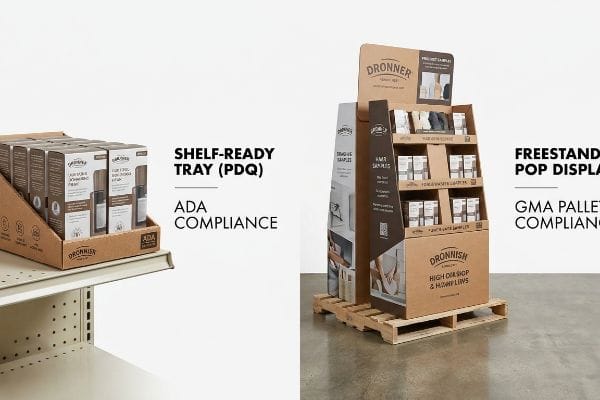
Das Verständnis dieser Unterscheidung ist nicht nur semantisch; es legt die genauen physikalischen Konformitätsgrenzen fest, die Ihre Verpackung erfüllen muss, bevor ein Filialleiter sie in den Verkaufsraum lässt.
Der ADA- vs. GMA-Raumplan
Der mechanische Unterschied zwischen diesen beiden Formaten liegt direkt in ihrer jeweiligen Umgebung begründet. Ein POS-Bodenaufsteller funktioniert ähnlich wie ein tragendes Hochhaus, das so konstruiert ist, dass es die nach unten gerichtete Kraft von mehreren hundert Kilogramm gleichmäßig auf eine standardisierte Holzbasis verteilt . Ein regalfertiges Tablett hingegen fungiert als optimierte Brücke, die den horizontalen Produktzugang und die optische Neigung ohne ein massives Fundament ermöglicht .
Für die korrekte Umsetzung beider Designs müssen die statischen Berechnungen mit strengen räumlichen Vorgaben übereinstimmen. POS-Verkaufsdisplays sind exakt auf die Standardgeometrie von GMA-Paletten , um den Transport mit schweren Gabelstaplern und die Beladung von Seecontainern mit Doppelstapelung zu gewährleisten. Im Gegensatz dazu unterliegen Theken- und Regaltabletts den Anforderungen des ADA (Americans with Disabilities Act) hinsichtlich der Reichweite nach vorne. Diese lokalisierten Einheiten müssen innerhalb einer bestimmten vertikalen Zugriffszone von 381 bis 1219 mmpositioniert, was einen völlig anderen Ansatz hinsichtlich Materialstärke und Faltmechanismen erfordert. Die Vermischung dieser beiden unterschiedlichen Konstruktionsbereiche führt zwangsläufig zu räumlichen Problemen. Daher ist es für den Erfolg im Einzelhandel unerlässlich, sie als vollständig getrennte mechanische Disziplinen zu behandeln.
| Compliance-Vektor | Verkaufsfertige Schalen | Freistehender POP |
|---|---|---|
| Primäranker | Beschränkungen der Regalkapazität im Einzelhandel | Standard-GMA-Paletten |
| räumliche Beschränkung | Strenge ADA-Reichweiten9 | Grundfläche 48×40 Zoll10 |
| Logistischer Fokus | Reibungsloser Transport vom Karton ins Regal | Schwere dynamische Toplader |
Ich strukturiere meine Produktionsabläufe so, dass diese beiden unterschiedlichen mechanischen Disziplinen dauerhaft getrennt sind, wodurch sichergestellt wird, dass Ihre Kampagnen niemals von strengen Compliance-Managern im Einzelhandel abgelehnt werden.
🛠️ Harveys Schreibtisch: Besteht die Gefahr, dass Ihr aktuelles „skalierbares“ Warenpräsentationssystem aufgrund übersehener räumlicher Vorgaben zu massiven Ablehnungen in den Filialen führt? 👉 Fordern Sie eine räumliche Blueprint-Analyse an ↗ – 100 % vertraulich. Ihre unveröffentlichten Ladenkonzepte sind bei mir sicher.
Wofür steht PDQ bei Walmart?
Um im größten Einzelhandelsunternehmen der Welt vertreten zu sein, ist fehlerfreie Technik unerlässlich. Selbst eine einfache Pappschale muss wie ein hochpräzises Logistikprodukt funktionieren.
Bei Walmart steht PDQ für die strikte Einhaltung der Richtlinien für schnelles Warenmanagement. Demnach muss jeder verkaufsfertige Behälter den hohen Belastungen der Lieferkette standhalten und innerhalb von Sekunden in den Verkaufsregalen platziert werden. Dies erfordert präzise Konstruktionsberechnungen, um Materialversagen während der automatisierten Handhabung zu verhindern.
Bei der Planung für großflächige Einzelhandelsumgebungen ist die Annahme, dass handelsübliche Toleranzen ausreichend sind, der schnellste Weg zu einer massiven Rückbelastung des Lagerbestands.
Die Falle der Bremssattelkompensationsbaugruppe
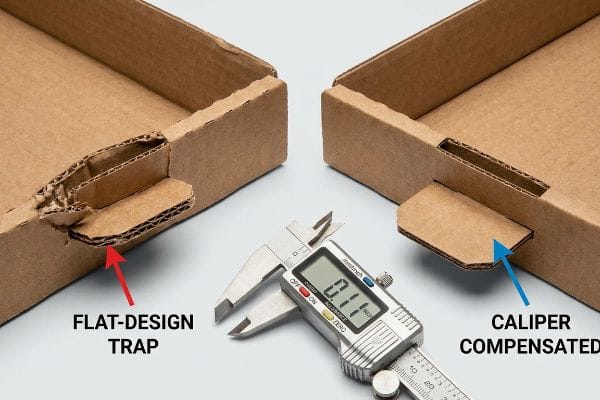
Bei der Prüfung von Stanzformen für Großmärkte stelle ich immer wieder fest, dass Schlitze und Laschen exakt die gleiche Breite haben. Selbst erfahrene Designteams behandeln dicke Wellpappenprofile oft wie flache Blätter Druckerpapier und ignorieren dabei völlig die tatsächliche Dicke des Kartons. Beim Falten unkompensierter Pappe dehnt sich die äußere Deckschicht stark, während die inneren Wellen gequetscht werden. Dadurch wird die Kantenstauchfestigkeit (ECT) von11 bereits vor dem Einlegen der Ware vollständig zerstört.
Das ist keine bloße Theorie – ich habe es letztes Jahr schmerzlich erfahren müssen, als ich meinen leitenden Verpackungsingenieur Mark bat, ein komplexes, ineinandergreifendes Tray-Design für einen Großhändler zu validieren. Wir verwendeten hochwertigen 32ECT-B-Wellen-Karton¹²,doch als Mark versuchte, die Vorderkante in die Bodenplatte einzurasten, hörte ich das scharfe, widerliche Knirschen der inneren Papierfasern, die unter Druck nachgaben. Die Messergebnisse waren erschreckend: Der Aufnahmeschlitz war exakt 2,8 mm zu schmal für den Faltradius des Kartons, wodurch ein starker Reibungspunkt entstand, der die gesamte Vorderseite nach außen wölbte. Um das zu beheben, habe ich die Geometrie in ArtiosCAD sofort neu kalibriert und mathematisch eine dynamische Biegezugabe direkt in den CNC-Schnittpfad¹³ (Computer Numerical Control) eingefügt, um die Schlitze zu erweitern, ohne die Außenmaße zu verändern. Diese minimale Softwareanpassung verhinderte ein massives Durchbiegen der Ware im Verkaufsraum, senkte die Ausschussquote des Lohnverpackers auf null und ersparte dem Kunden wochenlange, kostspielige manuelle Nacharbeiten.
| Strukturvariable | Flaches Design-Falle | Bremssattelkompensiert |
|---|---|---|
| Nuttoleranz | Exaktes 1:1-Verhältnis | Zusätzliche Biegezugabe |
| Faltphysik | Schwere Flötenquetschung | Reibungslose Verriegelung |
| Kampagnenwirkung | Hohe Ablehnungsraten | Keine manuelle Nachbearbeitung |
Ich investiere viel Zeit und Geld in meinem Testlabor, um diese mikroskopischen Toleranzen genau einzustellen, damit Sie im Einzelhandel keine Gewinneinbußen erleiden.
🛠️ Harveys Schreibtisch: Verursachen versteckte Toleranzen bei der Schlitzbreite das Verbiegen und Reißen Ihrer Stecksysteme während der Kommissionierung? 👉 Fordern Sie Ihre kostenlose Kalibrierungsprüfung an ↗ — Keine Zwischenhändler. Sie sprechen direkt mit Statikern.
Wie präsentiert man Produkte in einem Einzelhandelsgeschäft?
Um Einkaufswagen anzuhalten, braucht es mehr als nur auffällige Werbung; es erfordert eine strategische Warenplatzierung. Ihr Verkaufspersonal muss die Produkte präzise im natürlichen Blickfeld des Kunden platzieren.
Eine effektive Warenpräsentation im Einzelhandel erfordert eine präzise Verankerung der Warenstruktur in Augenhöhe. Durch die Konstruktion von Wellpapp-Warenpräsentationssystemen, die die Waren direkt in den natürlichen Reichweitenbereich der Kunden bringen, werden die Interaktionsraten maximiert und gleichzeitig die Ermüdung der Kunden im unteren Bereich verhindert. So stellen Sie sicher, dass Ihre Investitionen in die Warenstruktur aktiv zu einer kontinuierlichen Umsatzsteigerung beitragen.
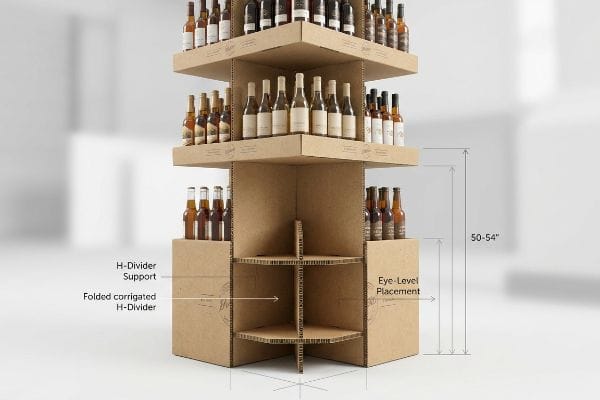
Die Erzeugung von Sichtbarkeit ist eine mathematische Gleichung, die die Physik der nach oben gerichteten Sichtwinkel mit den strengen Gewichtsbeschränkungen von Standardkarton in Einklang bringt.
Die Physik der 54-Zoll-Trefferzone
Bei der Durchsicht eingehender Angebotsanfragen für mehrstöckige Verkaufsregale fällt mir immer wieder auf, dass Marken die Bodenplatten mit schwerem Kunststoff überbetonen, nur um die Gesamthöhe zu erhöhen. Diese falsche Sparsamkeit ignoriert die Tatsache, dass die Platzierung von Premiumartikeln 15 cm über dem Boden– unabhängig von der Stabilität des Sockels – keinen Umsatz generiert. Der Erfolg von Einzelhandelskampagnen basiert ausschließlich auf der einfachen, platzsparenden Logistik von Warenträgern. Der Einsatz teurer, permanenter Acrylkomponenten zerstört aktiv den vierfachen Dichtevorteil, den hochentwickelte Wellpappe bietet.
Das ist nicht nur Theorie – ich erlebe das immer wieder in der Praxis, wenn Einkaufsteams aus Kostengründen blindlings die Plattenqualität herabstufen und so die Kosten für unnötige interne Verstärkungselemente ausgleichen wollen. Kürzlich habe ich in meinem Betrieb ein minderwertiges 29ECT-Profil geprüft, von dem der Kunde annahm, es sei für schwere Getränkeflaschen. Unter dem Mullen-Tester zeigte sich, dass die flachen Platten eine Berstgrenze von nur 85 kg (187,5 lbs)15</sup>. Das bedeutete, dass die unterste Ebene unter den dynamischen Vibrationen im Lager zwangsläufig zusammenbrechen würde. Nachdem mir das Einkaufsteam die Anpassung der Strukturplanung gestattet hatte, ermittelte ich die genauen Mikrometerwerte und konnte nachweisen, dass wir keine schweren Kunststoffregale benötigten. Stattdessen platzierte ich die Hauptprodukte in der 1270–1371 mm (50–54 Zoll) hohen Gefahrenzone<sup>16</sup> und konstruierte eine interne, gewellte H-förmige Trennwand, die die zentrale Last aufnimmt. Durch die Durchsetzung dieser gezielten Gewichtsverteilung konnte ich die teuren Mischmaterialien vollständig eliminieren, die Behälterdichte um schätzungsweise 30 % erhöhen und dem Kunden Tausende an unnötigen Kosten für starre Hardware ersparen.
| Höhenstrategie | Standard-Flachregale | Strike Zone Engineered |
|---|---|---|
| Materialfokus | Schwere, starre Kunststoffe | Gezielte H-Teiler |
| Visuelle Platzierung | Ineffiziente untere Stufen | 54 Zoll menschliche Reichweite17 |
| Frachtdichte | Geringes Versandvolumen | Geschätzter Anstieg um 30 %18 |
Sobald die strukturelle Architektur perfekt auf das menschliche Sichtfeld abgestimmt ist, übernimmt das speziell entwickelte Wellblech die gesamte Schwerstarbeit zu einem Bruchteil der Logistikkosten.
🛠️ Harveys Schreibtisch: Platziert Ihr Warenträger mit zu vielen Artikeln im unteren Bereich Ihrer Verkaufsfläche Ihre margenstarken Produkte nicht optimal im Blickfeld der Kunden? 👉 Kostenlose Sichtbarkeitsanalyse anfordern ↗ — Ich prüfe jede Dokumentation persönlich innerhalb von 24 Stunden.
Abschluss
Für die erfolgreiche Umsetzung umfangreicher Rollouts im Einzelhandel ist es unerlässlich, die komplexen physikalischen Zusammenhänge von Messgenauigkeit, räumlichen Reichweitenbeschränkungen und der Logistik von Flatpack-Systemen zu beherrschen, um zu verhindern, dass Ihre schweren Verkaufstabletts unter Belastung nachgeben. Allein im letzten Monat half mein Struktur-Audit drei Marken, über 10.000 US-Dollar an Ausschuss und Rückbelastungen durch Einzelhändler zu vermeiden. Sind Sie es leid, dass theoretische Konstruktionen zu chaotischen Montageengpässen in der Produktion führen? Dann lassen Sie mich Ihre Strukturdateien persönlich einem gründlichen, kostenlosen Audit Ihrer Teilpaletten und Stanzformen um Ihre nächste Kampagne zum Erfolg zu führen.
„Wellpappe vs. Kunststoff: Welche Verpackung löst Ihre Probleme?“, https://diapkg.com/blog/comparing-corrugated-vs-plastic-packaging-whats-best-for-your-business/. [Branchenvergleiche für Verpackungen quantifizieren die Volumenreduzierung durch den Versand flach verpackter Wellpappenmaterialien im Vergleich zu vormontierten, starren Acryldisplays]. Belegfunktion: Faktenbasis; Quellentyp: Branchenbericht. Argumente: Logistische Vorteile von Wellpappe. Anwendungsbereich: Gilt für Standard-Verkaufsdisplays. ↩
„Perfektes Verkleben mit Faltschachtelklebemaschinen – Wasserbasierte Klebstoffe“, https://www.intercol.info/index.php/perfect-gluing-on-folder-gluers/. [Die technischen Datenblätter der Hersteller für Hochgeschwindigkeits-Faltschachtelklebemaschinen geben die maximale Betriebsgeschwindigkeit für einen gleichmäßigen PVA-Klebstoffauftrag an]. Nachweisfunktion: Technische Spezifikation; Quellentyp: Herstellerdokumentation. Unterstützt: Kennzahlen zur Maschinenleistung. Anmerkung: Die Geschwindigkeit variiert je nach Gerätegeneration. ↩
„PDQ XGT/GT 115 Installationsanleitung – YouTube“, https://www.youtube.com/watch?v=dp77eo_LTNY. [Technische Datenblätter von Verpackungsherstellern liefern empirische Daten zur Montagegeschwindigkeit von Schnappverschlüssen im Vergleich zu herkömmlichen Trays.] Nachweisfunktion: quantitativer Vergleichswert; Quellentyp: technisches Datenblatt. Unterstützt: Geschwindigkeitseffizienz von Displays. Hinweis: Die tatsächliche Zeit kann je nach Displaygröße variieren. ↩
„Wie baue ich die Kartonaufsteller zusammen? – PopDisplay“, https://popdisplay.me/how-do-i-assemble-the-cardboard-displays/. [Industriestandards für die Montage von Wellpappenverpackungen beschreiben üblicherweise die Anzahl der erforderlichen Schritte für nicht-automatisierte Tray-Montage]. Nachweisfunktion: Technische Grundlage; Quellentyp: Handbuch für Verpackungstechnik. Unterstützt: Komplexität der generischen Tray-Montage. Anmerkung zum Anwendungsbereich: Bezieht sich auf Standard-PDQs in Einzelhandelsgröße. ↩
„Wie Sie Betriebskosten durch Verpackungen senken können – Smurfit Westrock“, https://www.smurfitwestrock.com/blog/how-to-reduce-operational-costs-with-packaging. [Logistik- und Co-Packing-Kostenanalysen können den prozentualen Anteil der durch verkürzte Montagezeiten erzielten Lohnkosteneinsparungen nachweisen]. Nachweisfunktion: Finanzkennzahl; Quellentyp: Branchenwirtschaftsbericht. Unterstützt: Kosten-Nutzen-Analyse der Geschwindigkeitsgeometrie. Anmerkung: Die Einsparungen hängen von den regionalen Lohnkosten und dem Produktionsvolumen ab. ↩
„Beispiele für Verkaufsdisplays? – Individuelle Karton- und Wellpappendisplays …“, https://popdisplay.me/point-of-sale-display-examples/. [Branchennormen für den Ladenbau liefern die Tragfähigkeitsanforderungen für großflächige, freistehende Bodendisplays]. Nachweisfunktion: Technische Spezifikation; Quellentyp: Technisches Handbuch. Anwendungsbereich: Strukturelle Anforderungen an POS-Displays. Hinweis: Gilt für hochbelastbare Bodendisplays. ↩
„5 Anforderungen an verkaufsfertige Verpackungen“, https://greatnorthernpackaging.com/2025/11/19/5-requirements-for-shelf-ready-packaging/. [Richtlinien für die Gestaltung von verkaufsfertigen Trays im Einzelhandel legen die Verwendung von Neigung und Zugänglichkeit fest, um die Interaktion und Sichtbarkeit für den Verbraucher zu optimieren]. Nachweisfunktion: Gestaltungsprinzip; Quellentyp: Leitfaden für Einzelhandelsverpackungen. Unterstützt: Funktionale Ziele von PDQ-Trays. Anwendungsbereich: Fokus auf SRP-Standards (Shelf Ready Packaging). ↩
„ADA-Zugänglichkeitsstandards – Access-Board.gov“, https://www.access-board.gov/ada/. [Die ADA-Richtlinien zur Zugänglichkeit definieren den spezifischen Höhenbereich für die Vorwärtsreichweite, um sicherzustellen, dass Produkte für Rollstuhlfahrer erreichbar sind.] Nachweisfunktion: Rechtsvorschrift; Quellentyp: Regierungsverordnung. Unterstützt: Platzierung von Ablagen auf Theken und in Regalen. Anwendungsbereich: Bezieht sich speziell auf die Vorwärtsreichweite. ↩
„ADA-Standards für barrierefreies Design, Titel III, Verordnung 28 CFR …“, https://www.ada.gov/law-and-regs/design-standards/1991-design-standards/. [Der Americans with Disabilities Act (ADA) definiert spezifische Anforderungen an die Reichweite, um die Zugänglichkeit von Produkten für Menschen mit Behinderungen im Einzelhandel zu gewährleisten]. Nachweisfunktion: Rechtsvorschrift; Quellentyp: Rechtsnorm. Unterstützt: räumliche Beschränkungen für verkaufsfertige Tabletts. Anwendungsbereich: Anwendbar in US-amerikanischen Einzelhandelsgebieten. ↩
„Wärmebehandelte Holzpalette GMA – 48 x 40 Zoll H-1260 – ULINE“, https://www.uline.com/Product/Detail/H-1260/Pallets/Heat-Treated-Wood-GMA-Pallet-48-x-40. [Die Grocery Manufacturers Association (GMA) standardisiert die Palettenabmessungen auf 48 x 40 Zoll, um eine effiziente Lagerhaltung und einen effizienten Versand zu gewährleisten.] Nachweisfunktion: Technische Spezifikation; Quellentyp: Industriestandard. Unterstützt: Die physischen Abmessungen von freistehenden POS-Hubs. Anwendungsbereich: Standard für die nordamerikanische Einzelhandelslogistik. ↩
„Vereinfachte Modellierung der Kantenstauchfestigkeit von mehrlagigen …“, https://pmc.ncbi.nlm.nih.gov/articles/PMC9821909/. [Eine maßgebliche Quelle im Bereich Verpackungstechnik sollte erläutern, wie das Quetschen der inneren Wellen beim Falten die strukturelle Integrität und die vertikale Tragfähigkeit der Platte verringert]. Nachweisfunktion: Technische Validierung; Quellentyp: Technisches Handbuch oder Industriestandard (z. B. TAPPI). Belege: Die Behauptung, dass fehlender Ausgleich der Kantendicke zu Materialversagen führt. Anwendungsbereich: Beschränkt auf die Mechanik von Wellpappe. ↩
„[PDF] Spezifikationen für Wellpappe – Fibre Box Association“, https://www.fibrebox.org/assets/2025/09/Walmart_Corrugated-Board_Specifications_Automation_Packaging_Standards.pdf. [Industriestandards für Wellpappenverpackungen definieren die Werte für den Kantenstauchtest (ECT) und die Wellenabmessungen zur Bestimmung der Tragfähigkeit]. Nachweisfunktion: Technische Spezifikation; Quellentyp: Industriestandard. Anwendungsbereich: Eignung des Materials für Verkaufsschalen. Geltungsbereich: Gilt für nordamerikanische Standardspezifikationen für Wellpappe. ↩
„Wellplattendesign“, https://groups.google.com/g/comp.cad.solidworks/c/bV6mhVT7YiQ. [Die technische Dokumentation für Verpackungs-CAD-Software erklärt, wie die Berechnung der Biegezugabe die Schnittpfade an die Materialstärke beim Falten anpasst]. Nachweisfunktion: Prozessvalidierung; Quellentyp: Technisches Handbuch. Unterstützt: Die Methodik zur Vermeidung von Materialverformung. Anwendungsbereich: Spezifisch für automatisierte Schneid- und Faltprozesse. ↩
„MARKENPLATZIERUNG UND KUNDENWAHL: EINE UNTERSUCHUNG IM LADEN …“, https://pmc.ncbi.nlm.nih.gov/articles/PMC2741065/. [Forschungen zu Blickzonen und „Aufmerksamkeitszonen“ im Einzelhandel stützen die Annahme, dass Produkte, die zu niedrig im Verkaufsdisplay platziert sind, zu minimaler Kundeninteraktion und geringeren Verkäufen führen]. Evidenzfunktion: Verhaltensvalidierung; Quellentyp: Studie zur Einzelhandelspsychologie. Unterstützt: Die Notwendigkeit, Produkte für bessere Sichtbarkeit höher zu platzieren. Anmerkung: Die Auswirkungen können je nach Produktkategorie variieren. ↩
„[PDF] Mullen-Test vs. Kantenstauchtest für Kartons – Crown Packaging Corp.“, https://crownpack.com/wp-content/uploads/2023/11/Crown-Packaging-Mullen-vs-ECT-Whitepaper.pdf. [Materialwissenschaftliche Normen für Wellpappenverpackungen definieren den Zusammenhang zwischen ECT-Klassen und der Berstfestigkeit nach Mullen, um die Bruchpunkte unter Last zu bestimmen]. Nachweisfunktion: Technische Spezifikation; Quellentyp: Materialdatenblatt. Beleg: Die spezifische Berstfestigkeitsschwelle von 29ECT-Karton. Anmerkung: Die Werte können je nach Kartonzusammensetzung variieren. ↩
„[PDF] Menschliche Dimension und Innenraum: Ein Quellenbuch für Design …“, https://ftp.idu.ac.id/wp-content/uploads/ebook/ip/BUKU%20ANTROPOMETRI/Human%20Dimension%20and%20Interior%20Space%20A%20Source%20Book%20of%20Design%20Reference%20Standards.pdf. [Branchenstandards für Einzelhandels-Merchandising und Ergonomie legen die optimale Augenhöhe für maximale Kundeninteraktion fest]. Nachweisfunktion: faktische Validierung; Quellentyp: Branchenstandard. Belegt: Wirksamkeit der Platzierung in 127–137 cm Höhe. Anmerkung: Die durchschnittliche Höhe kann je nach Region oder Zielgruppe variieren. ↩
„[PDF] Ergonomie und Design – Ein Leitfaden“, https://ehs.oregonstate.edu/sites/ehs.oregonstate.edu/files/pdf/ergo/ergonomicsanddesignreferenceguidewhitepaper.pdf. [Eine ergonomische Studie oder ein Handbuch für den Einzelhandel würde 54 Zoll als optimale Höhe für die visuelle Wahrnehmung und Reichweite der Kunden bestätigen]. Nachweisfunktion: faktische Bestätigung; Quellentyp: ergonomische Studie oder Branchenstandard. Unterstützt: Optimale Höhe für die visuelle Platzierung. Anmerkung: Durchschnittliche Körpergrößen können je nach demografischer Gruppe weltweit variieren. ↩
„Tipps für hochdichte Regalsysteme zur Optimierung der Lagergestaltung“, https://www.spacesaver.com/blog/high-density-shelving-tips-for-optimizing-warehouse-layout. [Analysen der Lieferkette oder Fallstudien aus der Logistik würden die durch speziell entwickelte Trennwände erzielte Steigerung der Versandeffizienz quantifizieren]. Nachweisfunktion: quantitative Verifizierung; Quellentyp: Logistikanalyse oder technisches Whitepaper. Unterstützt: Verbesserung der Frachtdichte. Anmerkung: Der Prozentsatz kann je nach den spezifischen Abmessungen der versendeten Produkte variieren. ↩