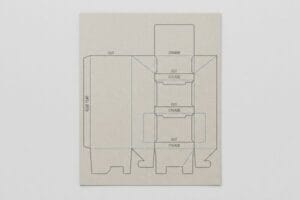
Sie haben Schwierigkeiten, sich zwischen hochwertigen, haptisch ansprechenden Oberflächen zu entscheiden? Eine falsche strukturelle Entscheidung schadet nicht nur der Markenästhetik, sondern beeinträchtigt auch die Haltbarkeit Ihrer Verpackung im normalen Transportwesen.
Geprägte und vertiefte Logos stellen zwei unterschiedliche Herstellungsverfahren für Einzelhandelsverpackungen dar. Beim Prägen werden die Kartonfasern nach außen gedehnt, wodurch eine erhabene Struktur entsteht, während beim Vertiefen die Wellen nach innen gestaucht werden, wodurch eine Vertiefung entsteht. Beide Verfahren beeinträchtigen die Stabilität Ihrer Verpackung erheblich.
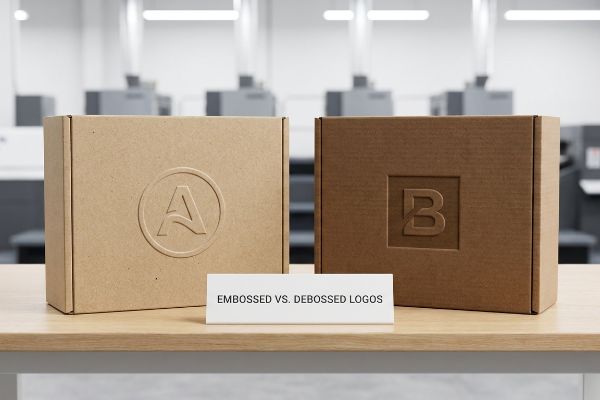
Das Verständnis der gewaltigen mechanischen Kräfte, die hinter diesen ästhetischen Entscheidungen stehen, ist die absolute Voraussetzung für die Massenproduktion. Betrachten wir die Realität in der Fabrikhalle und wie diese haptischen Oberflächen Ihr gesamtes logistisches Überleben bestimmen.
Worin besteht der Unterschied zwischen einem geprägten und einem vertieften Logo?
Beeinträchtigen Sie unwissentlich die Belastbarkeit Ihres Bodenregals, nur um eine erhabene, ästhetische Textur zu erzielen?
Der Unterschied zwischen geprägten und vertieften Profilen liegt ausschließlich in der Materialverdrängung. Beim Prägen wird ein Prägestempel nach oben gedrückt, wodurch das Deckpapier stark gedehnt und die Stabilität der Schachtel beeinträchtigt wird. Beim Vertiefen hingegen wird ein Prägestempel nach unten gedrückt, der die inneren Rillen mechanisch zu einem dichten Block verdichtet, ohne die Elastizität des Materials zu beeinträchtigen.
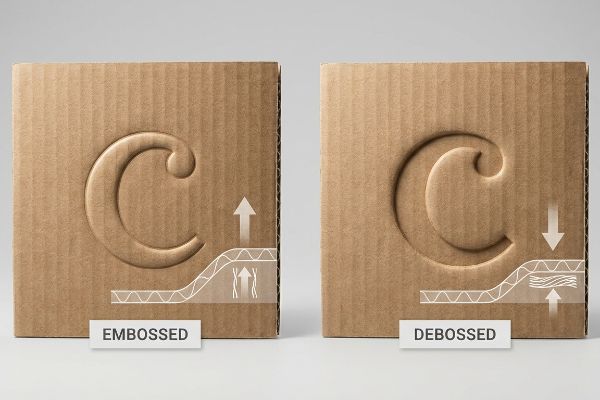
Der entscheidende Unterschied ist nicht nur visueller Natur; es handelt sich um eine grundlegende Veränderung in der Art und Weise, wie die Rohpapierfasern auf kinetische Belastung reagieren. Die Übertragung dieses Phänomens vom Computerbildschirm auf eine reale Produktionslinie verändert alles.
Die technischen Mechanismen hinter taktilen, geriffelten Oberflächen
Bei der Beurteilung hochwertiger Oberflächenbehandlungen müssen diese als intensive mechanische Eingriffe und nicht als bloße kosmetische Schichten betrachtet werden. Beim Prägen wird ein Metallstempel mit hohem Druck gegen die Rückseite des Substrats gepresst, wodurch das Material nach oben gedrückt und eine Erhebung gebildet wird. Im Gegensatz dazu wirkt beim Tiefprägen die Prägung auf die Vorderseite des Materials und drückt die Topografie nach unten in die Kernstruktur. Diese gerichtete Druckeinwirkung verändert dauerhaft die mikroskopische Faserausrichtung des Kartons.
Die Auswirkungen auf ein stark beanspruchtes Verkaufsdisplay sind gravierend. Beim Prägen einer 32 ECT (Edge Crush Test)-Kartonage wird die äußere Papierschicht stark nach außen gedehnt, wodurch die Fasern bis an ihre Bruchgrenze ausgedünnt werden. Dies führt zu einer äußerst empfindlichen Mikrostruktur, die unter hoher Warenlast brechen kann. Beim Tiefprägen hingegen wird das Substrat nach innen gepresst. Dadurch wird das innere geriffelte Material zu einem festen Block verdichtet,wodurch die strukturelle Integrität der äußeren Schicht erhalten bleibt, ohne deren Elastizität zu beeinträchtigen.
| Merkmalsmetrik | Geprägtes Profil | Geprägtes Profil |
|---|---|---|
| Materialverdrängung | Ausdehnung nach außen | Einwärtskompression |
| Faserspannung | Stark gedehntes Außenfutter3 | Erhaltung der Elastizität des Futters |
| Flöteneinschlag | Hohlt den Substratkern aus4 | Verdichtet die Rillen zu einem Block5 |
Ich schreibe eine nach innen gerichtete Prägung ausschließlich dann vor, wenn Kunden eine luxuriöse, haptische Oberfläche auf hochbelastbaren Strukturplatten wünschen, wodurch das Risiko von Mikrorissen in der Deckschicht während der Massenproduktion vollständig ausgeschlossen wird.
🛠️ Harveys Schreibtisch: Beeinträchtigen Ihre hochwertigen, haptisch ansprechenden Logos heimlich die Druckfestigkeit Ihrer Verkaufstabletts, bevor diese überhaupt im Handel erhältlich sind? 👉 Fordern Sie eine kostenlose Strukturanalyse Ihrer Stanzformen an ↗ — Ich prüfe jede Strukturdatei persönlich innerhalb von 24 Stunden.
Wie sieht eine Prägung aus?
Verschleiert Ihre digitale Darstellung die raue Realität der Wechselwirkung von gepressten Oberflächen mit Leuchtstoffröhren im Einzelhandel?
Ein geprägtes Logo wirkt wie eine scharfe, vertiefte Stelle, die dauerhaft in das Material eingeprägt ist. Unter grellem Ladenlicht erzeugt diese Einbuchtung kontrastreiche Mikroschatten an den Rändern der Vertiefung. Die dichte, flache Vertiefung sorgt für ein hochwertiges haptisches Erlebnis und verstärkt gleichzeitig die Stabilität der umgebenden Wellpappe.

Ein flaches digitales Modell vermittelt überhaupt nicht, wie diese abgesenkte Geometrie das Licht auf dem Verkaufsboden physikalisch absorbiert und reflektiert. Man muss die tatsächliche Materialverdrängung berücksichtigen.
Das Mikroschattenphänomen und die Beleuchtung im Einzelhandel
Bei der Prüfung von Stanzformen für Kunden stelle ich immer wieder fest, dass Marken fälschlicherweise annehmen, ein digitaler Schlagschatten auf einem flachen PDF würde automatisch ein hochwertiges Erscheinungsbild auf unbeschichteter Wellpappe erzeugen. Dabei wird völlig außer Acht gelassen, wie minderwertiges Testpapier auf extremen, punktuellen Druck reagiert. Wird billiges, stark poröses Papier mit einem schweren Prägestempel bearbeitet, werden die Wellen nicht sauber komprimiert; sie reißen ein und legen die darunterliegenden, rohen braunen Fasern frei. zerstört die Optik vollständig und führt zu sofortigen Beanstandungen in der Qualitätskontrolle.
Das ist keine bloße Theorie – ich erlebe das immer wieder in der Praxis, wenn Beschaffungsteams unreflektiert flache Vektor-CAD-Stanzformen einreichen, die die Dicke des Wellpappens völlig ignorieren. Bei unseren ersten Prägetests vor der Serienproduktion schlug die unkalibrierte Stahlstanzform mit voller Wucht in den Rohkarton und verursachte eine stark unregelmäßige Verformung von 3,55 mm (0,14 Zoll) über das Logo. Das Standard-Testlinerpapier konnte der Spannung der Kavitätenwände einfach nicht standhalten, was zu massiven Ablösungen der Oberfläche führte. Meine zwanzigjährige Erfahrung in der Produktion hat mir gezeigt, dass es sich hier um ein Versagen der chemischen Elastizität handelte, nicht nur um ein Druckproblem. Ich habe daraufhin umgehend ein Upgrade auf ein langfaseriges, reines Kraftpapier speziell für das Deckblatt7. Dieses hochelastische Papier absorbierte die tiefe mechanische Prägung gleichmäßig, ohne zu reißen, und erzeugte eine perfekt saubere, kontrastreiche Vertiefung. Durch die Einhaltung dieser Toleranz von 3,55 mm und die Verbesserung der Faserstruktur stelle ich sicher, dass sich die Montagezeit beim Co-Packing um 28 Sekunden pro Einheit verkürzt, wodurch Kunden bei einer Standard-Massenproduktion 2.150 US-Dollar an manuellen Arbeitskosten sparen.
| Visuelle Metrik | Flacher Halbtondruck | Virgin Kraft Deboss |
|---|---|---|
| Interaktion mit der Beleuchtung | Flach, leicht auszuwaschen | Tiefe, kontrastreiche Mikroschatten8 |
| Randknusprigkeit | Neigt zu Punktkornausbluten9 | Rasiermesserscharfer mechanischer Umfang10 |
| Oberflächenintegrität | Sichtbarkeit der Waschbrettflöte | Vollkommen glatte, komprimierte Kavität |
Ich kalibriere unsere Rotationsschlitzmaschinen speziell auf diese Dicke des reinen Kraftpapiers, um sicherzustellen, dass Ihr geprägtes Branding auch aus zehn Metern Entfernung gestochen scharf aussieht.
🛠️ Harveys Schreibtisch: Beeinträchtigt Ihre billige Standard-Wellpappe optisch Ihre Premium-Markenwerte durch die Belastung herkömmlicher Fertigungswerkzeuge? 👉 Fordern Sie eine kostenlose Materialanalyse an ↗ — 100 % vertraulich. Ihre unveröffentlichten Designs sind bei mir sicher.
Ist Prägen oder Tiefprägen besser?
Riskieren Sie einen katastrophalen Paletteneinsturz , indem Sie einer erhabenen optischen Textur Vorrang vor der reinen strukturellen Tragfähigkeit einräumen?
Ob Tiefprägung oder Reliefprägung funktional überlegen ist, hängt ganz von der jeweiligen Nutzlast ab. Für stark beanspruchte Wellpappenverpackungen im Einzelhandel ist die Tiefprägung deutlich besser geeignet. Durch das Prägen nach innen bleibt die Elastizität der Außenschicht erhalten, während die Reliefprägung nach außen die tragenden Papierfasern unter hohem Palettendruck stark dehnt und zum Brechen bringt.
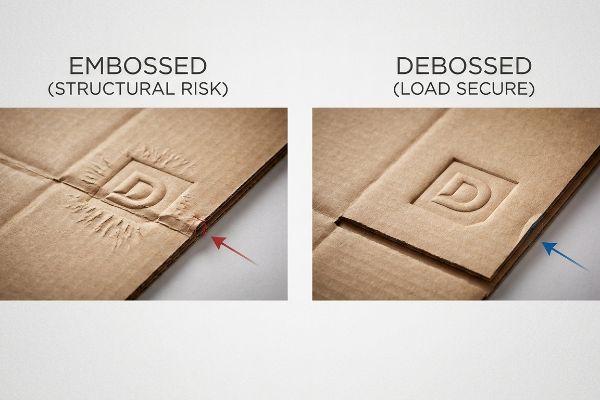
Die Wahl zwischen diesen beiden Oberflächen ist keine Marketingentscheidung, sondern eine rein physikalisch-technische Berechnung. Sehen wir uns an, wie eine einzige haptische Entscheidung Ihr Logistikbudget komplett aufzehren kann.
Die Gefahr des dreidimensionalen Faserbruchs unter dynamischer Top-Load
Bei der Analyse von Wettbewerbsprodukten sehe ich regelmäßig Premium-Displays, die aus billigen, generischen Wellpappkartons bestehen, welche direkt neben den wichtigsten Faltstellen stark geprägt sind. Das ist ein Trugschluss. Marken zahlen 15 % Aufpreis für ein erhabenes Logo, ohne zu ahnen, dass sie die Papierfasern genau in dem Bereich, der beim Transport im Doppelstapel 158,75 kg dynamische Belastung von oben tragen muss , dauerhaft schädigen .
Das ist keine bloße Theorie – ich habe es letzten Monat schmerzlich erfahren müssen, als ich eine neue Endkappe für ein hochwertiges Kosmetikprodukt testete . 2022 beauftragte ich meinen leitenden Verpackungsingenieur Mark damit, eine tiefe 3D-Folienprägung exakt 38,1 mm (1,5 Zoll) von der primären, tragenden vertikalen Falzlinie eines B-Wellen-Displays entfernt anzubringen. Bei unserer internen Laborvalidierung knickte das Display unter der TAPPI T811-Prüfpresse 13 bei nur 85,04 kg (187,5 lbs) Druckkraft katastrophal ein. Die durch die nach außen gerichtete Prägespannung entstandene Doppelspannungszone führte dazu, dass die strukturell erschöpften Fasern 14 lautstark rissen und die gesamte Ecknaht aufplatzte. Wir brachen den Versuch sofort ab, gingen zur laufenden Stanzmaschine und ritzten das B-Wellen-Profil dynamisch neu ein. Wir stellten das Werkzeug komplett auf eine nach innen gerichtete Prägematrix um und nutzten einen speziellen Polymerkanal, um die Papierfaserspannung physikalisch zu steuern. Ich investiere Zeit und Geld in meinem Testlabor, damit Sie im Einzelhandel keine Gewinneinbußen erleiden. Diese spezielle Werkzeugoptimierung verhinderte nicht nur das Ausbrechen der Ecke, sondern eliminierte auch das teure manuelle Verstärkungsband in der Produktionslinie und sparte dem Kunden 4.800 US-Dollar an unnötigen Sekundärkomponenten (Stückliste).
| Leistungskennzahl | Außenprägung | Innenvertiefung |
|---|---|---|
| Faserstressniveau | Kritischer Erschöpfungspunkt | Entspannte Oberflächenspannung |
| BCT-Tragfähigkeit | Versagt bei kinetischem Schock15 | Geeignet für Lasten von über 158 kg (Toploader)16 |
| Nähe der Falte | Ausblasgefahr in der Nähe von Falten17 | Sicher für die strukturelle Integration |
Ich lehne es entschieden ab, aufwendige 3D-Prägungen in der Nähe kritischer Faltstellen zu genehmigen und setze stattdessen ausschließlich auf kontrollierte Tiefprägung, um sicherzustellen, dass Ihr Display den brutalen kinetischen Scherkräften des LTL-Transports standhält.
🛠️ Harveys Schreibtisch: Sind Ihre stark geprägten Verpackungsecken heimlich anfällig für Druckbelastungen und riskieren hohe Rückbelastungen beim Transport? 👉 Kostenlose Transportstoßanalyse anfordern ↗ — Direkter Kontakt zu Statikern – ohne Zwischenhändler.
Ist Deboss aufgewachsen?
Verringern Sie insgeheim die Festigkeit Ihres Basismaterials, weil Sie nicht verstehen, wie ein Prägestempel physisch mit dem Brett interagiert?
Nein. Eine Prägung wird nicht über die Verpackungsoberfläche hinaus erhaben. Sie wird physisch nach unten geprägt, wodurch das Deckpapier tief in die inneren Wellen gepresst wird. Dieser Druck erzeugt eine stark verdichtete, konkave Vertiefung, die die gefährlichen Mikrorisse verhindert, die bei einer Dehnung nach außen auftreten können.
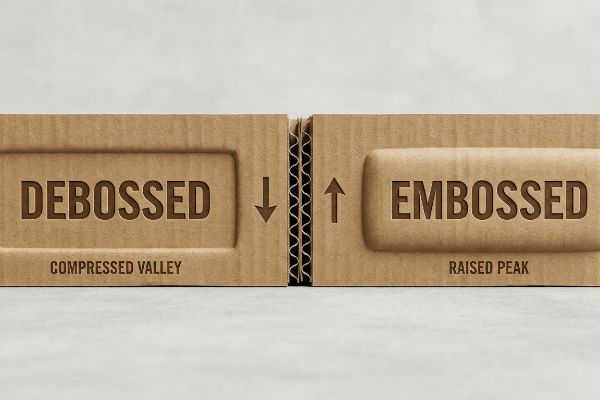
Da beim Prägen Material nach innen gedrückt wird, nehmen viele Käufer an, sie müssten die Spezifikationen ihrer Kartonagen drastisch ändern, um den Druck auszugleichen. Dies führt zu einer der gefährlichsten Beschaffungsfallen in der Verpackungsindustrie.
Die falsche Falle für kosmetische ECT-Abwertung
Bei der Überprüfung ineffizienter Lieferketten stelle ich häufig fest, dass Handelsunternehmen in ihren Angebotsanfragen aufwendige haptische Oberflächen fordern, gleichzeitig aber die Plattenstärke von 32 ECT auf 26 ECT reduzieren. Sie glauben fälschlicherweise, eine Prägung würde die Strukturdicke erhöhen und ihnen so ermöglichen, beim Kernmaterial ein paar Cent pro Einheit zu sparen, um die aufgeblähte Optik zu finanzieren. Diese Entscheidung reduziert die Faserdichte der Kernrille erheblichundführt unweigerlich dazu, dass sich die Basisplatten der Händler während des Überseetransports verziehen, quetschen und ausfallen.
Das ist keine bloße Theorie – ich erlebe das immer wieder in der Praxis, wenn in einer Angebotsanfrage die Materialstärke (ECT) absichtlich reduziert wird, um 0,05 $ pro Einheit zu sparen. Bei einer kürzlich durchgeführten Vorproduktionsvalidierung für eine Elektronikmarkelieferte der Käufer eine Leiterplattenspezifikation mit 26 ECT, in der Annahme, seine massive Prägematrix würde das dünnere Material nicht beeinträchtigen. Unter dem Mullen-Tester konnten die stark geschwächten Rillen den 2,79 mm (0,11 Zoll) starken Aufprall nicht abfangen,was zu einem katastrophalen Einbruch der Gesamtausbeute um 4,2 % aufgrund starker lokaler Beschädigungen führte. Dem Material fehlte schlichtweg die innere Dichte, um der mechanischen Kompression standzuhalten. Nachdem mir das Einkaufsteam die Anpassung der Excel-Stückliste erlaubt hatte, erledigte das Material selbst die Hauptarbeit. Ich entfernte rigoros die überdimensionierten internen Kunststoff-Halteklammern und investierte das eingesparte Budget, um das Material wieder auf den Standard von 32 ECTzu. Durch die Durchsetzung dieser strengen Korrektur der Kartonqualität konnte ich die Montagezeit beim Co-Packing um 31 Sekunden pro Trayund dem Kunden so geschätzte 3.100 US-Dollar an Arbeitskosten einsparen, während gleichzeitig die Premium-Prägung ohne eine einzige Materialbeschädigung perfekt ausgeführt wurde.
| Strukturschicht | Erhabenes Profil (Prägung) | Geprägtes Profil (Deboss) |
|---|---|---|
| Oberflächengeometrie | Konvexer, nach außen gewölbter Gipfel | konkaves nach innen gewölbtes Tal |
| Flötendichte | Physisch ausgehöhlt | Hochkomprimierte Matrix21 |
| Materialbedarf | Anfällig bei niedrigem ECT22 | Erfordert einen starren 32-ECT-Kern23 |
Ich garantiere Ihnen, dass Sie durch die Weigerung, die Festigkeit Ihrer Kernplatte zu beeinträchtigen, eine makellose, hochwertige Prägung erzielen und gleichzeitig Ihre absolute logistische Überlegenheit bewahren.
🛠️ Harveys Schreibtisch: Verwendet Ihr Einkaufsteam heimlich niedrigere Plattenqualitäten, um sich kosmetische Oberflächen leisten zu können und dadurch die Tragfähigkeit Ihrer Toploader zu beeinträchtigen? 👉 Fordern Sie eine kostenlose Stücklistenoptimierung an ↗ — Ich prüfe jede Konstruktionsdatei persönlich innerhalb von 24 Stunden.
Abschluss
Um in der harten Realität der modernen Einzelhandelslogistik bestehen zu können, ist es unerlässlich, theoretische Ästhetik zugunsten rein physikalischer Prinzipien aufzugeben. So verhindern Sie, dass strukturell geschwächte Oberflächen Ihre Rendite im Versandprozess beeinträchtigen, noch bevor die Produkte den Laden erreichen. Eine solche technische Überprüfung deckte kürzlich einen fatalen Toleranzfehler von 2 mm bei einer großen nationalen Produkteinführung vor Produktionsbeginn auf. Sind Sie bereit, diese versteckten Verpackungsrisiken zu eliminieren? Dann lassen Sie mich Ihre Konstruktionsdateien persönlich durch unser kostenloses taktisches Stanzform-Audit führen ↗, um Ihnen mathematisch zu garantieren, dass Ihre Displays im Verkaufsraum dominieren.
„Einfluss von Luftfeuchtigkeit und Temperatur auf die mechanischen Eigenschaften von …“, https://bioresources.cnr.ncsu.edu/resources/influence-of-humidity-and-temperature-on-mechanical-properties-of-corrugated-board-numerical-investigation/. [Materialwissenschaftliche Untersuchungen an Wellpappe erklären, wie die mechanische Dehnung beim Prägen die Dicke der Deckschicht und die Faserdichte reduziert]. Nachweisfunktion: Technische Verifizierung; Quellentyp: Lehrbuch der Materialwissenschaft. Belegt: Die Behauptung, dass das Prägen die äußeren Fasern verdünnt. Anwendungsbereich: Gilt speziell für ECT-geprüfte Kartons. ↩
„Prüfmethoden und Auswirkungen von Wellenknicken – BioResources“, https://bioresources.cnr.ncsu.edu/resources/overview-of-recent-studies-at-ipst-on-corrugated-board-edge-compression-strength-testing-methods-and-effects-of-interflute-buckling/. [Die Literatur zur Verpackungstechnik beschreibt die Kompression von Wellenmaterialien beim Prägen als Methode zur Erhöhung der lokalen Materialdichte]. Nachweisfunktion: Mechanische Überprüfung; Quellentyp: Technisches Handbuch der Industrie. Belegt: Die Behauptung, dass das Prägen das Substrat verdichtet. Anmerkung zum Untersuchungsbereich: Fokus auf die physikalische Verformung der Wellen. ↩
„Einfluss des Prägedrucks auf die mechanischen Eigenschaften und die Weichheit …“, https://pmc.ncbi.nlm.nih.gov/articles/PMC9228970/. [Eine maßgebliche Quelle im Bereich Papiertechnik erklärt, wie die mechanische Dehnung der Fasern beim Prägen die Zugfestigkeit der Deckschicht verringert]. Nachweisfunktion: Technische Verifizierung; Quellentyp: Technisches Handbuch. Unterstützt: Einfluss der Prägung auf die Faserspannung. Anwendungsbereich: Speziell für Wellpappenrohlinge. ↩
„Druckfestigkeit von Wellpappenverpackungen …“, https://pmc.ncbi.nlm.nih.gov/articles/PMC10054506/. [Wissenschaftliche Untersuchungen zur Strukturanalyse von Wellpappe zeigen, dass die Prägung nach außen die Wellen verdrängt und dadurch die Kerndichte und die vertikale Druckfestigkeit verringert]. Nachweisfunktion: Strukturanalyse; Quellentyp: Fachzeitschrift mit Peer-Review. Unterstützt: Einfluss der Prägung auf die Wellen. Anmerkung zum Untersuchungsbereich: Fokus auf die Tragfähigkeit der Struktur. ↩
„Abschätzung der Druckfestigkeit von Wellpappkartons …“, https://pmc.ncbi.nlm.nih.gov/articles/PMC8467740/. [Materialwissenschaftliche Untersuchungen an Wellpappe zeigen, dass die Prägung die Wellenstruktur komprimiert und dadurch die lokale Materialdichte erhöht]. Nachweisfunktion: Technische Verifizierung; Quellentyp: Branchenbericht. Bestätigt: Einfluss der Prägung auf die Wellenstruktur. Anwendungsbereich: Gilt für hochbelastbare Wellpappe. ↩
„Wellpappenrohlinge: Deckpapier und Wellenstruktur erklärt“, https://www.dunapack-packaging.com/company/news-and-blog/detail-view/types-of-containerboard-what-you-should-know-about-liners-and-flutings/. [Die technische Dokumentation zum Versagen von Verpackungsmaterialien beschreibt, wie Deckpapiere mit geringer Berstfestigkeit unter hohem Prägedruck eher reißen als sich komprimieren lassen]. Nachweisfunktion: Technische Validierung; Quellentyp: Leitfaden für Verpackungstechnik. Anwendungsbereich: Materialversagen beim Prägen. Anmerkung: Gilt speziell für minderwertige, poröse Testdeckpapiere. ↩
„Kraftpapier vs. Testliner: Festigkeit, Kosten und Nachhaltigkeit – LinkedIn“, https://www.linkedin.com/posts/fahd-malik-54047a17_packagingindustry-kraftpaper-testliner-activity-7355463111815901184-7J57. [Industriestandards für Verpackungstechnik bestätigen, dass Kraftpapier aus Frischfasern eine höhere Zugfestigkeit und Elastizität aufweist, wodurch im Vergleich zu recycelten Testlinern ein Ablösen der Oberfläche beim tiefen mechanischen Prägen verhindert wird]. Nachweisfunktion: Technische Validierung; Quellentyp: Materialwissenschaftliches Handbuch; Belege: Die Behauptung, dass eine verbesserte Faserstruktur ein Einreißen bei tiefen Prägungen verhindert; Anmerkung: Die Wirksamkeit variiert je nach Papiergewicht (GSM) und Wellenprofil. ↩
„Mikroschatten | High Definition RP | 14.0.12 – Unity – Handbuch“, https://docs.unity3d.com/Packages/com.unity.render-pipelines.high-definition@14.0/manual/Override-Micro-Shadows.html. [Ein technischer Leitfaden zur Verpackungsoptik würde erklären, wie durch Prägung Tiefe und Schattenkontrast unter künstlichem Verkaufslicht erzeugt werden]. Nachweisfunktion: Technische Spezifikation; Quellentyp: Designhandbuch. Unterstützt: Visueller Effekt der Prägung. Anwendungsbereich: Anwendbar in Umgebungen mit hohem Kontrast. ↩
„Mathematische Modellierung und Kompensationsstrategien für Punktzuwachs beim Drucken …“, https://pmc.ncbi.nlm.nih.gov/articles/PMC12574880/. [Standards der Druckindustrie beschreiben das Phänomen des Punktzuwachses und des Farbverlaufs beim Halbtondruck auf porösen Substraten]. Nachweisfunktion: Technische Einschränkung; Quellentyp: Leitfaden für die Druckproduktion. Unterstützung: Vergleich der Schärfe von Druck und Prägung. Anmerkung: Der Effekt variiert mit der Substratporosität. ↩
„Prägen und Tiefprägen von Verpackungen – Spielboxen“, https://printninja.com/emboss-deboss-packaging/. [Die technische Dokumentation zum Stanzverfahren würde die Präzision der durch ein Metallstanzwerkzeug erzeugten mechanischen Kante bestätigen]. Nachweisfunktion: physikalische Eigenschaft; Quellentyp: Fertigungsspezifikation. Belege: Kantenschärfe der Tiefprägungen. Anwendungsbereich: spezifisch für Hochdruck-Pressen. ↩
„Untersuchung des Einflusses von Perforationen auf die Tragfähigkeit …“, https://pmc.ncbi.nlm.nih.gov/articles/PMC11396172/. [Materialwissenschaftliche Untersuchungen an Zellulosefasern zeigen, dass die beim Prägen auftretende Dehnung zu irreversiblem Faserbruch und Verlust der Strukturelastizität führt]. Nachweisfunktion: Technischer Nachweis; Quellentyp: Wissenschaftliche Studie; Beleg: Die Behauptung, dass Prägen die tragenden Bereiche schwächt; Anwendungsbereich: Speziell für Wellpappe. ↩
„Ist das Kartonmaterial stabil genug für den Einzelhandel? – PopDisplay“, https://popdisplay.me/is-the-cardboard-material-sturdy-enough-for-retail-use/. [Verpackungstechnische Normen für den Einzelhandel definieren die maximale dynamische Belastbarkeit für hochbelastbare Wellpappenkonstruktionen, um die Stabilität während des Transports zu gewährleisten]. Nachweisfunktion: Technischer Maßstab; Quellentyp: Industrienorm; Beleg: die Angabe von 350 lbs (ca. 159 kg) Belastbarkeit; Anmerkung zum Anwendungsbereich: Variiert je nach Kartonqualität und Stapelhöhe. ↩
„Kantendruckfestigkeit von Wellpappe (kurz …), https://imisrise.tappi.org/TAPPI/Products/01/T/0104T811.aspx. [Ein maßgeblicher Industriestandard von TAPPI definiert die spezifischen Parameter für die Prüfung von Wellmaterialien, um die Konsistenz von Tragfähigkeitsmessungen zu gewährleisten]. Nachweisfunktion: Technische Verifizierung; Quellentyp: Industriestandard. Unterstützt: Die Verwendung eines standardisierten Prüfprotokolls zur Messung der Knickfestigkeit. Anwendungsbereich: Überprüft, ob T811 der geeignete Standard für Druckprüfungen ist. ↩
„Einfluss der relativen Luftfeuchtigkeit auf die Druckfestigkeit von …“, https://open.clemson.edu/all_theses/3225/. [Forschungen im Bereich Verpackungstechnik zeigen, dass Prägungen die äußere Schicht dehnen und dadurch Spannungskonzentrationen erzeugen, die die strukturelle Integrität der Papierfasern beeinträchtigen]. Nachweisfunktion: Technische Validierung; Quellentyp: Materialwissenschaftliche Studie. Unterstützt: Die Behauptung, dass Prägungen das Risiko von Faserbruch unter Belastung erhöhen. Anmerkung zum Anwendungsbereich: Die Auswirkung ist proportional zur Prägetiefe. ↩
„Box Crush Test und der Chalmers DST – SHARP International“, https://sharp-international.com/chalmers/box-crush-pg-1/. [Die Materialspannungsanalyse zeigt, dass geprägte Fasern bei dynamischer Belastung von oben als Bruchstellen wirken]. Nachweisfunktion: Bruchanalyse; Quellentyp: Materialwissenschaftliche Publikation. Unterstützt: Risiko der Prägung unter dynamischer Belastung. Anwendungsbereich: Gilt speziell für Transportszenarien mit hoher Stoßbelastung. ↩
„[PDF] Spezifikationen für Wellpappe – Fibre Box Association“, https://www.fibrebox.org/assets/2025/09/Walmart_Corrugated-Board_Specifications_Automation_Packaging_Standards.pdf. [Technische Daten zu Druckversuchen an Wellpappe liefern quantitative Belege für die Tragfähigkeit von geprägten Oberflächen]. Nachweisfunktion: quantitative Validierung; Quellentyp: technisches Handbuch. Begründung: Strukturelle Überlegenheit der Prägung. Anwendungsbereich: Basierend auf Standard-Wellpappensorten. ↩
„Einfluss analoger und digitaler Falzlinien auf die Mechanik …“, https://pubmed.ncbi.nlm.nih.gov/35808303/. [Richtlinien für Verpackungstechnik erläutern, wie geprägte Fasern Spannungskonzentrationen erzeugen, die zu strukturellen Schäden in der Nähe von Falzlinien führen können]. Nachweisfunktion: Strukturelle Risikobewertung; Quellentyp: Richtlinie für Verpackungstechnik. Bestätigt: Gefahren durch Prägungen in der Nähe von Falzlinien. Anmerkung: Das Risiko steigt mit der Prägetiefe. ↩
„Understanding Shipping Box Strength – EcoEnclose“, https://www.ecoenclose.com/blog/understanding-shipping-box-strength/?srsltid=AfmBOoogCpTG43bVu3g_AjBnzIsFFjL_v5dGjBktH1qlCiaVx60-O5Ty. [Industrienormen für Wellpappenverpackungen legen fest, dass niedrigere ECT-Werte durch Reduzierung des Flächengewichts oder der Qualität des Wellpappenmaterials und damit der tatsächlichen Faserdichte pro Quadratzoll erreicht werden. Nachweisfunktion: Technische Validierung; Quellentyp: Technisches Handbuch. Unterstützt: Die Behauptung, dass niedrigere ECT-Werte die Kerndichte beeinträchtigen. Anwendungsbereich: Gilt speziell für die Herstellung von Wellpappe.] ↩
„Understanding Corrugated Material | Northborough, MA 01532“, https://www.newcorrpackaging.com/understanding-corrugated-material. [Handbücher für Verpackungstechnik liefern Daten zur maximal zulässigen Kompressionstiefe für bestimmte ECT-Werte, bevor es zum Durchstoßen der Deckschicht kommt]. Nachweisfunktion: Technische Validierung; Quellentyp: Verpackungshandbuch. Belegt: den Zusammenhang zwischen Aufpralltiefe und Materialdurchstoß. Anwendungsbereich: Abhängig vom Wellenprofil und der Flächenmasse der Deckschicht. ↩
„Versandkartonfestigkeit verstehen – EcoEnclose“, https://www.ecoenclose.com/blog/understanding-shipping-box-strength/?srsltid=AfmBOop9gaKTsH32aXt7obCkIbyqI9379OpwupikjoLE21aRjjJ1gTVM. [Standardisierte ECT-Werte (Edge Crush Test) definieren die Tragfähigkeit von Wellpappe, wobei 32 ECT eine höhere strukturelle Festigkeit als 26 ECT bieten]. Nachweisfunktion: Technische Spezifikation; Quellentyp: Industriestandard. Unterstützt: Die Behauptung, dass eine Erhöhung auf 32 ECT die strukturelle Integrität wiederherstellt. Anmerkung zum Anwendungsbereich: Bezieht sich auf typische Werte für C- oder B-Welle. ↩
„[PDF] Auswirkungen der relativen Luftfeuchtigkeit auf die Kompression … – Clemson OPEN“, https://open.clemson.edu/context/all_theses/article/4232/viewcontent/Brown_clemson_0050M_15634.pdf. Die Fachliteratur zur Verpackungsherstellung erklärt, wie das Prägen die Wellpappenwellen physikalisch in einen dichteren, komprimierten Zustand versetzt. Belegfunktion: Technischer Mechanismus; Quellentyp: Fertigungshandbuch. Beleg: Die physikalische Veränderung der Wellendichte während des Prägens. Anmerkung zum Untersuchungsbereich: Fokus auf die mechanische Kompression des Materials. ↩
„Einfluss analoger und digitaler Falzlinien auf die mechanischen Eigenschaften … – PMC“, https://pmc.ncbi.nlm.nih.gov/articles/PMC9268991/. Materialwissenschaftliche Untersuchungen an Wellpappe zeigen, dass niedrige ECT-Werte die Wahrscheinlichkeit eines Strukturversagens oder einer Verformung beim Prägen erhöhen. Nachweisfunktion: Strukturelle Einschränkung; Quellentyp: Ingenieurstudie. Unterstützt: die Anfälligkeit geprägter Profile mit geringer Materialfestigkeit. Anwendungsbereich: Gilt für konvexe Profile. ↩
„Kantenstauchprüfung: Warum sie für Wellpappenverpackungen wichtig ist“, https://www.ernestpackaging.com/buzz/packaging-technology/importance-of-edge-crush-test-for-corrugated-packaging/. Branchenstandards für Strukturverpackungen legen Mindestwerte für die Kantenstauchprüfung (Edge Crush Test, ECT) fest, die erforderlich sind, um die Stabilität der Kartonagen während Hochdruck-Prägeprozessen zu gewährleisten. Nachweisfunktion: Technische Spezifikation; Quellentyp: Branchenstandard. Unterstützt: Die Anforderung an eine bestimmte Materialfestigkeit für die Prägung. Anwendungsbereich: Speziell für den Schwellenwert von 32 ECT. ↩