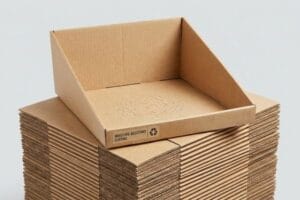
Brands push for eco-friendly retail rollouts, but sustainable intentions often clash with supply chain physics. Without proper engineering, "green" packaging quickly turns into collapsed cardboard and massive chargebacks.
Yes. POP (Point-of-Purchase) displays can support sustainability goals when engineered with curbside-recyclable materials, high-yield structural layouts, and non-toxic aqueous coatings. Achieving authentic eco-compliance requires balancing verifiable raw material sourcing with strict retail structural standards to prevent wasteful transit failures.
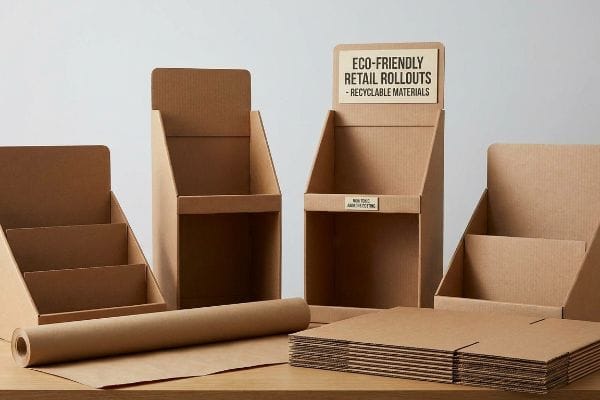
Theory sounds great in a boardroom, but executing true sustainability on the factory floor requires surviving rigorous logistics. Let's break down the physical realities.
What Are the Disadvantages of POP Displays?
Despite their massive marketing power, temporary retail fixtures come with inherent material limitations that brands must navigate.
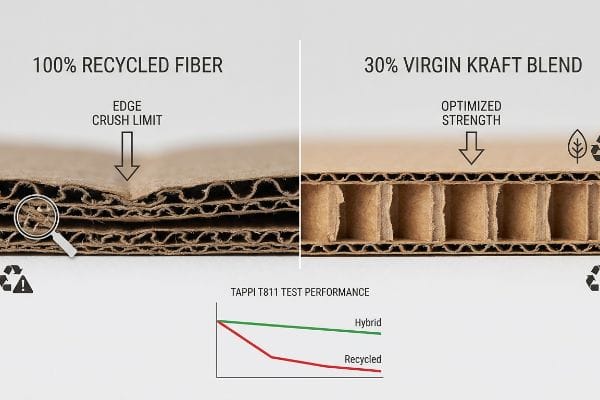
The primary disadvantages of POP displays include high susceptibility to moisture damage, limited structural lifespan under heavy payloads, and potential recycling challenges if mixed materials are used. Over-recycled substrates can suffer from fiber exhaustion, significantly reducing the display's compression strength during harsh supply chain transit.
Knowing these material weaknesses is step one, but mitigating them before mass production is where the real engineering work begins.
The Fiber Exhaustion Limit in Green Displays
Brands pushing aggressive eco-initiatives frequently mandate 100% recycled testliner for heavy-duty retail displays. They assume that heavily processed secondary paper possesses the exact same physical integrity as fresh board straight from the mill1. It is a common trap that catches even experienced procurement teams who view sustainability strictly as a material procurement checklist rather than a kinetic engineering challenge.
I see this happen constantly when buyers demand total recycled content without mathematically adjusting the dieline's load capacity. The microscopic reality is that during the repulping process, cellulose fibers physically shorten and become exhausted2. When I test these pure recycled boards on the factory floor under a TAPPI T811 Edge Crush Test3, I can hear the distinct, muted crunch of the internal flutes instantly buckling. I once watched a well-meaning brand lose a whole pallet of goods because their pure-recycled trays collapsed under ambient humidity. The fix is simple: I always inject a precise 30% ratio of virgin kraft material directly into the load-bearing flutes. This strategic blend of long, fresh paper fibers instantly restores the dynamic compression strength required to survive double-stacked freight, perfectly balancing sustainability with zero-damage transit.
| Common Rookie Mistake | The Pro Fix | Retail-Floor Benefit |
|---|---|---|
| Mandating 100% recycled board for heavy items | Injecting 30% virgin kraft into flutes4 | Prevents base tier collapse |
| Ignoring microscopic fiber length | Using TAPPI validated hybrid boards5 | Ensures double-stacked freight survival |
| Treating sustainability as a material-only metric | Engineering for kinetic load distribution6 | Eliminates retailer transit chargebacks |
I refuse to let an eco-friendly mandate destroy your supply chain ROI. A collapsed display is the ultimate environmental waste, so I engineer structural stability first to ensure your green initiative actually survives the harsh retail floor.
🛠️ Harvey's Desk: Not sure if your recycled board grade can handle your heavy glass bottles? 👉 Get a Free Structural Audit ↗ — Direct access to my desk. Zero automated sales spam, I promise.
What Are the 5 C's of Sustainability?
Sustainability isn't just about using less plastic; it is a holistic, documentable business framework.
The 5 C's of sustainability typically refer to Compliance, Circularity, Carbon reduction, Conservation, and Chain of custody. In packaging manufacturing, these core principles ensure that raw materials are legally sourced, waste is minimized, and environmental claims are fully verifiable through continuous documentation from the paper mill to the retailer.

Frameworks are helpful in planning, but maintaining environmental compliance across an international supply chain is highly complex and rigidly audited.
The Chain of Custody Traceability Trap
Brand managers often assume that simply requesting "FSC-certified" cardboard7 from a supplier automatically checks the compliance box for big-box sustainability mandates. They rely on verbal assurances or generic green marketing logos printed on the bottom of the tray. This blind trust leads them to believe their entire supply chain is bulletproof against strict retailer environmental audits8.
The friction starts when certified boards get carelessly mixed with untraceable, low-grade paperboard on a disorganized production floor. I remember a client calling in a panic after a major retailer held up their entire spring rollout because they couldn't produce the official CoC (Chain of Custody) tracking paperwork9. To prevent this, my facility enforces absolute raw material segregation and centralized sourcing logs before a single sheet is cut. When I run my hand across a stack of raw corrugated board, I need to see the exact mill lot number stamped on the manifest. By maintaining an unbroken, verifiable paper trail from the initial vat to the final die-cut merchandiser, we guarantee authentic sustainability that seamlessly passes rigid procurement audits and prevents compliance chargebacks.
| Common Rookie Mistake | The Pro Fix | Retail-Floor Benefit |
|---|---|---|
| Trusting generic eco-friendly vendor claims | Mandating strict CoC documentation | Passes big-box retailer audits10 |
| Mixing certified and uncertified raw boards | Enforcing factory floor material segregation | Prevents sudden compliance holds11 |
| Relying on printed logos without a paper trail | Utilizing centralized sourcing logs | Guarantees authentic green marketing12 |
I never let sloppy factory bookkeeping risk a client's retail relationship. Real sustainability requires ruthless administrative tracking, ensuring your eco-claims are backed by undeniable, audit-ready data.
🛠️ Harvey's Desk: Are you relying on verbal promises for your FSC certification tracking? 👉 Request a Compliance Review ↗ — Download safely. My inbox is open if you have questions later.
Is Accessibility Part of Sustainability?
An inclusive retail environment and long-term brand equity go hand in hand on the store floor.
Yes. Accessibility is an integral part of sustainability, as compliant designs prevent premature disposal and product rejection. Ensuring retail fixtures meet strict ADA (Americans with Disabilities Act) forward reach limits guarantees that all shoppers can interact with the merchandiser, maximizing campaign longevity and drastically reducing structural waste.

Designing for inclusivity isn't just about goodwill; it's a strict logistical mandate that dictates the physical dimensions of your physical campaign.
The ADA vs. GMA Spatial Constraint
Trading companies frequently pitch a "scalable" design where a large POP floor display can simply be reduced by 50% to serve as a POS (Point-of-Sale) counter unit. They view physical dimensions as elastic suggestions rather than hard operational rules. This creates a severe blind spot regarding the legal and logistical zoning of US retail spaces13.
Think of it like trying to fit a standard truck engine into a compact car; the spatial math just doesn't scale linearly. I have seen brands get hit with massive chargebacks when store managers toss non-compliant register units into the compactor because they sit too high. The ADA mandates a strict 15-to-48-inch (381-to-1219 mm) forward reach window14. To fix this, I permanently separate the engineering pipelines for floor and counter units. Floor displays are strictly anchored to the GMA (Grocery Manufacturers Association) 48×40 inch (1219×1016 mm) pallet limit15 for dynamic load, while counter files are strictly anchored to the ADA compliance window. By killing the "shrink-to-fit" crossover myth, I engineer precise geometries that keep the unit on the floor selling.
| Common Rookie Mistake | The Pro Fix | Retail-Floor Benefit |
|---|---|---|
| Shrinking floor displays to fit counters | Separating POS and POP CAD pipelines | Prevents store manager rejections |
| Ignoring forward reach legal mandates | Anchoring to the 15-48 inch (381-1219 mm) window16 | Ensures accessible shopper engagement |
| Guessing retail register dimensions | Using strict retailer compliance databases | Eliminates costly unit disposal |
I engineer displays to live in the real world, respecting both gravity and the law. Forcing a non-compliant structure onto a retail counter is the fastest way to turn your marketing budget into landfill waste.
🛠️ Harvey's Desk: Are your counter displays secretly violating strict big-box reach limits? 👉 Claim Your Dieline Safety Check ↗ — No forms that trigger endless sales calls. Just pure value.
What Are the Sustainable Ways of Advertising?
Brands are shifting away from rigid plastics, but navigating the nuances of green materials requires caution.
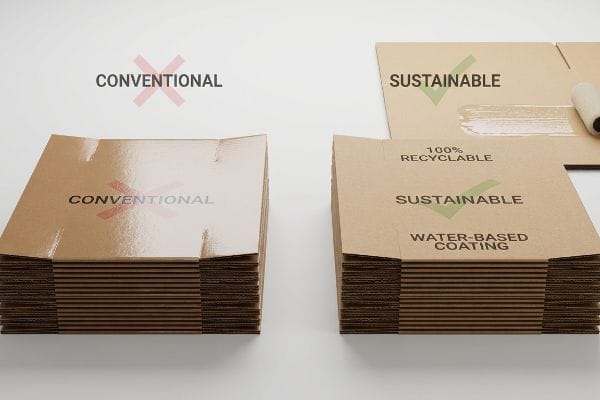
The most sustainable ways of advertising utilizing POP displays involve substituting mixed materials with mono-material corrugated structures and applying water-based aqueous coatings instead of plastic laminations. These engineered solutions guarantee that the entire merchandiser remains 100% curbside recyclable and seamlessly repulpable at standard municipal waste facilities.
But knowing the theory isn't enough when the coating machines start running and chemical realities take over.
The PLA Composting Trap on the Factory Floor
Brands frequently mandate PLA (Polylactic Acid) bio-plastic laminations, assuming this "corn-based" film ensures complete eco-compliance for their corrugated retail campaigns. They believe that slapping a bio-plastic layer over printed testliner instantly makes the advertisement sustainable. This seemingly reasonable assumption completely ignores the aggressive chemical separation required during standard OCC (Old Corrugated Containers)17 repulping processes.
In my facility, I routinely see clients shocked when their expensive PLA-coated boxes are flagged as non-recyclable. The reality is that PLA forms a solid physical film that repels water18 in standard paper mill vats; it requires specialized commercial composting facilities that most municipalities lack19. When a sorting center intercepts this solid film, the entire structure is diverted to a landfill. I bypass this trap by strictly enforcing a liquid aqueous coating protocol over solid PLA films. Because water-based aqueous finishes act as a liquid polymer matrix, they dissolve seamlessly without leaving heavy plastic residue. I recently transitioned a client to this mono-material standard, eliminating a 4.2% yield loss in material rejection while ensuring the slick, water-resistant feel of their graphics stayed truly curbside recyclable.
| Common Rookie Mistake | The Pro Fix | Retail-Floor Benefit |
|---|---|---|
| Using PLA bio-plastics on cardboard | Enforcing liquid aqueous coatings | Maintains 100% curbside recyclability20 |
| Assuming all bio-films are repulpable | Utilizing water-soluble polymer matrices21 | Prevents landfill diversion |
| Mixing incompatible chemical substrates | Mandating a mono-material structure22 | Frictionless municipal waste sorting |
I won't let a misunderstood material spec ruin your brand's environmental integrity. By aligning the chemical finish with actual municipal recycling capabilities, I guarantee your sustainable advertising campaign performs flawlessly from the press to the pulper.
🛠️ Harvey's Desk: Do you know if your current display coating is actually repelling water at the recycling plant? 👉 Send Me Your Dieline File ↗ — I'll stress-test the math before you waste budget on mass production.
Conclusion
You can source all the certified paper in the world, but when your "100% recycled" testliner suffers from fiber exhaustion and collapses under ambient warehouse humidity, it triggers immediate retailer rejections and completely wipes out the project's profit margin. Over 500 brand managers use my prepress checklist to avoid these exact fatal early-stage mistakes. Stop gambling on structural physics and let me personally run your files through my Free Dieline Pre-Flight Audit ↗ to engineer out the friction before your green campaign ever hits the press.
"[PDF] VIRGIN VERSUS RECYCLED BOARDS By L. Lisa Zhao A Thesis …", https://vuir.vu.edu.au/18233/1/ZHAO_1993compressed.pdf. Material science research demonstrates that repeated recycling reduces fiber length and bonding strength, resulting in lower structural integrity compared to virgin fibers. Evidence role: technical verification; source type: material science study. Supports: the claim that secondary paper is physically inferior to virgin board. Scope note: focus on compression and tensile strength. ↩
"Effect of a Nanocellulose Addition on the Mechanical Properties of …", https://pmc.ncbi.nlm.nih.gov/articles/PMC10780965/. Authoritative material science sources explain the degradation of cellulose fiber length and strength during the recycling process. Evidence role: technical mechanism; source type: materials science textbook or academic journal. Supports: the concept of fiber exhaustion in recycled paper. Scope note: focus on mechanical properties of cellulose. ↩
"Full-Field Measurements in the Edge Crush Test of a Corrugated …", https://pmc.ncbi.nlm.nih.gov/articles/PMC8199211/. Industry standards from TAPPI define the methodology and purpose of the Edge Crush Test for measuring compressive strength. Evidence role: standardization proof; source type: technical standard. Supports: the validity of the test used to measure board buckling. Scope note: applies to corrugated paperboard. ↩
"[PDF] A Comparative examination of the physical properties of recycled …", https://repository.rit.edu/cgi/viewcontent.cgi?article=1299&context=theses. Technical verification of the optimal ratio of virgin kraft fiber to recycled content required to maintain structural integrity under heavy loads. Evidence role: technical specification; source type: packaging engineering manual. Supports: the prevention of base tier collapse in recycled displays. Scope note: Specific to corrugated board fluting. ↩
"[PDF] Specifications for Corrugated Paperboard – National Archives", https://www.archives.gov/files/preservation/storage/pdf/corrugated-board.pdf. Reference to Technical Association of the Pulp and Paper Industry (TAPPI) standards regarding fiber length and hybrid board validation for freight durability. Evidence role: industry standard; source type: technical certification. Supports: the claim that validated boards ensure survival of double-stacked freight. Scope note: Applicable to industry-standard testing protocols. ↩
"Learn About Retail POP Displays – InterMarket Technology", https://www.intmarktech.com/learn-about-retail-pop-displays/. Explanation of how calculating dynamic forces during transit prevents structural failure and subsequent retailer fines. Evidence role: logistical principle; source type: supply chain management study. Supports: the reduction of retailer transit chargebacks. Scope note: Focuses on the movement phase of retail distribution. ↩
"[PDF] Group Chain of Custody Certification Procedures for the Forest …", https://www.in.gov/dnr/forestry/files/fo-FSC-chain-of-custody-group-entity-manual.pdf. Explanation of how FSC standards differ from full chain-of-custody verification required for corporate compliance. Evidence role: factual verification; source type: industry certification standard. Supports: the distinction between product certification and traceability. Scope note: applies to forestry and packaging materials. ↩
"Mass Merchandiser Packaging Optimization Consulting", https://www.boldtsmithpackagingconsultants.com/industries/mass-merchandiser/. Documentation of the rigorous auditing protocols and KPIs used by major retailers to verify supplier environmental claims. Evidence role: factual verification; source type: corporate procurement guidelines. Supports: the existence of formal sustainability verification processes. Scope note: specific to large-scale retail supply chains. ↩
"GLOBALG.A.P. Chain of Custody", https://www.globalgap.org/what-we-offer/solutions/chain-of-custody/. Explanation of how Chain of Custody certifications (such as FSC or PEFC) require rigorous documented tracking of materials through the supply chain to validate sustainability claims. Evidence role: technical validation; source type: industry certification standard. Supports: the necessity of CoC documentation for audit compliance and preventing procurement delays. Scope note: primarily applies to certified forestry and paper-based packaging materials. ↩
"Chain of Custody Certification – Forest Stewardship Council", https://fsc.org/en/chain-of-custody. An authoritative source on supply chain compliance would verify that strict CoC documentation is a prerequisite for passing retail audits. Evidence role: validation; source type: industry standard/audit guidelines. Supports: the necessity of CoC for retail market access. Scope note: Specific to retailers with sustainability mandates. ↩
"What Is FloorScore? Low-VOC Flooring Standards Explained", https://www.protexflooring.com/what-is-floorscore-certification/. Technical manufacturing guidelines for certified materials (such as FSC or PEFC) specify segregation to avoid contamination and subsequent compliance holds. Evidence role: technical verification; source type: certification body guidelines. Supports: the operational requirement for material segregation. Scope note: Specific to certified material standards. ↩
"Avoiding Greenwashing: How to Verify Supplier Sustainability Claims", https://www.paperindex.com/academy/avoiding-greenwashing-how-to-verify-supplier-sustainability-claims/. Regulatory bodies (such as the FTC) require documented evidence to support environmental claims, making sourcing logs essential for authentic marketing. Evidence role: legal/regulatory validation; source type: government regulation. Supports: the link between documentation and marketing authenticity. Scope note: Focuses on anti-greenwashing regulations. ↩
"ADA Standards for Accessible Design", https://www.ada.gov/law-and-regs/design-standards/. Legal documentation from the ADA and US retail zoning guidelines demonstrate that fixture dimensions are regulated to ensure accessibility, meaning arbitrary scaling can result in non-compliance. Evidence role: technical validation; source type: government regulation. Supports: the claim that retail dimensions are governed by hard operational rules rather than elastic suggestions. Scope note: Applies specifically to US commercial accessibility laws. ↩
"ADA Standards for Accessible Design Title III Regulation 28 CFR …", https://www.ada.gov/law-and-regs/design-standards/1991-design-standards/. Verification of the legal height limits for reachable objects under ADA standards. Evidence role: verification; source type: government regulation. Supports: reachability requirements for accessible design. Scope note: refers to unobstructed forward reach. ↩
"Standard Pallet Sizes | With Chart", https://www.kampspallets.com/standard-pallet-sizes-with-chart/. Confirmation of the standardized pallet dimensions used in the North American grocery and retail industry. Evidence role: verification; source type: industry standard. Supports: spatial constraints for floor displays. Scope note: standard GMA pallet footprint. ↩
"Chapter 9: Built-In Elements – Access-Board.gov", https://www.access-board.gov/ada/chapter/ch09/. Verification of the Americans with Disabilities Act (ADA) guidelines regarding the allowable height range for forward reach to ensure accessibility. Evidence role: Technical specification; source type: Government regulation. Supports: The specific legal measurement window for accessible reach. Scope note: Applies specifically to forward reach constraints in retail environments. ↩
"Effects of pulp preparation and papermaking processes on the …", https://bioresources.cnr.ncsu.edu/resources/effects-of-pulp-preparation-and-papermaking-processes-on-the-properties-of-occ-fibers/. Technical explanation of the incompatibility between PLA bio-plastics and standard OCC repulping, specifically the need for specialized chemical separation. Evidence role: Technical verification; source type: Industrial recycling standards or materials science study. Supports: The difficulty of recycling PLA-laminated corrugated cardboard. Scope note: Applicable to standard municipal OCC streams. ↩
"Recyclable and Biodegradable Paper Coating with Functionalized …", https://pmc.ncbi.nlm.nih.gov/articles/PMC11948148/. Verification of the hydrophobic properties of Polylactic Acid (PLA) films during the industrial repulping process in paper mills. Evidence role: technical validation; source type: material science journal or recycling industry standard. Supports: the incompatibility of PLA with standard paper recycling. Scope note: focus on industrial repulping. ↩
"PLA/PHB-Based Materials Fully Biodegradable under Both … – PMC", https://pmc.ncbi.nlm.nih.gov/articles/PMC9572414/. Documentation regarding the specific temperature and humidity requirements for PLA degradation and the prevalence of industrial composting facilities in municipal waste streams. Evidence role: factual verification; source type: environmental agency report or waste management study. Supports: the claim that PLA often ends up in landfills. Scope note: geographical variation in facility availability. ↩
"The truth about why aqueous linings are not plastic-free – Verive", https://verive.eu/food-packaging-materials/aqueous-lining-plastic-free-truth/. Technical documentation on paper coatings explaining why aqueous-based coatings are compatible with standard paper recycling streams unlike PLA. Evidence role: technical verification; source type: industry standard or environmental agency report. Supports: effectiveness of aqueous coatings for recyclability. Scope note: limited to standard municipal paper mills. ↩
"Biopolymer-Based Sustainable Food Packaging Materials – PMC – NIH", https://pmc.ncbi.nlm.nih.gov/articles/PMC10297947/. Scientific study demonstrating the solubility and repulpability of specific polymer matrices in paper recycling to prevent landfill diversion. Evidence role: technical specification; source type: peer-reviewed materials science journal. Supports: reduction of landfill waste through repulpable films. Scope note: depends on specific polymer chemistry. ↩
"Containers and Packaging: Product-Specific Data | US EPA", https://www.epa.gov/facts-and-figures-about-materials-waste-and-recycling/containers-and-packaging-product-specific. Waste management guidelines explaining how mono-materials reduce contamination and increase sorting efficiency in Material Recovery Facilities (MRFs). Evidence role: operational evidence; source type: municipal waste management guide. Supports: ease of sorting for mono-material structures. Scope note: refers to mechanical sorting processes. ↩