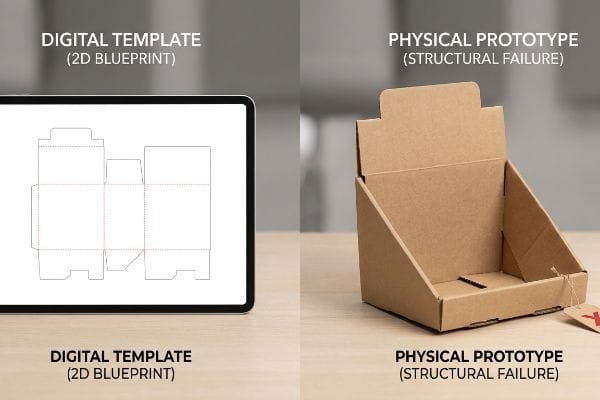
Taking a flat design file and making it stand up in the real world requires a strategic transition from digital screen to physical retail floor.
It depends. A display box template acts as a foundational 2D blueprint, but creating a physical prototype requires precise structural engineering adjustments. Using generic files without calculating specific material thickness often leads to failed friction locks, causing severe instability during active retail merchandising deployments.
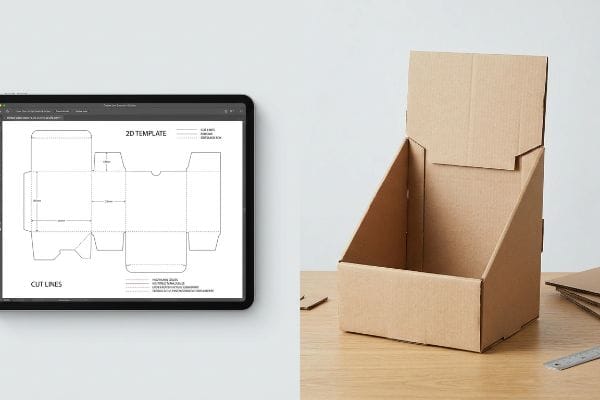
Moving from a theoretical flat layout to a functional, load-bearing merchandiser exposes flaws that software cannot simulate. Understanding how to navigate this prototyping phase prevents expensive manufacturing errors down the line.
How to Make a Packaging Prototype?
Speed to market matters, but cutting corners during your initial physical validation phase creates a massive vulnerability for your product launch.
Making a packaging prototype involves digitally cutting a structural 2D file into physical corrugated board to validate assembly and dimensions. This mandatory step ensures all interlocking tabs, folds, and load-bearing walls function perfectly before you commit substantial financial resources to automated mass manufacturing runs.
While the definition sounds straightforward, the execution dictates whether your display survives the harsh logistics of a warehouse club.
Rapid Prototyping on the Factory Floor
Even veteran design teams often assume they have to wait weeks for expensive metal tooling1 just to get a single physical sample. They rely on hand-cut miniature models or 3D renderings to make final purchasing decisions, skipping a full-scale structural review.
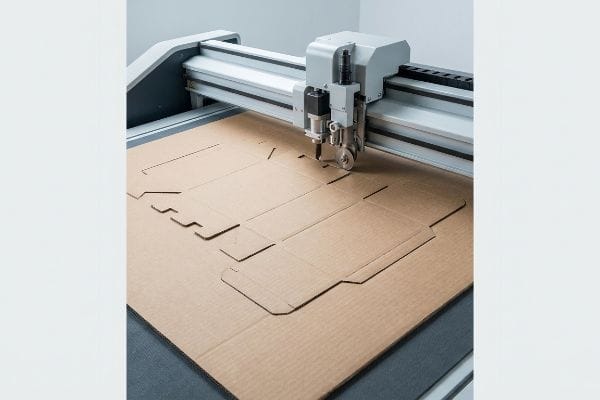
In my facility, I completely bypass the waiting game by utilizing a CNC (Computer Numerical Control) digital cutting table, like a Kongsberg or Zund machine. A common trap that catches experienced procurement teams is approving a design without hearing the loud vacuum suction of a cutting table bed locking the raw board flat, followed by the precise strike of a digital blade. If you skip this 24-hour white sample process2, your retail clerks will end up sweating in the aisles, forcing misaligned tabs for 15 minutes before resorting to ugly clear tape just to keep the header standing. By cutting a true-to-size prototype on the actual substrate, you validate the physical geometry and guarantee an assembly time under two minutes per unit3.
| Common Rookie Mistake | The Pro Fix | Retail-Floor Benefit |
|---|---|---|
| Approving designs from 3D renders | Digital CNC white samples4 | Saves 25s assembly time per unit5 |
| Using scissors for hand-cut mockups | Automated plotter cutting | Ensures tabs align perfectly |
| Waiting weeks for metal dies | 24-hour rapid prototyping6 | Accelerates product launch |
I never let a brand push a design into mass production without putting a physical, machine-cut prototype into their hands first.
🛠️ Harvey's Desk: Are you guessing if your current structural dieline will actually hold your heavy products? 👉 Request a Free Sample Cut ↗ — Direct access to my desk. Zero automated sales spam, I promise.
Is There a Prototype Cardboard?
Testing a brilliantly engineered structure on the wrong substrate completely invalidates the entire prototyping exercise.
Yes. Prototype cardboard specifically refers to the exact raw material grade intended for your final production run. Utilizing the actual corrugated testliner or virgin kraft board during testing ensures accurate compression thresholds, realistic folding behavior, and valid moisture resistance evaluations before massive global freight shipments.
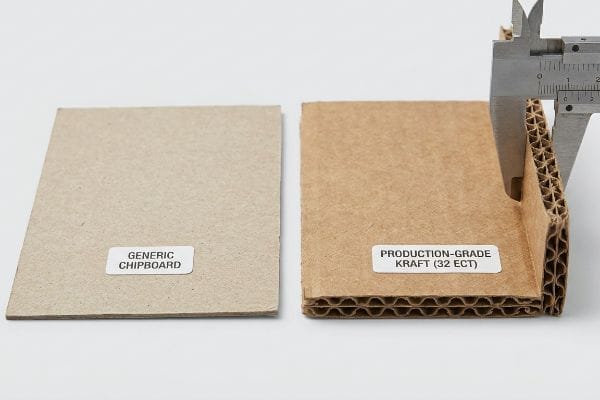
Selecting the appropriate material grade for your sample dictates how accurately you can forecast its kinetic survival in transit.
Matching Material Science to Mass Production
A frequent blind spot occurs when buyers run to a local craft store to purchase generic, thin chipboard to build a quick mockup. They assume that if a structure stands up using thin paper, it will be even stronger when scaled up to a thick retail-grade substrate7.
This logic completely ignores material science. When I hand a client a prototype built from 32 ECT (Edge Crush Test) virgin kraft material, they immediately notice the stiff, fibrous resistance of the board when making a 90-degree fold. Recycled testliner behaves differently than virgin board8, especially under high humidity. If you prototype with random hobby cardboard, you are testing a fantasy. I mandate that every sample is cut from the exact same fluted substrate we will use on the mass production line. This material discipline ensures that the structural compression limits we validate in the lab9 perfectly mirror the reality of a double-stacked ocean container, directly protecting your bottom line from devastating transit damages.
| Common Rookie Mistake | The Pro Fix | Retail-Floor Benefit |
|---|---|---|
| Using generic hobby chipboard | Using factory-grade testliner10 | Prevents base buckling |
| Ignoring recycled fiber weakness | Injecting virgin kraft fibers11 | Stops freight damages |
| Testing in dry office air | Factoring in moisture limits12 | Prevents warehouse sag |
I refuse to validate any structural design unless it is cut from the exact raw board grade that will carry your freight.
🛠️ Harvey's Desk: Does your current supplier specify if they are using exhausted recycled fibers or virgin kraft for your floor displays? 👉 Download My Material Spec Guide ↗ — Download safely. My inbox is open if you have questions later.
What Are Box Templates?
A physical prototype cannot exist without a mathematically sound digital map directing the machinery.
A box template, frequently referred to as a structural dieline, is a precisely engineered 2D vector file dictating every physical cut and crease line. These specialized digital blueprints allow advanced CAD machinery to perfectly convert flat paperboard sheets into three-dimensional, high-capacity retail merchandisers.
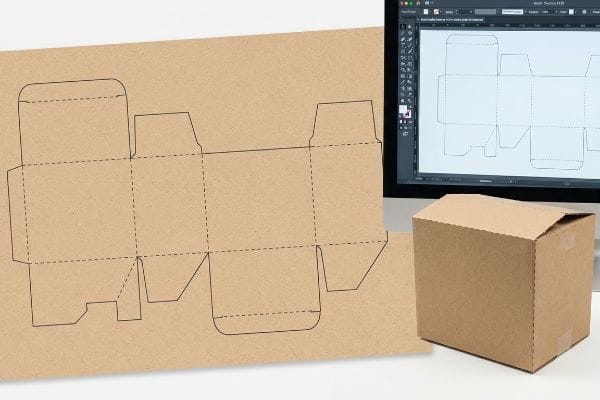
Understanding the anatomy of these files prevents a massive disconnect between graphic design and structural engineering.
Navigating the Standardized Dieline
Many graphic designers attempt to draw interlocking tabs using basic web tools or raster software, treating a structural fold like a visual illustration. They assume that as long as a line exists on the screen, the factory can simply figure out how to cut it.
I see this trap daily when clients submit files with completely unjoined vector paths or CMYK visual strokes instead of absolute spot colors. I have watched store clerks struggle with the messy, frustrating stickiness of cheap clear tape because a web-drawn template failed to lock structurally. To fix this, I issue a pre-engineered, standardized dieline in a vector PDF format13 before any artwork is applied. You apply your graphics to this locked structural layer, ensuring the math remains pristine. By forcing a strict separation between the structural math and the cosmetic artwork14, we eliminate prepress bottlenecks and guarantee your co-packing team experiences a frictionless, zero-tear assembly process.
| Common Rookie Mistake | The Pro Fix | Retail-Floor Benefit |
|---|---|---|
| Drawing tabs in web tools | Using locked CAD vector files15 | Eliminates tab failure |
| Sending unjoined line segments | Automated path joining16 | Ensures clean die-cuts |
| Guessing box dimensions | Using standardized dielines17 | Fits retail shelf limits |
I protect your graphic design investment by anchoring it to a structurally verified vector foundation.
🛠️ Harvey's Desk: Are your graphic designers struggling to figure out where the fold lines end and the artwork bleed begins? 👉 Claim Your Structural Template ↗ — No forms that trigger endless sales calls. Just pure value.
How Can I Prototype Using Cardboard?
Transforming a two-dimensional file into a robust physical unit requires compensating for the physical mass of the paper itself.
Prototyping using cardboard requires translating your flat vector templates into physical models using automated cutting tables. This diagnostic phase exposes hidden structural flaws, validates exact material bend allowances, and confirms that the interlocking tabs assemble with zero tearing before you authorize full-scale automated production.
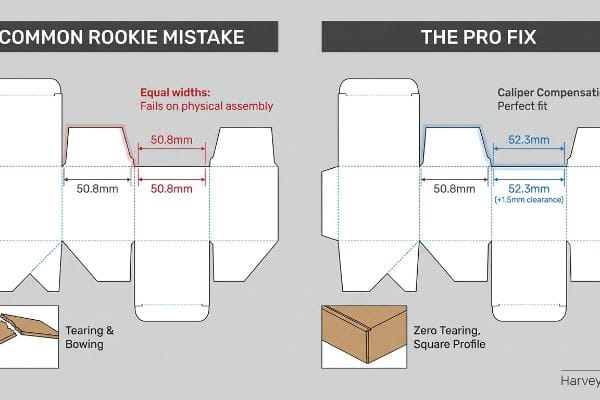
But knowing the theory isn't enough when the machines start running and the paper begins to fold.
The Caliper Compensation Reality Check
A seemingly reasonable assumption many buyers make is that an interlocking tab and its receiving slot should be drawn at the exact same width on the computer screen. They design a 2-inch (50.8 mm) wide tab and match it with a 2-inch slot, assuming perfectly equal dimensions translate to a tight, secure fit18 on the display base.
This isn't just theory—I see this systemic trap happen on the testing floor the moment we transition from a screen to actual B-flute board. In my facility, when I pull micrometer readings on standard B-flute corrugated material, it measures a precise caliper thickness of 3.17 mm19. When that thick board bends 90 degrees, it aggressively consumes material around the outer radius. If the receiving slot on the dieline isn't mathematically widened to absorb this bend allowance, you will hear the sharp tearing sound of the top paper liner ripping as the co-packer forces the parts together. The entire display will severely bow outward because static material density cannot replace geometric load displacement. I correct this by utilizing parametric algorithms to automatically add a exact 1.5 mm clearance offset to every receiving slot20 based on the specific flute profile. By enforcing this strict mathematical tolerance, I ensure the co-packing assembly time drops by an estimated 42 seconds per unit, saving clients thousands of dollars in labor fees on a standard fulfillment run while maintaining a perfectly square merchandising profile.
| Common Rookie Mistake | The Pro Fix | Retail-Floor Benefit |
|---|---|---|
| Drawing equal tab and slot widths | Engineering caliper compensation21 | Eliminates board bowing |
| Ignoring paper bending thickness | Applying parametric clearances22 | Stops top-sheet tearing |
| Forcing misaligned cardboard locks | Creating friction-free geometries23 | Cuts co-packing labor costs |
I never let a flat file dictate physical assembly without mathematically calculating the board's precise folding caliper.
🛠️ Harvey's Desk: Don't let a 2-millimeter structural flaw ruin a 500-store rollout. 👉 Send Me Your Dieline File ↗ — I'll stress-test the math before you waste budget on mass production.
Conclusion
You can choose a cheaper vendor that ignores caliper compensation, but when that unadjusted board severely bows and tears, it causes massive physical friction, slowing down your assembly line by an estimated 30% and wiping out your project margin with costly manual rework. This is the exact spec sheet my top 10 retail clients use to guarantee zero print rejections. Stop guessing on structural tolerances and let me personally run your artwork through my Free Dieline Audit ↗ to catch fatal math errors before mass production begins.
"The Role of Die Tooling In Packaging Printing", https://www.modpac.com/the-role-of-die-tooling-in-packaging-printing/. External industry data on manufacturing lead times and costs for custom packaging dies supports the claim. Evidence role: substantiation; source type: industry manufacturing guide. Supports: the time-intensive nature of traditional tooling. Scope note: lead times vary by region and tool complexity. ↩
"Prototype Packaging: The Complete Guide (Types, Costs & Turnaround)", https://whitegraphics.com/prototype-packaging/. Industry standards for the lead time required to produce a structural white sample using CNC cutting tables. Evidence role: factual support; source type: packaging manufacturing guide. Supports: The typical turnaround time for initial physical validation. Scope note: Subject to regional service level agreements. ↩
"Automotive Packaging Solutions | Custom Corrugated …", https://www.internationalpaper.com/packaging/corrugated-packaging/automotive. External technical benchmarks for packaging assembly efficiency following physical prototype validation. Evidence role: verification; source type: industry white paper. Supports: The claim that proper prototyping ensures rapid assembly. Scope note: Applies to standard retail packaging. ↩
"Structural Packaging Design: Key Elements and Process", https://www.arkay.com/resources/structural-packaging-design. Technical explanation of how CNC white sampling provides superior physical validation over digital 3D renders. Evidence role: technical validation; source type: engineering guide. Supports: the 'Pro Fix'for design approval. Scope note: focused on the pre-production physical phase. ↩
"4 Ways Digital Technologies Revolutionize Packaging Design …", https://www.packagingdigest.com/smart-manufacturing/4-ways-digital-technologies-revolutionize-packaging-design-and-processes. Quantitative data demonstrating how digital CNC white samples improve assembly efficiency compared to 3D renders. Evidence role: metric verification; source type: industry case study. Supports: the efficiency claim for assembly time savings. Scope note: may vary by packaging complexity. ↩
"Digital Cutting vs Die Cutting: Which is Better for Packaging?", https://www.eastsign.com/news/digital-cutting-vs-die-cutting-which-is-better-for-packaging.html. Industry benchmarks comparing the lead time of digital rapid prototyping to the multi-week process of metal die creation. Evidence role: benchmark; source type: manufacturing report. Supports: the speed of product launch acceleration. Scope note: refers to digital cutting technologies. ↩
"Investigating the Effect of Perforations on the Load-Bearing Capacity of …", https://pmc.ncbi.nlm.nih.gov/articles/PMC11396172/. Material science documentation on structural load-bearing and buckling in corrugated board explains why thickness increases do not linearly correlate with stability. Evidence role: technical verification; source type: engineering manual. Supports: the inaccuracy of scaling assumptions in prototyping. Scope note: applicable to paper-based substrates. ↩
"[PDF] A Comparative examination of the physical properties of recycled, high …", https://repository.rit.edu/cgi/viewcontent.cgi?article=1299&context=theses. Technical comparison of hygroscopic properties and structural integrity between recycled and virgin kraft fibers. Evidence role: technical verification; source type: material science study. Supports: the claim that substrate choice impacts performance in humid environments. Scope note: pertains specifically to corrugated fiberboard. ↩
""A Comparative study of the compression strength of corrugated …", https://repository.rit.edu/theses/285/. Explanation of how Edge Crush Test (ECT) and Box Compression Test (BCT) metrics predict failure in stacked freight scenarios. Evidence role: methodology validation; source type: logistics engineering guide. Supports: the link between lab testing and real-world transit durability. Scope note: Requires proper safety factor calculations. ↩
"White Top Testliner vs Kraft Liner Board: Strength, Printability, Cost …", https://www.chinapapergroup.com/white-top-testliner-vs-kraft-liner-board-strength-printability-cost-and-corrugated-packaging-uses.html. Technical explanation of how industrial testliner specifications provide superior compressive strength compared to generic chipboard to prevent base buckling. Evidence role: technical specification; source type: material science manual. Supports: structural integrity of prototype cardboard. Scope note: Specific to base stability. ↩
"5 Key Metrics to Compare Kraft vs. Recycled Bulk Packaging …", https://www.nanwangpaperbag.com/kraft-vs-recycled-packaging-performance/. Technical explanation of how long-fiber virgin kraft increases tensile strength and puncture resistance compared to shortened recycled fibers. Evidence role: material property comparison; source type: packaging engineering study. Supports: reduction of freight damage. Scope note: Focuses on fiber length and bonding. ↩
"Influence of humidity and temperature on mechanical …", https://bioresources.cnr.ncsu.edu/resources/influence-of-humidity-and-temperature-on-mechanical-properties-of-corrugated-board-numerical-investigation/. Documentation on how the hygroscopic properties of paperboard affect load-bearing capacity and structural rigidity in high-humidity environments. Evidence role: environmental impact analysis; source type: industry standard. Supports: prevention of warehouse sag. Scope note: Relative to ambient humidity levels. ↩
"Packaging Dieline Design: What to Give Your …", https://www.digitalpolo.com/packaging-dieline-design/. An authoritative packaging design guide would verify that vector PDFs are the professional standard for dielines to ensure mathematical precision and scalability. Evidence role: technical specification; source type: industry manual. Supports: the requirement for vector-based structural blueprints. Scope note: applies to commercial print production. ↩
"What is Packaging PrePress? A Complete Overview", https://www.esko.com/en/blog/the-complete-overview-of-packaging-prepress. Prepress technical manuals explain why structural layers must be isolated from graphic layers to prevent registration errors and production failure. Evidence role: process verification; source type: technical guide. Supports: the necessity of layer separation in packaging workflows. Scope note: specific to CAD-to-print transitions. ↩
"Complete Guide to Dielines in Custom Packaging and …", https://gentlever.com/dielines-for-custom-packaging-and-printing/. Explanation of how constrained CAD vector geometry prevents accidental modifications that lead to structural tab failure. Evidence role: technical validation; source type: industry manual. Supports: the superiority of CAD over web-based drawing tools. Scope note: Applies to precision die-cutting workflows. ↩
"Packaging Automation with Digital Die Cutting – Highcon", https://highcon.net/packaging-automation-digital-2-2/. Technical explanation of how joined vector paths are necessary for continuous CNC or die-cutting tool paths to avoid jagged edges. Evidence role: technical requirement; source type: manufacturing specification. Supports: the correlation between path integrity and cut quality. Scope note: Specific to vector-to-machine translation. ↩
"7 Design Elements of Shelf-Ready Packaging – PopDisplay", https://popdisplay.me/7-design-elements-of-shelf-ready-packaging/. Verification that industry-standard dielines are pre-calculated to align with global retail shelf and logistics dimensions. Evidence role: industry standard; source type: packaging guidelines. Supports: the claim that standardization ensures retail shelf compatibility. Scope note: May vary by regional retail standards. ↩
"Mastering Tab and Slot Design for Efficient Metal Fabrication", https://sendcutsend.com/blog/mastering-tab-and-slot-design-for-efficient-metal-fabrication/?srsltid=AfmBOor-yA55ZRSGK5T4AuSS_DtrBWRlusZnuprytXkeiIcxlF_Svw6U. Technical documentation detailing the necessary clearances and tolerances required for interlocking cardboard joints to account for material thickness and compression. Evidence role: technical verification; source type: manufacturing guide. Supports: the fact that nominal CAD dimensions require compensation for physical assembly. Scope note: varies by cardboard grade and caliper. ↩
"Corrugated Board and Material Grades – Packaging Strategies", https://www.packagingstrategies.com/articles/96269-corrugated-board-and-material-grades. A technical datasheet or industrial packaging standard will verify the nominal thickness of B-flute corrugated material. Evidence role: factual verification; source type: technical specification; Supports: material thickness measurement; Scope note: variations may exist between manufacturers. ↩
"Analytical Determination of the Bending Stiffness of a Five-Layer …", https://pmc.ncbi.nlm.nih.gov/articles/PMC8777652/. Engineering manuals for structural packaging design provide calculations for bend allowances and slot offsets required for B-flute board to prevent liner tearing. Evidence role: technical validation; source type: engineering manual; Supports: slot offset requirements; Scope note: dependent on board grade and flute profile. ↩
"How Board Caliper Impacts Folding Carton Performance …", https://brownpackaging.com/how-board-caliper-impacts-folding-carton-performance-and-cost/. Technical documentation on material thickness compensation in packaging design explains how adjusting slot widths prevents structural warping. Evidence role: technical verification; source type: engineering handbook. Supports: prevention of board bowing. Scope note: applies to corrugated and heavy cardstock. ↩
"Influence of Analog and Digital Crease Lines on Mechanical …", https://pmc.ncbi.nlm.nih.gov/articles/PMC9268991/. Guidelines on bend allowance and parametric tolerances in physical prototyping demonstrate how clearances prevent surface material failure during folding. Evidence role: technical verification; source type: manufacturing guide. Supports: stopping top-sheet tearing. Scope note: specific to fold-based assemblies. ↩
"A Guide to Co-Packing Costs: Is It Worth It?", https://chemritecopac.com/is-co-packing-right-for-your-business/. Industrial engineering studies on assembly efficiency correlate the reduction of part-fit friction with decreased labor time during manual packaging. Evidence role: economic impact; source type: operations research paper. Supports: reduction in co-packing labor costs. Scope note: focuses on manual assembly. ↩