
Every product eventually hits a corrugated wall. Whether you are shipping high-value electronics or bulk retail cosmetics, the structural integrity of your packaging dictates your shelf survival.
Boxes are an essential part of global supply chains, serving as the primary structural defense for retail goods. They utilize engineered corrugated cardboard to absorb kinetic transit shock, prevent product damage, and communicate brand equity through direct lithographic printing across international logistics networks.
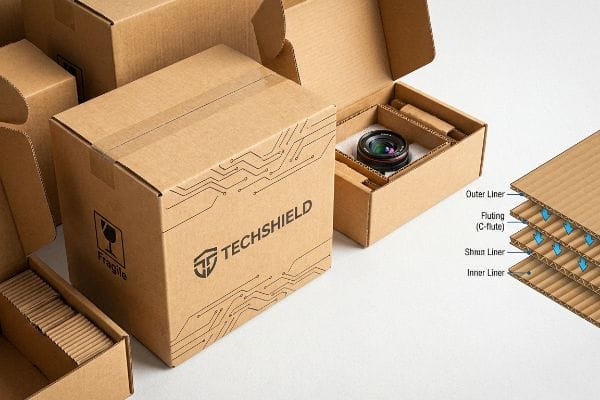
Understanding the raw materials is just the beginning. Translating that flat paperboard into a retail-ready powerhouse requires strict engineering discipline.
What Are the Three Types of Boxes?
Procurement teams constantly debate box styles. Choosing the wrong format to save a few pennies often results in catastrophic freight collapse before the product even reaches the aisle.
The three types of boxes primarily used in retail supply chains are Regular Slotted Containers (RSC), Half Slotted Containers (HSC), and die-cut folding cartons. Each structural format offers varying levels of edge crush resistance, dynamic load capacity, and material efficiency for specific merchandising and warehousing applications.
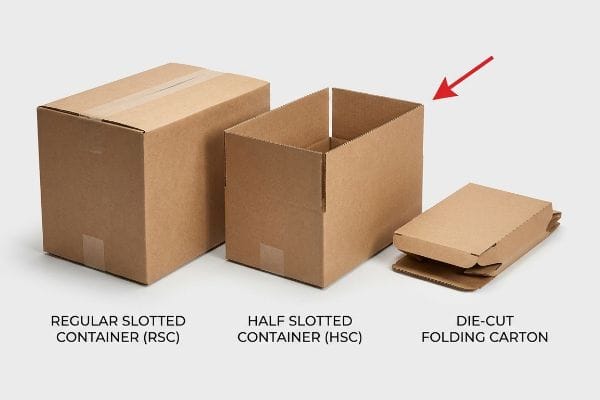
Selecting between these structures isn't just an aesthetic choice; it directly dictates how much vertical weight your pallets can survive.
The Load Capacity Gap in Box Types
Junior designers often view standard boxes as interchangeable templates, substituting a Regular Slotted Container for a Half Slotted Container to create instant open-top bins. They assume the base board grade provides all the necessary strength. This completely ignores how vertical compression spreads across a 3D structure1.
Even veteran procurement teams fall into this trap. When you remove the continuous top flaps to create an HSC open-top bin, you completely eliminate the 360-degree upper enclosure that stabilizes the vertical corners2. I have watched fulfillment crews load pallets of these open-top bins carrying up to 40 lbs (18.1 kg) per tier, only to hear the distinct, sickening crunch of the bottom tier buckling because the unsupported edges sheared under the top weight. If you require open-top shelf access, I always mandate mathematically compensating for that missing lid by upgrading to a double-wall board profile3 or strictly aligning the paper fiber grain vertically. This prevents costly retailer chargebacks from crushed inventory.
| Common Rookie Mistake | The Pro Fix | Retail-Floor Benefit |
|---|---|---|
| Using HSC bins for heavy loads | Upgrading to double-wall board4 | Prevents bottom-tier crushing |
| Ignoring missing top flaps | Vertical paper fiber alignment5 | Stops corner shear buckling |
| Assuming flat board equals strength | Calculating dynamic top-load limits6 | Eliminates pallet rejection |
I never allow clients to hollow out structural integrity just to save on unit costs. You must build the architecture to support the actual payload, or you will pay for it later in transit damages.
🛠️ Harvey's Desk: Not sure if your open-top bins can handle double-stacked pallets? 👉 Request a Structural Audit ↗ — Direct access to my desk. Zero automated sales spam, I promise.
What Do Children Learn from Playing with Boxes?
There is a reason simple cardboard structures engage spatial logic so effectively. The basic principles of folding and interlocking paperboard remain the foundation of heavy-duty retail engineering.
Children learn spatial logic, geometric weight distribution, and mechanical cause-and-effect from playing with boxes. These same fundamental principles of structural origami apply directly to industrial packaging, where strategic folding and interlocking friction mechanisms replace external hardware to maximize dynamic load capacity without requiring plastic clips.

The simplicity of an interlocking tab is deceptive. When scaled to hold industrial payloads, that basic friction mechanism requires absolute precision.
Turning Playroom Logic into Retail Payload Systems
Brands pushing for maximum sustainability frequently try to eliminate all external hardware, relying purely on the paperboard itself to hold the structure together. They request complex, interlocking friction tabs without fully understanding the physical limitations of raw corrugated substrates7.
The reality of forcing thick paper to lock into itself is often messy. Store clerks do not have the patience to solve complex puzzles, and when a die-cut slot is too tight, I see them aggressively force the panels together until the raw testliner violently tears. Instead of an elegant mono-material structure, they just wrap the broken joints in ugly clear tape, destroying your brand equity on the shelf. To fix this, I implement origami-style engineering with precise parametric bend allowances (caliper compensation)8. This guarantees the paper fibers curve smoothly into the locking matrix, resulting in a satisfying, effortless snap that takes seconds to assemble.
| Common Rookie Mistake | The Pro Fix | Retail-Floor Benefit |
|---|---|---|
| Overly complex locking tabs | Parametric bend allowances9 | Cuts assembly frustration |
| Tight zero-clearance slots | Engineered friction matrices10 | Prevents torn paperboard |
| Relying on plastic joiners | Origami-style paper locks11 | Maintains eco-compliance |
I engineer every interlocking mechanism to assemble effortlessly in the field. If a store employee needs an instruction manual to fold your primary structure, your geometry is completely flawed.
🛠️ Harvey's Desk: Are your store-level teams struggling with complicated locking mechanisms? 👉 Get a Free Tab Geometry Review ↗ — Download safely. My inbox is open if you have questions later.
What Is a Company Box?
Launching a branded outbound shipment program feels like a major milestone. However, treating your master cartons as just another marketing canvas often introduces severe logistical vulnerabilities.
A company box is a customized, branded master shipping carton engineered to safely transport commercial goods while projecting corporate identity. These outbound vessels utilize fresh corrugated substrates and specific edge crush ratings to absorb multi-axis transit vibration, ensuring retail-ready packaging arrives perfectly intact and visually pristine.
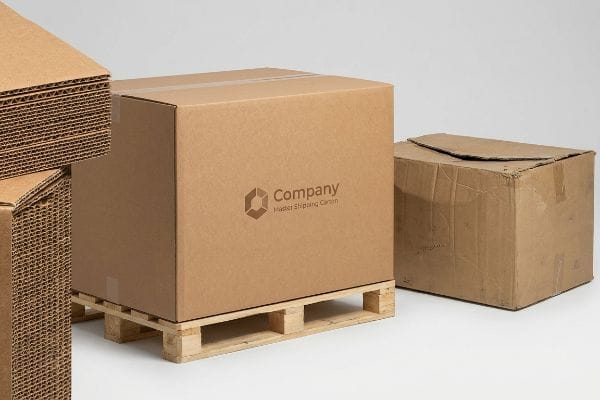
While putting your logo on a shipping carton looks professional, the physical strength of that vessel is what actually matters.
The Hidden Danger in Reused Shipping Cartons
Emerging startups often attempt to bootstrap their logistics by reusing inbound B2C (Business-to-Consumer) ecommerce boxes for their outbound B2B (Business-to-Business) retail fulfillment. They assume that if a box looks visually intact, it retains its original factory strength12 and is perfectly safe for a second trip.
Think of corrugated flutes like the shock absorbers on your car. During a box's initial journey, those internal paper waves absorb micro-impacts and moisture that permanently fatigue the cellulose fibers13. I have watched shipping teams stack these reused, structurally exhausted mailers onto standard wooden pallets, only to see the corners spontaneously sag under the compression of standard 48×40 inch (121.9×101.6 cm) base footprints. It is a massive, invisible loss of strength. I mandate a strict virgin-material rule and utilize fresh ISTA 6 (International Safe Transit Association) tested shippers14 for all outbound loads. This ensures the corners maintain full dynamic load capacity, entirely eliminating transit damages that eat your margin.
| Common Rookie Mistake | The Pro Fix | Retail-Floor Benefit |
|---|---|---|
| Reusing fatigued inbound boxes | Mandating virgin-material shippers | Eliminates hidden compression loss15 |
| Trusting visual box appearance | ISTA 6 testing protocols16 | Stops transit damages |
| Using weak B2C mailers for B2B | Upgrading ECT ratings17 | Ensures pallet stack stability |
I refuse to gamble a client's inventory on structurally exhausted materials. Upfront investment in proper outbound shippers is the only way to avoid catastrophic freight penalties.
🛠️ Harvey's Desk: Are your outbound cartons losing their rigid shape during LTL freight transit? 👉 Claim Your Master Carton Review ↗ — No forms that trigger endless sales calls. Just pure value.
How to Make a Box Business?
Entering the packaging procurement space requires more than just finding a cheap factory. Building a viable operation means mastering the delicate balance between structural math and supply chain realities.
Making a box business requires executing a precise strategy balancing structural engineering, raw material procurement, and localized assembly logistics. Successful operations avoid single-metric cost-cutting, opting instead to optimize total supply chain efficiency by mitigating machine downtime, maximizing freight density, and ensuring strict compliance with high-volume retail mandates.
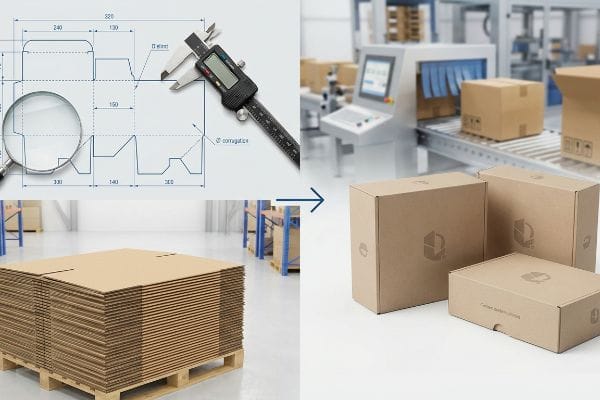
But knowing the theory isn't enough when the machines start running. The fastest way to destroy your margin is treating packaging strictly as a line-item expense.
Why Single-Metric Procurement Fails on the Factory Floor
Brand procurement teams frequently use standard frameworks to guide their physical retail rollouts, isolating unit cost as the only metric that matters. They artificially push suppliers to downgrade board grades and thin out material specs18 to save a few cents per unit on paper.
This isn't just theory—I see this happen on the testing floor when buyers attempt to hollow out their substrates. They downgrade from a robust 32ECT (Edge Crush Test) board to a flimsy 26ECT substitute19. When I measure the physical output on the hydraulic compression press, that slight 0.03 inches (0.76 mm) reduction in caliper20 completely destroys the architecture. The physical concept buckles, assembly convenience is ruined by distorted dielines, and the shelf branding is erased by transit-crushed graphics. I fix this by enforcing a unified assessment matrix. By restoring the material to a virgin standard and cutting waste from oversized master cartons instead, I ensure the assembly time drops by roughly 35 seconds per unit. This operational speed reduces labor fees at the co-packer, vastly outweighing the pennies saved on cheaper cardboard.
| Common Rookie Mistake | The Pro Fix | Retail-Floor Benefit |
|---|---|---|
| Downgrading ECT21 to save pennies | Unified supply chain assessment | Protects overall margin |
| Ignoring co-packer assembly time | Precision dieline tolerances22 | Speeds up fulfillment |
| Treating packaging as purely a cost | Calculating downstream ROI | Prevents retail chargebacks23 |
I track total cost of ownership, not just the raw unit price. If a cheaper box adds twenty seconds of labor to every single unit on your assembly line, you are losing money.
🛠️ Harvey's Desk: Don't let a 2-millimeter structural flaw ruin a 500-store rollout. 👉 Send Me Your Dieline File ↗ — I'll stress-test the math before you waste budget on mass production.
Conclusion
You can choose a cheaper vendor, but when that unsupported open-top bin collapses in a humid warehouse, slowing down the assembly line by an estimated 30% and completely wiping out the project's profit margin. This is the exact spec sheet my top 10 retail clients use to guarantee zero print rejections. Stop guessing on board tolerances and let me personally run your structural files through my Free Dieline Pre-Flight Audit ↗ to catch fatal edge crush errors before they hit the factory floor.
"Estimation of the Compressive Strength of Corrugated Board …", https://pmc.ncbi.nlm.nih.gov/articles/PMC8467740/. Technical explanation of how the geometric configuration and fold patterns of a box affect its load-bearing capacity and vertical compression strength. Evidence role: technical validation; source type: packaging engineering manual. Supports: the assertion that structural design is critical for load capacity beyond material grade. Scope note: specific to corrugated fiberboard containers. ↩
"Box Styles", https://www.acmebox.com/product-offerings/box-styles/. Technical verification of how top flaps contribute to the vertical compression strength and corner stability of corrugated containers. Evidence role: structural validation; source type: packaging engineering manual. Supports: The claim that removing top flaps reduces structural integrity. Scope note: Applies specifically to corrugated fiberboard. ↩
"Single Wall vs Double Wall Corrugated Boxes", https://www.boxish.in/blogs/post/single-wall-vs-double-wall-corrugated-boxes-whats-the-difference?srsltid=AfmBOooSDbx-ykt6JvzZTtIroYzZ3djidkK4xHjZJGrO47G0sjJQB5iC. Validation of material science regarding the increased Edge Crush Test (ECT) values of double-wall corrugated board compared to single-wall. Evidence role: technical mitigation proof; source type: material science standard. Supports: The effectiveness of board upgrades to offset structural loss. Scope note: Focuses on vertical compression strength. ↩
"Optimal Design of Double-Walled Corrugated Board Packaging", https://pmc.ncbi.nlm.nih.gov/articles/PMC8950760/. Technical documentation on corrugated board strength explains how double-wall construction increases vertical compression strength to prevent bottom-tier crushing. Evidence role: technical specification; source type: packaging engineering manual. Supports: benefit of double-wall board for heavy loads. Scope note: Effectiveness varies by flute size. ↩
"The Role of Buckling in the Estimation of Compressive … – PMC", https://pmc.ncbi.nlm.nih.gov/articles/PMC7602429/. Material science data demonstrates how vertical fiber orientation maximizes the stacking strength of corrugated board to prevent shear buckling at the corners. Evidence role: structural mechanism; source type: material science journal. Supports: impact of fiber alignment on buckling. Scope note: Specifically applies to corrugated cardboard structures. ↩
"Investigation of the Effect of Pallet Top-Deck Stiffness … – PMC", https://pmc.ncbi.nlm.nih.gov/articles/PMC8585293/. Logistics and packaging standards define the methodology for calculating top-load limits to ensure pallet stability and avoid freight collapse. Evidence role: industry standard; source type: supply chain management guide. Supports: necessity of load limit calculations to prevent pallet rejection. Scope note: Depends on specific warehouse racking and transport conditions. ↩
"Compressive Strength of Corrugated Paperboard Packages …", https://pmc.ncbi.nlm.nih.gov/articles/PMC10054506/. Technical packaging engineering data explaining how material fatigue, compression strength, and friction coefficients limit the stability of hardware-free joints. Evidence role: technical verification; source type: engineering manual. Supports: the claim that raw corrugated materials have inherent physical limits for interlocking mechanisms. Scope note: specific to non-reinforced corrugated substrates. ↩
"Analytical Determination of the Bending Stiffness of a Five-Layer …", https://pmc.ncbi.nlm.nih.gov/articles/PMC8777652/. Explain how parametric bend allowances account for material thickness (caliper) to prevent stress fractures and ensure precise fit in folding cartons. Evidence role: technical verification; source type: engineering manual or packaging standards. Supports: the effectiveness of caliper compensation in structural integrity. Scope note: specifically for heavy-duty paperboard. ↩
"What Are Corrugated Boxes? – PopDisplay", https://popdisplay.me/what-are-corrugated-boxes/. Technical documentation on CAD/CAM standards for corrugated cardboard folding and the calculation of bend allowances to ensure precision. Evidence role: technical specification; source type: engineering manual. Supports: The use of parametric adjustments to reduce assembly frustration. Scope note: Applies to industrial paperboard engineering. ↩
"Materials science. Understanding friction in layered materials", https://pubmed.ncbi.nlm.nih.gov/25953991/. Research on friction-fit joint design and material stress distribution in sustainable packaging to prevent structural failure. Evidence role: technical mechanism; source type: materials science paper. Supports: The prevention of torn paperboard through engineered slot tolerances. Scope note: Focused on material fatigue and shear stress. ↩
"Origami-Inspired Paper-Based Protective Packaging offers …", https://www.packagingdigest.com/packaging-design/origami-inspired-paper-based-protective-packaging-offers-a-sustainable-alternative-to-fossil-based-materials. Industry standards for plastic-free packaging design utilizing folding geometry for structural integrity. Evidence role: technical standard; source type: industry sustainability guide. Supports: The use of paper locks to maintain eco-compliance by eliminating plastic joiners. Scope note: Specific to circular economy packaging requirements. ↩
"The Circular Life of a Cardboard Box", https://www.internationalpaper.com/resources/recycling/white-paper/circular-life-cardboard-box. Authoritative packaging engineering sources detail how corrugated fiberboard loses structural integrity and Edge Crush Test (ECT) values after one shipping cycle regardless of visual appearance. Evidence role: technical verification; source type: packaging science journal. Supports: the claim that reused boxes lack original strength. Scope note: specifically concerns corrugated substrates. ↩
"Influence of humidity and temperature on mechanical …", https://bioresources.cnr.ncsu.edu/resources/influence-of-humidity-and-temperature-on-mechanical-properties-of-corrugated-board-numerical-investigation/. Technical explanation of how corrugated flutes lose structural integrity through fiber fatigue and moisture absorption. Evidence role: technical verification; source type: material science journal or packaging engineering guide. Supports: the claim that reused cartons are structurally exhausted. Scope note: focuses on the degradation of cellulose in corrugated substrates. ↩
"Test Procedures – International Safe Transit Association", https://ista.org/test_procedures.php. Documentation of the ISTA 6 standard for transit testing to ensure packaging durability. Evidence role: standard verification; source type: official ISTA certification or standards documentation. Supports: the efficacy of using tested shippers to maintain load capacity. Scope note: specifically addresses the ISTA 6 protocol. ↩
""Relative Humidity Effects on the Compression Strength of …", https://open.clemson.edu/all_theses/3225/. Technical explanation of how fatigued corrugated fiberboard suffers structural degradation and reduced compression strength compared to virgin material. Evidence role: technical validation; source type: packaging engineering guide. Supports: The benefit of using new shippers over reused ones. Scope note: Specific to corrugated cardboard structural integrity. ↩
"ISTA Packaging Test and Certification", https://www.ul.com/services/ista-packaging-test-and-certification. Verification of ISTA 6 as an industry standard for testing the performance of shipping containers to mitigate transit damage. Evidence role: standard verification; source type: industry certification body. Supports: The use of standardized testing to stop damages. Scope note: Refers to International Safe Transit Association standards. ↩
"Reducing the occurrence of collapsing pallet loads: Part II | Packaging World", https://www.packworld.com/home/article/13372817/reducing-the-occurrence-of-collapsing-pallet-loads-part-ii. Technical data linking the Edge Crush Test (ECT) value to the vertical load-bearing capacity and overall stability of stacked pallet loads. Evidence role: technical specification; source type: materials science manual. Supports: The correlation between ECT ratings and pallet stability. Scope note: Applies to the strength of corrugated board. ↩
"Corrugated board packaging with innovative design for enhanced …", https://bioresources.cnr.ncsu.edu/resources/corrugated-board-packaging-with-innovative-design-for-enhanced-durability-during-transport/. Industry whitepapers or packaging engineering guides documenting the practice of reducing material specifications to lower unit costs. Evidence role: factual verification; source type: industry report. Supports: the claim that procurement prioritizes unit cost via material downgrades. Scope note: focused on the corrugated packaging sector. ↩
"Understanding Shipping Box Strength", https://www.ecoenclose.com/blog/understanding-shipping-box-strength/?srsltid=AfmBOorYVZYI4a3gxm2GFwsQyo5fepXFESQ6YTp8u_IJ3arzdkieUSaz. Industry standards for Edge Crush Test (ECT) ratings quantify the difference in stacking strength between 32 and 26 ECT board. Evidence role: technical validation; source type: material specification. Supports: the claim that downgrading board strength compromises structural integrity. Scope note: Applies to standard corrugated materials. ↩
"[PDF] FALL 2007 – TAPPI.org", https://www.tappi.org/content/journal/2007/ci/07octci.pdf?tapmkt=ecorr. Engineering data on corrugated caliper illustrates how fractional changes in material thickness affect structural stability and fit. Evidence role: technical validation; source type: engineering manual. Supports: the claim that a 0.03 inch reduction in caliper degrades box architecture. Scope note: Effect depends on flute profile. ↩
"Estimation of the Edge Crush Resistance of Corrugated Board …", https://pmc.ncbi.nlm.nih.gov/articles/PMC9961700/. Industry standards from TAPPI or similar bodies define how Edge Crush Test (ECT) ratings correlate to stacking strength and failure rates. Evidence role: technical verification; source type: industry standard. Supports: the risk of structural failure when lowering material specs. Scope note: limited to corrugated cardboard packaging. ↩
"Efficiency and Automation: The Technological Basis of …", https://www.lantech.com/efficiency-and-automation-the-technological-basis-of-modern-packaging-lines/. Packaging engineering guidelines demonstrate how tight tolerances in dieline specifications reduce machine downtime and assembly errors in co-packing. Evidence role: process verification; source type: technical manual. Supports: the link between precision tolerances and fulfillment speed. Scope note: specifically applicable to automated assembly lines. ↩
"What Contract Packaging Mistakes Trigger Retailer Chargebacks?", https://www.industrialpackaging.com/blog/copacker-mistakes-retailer-chargebacks. Retailer compliance manuals (e.g., Amazon or Walmart) list specific packaging failures that trigger financial penalties known as chargebacks. Evidence role: compliance verification; source type: corporate policy. Supports: the claim that packaging quality affects retail financial penalties. Scope note: penalties vary by retailer agreement. ↩