
Are your retail shipments arriving crushed, despite using what you thought was strong packaging? The problem often starts with fundamentally misunderstanding your base material.
Corrugated boxes are structural shipping containers engineered with a fluted middle layer sandwiched between two flat linerboards. This arched geometry provides high compression strength and shock absorption, making them fundamentally different from standard single-layer cardboard and required for protecting heavy retail goods during transit.

Understanding this specific three-tier architecture is the first step to eliminating expensive transit damages and optimizing your logistics footprint.
What Is the Difference Between Cardboard and Corrugated Boxes?
Many brands mistakenly use these terms interchangeably, leading to severe under-specification of material limits and eventual supply chain failure.
The difference between cardboard and corrugated boxes lies strictly in their internal geometry. Cardboard is a generic term for thick, flat, unfluted paper pulp. Corrugated boxes feature a mathematically arched internal flute layer glued between two flat liners, specifically engineered to disperse kinetic shock.
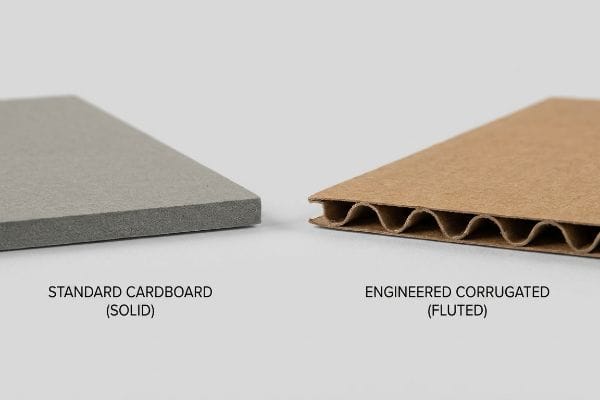
Knowing exactly how these internal arches function dictates whether your packaging will survive a trans-Pacific ocean journey or collapse on a warehouse floor.
The Engineering Mechanics Behind Fluted Substrates
Think of standard cardboard, or solid chipboard, as a single, dense plane of material. It relies entirely on its raw static thickness to resist bending. Corrugated material, however, borrows architectural principles from ancient Roman bridges. By injecting a continuous wave-like arch—known as the fluting—between two flat outer liners, it transforms standard paper fibers into a dynamic load-bearing truss system1.
I frequently explain to new product managers that unfluted substrates lack any mechanical mechanism to dynamically disperse kinetic energy. When vertical pressure is applied to a flat solid board, the force concentrates in one spot until the material simply bows outward and buckles. In contrast, when heavy top-loads sit on a fluted corrugated profile, the kinetic stress is actively routed down through the arched network2. This internal geometry mathematically displaces the force across the entire panel3, allowing lightweight micro-fluted boards to safely support heavy structural payloads without relying on expensive, inflated material density. This precise energy dispersion reduces raw material costs while massively increasing your dynamic load capacity.
| Structural Feature | Standard Cardboard | Engineered Corrugated |
|---|---|---|
| Internal Architecture | Solid unfluted paper layer | Arched flute truss system4 |
| Kinetic Energy Dispersion | Low (concentrates force) | High (distributes force)5 |
| Dynamic Load Capacity | Poor top-load resistance | Superior vertical stacking6 |
I never specify unfluted chipboard for any retail trays carrying physical payloads. Relying on engineered flutes ensures maximum geometric load displacement, cutting material waste by nearly 20% while guaranteeing perfect structural integrity.
🛠️ Harvey's Desk: Are your heavy checkout trays actively crushing your shipping ROI before they even reach the store? 👉 Get a Free Freight Density Audit ↗ — I review every structural file personally within 24 hours.
What Is the Difference Between Paper Box and Corrugated Box?
Scaling up a thin product box into a master shipper requires an entirely different structural math.
The difference between a paper box and a corrugated box centers on structural caliper. A paper box uses a thin, single-ply substrate ideal for lightweight surface graphics. A corrugated box utilizes a multi-ply fluted construction, ranging from 1.5 mm to 8 mm thick, demanding precise bend allowance calculations.
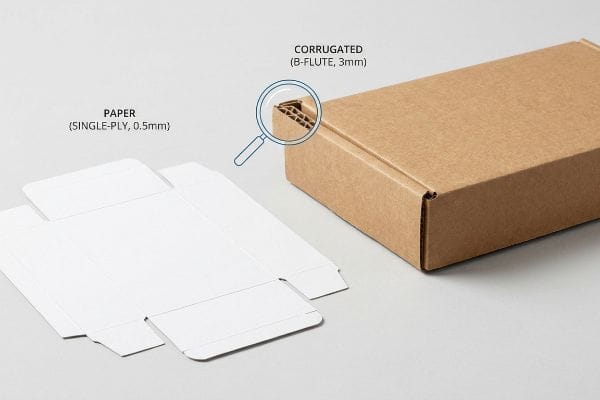
That massive jump in material thickness introduces strict bend allowances that dictate how the package will fold on the assembly line.
The Engineering Mechanics Behind Structural Caliper
A standard paper box folds almost exactly on the printed crease line because the material is exceptionally thin, typically under 0.02 inches (0.5 mm)7. Corrugated boxes, however, possess a significant physical thickness, known as caliper. For example, a standard B-flute board is roughly 0.12 inches (3 mm) thick8. When you force a substrate of that volume to fold 90 degrees, it physically consumes material, creating an outer radius that must be mathematically accommodated in the die-cut pattern.
I use parametric CAD (Computer-Aided Design) software to demonstrate to procurement teams how this caliper shift completely rewrites structural tolerances. If you take a flat template designed for a thin paper box and simply cut it out of dense corrugated board, the interlocking tabs and receiving slots will remain too narrow9. The rigid corrugated board will forcefully push against itself during assembly, creating massive friction that prevents the box from sitting square. By automatically applying specific bend allowance algorithms to every fold and slot10, we mathematically compensate for the material's thickness. This structural adjustment guarantees a frictionless assembly process on the co-packing line, drastically reducing manual labor time.
| Material Characteristic | Thin Paper Box | Multi-Ply Corrugated Box |
|---|---|---|
| Substrate Caliper | Under 0.02 inches (0.5 mm)11 | Up to 0.12 inches (3 mm)12 |
| Bend Allowance Need | Minimal fold compensation | Strict parametric adjustment13 |
| Co-packing Friction | Low physical resistance | High if uncalibrated |
I strictly enforce caliper compensation algorithms on every dieline to mathematically account for paper expansion. This precise tolerance adjustment guarantees frictionless interlocking, instantly streamlining automated assembly operations and protecting your baseline margins.
🛠️ Harvey's Desk: Are your rigid tabs tearing during assembly because your designer ignored material caliper? 👉 Secure Your CAD Architecture ↗ — 100% confidential. Your unreleased retail designs are safe with me.
What Is the Difference Between Folding Carton and Corrugated?
Premium aesthetics often clash with heavy-duty structural requirements.
The difference between a folding carton and a corrugated box involves print surface quality versus dynamic strength. Folding cartons utilize smooth SBS paperboard for flawless, high-resolution graphics. Corrugated boxes utilize fluted cores for high impact resistance but require micro-fluting or litho-lamination to prevent visual surface rippling.
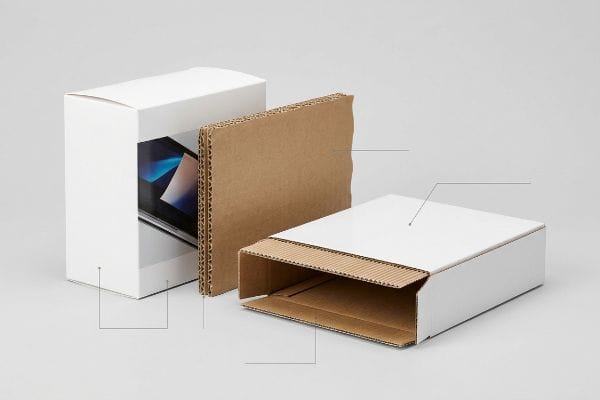
Bridging the gap between flawless commercial printing and industrial load-bearing strength requires a highly specialized hybrid manufacturing process.
The Engineering Mechanics Behind Surface Aesthetics
Folding cartons are typically manufactured from SBS (Solid Bleached Sulfate)14, which provides a perfectly uniform, bright-white surface ideal for direct, high-fidelity commercial printing. Because it lacks an internal fluted core, the surface remains completely flat under the pressure of printing rollers. Corrugated board, conversely, has an uneven internal structure. When thin outer liners are glued over large B-flutes or C-flutes, the spaces between the internal arches create distinct ridges, a visual distortion known as the washboard effect15.
I teach brand designers that you do not have to sacrifice the superior BCT (Box Compression Test) strength of corrugated to achieve folding-carton-level aesthetics. Instead of printing directly onto raw testliner, we utilize a litho-lamination process combined with engineered micro-flutes16. By first printing the high-resolution graphics onto a premium top-sheet, and then meticulously gluing it over a dense E-Flute profile17, we mathematically eliminate the washboard ridges. The tighter frequency of the micro-flutes provides a perfectly smooth structural foundation for the printed sheet. This hybrid approach delivers the pristine visual communication of a folding carton while retaining the necessary kinetic shock absorption to survive double-stacked pallets.
| Performance Metric | Traditional Folding Carton | Micro-Fluted Corrugated |
|---|---|---|
| Surface Flatness | Perfectly smooth (SBS)18 | Smooth (Litho-lamination) |
| Washboard Distortion | Zero risk | Eliminated via E-flute19 |
| Kinetic Shock Absorption | Extremely vulnerable | Highly resilient20 |
I completely bypass the washboard effect on premium retail runs by specifying strict E-flute litho-lamination. This hybrid engineering guarantees your structural packaging maintains absolute graphic fidelity without sacrificing critical pallet top-load performance.
🛠️ Harvey's Desk: Is your luxury packaging suffering from the washboard effect under harsh fluorescent retail lighting? 👉 Claim A Litho-Lamination Assessment ↗ — No account managers in the middle. You talk directly to structural engineers.
What Is an Example of a Corrugated Box?
Identifying the right structural classification determines whether your merchandise remains protected or becomes instantly accessible to shoppers.
A classic example of a corrugated box is the Regular Slotted Container, the standard master shipper featuring four continuous top and bottom flaps. Another key example is the Half Slotted Container, which omits the top flaps to create an instant open-top bin for retail-ready shelf access.
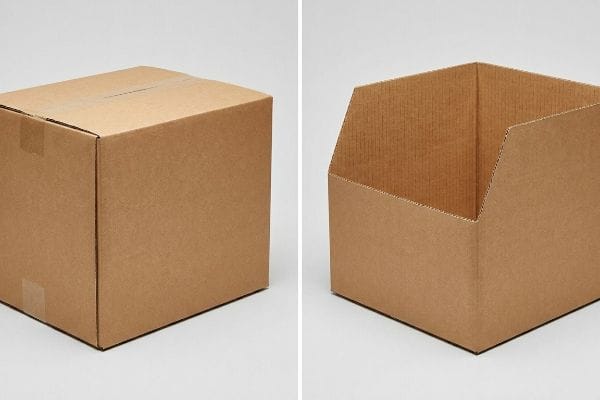
Choosing between a closed shipper and an open-top display bin completely alters the package's vertical compression mechanics.
The Engineering Mechanics Behind Slotted Containers
The RSC (Regular Slotted Container) is the foundational building block of global logistics, engineered so all flaps are the same length, meeting perfectly in the center to create a secure 360-degree enclosure. This continuous upper perimeter mechanically stabilizes the four vertical corners21. When you modify this baseline into an HSC (Half Slotted Container) for retail shelf displays, removing the top flaps eliminates that critical upper tension ring, significantly altering how the box bears vertical weight22.
I advise procurement teams that transitioning from a closed RSC to an open HSC immediately introduces compressive vulnerability. Without the top flaps holding the structural corners square, the open edges become highly susceptible to bowing and crushing under standard 48×40 inch (1219×1016 mm) GMA (Grocery Manufacturers Association) pallet top-loads23. To safely execute an HSC example, we must mathematically compensate for the missing structural lid. We achieve this by strictly aligning the internal corrugated grain perfectly vertically, instantly maximizing the ECT (Edge Crush Test) baseline24. If the internal merchandise is not rigid enough to carry the dynamic weight, I immediately engineer an upgrade to a double-wall board profile to restore the lost stability, preventing expensive transit collapse.
| Box Architecture | Regular Slotted Container | Half Slotted Container |
|---|---|---|
| Upper Enclosure | 360-degree flap stability | Open-top shelf access |
| Corner Tension | Mechanically supported | Vulnerable to outward bow25 |
| Stacking Engineering | Standard ECT limits26 | Requires grain alignment27 |
I strictly mandate vertical grain alignment and potential double-wall upgrades whenever an open-top HSC is specified. Compensating mathematically for the missing top flaps restores full structural stability, entirely eliminating the risk of crushing under warehouse racking.
🛠️ Harvey's Desk: Are your open-top shelf bins buckling laterally under heavy warehouse stacking pressure? 👉 Request A Compression Strategy Audit ↗ — I review every structural file personally within 24 hours.
Conclusion
Transitioning from standard unfluted cardboard to meticulously engineered fluted structures is the only mathematical way to prevent heavy retail trays from buckling under kinetic transit shock. Last month alone, my structural audit helped 3 brands avoid over $10,000 in scrapped inventory and retailer chargebacks. If your packaging is failing BCT metrics, let me personally run your structural files through a Free Edge Crush Assessment ↗ to mathematically lock down your supply chain physics.
"Numerical study of I-joists with wood-based corrugated panel web", https://bioresources.cnr.ncsu.edu/resources/numerical-study-of-i-joists-with-wood-based-corrugated-panel-web/. Materials science or structural engineering literature explains how the corrugated medium acts as a truss to increase the moment of inertia and vertical load capacity. Evidence role: Technical verification; source type: Engineering textbook. Supports: The mechanical transformation of paper into a structural substrate. Scope note: Specifically refers to the fluting's role in stiffness. ↩
"Mechanical Analysis of Corrugated Cardboard Subjected to Shear …", https://www.mdpi.com/2504-477X/8/10/404. Authoritative packaging engineering sources describe how the sinusoidal shape of corrugated flutes transfers vertical compressive loads to the liners. Evidence role: mechanism explanation; source type: technical manual. Supports: load-bearing efficiency of fluted substrates. Scope note: focused on vertical compression. ↩
"Modeling of load-displacement relationships for corrugated …", https://ui.adsabs.harvard.edu/abs/2023E3SWC.40201006K/abstract. Structural analysis papers provide the mathematical basis for how fluted geometry distributes stress across the board's surface area. Evidence role: technical validation; source type: peer-reviewed engineering journal. Supports: geometric displacement of force. Scope note: applies to standard corrugated profiles. ↩
"A Review of Corrugated Board Structure – Shanghai DE Printed Box", https://www.deprintedbox.com/blog/a-review-of-corrugated-board-structure/. Authoritative materials science source verifying the structural role of fluting as a mechanical truss system. Evidence role: technical specification; source type: engineering textbook. Supports: The internal architecture of corrugated substrates. Scope note: Applies to standard A, B, C, and E flute profiles. ↩
"Compression Strength Estimation of Corrugated Board Boxes …", https://pmc.ncbi.nlm.nih.gov/articles/PMC9864211/. Mechanical analysis demonstrating how fluted layers attenuate and distribute impact force compared to solid paper. Evidence role: performance validation; source type: peer-reviewed journal. Supports: The kinetic energy dispersion claims. Scope note: Focuses on impact resistance. ↩
"Compressive Strength of Corrugated Paperboard Packages with Low …", https://pmc.ncbi.nlm.nih.gov/articles/PMC10054506/. Packaging industry test data comparing the top-load compression strength (ECT) of corrugated materials against solid paperboard. Evidence role: comparative performance metric; source type: industry standard. Supports: The dynamic load capacity claim. Scope note: Dependent on liner grade and flute thickness. ↩
"Paperboard Caliper Explained: Folding Carton Thickness", https://pmpackaging.com/posts/2026/07/paperboard-caliper-explained-how-thick-should-a-folding-carton-be. Technical confirmation of standard thickness ranges for single-ply paperboard used in folding cartons. Evidence role: verification; source type: industry technical manual. Supports: material thickness claim. Scope note: applies to standard SBS or CUK paperboards. ↩
"Corrugated Board and Material Grades – Packaging Strategies", https://www.packagingstrategies.com/articles/96269-corrugated-board-and-material-grades. Verification of industry standard dimensions for B-flute corrugated medium. Evidence role: specification check; source type: packaging engineering standard (e.g., TAPPI). Supports: thickness of B-flute. Scope note: actual thickness may vary slightly by manufacturer. ↩
"RSC Tolerances for Case Erectors and Packers – AICC Now", https://now.aiccbox.org/rsc-tolerances-for-case-erectors-and-packers/. Technical documentation on how material caliper affects the clearance requirements for interlocking tabs in corrugated board. Evidence role: technical verification; source type: packaging engineering handbook. Supports: the claim that templates for thin paper do not scale linearly to corrugated board. Scope note: focus on fitment tolerances. ↩
"Corrugated Design – Google Groups", https://groups.google.com/g/comp.cad.solidworks/c/bV6mhVT7YiQ. Explanation of K-factor and bend allowance algorithms used in parametric CAD to compensate for material thickness during folding. Evidence role: technical verification; source type: mechanical engineering standard. Supports: the use of mathematical compensation for structural thickness. Scope note: applicable to folding and bending operations. ↩
"Paper Weight and Thickness Guide: GSM, Caliper & Packaging Uses", https://www.epackprinting.com/paper-thickness-guide/. Verify standard caliper measurements for lightweight paperboard packaging. Evidence role: factual verification; source type: industry packaging standard. Supports: typical substrate thickness for thin paper boxes. Scope note: applies to standard folding cartons. ↩
"Strength Packaging Substrates", https://durafibre.com/strength-packaging-substrates/. Confirm standard thickness ranges for multi-wall corrugated fiberboard. Evidence role: factual verification; source type: technical specification sheet. Supports: typical substrate thickness for corrugated boxes. Scope note: focuses on multi-ply configurations. ↩
"Calculate K factor and bend allowance for sheet metal …", https://www.gasparini.com/en/calculators/calculate-k-factor-and-bend-allowance-for-sheet-metal-bending/. Explain the necessity of parametric adjustments and bend allowance calculations for thick corrugated materials. Evidence role: technical justification; source type: structural engineering manual. Supports: requirements for structural integrity in corrugated folding. Scope note: relates to material deformation and K-factor. ↩
"Solid Bleached Sulfate (SBS) Folding Cartons Explained", https://brownpackaging.com/solid-bleached-sulfate-sbs-folding-cartons-explained-properties-and-packaging-applications/. An industry material specification sheet would verify SBS as the primary substrate for high-end folding cartons due to its brightness and smoothness. Evidence role: material verification; source type: technical data sheet. Supports: the common material composition of premium folding cartons. Scope note: typical for retail and cosmetic packaging. ↩
"With corrugated boxes, you can measure success – Billerud", https://www.billerud.com/products/packaging-materials/corrugated-materials/knowledge-center/washboarding. A packaging engineering source would define the washboard effect as the mirroring of the fluting pattern on the surface of the liner during printing. Evidence role: technical definition; source type: packaging engineering manual. Supports: the relationship between fluted cores and surface quality. Scope note: specifically occurs during high-pressure printing processes. ↩
"Understanding Litho Laminated Packaging & Single Face Lamination", https://pmpackaging.com/posts/2025/03/understanding-litho-laminated-packaging. Technical packaging documentation confirms that litho-lamination on micro-flutes mitigates the washboarding effect to achieve high-resolution surface quality. Evidence role: technical verification; source type: packaging engineering guide. Supports: the efficacy of litho-lamination for aesthetics. Scope note: specific to high-end retail corrugated packaging. ↩
"[PDF] Specifications for Corrugated Paperboard – National Archives", https://www.archives.gov/files/preservation/storage/pdf/corrugated-board.pdf. Material data sheets for corrugated board specify that E-flute's high flute frequency provides a flatter surface for printing compared to coarser flutes. Evidence role: technical specification; source type: material data sheet. Supports: the use of E-flute for structural smoothness. Scope note: focuses on flute dimensions and printing suitability. ↩
"SBS vs SUS Paperboard", https://unicopacking.com/en/new/sbs-vs-sus-paperboard.html. Technical data sheets for SBS paperboard confirm its high surface smoothness and suitability for premium printing. Evidence role: Material specification; source type: Technical data sheet. Supports: Surface flatness of traditional folding cartons. Scope note: Applicable to premium grade SBS. ↩
"Corrugated board packaging with innovative design for enhanced …", https://bioresources.cnr.ncsu.edu/resources/corrugated-board-packaging-with-innovative-design-for-enhanced-durability-during-transport/. Packaging engineering literature explains how reducing flute size to E-flute minimizes the 'washboard'rippling effect on printed surfaces. Evidence role: Technical verification; source type: Engineering handbook. Supports: The reduction of surface distortion in micro-flutes. Scope note: Specific to small-flute corrugated types. ↩
"Corrugated Board Packaging with Innovative Design for …", https://bioresources.cnr.ncsu.edu/wp-content/uploads/2026/01/BioRes_21_1_2229_Tworzydlo_PSMPGG_Corrugated_Packaging_Design_Durability_Transport_25399.pdf. Comparative impact tests validate that corrugated fluting provides superior kinetic energy absorption compared to non-fluted paperboard. Evidence role: Comparative analysis; source type: Packaging performance study. Supports: The shock absorption capabilities of micro-fluted board. Scope note: Relative to folding carton substrates. ↩
"Basic Box Styles", https://www.packagingcorp.com/resource-hub/beyond-the-box/basic-box-styles/. A technical packaging engineering guide would explain how closed top flaps prevent the vertical walls from buckling under compression. Evidence role: technical validation; source type: engineering manual. Supports: the mechanical stabilization of the RSC structure. Scope note: focused on compressive load distribution. ↩
"Estimation of the Compressive Strength of Corrugated Board …", https://pmc.ncbi.nlm.nih.gov/articles/PMC8467740/. Comparative studies on corrugated box design would provide data on the reduction of stacking strength (BCT) when top flaps are removed in Half Slotted Containers. Evidence role: comparative performance analysis; source type: industry whitepaper or academic study. Supports: the impact of flap removal on weight bearing. Scope note: applies to vertical compression/stacking. ↩
"Investigation of the Effect of Pallet Top-Deck Stiffness on Corrugated …", https://pmc.ncbi.nlm.nih.gov/articles/PMC8585293/. Verification of industry-standard GMA pallet dimensions and the resulting compressive stress on open-top containers. Evidence role: factual verification; source type: industry standard manual. Supports: the susceptibility of open edges to bowing under specific pallet loads. Scope note: Limited to North American shipping standards. ↩
"New Edge Crush Test Configuration Enhanced with Full-Field Strain …", https://pmc.ncbi.nlm.nih.gov/articles/PMC8510352/. Technical explanation of how vertical fluting orientation maximizes the Edge Crush Test (ECT) value to enhance stacking strength. Evidence role: technical specification; source type: engineering handbook. Supports: the use of grain alignment to compensate for missing structural lids. Scope note: Specific to corrugated fiberboard engineering. ↩
"Maximizing Protection with Regular Slotted Container Design", https://allstarbox.com/maximizing-protection-with-regular-slotted-container-design/. Engineering analysis of half slotted containers explains how the absence of top flaps reduces lateral stability and increases the risk of outward bowing under tension. Evidence role: mechanical analysis; source type: engineering textbook. Supports: structural vulnerability of HSCs. Scope note: applies to unreinforced containers. ↩
"How to Choose Shipping Box Size, Shape and Strength – Grainger", https://www.grainger.com/know-how/equipment/kh-video-guide-to-shipping-box-sizes. Authoritative industry standards for Edge Crush Test (ECT) define the stacking strength and compression limits of regular slotted containers. Evidence role: technical specification; source type: industry standard. Supports: stacking capacity of RSCs. Scope note: limited to standard corrugated board. ↩
"A Comparative study of the compression strength of …", https://repository.rit.edu/theses/285/. Materials science documentation explains the necessity of aligning the flute direction (grain) vertically to maximize compression strength in open-top containers. Evidence role: technical requirement; source type: packaging manual. Supports: stacking engineering for HSCs. Scope note: specific to corrugated flute orientation. ↩