You want your retail rollout to be sustainable, but navigating environmental compliance is a minefield. The wrong material choice can send your entire campaign straight to a landfill.
Yes. Retail display stands are eco-friendly when engineered exclusively from corrugated paperboard with water-based coatings, avoiding mixed plastics. True sustainability relies on single-stream curbside recyclability, ensuring the materials can be easily repulped at standard municipal facilities without causing harmful micro-plastic contamination or requiring specialized commercial composting.

But slapping a green recycling logo on your packaging doesn't guarantee compliance. Let's look at how actual sustainability is engineered on the factory floor.
What Are Eco-Friendly Practices in Retail?
Real environmental impact goes far beyond using brown kraft paper. True eco-friendly practices require strict chemical alignment with actual municipal recycling capabilities.
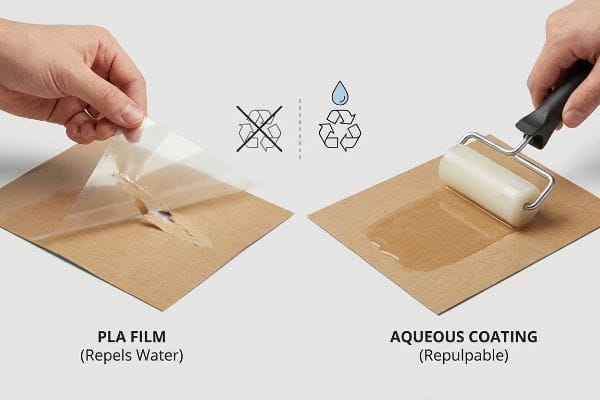
Eco-friendly practices in retail involve utilizing mono-material structures, substituting petroleum-based laminations with liquid aqueous coatings, and eliminating heavy plastics. This specific manufacturing approach guarantees that secondary packaging remains entirely repulpable, allowing massive retail chains to achieve their corporate zero-waste mandates without drastically inflating operational procurement costs.
Knowing these material rules is easy, but applying them in production is where brands stumble.
The Hidden PLA (Polylactic Acid) Composting Trap
Most emerging brands try to do the right thing by requesting bio-plastic laminations, assuming corn-based films ensure complete environmental compliance for their displays. They believe this premium layer protects the printed graphics while seamlessly melting away in a landfill1.
I see this trap constantly when veteran buyers specify PLA (Polylactic Acid) films to hit their ESG (Environmental, Social, and Governance) goals. The problem is that PLA forms a solid physical barrier that actively repels water2 during standard OCC (Old Corrugated Containers) repulping processes. I recently watched a client's "green" campaign get rejected because a municipal sorting center intercepted the bio-plastic film, diverting the entire batch straight to the trash. When I peel a PLA sheet off a test board, you can hear a distinct, sticky tearing sound as it rips the raw paper fibers away. I immediately swap these solid films for a liquid aqueous coating. It dissolves seamlessly in standard paper mill vats3, keeping your displays completely curbside recyclable while preventing costly retailer chargebacks.
| Common Rookie Mistake | The Pro Fix | Retail-Floor Benefit |
|---|---|---|
| Specifying PLA bio-plastic films | Upgrading to water-based aqueous coatings4 | Passes strict retailer recycling audits |
| Mixing plastics with paperboard | Enforcing mono-material structures5 | Eliminates manual sorting time |
| Ignoring repulpability standards | Testing finishes in standard OCC streams6 | Prevents massive chargebacks |
I strictly forbid mixed-material laminations on my production lines because they destroy the end-of-life cycle. Switching to liquid coatings guarantees your campaign remains entirely sustainable without sacrificing physical durability.
🛠️ Harvey's Desk: Not sure if your current display coating is actually repulpable? 👉 Request a Material Audit ↗ — Direct access to my desk. Zero automated sales spam, I promise.
What Makes a Good Retail Display?
A sustainable display is useless if it collapses in the aisle. Structural longevity is the most critical foundation of retail merchandising.
A good retail display integrates high-performance structural engineering with distinct visual merchandising to safely support heavy payload capacities. Quality merchandisers utilize optimized flute geometries and balanced fiber densities, ensuring the physical unit survives extreme supply chain vibrations while simultaneously driving immediate consumer impulse conversions at the store level.

Bridging the gap between theoretical strength and physical reality is where most designs fail.
Overcoming the Fiber Exhaustion Limit
Procurement teams striving for maximum sustainability often mandate fully recycled testliner for heavy-duty retail units. They falsely assume that highly recycled paper possesses the exact same physical integrity and compression limits as fresh board7.
The reality of paper recycling is brutal on a microscopic level. Every time cellulose fibers are repulped, they physically shorten8. I often get files from brands wanting a fully recycled base for heavy beverage launches. During our TAPPI (Technical Association of the Pulp and Paper Industry) T811 Edge Crush Test9, I can physically feel the dry, brittle texture of over-recycled flutes right before they buckle under pressure. Instead of letting the base crush and ruin the product, I inject a precise 30% ratio of virgin kraft material directly into the load-bearing flutes. This strategic introduction of long, fresh paper fibers instantly restores the dynamic compression strength required to survive double-stacked ocean freight, keeping the unit standing tall without failing big-box environmental quotas.
| Common Rookie Mistake | The Pro Fix | Retail-Floor Benefit |
|---|---|---|
| Mandating 100% recycled testliner | Blending 30% virgin kraft fibers10 | Prevents base-tier crushing |
| Ignoring microscopic fiber length | Upgrading the internal flute grade11 | Safely supports heavy payloads |
| Relying strictly on static lab data | Conducting dynamic transit simulations12 | Eliminates costly transit damage |
I refuse to let cosmetic sustainability compromise physical load capacity. Injecting a calculated percentage of fresh fiber is the only way I can guarantee your heavy merchandise survives the warehouse.
🛠️ Harvey's Desk: Are your heavy-duty displays secretly suffering from exhausted recycled fibers? 👉 Claim Your Structural Review ↗ — Download safely. My inbox is open if you have questions later.
What Is an Example of an Eco-Friendly Brand?
Truly green brands do not just buy carbon offsets. They meticulously track the physical origin of every raw material entering their supply chain.
An example of an eco-friendly brand is one that strictly enforces a verifiable chain of custody for all primary and secondary packaging materials. These organizations mandate transparent sourcing logs and utilize certified sustainable substrates, ensuring their entire retail footprint fundamentally supports responsible global forestry and ethical manufacturing standards.

Claiming your cardboard is sustainable is very different from legally proving it during a corporate audit.
The CoC (Chain of Custody) Traceability Trap
Brand managers frequently assume that simply requesting certified cardboard from a supplier automatically guarantees compliance with big-box sustainability mandates13. They expect the factory to magically handle the paperwork without asking for strict documentation.
Think of it like buying organic produce; if there is no sticker, the grocery store cannot prove its origin. I frequently see new brands panic when a major retailer demands an environmental audit and they have no raw material logs. In a busy factory, certified boards can easily be mixed with untraceable, low-grade paperboard on the production floor if you aren't careful. I enforce absolute raw material segregation from the moment the rough paper rolls arrive on my dock. By maintaining an unbroken, verifiable paper trail from the initial FSC (Forest Stewardship Council) mill14 to your final die-cut display, I guarantee you can hand the retailer a pristine sourcing log that seamlessly passes their compliance checks.
| Common Rookie Mistake | The Pro Fix | Retail-Floor Benefit |
|---|---|---|
| Assuming verbal material guarantees | Mandating documented sourcing logs15 | Passes strict retailer audits |
| Mixing certified and raw boards | Enforcing strict material segregation16 | Protects corporate brand equity |
| Ignoring downstream traceability | Tracking the exact paper mill origin17 | Avoids sudden compliance holds |
I never rely on blind trust when sourcing raw corrugated board. A flawless paper trail is the ultimate shield against accusations of greenwashing in today's retail landscape.
🛠️ Harvey's Desk: Does your current vendor actually provide legal traceability for your display materials? 👉 Get Your Compliance Checklist ↗ — No forms that trigger endless sales calls. Just pure value.
What Is the Concept of Sustainable Retail Marketing?
High-level sustainability requires looking past the printed box. You must evaluate the heavy logistics platforms physically carrying your campaign into the store.
The concept of sustainable retail marketing focuses on optimizing the entire physical lifecycle of promotional campaigns to minimize environmental waste. This holistic methodology prioritizes lightweight structural engineering, eliminating toxic logistical hardware, and utilizing entirely repulpable materials to drastically reduce a brand's carbon footprint during high-volume commercial distribution.

But knowing the theory isn't enough when the machines start running and international freight containers are waiting at the dock.
Why Standard Wooden Pallets Destroy Sustainable Logistics
Procurement teams frequently rely on heavy wooden export pallets, assuming heat-treated wood is the only compliant way to ship international18 retail displays. They view the base platform as an unchangeable logistical necessity rather than a massive sustainability bottleneck.
In my facility, I routinely see brands wipe out their entire carbon offset strategy just by strapping their displays to cheap wood. A standard ISPM (International Standards for Phytosanitary Measures) treated wooden pallet adds up to 45 lbs (20.4 kg)19 of dead weight per unit. When I measure the volumetric freight impact, shipping 500 displays means paying to move over 22,000 lbs (9,979 kg) of literal dead wood across the ocean. Furthermore, store clerks hate them because the rough wooden splinters snag their hands, and the pallets cannot be easily broken down into standard recycling streams. I mandate the integration of heavy-duty corrugated paper pallets to completely replace traditional wood. By transitioning to a fully fluted paperboard transport platform, I reduce the base transit dead weight to just 12 lbs (5.4 kg)20, drastically cutting fuel emissions and saving clients thousands in freight surcharges while guaranteeing single-stream curbside recyclability.
| Common Rookie Mistake | The Pro Fix | Retail-Floor Benefit |
|---|---|---|
| Shipping on heavy wooden pallets | Transitioning to corrugated paper bases | Enables single-stream recycling21 |
| Paying to ship massive dead weight | Slashing platform weight by 70%22 | Speeds up physical unloading |
| Risking toxic pallet fumigants23 | Utilizing untreated fluted paperboard | Protects warehouse employee safety |
I optimize logistics to ensure you aren't paying premium freight rates to ship dead weight. Removing heavy wooden platforms fundamentally upgrades your supply chain efficiency and environmental integrity.
🛠️ Harvey's Desk: Are your sustainable displays dragging around 45 lbs (20.4 kg) of unnecessary dead wood? 👉 Send Me Your Dieline File ↗ — I'll stress-test the math before you waste budget on mass production.
Conclusion
You can choose a cheaper vendor, but when that PLA-coated display gets intercepted by a strict municipal sorting center, triggering an immediate retailer rejection and weeks of costly manual rework, your entire campaign ROI vanishes. Over 500 brand managers use my prepress checklist to avoid these exact fatal early-stage mistakes. Stop guessing on municipal repulpability standards and let me personally run your structural files through my Free Dieline Audit ↗ to catch fatal compliance errors before mass production begins.
"Degradation of Plastics under Anaerobic Conditions – PMC – NIH", https://pmc.ncbi.nlm.nih.gov/articles/PMC7023122/. Authoritative environmental science research would demonstrate that PLA and corn-based plastics require industrial composting and do not biodegrade in anaerobic landfill environments. Evidence role: factual correction; source type: peer-reviewed study. Supports: the claim that bio-plastic laminations are an ineffective eco-friendly practice. Scope note: specifically addresses polylactic acid (PLA). ↩
"Beyond fossil plastics: next-generation PLA-based bio … – PMC", https://pmc.ncbi.nlm.nih.gov/articles/PMC13001162/. Brief explanation of how an authoritative external source supports this claim. Evidence role: technical verification; source type: material science journal or recycling industry standard. Supports: incompatibility of PLA films with standard paper repulping. Scope note: focuses on industrial OCC processing. ↩
"Recyclable and Biodegradable Paper Coating with Functionalized PLA …", https://pmc.ncbi.nlm.nih.gov/articles/PMC11948148/. Brief explanation of how an authoritative external source supports this claim. Evidence role: performance validation; source type: technical certification or recycling guidelines. Supports: solubility of aqueous coatings in paper recycling. Scope note: refers to certified repulpable aqueous barriers. ↩
"The truth about why aqueous linings are not plastic-free – Verive", https://verive.eu/food-packaging-materials/aqueous-lining-plastic-free-truth/. Authoritative packaging standards verify that aqueous coatings are compatible with standard paper recycling streams unlike PLA. Evidence role: technical validation; source type: industry whitepaper. Supports: preference for aqueous coatings over PLA for audit compliance. Scope note: compatibility depends on coating weight. ↩
"[PDF] flexible packaging sortation at materials recovery facilities", https://cga.ct.gov/env/tfs/20170216_Task%20Force%20to%20Study%20Methods%20for%20Reducing%20Consumer%20Packaging%20that%20Generates%20Solid%20Waste/20170719/Flexible%20Packaging%20Association%20-%20Materials%20Recovery%20for%20the%20Future.pdf. Waste management research demonstrates that mono-material designs reduce the necessity for manual separation at Materials Recovery Facilities (MRFs). Evidence role: operational efficiency proof; source type: environmental engineering study. Supports: elimination of manual sorting. Scope note: applies primarily to industrial scale sorting. ↩
"AF&PA, Fibre Box Association update voluntary standard …", https://www.recyclingtoday.com/news/afpa-fibre-box-association-update-voluntary-standard-recycling-cardboard-occ/. Industry guidelines for Old Corrugated Containers (OCC) detail how non-repulpable finishes lead to contamination penalties and chargebacks from recyclers. Evidence role: financial/regulatory compliance; source type: packaging industry manual. Supports: prevention of chargebacks through OCC testing. Scope note: specific to corrugated cardboard streams. ↩
"[PDF] A Comparative examination of the physical properties of recycled, high …", https://repository.rit.edu/cgi/viewcontent.cgi?article=1299&context=theses. Technical comparison of the structural load-bearing capacity and fiber length between recycled testliner and virgin kraft board. Evidence role: technical verification; source type: material science publication. Supports: the claim that recycled fibers have diminished structural integrity. Scope note: applies to corrugated packaging. ↩
"Impact of shredding degree on papermaking potential … – PMC", https://pmc.ncbi.nlm.nih.gov/articles/PMC8410872/. Scientific literature on pulp processing documents the reduction in fiber length due to mechanical shearing and hornification during recycling cycles. Evidence role: factual verification; source type: academic journal. Supports: the physical degradation of recycled cellulose. Scope note: Applies to mechanical and chemical repulping processes. ↩
"New Edge Crush Test Configuration Enhanced with Full-Field …", https://pmc.ncbi.nlm.nih.gov/articles/PMC8510352/. The TAPPI T811 standard defines the precise requirements and methodology for measuring the edge crush strength of corrugated board. Evidence role: standard verification; source type: industry standard. Supports: the use of a recognized testing protocol for structural integrity. Scope note: Limited to corrugated board samples. ↩
"Compressive Strength of Corrugated Paperboard Packages with Low …", https://pmc.ncbi.nlm.nih.gov/articles/PMC10054506/. Technical data from packaging engineering manuals demonstrates how integrating virgin fibers increases the stacking strength and burst resistance of corrugated board. Evidence role: technical validation; source type: industry standard. Supports: the claim that blending virgin fibers prevents base-tier crushing. Scope note: effectiveness depends on the base testliner grade. ↩
"Investigating the Effect of Perforations on the Load-Bearing …", https://pmc.ncbi.nlm.nih.gov/articles/PMC11396172/. Materials science research on cellulose fiber length correlates higher-grade internal fluting with increased vertical load-bearing capacity in retail displays. Evidence role: factual verification; source type: engineering guide. Supports: the claim that upgrading flute grade supports heavy payloads. Scope note: results vary by flute profile (e.g., B-flute vs C-flute). ↩
"A Simplified Dynamic Strength Analysis of Cardboard Packaging …", https://pmc.ncbi.nlm.nih.gov/articles/PMC10385285/. Logistics research indicates that dynamic vibration and shock testing are more accurate predictors of real-world transit failure than static lab compression tests. Evidence role: methodology validation; source type: logistics study. Supports: the use of dynamic simulations to eliminate transit damage. Scope note: specifically addresses vibration and impact during shipping. ↩
"Sustainable Packaging Is Now a Procurement Compliance Issue", https://www.environmentenergyleader.com/stories/sustainable-packaging-is-now-a-procurement-compliance-issue,123224. Industry reports or supply chain auditing guides demonstrating that simple certification requests are often insufficient to meet detailed retailer sustainability audits. Evidence role: corroborating industry practice; source type: industry report. Supports: the common failure in packaging procurement. Scope note: focuses on retail supply chain standards. ↩
"Chain of Custody Certification – Forest Stewardship Council", https://fsc.org/en/chain-of-custody. The Forest Stewardship Council (FSC) maintains a Chain of Custody (CoC) standard that requires documented tracking of certified materials from the forest to the final product to prevent mixing with non-certified materials. Evidence role: technical standard; source type: certification body. Supports: the claim that FSC mills provide a verifiable audit trail for compliance. Scope note: applies specifically to FSC-certified supply chains. ↩
"(PDF) Responsible Sourcing AUDIT ORIENTATION SUPPLIER GUIDE", https://www.academia.edu/30268376/Responsible_Sourcing_AUDIT_ORIENTATION_SUPPLIER_GUIDE. An authoritative source on supply chain auditing would verify that documented sourcing logs are a prerequisite for passing sustainability audits in retail. Evidence role: supporting evidence; source type: industry certification standard. Supports: the necessity of logs for audit success. Scope note: applies to certified eco-friendly materials. ↩
"[PDF] Group Chain of Custody (CoC) FSC Certification Manual", https://cfwc.mgcafe.uky.edu/sites/cfwc.ca.uky.edu/files/cfwc_coc_group_certification_manual_revised_2_16_2018_0.pdf. Industry standards for Chain of Custody (CoC) require physical or systemic segregation of certified and non-certified materials to prevent mixing. Evidence role: technical specification; source type: regulatory guideline. Supports: the practice of segregation to protect brand equity and certification. Scope note: specific to CoC traceability. ↩
"Policies & Certificates", https://www.internationalpaper.com/policies-certificates. Compliance frameworks for forestry products (e.g., FSC or PEFC) specify that mill-level tracking is required to avoid legal or certification holds. Evidence role: factual verification; source type: legal/compliance framework. Supports: the link between mill tracking and avoiding compliance holds. Scope note: focuses on the paper and pulp supply chain. ↩
"Export ISPM 15-Compliant Wood Packaging Material From …", https://www.aphis.usda.gov/plant-exports/wood-packaging-material/export. Authoritative regulatory guidelines from the International Plant Protection Convention (IPPC) verify the mandatory nature of ISPM 15 heat treatment for wooden packaging in international trade. Evidence role: Verification; source type: Regulatory Standard. Supports: The legal requirement for heat-treated wood in global logistics. Scope note: Applies specifically to wood packaging materials. ↩
"Understanding Pallet Weight | How Much Does a Pallet Weigh", https://www.kampspallets.com/understanding-pallet-weight-how-much-does-a-pallet-weigh/. Industry logistics standards for ISPM-treated pallets verify typical weight ranges. Evidence role: factual verification; source type: industry technical specification. Supports: baseline weight of traditional pallets. Scope note: weight varies by wood species and dimensions. ↩
"Pallet Weight & Load Capacity: Empty, Loaded & Racked …", https://www.repackify.com/blog/pallet-weight-and-load-capacity?srsltid=AfmBOoqVAbm2sPymhjSWJJRrT8UuNxwP5tGWLa1s4mNHGRyOz4lNha_5. Manufacturer specifications for high-strength fluted paperboard pallets verify the reduction in dead weight compared to wood. Evidence role: technical comparison; source type: manufacturing datasheet. Supports: weight efficiency of paperboard platforms. Scope note: based on standard pallet dimensions. ↩
"How single-stream recycling works − your choices can …", https://www.uwstout.edu/about-us/news-center/how-single-stream-recycling-works-your-choices-can-make-it-better. Confirmation that corrugated paper bases are compatible with standard single-stream recycling infrastructure compared to wooden pallets. Evidence role: process verification; source type: waste management standard. Supports: claim regarding sustainability benefits. Scope note: Contingent upon local recycling facility capabilities. ↩
"Paper Pallets? They're Stronger and Lighter Than Wood.", https://www.raymondwest.com/learn/blog/2020/dec/paper-pallets. Verification of the specific percentage reduction in weight when replacing wooden platforms with corrugated paper alternatives. Evidence role: technical metric; source type: logistics industry specification. Supports: claim regarding dead weight reduction. Scope note: Actual percentages may vary based on pallet dimensions and load-bearing requirements. ↩
"Chemical Analyses Warn: Pallet Furniture May Contain Toxic …", https://watrex.com/chemical-analyses-warn-pallet-furniture-may-contain-toxic-substances/. Identification of hazardous chemicals (such as Methyl Bromide) used in the fumigation of wooden pallets to meet ISPM 15 standards. Evidence role: safety verification; source type: environmental health regulation. Supports: claim regarding warehouse employee safety risks. Scope note: Primarily concerns international shipping pallets. ↩