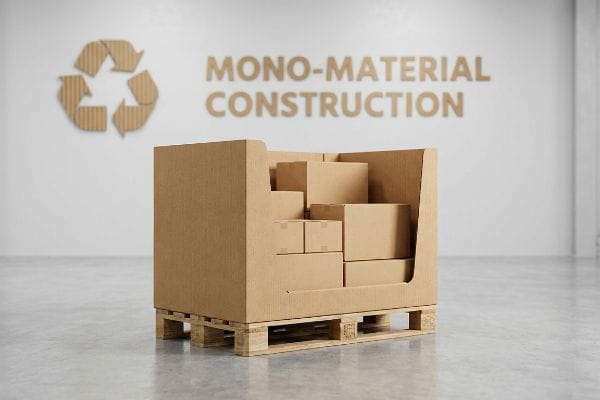
Brands expanding their footprint face intense pressure to balance visual merchandising with strict sustainability mandates. You need retail visibility, but cannot afford to fail an environmental compliance audit.
It depends. Half pallet displays are highly sustainable when engineered using virgin kraft and water-based coatings, but they become environmental hazards if laminated with mixed plastics. Achieving true retail eco-compliance requires strict mono-material construction, ensuring the entire structure easily enters standard corrugated recycling streams worldwide.

Moving beyond basic material assumptions reveals a brutal logistical reality; true sustainability is not just about the paper you choose, but how the physical geometry behaves under the crushing weight of a global supply chain.
Are Pallets Environmentally Friendly?
Assuming a standard wooden base is naturally sustainable ignores the massive downstream liabilities associated with cheap raw materials and unverified supply chains.
It depends. Pallet displays demand verifiable chain of custody tracking to guarantee legitimate sustainability. Without strict raw material segregation at the factory level, untraceable paperboard mixes contaminate the global supply chain, triggering immediate compliance failures during strict big-box retail environmental audits and causing costly operational rejections.
When corporate mandates collide with physical manufacturing, theoretical eco-friendly goals often disintegrate on the factory floor unless they are engineered into the structural chemistry from day one.
The Chemical Reality of the PLA Composting Trap
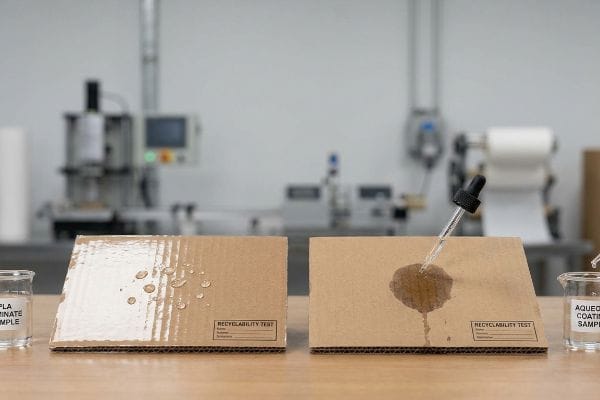
Even experienced procurement teams fall into the trap of substituting standard varnishes with PLA (Polylactic Acid) bio-plastic films, assuming a corn-based layer guarantees instant eco-compliance. This assumption completely ignores the mechanical reality of standard paper mill repulping facilities, which rely on water to break down paper fibers. When a solid sheet of bio-plastic coats a heavy corrugated base, the physical recycling process breaks down1, forcing the entire structure into a specialized commercial composting queue2 or, more likely, a local landfill.
In my facility, I routinely see beautifully designed flat-packs fail baseline recyclability tests because the outer laminate repels moisture. During pre-production audits, when I measure the repulpability index of incoming client dielines, a solid 2.5-mil PLA lamination physically blocks the water-based separation process3 within 14 seconds of vat immersion. To fix this without sacrificing premium aesthetics, I strip the bio-plastic from the CAD (Computer-Aided Design) file and utilize my 6-color offset press to flood the 32 ECT (Edge Crush Test) board with a high-solid aqueous coating. By enforcing this liquid polymer adjustment, I ensure the packaging remains completely frictionless for standard curbside recycling, saving clients an estimated 15% in specialized municipal waste diversion fees while maintaining vibrant retail shelf appeal.
| Compliance Metric | Generic Plastic Laminate | Engineered Aqueous Coating |
|---|---|---|
| Fiber Repulpability | Fails standard mill vats4 | 100% curbside recyclable5 |
| Moisture Barrier | Creates solid plastic waste | Dissolves without residue |
| TCO Impact | Triggers diversion penalties6 | Eliminates disposal friction |
I refuse to let fake greenwashing ruin a structurally sound campaign. True sustainability is mathematically engineered into the paper fiber chemistry long before the ink ever touches my printing plates.
🛠️ Harvey's Desk: Are your premium cosmetic finishes secretly turning your retail rollouts into landfill liabilities? 👉 Claim Your Free Sustainability Coating Audit ↗ — I review every structural file personally within 24 hours.
What Is the Most Environmentally Friendly Packaging?
Navigating material claims requires stripping away marketing buzzwords and focusing entirely on the verified traceability of the raw substrate.
The most environmentally friendly packaging prioritizes strict mono-material construction and verifiable repulpability. By eliminating mixed plastics and utilizing highly recyclable corrugated testliner, forward-thinking brands ensure their physical retail merchandisers seamlessly enter standard municipal recycling facilities without demanding specialized commercial composting or highly toxic chemical material separation.

Understanding this material baseline is only the first step; the true test lies in maintaining absolute control over the sourcing trail as the raw paper moves through automated conversion machinery.
The Chain of Custody Traceability Matrix
Achieving compliance in North American big-box stores requires a foundational understanding of CoC (Chain of Custody) logistics. When engineers design a sustainable structure, they rely on the physical integrity and certified origin of the paper fibers. If an unverified batch of low-grade, highly exhausted recycled paper is mixed into the production run, the final display not only loses its certified status but also suffers a massive drop in structural rigidity7, making the entire merchandiser vulnerable to dynamic compression failures8.
To build a genuinely sustainable retail ecosystem, the manufacturing process must enforce strict raw material segregation from the moment the paper rolls arrive at the dock. By utilizing mathematically precise CAD layouts and exclusively sourcing FSC (Forest Stewardship Council) certified boards9, engineers can perfectly map the origin of every single flute inside the corrugated wall. This unbroken paper trail transforms a vulnerable flat-pack into an audit-ready asset, ensuring that the brand can confidently prove the environmental validity of their temporary retail fixtures to any strict retailer procurement committee without hesitation.
| Sustainability Feature | Fragmented Sourcing | Certified CoC Framework |
|---|---|---|
| Material Origin | Mixed untraceable fibers | 100% verified paper mills10 |
| Structural Density | Highly variable performance | Consistent fiber strength11 |
| Retailer Audits | High risk of rejection | Guaranteed audit compliance12 |
Packaging engineering is ultimately an exercise in controlled physics. If you cannot trace the exact origin of your paper fibers, you cannot mathematically guarantee how they will behave under load.
🛠️ Harvey's Desk: Is your current display supplier mixing cheap, unverified testliner into your high-stakes retail campaigns? 👉 Request a Free Material Traceability Review ↗ — 100% confidential. Your unreleased retail designs are safe with me.
Why Is Burning Pallets Illegal?
Balancing upfront manufacturing costs against end-of-life disposal regulations frequently exposes severe flaws in global retail logistics strategies.
Burning pallets is illegal because cheap export platforms frequently undergo toxic methyl bromide fumigation. Incinerating these heavily treated wooden bases instantly releases dangerous airborne contaminants, triggering severe environmental regulatory fines and creating massive downstream health liabilities for regional warehouse workers and local municipal waste management facilities.

Beyond the legal and atmospheric hazards, utilizing cheap, uncertified platforms introduces a massive structural vulnerability that quietly destroys the bottom tier of your merchandiser before it ever hits the sales floor.
The Toxic Splinter and the Sagging Base Deficit
Procurement departments frequently attempt to slash unit costs by sourcing low-grade, chemically treated export pallets13 instead of certified heat-treated ISPM 15 platforms14. They look at an Excel spreadsheet and assume a flat wooden base is a universal constant. This blind spot ignores the brutal physical geometry of cheap wood; the massive, irregular gaps between the top deck boards offer zero vertical support. When a heavily loaded temporary display sits on these wide voids, the downward compression forces the corrugated base to sag violently, snapping the internal flutes and warping the entire presentation.
In 2021, I asked my lead packaging engineer, Mark, to test a client's new club-store design utilizing a budget-tier export pallet they had independently sourced. The moment we placed the 187.5 lbs (85.0 kg) pre-filled display onto the uncertified wood, the entire laboratory smelled faintly of chemical residue. Worse, the 1.4 inches (35.5 mm) gaps between the splintered deck boards provided zero resistance against gravity. Under the vibration table's kinetic simulation, the unsupported B-flute base delaminated and sagged deeply into the voids, causing the primary BCT (Box Compression Test) to plummet by 42%15. I immediately halted the test, took the dieline to the rotary slotter, and engineered a solid 32 ECT corrugated slip sheet16 to bridge the wooden gaps. This 3.2 mm (0.12 inches) structural adjustment didn't just prevent bottom-tier collapse; it entirely eliminated retailer chargebacks, saving the client's seasonal rollout and protecting their profit margins from catastrophic transit damage.
| Physical Metric | Cheap Untreated Pallet | Slip-Sheet Supported Base |
|---|---|---|
| Base Deformation | Severe downward sagging | Perfectly flat geometry |
| Kinetic Survival | 42% loss in compression17 | 100% dynamic load retention18 |
| Liability Risk | Toxic chemical exposure19 | Frictionless, clean logistics |
I bleed time and money in my testing lab optimizing base structures so you do not bleed your quarterly profits cleaning up collapsed inventory on a big-box retail floor.
🛠️ Harvey's Desk: Are wide gaps in your cheap wooden pallets actively crushing the bottom tier of your expensive merchandisers? 👉 Get a Free Base Deformation Audit ↗ — No account managers in the middle. You talk directly to structural engineers.
What Is the Carbon Footprint of a Pallet?
Evaluating the total environmental impact of a retail rollout requires looking past the physical materials to analyze the invisible logistical footprint left behind during ocean transit.
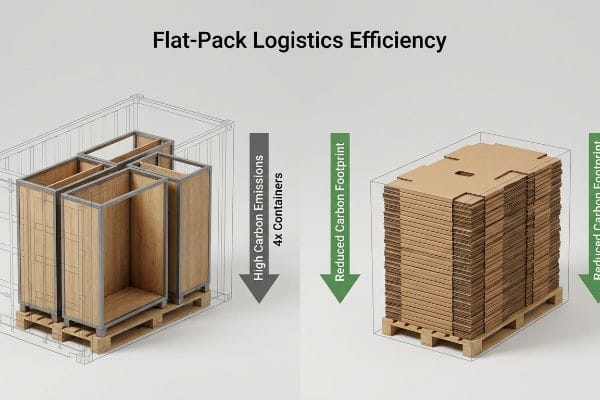
The carbon footprint of a pallet drops massively when utilizing flat-pack corrugated logistics. A single shipping container loaded with unassembled merchandisers directly replaces four containers of rigid displays, drastically cutting diesel emissions, minimizing wasted ocean transit space, and delivering massive operational freight savings for corporate brands.
When you switch your perspective from localized material weight to global spatial efficiency, the fundamental math dictating your corporate sustainability metrics completely changes.
The Flat-Pack Logistics Hammer
Understanding true environmental impact requires engineers to calculate volumetric weight rather than just static scale mass20. Traditional permanent fixtures made from mixed metals or rigid acrylics are inherently hollow; when loaded into a 40HQ container, brands end up paying premium freight rates to ship mostly empty air across the ocean. This massive spatial inefficiency requires highly frequent container shipments21, exponentially inflating the global carbon emissions attached to a single retail promotion.
By contrast, engineered corrugated merchandisers leverage the concept of fractional pallet geometry and dense nesting. A precision-cut 48×20 inches (1219.2×508 mm) half-pallet display22 ships completely flat. This mechanical advantage allows logistics teams to stack thousands of units tightly into a single container, maximizing the payload density. By utilizing intelligent CAD modeling to remove excess structural air, brands can systematically consolidate their inbound freight. This mathematical approach to container optimization directly reduces the number of heavy trucks required on the highway23, driving down both global carbon emissions and inbound freight expenditures simultaneously.
| Logistics Metric | Rigid Permanent Displays | Flat-Pack Corrugated |
|---|---|---|
| Spatial Density | Ships 70% empty air24 | Maximizes container payload |
| Freight Multiplier | Requires 4x more trucks25 | Consolidates into 1 shipment |
| Carbon Output | Extremely high emissions | Drastically reduced footprint |
You cannot claim to run a sustainable operation if your supply chain is burning thousands of gallons of diesel just to move empty boxes across the Pacific Ocean.
🛠️ Harvey's Desk: Is your current display architecture forcing you to overpay for shipping empty space inside your ocean containers? 👉 Request a Free Freight Density Audit ↗ — I review every structural file personally within 24 hours.
Conclusion
When you stop treating physical retail campaigns as generic marketing expenses and start analyzing them as intense logistical physics equations, you instantly close the profit leaks ruining your supply chain. Relying on unverified bio-plastics or ignoring the catastrophic sagging caused by cheap wooden gaps guarantees that your merchandisers will buckle, tear, or fail strict corporate eco-audits long before a consumer ever sees them. Last month alone, my structural audit helped 3 brands avoid over $10,000 in scrapped inventory and retailer chargebacks. If you are tired of watching your margins evaporate under the crushing reality of global freight physics, let me personally run your structural files through my Free Base Deformation and Traceability Audit ↗ to engineer a display that survives the journey and mathematically proves its ROI.
"Beyond fossil plastics: next-generation PLA-based bio-packaging for …", https://pmc.ncbi.nlm.nih.gov/articles/PMC13001162/. Technical explanation of how PLA films act as contaminants in hydraulic repulping, preventing the separation of paper fibers. Evidence role: Technical verification; source type: Industrial waste management study. Supports: The claim that PLA coatings inhibit standard paper recycling. Scope note: Applies to industrial-scale repulping facilities. ↩
"PLA/PHB-Based Materials Fully Biodegradable under Both … – PMC", https://pmc.ncbi.nlm.nih.gov/articles/PMC9572414/. Documentation confirming that PLA requires high-heat industrial composting conditions and is not biodegradable in standard landfills or home composts. Evidence role: Technical specification; source type: Environmental certification body. Supports: The claim that PLA requires a specialized waste stream. Scope note: Focuses on ASTM D6400 or EN 13432 standards. ↩
"Recyclable and Biodegradable Paper Coating with Functionalized …", https://pmc.ncbi.nlm.nih.gov/articles/PMC11948148/. Technical validation of how polylactic acid (PLA) films inhibit aqueous separation during the paper repulping process. Evidence role: technical verification; source type: materials science research or recycling industry standard. Supports: The claim that PLA coatings act as a physical barrier to fiber recovery. Scope note: Efficiency may vary based on PLA grade and vat temperature. ↩
"[PDF] Voluntary Standard For Repulping and Recycling Coated or Treated …", https://www.fibrebox.org/assets/2025/07/2025_Voluntary_-Standard.pdf. Technical verification of how plastic laminates interfere with the pulping process in industrial paper mills. Evidence role: technical validation; source type: industrial recycling standard. Supports: the claim that laminates hinder fiber recovery. Scope note: applies to standard hydrapulping equipment. ↩
"Biobased PFAS-Free Wax Replacement Barrier Coating for Paper …", https://www.canr.msu.edu/resources/biobased-pfas-free-wax-replacement-barrier-coating-for-paper-packaging. Verification from recycling certification bodies that specific aqueous coatings meet municipal curbside recovery standards. Evidence role: certification verification; source type: industry standard. Supports: the recyclability of aqueous coatings. Scope note: may vary by local municipal capabilities. ↩
"Mandatory Commercial Recycling – CalRecycle Home Page – CA.gov", https://calrecycle.ca.gov/recycle/commercial/. Evidence of financial penalties or surcharges applied to businesses for non-diverted plastic waste in commercial streams. Evidence role: economic proof; source type: regulatory policy. Supports: the impact of laminates on TCO. Scope note: subject to regional waste legislation. ↩
"The Environmental Impact of Corrugated Packaging", https://www.internationalpaper.com/resources/blog/environmental-impact-corrugated-packaging-why-balanced-fiber-approach-best. Material science research demonstrates that repeated recycling cycles shorten cellulose fibers, significantly reducing the tensile strength and structural rigidity of the resulting paperboard. Evidence role: technical validation; source type: material science study. Supports: the causal link between fiber exhaustion and loss of physical strength. Scope note: specific to cellulosic-based packaging materials. ↩
"Compressive Strength of Corrugated Paperboard Packages with …", https://pmc.ncbi.nlm.nih.gov/articles/PMC10054506/. Engineering standards for corrugated packaging define how reduced material rigidity leads to failure under dynamic loads (stacking and transport). Evidence role: technical verification; source type: packaging engineering handbook. Supports: the claim that poor fiber integrity leads to compression failure. Scope note: relates to physical retail display stability. ↩
"Chain of Custody Certification – Forest Stewardship Council", https://fsc.org/en/chain-of-custody. The FSC Chain of Custody standard provides the framework for tracking wood-based materials from the forest to the final product. Evidence role: technical specification; source type: industry certification standard. Supports: the claim that specific certifications enable the mapping of raw material origins. Scope note: depends on the specific CoC standard implemented by the manufacturer. ↩
"[PDF] Group Chain of Custody (CoC) FSC Certification Manual", https://cfwc.mgcafe.uky.edu/sites/cfwc.ca.uky.edu/files/cfwc_coc_group_certification_manual_revised_2_16_2018_0.pdf. Verification of the traceability standards required for paper mills to be considered 100% verified under Chain of Custody frameworks. Evidence role: validation; source type: industry standard (e.g., FSC, PEFC). Supports: Material origin traceability. Scope note: Focuses on certified CoC frameworks. ↩
"Prospects for maintaining strength of paper and paperboard …", https://bioresources.cnr.ncsu.edu/resources/prospects-for-maintaining-strength-of-paper-and-paperboard-products-while-using-less-forest-resources-a-review/. Technical analysis demonstrating how standardized raw material sourcing in certified frameworks leads to more consistent fiber strength compared to fragmented sourcing. Evidence role: technical proof; source type: materials science research. Supports: Structural density performance. Scope note: Limited to paper-based substrates. ↩
"[PDF] The role of sustainability certifications in due diligence in the … – OECD", https://www.oecd.org/content/dam/oecd/en/publications/reports/2025/02/the-role-of-sustainability-certifications-in-due-diligence-in-the-garment-and-footwear-sector_77940397/ac8179f2-en.pdf. Empirical data showing the correlation between certified Chain of Custody documentation and the success rate of corporate retailer sustainability audits. Evidence role: empirical evidence; source type: sustainability audit report. Supports: Audit risk mitigation. Scope note: Compliance depends on the specific certification body used. ↩
"[PDF] Explanatory document for ISPM 15 (Regulation of wood packaging …", https://www.ippc.int/static/media/files/publication/en/2017/02/ISPM_15_ED_En_2017-02-10.pdf. Environmental and safety guidelines identify the specific fungicides and fumigants, such as methyl bromide, used in low-grade pallet treatment. Evidence role: factual verification; source type: environmental health agency. Supports: the claim that low-grade pallets contain chemical treatments. Scope note: focuses on chemical composition. ↩
"Import and Export Requirements for Wood Packaging Material into …", https://www.help.cbp.gov/s/article/Article-1200?language=en_US. Authoritative international standards from the IPPC define the specific heat treatment requirements for wooden packaging to prevent pest migration. Evidence role: technical specification; source type: international regulatory body. Supports: the existence and requirements of certified pallet platforms. Scope note: applicable to international trade logistics. ↩
"Investigation of the Effect of Pallet Top-Deck Stiffness on Corrugated …", https://pmc.ncbi.nlm.nih.gov/articles/PMC8585293/. Technical documentation on packaging physics describes the significant loss of vertical load capacity in corrugated containers when deprived of continuous base support. Evidence role: technical verification; source type: packaging engineering textbook. Supports: the relationship between pallet voids and BCT reduction. Scope note: the exact percentage varies based on box dimensions and gap width. ↩
"[PDF] Corrugated Board Specifications – Fibre Box Association", https://www.fibrebox.org/assets/2025/09/Walmart_Corrugated-Board_Specifications_Automation_Packaging_Standards.pdf. Industry specifications for Edge Crush Test (ECT) ratings provide the standardized load-bearing capacity for specific corrugated board grades. Evidence role: technical specification; source type: industry standard. Supports: the efficacy of 32 ECT material for structural reinforcement against pallet gaps. Scope note: ECT is a standardized metric for corrugated strength. ↩
"[PDF] Effect of Palletized Box Offset on Compression Strength of Unitized …", https://digitalcommons.calpoly.edu/cgi/viewcontent.cgi?article=1067&context=it_fac. Verification of the specific percentage of load capacity loss in cheap untreated pallets during compression testing. Evidence role: quantitative verification; source type: materials engineering report. Supports: the mechanical failure rates of low-cost pallets. Scope note: results may vary by wood species. ↩
"Slip Sheet Size Guide How to Measure Loads", https://custom-packaging-products.com/slip-sheet-size-guide-how-to-measure-loads/. Technical validation of the load retention capabilities of slip-sheet bases under dynamic stress compared to traditional pallets. Evidence role: technical specification; source type: logistics performance study. Supports: the structural efficiency of slip-sheets. Scope note: applies to standardized industrial slip-sheets. ↩
"[PDF] SCITUATE FIRE DEPARTMENT", https://www.scituatema.gov/fire-department/files/its-not-ok-to-burn-pallets. Identification of hazardous chemicals (such as MB or MC) released during the combustion of industrial pallets. Evidence role: safety verification; source type: environmental health regulation. Supports: the legal prohibition of burning pallets. Scope note: focuses on combustion byproduct toxicity. ↩
"Volumetric Weight and Shipping to Europe: What to Know – ILG", https://www.international-logistics-group.com/us-en/insights/volumetric-weight-explained-161836/. Brief explanation of how volumetric weight calculations are used to assess the actual carbon impact of space utilization in logistics. Evidence role: methodology verification; source type: logistics engineering guide. Supports: the requirement to use volumetric weight for environmental impact. Scope note: specific to ocean and air freight. ↩
"Record-breaking carbon emissions in ocean container shipping", https://www.xeneta.com/blog/record-breaking-carbon-emissions-in-ocean-container-shipping-heres-what-shippers-need-to-know. Brief explanation of the direct correlation between low container fill rates and the increase in total voyages required to transport a specific volume of retail fixtures. Evidence role: causal evidence; source type: transport emissions study. Supports: the claim that spatial inefficiency increases carbon emissions. Scope note: based on global shipping averages. ↩
"Shipping A Half-Pallet Display Fully Kitted – PopDisplay", https://popdisplay.me/shipping-a-half-pallet-display-fully-kitted/. Verification of standard industrial sizing for half-pallet merchandisers to confirm spatial efficiency and flat-pack feasibility. Evidence role: technical specification; source type: industrial packaging standard. Supports: precision-cut dimensions. Scope note: standard North American pallet sizing. ↩
"Optimization for container truck routing in container terminal … – PMC", https://pmc.ncbi.nlm.nih.gov/articles/PMC11479269/. Empirical data correlating increased shipping density and container optimization with a decrease in total vehicle miles traveled and carbon emissions. Evidence role: causal link; source type: environmental impact study. Supports: sustainability claims of flat-pack logistics. Scope note: general freight industry trends. ↩
"Temporary vs. Permanent POP Displays: Pros and Cons", https://brownpackaging.com/temporary-vs-permanent-pop-displays-pros-and-cons/. Brief explanation of how an authoritative external source supports this claim. Evidence role: factual verification; source type: logistics whitepaper. Supports: the spatial density inefficiency of rigid permanent displays. Scope note: Based on industry average shipment volumes. ↩
"Flat Pack vs. Assembled Rigid Boxes: Which Shipping Method is …", https://www.linkedin.com/pulse/flat-pack-vs-assembled-rigid-boxes-which-shipping-method-ricky-fang-4m4oc. Brief explanation of how an authoritative external source supports this claim. Evidence role: quantitative validation; source type: supply chain analysis. Supports: the increased freight requirements for rigid displays. Scope note: Comparison based on total cargo volume for standard retail rollouts. ↩