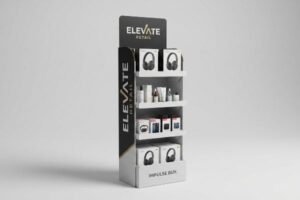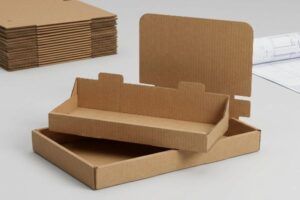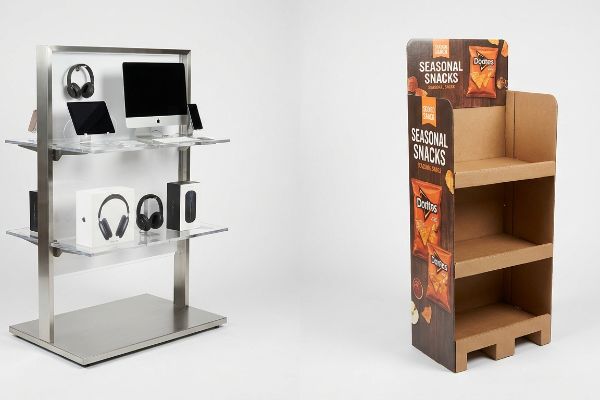
Brands constantly debate whether to invest in permanent fixtures or agile temporary setups. The wrong choice drains marketing budgets and triggers massive logistical bottlenecks.
Permanent and temporary POP (Point of Purchase) displays serve completely different retail strategies. Permanent fixtures use heavy metal or acrylic for multi-year merchandising, while temporary structures utilize flat-packed corrugated board to drive agile, short-term seasonal campaigns and drastically reduce outbound freight expenses.
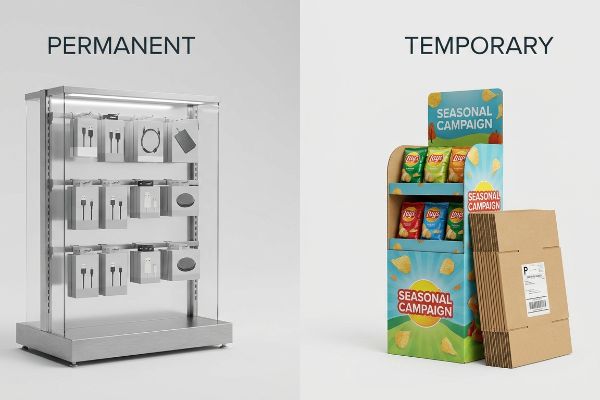
Choosing between a permanent steel rack and a temporary corrugated shipper isn't just an aesthetic preference; it is a brutal calculation of freight density, campaign lifespan, and retailer compliance.
What Are the Different Types of POP Displays?
Understanding different retail merchandisers isn't just about picking attractive shapes; it is about choosing the right format to maximize product visibility and align with basic store layouts.
Different types of POP displays include massive floor stands, compact countertop units, heavy-duty pallet configurations, inline shelf trays, and clip strips. Each format serves a specific purpose in a commercial store, balancing visibility with basic spatial footprint constraints to improve the shopper experience.
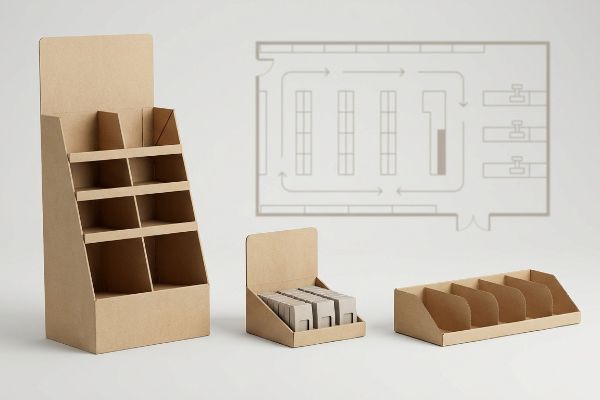
When you move past basic definitions, you realize that deploying these different formats requires understanding retail strategy.
Retail Zone Strategy and Footprint Basics
Junior designers often pitch a scalable concept where a massive floor merchandiser can simply be shrunk by fifty percent to serve as a register unit. They treat different formats as interchangeable artboards, assuming that a design that looks good as a freestanding unit will automatically work right next to the checkout line. This theoretical approach ignores how shoppers naturally interact with different commercial environments1 and often leads to units that feel awkward or out of place.
In retail reality, choosing the right display format is about matching the unit to the specific shopper mindset in that exact zone. Floor displays are designed for deep-aisle engagement2 where customers have time to casually browse, while countertop units must facilitate rapid, impulsive decisions right at the register. By separating these formats and focusing on basic consumer behavior, brands can deploy merchandisers that naturally fit the store's flow, preventing cluttered aisles and maximizing overall sales opportunities.
| Metric/Feature | Generic Scaling Approach | Strategic Retail Reality |
|---|---|---|
| Floor Format | Arbitrary base footprint | Deep-aisle browsing zone |
| Counter Format | Interchangeable artwork | Quick impulse checkout3 |
| Store Impact | Cluttered shopping experience | Optimized traffic flow4 |
Designing distinct display formats guarantees your products meet shoppers precisely where they are ready to buy. I always align the physical merchandiser with its optimal store zone to maximize natural impulse conversions.
🛠️ Harvey's Desk: Are your shrink-to-fit designs violating strict retailer zone limits and risking mass chargebacks? 👉 Request a Spatial Compliance Audit ↗ — I review every structural file personally within 24 hours.
What Displays Are Suggested for Salons?
Premium environments demand flawless aesthetics, making compact countertop setups the ultimate visual choice for high-end beauty locations.
Suggested displays for salons prioritize high-end countertop units, elegant temporary PDQ trays, and compact shelf structures. Because salon environments feature extremely limited physical counter space, these merchandisers must utilize small footprints while delivering premium visual branding that elevates the product's perceived luxury value.

Pitching a luxury salon display sounds simple until you realize that creating a premium visual experience requires precise retail strategy.
The Premium Aesthetics and Space Trap
Junior design agencies love to submit beautiful, compact salon trays drawn perfectly in Adobe Illustrator with intricate messaging. They treat the limited space like a standard billboard, assuming that overwhelming the shopper with benefits and bright colors will automatically drive beauty sales. This theoretical approach clutters the elegant environment and fights against the relaxing atmosphere salons work hard to cultivate.
In retail reality, successful salon displays thrive on minimalist design5 and strict space conservation. Because counter space at a salon register is incredibly scarce, merchandisers must have a minimal footprint while relying on clean, sophisticated branding to catch the eye. By shifting the focus away from loud graphics and prioritizing a sleek, premium presentation, brands can naturally blend into the luxury salon environment and capture high-end impulse purchases6 without looking cheap or overly promotional.
| Metric/Feature | Generic Design Approach | Premium Retail Reality |
|---|---|---|
| Visual Style | Cluttered messaging | Clean, minimalist luxury |
| Space Usage | Standard bulky footprint | Extremely compact base7 |
| Shopper Appeal | Cheap billboard aesthetic | High-end impulse driver8 |
Building clean, compact salon displays guarantees your brand elevates the room rather than cluttering the register. I always strip away excess visual noise to create premium merchandisers that beauty customers actually want to explore.
🛠️ Harvey's Desk: Is your compact counter unit physically tearing itself apart due to ignored material caliper tolerances? 👉 Claim Your Free Dieline Audit ↗ — 100% confidential. Your unreleased retail designs are safe with me.
What Are the Five Types of Displays?
Categorizing the five primary formats is easy; ensuring they actually align with a cohesive in-store marketing strategy is the real challenge.
The five types of displays generally include heavy floor stands, temporary countertop trays, bulk pallet wrappers, inline shelf merchandisers, and hanging sidekick units. Each structural format serves a unique strategic role to successfully engage shoppers while organizing products cleanly across different retail departments.
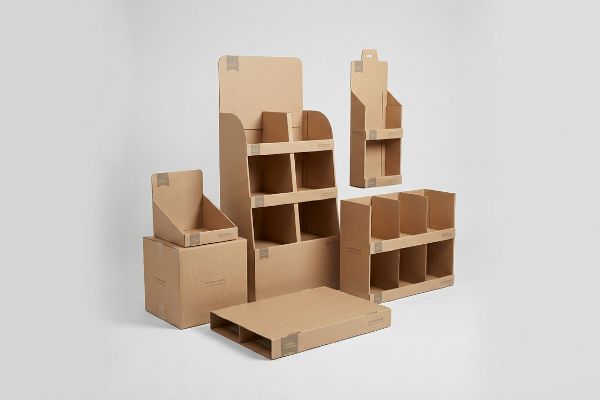
Knowing these five categories is just the entry ticket; the real battle begins when you try to launch them together in a unified campaign.
The Cohesive Retail Strategy Challenge
Marketing teams often try to deploy all five display formats simultaneously using a fragmented design approach. They assume that as long as the core logo is present, a floor stand and a hanging sidekick can feature completely different color palettes and messaging hierarchies. This disconnected strategy dilutes brand identity and confuses shoppers9 who encounter multiple, visually inconsistent units throughout their store visit.
In retail reality, deploying these five formats requires a strictly unified visual merchandising strategy. Whether a customer sees a pallet wrapper at the entrance or an inline shelf tray in the back aisle, the core brand colors and primary messaging must remain entirely consistent. By treating all five formats as a cohesive ecosystem rather than isolated units, marketers create multiple familiar touchpoints that gently reinforce the campaign and significantly boost final checkout conversions10.
| Metric/Feature | Fragmented Campaign Approach | Unified Retail Reality |
|---|---|---|
| Visual Identity | Disconnected color palettes | Strictly consistent branding11 |
| Messaging | Conflicting benefit claims | Unified campaign focus12 |
| Shopper Journey | Confusing brand experience | Reinforced familiar touchpoints13 |
A synchronized rollout across all five formats ensures your brand messaging resonates loudly in every aisle. I align visual elements across the entire display ecosystem to build undeniable campaign momentum.
🛠️ Harvey's Desk: Are your heavy floor units suffering from hidden micro-fractures along the primary folds before they even ship? 👉 Get a Free Structural Integrity Check ↗ — No account managers in the middle. You talk directly to structural engineers.
What Is the Best Way to Display Seasonal Products?
Seasonal retail pushes are fast, ruthless, and unforgiving, requiring strict structural engineering that drives immediate impulse conversions without collapsing under pressure.
The best way to display seasonal products is by utilizing visually disruptive, flat-packed corrugated merchandisers equipped with custom die-cut shapes and dense spot colors. Because seasonal campaigns expire rapidly, temporary paperboard structures provide maximum ROI while surviving brutal transit networks without creating permanent disposal liabilities.
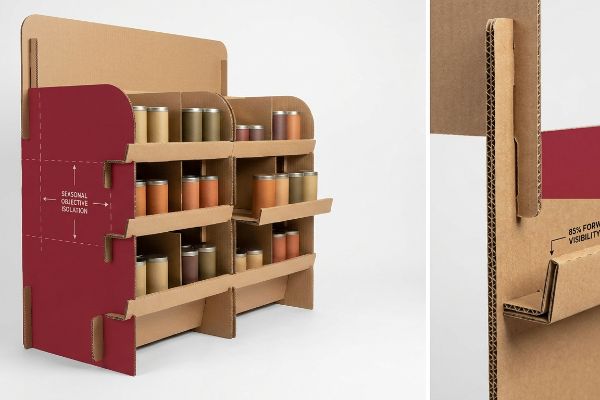
Moving from the psychological strategy of a seasonal campaign to its physical execution requires mastering precise engineering mechanics and kinetic aisle disruption.
The Engineering Mechanics Behind Objective-Isolation
Seasonal campaigns often attempt to communicate every single brand benefit simultaneously, creating a dense wall of text that rushing shoppers physically ignore. Junior engineers frequently compound this error by drafting massive flat-panel headers that catch warehouse drafts and fold under basic HVAC air pressure. They treat temporary corrugated like a static museum wall, assuming the massive header will naturally stand straight without understanding the kinetic wind load generated inside a sprawling commercial retail box14.
In structural engineering, we counter this cognitive and physical overload by deploying an objective-isolation protocol, utilizing high-contrast geometries supported by reinforced dual-flute back panels. When mapping out a seasonal execution, mastering the spatial engagement continuum is mandatory before CAD drawing begins. The primary die-cut header must feature a solid Pantone flood to create optical disruption from thirty feet away, while its internal structure utilizes cross-corrugated B-flute to resist warping15. As the shopper steps into the engagement zone, the structural retaining lips must be mathematically angled to guarantee 85% forward visibility of the core SKUs16. Finally, the internal modular dividers group the products into asymmetrical clusters, creating visual tension while distributing the heavy payload evenly across the structural base to prevent catastrophic center-sag during the short promotional window.
| Metric/Feature | Generic Seasonal Approach | Engineered Reality |
|---|---|---|
| Aisle Engagement | Dense text overload | Single 3D structural trigger |
| Header Rigidity | Weak single-wall warping | Cross-corrugated B-flute17 |
| Product Visibility | High generic retaining lips | 85% forward sightline clearance18 |
I engineer seasonal units to function as precision visual funnels fortified by rigid load-bearing geometry. By deploying calculated structural tension, you dominate short-term holiday sales without risking a mid-aisle display collapse.
🛠️ Harvey's Desk: Is your seasonal campaign blending into the aisle because of cognitive overload and poor structural sightlines? 👉 Request a Free Sightline Analysis ↗ — I review every structural file personally within 24 hours.
Conclusion
Whether you are debating the long-term endurance of a heavy metal stand or the agile freight advantages of a flat-packed corrugated unit, surviving the retail aisle requires mastering complex load physics and precise caliper geometries. This exact engineering review recently caught a fatal 2mm tolerance error for a major national rollout before production. To ensure your next temporary campaign avoids top-heavy tipping and catastrophic crushing, let me personally run your structural files through a Free Structural Dieline Audit ↗.
"Point-of-Purchase (POP) Display: How They Work & Their …", https://www.optisigns.com/post/point-of-purchase-pop-display-how-they-work-their-retail-impact. An authoritative source on retail psychology or consumer behavior would explain the distinct differences in dwell time and shopper mindset between browsing floor displays and the transactional nature of checkout zones. Evidence role: Principle validation; source type: retail marketing research or textbook. Supports: The claim that display formats are not interchangeable due to spatial and behavioral contexts. Scope note: Applies to general brick-and-mortar retail settings. ↩
"The Psychology of POP Display Placement", https://procorrdisplay.com/the-psychology-of-pop-display-placement/. Brief explanation of how retail merchandising standards define the strategic role of floor displays in promoting customer browsing. Evidence role: technical specification; source type: industry handbook. Supports: display placement strategy. Scope note: applicability may vary based on store layout. ↩
"How POS and POP Displays Drive Impulse Purchases in Retail", https://www.weareamnet.com/blog/impact-pos-pop-impulse-purchases/. Professional retail merchandising guides explain how counter-top displays are specifically positioned to trigger unplanned impulse buys during the checkout process. Evidence role: supportive fact; source type: industry guide. Supports: the purpose of counter format displays. Scope note: applies to point-of-purchase zones. ↩
"POINT-OF-PURCHASE INSIGHTS: THE IMPACT OF RETAIL POP …", https://www.bcipkg.com/point-of-purchase-insights-the-impact-of-retail-pop-displays-on-consumer-behavior/. Retail layout studies demonstrate that strategic placement of POP displays prevents congestion and guides customer movement. Evidence role: technical outcome; source type: retail design manual. Supports: the effect of strategic retail reality on store impact. Scope note: focuses on spatial optimization. ↩
"Retail Displays in Salons: A Key to Unlocking Extra Profit", https://www.simplyorganicbeauty.com/retail-displays-in-salons-a-key-to-unlocking-extra-profit/. Industry guidelines on salon merchandising that correlate minimal footprints and clean aesthetics with higher sales conversion in professional beauty settings. Evidence role: validation; source type: industry trade publication. Supports: the efficacy of minimalist design for salon environments. Scope note: limited to premium beauty sectors. ↩
"In modern retail, beverages are one of the most reliable drivers of …", https://www.instagram.com/reel/DV_a1PHjZoX/. Consumer psychology research explaining how high-end presentation and subtle branding trigger impulse buying in luxury retail environments compared to aggressive promotion. Evidence role: theoretical support; source type: market research study. Supports: the link between premium aesthetics and high-value impulse sales. Scope note: applicable across luxury retail categories. ↩
"Countertop Displays for High-Traffic Retail: Sales Boost Guide", https://www.displaysandholders.com/top-countertop-display-solutions-for-high-traffic-retail-areas?srsltid=AfmBOoodVb5KK9Mh0bObUp94eozGmVsiSg7_lPdxEKUilpEqEsSTzeuP. Verification of industry standards for high-end retail fixtures where minimal footprints are required to maintain luxury spatial flow. Evidence role: technical specification; source type: retail design guide. Supports: the necessity of compact bases in premium environments. Scope note: specifically for countertop or point-of-sale displays. ↩
"Point of Purchase: How Retailers Can Influence Shoppers …", https://blog.intouch.com/posts/points-of-purchase-displays. Empirical evidence from consumer psychology regarding how premium aesthetic presentation increases the likelihood of impulse purchases in high-end settings. Evidence role: behavioral validation; source type: market research study. Supports: the effectiveness of premium displays as sales drivers. Scope note: focused on luxury retail demographics. ↩
"The cost of an inconsistent visual identity – Letsignit", https://letsignit.com/blog/cost-of-an-inconsistent-visual-identity. Authoritative marketing research or consumer behavior studies demonstrate how visual inconsistency across retail touchpoints negatively impacts brand recall and customer decision-making. Evidence role: Theoretical support; source type: Marketing textbook or peer-reviewed journal. Supports: The claim that fragmented design leads to brand dilution. Scope note: Specifically relates to in-store visual communication. ↩
"Visual merchandising and store atmospherics: An integrated review …", https://www.sciencedirect.com/science/article/pii/S0148296322006233. A retail marketing study or consumer behavior analysis would demonstrate how consistent brand touchpoints reduce cognitive friction and increase purchase intent. Evidence role: causal validation; source type: industry research report. Supports: the link between cohesive display ecosystems and increased sales. Scope note: results may vary by product category. ↩
"The Importance Of Consistency In Branding – Forbes", https://www.forbes.com/councils/forbescommunicationscouncil/2024/12/30/the-importance-of-consistency-in-branding/. An industry report or marketing study illustrating how visual consistency increases brand recognition and trust. Evidence role: supportive; source type: marketing research. Supports: the benefit of a unified visual identity. Scope note: focused on retail environments. ↩
"What Is Integrated Marketing Communications? | National University", https://www.nu.edu/blog/what-is-integrated-marketing-communications/. Academic research on Integrated Marketing Communications (IMC) demonstrating that unified messaging improves campaign effectiveness. Evidence role: corroborative; source type: peer-reviewed journal. Supports: the advantage of unified messaging. Scope note: applies to multi-channel retail strategies. ↩
"The Impact of Different Touchpoints on Brand Consideration", https://www.sciencedirect.com/science/article/pii/S0022435914000967. Consumer psychology studies explaining how familiar touchpoints reduce cognitive load and increase purchase intent. Evidence role: foundational; source type: psychology journal. Supports: the optimization of the shopper journey. Scope note: limited to physical store interactions. ↩
"DISPLAY STRUCTURAL DESIGN FOR INTERACTIVE RETAIL …", https://www.bcipkg.com/display-structural-design-for-interactive-retail-displays/. Technical data from structural engineering or retail fixtures guides would quantify how internal airflow and HVAC currents create lateral force (wind load) on flat-surface displays. Evidence role: technical validation; source type: structural engineering manual. Supports: the claim that large headers are susceptible to collapse from air movement. Scope note: applies specifically to high-surface-area temporary paperboard. ↩
"[PDF] Investigating the mechanical properties of paperboard packaging …", https://repository.rit.edu/cgi/viewcontent.cgi?article=1066&context=japr. Technical verification of the structural integrity and anti-warping properties of cross-corrugated B-flute in retail displays. Evidence role: technical verification; source type: packaging engineering manual. Supports: the claim that B-flute resists warping in headers. Scope note: limited to corrugated paperboard specifications. ↩
"14 Types Of Retail Displays | Chicago, IL", https://wertheimerbox.com/types-of-retail-displays/. Industry benchmarks for point-of-purchase display geometry and visual merchandising visibility metrics. Evidence role: validation of quantitative benchmark; source type: retail design standard. Supports: the 85% visibility metric. Scope note: applies specifically to seasonal corrugated merchandisers. ↩
"A Review of Corrugated Board Structure – Shanghai DE Printed Box", https://www.deprintedbox.com/blog/a-review-of-corrugated-board-structure/. Technical specifications regarding the rigidity and warping resistance of B-flute corrugated cardboard in load-bearing retail structures. Evidence role: Technical validation; source type: Engineering manual. Supports: The claim that cross-corrugation prevents header warping. Scope note: Specific to corrugated fiberboard materials. ↩
"Elevate Your In-Store Product Presence with These 5 …", https://spc-retail.com/5-tips-for-better-in-store-product-visibility/. Industry benchmarks for visual ergonomics and percentage-based sightline clearance in Point-of-Purchase (POP) engineering. Evidence role: Quantitative verification; source type: Retail design research. Supports: The specific metric for optimized product visibility. Scope note: Benchmarks may vary by product size and shelf height. ↩