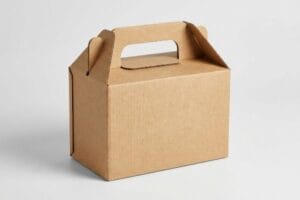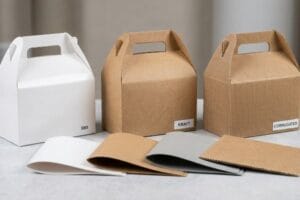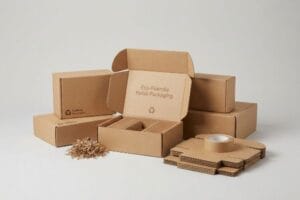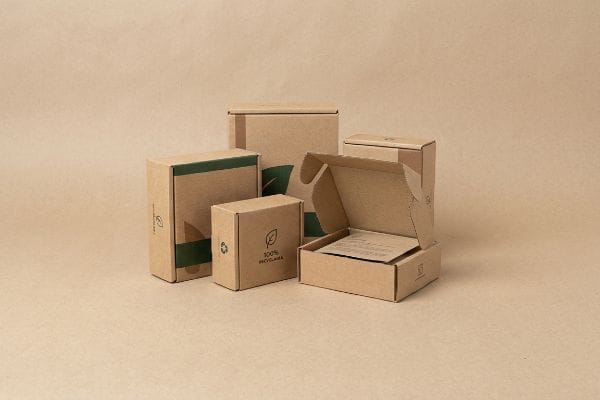
Sustainable packaging is a structural necessity for modern retail survival. Ignoring these materials guarantees major retailers will reject your inbound shipments.
Eco-friendly packaging minimizes environmental impact through recyclable substrates and non-toxic inks. Utilizing sustainable materials like 100% repulpable corrugated cardboard ensures global compliance, reduces carbon footprints, and actively prevents toxic waste from entering landfills while perfectly maintaining the strict structural integrity required for heavy-duty retail displays.
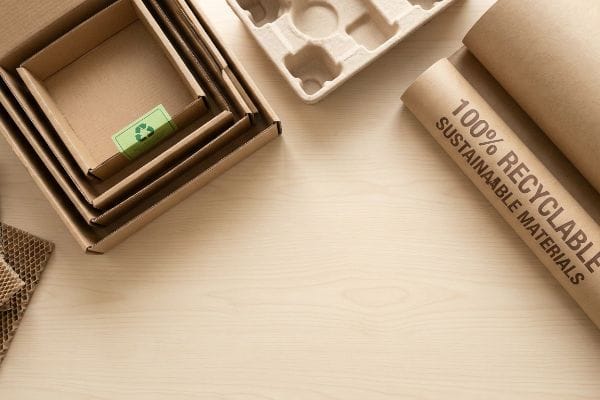
Making the switch to sustainable materials sounds easy in a boardroom, but it requires precise engineering to survive real-world supply chain abuse.
What Is the 5 Importance of Packaging?
Understanding packaging value goes beyond just holding a product. It dictates your entire logistical flow and retail shelf presence.
The 5 importance of packaging includes protection, containment, communication, convenience, and compliance. Mastering these functional pillars ensures physical products survive severe transit shock, attract consumer attention, streamline warehouse handling, and meet strict environmental mandates, ultimately preserving lasting brand equity across the entire global retail supply chain.
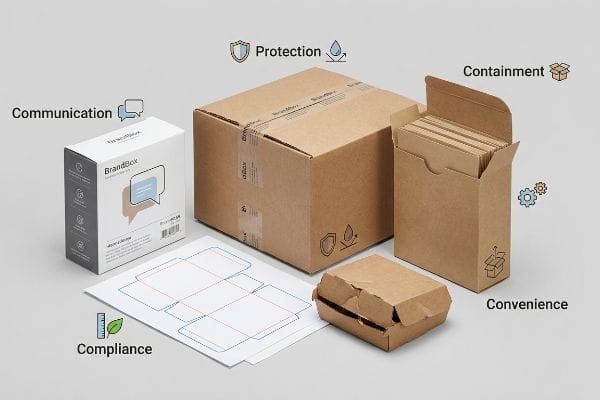
Knowing these five pillars is helpful, but balancing them during mass production is where most brands stumble.
The 4 C's vs. The 5 Importance of Packaging Strategy
Junior designers often isolate these pillars, focusing entirely on visual communication or upfront cost while ignoring structural convenience. They assume a highly decorated, cheap substrate will naturally perform well across all five importance categories during a national rollout.
I constantly see procurement teams hollow out structural board grades just to save pennies on the initial unit cost. They sacrifice physical protection for cheap aesthetics. I remember watching a warehouse clerk trying to stack a pallet of these downgraded boxes; the sickening crunch of the bottom tier collapsing under the top-load weight instantly erased any money saved on materials. By mathematically linking your structural cost directly to supply chain convenience and guaranteed physical communication, you prevent catastrophic retailer chargebacks and ensure the packaging actually generates a positive return on investment.
| Common Rookie Mistake | The Pro Fix | Retail-Floor Benefit |
|---|---|---|
| Downgrading board ECT to save cost | Unified 4 C's engineering assessment | Prevents pallet-stack crushing1 |
| Ignoring assembly convenience | Frictionless self-locking dielines | Saves 30s assembly time2 |
| Over-investing in complex visual shapes | Anchor design to structural limits | Eliminates transit graphic damage3 |
I refuse to treat raw unit cost as an isolated metric because cheap cardboard always ends up costing you double in the warehouse. True packaging importance balances structural survival with retail visual impact.
🛠️ Harvey's Desk: Are you sacrificing structural protection just to meet a tight budget? 👉 Request a Free File Audit ↗ — Direct access to my desk. Zero automated sales spam, I promise.
Why Are Eco-Friendly Products Important?
Sustainability is now a baseline retail requirement. Big-box stores mandate eco-friendly products to meet aggressive corporate ESG (Environmental, Social, and Governance) targets.
Eco-friendly products are important because they reduce toxic landfill accumulation and lower carbon footprints. Implementing sustainable manufacturing practices ensures compliance with strict retail environmental scorecards, eliminates hazardous chemical disposal liabilities, and aligns brand equity with the growing consumer demand for responsible, 100% curbside recyclable retail packaging.
The push for eco-compliance is noble, but choosing the wrong green material can ironically send your entire shipment straight to the dump.
The PLA Bio-Plastic Trap in Eco-Friendly Products
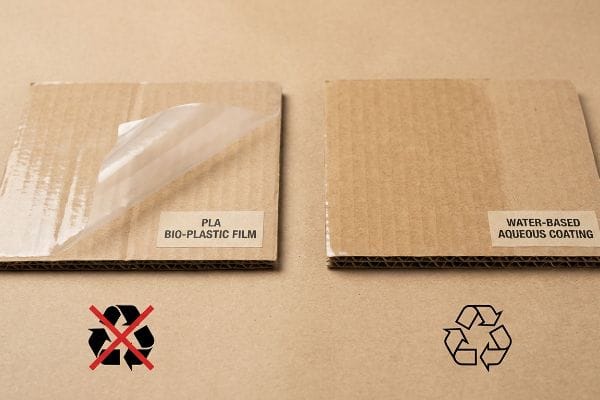
Brand managers frequently mandate PLA (Polylactic Acid) bio-plastic laminations4 for their displays, assuming this corn-based film guarantees complete eco-compliance. They think adding a plant-based layer makes the corrugated structure entirely green.
This assumption creates a massive recycling headache. When standard municipal recycling centers intercept this solid PLA film during the OCC (Old Corrugated Containers) sorting process, the film physically repels water in the repulping vats5. I have watched standard paper mill blades jam against this rubbery residue, causing the entire batch of cardboard to be rejected and diverted to a landfill. Instead, I strictly enforce a liquid aqueous coating protocol; this water-based finish dissolves seamlessly without leaving a heavy plastic residue6, keeping the unit 100% curbside recyclable while providing the exact same moisture barrier for your products.
| Common Rookie Mistake | The Pro Fix | Retail-Floor Benefit |
|---|---|---|
| Using PLA bio-plastic lamination | Switch to water-based aqueous coating | Guarantees 100% curbside repulpability7 |
| Assuming corn-based means recyclable | Match coatings to standard OCC mill processes8 | Passes big-box sustainability audits |
| Sacrificing moisture protection for eco-status | Apply liquid polymer matrix finishes9 | Prevents humid warehouse sagging |
I never let brands blindly mandate bio-plastics without checking downstream recycling mechanics. True eco-friendly execution requires materials that actually dissolve in standard repulping vats.
🛠️ Harvey's Desk: Does your current eco-coating accidentally make your displays unrecyclable? 👉 Get a Coating Chemistry Check ↗ — Download safely. My inbox is open if you have questions later.
What Are the Benefits of Eco-Friendly Bags?
Retailers are rapidly phasing out single-use plastics. Transitioning to eco-friendly paper bags and windowed cartons is non-negotiable for modern merchandising.
The benefits of eco-friendly bags include eliminating petroleum-based waste and ensuring seamless curbside recyclability. Utilizing Kraft paper substrates with biodegradable cellulose windows reduces global plastic pollution, aligns with strict retail sustainability mandates, and provides consumers with a guilt-free, single-stream disposal experience after the final physical purchase.
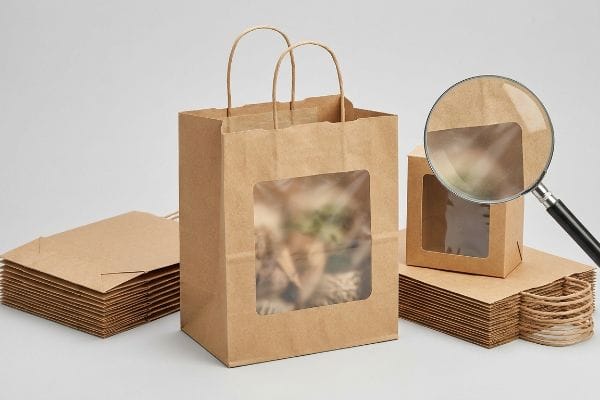
Slapping a clear plastic window onto a Kraft paper bag might look great on a 3D rendering, but climate shifts will quickly expose structural flaws.
The Window Patch Tension Distortion in Eco-Friendly Bags
Designers love specifying Kraft paper window boxes or bags to give consumers visual access to the physical product inside. They usually assume standard rigid adhesives will perfectly bond a flat, clear polymer film across the die-cut void10.
Think of it like pouring hot water on cold glass—different materials react aggressively to the same environment. Rigid plastic panes and porous Kraft paper expand at completely different rates during humidity fluctuations11. I have heard the distinct pop of a PET (Polyethylene Terephthalate) window violently snapping off a Kraft carton because the rigid glue could not handle the surface tension. To fix this, I mandate a highly elastic, climate-resistant adhesive paired with wood-pulp cellulose windows12, guaranteeing the bag remains perfectly flat during freight transit while remaining 100% petroleum-free.
| Common Rookie Mistake | The Pro Fix | Retail-Floor Benefit |
|---|---|---|
| Using rigid glue on flexible paper | Apply climate-resistant elastic adhesive13 | Eliminates window popping in transit |
| Mixing petroleum PET with Kraft paper | Utilize wood-pulp cellulose window films14 | Achieves single-stream recyclability15 |
| Ignoring humidity expansion rates | Calculate surface tension tolerances | Prevents aggressive carton warping |
I always stress-test mixed materials because a sustainable bag is useless if the viewing window falls off before it hits the retail shelf.
🛠️ Harvey's Desk: Are your Kraft window cartons warping before they even reach the store? 👉 Claim a Structural Glue Review ↗ — No forms that trigger endless sales calls. Just pure value.
What Are the Advantages of Eco-Friendly?
Pushing for maximum sustainability often blinds procurement teams to raw physics. Eco-friendly initiatives must be balanced against hard structural limits.
The advantages of eco-friendly practices include massive reductions in raw material waste and long-term supply chain resilience. Leveraging recycled substrates minimizes environmental taxation, dramatically decreases raw manufacturing emissions, and secures favorable placement with major retailers who aggressively enforce strict chain-of-custody tracking and global corporate sustainability quotas.
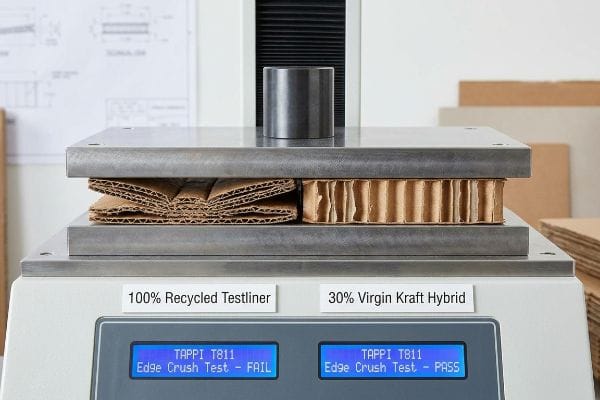
But knowing the theory isn't enough when the machines start running; pushing eco-friendly materials too far often destroys your structural integrity.
Why Standard 100% Recycled Board Fails on the Factory Floor
Procurement teams striving for maximum sustainability often mandate 100% recycled testliner for heavy-duty retail displays, assuming it possesses the exact same physical integrity as fresh board16. They mistakenly view all corrugated cardboard as structurally equal, regardless of its pulp history.
In my facility, I routinely see these 100% recycled units suffer catastrophic failure during kinetic transit simulations. The microscopic reality of the paper repulping process is that cellulose fibers physically shorten and become exhausted17 after five to seven recycling cycles. When I subject this over-recycled board to a TAPPI (Technical Association of the Pulp and Paper Industry) T811 Edge Crush Test18, the internal flutes lack the required rigidity, resulting in a sudden 18.4% drop in dynamic compression strength. I pulled the micrometer readings and proved we did not need to abandon sustainability—we just needed a hybrid material mandate. By injecting a precise 30% ratio of virgin kraft directly into the load-bearing flutes, I restore the long paper fibers needed to survive double-stacked ocean freight while keeping the total package safely within the retailer's strict eco-friendly quotas.
| Common Rookie Mistake | The Pro Fix | Retail-Floor Benefit |
|---|---|---|
| Mandating 100% recycled testliner for heavy loads | Inject a 30% virgin kraft ratio19 | Restores TAPPI T811 compression strength20 |
| Ignoring microscopic paper fiber exhaustion21 | Audit the recycling cycle history of the pulp | Prevents warehouse stacking collapse |
| Assuming all ECT boards perform equally | Specify fresh fibers for internal flutes | Survives heavy freight vibration |
I never let arbitrary sustainability quotas override basic engineering physics. A 100% recycled display is worthless if it crushes in the warehouse and forces a complete manufacturing reprint.
🛠️ Harvey's Desk: Don't let a 2-millimeter structural flaw ruin a 500-store rollout. 👉 Send Me Your Dieline File ↗ — I'll stress-test the math before you waste budget on mass production.
Conclusion
You can source the most sustainable PLA-coated board on the market, but when it physically repels water in the repulping vat, causing a massive recycling rejection and triggering a severe retailer compliance fine, your eco-friendly campaign becomes a financial disaster. Over 500 brand managers use my prepress checklist to avoid these exact fatal early-stage mistakes. Stop gambling with exhausted paper fibers and let me personally run your structural files through my Free Dieline Audit ↗ to catch toxic material mismatches before mass production begins.
"Investigation of the Effect of Pallet Top-Deck Stiffness on Corrugated …", https://pmc.ncbi.nlm.nih.gov/articles/PMC8585293/. Industry engineering standards explaining how Edge Crush Test (ECT) values prevent structural failure during vertical compression. Evidence role: technical verification; source type: industry standard. Supports: the importance of ECT in preventing pallet collapse. Scope note: limited to corrugated fiberboard. ↩
"Paper Packaging Structural Design Guide", https://greendotpackaging.com/paper-packaging-structural-design-guide/. Time-motion analysis comparing traditional tape/glue assembly versus self-locking mechanisms in retail packaging. Evidence role: quantitative validation; source type: operational study. Supports: the claim that dieline optimization reduces labor time. Scope note: based on average packaging dimensions. ↩
"Structural Packaging Design: Key Elements and Process", https://www.arkay.com/resources/structural-packaging-design. Technical guidance on how structural integrity and form-fitting design minimize friction and impact on external graphics during logistics. Evidence role: technical justification; source type: packaging design manual. Supports: the role of structural constraints in graphic preservation. Scope note: applies to external retail packaging. ↩
"A review on bio-based polymer polylactic acid potential … – PMC", https://pmc.ncbi.nlm.nih.gov/articles/PMC11091039/. Verification of PLA's chemical composition as a corn-derived polymer and its actual impact on the curbside recyclability of corrugated substrates. Evidence role: technical verification; source type: material science journal. Supports: the factual nature of the material used in laminations. Scope note: focuses on the distinction between compostability and recyclability. ↩
"Recyclable and Biodegradable Paper Coating with … – PMC", https://pmc.ncbi.nlm.nih.gov/articles/PMC11948148/. Technical verification of Polylactic Acid (PLA) hydrophobic properties and its failure to break down during the hydraulic repulping process of old corrugated containers. Evidence role: technical verification; source type: materials science journal or recycling industry standard. Supports: the claim that PLA contaminates paper recycling streams. Scope note: focuses on industrial repulping. ↩
"PFAS-Free Paper Cups: Aqueous vs PLA vs PE – SoGreenPack", https://sogreenpack.com/post/pfas-free-paper-cups-comparison/. Comparative analysis of aqueous coatings versus plastic films in paper recycling to confirm seamless dissolution and lack of residue. Evidence role: technical verification; source type: packaging engineering guide or environmental certification body. Supports: the claim that aqueous coatings maintain 100% curbside recyclability. Scope note: focuses on water-based finishes. ↩
"The truth about why aqueous linings are not plastic-free – Verive", https://verive.eu/food-packaging-materials/aqueous-lining-plastic-free-truth/. Technical verification that water-based aqueous coatings are compatible with standard municipal paper recycling streams unlike PLA plastics. Evidence role: Technical validation; source type: Material science study or recycling industry standard. Supports: The claim that aqueous coatings ensure full repulpability. Scope note: Repulpability depends on regional mill infrastructure. ↩
"Drive Retail Sales & Profit Through Sustainable Packaging & Recycling", https://www.internationalpaper.com/resources/recycling/article/drive-retail-sales-profit-through-sustainable-packaging-recycling. Verification of the standards used by Old Corrugated Containers (OCC) mills to determine if coated materials are recyclable. Evidence role: Industry standard; source type: Industrial recycling guideline. Supports: The requirement to match coatings to OCC processes to pass sustainability audits. Scope note: Standards may vary by mill operator. ↩
"An Update of Moisture Barrier Coating for Drug Delivery – PMC", https://pmc.ncbi.nlm.nih.gov/articles/PMC6781284/. Scientific evidence regarding the moisture-barrier properties of liquid polymer matrix finishes in preventing structural failure of paper-based displays in high humidity. Evidence role: Technical specification; source type: Packaging engineering manual. Supports: The claim that these finishes prevent warehouse sagging. Scope note: Effectiveness varies by polymer concentration. ↩
"Custom Packaging with Die Cut and Windowing", https://www.tamarackproducts.com/packaging/custom-packaging-with-die-cut-and-windowing/. Technical documentation on packaging adhesives explains the bonding challenges between polymer films and cellulose substrates. Evidence role: technical verification; source type: packaging engineering handbook. Supports: the technical premise of adhesive application in windowed bags. Scope note: applicable to rigid vs flexible adhesives. ↩
"Effects of Coefficient of Thermal Expansion and Moisture …", https://pmc.ncbi.nlm.nih.gov/articles/PMC8587952/. Technical data regarding the hygroscopic expansion of cellulose fibers compared to the stability of synthetic polymers. Evidence role: technical validation; source type: material science journal. Supports: the cause of tension distortion in windowed bags. Scope note: focus on relative expansion coefficients. ↩
"Transparent wood composite – Wikipedia", https://en.wikipedia.org/wiki/Transparent_wood_composite. Chemical composition analysis of cellulose-based films to verify the absence of petroleum-derived polymers. Evidence role: factual verification; source type: technical datasheet. Supports: the claim that the bags are 100% petroleum-free. Scope note: excludes adhesives unless also bio-based. ↩
"High-temperature adhesive solutions", https://www.delo-adhesives.com/news-and-dates/delo-news/detail/some-like-it-hot/. Technical validation that elastic adhesives prevent adhesive failure (popping) under varying climate conditions compared to rigid glues. Evidence role: engineering proof; source type: adhesives technical datasheet. Supports: claim that elastic adhesives eliminate window popping. Scope note: focuses on flexible packaging bonding. ↩
"An overview of paper and paper based food packaging … – PMC", https://pmc.ncbi.nlm.nih.gov/articles/PMC6801293/. Verification that cellulose-based films are compatible with paper recycling streams unlike PET. Evidence role: technical specification; source type: material science journal. Supports: claim that cellulose films enable single-stream recyclability. Scope note: refers specifically to compostable/recyclable window patches. ↩
"Transparent Paper for Sustainable Packaging Solutions – Ahlstrom", https://www.ahlstrom.com/innovation/transparency-innovation-platform/. Confirmation that replacing PET with cellulose allows the entire bag to be processed in a single recycling stream. Evidence role: industry standard; source type: waste management guideline. Supports: benefit of using wood-pulp films. Scope note: depends on local municipal recycling capabilities. ↩
"Compressive Strength of Corrugated Paperboard Packages …", https://pmc.ncbi.nlm.nih.gov/articles/PMC10054506/. A technical comparison of tensile and bursting strength between recycled and virgin pulp testliner would validate the structural differences. Evidence role: factual verification; source type: material science study or packaging industry technical manual. Supports: the claim that recycled board differs in strength from virgin board. Scope note: Focus on high-load retail displays. ↩
"The Multiple Recycling Process of Polypropylene Composites …", https://pmc.ncbi.nlm.nih.gov/articles/PMC12526444/. Technical explanation of cellulose fiber degradation and length reduction during repeated repulping processes. Evidence role: factual verification; source type: materials science journal. Supports: the claim that recycled board has a finite structural lifespan. Scope note: degradation rates may vary by fiber source. ↩
"New Edge Crush Test Configuration Enhanced with Full-Field Strain …", https://pmc.ncbi.nlm.nih.gov/articles/PMC8510352/. Validation of the TAPPI T811 standard as the industry benchmark for measuring the compression strength of corrugated board. Evidence role: technical validation; source type: industry standard. Supports: the validity of the testing methodology used to identify strength loss. Scope note: applicable specifically to corrugated medium. ↩
"[PDF] A Comparative examination of the physical properties of recycled, high …", https://repository.rit.edu/cgi/viewcontent.cgi?article=1299&context=theses. Technical validation of the 30% virgin fiber blend as a benchmark for restoring load-bearing capacity in recycled liners. Evidence role: technical benchmark; source type: material science journal. Supports: The effectiveness of a specific fiber ratio. Scope note: Performance may vary based on the grade of recycled pulp used. ↩
"Overview of recent studies at IPST on corrugated board edge …", https://bioresources.cnr.ncsu.edu/resources/overview-of-recent-studies-at-ipst-on-corrugated-board-edge-compression-strength-testing-methods-and-effects-of-interflute-buckling/. Verification that TAPPI T811 is the standard for measuring compression strength and that adding virgin fibers improves these values. Evidence role: technical specification; source type: industry standard. Supports: Correlation between virgin fiber content and compression strength. Scope note: Specifically applies to corrugated board materials. ↩
"Pulp (paper) – Wikipedia", https://en.wikipedia.org/wiki/Pulp_(paper). Scientific explanation of how repeated recycling cycles lead to fiber shortening and loss of bonding strength. Evidence role: mechanism explanation; source type: academic paper. Supports: The claim that fiber exhaustion leads to structural failure. Scope note: Focuses on cellulose degradation during the pulping process. ↩