
You are fighting for inches on the retail floor, and a well-engineered dump bin is the fastest way to turn dead aisle space into a high-velocity conversion zone.
Investing in dump bin displays rapidly accelerates impulse purchases for bulk or promotional merchandise. These freestanding retail merchandisers leverage strategic placement to disrupt shopper traffic flows, transforming otherwise underutilized floor footprints into highly profitable, high-visibility retail zones that generate immediate sales velocity without requiring permanent shelving.
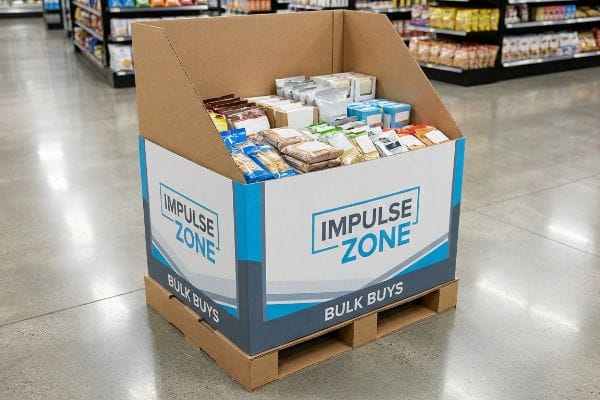
But understanding the marketing theory is only half the battle; the real test happens when these structures face the physical stress of a high-traffic store.
What Is a Dump Bin in Retail?
At its core, a dump bin is an open-top merchandiser designed for loose, fast-moving items, relying on sheer product volume to drive impulse buys.
A dump bin is an open-top, freestanding corrugated container strategically positioned in retail aisles to hold high quantities of loose merchandise. By removing structural barriers like shelves or hooks, this high-capacity format encourages frictionless shopper interaction, making it highly effective for fast-moving consumer goods and seasonal promotional rollouts.

It looks like a simple box, but filling an open structure with loose, heavy merchandise introduces serious structural physics.
Why Standard Dump Bins Buckle Under Pressure
When designers first approach a dump bin, they usually treat it just like an oversized shipping box with the top flaps cut off. They assume that using a standard 32ECT (Edge Crush Test) corrugated board1 will naturally hold the shape of the bin, regardless of what gets tossed inside.
I see this trap constantly when brands try to load these bins with heavy, irregular items like seasonal candy or clearance cosmetics. Without internal support, the sheer outward pressure of the loose merchandise pushes against the unreinforced sidewalls2. I have watched store clerks frantically apply thick, sticky packing tape to the corners of a bulging bin just to keep it from ripping open on the floor. To fix this, I mandate an internal H-Divider or a hidden belly band3 in the structural design. This simple friction-locked corrugated insert reinforces the walls from the inside out, completely stopping the outward bulge and keeping the brand's graphic presentation perfectly square, saving you from a costly retailer rejection.
| Common Rookie Mistake | The Pro Fix | Retail-Floor Benefit |
|---|---|---|
| Leaving large bins hollow | Adding a friction-locked H-Divider4 | Prevents ugly sidewall bulging |
| Using standard box joints | Engineering a hidden belly band5 | Keeps graphics perfectly aligned |
| Relying on raw material strength | Dispersing outward product pressure6 | Avoids store-level tape fixes |
I refuse to let an unreinforced bin ruin your campaign. A structurally sound divider prevents outward wall bowing, guaranteeing your merchandiser survives the retail floor while protecting your brand equity.
🛠️ Harvey's Desk: Are your open-top bins bowing outward under the weight of loose merchandise? 👉 Request a Structural Audit ↗ — Direct access to my desk. Zero automated sales spam, I promise.
Why Are Displays so Important in Any Retail Environment?
A physical merchandiser is your last chance to influence a buyer before they reach the register, bridging the critical gap between digital marketing and a tangible purchase.
Displays are important because they actively disrupt subconscious shopping patterns, forcing consumers to notice specific merchandise within crowded retail aisles. By utilizing structural geometry, high-contrast printing, and strategic placement, these fixtures physically separate your products from inline competition, dramatically increasing impulse purchase conversion rates and brand visibility.
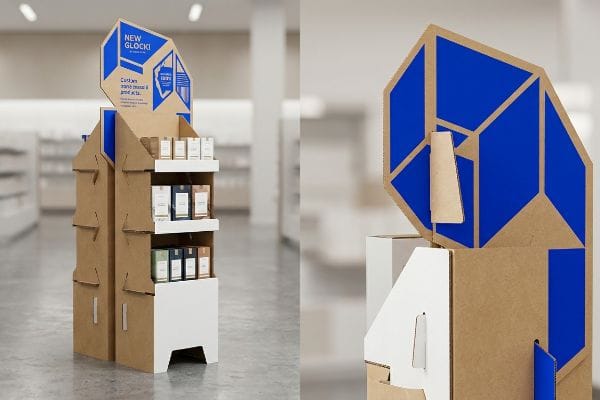
Getting noticed requires more than just loud graphics; it demands a precise spatial strategy.
The 3-3-3 Rule for Retail Display Impact
Junior marketing teams frequently design POP (Point of Purchase) floor displays by staring at flat artwork on a backlit computer monitor. They assume that if the logo looks good from two feet away on their screen, it will naturally command attention in a massive, visually chaotic big-box store.
It is a common trap that catches even experienced procurement teams, assuming a colorful box is enough to win. In reality, a display must execute the spatial engagement rule to survive: grab attention from 30 feet (9.14 m) away, engage at 3 feet (0.91 m), and close the sale at 3 inches (7.62 cm)7. I once watched a beautifully printed merchandiser completely vanish into the background noise of an aisle because it lacked aggressive die-cut shapes to disrupt the distant sightline. I fix this by integrating a massive structural header and utilizing PMS (Pantone Matching System) spot color floods instead of standard process inks8, creating a dense, glare-free visual anchor. This physical separation forces the human eye to stop scrolling the aisle, directly translating into higher unit velocity for your brand.
| Common Rookie Mistake | The Pro Fix | Retail-Floor Benefit |
|---|---|---|
| Designing only for close-up viewing | Using the spatial engagement rule9 | Captures distant foot traffic |
| Blending into standard aisle shelving | Adding oversized die-cut headers | Creates immediate visual tension |
| Using muddy process inks for logos | Flooding with PMS spot colors10 | Ensures high-contrast branding |
I engineer displays specifically to disrupt automatic walking patterns. If your structure does not mathematically command attention from a distance, you are simply paying to store inventory on the retail floor.
🛠️ Harvey's Desk: Are your retail merchandisers actually disrupting foot traffic, or are they just blending into the crowded aisle? 👉 Get a Visibility Assessment ↗ — Download safely. My inbox is open if you have questions later.
What Is a Dump Bin Display?
Structurally, a dump bin display is an open-top merchandiser built specifically to provide unobstructed overhead access, removing physical barriers between the shopper and the bulk product.
A dump bin display is an engineered corrugated fixture utilizing a half-slotted container architecture to provide immediate, unhindered access to high-volume goods. By eliminating top flaps and shelving tiers, this specialized merchandising unit maximizes product capacity while allowing shoppers to effortlessly grab loose, irregularly shaped retail items.
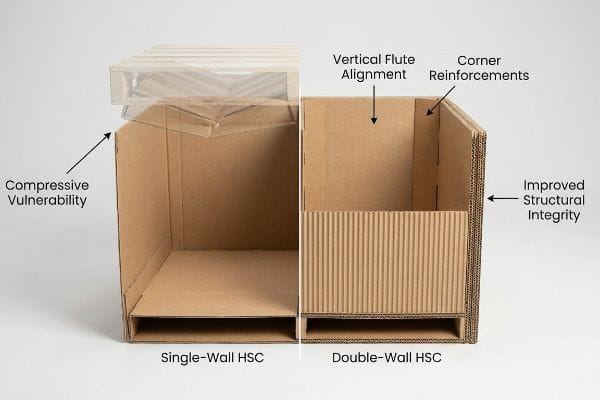
While removing the lid makes shopping effortless, it completely alters the kinetic stability of the packaging.
The Compressive Vulnerability in Dump Bin Architecture
Procurement departments often view dump bins as a quick way to save money, substituting fully enclosed RSC (Regular Slotted Container) structures for open-top HSC (Half Slotted Container) designs. They assume the raw base material retains its original compressive strength11 even after the top flaps are permanently removed.
Think of a cardboard box like a brick house; the roof ties all four walls together to hold the structure rigid. When you remove that roof to create an open dump bin, you completely lose the upper enclosure, leaving the vertical corners vulnerable. I recently handled a project where a client's open-top bins were brutally crushed under heavy warehouse pallets because the unsupported edges folded inward with a sickening crunch. My rule of thumb is to mathematically compensate for this lost upper stability by strictly aligning the internal flute grain perfectly vertical12. By upgrading the vulnerable panels to a double-wall profile13, I restore the structural deficit caused by the missing lid, guaranteeing your bins remain upright during multi-tier freight transit.
| Common Rookie Mistake | The Pro Fix | Retail-Floor Benefit |
|---|---|---|
| Treating HSCs like fully enclosed boxes | Upgrading to double-wall profiles14 | Survives top-heavy warehouse loads |
| Ignoring grain direction on open bins | Aligning flutes strictly vertically15 | Maximizes vertical edge crush strength |
| Removing top flaps without reinforcing | Engineering dynamic corner supports16 | Prevents catastrophic freight crushing |
I never let a client launch an open-top bin without reinforcing the load-bearing corners. If you strip away the top flaps, you must upgrade the core fluting to prevent total structural collapse.
🛠️ Harvey's Desk: Are your open-top merchandisers buckling under top-heavy warehouse pallets during transit? 👉 Claim Your Structural Review ↗ — No forms that trigger endless sales calls. Just pure value.
What Is the Role of Display in Retailing?
Ultimately, the role of a retail display is to seamlessly bridge logistics and marketing, physically protecting inventory while actively driving product sell-through on the store floor.
The role of display in retail is to simultaneously function as an aggressive marketing tool and a resilient logistical vessel. These structures must physically safeguard bulk merchandise during harsh transit conditions while instantly communicating brand value to consumers, ultimately driving high-velocity impulse conversions at the point of purchase.
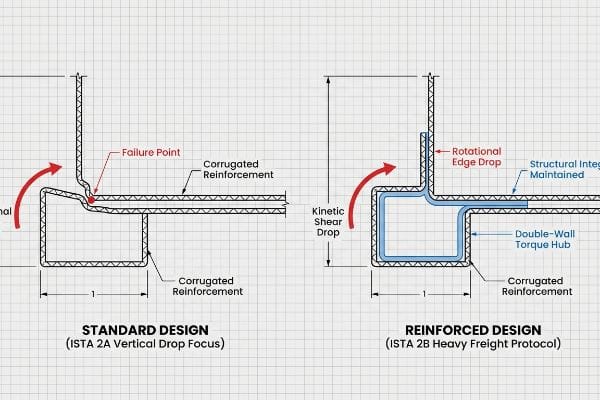
Getting one display to look beautiful in a lab is easy, but here is the harsh reality when you ship 500 loaded bins across the country.
Why Heavy Merchandise Fails the ISTA Validation Trap
Brands frequently load their dump bins with heavy consumer goods, test the unbuilt flat boards for basic material strength, and assume they are ready for national distribution. They confidently ship massive orders, believing that a standard vertical free-fall test is sufficient to validate a fully assembled, bulk-loaded merchandiser.
In my facility, I routinely see this systemic trap destroy entire retail rollouts. When buyers load an open bin with dense merchandise, the total weight easily surpasses the critical 150 lbs (68.03 kg) threshold. At this weight class, a standard vertical drop is irrelevant; the real threat is kinetic shear force during LTL (Less-Than-Truckload) freight transit. When I place these overloaded bins on the testing floor, I subject them to ISTA (International Safe Transit Association) 2B rotational edge drops. I have measured catastrophic failures where the corner seams tear open by exactly 2.4 inches (60.96 mm), spilling product instantly. I fix this by bypassing standard profiles entirely and engineering an isolated double-wall torque hub into the base architecture. By reinforcing the bottom tier to absorb lateral kinetic shock, I cut out over-engineered plastic corner clips and guarantee a zero-damage freight survival, saving clients massive retailer chargeback penalties on heavy payloads.
| Common Rookie Mistake | The Pro Fix | Retail-Floor Benefit |
|---|---|---|
| Using standard parcel drop tests | Mandating ISTA 2B heavy freight protocols17 | Accurately simulates real transit stress |
| Ignoring lateral kinetic shear force18 | Engineering double-wall base hubs | Prevents bottom-tier seam tearing |
| Adding expensive plastic corners | Utilizing targeted corrugated reinforcement19 | Lowers material costs while boosting strength |
I do not trust static lab numbers when kinetic freight physics are involved. If your pre-filled bin exceeds the weight threshold, it requires heavy-freight engineering to survive the rotational drops of real-world logistics.
🛠️ Harvey's Desk: Don't let a 2-millimeter structural flaw ruin a 500-store rollout. 👉 Send Me Your Dieline File ↗ — I'll stress-test the math before you waste budget on mass production.
Conclusion
You can choose a cheaper unreinforced vendor, but when that overloaded dump bin suffers a 2.4-inch seam tear during transit and spills loose product across a humid warehouse floor, the resulting manual rework will completely wipe out your campaign's profit margin. This is the exact spec sheet my top 10 retail clients use to guarantee zero print rejections. Stop guessing on dynamic load tolerances and let me personally run your structural files through my Free Dieline Audit ↗ to catch fatal engineering errors before you start mass production.
"[PDF] Corrugated Board Specifications – Fibre Box Association", https://www.fibrebox.org/assets/2025/09/Walmart_Corrugated-Board_Specifications_Automation_Packaging_Standards.pdf. Technical specification of 32ECT board strength and its suitability for load-bearing retail displays. Evidence role: technical verification; source type: industrial packaging standard. Supports: the specific material grade commonly used in corrugated bin design. Scope note: focuses on compression strength ratings. ↩
"Compressive Strength of Corrugated Paperboard Packages with …", https://pmc.ncbi.nlm.nih.gov/articles/PMC10054506/. Technical explanation of lateral force and structural stress on corrugated cardboard walls in bulk merchandising. Evidence role: technical validation; source type: engineering manual or packaging guide. Supports: the cause of bin bulging. Scope note: specific to unreinforced corrugated materials. ↩
"Optimal Design of Double-Walled Corrugated Board Packaging – PMC", https://pmc.ncbi.nlm.nih.gov/articles/PMC8950760/. Industry standard specifications for internal supports used to prevent bowing in retail cardboard displays. Evidence role: industry practice; source type: packaging design textbook or manufacturer specs. Supports: the efficacy of specific structural reinforcements. Scope note: limited to corrugated retail displays. ↩
"DISPLAY STRUCTURAL DESIGN FOR INTERACTIVE RETAIL …", https://www.bcipkg.com/display-structural-design-for-interactive-retail-displays/. Technical explanation of how H-dividers provide structural reinforcement to prevent sidewall bulging in cardboard displays. Evidence role: technical specification; source type: industry engineering guide. Supports: structural integrity of dump bins. Scope note: specifically for corrugated material. ↩
"What retail dump bin styles do we carry? – PopDisplay", https://popdisplay.me/what-retail-dump-bin-styles-do-we-carry/. Detailed evidence explaining the use of belly bands to reinforce structural alignment and maintain graphic integrity under load. Evidence role: design standard; source type: packaging engineering manual. Supports: graphic alignment and stability. Scope note: applies to large-format retail bins. ↩
"Barrel Crush – Physics Force", https://physicsforce.umn.edu/content/barrel-crush. Scientific or engineering proof regarding the distribution of mass and outward force in bulk merchandisers to prevent structural failure. Evidence role: mechanical principle; source type: structural engineering textbook. Supports: prevention of structural collapse. Scope note: general physics of containment. ↩
"Point of Purchase: How Retailers Can Influence Shoppers …", https://blog.intouch.com/posts/points-of-purchase-displays. An authoritative marketing or retail design guide explains the psychological triggers and sightline distances used in the 3-3-3 rule for point-of-purchase displays. Evidence role: technical specification; source type: industry standard manual. Supports: the effectiveness of distance-based engagement tiers. Scope note: focuses on visual merchandising psychology. ↩
"CMYK vs. Spot Colors in Packaging Printing – Meyers Printing", https://meyers.com/meyers-blog/cmyk-vs-spot-colors-in-packaging-printing-what-cpg-brands-need-to-know/. Technical print specifications demonstrate that spot colors provide higher saturation and consistency compared to process inks, reducing visual noise in bright retail lighting. Evidence role: technical comparison; source type: printing industry standard. Supports: the use of PMS for visual anchors. Scope note: limited to color science and print production. ↩
"5 Ways Retailers Can Generate More Foot Traffic – SPC Retail", https://spc-retail.com/5-ways-retailers-can-generate-more-foot-traffic/. An authoritative source on retail psychology or merchandising would define the specific distances and sightlines required to attract distant customers. Evidence role: definition; source type: industry standard. Supports: the effectiveness of strategic distance in display design. Scope note: specific to physical retail environments. ↩
"Spot color vs. process color | Adobe", https://www.adobe.com/creativecloud/design/discover/spot-vs-process-color.html. Technical printing guides would explain why Pantone Matching System (PMS) spot colors provide higher saturation and consistency than CMYK process inks for brand recognition. Evidence role: technical specification; source type: graphic arts manual. Supports: the claim that spot colors ensure high-contrast branding. Scope note: applies to large-format retail printing. ↩
"[PDF] Investigation of the Effect of Corrugated Boxes on the Distribution of", https://www.unitload.vt.edu/content/dam/unitload_vt_edu/graduate-research-and-subpages-pictures-and-docs/thesis-and-dissertations-/Clayton%20-%20ETD%20-%20Investigation%20of%20the%20Effect%20of%20Corrugated%20Boxes%20on%20the%20Distribution%20of%20Compression%20Stresses%20on%20the%20Top%20Surface%20of%20Wooden%20Pallets.pdf. Engineering documentation or structural packaging studies demonstrating how the removal of top flaps in HSC designs affects the overall vertical load-bearing capacity compared to RSCs. Evidence role: technical validation; source type: structural engineering manual. Supports: The claim regarding procurement's assumption of unchanged compressive strength. Scope note: Focuses on corrugated cardboard physics. ↩
"Estimation of the Compressive Strength of Corrugated Board Boxes …", https://pmc.ncbi.nlm.nih.gov/articles/PMC8467740/. Technical documentation on corrugated packaging engineering explains how vertical flute alignment maximizes compressive strength (stacking strength). Evidence role: technical validation; source type: engineering manual. Supports: the claim that vertical grain compensates for lost structural stability. Scope note: applies specifically to vertical compression loads. ↩
"Comparing Single Wall and Double Wall Boxes: Understanding the …", https://arvco.com/articles/comparing-single-wall-and-double-wall-boxes-understanding-the-differences/. Material science data comparing ECT (Edge Crush Test) values between single-wall and double-wall corrugated board to prove increased load capacity. Evidence role: factual verification; source type: industry standard. Supports: the claim that double-wall profiles restore structural deficits. Scope note: focuses on axial load capacity. ↩
"Heavy Duty Packaging — When to Use Double Wall Corrugated", https://lionpackaging.com.au/blogs/news/heavy-duty-packaging-when-to-use-double-wall-corrugated?srsltid=AfmBOopgDw98lYYF2TJ8TUt0PWv6SmeTveaL-pZk_z8vBCrhkO4Mjjbv. Comparative analysis of double-wall corrugated board versus single-wall in terms of compressive strength and stackability. Evidence role: structural comparison; source type: material science manual. Supports: Survival of top-heavy loads. Scope note: Focuses on HSC (Heavy Duty Shipping Container) specifications. ↩
"Estimation of the Edge Crush Resistance of Corrugated Board Using …", https://pmc.ncbi.nlm.nih.gov/articles/PMC9961700/. Technical verification that vertical flute alignment optimizes the Edge Crush Test (ECT) value for load-bearing capacity. Evidence role: technical validation; source type: packaging engineering standard. Supports: Maximizing vertical strength. Scope note: Specific to corrugated materials. ↩
"Corner Edge Protectors for Pallets & Boxes – Gpack Supplies", https://gpackusa.com/collections/corner-edge-protectors?srsltid=AfmBOorEB2oO8MI00SjlC1bwJdvmfuYGWReI6_fhplk3fC8zA6sPlknu. Engineering documentation on how corner posts or reinforced edges mitigate structural failure in open-top packaging during transit. Evidence role: design validation; source type: logistics engineering guide. Supports: Prevention of freight crushing. Scope note: Applies to containers without top flaps. ↩
"Test Procedures – International Safe Transit Association", https://ista.org/test_procedures.php. Verification of the specific technical requirements and stress simulation parameters of the ISTA 2B standard for heavy shipments. Evidence role: technical specification; source type: industry standard. Supports: The validity of ISTA 2B as a superior alternative to parcel drop tests. Scope note: Applies to heavy retail merchandise. ↩
"14 Types Of Retail Displays | Chicago, IL", https://wertheimerbox.com/types-of-retail-displays/. Technical explanation of how lateral kinetic shear force affects the structural integrity of display bases. Evidence role: physical principle; source type: engineering manual. Supports: The necessity of double-wall base hubs to prevent seam failure. Scope note: Focused on shipping logistics. ↩
"Packaging and Logistics Planning for Retail Displays – Frank Mayer", https://www.frankmayer.com/blog/packaging-and-logistics-planning-for-retail-displays/. Comparative analysis of material strength and cost-efficiency between targeted corrugated reinforcement and plastic corner protectors. Evidence role: material science comparison; source type: packaging whitepaper. Supports: The claim that targeted reinforcement lowers cost while boosting strength. Scope note: Focused on sustainable packaging. ↩