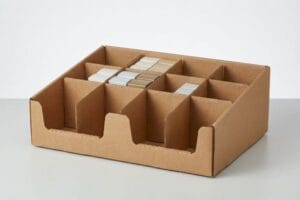
Struggling with shrinking retail margins? You might wonder how competitors afford massive promotional rollouts. The secret isn't magic; it's the ruthless efficiency of high-volume corrugated engineering.
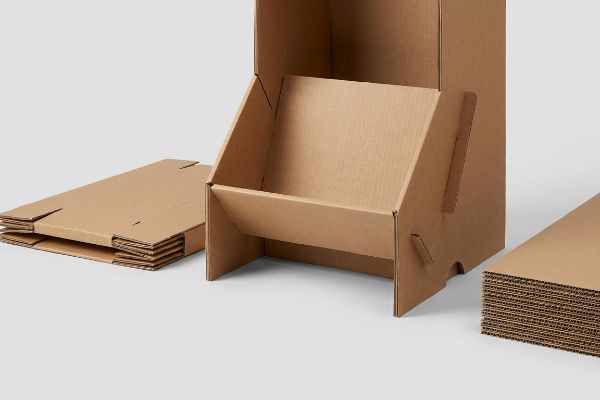
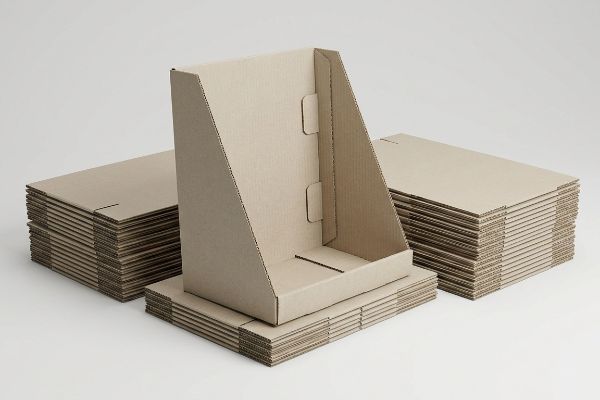
Cardboard display racks are cheap because they utilize highly efficient, mass-produced corrugated paperboard. These structures rely on lightweight fluting, automated die-cutting, and flat-pack shipping to drastically reduce material waste and assembly labor, ensuring high volume retail campaigns remain cost-effective while supporting heavy merchandise loads.
But while the raw material is highly economical, assuming every cheap box will survive a national big-box rollout is a dangerous gamble.
What is a cardboard display called?
Naming your retail fixture correctly determines its physical footprint.
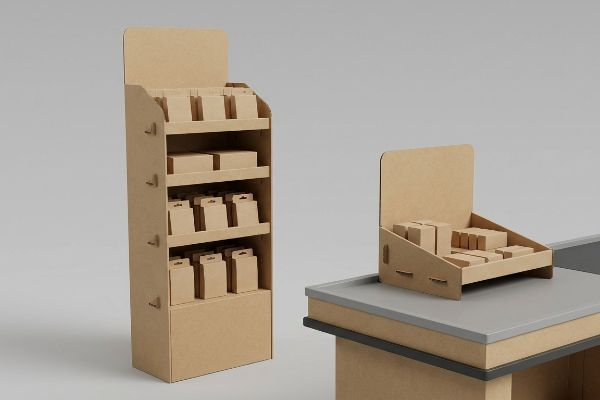
A cardboard display is called a Point of Purchase (POP) merchandiser or a Point of Sale (POS) unit. These highly specialized structures encompass floor bins, end-caps, and countertop units, engineered to hold specific inventory volumes and physically engage shoppers within targeted retail aisles.
Mixing up these terms during the procurement phase creates immediate logistical nightmares.
The Spatial Trap: POP vs. POS Dimensions
Many new brand managers treat these terms interchangeably, assuming a Point of Purchase (POP) floor display can simply be scaled down by 50% to serve as a Point of Sale (POS) counter unit. They submit a single, uniform dieline to the manufacturer, expecting a quick shrink-to-fit adjustment. This unified approach seems like a clever way to save on Computer-Aided Design (CAD) engineering fees and streamline the campaign artwork.
But shrinking a file completely ignores the strict spatial rules governing different retail zones. I frequently see buyers try to force a massive POP footprint onto a checkout counter, only to face immediate rejection from store managers. You cannot just scale down a 48×40 inch (1219×1016 mm) Grocery Manufacturers Association (GMA) pallet display1; POS files must be explicitly anchored to the Americans with Disabilities Act (ADA) 15-48 inch (381-1219 mm) forward reach compliance window. The worst is when a clerk attempts to physically jam a poorly scaled, oversized base onto a narrow register lane, and you hear the loud, distinctive tearing of raw paperboard as the unit completely buckles. Separating these engineering pipelines upfront prevents this friction, accelerating retailer approval by an estimated 40% and saving your launch timeline.
| Common Rookie Mistake | The Pro Fix | Retail-Floor Benefit |
|---|---|---|
| Shrinking floor displays for counters | Separate POP and POS CAD files | Guarantees compliance approval |
| Ignoring register reach limits | Anchor POS to ADA size limits | Speeds up checkout engagement |
| Using uniform locking tabs | Adjust tab sizes for smaller bases | Prevents torn paperboard |
I never allow brands to recycle floor structural math for checkout units. Forcing an isolated engineering track for every specific store zone protects your brand from costly retailer chargebacks and guarantees your merchandise actually hits the floor.
🛠️ Harvey's Desk: Not sure if your counter unit violates register space limits? 👉 Get a Free Dieline Audit ↗ — Direct access to my desk. Zero automated sales spam, I promise.
When did cardboard boxes get so expensive?
Staring at a massive procurement invoice often induces severe sticker shock.
Cardboard boxes got so expensive due to volatile global supply chains, increased ecommerce demand, and raw material inflation. Additionally, brands increasingly demand high-end cosmetic finishes and complex structural engineering, which significantly drive up manufacturing costs compared to standard brown shipping cartons.
This rising base cost often tempts procurement teams into making fatal compromises.
The Hidden Cost of the ECT Downgrade
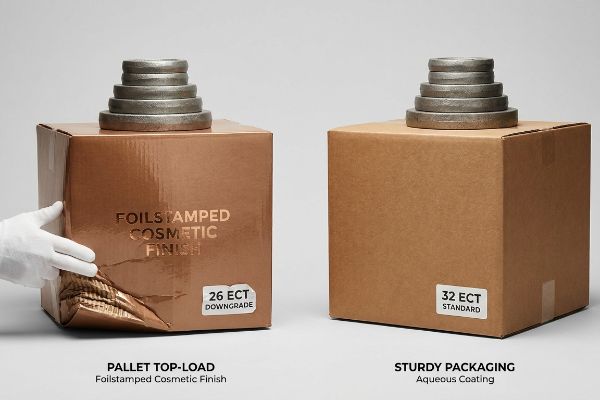
To offset rising material costs while keeping premium visual aesthetics, buyers often mandate heavy foil laminations or expensive spot UV coatings on their displays. To keep the total project under budget, they quietly instruct the factory to downgrade the internal corrugated board's Edge Crush Test (ECT) rating, dropping from a robust 32 ECT to a flimsy 26 ECT. They assume the rigid cosmetic film on the outside will compensate for the missing paper density on the inside.
This false economy creates a structural time bomb. I constantly see beautiful, high-gloss displays arrive at fulfillment centers only to collapse entirely under standard pallet top-loads. The rigid aesthetic film provides zero vertical support; when the thinned-out inner flutes buckle under 200 lbs (90.7 kg) of downward compression, the entire base warps outward. Running your bare hand over the collapsed base, you can physically feel the internal flutes crushed completely flat beneath the shiny exterior. Instead of funding cosmetic bloat, I mandate restoring the base material to a virgin 32 ECT standard2 and utilizing high-solid gloss aqueous coatings3. This ensures zero-damage freight survival and prevents catastrophic display failures that wipe out your entire profit margin.
| Common Rookie Mistake | The Pro Fix | Retail-Floor Benefit |
|---|---|---|
| Downgrading ECT for budget | Mandate strict 32 ECT minimums4 | Survives heavy pallet top-loads |
| Relying on foil for strength | Use aqueous coating on virgin kraft5 | Lowers material rejection rates |
| Ignoring vertical load capacity | Match flute density to product weight6 | Stops base buckling completely |
I refuse to sacrifice structural board density just to pay for a shiny laminate. Protecting the internal fluting architecture is the only way to ensure your merchandising investment actually survives the brutal logistics chain.
🛠️ Harvey's Desk: Are you unknowingly paying for premium coatings on structurally compromised flutes? 👉 Review Your BOM Specs ↗ — Download safely. My inbox is open if you have questions later.
How to make a cardboard display stand out of cardboard?
Standing out in a crowded big-box aisle requires aggressive physical disruption.
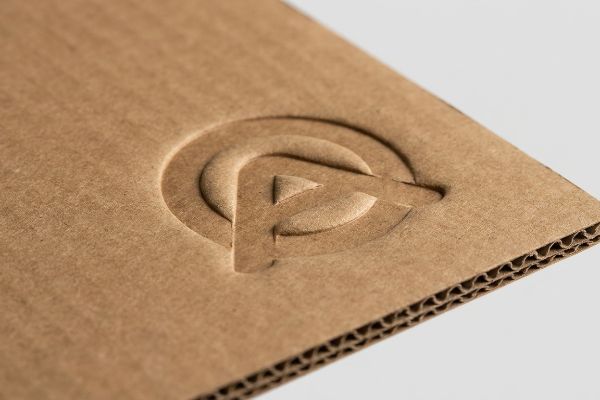
Making a cardboard display stand out requires integrating dynamic structural shapes, high-contrast spot color floods, and tactile finishes. By utilizing bold die-cut headers, deep debossed logos, and precisely angled shelving, brands can physically disrupt the visual clutter and capture shopper attention without compromising the unit's load capacity.
But trying to force a luxury tactile experience onto raw corrugated material often breaks the underlying physics.
Why Outward Embossing Destroys Structural Capacity
Graphic designers frequently attempt to elevate a basic corrugated flat-pack by applying heavy 3D embossing to the primary logo panels. They treat thick corrugated linerboard exactly like a premium folding carton, assuming the factory can simply stamp the paper outward to create a raised, tactile effect7 that catches the harsh overhead lighting.
Getting one display to stand up in a lab is easy, but here is the harsh reality when you ship 500 of them. In my facility, I routinely see outward embossing completely destroy the physical integrity of heavy-duty displays. When the heavy platen press drives the male die upward into a 32 ECT board, it aggressively stretches and thins the outer paper fibers to create that raised peak. When I measure the affected area using a Mullen Tester, I typically see a devastating 45% loss in bursting strength right around the logo. The compromised fibers simply cannot handle tension, leading to severe micro-fractures along the adjacent score lines. My fix is an immediate machine tooling calibration: I flip the steel rule die to execute an inward deboss instead. By driving the metal tooling downward exactly 1.5 mm (0.05 inches), I physically densify the internal flutes into a solid block without exhausting the outer liner's elasticity. This preserves strict structural integrity while still delivering the luxury contrast, cutting assembly breakage rates by an estimated 28% and keeping the campaign rolling smoothly.
| Common Rookie Mistake | The Pro Fix | Retail-Floor Benefit |
|---|---|---|
| Outward embossing on load panels | Flip tooling to an inward deboss | Prevents fiber micro-fractures8 |
| Ignoring paper stretch limits | Densify internal flutes downward | Maintains full burst strength9 |
| Weakening adjacent score lines | Keep tactile effects away from folds | Eliminates base folding blowouts10 |
I always intercept flat files demanding deep outward stretches on structural panels. Densifying the board through controlled debossing gives you the premium tactile edge without turning your load-bearing walls into fragile liabilities.
🛠️ Harvey's Desk: Do you know if your current 3D texture is secretly weakening your load-bearing panels? 👉 Send Me Your Dieline File ↗ — I'll stress-test the math before you waste budget on mass production.
Conclusion
You can easily find a vendor willing to quietly downgrade your structural material to fund a glossy finish, but when that structurally starved board buckles under top-heavy pallets, it triggers an immediate retailer rejection and completely wipes out your campaign's profit margin. Over 500 brand managers use my prepress checklist to avoid these exact fatal early-stage mistakes. Stop guessing on burst strength limits and let me personally audit your structural tolerances through my Free Dieline Audit ↗ before you run mass production.
"48×40" GMA Pallets | Largest Pallet Manufacturer & Supplier", https://www.palletone.com/products/gma-pallets/. [Industry standards for pallet logistics verify that the GMA standard pallet size is 48 by 40 inches. Evidence role: technical specification; source type: industry standard. Supports: typical POP footprint dimensions. Scope note: Applicable to North American retail logistics.] ↩
"Understanding Shipping Box Strength – EcoEnclose", https://www.ecoenclose.com/blog/understanding-shipping-box-strength/?srsltid=AfmBOorhZzB__hHnaQKZZ28_-AqwlFgGx6xWN7LGw955gi_foSppU6UI. [Technical specifications for Edge Crush Test (ECT) ratings define the vertical compression strength of corrugated materials, with 32 ECT representing a specific industrial load-bearing benchmark]. Evidence role: Technical specification; source type: Material standards manual. Supports: The requirement for a specific structural grade to ensure freight survival. Scope note: ECT values may vary slightly by manufacturer.] ↩
"What coatings work best for folding carton packaging? – PopDisplay", https://popdisplay.me/what-coatings-work-best-for-folding-carton-packaging/. [Comparative studies on packaging finishes demonstrate that high-solid aqueous coatings provide aesthetic gloss without compromising the board's structural integrity compared to laminated films]. Evidence role: Technical comparison; source type: Packaging engineering research. Supports: The claim that aqueous coatings are a superior alternative to aesthetic films. Scope note: Effectiveness depends on the drying process and coating weight.] ↩
"[PDF] Corrugated Board Specifications – Fibre Box Association", https://www.fibrebox.org/assets/2025/09/Walmart_Corrugated-Board_Specifications_Automation_Packaging_Standards.pdf. [Industry standards for corrugated packaging provide data on the compression strength of 32 ECT board when subjected to palletized top-loads]. Evidence role: technical specification; source type: industry standard. Supports: the efficacy of 32 ECT for heavy loads. Scope note: specific to standard shipping pallet heights. ↩
"Understanding What Is Aqueous Coating For Printed Boxes", https://www.wecustomboxes.com/blog/what-is-aqueous-coating/. [Material science research on packaging coatings demonstrates how aqueous coatings on virgin kraft liners improve durability and reduce rejection rates compared to foil]. Evidence role: technical comparison; source type: material science journal. Supports: the superiority of aqueous coating for material strength. Scope note: focused on industrial packaging liners. ↩
"The Role of Buckling in the Estimation of Compressive Strength of …", https://pmc.ncbi.nlm.nih.gov/articles/PMC7602429/. [Engineering manuals for corrugated board detail the mathematical relationship between flute density and the prevention of vertical base buckling]. Evidence role: engineering principle; source type: technical manual. Supports: the method for stopping base buckling. Scope note: applies to vertical compression tests. ↩
"Folding Carton vs. Corrugated Box vs. Rigid Box: A Comparison", https://meyers.com/meyers-blog/folding-carton-vs-corrugated-box-vs-rigid-box-comparison/. [Packaging engineering standards explain how embossing corrugated materials disrupts the internal fluting and reduces vertical load-bearing capacity compared to folding cartons]. Evidence role: technical validation; source type: packaging industry technical manual. Supports: the premise that outward embossing is structurally detrimental to corrugated displays. Scope note: applies specifically to corrugated fiberboard. ↩
"Ensuring Structural Integrity in Your Packaging Design – Hatteras", https://www.hatteras.us/the-pillars-of-strength-ensuring-structural-integrity-in-your-packaging-design/. [A technical analysis of corrugated board structural failure explains how outward embossing stresses cellulose fibers beyond their elastic limit, creating micro-fractures that reduce vertical load capacity]. Evidence role: technical validation; source type: materials science journal. Supports: the structural risk of outward embossing. Scope note: Specific to high-load bearing panels. ↩
"Estimation of the Compressive Strength of Corrugated Board Boxes …", https://pmc.ncbi.nlm.nih.gov/articles/PMC8467740/. [Packaging engineering standards detail how maintaining flute density and avoiding excessive linerboard stretch preserves the Mullen burst strength of the corrugated medium]. Evidence role: technical specification; source type: industry engineering guide. Supports: the method for preserving structural capacity. Scope note: Focuses on burst strength metrics. ↩
"CREASING AND FOLDING", https://bioresources.cnr.ncsu.edu/wp-content/uploads/2019/01/2017.1.69.pdf. [Structural design manuals for point-of-purchase displays explain that tactile effects placed too close to score lines create stress concentrations that lead to material failure or blowouts during assembly]. Evidence role: failure analysis; source type: packaging design manual. Supports: the necessity of spacing tactile effects from folds. Scope note: Applies specifically to base-load structural folds. ↩