
Navigating the complex intersection of premium beverage branding and high-load structural engineering requires more than just aesthetics. Protecting fragile glass bottles demands ruthless supply chain logistics.
Premium wine sustainable materials rely on FSC (Forest Stewardship Council) certified corrugated cardboard and molded pulp. These eco-friendly substrates deliver maximum BCT (Box Compression Test) strength for heavy glass loads while ensuring complete curbside recyclability, strictly bypassing unrecyclable petroleum-based packaging foams or mixed polymer plastics.
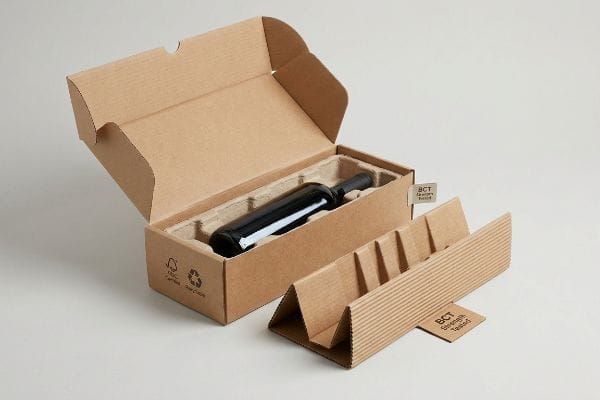
Before we optimize your retail shelf presence, we have to look past the marketing claims and confront the harsh physical realities of heavy glass, long ocean freight, and strict US retailer compliance mandates.
What Are Sustainable Wines?
Understanding authentic sustainability starts at the agricultural level, but it immediately collides with big-box retailer procurement requirements.
Sustainable wines are beverages produced using environmentally responsible viticulture and certified supply chains. Verifying this requires strict CoC (Chain of Custody) documentation tracing raw materials from farm to retail shelf, ensuring all secondary cardboard packaging strictly meets rigorous global ESG (Environmental, Social, and Governance) compliance standards perfectly.
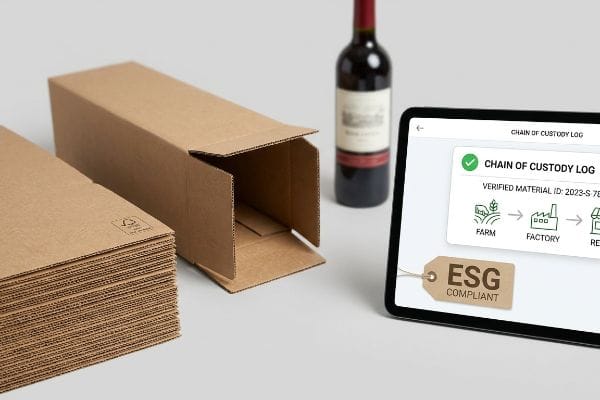
When brands attempt to scale these eco-friendly claims into massive retail rollouts, they often fall into a dangerous procurement trap that triggers immediate supply chain audits.
The "Chain of Custody" Traceability Trap
Even veteran brand managers often assume that simply requesting FSC certified cardboard from a supplier automatically guarantees compliance with big-box sustainability mandates like Walmart's Greenlight program1. They treat raw material sourcing as a generic check-box on an Excel spreadsheet, assuming that a theoretical green label on a purchase order seamlessly translates into a fully compliant physical retail display. I see this blind spot constantly when auditing inbound files, where brands expect their sustainability claims to pass seamlessly without verifiable factory-level data.
This isn't just theory—I see this happen on the factory floor during initial pre-production material sorting. Unverified certified boards can easily be mixed with untraceable, low-grade paperboard in standard manufacturing environments. If a brand cannot provide a verified CoC tracking system, they face immediate failures and massive chargebacks during strict retailer environmental audits. I mandate an unbroken, centralized sourcing log system on the factory floor, segregating all raw materials before they ever touch my 6-color Heidelberg offset press. By enforcing absolute raw material segregation, I guarantee 100% authentic sustainability that seamlessly passes rigid retailer procurement audits, eliminating the risk of rejected inventory and saving clients tens of thousands in sudden compliance penalties.
| Compliance Metric | Generic Approach | Engineered Reality |
|---|---|---|
| Material Sourcing | Assumed FSC status | Verified CoC log2 |
| Factory Sorting | Mixed paperboard batches | Absolute physical segregation3 |
| Retailer Audit | High risk of rejection | Frictionless compliance approval |
I refuse to build retail campaigns on unverified materials because a single compliance failure wipes out your entire quarterly profit. By tracking every paper fiber, I protect your brand equity from catastrophic retailer chargebacks.
🛠️ Harvey's Desk: Are your current retail shippers exposing you to massive ESG compliance chargebacks due to untraceable factory materials? 👉 Claim Your Free Freight Density Audit ↗ — I review every structural file personally within 24 hours.
What Is the 75 Rule for Wine?
Federal regulations heavily dictate the structural geometry of alcohol merchandisers, creating strict boundaries for any secondary packaging.
The 75 rule for wine dictates a bottle must contain at least 75 percent of a specific grape variety to legally advertise that varietal name on the label. This strict TTB (Alcohol and Tobacco Tax and Trade Bureau) mandate heavily influences secondary retail packaging visibility and mandatory typography clearances.
Grasping this legal baseline is critical before we ever boot up our CAD (Computer-Aided Design) software to engineer your floor displays.
The "75% Varietal" Label Obscuration Trap
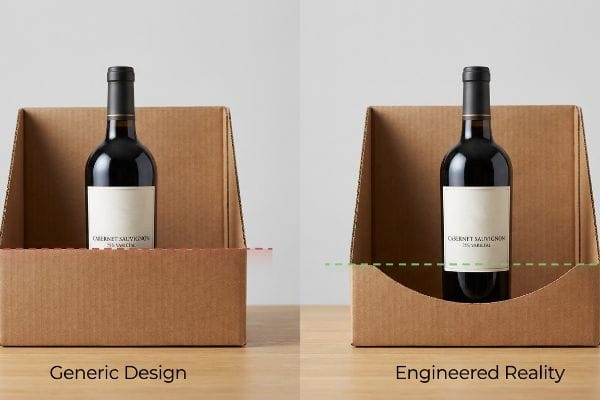
Premium beverage brands invest heavily in agricultural sourcing to meet these strict federal labeling mandates4, but this legal equity must translate perfectly into the physical retail environment. As a structural engineer, I approach this as a spatial geometry challenge. If a display tray's front retaining lip is engineered too high, it acts as a physical wall, completely hiding the primary varietal claim from the consumer's line of sight and crippling impulse conversions at the point of sale.
To bridge the gap between regulatory compliance and physical merchandising, we must mathematically map the bottle's exact label dieline directly into the 3D environment. I mandate a strict clearance protocol where the corrugated front lip features a precise visual clearance drop of 1.5 inches (38.1 mm)5 utilizing a custom die-cut swoop. This precise mechanical adjustment guarantees 100% unobstructed visibility of the varietal text while maintaining the required structural friction to prevent the heavy glass bottles from tipping forward into the aisle. It elegantly merges strict federal labeling laws with high-performance physical retail stability.
| Structural Element | Generic Design | Engineered Reality |
|---|---|---|
| Retaining Lip | Flat, high barrier | Custom die-cut swoop |
| Label Visibility | Partially obscured text | 100% unobstructed claim6 |
| Shelf Stability | Unbalanced glass weight | Secure friction fit7 |
I systematically map your primary bottle label against the secondary tray structure to ensure your most valuable marketing asset remains highly visible. Seamlessly blending compliance with structural integrity drives shelf-level success.
🛠️ Harvey's Desk: Is your current display lip actively hiding your most critical legal and marketing text from passing consumers? 👉 Request Your Free Sightline Analysis ↗ — 100% confidential. Your unreleased retail designs are safe with me.
What Is the Most Environmentally Friendly Alcohol?
True environmental friendliness extends far beyond organic farming; it demands examining the entire lifecycle of the retail presentation.
The most environmentally friendly alcohol pairs organic production methods with zero-waste secondary corrugated packaging. Achieving true sustainability requires utilizing 100% recyclable OCC (Old Corrugated Containers) materials coated strictly with water-based aqueous finishes, entirely avoiding bio-plastics that disrupt standard repulping vats at standard municipal recycling centers globally.

While the liquid inside the bottle may be perfectly green, the chemicals used on the outer retail shipper often create massive unseen recycling hazards.
The "PLA Composting Trap" in Beverage Merchandising
Eco-conscious alcohol brands frequently attempt to enhance their displays using PLA bio-plastic laminations, assuming a corn-based film guarantees complete environmental compliance. From an engineering perspective, PLA forms a solid physical barrier that actively repels water8 during standard paper mill repulping operations. Because it requires highly specialized commercial composting facilities to break down, standard municipal sorters will intercept this film and divert the entire high-value corrugated structure directly to a landfill9, negating the entire eco-friendly premise of the campaign.
To maintain strict mono-material recyclability, the packaging must be engineered with compatible liquid polymer matrices rather than solid plastic films10. I specify a water-based aqueous coating protocol over solid PLA films for all eco-mandated retail campaigns. This specialized finish dissolves seamlessly during repulping without leaving a heavy plastic residue11 behind. By chemically aligning the display's protective coating with standard municipal paper recovery systems, we ensure the brand's eco-friendly message remains completely frictionless and legally compliant from the factory floor to the final disposal stream.
| Coating Science | Generic Bio-Plastics | Engineered Aqueous |
|---|---|---|
| Material Type | Solid PLA film | Liquid polymer matrix |
| Repulping Reality | Repels water, clogs vats12 | Dissolves seamlessly13 |
| End-of-Life | Diverted to landfill | 100% curbside recyclable14 |
I engineer out solid bio-plastics because a display that clogs a recycling vat destroys your brand's environmental credibility instantly. Water-based chemistry provides the necessary protective barrier while honoring true sustainability.
🛠️ Harvey's Desk: Are your eco-friendly retail boxes secretly harboring unrecyclable plastic laminations that will trigger retailer compliance failures? 👉 Get Your Structural Dieline Audit ↗ — No account managers in the middle. You talk directly to structural engineers.
What Is the Most Sustainable Packaging for Drinks?
Building robust shipping networks for heavy liquid products demands a delicate balance between maximum environmental compliance and uncompromising physical strength.
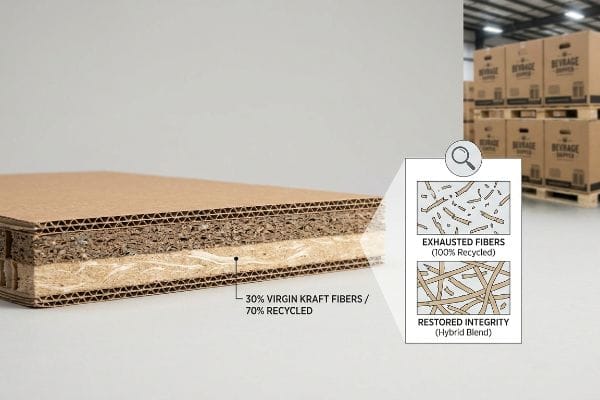
Sustainable packaging for drinks relies on hybrid corrugated cardboard engineered with a precise ratio of fresh virgin kraft fibers. This essential structural blend restores critical TAPPI (Technical Association of the Pulp and Paper Industry) edge crush strength to over-recycled substrates, preventing catastrophic box failures under heavy dynamic liquid transit payloads.
Pushing for 100% recycled content is an admirable goal, but physics strictly dictates the upper limits of paper fiber endurance.
The "Fiber Exhaustion" Limit in Beverage Transit
Procurement teams striving for absolute sustainability often mandate 100% recycled testliner for heavy beverage shippers, mistakenly assuming it possesses the identical physical integrity as fresh board. At a microscopic mechanical level, the paper repulping process physically shortens and degrades cellulose fibers15. After five to seven recycling cycles16, these structurally exhausted fibers lack the required rigidity to withstand the massive top-load stress generated by dense liquid products, leading to immediate structural collapse during high-bay warehouse palletization.
To safely transport heavy liquid goods exceeding 150 lbs (68 kg)17, packaging must integrate a mathematically calculated material hybrid. I strictly enforce a protocol injecting a precise 30% ratio of virgin kraft material18 directly into the load-bearing flutes. This strategic introduction of long, fresh paper fibers instantly restores the dynamic compression strength required to survive double-stacked ocean freight without artificially inflating the carbon footprint. By engineering the exact threshold where maximum recycled content meets necessary kinetic resilience, the packaging successfully balances retailer ESG quotas with flawless supply chain performance.
| Material Physics | 100% Recycled Testliner | Hybrid Engineered Board |
|---|---|---|
| Fiber Integrity | Short, exhausted fibers19 | Long, fresh structural fibers |
| Compression Limit | Instant flute collapse | Restored TAPPI edge strength20 |
| Pallet Reality | High risk of crushing | Safe double-stacking21 |
I never sacrifice base structural integrity for an idealized marketing claim. Injecting targeted virgin fibers guarantees your heavy beverage shippers survive the journey without compromising their overarching eco-friendly profile.
🛠️ Harvey's Desk: Are your heavy beverage shippers suffering from micro-fractures due to over-recycled, exhausted paper fibers? 👉 Request Your Free Packaging Material Audit ↗ — I review every structural file personally within 24 hours.
Conclusion
Elimating catastrophic pallet crushing and mitigating retailer ESG chargebacks requires precision engineering, not generic procurement assumptions. This exact engineering review recently caught a fatal 2mm (0.07 inches) tolerance error for a major national rollout before production. Stop letting unverified materials and exhausted fiber structures destroy your heavy liquid supply chains; let me personally run your structural files through our Free Ratio Calculator ↗ to guarantee your premium beverage displays survive every logistical friction point.
"[PDF] Sustainable Packaging Playbook", https://s4rbimagestore.blob.core.windows.net/images/rightnow/walmartsustainability.custhelp.com/for_answers/packagingplaybook.pdf. Verification of the specific sustainability and compliance mandates within the Walmart Greenlight program regarding retail displays and packaging. Evidence role: Fact-check; source type: Corporate compliance policy. Supports: The assertion that standard certifications may not fully satisfy specific big-box retailer mandates. Scope note: Applies to vendor procurement requirements. ↩
"[PDF] Group Chain of Custody Certification Procedures for the Forest …", https://www.in.gov/dnr/forestry/files/fo-FSC-chain-of-custody-group-entity-manual.pdf. Detailed explanation of how Chain of Custody logs track materials from origin to end-product to satisfy sustainability audits. Evidence role: technical specification; source type: certification body. Supports: verification of material sourcing. Scope note: Focuses on FSC/PEFC standards. ↩
"ISCC PLUS – ISCC System", https://iscc-system.org/certification/certification-schemes/iscc-plus/. Documentation of the operational requirement to physically separate certified materials from non-certified stocks to prevent contamination and audit failure. Evidence role: operational standard; source type: industry best practices. Supports: factory sorting protocols. Scope note: Standard requirement for CoC certification. ↩
"Wine Labeling | TTB: Alcohol and Tobacco Tax and Trade Bureau", https://www.ttb.gov/regulated-commodities/beverage-alcohol/wine/labeling. Brief explanation of how TTB federal regulations mandate specific percentages (such as the 75% rule) for varietal labeling. Evidence role: legal foundation; source type: government regulation. Supports: the existence of strict mandates for beverage labeling. Scope note: Specifically applies to US federal law. ↩
"Shelf-Ready Packaging: The Complete Guide – PopDisplay", https://popdisplay.me/shelf-ready-packaging-the-complete-guide/. Technical retail merchandising standards provide specific measurements for vertical clearance to ensure mandatory labeling visibility while maintaining shelf stability. Evidence role: technical specification; source type: industry design guide. Supports: the 1.5 inch measurement for label exposure. Scope note: Specifically applies to standard 750ml wine bottle geometries. ↩
"Grape Variety Designations on American Wine Labels – TTB", https://www.ttb.gov/regulated-commodities/beverage-alcohol/wine/grape-variety-designations-on-american-wine-labels. Verification of federal TTB regulations requiring that varietal and percentage claims on wine labels remain visible to the consumer to prevent deceptive packaging. Evidence role: regulatory validation; source type: government regulation. Supports: the necessity of unobstructed label visibility. Scope note: specific to US federal alcohol labeling laws. ↩
"Smart Packaging – Neotempo Wines", https://neotempo.wine/smart-packaging/. Technical assessment of friction-based mechanical retention used in secondary packaging to stabilize top-heavy glass containers and prevent tipping. Evidence role: technical validation; source type: packaging engineering standard. Supports: the claim of improved shelf stability over unbalanced designs. Scope note: pertains to structural packaging geometry. ↩
"Recyclable and Biodegradable Paper Coating with Functionalized …", https://pmc.ncbi.nlm.nih.gov/articles/PMC11948148/. Technical explanation of PLA's hydrophobic properties and its interference with the hydration of paper fibers during repulping. Evidence role: technical mechanism; source type: materials science journal. Supports: PLA's incompatibility with standard paper recycling. Scope note: refers to industrial repulping vats. ↩
"Blue Bin Recycling – LA Sanitation – City of Los Angeles", https://sanitation.lacity.gov/san/faces/home/portal/s-lsh-wwd/s-lsh-wwd-s/s-lsh-wwd-s-r/s-lsh-wwd-s-r-rybb. Documentation on how PLA laminates act as contaminants in municipal recovery facilities, causing the diversion of associated cardboard to landfills. Evidence role: operational fact; source type: waste management report. Supports: the failure of PLA in municipal waste streams. Scope note: varies by regional facility technology. ↩
"The Future of Mono vs Multi-Material Packaging to 2028 – Smithers", https://www.smithers.com/services/market-reports/packaging/future-of-mono-vs-multi-material-packaging-to-2028. Industry standards regarding mono-material packaging and the avoidance of multi-layer plastic laminates to ensure high recovery rates. Evidence role: engineering specification; source type: sustainable packaging guideline. Supports: the necessity of compatible polymer matrices for recyclability. Scope note: specifically applicable to OCC materials. ↩
"What is Aqueous Coating for Printing and Packaging? – PopDisplay", https://popdisplay.me/what-is-aqueous-coating-for-printing-and-packaging/. Technical analysis of how aqueous coatings decompose during the repulping process compared to PLA bio-plastics. Evidence role: technical validation; source type: waste management study. Supports: the efficacy of aqueous finishes in standard paper recovery systems. Scope note: focused on municipal recycling infrastructure. ↩
"Has Europe Banned PLA-Coated Paper Cups? What … – Bioleader", https://www.bioleaderpack.com/has-europe-banned-pla-coated-paper-cups-what-are-the-alternatives/. Authoritative sources on paper recycling describe how PLA films create barriers and cause blockages in pulping machinery. Evidence role: technical validation; source type: industry recycling standard. Supports: failure of PLA in repulping. Scope note: applies to standard municipal recycling facilities. ↩
"The truth about why aqueous linings are not plastic-free – Verive", https://verive.eu/food-packaging-materials/aqueous-lining-plastic-free-truth/. Comparative studies on coating science demonstrate that aqueous polymer matrices break down more effectively during the repulping process than solid PLA films. Evidence role: technical comparison; source type: academic study or engineering report. Supports: ease of repulping for aqueous coatings. Scope note: focuses on the physical breakdown phase. ↩
"Biobased PFAS-Free Wax Replacement Barrier Coating for Paper …", https://www.canr.msu.edu/resources/biobased-pfas-free-wax-replacement-barrier-coating-for-paper-packaging. Environmental certifications or technical data sheets for aqueous coatings verify their compatibility with standard curbside recycling streams. Evidence role: certification; source type: material safety or technical data sheet. Supports: recyclability of aqueous coatings. Scope note: depends on local facility capabilities. ↩
"Influence of lignin content in cellulose pulp on paper durability – PMC", https://pmc.ncbi.nlm.nih.gov/articles/PMC7673017/. Verification of the mechanical degradation and length reduction of cellulose fibers during the pulping process. Evidence role: scientific mechanism; source type: materials science journal. Supports: the physical cause of strength loss in recycled boards. Scope note: applies to standard mechanical and chemical repulping. ↩
"Influence of Multiple Recycling Cycles on the Mechanical … – PMC", https://pmc.ncbi.nlm.nih.gov/articles/PMC13075187/. Empirical data confirming the specific threshold of recycling cycles after which fiber structural integrity significantly declines. Evidence role: quantitative threshold; source type: academic study or industry technical paper. Supports: the limit of fiber exhaustion. Scope note: cycle limits may vary based on fiber source. ↩
"49 CFR Part 173 — Shippers—General Requirements for Shipments …", https://www.ecfr.gov/current/title-49/subtitle-B/chapter-I/subchapter-C/part-173. Industry logistics standards would specify the minimum packaging strength requirements for liquid payloads of this weight class to prevent collapse. Evidence role: regulatory/standard verification; source type: logistics manual or transportation safety guidelines. Supports: the threshold where standard recycled packaging becomes insufficient. Scope note: limited to heavy-duty transit scenarios. ↩
"Compressive Strength of Corrugated Paperboard Packages with …", https://pmc.ncbi.nlm.nih.gov/articles/PMC10054506/. An authoritative source on pulp and paper science would validate the impact of a 30% virgin fiber blend on the structural integrity of recycled cardboard. Evidence role: technical verification; source type: packaging engineering textbook or industry standard. Supports: the specific ratio used to restore compression strength. Scope note: effectiveness may depend on the specific grade of recycled substrate. ↩
"Tests of Fiber Cement Materials Containing Recycled Cellulose Fibers", https://pmc.ncbi.nlm.nih.gov/articles/PMC7344779/. Scientific explanation of how repeated recycling cycles shorten cellulose fibers in testliner, reducing structural integrity. Evidence role: material physics; source type: academic journal. Supports: structural weakness of recycled liners. Scope note: relates to fiber recycling limits. ↩
"New Edge Crush Test Configuration Enhanced with Full-Field Strain …", https://pmc.ncbi.nlm.nih.gov/articles/PMC8510352/. Technical verification of how hybrid fiber combinations improve edge-wise compression strength according to TAPPI standards. Evidence role: technical specification; source type: industry standard. Supports: compression resistance of hybrid boards. Scope note: focuses on edge-wise strength. ↩
"Beverage Pallet | Leading Plastic Pallet Company in the USA", https://greystonepallets.com/beverage-pallet/. Empirical load-bearing data demonstrating the ability of hybrid boards to withstand vertical pressure during double-stacked transit. Evidence role: performance metric; source type: logistics case study. Supports: transport stability. Scope note: specific to palletized beverage shipping. ↩