
You've finalized the artwork, but the supply chain remains a black box. Understanding where and how materials are sourced is the difference between a smooth rollout and massive delays.
Packaging is all produced from global supply chains heavily reliant on paper mills, converting facilities, and specialized printing plants. Most raw corrugated materials are sourced domestically or imported from major manufacturing hubs, depending on pricing, structural requirements, and retail compliance standards mandated by major big-box stores.
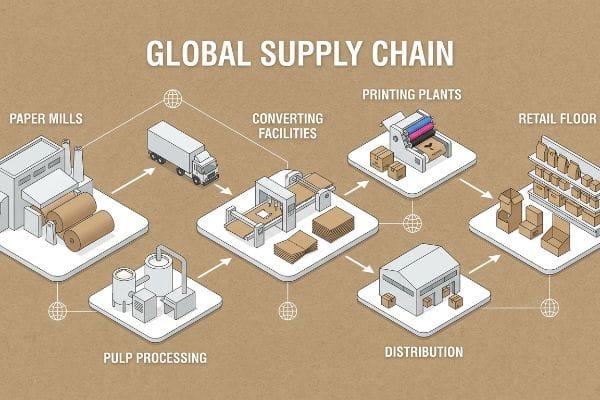
Let's strip away the corporate buzzwords and look at the physical realities of where your display materials actually originate before they hit the retail floor.
Where does packaging come from?
Knowing the geographic origin of your display is only half the battle; knowing the structural origin of the paper fibers dictates if it survives shipping.
Packaging comes from a vast global network of paper mills that process either virgin wood fibers or recycled pulp into large rolls of linerboard. These heavy rolls are then shipped to specialized converting plants where they are glued and corrugated into rigid boards for retail displays.
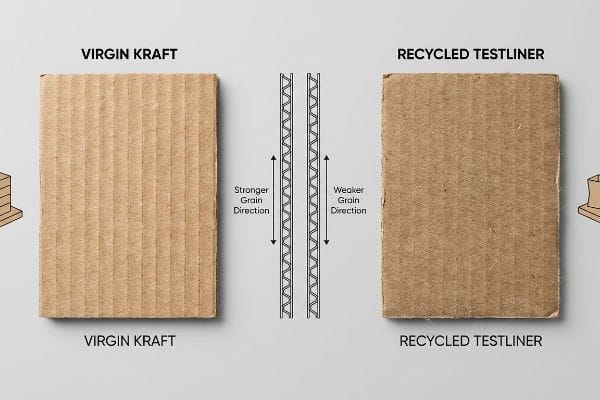
Knowing that your board comes from a mill doesn't help when a heavy master carton collapses in transit.
The Virgin Kraft vs. Recycled Testliner Debate
Many brand managers assume that all corrugated cardboard is structurally identical regardless of where it is sourced. They push for 100% recycled materials to hit sustainability targets without adjusting the structural math of their dielines. While eco-friendly sourcing is important, treating paper fibers as interchangeable commodities often leads to severe structural deficits during high-humidity ocean transit1 or long-term warehouse storage.
I see this trap all the time when a buyer forces a switch to fully recycled testliner for a heavy beverage floor display carrying up to 150 lbs (68 kg). The recycled fibers are shorter and weaker2, meaning the board feels noticeably spongier when you press your thumb into it. I once watched a merchandising team try to build a base using recycled board without adjusting the structural tolerances. The locking tabs kept buckling and tearing with a dull ripping sound under minimal pressure. They ended up wrapping clear packing tape around the entire base just to keep it upright, completely destroying the premium brand aesthetic.
| Common Rookie Mistake | The Pro Fix | Retail-Floor Benefit |
|---|---|---|
| Using 100% recycled board for heavy items | Switch to Virgin Kraft for load-bearing panels3 | Prevents base buckling and tape fixes |
| Ignoring fiber grain direction | Align flute grain vertically | Increases stacking strength by up to 40%4 |
| Blindly matching competitor specs | Test raw material Bursting Strength locally | Eliminates crushed corners in transit |
I always engineer heavy-duty bases using virgin kraft fibers because the longer fibers provide undeniable rigidity. You can push environmental initiatives on the header cards, but the foundation must survive the physical reality of the retail floor.
🛠️ Harvey's Desk: Not sure if your current material spec can handle the heavy weight of your product? 👉 Send Me Your Dieline File ↗ — Direct access to my desk. Zero automated sales spam, I promise.
How is packaging manufactured?
A brilliant design on a monitor means nothing if the physical converting machinery destroys the material during production.
Packaging is manufactured through a multi-step industrial process involving lithographic printing, laminating the printed top-sheet to a corrugated backing, and utilizing heavy-duty die-cutting machines. These massive steel rule dies punch out precise structural shapes and press score lines, ensuring the final product folds correctly without tearing.
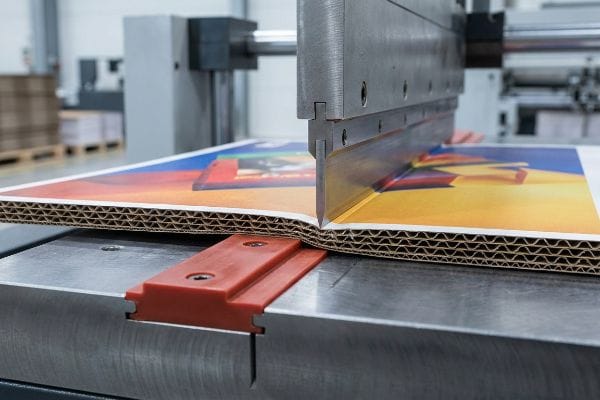
But standard die-cutting processes often fail when applied to heavy-duty, premium retail materials.
Preventing Litho-Cracking on the Manufacturing Floor
Even veteran designers often overlook the violent physical force required to fold thick corrugated boards. They place basic crease lines on a flat CAD (Computer-Aided Design) file, assuming the factory machines will magically create a clean 90-degree fold. However, pushing a blunt steel rule die into a rigid 32ECT board5 inherently strains the outer layers of the paper, especially if it has a high-quality printed top sheet attached.
I remember a client who insisted on using standard creasing tools for a massive club store tray. When I ran the first physical prototype on the cutting table, the loud snap of the paper fibers breaking was immediate. The rigid litho-varnish literally fractured along the fold line, exposing the ugly raw brown cardboard underneath. I had to manually install specific female creasing matrix channels on the machine bed6 to act as a supportive anvil. This controlled exactly how the fibers stretched during the strike, yielding a perfectly smooth, uncracked edge that saved the client from a costly reprint.
| Common Rookie Mistake | The Pro Fix | Retail-Floor Benefit |
|---|---|---|
| Relying on standard steel rule creases | Install custom polymer creasing matrices7 | Prevents ugly cracked ink on corners |
| Ignoring board caliper during folds | Apply bend allowances in the software8 | Ensures locking tabs slide in smoothly |
| Laminating dry, rigid varnishes | Use highly elastic anti-crack film9 | Eliminates peeling during fast assembly |
Adjusting the physical creasing matrix is non-negotiable for premium displays. This engineering tweak eliminates exposed brown edges, slashes co-packer setup time, and maintains flawless brand visibility under harsh retail lights.
🛠️ Harvey's Desk: Are your printed edges cracking and exposing raw brown cardboard every time you fold a heavy-duty display? 👉 Get a Production Audit ↗ — Download safely. My inbox is open if you have questions later.
What country produces the most packaging?
Global production volumes dictate pricing, but understanding exactly how overseas manufacturing calendars operate determines whether you hit retail launch dates.
China produces the most packaging globally, serving as the primary manufacturing hub for retail displays, corrugated boxes, and customized paper materials. Its immense infrastructure of specialized printing facilities, automated converting plants, and deep raw material supply chains allows for unparalleled scalability and highly competitive unit costs worldwide.
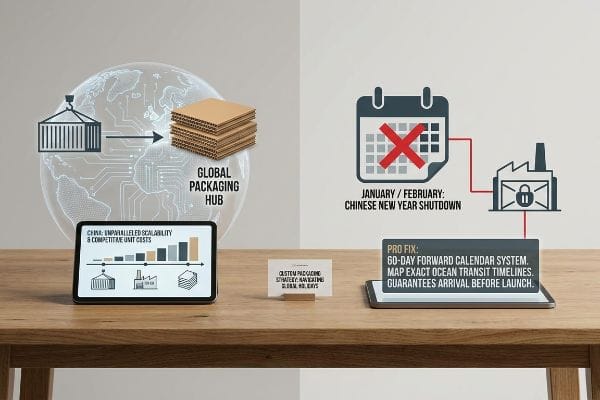
Sourcing from the world's largest packaging hub is highly efficient, until you slam right into their inflexible cultural calendars.
Surviving the Chinese New Year Production Gap
Procurement teams often build their US retail launch timelines using standard 30-day western production cycles, completely ignoring the seasonal dynamics of Asian manufacturing. They assume that because a factory produces millions of units a month, it will simply churn out their order whenever they send the purchase order. This naive approach leads to catastrophic delays when major national holidays halt the entire supply chain10.
Think of overseas production like catching a train; if you miss the final boarding call, you are stranded until the next shift. I frequently see buyers try to push a complex litho-laminated display order through in early January, completely blind to the upcoming Chinese New Year shutdown11. When the factories close, I've had panicked brand managers calling me because their seasonal end-caps are locked inside a dormant facility for a month. To fix this, I enforce a strict "60-Day Forward Calendar" alert system, forcing clients to approve final 3D proofs before the holiday blackout hits, ensuring their displays arrive stateside exactly when the retailer demands them.
| Common Rookie Mistake | The Pro Fix | Retail-Floor Benefit |
|---|---|---|
| Ignoring overseas holiday schedules | Implement a 60-day early alert system | Guarantees displays arrive before launch |
| Ordering minimum runs during peak season | Consolidate Q1 and Q2 bulk orders | Avoids massive peak-season freight spikes |
| Assuming standard 30-day turnarounds | Map exact ocean transit timelines | Prevents empty shelves during promotions |
I always reverse-engineer a project timeline starting directly from the retailer's "in-store date." By factoring in global holiday shutdowns before we even cut the first sample, I eliminate rush fees and protect your profit margin.
🛠️ Harvey's Desk: Are your current production timelines ignoring major global holidays and threatening your retail launch? 👉 Request a Timeline Review ↗ — No forms that trigger endless sales calls. Just pure value.
What is the country of origin on packaging?
A legally required label is just ink, but the compliance documentation behind that label dictates whether your product gets through customs or gets seized.
The country of origin on packaging dictates the specific nation where the physical materials were substantially transformed or manufactured into their final state. This mandatory legal labeling is heavily monitored by customs authorities to enforce accurate tariff applications, prevent trade deception, and ensure strict global supply chain transparency.
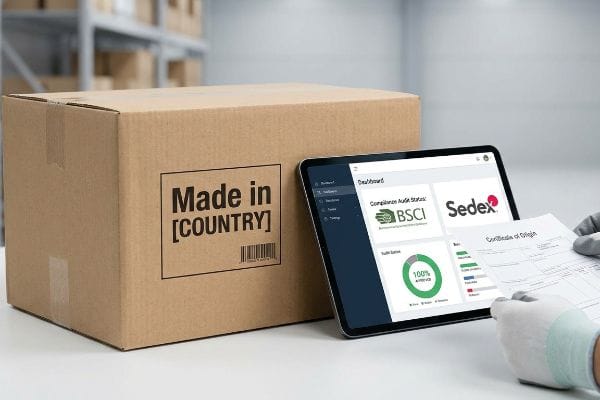
But knowing the theory isn't enough when the machines start running and the customs brokers demand physical proof of compliance.
Why Audit-Ready Factories Prevent Border Nightmares
Many brand buyers assume that as long as they print "Made in China" or "Made in USA" on the master carton, their compliance duties are completely finished. They treat origin labeling as a basic typography task on their artwork file. However, major US retailers and customs enforcement agencies require deep, verifiable audit trails12 proving that the manufacturing facility itself meets stringent ethical, security, and quality standards before the goods are ever allowed on the shelf.
In my facility, I routinely see brands scramble when big-box retailers demand immediate proof of compliance. This isn't just theory—I see this happen on the testing floor when a client tries to push a massive end-cap rollout into a major US retailer without verifying the factory's credentials. They assume their cheap broker has it covered, but then the shipment hits the port and US Customs or Walmart's QA (Quality Assurance) team demands an FCCA (Factory Capability and Capacity Audit) report. I remember a client who faced a crushing 3-week port delay because their previous supplier couldn't produce valid BSCI (Business Social Compliance Initiative) paperwork13. To eliminate this friction, I strictly enforce an "Audit-Ready" status across all production lines. By maintaining pre-approved compliance data and optimizing the ISF 10+2 filings exactly 72 hours before sailing14, I ensure the co-packing assembly time stays on track, saving clients thousands in unexpected holding fees and retailer chargebacks.
| Common Rookie Mistake | The Pro Fix | Retail-Floor Benefit |
|---|---|---|
| Treating origin labels as just artwork | Maintain strict BSCI and SEDEX audits15 | Prevents massive retailer rejection |
| Filing customs data at the last minute | Submit ISF 10+2 data 72 hours early16 | Eliminates expensive port holding fees |
| Using unvetted third-party brokers | Partner with direct, audit-ready facilities | Guarantees seamless retail compliance |
I don't let paperwork ruin months of engineering. By ensuring my facility maintains rigorous, big-box approved audit standards, I remove the logistical friction, allowing your campaign to clear customs and hit the retail floor seamlessly.
🛠️ Harvey's Desk: Do you know if your current facility actually holds the rigid audit certifications required by major US retailers? 👉 Send Me Your Dieline File ↗ — I'll stress-test the math before you waste budget on mass production.
Conclusion
You can choose a cheaper, unvetted facility, but when standard creasing matrices fracture your rigid litho-varnish and expose raw brown edges, you risk slowing down the co-packing assembly line by an estimated 30% and completely ruining your brand's premium aesthetic. Over 500 brand managers use my prepress checklist to avoid these exact fatal early-stage mistakes. Stop guessing on factory tolerances and let me personally run your structural files through my Free Dieline Pre-Flight Audit ↗ to catch these expensive errors before they hit mass production.
"[PDF] Fiber-Based Packaging – World Wildlife Fund", https://www.worldwildlife.org/documents/2321/26_3114_Fiber_Pkg_Whitepaper_FINAL_040826_DD.pdf. Material science studies on cellulose fiber length and bonding strength demonstrate that recycled fibers typically exhibit lower moisture resistance than virgin kraft. Evidence role: technical validation; source type: peer-reviewed material science journal. Supports: structural failure of recycled fibers in humidity. Scope note: Comparison between virgin kraft and recycled testliner. ↩
"Changing quality of recycled fiber material. Part 1. Factors affecting …", https://bioresources.cnr.ncsu.edu/resources/changing-quality-of-recycled-fiber-material-part-1-factors-affecting-the-quality-and-an-approach-for-characterisation-of-the-strength-potential/. [A technical analysis of pulp properties would verify that repeated recycling cycles shorten cellulose fibers and reduce inter-fiber bonding strength]. Evidence role: technical specification; source type: material science publication. Supports: the structural inferiority of recycled testliner compared to virgin kraft. Scope note: Fiber degradation varies based on the number of recycling cycles. ↩
"Difference between Testliner and Kraft Paper – TLP Packaging", https://tlppackaging.com/difference-between-testliner-and-kraft-paper/. [Materials science research indicates that longer, uncut virgin fibers in Kraft paper provide higher tensile strength and burst resistance than shorter recycled fibers]. Evidence role: technical justification; source type: materials science study. Supports: the preference for Virgin Kraft in heavy-duty packaging. Scope note: focuses on fiber length and bonding strength. ↩
"The Science Behind Strong, Durable Corrugated Packaging", https://diapkg.com/blog/the-science-behind-stronger-and-more-durable-corrugated-packaging/. [Engineering data on corrugated board physics demonstrates how aligning the flutes vertically maximizes the vertical compression strength of the box]. Evidence role: quantitative verification; source type: technical manual. Supports: the benefit of proper grain alignment. Scope note: results may vary based on board grade and flute profile. ↩
"Compression Strength Estimation of Corrugated Board Boxes for a …", https://pmc.ncbi.nlm.nih.gov/articles/PMC9864211/. [An engineering manual or packaging material science guide would explain the mechanical tension and strain placed on the linerboard of specific Edge Crush Test (ECT) rated materials during the die-cutting process]. Evidence role: Technical verification; source type: Industrial engineering standard. Supports: The physical mechanism causing material strain and potential cracking. Scope note: Specific to corrugated board grades. ↩
"Die-cutting and creasing your paperboard – Holmen Iggesund", https://www.iggesund.com/insights/paperboard-know-how/paperboard-manual/paperboard-manual-publication/printing-and-converting-performance/die-cutting-and-creasing/. [An authoritative source on die-cutting technology would explain how matrix channels act as a calibrated anvil to control fiber stretch and prevent varnish fracturing]. Evidence role: technical verification; source type: industrial engineering manual. Supports: the use of specific tooling to prevent litho-cracking. Scope note: specifically applies to lithographed corrugated materials. ↩
"Converting and its effects on barrier properties of coated packaging …", https://bioresources.cnr.ncsu.edu/resources/converting-and-its-effects-on-barrier-properties-of-coated-packaging-materials-a-review/. [Authoritative sources on packaging converting explain how polymer matrices distribute pressure to prevent ink fracture during folding]. Evidence role: technical validation; source type: industry handbook. Supports: effectiveness of polymer matrices in preventing litho-cracking. Scope note: specific to high-end folding cartons. ↩
"How to Use Onshape's Versatile Sheet Metal Tools for …", https://www.onshape.com/en/blog/how-to-use-onshapes-versatile-sheet-metal-tools-for-consumer-packaging-design. [Technical documentation for packaging CAD software describes how calculating bend allowances accounts for board thickness to ensure precise fit]. Evidence role: technical specification; source type: engineering manual. Supports: accuracy of locking tab fit based on board caliper. Scope note: applies to corrugated and folding carton boards. ↩
"What is Varnish Coating in Packaging and Printing? | Complete Guide", https://www.wecustomboxes.com/blog/what-is-varnish-coating-in-packaging-and-printing/. [Material science data on packaging coatings demonstrates that elastic films withstand folding stress better than rigid varnishes, reducing delamination]. Evidence role: material comparison; source type: technical data sheet. Supports: reduction in peeling during assembly. Scope note: focuses on lamination properties. ↩
"Chinese New Year and its Impact on Global Supply Chain", https://ctl.mit.edu/news/chinese-new-year-and-its-impact-global-supply-chain. [An authoritative logistics or supply chain report would document the systemic production shutdowns and labor shortages during major Asian national holidays]. Evidence role: factual verification; source type: industry analysis. Supports: the claim that seasonal holidays create production gaps. Scope note: primarily refers to East Asian manufacturing hubs. ↩
"Planning Ahead for Chinese New Year Production Timelines", https://www.zenpack.us/blog/planning-ahead-for-chinese-new-year-production-timelines/. [Authoritative industry reports and logistics guides verify the systemic shutdown of Chinese factories during the Lunar New Year holiday period]. Evidence role: Fact-check; source type: Supply chain analysis. Supports: The claim that production halts during this specific window. Scope note: Impact varies slightly by province and industry. ↩
"CBP initiates interoperability standards test to improve supply chain …", https://www.cbp.gov/newsroom/national-media-release/cbp-initiates-interoperability-standards-test-improve-supply-chain. [Authoritative government guidelines or retail compliance manuals would document the requirement for factory audits to verify ethical and security standards]. Evidence role: technical verification; source type: regulatory documentation. Supports: the claim that labeling alone is insufficient for customs and retail entry. Scope note: primarily applies to US-bound imports. ↩
"Responsible Supply Chain Step by Step | TÜV Rheinland", https://www.tuv.com/landingpage/en/supply-chain-audits/main-topics/3-step-by-step-to-a-responsible-supply-chain.html. [Official BSCI standards documentation outlines the mandatory social compliance audits required by global retailers to verify ethical manufacturing and labor practices]. Evidence role: industry standard; source type: professional organization. Supports: factory certification requirements. Scope note: primarily focused on social and labor standards. ↩
"19 CFR Part 149 — Importer Security Filing – eCFR", https://www.ecfr.gov/current/title-19/chapter-I/part-149. [Official US Customs and Border Protection (CBP) guidelines specify the mandatory filing window and data requirements for Importer Security Filings to avoid port penalties]. Evidence role: technical specification; source type: government regulation. Supports: regulatory compliance timelines. Scope note: Specific to US ocean imports. ↩
"amfori BSCI or SMETA? Which ethical audit do I need? – Eurofins", https://www.eurofins.com/assurance/resources/articles/amfori-bsci-or-smeta-which-ethical-audit-do-i-need/. [Industry compliance manuals detail how BSCI and SEDEX audits verify ethical sourcing and operational standards to meet retailer requirements]. Evidence role: factual verification; source type: industry standard. Supports: The role of audits in preventing retailer rejection. Scope note: Focused on social compliance audits. ↩
"Import Security Filing (ISF) – When to submit to CBP", https://www.help.cbp.gov/s/article/Article-1868. [U.S. Customs and Border Protection regulations define the Importer Security Filing (ISF) 10+2 requirements and the resulting penalties for late or inaccurate submission]. Evidence role: regulatory verification; source type: government regulation. Supports: The claim that timely ISF filing avoids port delays and fees. Scope note: Applies to U.S. customs imports. ↩