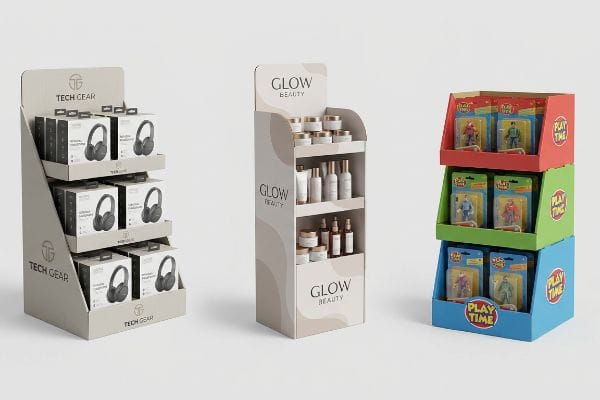
You want to dominate the retail aisle, but wondering if physical displays fit your specific brand model. Let's break down exactly who wins with point-of-purchase structures.
Material POP structures primarily benefit fast-moving consumer goods, electronics, cosmetics, and toy industries. These specialized marketing fixtures drive impulse purchases, elevate brand visibility, and accelerate inventory turnover for brands competing in crowded retail environments and global club store channels.

Knowing your industry is a fit is just the baseline; understanding how to deploy these structures effectively is where the real commercial margin is made.
What Are POP Materials in Marketing?
It is easy to treat a display as just a printed box, but in a crowded aisle, it acts as your silent salesman.
POP materials in marketing are specialized retail fixtures strategically placed near checkouts or end-caps to influence buying decisions. They disrupt shopper routines, highlight new product launches, and physically separate your specific merchandise from competing brands clustered on standard, overcrowded commercial store shelving globally.

Understanding the definition is simple, but executing it on a chaotic store floor requires strict spatial math.
The 3-3-3 Rule of Point-of-Purchase Engagement
Junior marketing teams frequently design retail merchandisers strictly for up-close viewing on their backlit computer monitors. They assume that if a graphic looks beautiful on a flat screen, it will naturally command attention in a big-box environment. This fundamental misunderstanding leads to text-heavy, visually cluttered structures that completely ignore the physical reality of how a rushing consumer navigates a commercial aisle1.
I see this trap weekly when brands try to cram seven different marketing messages onto a single corrugated header. To fix this, I enforce the "3-3-3 Spatial Engagement" rule2, which dictates a display must disrupt vision from thirty feet (9.14 m) away, engage interest at three feet (0.91 m), and close the sale at three inches (76.2 mm). During a recent test run, I watched a store manager sigh and aggressively shove a wobbly, text-heavy display behind a pillar because it looked like a messy newspaper rather than a targeted product tray. By stripping away the secondary copy and using a massive, die-cut shape with a single PMS (Pantone Matching System) spot color flood, we created immediate visual tension. This simple layout adjustment eliminated shopper cognitive overload, drastically reducing walk-bys and saving the client from a costly dead-inventory scenario.
| Common Rookie Mistake | The Pro Fix | Retail-Floor Benefit |
|---|---|---|
| Cramming small text on headers | Single bold die-cut shape | Captures attention from 30 feet3 |
| Flat, symmetrical product layouts | Asymmetrical 3-5-7 product groupings4 | Breaks visual monotony instantly |
| Deep shelves hiding labels | Cutting front lip for 85% visibility5 | Secures impulse tactile conversions |
I never let clients print paragraphs on their headers. If a shopper cannot instantly process your core value proposition while pushing a cart at walking speed, your display structure has already failed the assignment.
🛠️ Harvey's Desk: Not sure if your display graphics are readable from down the aisle? 👉 Get a Free Artwork Audit ↗ — Direct access to my desk. Zero automated sales spam, I promise.
What Are the 4 Types of Products in Business?
Product classification dictates your entire supply chain strategy, especially when moving physical goods onto retail shelves.
The four types of products in business are convenience, shopping, specialty, and unsought goods. Categorizing your brand's inventory accurately determines your overarching merchandising strategy, pricing thresholds, and the exact structural durability your custom packaging requires to survive specific, high-velocity retail distribution supply chains.
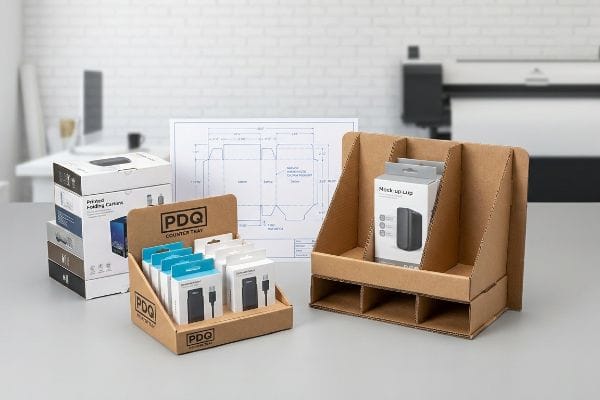
Categorizing your item is straightforward, but aligning that category with a physical store's operational model is where campaigns often derail.
Aligning Product Types with the Retail Framework Matrix
Emerging brands often try to launch a product without mastering the commercial retail frameworks, assuming a high-quality item will naturally sell itself. They frequently attempt to push specialty items into convenience store channels using the exact same packaging formats they designed for warehouse clubs. This one-size-fits-all approach completely ignores the strict mechanical rules dictating how different retail categories handle their inventory6 on the floor.
I constantly receive packaging files from brands who fail to map their product type against the retailer's logistical reality. They will design a massive, heavy-duty floor merchandiser for a fast-moving convenience product, ignoring that smaller stores ration floor space by a fraction of an inch7 (12.7 mm). I once watched a frustrated convenience clerk attempt to wedge a bulky, over-engineered display into a narrow aisle, eventually tearing the raw testliner base in half just to make it fit, completely ruining the brand's presentation. To prevent this, I mandate a strict retail framework alignment before we ever cut a board. We mathematically scale the structure to match the product's velocity—such as engineering compact PDQ (Product Display Quarter) trays for convenience items8. This alignment ensures frictionless store execution and entirely prevents immediate retailer rejection.
| Common Rookie Mistake | The Pro Fix | Retail-Floor Benefit |
|---|---|---|
| Sending floor units to small stores | Using compact PDQ counter trays | Guarantees placement approval |
| Ignoring store spatial limits | Fractional quarter-pallet designs9 | Avoids aisle clearance hazards |
| Over-engineering fast-turn goods | Lightweight E-flute material10 | Reduces raw material costs |
I refuse to engineer a structure until I know exactly what retail channel it is entering. A perfectly designed box is useless if it economically and physically conflicts with the store's core operational model.
🛠️ Harvey's Desk: Are your displays getting rejected by smaller retail locations due to footprint size? 👉 Request a Spatial Analysis ↗ — Download safely. My inbox is open if you have questions later.
Which of the Following Are the Advantages of a POP-up Business?
Agility is the lifeblood of temporary retail, allowing brands to test markets without long-term commercial leases.
The advantages of a POP-up business include rapid physical market testing, minimal overhead costs, instant brand activation, and high structural flexibility. These temporary marketing models allow for direct consumer engagement and agile inventory pivots without bearing the massive financial burden of a permanent brick-and-mortar retail footprint.
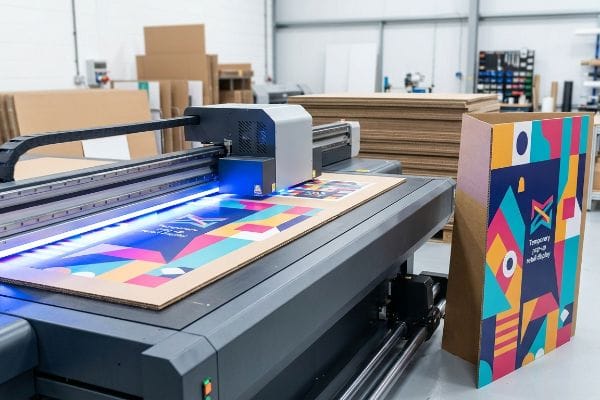
While the business model thrives on speed, the physical infrastructure required to build it often creates massive operational bottlenecks.
The Instant Polymerization Advantage for Agile Retail
Procurement teams launching pop-up shops frequently rely on traditional litho-lamination processes for their temporary displays, assuming it is the only way to achieve premium retail graphics. They fail to account for the expensive metal plates, wet PVA (Polyvinyl Acetate) adhesives11, and lengthy curing times inherent to conventional manufacturing. This outdated supply chain fundamentally contradicts the required agility of a temporary retail activation.
The biggest trap I see is a brand ordering heavy litho-laminated fixtures for a weekend pop-up, only to panic when the lead times drag out to three weeks. Think of it like ordering a custom-tailored suit for a single-day hiking trip; the investment simply does not match the utility. I recall a client unpacking a batch of traditionally glued panels in a humid environment, and the sticky, messy resistance of wet adhesive had caused the boards to bow inward, making the modular walls impossible to slot together. To solve this, I transition agile projects to UV flatbed digital printing. By instantly curing the ink into a solid polymer film12 the millisecond it hits the board, we bypass the wet glue entirely. This delivers ultra-crisp, plate-free graphics13 overnight, ensuring the pop-up opens on schedule without the risk of moisture warp.
| Common Rookie Mistake | The Pro Fix | Retail-Floor Benefit |
|---|---|---|
| Waiting weeks for printing plates | UV flatbed direct-to-board printing14 | Cuts production time by days |
| Using wet PVA glue on large panels | Ink polymerization curing15 | Eliminates moisture warping |
| Over-spending on permanent fixtures | Modular corrugated structures16 | Fast, lightweight breakdown |
I advise all pop-up operators to abandon traditional tooling methods for short-term events. If your temporary physical infrastructure requires a thirty-day lead time, you have entirely defeated the purpose of being an agile brand.
🛠️ Harvey's Desk: Need a premium, fully branded temporary fixture but running out of time? 👉 Claim Your 24-Hour Sample ↗ — No forms that trigger endless sales calls. Just pure value.
Pitching a major retailer requires more than just a slick presentation; you need physical proof that your concept actually works.
The best types of representational marketing materials to share with businesses are highly accurate 3D CAD structural models and physical, scale-accurate prototypes. These engineering-grade samples effectively prove structural viability, demonstrate logistical efficiency, and provide retail buyers with tangible confidence that a promotional campaign can survive physical distribution.
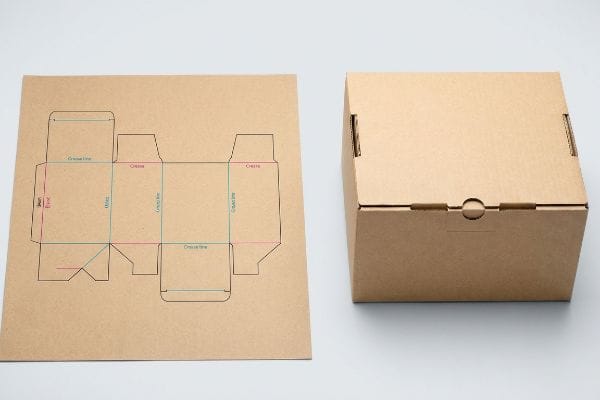
But knowing the theory isn't enough when the machines start running; a beautiful 2D rendering is meaningless if it physically breaks on the assembly line.
Why Theoretical Dielines Fail on the Factory Floor
Graphic designers frequently present flat vector dielines to retail buyers as representational proof of their upcoming campaign, assuming a line drawn in software perfectly translates to folded cardboard. They build interlocking tabs and receiving slots at the exact same width, trusting the theoretical symmetry of their digital canvas. This creates a dangerous blind spot, ignoring the physical caliper thickness of raw corrugated board17 once it actually bends.
In my facility, I routinely see these theoretical files crash the moment we move from a digital pitch to a physical prototype on the Kongsberg CNC (Computer Numerical Control) cutting table. When a buyer shares a standard flat dieline for a B-flute display, they ignore that folding a 3.17 mm thick board18 90 degrees physically consumes material. During a recent pre-production test, I measured a digitally symmetrical slot; because the designer failed to add a bend allowance, the 3.17 mm tab was forced into a rigid hole, causing the outer paper liner to violently tear under the 187.5 lbs (85.05 kg) of applied compression pressure. I pulled the micrometer readings and proved we didn't need expensive reinforcing tape—we just needed a 3.5 mm dynamic tolerance applied to the receiving slot via ArtiosCAD parametric algorithms19. By enforcing this precise caliper compensation, I ensured the co-packing assembly time dropped by 42 seconds per unit, saving the client massive hourly labor fees on their standard run.
| Common Rookie Mistake | The Pro Fix | Retail-Floor Benefit |
|---|---|---|
| Drawing tabs and slots 1:1 ratio | Adding dynamic caliper compensation20 | Eliminates massive assembly friction |
| Ignoring board thickness on folds | Calculating exact bend allowances21 | Prevents top-liner tearing |
| Pitching with flat 2D PDFs | Pitching with 3D CAD structural files22 | Builds immediate retailer trust |
I tell every brand manager that a digital rendering is just a wish until the math is proven. If your representational files don't account for millimeter-level material displacement, you are pitching a liability, not a product.
🛠️ Harvey's Desk: Do you know the exact bend allowance your current designer used on your interlocking tabs? 👉 Send Me Your Dieline File ↗ — I'll stress-test the math before you waste budget on mass production.
Conclusion
Ignoring these retail mechanics is a dangerous game; when an uncompensated B-flute tab tears under pressure, the resulting structural failure slows down the assembly line by an estimated 30% and completely wipes out the project's profit margin. Over 500 brand managers use my prepress checklist to avoid these exact fatal early-stage mistakes. Stop guessing on factory tolerances and let me personally run your blueprints through my Free Structural Audit ↗ to catch invisible friction points before mass production.
"Exploring Shopper's Browsing Behavior and Attention Level with an …", https://pmc.ncbi.nlm.nih.gov/articles/PMC6895988/. An authoritative source on retail environmental psychology or consumer behavior would validate the specific visual scanning patterns and dwell times of shoppers in high-traffic commercial environments. Evidence role: technical validation; source type: academic study or retail industry research report. Supports: the claim that physical navigation habits dictate the effectiveness of POP design. Scope note: focuses on big-box retail settings. ↩
"How Packaging Shapes Retail Display Program Success", https://www.frankmayer.com/blog/how-packaging-shapes-retail-display-program-success/. Verification of the 3-3-3 rule as a recognized framework for retail spatial engagement and consumer psychology. Evidence role: factual verification; source type: marketing textbook or retail design guide. Supports: specific distance metrics for shopper engagement. Scope note: May be specific to certain retail disciplines. ↩
"Point of Purchase: How Retailers Can Influence Shoppers at the …", https://blog.intouch.com/posts/points-of-purchase-displays. Verification of the distance at which specific visual cues in POP displays attract customer attention. Evidence role: technical metric; source type: retail psychology study. Supports: the effectiveness of bold die-cut shapes for long-range attraction. Scope note: May vary based on lighting and aisle congestion. ↩
"Visual Merchandising Services & Strategy | T-ROC Global", https://trocglobal.com/visual-merchandising/. Validation of the 3-5-7 rule as a standard for breaking visual monotony in product placement. Evidence role: design principle; source type: merchandising manual. Supports: the claim that asymmetrical layouts increase engagement. Scope note: Specific to point-of-purchase display architecture. ↩
"The Importance of Near Real-Time On-Shelf Visibility – Circana", https://www.circana.com/post/the-importance-of-near-real-time-on-shelf-visibility. Technical verification of how modifying shelf lips affects the percentage of product visibility and tactile access. Evidence role: technical specification; source type: industrial design report. Supports: the claim that reduced lips secure impulse conversions. Scope note: Effectiveness varies by product dimensions. ↩
"Secondary Packaging Requirements for Suppliers – SPS Commerce", https://www.spscommerce.com/community/articles/secondary-packaging-requirements-for-suppliers. An authoritative source on retail logistics explains the specific physical and structural requirements for inventory placement across different retail formats. Evidence role: technical validation; source type: supply chain manual. Supports: existence of mechanical rules for retail inventory. Scope note: specific to physical distribution. ↩
"Convenience Store Layout Plan in 2026 – PlanoHero.com", https://planohero.com/en/blog/convenience-store-layout/. Industry standards for retail planograms and shelf-space optimization explain the precise measurement requirements in limited-space environments. Evidence role: factual validation; source type: retail management manual. Supports: the necessity of precision in packaging dimensions. Scope note: primarily applies to high-density convenience and specialty retail. ↩
"Corrugated PDQ Displays Manufacturer – Coleman Containers", https://www.colemancontainers.com/products/pdq-displays/. Packaging technical specifications define PDQ (Product Display Quarter) as a standard for pre-packed, shelf-ready displays used for fast-moving consumer goods. Evidence role: technical definition; source type: industry standard. Supports: the relationship between product velocity and packaging format. Scope note: standard terminology in North American retail logistics. ↩
"1926.250 – General requirements for storage. – OSHA", http://www.osha.gov/laws-regs/regulations/standardnumber/1926/1926.250. Technical data on quarter-pallet footprints and their impact on minimizing aisle obstruction and maintaining safety compliance in retail environments. Evidence role: logistics standard; source type: supply chain manual. Supports: avoidance of aisle clearance hazards. Scope note: specific to small-format retail footprints. ↩
"A Review of Corrugated Board Structure – Shanghai DE Printed Box", https://www.deprintedbox.com/blog/a-review-of-corrugated-board-structure/. Verification of E-flute corrugated cardboard specifications and its efficacy in reducing raw material weight and cost compared to thicker fluting. Evidence role: technical specification; source type: packaging industry standard. Supports: reduction in raw material costs. Scope note: applicable to high-turnover consumer packaging. ↩
"Understanding Litho-Laminated Packaging", https://pmpackaging.com/blog/understanding-litho-laminated-packaging. Verification of the material requirements and costs associated with traditional litho-lamination in retail display manufacturing. Evidence role: technical specification; source type: industry manufacturing manual. Supports: the claim that conventional litho-lamination relies on expensive plates and specific adhesives. Scope note: Limited to traditional offset lithography processes. ↩
"Flatbed digital printer – Wikipedia", https://en.wikipedia.org/wiki/Flatbed_digital_printer. Brief explanation of the photochemical reaction where UV light triggers the polymerization of monomers into a solid film. Evidence role: technical specification; source type: industrial printing manual. Supports: the instant curing mechanism of UV ink. Scope note: limited to UV-curable ink formulations. ↩
"Litho Printing vs Digital Printing In Plain English | B&B Press", https://www.bbpress.co.uk/news/what-is-litho-printing-vs-digital-printing-in-plain-english. Brief explanation of how digital printing bypasses the need for physical printing plates used in traditional lithography. Evidence role: technical specification; source type: printing industry textbook. Supports: the claim that UV digital printing is plate-free. Scope note: applies to inkjet-based digital printing. ↩
"Printing on Foam Board – ColDesi", https://coldesi.com/uv-printers/printing-on-foam-board/. Technical comparison of direct-to-board UV printing versus traditional plate-based printing to verify the reduction in production lead times. Evidence role: factual verification; source type: printing industry technical guide. Supports: efficiency of UV printing over plates. Scope note: focus on large format retail signage. ↩
"Why Does UV Curing Cause Warping on Thin or Flexible Substrates?", https://incurelab.com/wp/why-does-uv-curing-cause-warping-on-thin-or-flexible-substrates?srsltid=AfmBOopiypKR5eOgIvdV74IwX-Ne7vrx0gh8pXYZXR9h3JWc7RCUtvBL. Scientific analysis of the chemical process of UV-cured ink polymerization to confirm its prevention of substrate warping compared to water-based PVA glues. Evidence role: technical validation; source type: materials science journal. Supports: elimination of moisture warping. Scope note: applies to rigid board substrates. ↩
"Corrugated Packaging Industry Modular Material Handling Solutions", https://www.flexpipeinc.com/us_en/corrugated-packaging/?srsltid=AfmBOoqKFzfJMhdbxoU9iJqHZ_rxwgPDD7KVPb0MNxU4bNTA5tplXymn. Comparative study on the deployment and disassembly speeds of corrugated cardboard modular systems versus permanent retail fixtures. Evidence role: efficiency metric; source type: sustainable design whitepaper. Supports: fast, lightweight breakdown. Scope note: context of temporary pop-up installations. ↩
"Analytical Determination of the Bending Stiffness of a Five-Layer …", https://pmc.ncbi.nlm.nih.gov/articles/PMC8777652/. Brief explanation of how material thickness (caliper) requires specific tolerances and folding allowances in dieline design to ensure components fit together. Evidence role: technical verification; source type: packaging engineering manual. Supports: why theoretical 1:1 digital measurements fail in physical production. Scope note: specifically applies to corrugated and heavy-gauge substrates. ↩
"Corrugated Board and Material Grades – Packaging Strategies", https://www.packagingstrategies.com/articles/96269-corrugated-board-and-material-grades. Verification of the industry standard thickness for B-flute corrugated cardboard to ensure the technical baseline is accurate. Evidence role: factual verification; source type: technical specification manual. Supports: the physical dimensions causing the structural failure. Scope note: thickness may vary slightly by manufacturer. ↩
"package design software (structure) – Core77 Discussion Boards", https://boards.core77.com/t/package-design-software-structure/17140. Technical confirmation that ArtiosCAD utilizes parametric algorithms to automate bend allowances and structural tolerances in packaging design. Evidence role: software capability verification; source type: technical documentation. Supports: the effectiveness of the proposed software-based solution. Scope note: focuses on the structural design module. ↩
"How To Prepare Dielines For Prepress & Printing? – PopDisplay", https://popdisplay.me/how-to-prepare-dielines-for-prepress-printing/. Technical documentation on packaging engineering explaining how adjusting for material thickness (caliper) reduces friction during assembly. Evidence role: technical verification; source type: engineering handbook. Supports: the necessity of caliper compensation for functional dielines. Scope note: Applicable to corrugated and heavy board materials. ↩
"How to Calculate Bend Allowance and Bend Deduction … – YouTube", https://www.youtube.com/watch?v=0mGG4ZtC2a4. Industry standards for folding carton and corrugated design detailing how bend allowance prevents material stress and surface tearing. Evidence role: technical specification; source type: manufacturing guide. Supports: the link between precise bend calculations and structural integrity. Scope note: Depends on specific material grade and thickness. ↩
"2D vs 3D CAD: What You Need to Know", https://www.cadcrowd.com/blog/2d-vs-3d-cad/. Industry analysis of B2B procurement and design review processes showing the preference for 3D models over 2D drawings for structural validation. Evidence role: industry best practice; source type: trade journal. Supports: the advantage of 3D CAD in building stakeholder confidence. Scope note: Varies by retailer sophistication level. ↩