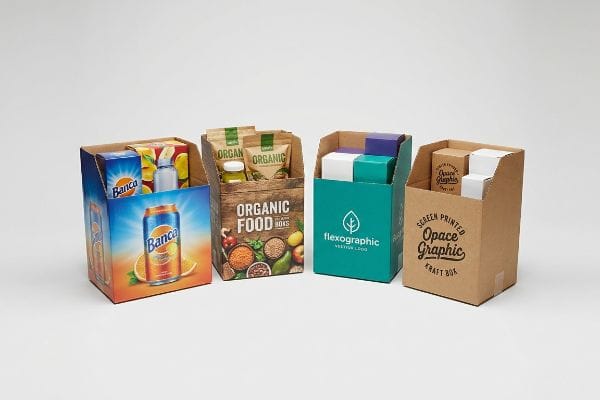
You have a great product, but if your corrugated display looks washed out or peels apart in the retail aisle, rushing shoppers will simply walk right past it.
Printing options for corrugated display boxes include lithographic lamination, direct-to-board digital, flexographic, and screen printing. Selecting the correct method depends strictly on your volume, budget, and desired graphic quality. Utilizing universal prepress color standards ensures optimal ink adhesion and structural packaging integrity for global retail execution.
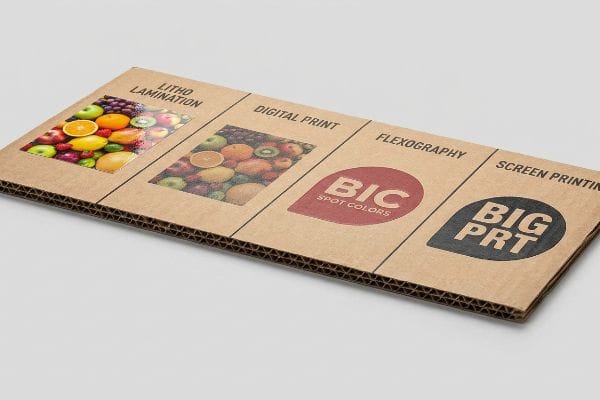
Understanding these technical printing methods is the baseline, but the real challenge begins when digital artwork meets physical cardboard on the factory floor.
What Kind of Printer Can Print on Cardboard?
To achieve commercial quality, you need specific machinery designed to handle thick materials without destroying them.
Printing on cardboard typically requires industrial UV (Ultraviolet) flatbed digital printers, offset lithographic presses, or high-speed flexographic machines. Standard commercial document printers cannot handle the physical thickness or porous nature of fluted paperboard, requiring specialized equipment to prevent severe mechanical jams and ink bleeding.
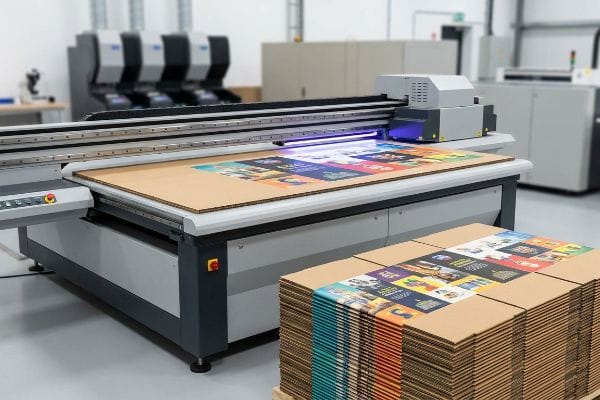
Knowing which machine to use is crucial, but knowing how the ink interacts with the material saves your budget.
The Power of Direct UV Flatbed Printing
Buyers often assume they need expensive metal plates and massive offset runs1 for every custom display. This pushes startups to over-order inventory just to justify the setup costs, locking up capital in warehouse storage for months.
It is a common trap that catches even experienced procurement teams when testing short-run agile campaigns. When you try to apply standard liquid inks directly to porous 32ECT (Edge Crush Test) virgin kraft linerboard2, the fibers absorb the moisture like a sponge. I see this fail constantly—the ink bleeds uncontrollably, leaving you with muddy graphics and the distinct, damp smell of wet paper fibers struggling to dry. I solve this by bypassing liquid absorption entirely using direct-to-board digital printing. A Kongsberg C-series cutter paired with heavy-duty UV light arrays instantly polymerizes the ink3 the millisecond it hits the board. This creates a solid, vibrant film on the surface, skipping prepress bottlenecks and saving massive plate setup fees.
| Common Rookie Mistake | The Pro Fix | Retail-Floor Benefit |
|---|---|---|
| Using liquid inks on raw board | UV instant-cure polymerization4 | Prevents washed-out graphics |
| Paying for expensive offset plates | Direct-to-board digital printing5 | Saves massive upfront tooling costs |
| Over-ordering to justify setups | Agile short-run production | Reduces dead warehouse inventory |
I strictly mandate direct-to-board UV printing for agile campaigns. It completely eliminates plate fees and moisture warp, giving you high-end, retail-ready prototypes in hours instead of weeks.
🛠️ Harvey's Desk: Are you burning budget on metal plates for short-run promotional tests? 👉 Request a Digital Prototype Audit ↗ — Direct access to my desk. Zero automated sales spam, I promise.
What Are the 8 Types of Printing Methods?
The commercial printing industry utilizes a wide variety of techniques, each engineered for highly specific material substrates and volume requirements.
The eight printing methods for commercial packaging encompass offset lithography, flexography, digital direct-to-board, screen printing, gravure, letterpress, 3D printing, and foil stamping. For high-volume retail displays, offset and flexography dominate the market, balancing high-speed production efficiency with precise brand color matching across massive supply chains.
Selecting the right method from this list is important, but how you prepare your colors for that specific method dictates your final retail success.
Why CMYK Fails on Raw Testliner
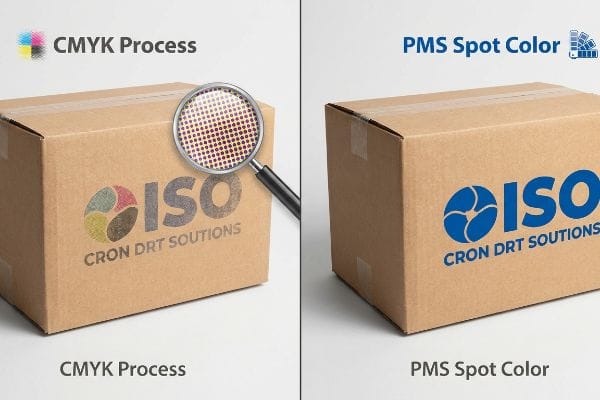
Marketing teams frequently convert solid corporate logos into standard CMYK (Cyan, Magenta, Yellow, Key/Black) formats for their dielines. They logically assume that standard process printing will seamlessly match the vibrant colors they see on their backlit digital monitors6.
But when those standard four-color halftone dots hit raw, unsealed corrugated testliner, the visual clarity falls apart. The tiny overlapping ink dots absorb unevenly into the rough substrate7, resulting in a grainy, washed-out logo that looks terrible under harsh big-box store lighting. I fix this by enforcing a spot color flood protocol for primary brand elements. Instead of relying on optical blending, I mix a single, dense PMS (Pantone Matching System) ink8 and flood the zone. You can physically feel the smooth, thick layer of pigment sitting cleanly on top of the board, completely eliminating halftone grain and guaranteeing your logo pops from 20 feet (6.09 m) away.
| Common Rookie Mistake | The Pro Fix | Retail-Floor Benefit |
|---|---|---|
| Relying on CMYK for logos | Flooding solid PMS spot colors9 | Eliminates grainy halftone dots |
| Printing directly on unsealed kraft | Chemically matched ink layers | Prevents visual absorption fade10 |
| Ignoring harsh retail lighting | High-contrast spot ink formulation11 | Drives impulse aisle visibility |
I never let brands rely on basic process colors for their primary logos on unsealed testliner. Flooding a true spot color guarantees the visual contrast necessary to pull impulse foot traffic in crowded aisles.
🛠️ Harvey's Desk: Does your printed logo look muddy and washed out when placed under harsh big-box fluorescent lights? 👉 Get a Color Contrast Strategy ↗ — Download safely. My inbox is open if you have questions later.
Can I Press Dtf on Cardboard?
Many startups try to cross-apply apparel decoration techniques to their secondary packaging, hoping for an easy customization hack.
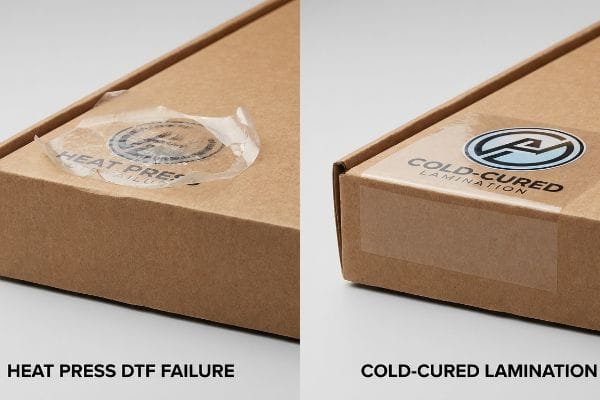
No. Pressing Direct-to-Film (DTF) on cardboard severely degrades physical structural integrity. The intense thermal heat required for transfers aggressively bakes the internal paperboard moisture, causing immediate panel warping. Additionally, polymer films frequently suffer surface tension rejection against porous fibers, leading to peeling graphics during retail handling.
While avoiding heat transfers is a basic rule of thumb, the underlying chemistry of ink adhesion requires a much closer look.
The Chemistry of Heat Transfers on Paperboard
Startup apparel brands often own heat press equipment and attempt to bootstrap their packaging by pressing custom films directly onto blank shipper boxes. They assume cardboard is just another flat canvas, much like a cotton t-shirt.
Even veteran designers often overlook the volatile chemistry between heat-activated polymers and raw wood pulp. When you press a hot platen onto a box, you instantly boil the ambient moisture trapped inside the flutes12, warping the flat panel permanently. Worse, the film suffers a chemical mismatch with the substrate's dyne level13. I see the aftermath when store clerks handle these boxes—the film unbinds, and you are left rubbing a dusty, flaky residue off your hands as the logo aggressively peels away. I solve this by matching the surface energy exactly to the specific ink oxidation rate, completely bypassing thermal pressing in favor of cold-cured laminations that survive rough transit friction.
| Common Rookie Mistake | The Pro Fix | Retail-Floor Benefit |
|---|---|---|
| Baking cardboard with heat presses | Utilizing cold-cured laminations | Prevents irreversible panel warp14 |
| Ignoring substrate surface tension | Matching dyne levels to inks15 | Stops logos from flaking off |
| Using apparel films on packaging | Deploying rigid-grade topcoats16 | Survives heavy transit friction |
I strictly forbid heat-pressing films onto structural corrugated board. Upgrading to a chemically matched aqueous or UV coating protects both your visual branding and your critical compression strength.
🛠️ Harvey's Desk: Are your custom box graphics peeling off the cardboard before they even reach the retail shelf? 👉 Claim Your Ink Adhesion Audit ↗ — No forms that trigger endless sales calls. Just pure value.
How to Print a Design on a Cardboard Box?
Bringing a digital concept into the physical world requires strict adherence to standardized prepress protocols.
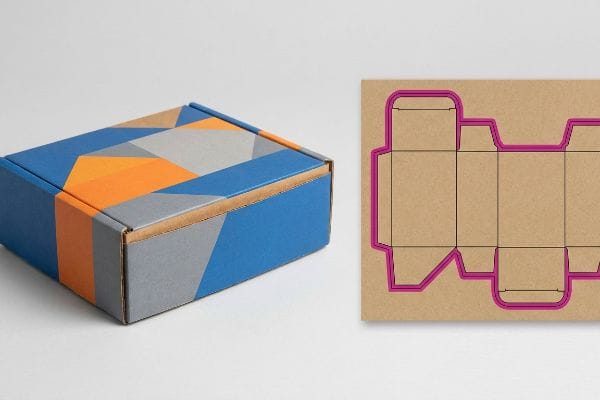
Printing a design on a cardboard box requires generating an accurate structural dieline, applying mandatory artwork bleeds, and selecting the correct commercial printing press. Professional manufacturing integrates prepress RIP (Raster Image Processor) software to map spot colors perfectly to computerized cutting tables for pristine edge execution.
But knowing the theory isn't enough when the heavy laminating machines start running on the factory floor.
The Hidden Danger of Litho-Lamination Shift
Graphic designers routinely apply standard commercial print bleeds—typically 0.125 inches (3.17 mm)17—to their retail display files. They logically assume that the exact same prepress rules used for thin, flat brochures apply safely to large-scale corrugated packaging structures.
In my facility, I routinely see this theoretical assumption cause catastrophic visual failures during automated mounting. Litho-lamination involves gluing wet printed top-sheets onto thick B-flute boards using PVA18 (Polyvinyl Acetate) adhesive. The physical reality of joining two thick substrates at high speeds naturally creates mechanical variance. When I measure the output, a tiny 3 mm bleed simply isn't wide enough to cover the shift, resulting in "flashing"—ugly exposed raw brown edges along every fold. I fix this by ruthlessly rejecting files in prepress until designers extend backgrounds to a strict 0.5-inch (12.7 mm) minimum bleed19. By mathematically enforcing this massive safety net, I guarantee the graphic completely wraps around the exposed edge, ensuring a premium presentation that prevents costly retailer rejections and saves massive manual rework fees.
| Common Rookie Mistake | The Pro Fix | Retail-Floor Benefit |
|---|---|---|
| Using standard 3 mm print bleeds | Enforcing a 12.7 mm bleed margin20 | Eliminates exposed brown edges |
| Ignoring machine lamination shift21 | Pre-calculating mechanical variance | Prevents mass visual defects |
| Assuming paper rules apply to boxes | Utilizing heavy corrugated prepress22 | Secures retailer compliance |
I refuse to let a microscopic prepress error ruin an entire mass production run. Mandating aggressive bleed margins is the cheapest insurance policy against inevitable mechanical lamination shift.
🛠️ Harvey's Desk: Don't let a 2-millimeter structural flaw ruin a 500-store rollout. 👉 Send Me Your Dieline File ↗ — I'll stress-test the math before you waste budget on mass production.
Conclusion
You can rely on standard print vendors, but when inadequate bleed tolerances cause severe litho-lamination shift and exposed raw edges, you risk triggering immediate retailer rejections that destroy your entire profit margin. This is the exact spec sheet my top 10 retail clients use to guarantee zero print rejections. Stop guessing on mechanical tolerances and let me personally run your artwork through my Free Dieline Pre-Flight Audit ↗ to secure your files before mass production begins.
"A method of minimising paper requirements for offset printing", https://bioresources.cnr.ncsu.edu/resources/a-method-of-minimising-paper-requirements-for-offset-printing/. An authoritative source on commercial printing processes would confirm the requirement of aluminum plates and high minimum run lengths for offset lithography on corrugated materials. Evidence role: technical validation; source type: printing industry guide. Supports: the high setup cost and scale requirements of offset printing. Scope note: pertains specifically to lithographic offset processes. ↩
"The effect of colorants on the content of heavy metals in …", https://bioresources.cnr.ncsu.edu/resources/the-effect-of-colorants-on-the-content-of-heavy-metals-in-recycled-corrugated-board-papers/. Technical verification of how the porosity and absorbent nature of specific ECT-graded kraft linerboard affects liquid ink stability. Evidence role: technical verification; source type: industrial packaging specifications. Supports: claims regarding ink bleeding and moisture absorption. Scope note: specific to virgin kraft materials. ↩
"Formulating UV Inkjet Inks: Challenges and Solutions", https://www.specialchem.com/coatings/guide/formulating-uv-inkjet-inks-challenges-and-solutions. Scientific explanation of the photochemical reaction where UV radiation triggers instant polymerization of monomers into a solid film. Evidence role: mechanistic proof; source type: chemical engineering or printing technology manual. Supports: the effectiveness of UV printing over liquid inks for porous surfaces. Scope note: applies specifically to UV-curable ink chemistries. ↩
"Understanding the Role of Paper-Ink Interactions on … – PMC", https://pmc.ncbi.nlm.nih.gov/articles/PMC10145729/. Brief explanation of how UV curing creates a polymer film on the surface to prevent ink bleeding into porous cardboard. Evidence role: technical validation; source type: chemical engineering or printing industry guide. Supports: efficacy of UV curing on raw board. Scope note: specifically for UV-curable inks. ↩
"Digital vs Offset Printing: Pros, Cons & Cost Comparison – Doceo", https://mydoceo.com/blog/digital-vs-offset-printing/. Brief explanation of how digital printing eliminates the need for physical printing plates required in offset printing. Evidence role: economic verification; source type: printing industry cost analysis. Supports: reduction of upfront tooling costs. Scope note: applies to short and medium run volumes. ↩
"RGB vs. CMYK: The 2026 Guide to Perfect Print Colors", https://www.jukeboxprint.com/blog/rgb-vs-cmyk-for-print. Explanation of the technical difference between additive RGB color gamuts used in digital displays and subtractive CMYK gamuts used in printing. Evidence role: Technical contrast; source type: Color science reference. Supports: The claim that digital colors often cannot be perfectly replicated in process printing. Scope note: Limited to color gamut disparities. ↩
"Mathematical modelling and compensation strategies for printing …", https://pmc.ncbi.nlm.nih.gov/articles/PMC12574880/. Technical documentation on substrate porosity and ink absorption explains how unsealed corrugated board causes excessive dot gain and loss of image clarity. Evidence role: technical validation; source type: printing engineering manual. Supports: why CMYK fails on raw testliner. Scope note: applies specifically to unsealed, porous substrates. ↩
"Pantone vs. CMYK for Custom Branded Packaging", https://www.ecoenclose.com/blog/pantone-vs-cmyk-for-custom-branded-packaging?srsltid. Specifications for Pantone Matching System inks confirm higher opacity and pigment density compared to CMYK process inks, reducing substrate show-through. Evidence role: technical specification; source type: color system standard. Supports: the efficacy of spot colors for brand consistency. Scope note: focuses on pigment density and opacity. ↩
"CMYK vs. Spot Colors in Packaging Printing: What CPG Brands Need to …", https://meyers.com/meyers-blog/cmyk-vs-spot-colors-in-packaging-printing-what-cpg-brands-need-to-know/. Technical verification that pre-mixed Pantone Matching System (PMS) spot colors provide a solid ink layer, avoiding the halftone dot patterns inherent in CMYK process printing. Evidence role: technical specification; source type: printing industry manual. Supports: elimination of halftone grain. Scope note: specifically regarding logo reproduction. ↩
"Effect of papermaking conditions on the ink absorption and …", https://bioresources.cnr.ncsu.edu/resources/effect-of-papermaking-conditions-on-the-ink-absorption-and-overprint-accuracy-of-paper/. Scientific explanation of how chemically matched ink formulations or primers prevent ink from soaking into the porous cellulose fibers of unsealed kraft paper, which typically causes color dulling. Evidence role: material science proof; source type: substrate chemistry guide. Supports: prevention of color fade on kraft. Scope note: focused on raw testliner/kraft materials. ↩
"Retail Lighting", https://contechlighting.com/solutions/retail-lighting. Analysis of how specific spot ink pigments maintain higher chromatic intensity and contrast under high-intensity retail fluorescent or LED lighting compared to process colors. Evidence role: visual performance validation; source type: color science study. Supports: increased aisle visibility. Scope note: varies by lighting spectrum. ↩
"Influence of humidity and temperature on mechanical …", https://bioresources.cnr.ncsu.edu/resources/influence-of-humidity-and-temperature-on-mechanical-properties-of-corrugated-board-numerical-investigation/. Technical explanation of how high-temperature application causes rapid evaporation of interstitial moisture in corrugated board leading to structural deformation. Evidence role: technical validation; source type: material science or industrial packaging guide. Supports: moisture-induced warping. Scope note: specifically for corrugated substrates. ↩
"Categorizing Surface Energy", https://www.3m.com/3M/en_US/bonding-and-assembly-us/resources/science-of-adhesion/categorizing-surface-energy/. Scientific data regarding the surface energy (dyne level) of raw cellulose fibers compared to the requirements for polymer film bonding. Evidence role: chemical verification; source type: adhesives manual or polymer science journal. Supports: adhesion failure due to surface tension. Scope note: applies to uncoated paperboard. ↩
"Thermal Deformations of Thermoplast during 3D Printing: Warping in the …", https://pmc.ncbi.nlm.nih.gov/articles/PMC8620654/. Explanation of how high heat and pressure induce thermal deformation and moisture loss in paperboard fibers leading to warping. Evidence role: technical validation; source type: material science journal. Supports: why cold-cured alternatives prevent warping. Scope note: specific to corrugated and heavy-weight cardstock. ↩
"Adhesion Factors of Surface Energy & Surface Tension", https://corkindustries.com/adhesion-factors-of-surface-energy-surface-tension/. Technical documentation on how matching surface energy (dyne levels) between the substrate and ink is critical for chemical bonding and preventing delamination. Evidence role: technical specification; source type: printing industry standard. Supports: prevention of logo flaking. Scope note: applies to treated and untreated paperboard. ↩
"Why Rigid Packaging Is the Smarter Choice", https://jadex.com/press-media/why-rigid-packaging-is-the-smarter-choice. Comparative analysis of the abrasion resistance and shear strength of rigid-grade industrial topcoats versus flexible apparel-grade films. Evidence role: technical comparison; source type: packaging engineering manual. Supports: durability during transit friction. Scope note: focuses on secondary packaging materials. ↩
"How can I determine how much bleed to use?", https://graphicdesign.stackexchange.com/questions/55905/how-can-i-determine-how-much-bleed-to-use. Industry printing manuals and prepress guides verify the use of 0.125 inches as a standard bleed for commercial prints. Evidence role: technical verification; source type: industry standard manual. Supports: standard bleed dimensions. Scope note: primarily common in North American commercial printing. ↩
"Understanding Litho Laminated Packaging & Single Face Lamination", https://pmpackaging.com/posts/2025/03/understanding-litho-laminated-packaging. Industry packaging manuals verify the use of Polyvinyl Acetate (PVA) adhesives for bonding printed sheets to corrugated B-flute boards. Evidence role: technical verification; source type: manufacturing manual. Supports: the standard materials used in litho-lamination. Scope note: applies to standard commercial corrugated mounting. ↩
"Lithographic Lamination", https://packlane.com/support/lithographic-lamination?srsltid=AfmBOoohQmYizDVwgRpfrCXn9EP77wt9syIQ_joZXswEklCey5jKsHde. Commercial prepress standards for corrugated packaging specify bleed requirements to compensate for mechanical shift during automated mounting. Evidence role: technical specification; source type: prepress guide. Supports: the necessity of specific bleed widths to avoid raw edges. Scope note: may vary based on machine tolerance. ↩
"Printing Directly on Box Inserts? – PopDisplay custom cardboard …", https://popdisplay.me/printing-directly-on-box-inserts/. Technical documentation or industry guidelines for corrugated printing specify the necessary bleed margins to account for cutting tolerances and lamination shift. Evidence role: Technical specification; source type: Printing industry manual. Supports: The specific bleed requirement for corrugated packaging. Scope note: May vary slightly by equipment manufacturer. ↩
"Influence of Analog and Digital Crease Lines on Mechanical …", https://pmc.ncbi.nlm.nih.gov/articles/PMC9268991/. Engineering papers or packaging textbooks explaining how the process of bonding printed sheets to corrugated board can cause misalignment (shift). Evidence role: Technical principle; source type: Packaging engineering textbook. Supports: The necessity of pre-calculating mechanical variance. Scope note: Focuses on the mechanical misalignment during the lamination process. ↩
"Corrugated Packaging Prepress for Better Print Outcomes", https://alphaprepress.com/why-corrugated-packaging-prepress-needs-a-different-approach.php. Comparative analysis of prepress requirements for corrugated materials versus traditional thin-stock paper printing. Evidence role: Procedural difference; source type: Graphic arts professional guide. Supports: The distinct requirements for heavy corrugated substrates. Scope note: Covers trapping, bleed, and registration differences. ↩