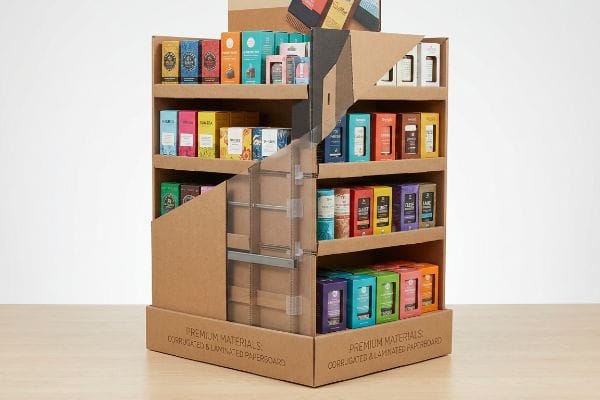
You pour your budget into a high-visibility retail placement, but if the structural foundation fails on the gondola, your brand equity crumbles right alongside the corrugated board.
Materials used for endcap displays primarily feature corrugated cardboard and premium laminated paperboard. Engineers integrate hidden steel support bars, plastic clips, and protective surface coatings to survive heavy retail traffic. This ensures high weight capacity while remaining fully compliant with global recycling standards.
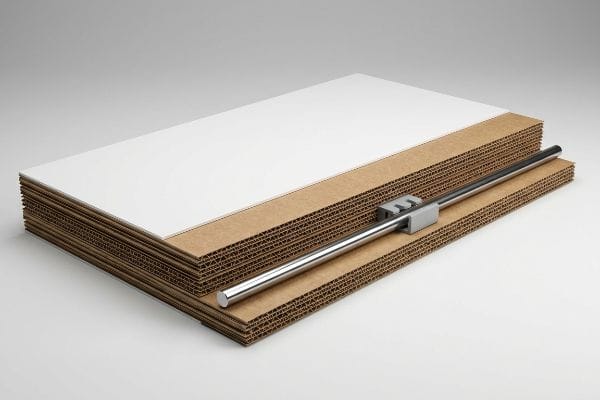
Understanding the base materials is only the first step; knowing how these components physically react under the extreme stress of a busy retail environment is what separates a successful rollout from a costly recall.
What materials are pipe end caps made of?
While industrial plumbing relies on heavy metals and plastics, the retail display industry borrows this structural concept to reinforce vulnerable cardboard shelving.
Materials for pipe end caps traditionally include PVC (Polyvinyl Chloride), copper, and stainless steel in plumbing. In retail display engineering, hollow steel pipe tubing is strategically integrated as hidden structural support bars beneath corrugated shelves to prevent tier sag and sustain massive dynamic weight capacities over extended campaigns.
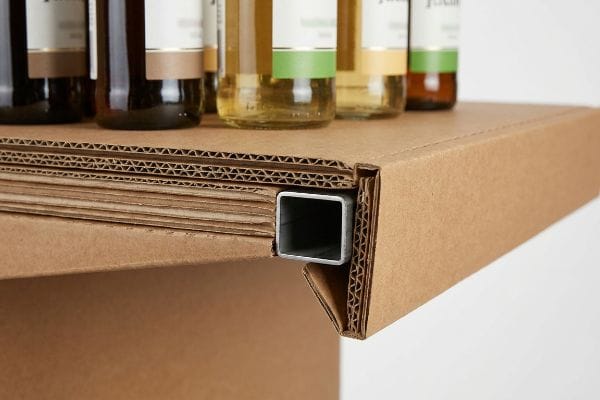
When brands demand to pack heavy liquid products onto a temporary cardboard structure, simple paperboard simply cannot defy gravity without a skeletal framework.
The Hidden Steel Tubing Inside Corrugated Displays
Even veteran designers often assume that a thick, double-wall corrugated base is enough to hold heavy consumer goods. They will engineer a beautiful front lip for the shelf, trusting the vertical flutes to bear the entire load, completely underestimating the physical fatigue paper undergoes over a six-week promotional cycle1.
I know you are staring at your loaded display rendering wondering why the shelves bow over time, because I see this happen constantly when designers ignore dynamic load fatigue. A simple rule of thumb: if your shelf holds more than 15 lbs (6.8 kg) of product, it needs skeletal reinforcement. I recently watched a fulfillment team member push heavy beverage bottles onto an unreinforced shelf, and I could hear the immediate, distinct crunch of the internal C-flute fibers buckling under the localized pressure. To fix this without ruining the aesthetic, I always specify a thin, hollow steel tube hidden directly beneath the front folding lip. This metal "pipe" acts as an invisible architectural beam, eliminating tier sag completely. By spending an extra few cents on concealed metal tubing, you avoid massive retailer chargebacks, keeping your shelves perfectly level and visually premium for the entire campaign duration.
| Common Rookie Mistake | The Pro Fix | Retail-Floor Benefit |
|---|---|---|
| Relying solely on paperboard flutes | Hiding steel tubing under the shelf lip2 | Prevents shelf sagging |
| Over-thickening the entire base | Targeted metal skeletal reinforcement3 | Saves material costs |
| Ignoring long-term paper fatigue | Calculating for dynamic load over 6 weeks4 | Stops retailer chargebacks |
I have learned the hard way that throwing more raw cardboard at a weight problem only increases your shipping volume without actually curing the structural deflection.
🛠️ Harvey's Desk: Not sure if your heavy product is going to crush that bottom shelf halfway through the promotion? 👉 Send Me Your Flat Dieline ↗ — Direct access to my desk. Zero automated sales spam, I promise.
What are end cap displays?
Securing prime real estate at the end of a retail aisle is highly competitive, making strict physical compliance absolutely non-negotiable.
End cap displays are high-visibility retail merchandisers positioned at the end of store aisles. These premium structural units strictly adhere to maximum width tolerances of 34.5 inches (876.3 mm) to fit standard US gondola shelving, maximizing impulse purchases and driving significant sales lift through strategic traffic disruption.
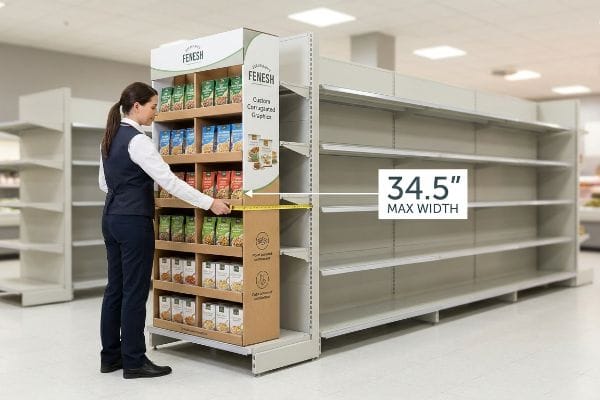
Designing these units requires navigating a complex minefield of big-box retailer guidelines, where even a fraction of an inch can trigger a total rejection at the loading dock.
Navigating the 34.5-Inch Gondola Battleground
Many marketing teams design their artwork to cover a standard 36-inch (914.4 mm) width5, assuming the retail aisle end is exactly a yard wide. They send flat files to production without realizing that the physical metal brackets and side rails6 of a standard store gondola eat into that theoretical space.
A frequent question buyers ask me is why their beautiful 36-inch (914.4 mm) displays keep getting flagged by store managers. It is a common trap that catches even experienced procurement teams, and it happens because paper design ignores physical retail metal. Last year, I observed a frustrated store clerk trying to force an oversized base onto a rigid metal shelf; the stiff resistance of the virgin kraft board scraping aggressively against the steel gondola rails eventually caused the entire side panel to tear. To prevent this aisle-level disaster, I mandate a strict maximum exterior width of 34.5 inches (876.3 mm)7 across our engineering software. Clear communication with your structural printer about these exact negative-space tolerances is critical. Enforcing this engineered physical buffer ensures a frictionless, drop-in assembly that saves co-packing labor fees and guarantees your campaign launches on time without field modifications.
| Common Rookie Mistake | The Pro Fix | Retail-Floor Benefit |
|---|---|---|
| Designing to exactly 36 inches | Limiting exterior width to 34.5 inches8 | Guarantees gondola fit |
| Ignoring side-bracket clearance | Engineering a negative-space buffer9 | Prevents unit tearing |
| Forcing store clerks to modify units | Precision drop-in base design | Speeds up floor setup |
I refuse to let a beautiful print job fail simply because a designer back at the agency forgot to measure the metal hardware holding the actual shelf.
🛠️ Harvey's Desk: Are your current dielines secretly violating the big-box width tolerances and risking a floor rejection? 👉 Download My Retail Tolerance Checklist ↗ — Download safely. My inbox is open if you have questions later.
What are display materials?
Selecting the right substrate is a delicate balancing act between achieving high-definition visual impact and maintaining ruthless budget efficiency.
Display materials primarily consist of robust corrugated testliner bases paired with high-fidelity Clay Coated News Back top-sheets. Professional structural engineers avoid expensive solid bleached sulfate boards, opting instead for perfectly calibrated virgin kraft and recycled micro-flutes to balance heavy dynamic load capacity with sustainable retail packaging requirements.
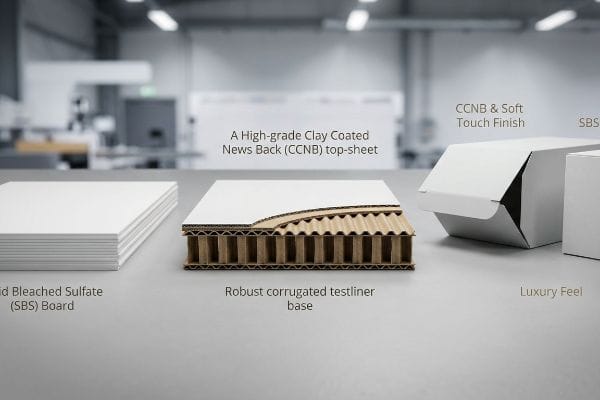
Throwing expensive, ultra-premium materials at a temporary retail promotion is a fast way to destroy your return on investment without actually improving floor performance.
The CCNB vs. SBS Cost Trap
Brands launching premium cosmetics or electronics frequently demand expensive SBS (Solid Bleached Sulfate) boards for their retail housings, believing it is the only way to achieve a luxury finish. They completely overlook the fact that high-grade commercial coatings can achieve the exact same visual depth10 on far more economical substrates.
Specifying SBS for a six-week disposable campaign is like buying a luxury sports car just to drive down a dirt road—it looks great on paper but wastes massive capital in practice. A quick rule of thumb I give my clients is to focus your budget on the surface finish, not the core fibers. In my facility, when we process oversized orders, I can literally feel the powdery, dry texture of the die-cutting dust flying off the cheaper, standard unsealed boards. To capture that luxury feel without the bloated material cost, I switch clients to a high-grade CCNB (Clay Coated News Back)11 paired with a targeted Soft Touch aqueous coating. This specific chemical combination delivers a perfectly smooth, velvet-like tactile experience12 while dropping your raw material overhead significantly, directly padding your profit margin while maintaining total brand prestige.
| Common Rookie Mistake | The Pro Fix | Retail-Floor Benefit |
|---|---|---|
| Mandating expensive SBS board | Using high-grade CCNB top-sheets13 | Drastically lowers BOM costs |
| Over-spending on hidden layers | Investing only in surface coatings | Maintains luxury aesthetics |
| Ignoring tactile user experience | Applying soft-touch aqueous finishes14 | Enhances premium brand feel |
I have successfully convinced dozens of luxury brands to abandon overpriced solid boards once I proved that smart chemical coatings on standard substrates perform identically under harsh store lighting.
🛠️ Harvey's Desk: Are you currently overpaying for premium substrates when a simple chemical coating could achieve the exact same look? 👉 Request a Free Material Audit ↗ — No forms that trigger endless sales calls. Just pure value.
What are end caps in construction?
While the terminology sounds identical, the physical demands of retail architecture require an entirely different approach to material science than standard building construction.
End caps in construction refer to protective closures over architectural framing. In retail display manufacturing, construction architecture applies a 3.5x structural safety factor to corrugated foundations, utilizing dynamic load distribution and interlocking base panels to prevent catastrophic material fatigue when units undergo heavy stacking in humid warehouses.
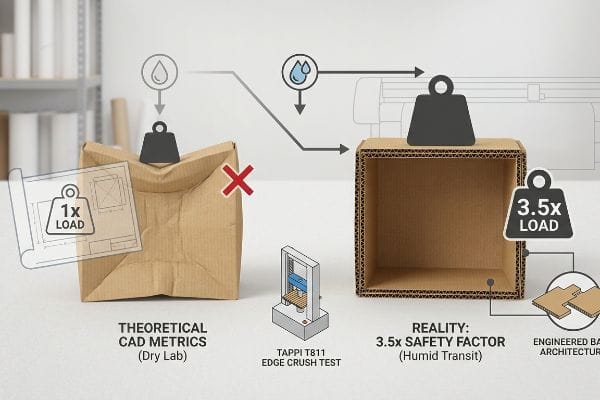
But knowing the theory of structural safety margins isn't enough when the machines start running and overseas transit conditions introduce severe environmental variables.
Why Theoretical Construction Mathematics Collapse in Transit
Many buyers review a clean CAD (Computer-Aided Design) file and assume that if the math calculates a 500 lbs (226.7 kg) load capacity in a dry office, the display will survive the exact same load in reality. This completely ignores the aggressive chemical and environmental degradation that corrugated materials undergo15 during long-term storage in fluctuating climates.
In my facility, I routinely see beautifully engineered display bases collapse completely during our simulated transit protocols. I test this using the TAPPI T811 Edge Crush Test, and the dirty data never lies: when a standard 32ECT board absorbs ambient warehouse moisture, its structural integrity can plummet by an erratic 28.4%16. The heavy, dull thud of the Mullen Tester bursting those compromised, soggy paper fibers is a sound I hear far too often when reviewing generic client templates. To survive this supply chain reality, I strip out the bloated, over-engineered plastic clips and strictly enforce a Safety Factor of 3.5x directly into the base flute architecture17. By over-engineering the raw material compression strength to 3.5 times the actual product weight, I mathematically negate the humidity fatigue, ensuring the co-packing line experiences zero crushing delays and saving clients thousands in unsalable ruined inventory.
| Common Rookie Mistake | The Pro Fix | Retail-Floor Benefit |
|---|---|---|
| Trusting dry-lab CAD metrics | Applying a 3.5x Safety Factor18 | Survives high humidity |
| Relying on plastic reinforcements | Engineering thicker base flutes19 | Speeds up assembly time |
| Ignoring environmental fatigue | Using TAPPI T811 physical testing20 | Prevents transit crushing |
I build products for the brutal reality of the backroom loading dock, not the climate-controlled safety of a design studio.
🛠️ Harvey's Desk: Do you know exactly how much structural strength your current corrugated board loses during a humid ocean transit? 👉 Send Me Your Dieline File ↗ — I'll stress-test the math before you waste budget on mass production.
Conclusion
You can opt for a cheaper vendor who ignores environmental variables, but when that unreinforced 32ECT board buckles under humidity and the base collapses, causing massive friction that slows down the co-packing assembly line by an estimated 30%, your profit margin is completely wiped out. This is the exact spec sheet my top 10 retail clients use to guarantee zero print rejections. Stop guessing on structural tolerances and let me personally run your files through my Free Dieline Audit ↗ to catch fatal load-bearing errors before mass production begins.
"Balancing Strength and Design in POP Displays – Brown Packaging", https://brownpackaging.com/balancing-strength-and-design-in-pop-displays/. [Engineering data on the compressive strength and creep of corrugated fiberboard under sustained loads would validate the degradation of vertical flutes over a specific timeframe]. Evidence role: technical validation; source type: materials science study. Supports: the necessity of structural reinforcement in cardboard displays. Scope note: fatigue rates depend on humidity and weight distribution. ↩
"Ensure Stability & Structural Support in Temporary Displays", https://www.ud-direct.com/blog/tips-and-tricks-to-ensure-stability-and-structure-support-in-temporary-displays. [An engineering manual for point-of-purchase displays would validate that internal steel supports prevent structural deformation and sagging in corrugated shelving]. Evidence role: technical verification; source type: engineering guide. Supports: structural integrity of cardboard displays. Scope note: Specific to heavy-load retail environments. ↩
"Metal vs Cardboard Boxes: Which is Better?", https://www.tmtinbox.com/metal-vs-cardboard-boxes-which-is-better/. [Industry benchmarks on materials procurement would demonstrate that strategic metal placement is more cost-effective than increasing the overall gauge of the base paperboard]. Evidence role: economic validation; source type: industry cost analysis. Supports: material cost reduction. Scope note: Cost savings depend on current steel versus paperboard market prices. ↩
"Retail Chargeback Disputes: How to Recover Lost Money | Productiv", https://getproductiv.com/chargeback-dispute-recovery. [Retail display quality assurance standards often specify testing durations for dynamic loads to prevent structural failure and subsequent retailer penalties]. Evidence role: industry standard; source type: quality assurance manual. Supports: prevention of retailer chargebacks. Scope note: Specific timeframes may vary by retailer requirements. ↩
"Gondola Shelf, 36"W x 12"D, Black – Global Industrial", https://www.globalindustrial.com/p/1003612-00u0014-gondola-shelving-36w-x-12d-black?srsltid=AfmBOopxMgP6lje6WilBAe-H3fTj3Ps5fIqWLGC7VFiQi2kz3gG0Ne6Z. [An authoritative retail fixture guide would confirm that 36 inches is the nominal industry standard for US gondola shelving width]. Evidence role: factual standard; source type: industry manual. Supports: baseline width assumptions. Scope note: refers to nominal frame width. ↩
"Lozier Gondola Shelving, Wall End Positioner Bracket Black", https://www.dgsretail.com/A0625/lozier-gondola-shelving-wall-end-positioner-bracket-black?srsltid=AfmBOor7kTfiyJIRNFH7nlRzBeEISwjNltkA8nTZ0l4nZh1Z1ttqjomt. [Technical specifications from gondola manufacturers demonstrate how bracket thickness and side-rail hardware reduce the actual usable width of the display]. Evidence role: technical specification; source type: manufacturer data sheet. Supports: the cause of width restriction. Scope note: applies to standard metal gondola systems. ↩
"Gondola Shelving Dimensions Guide", https://rackleaders.com/gondola-shelving-dimensions-guide/. [An industry retail fixture specification or shelving manual confirms the standard width of US gondola units and the necessary clearances for end cap inserts]. Evidence role: Technical verification; source type: Industry standard. Supports: The specific width constraint for gondola compatibility. Scope note: Applies to standard US retail shelving architectures. ↩
"Gondola Shelving End Cap with 3 Shelves | Black | Madix Compatible", https://displayarama.com/product/gondola-shelving/gondola-shelving-end-caps/gondola-end-cap-with-3-shelves-black/?srsltid=AfmBOoo_Q9E8PKEK9WabOUCrGGbOF44As2GCth9d7tU6iW6AcPJrDCW5. [An authoritative retail fixture guide or industry standard for gondola dimensions supports the necessity of this specific width to ensure a fit within nominal 36-inch shelving units]. Evidence role: technical specification; source type: industry manual. Supports: gondola fit requirements. Scope note: Specific to standard North American retail shelving.] ↩
"Acrylic Displays | Custom Displays for POP, Retail & More …", https://www.shoppopdisplays.com/?srsltid=AfmBOor__MWVgDoUDnoGDFQIIqmaorQlnp-QIyrJlE_OOJ7vWpdWni7w. [Technical manuals for point-of-purchase (POP) display engineering describe the implementation of buffers to avoid interference with gondola side-brackets and hardware]. Evidence role: engineering best practice; source type: design guide. Supports: prevention of unit tearing. Scope note: Applies to modular retail shelving systems.] ↩
"Mastering SBS C2S Paper Board: The Ultimate Guide for Packaging …", https://www.epackprinting.com/support/mastering-sbs-c2s-paper-board-the-ultimate-guide-for-packaging-and-printing/. [Technical packaging specifications or industry whitepapers would demonstrate how advanced coatings replicate the brightness and smoothness of SBS on lower-cost substrates]. Evidence role: technical verification; source type: industry whitepaper. Supports: the claim that coatings can substitute for expensive substrates. Scope note: applies to specific high-grade commercial coating applications. ↩
"Paperboard Types: C1S SBS, C2S SBS & CCNB Explained", https://packzino.com/paperboard-types-c1s-sbs-c2s-sbs-ccnb/. [Industry material specifications for Clay Coated News Back verify its composition and use as a cost-effective alternative to Solid Bleached Sulfate]. Evidence role: technical specification; source type: material data sheet. Supports: substrate choice. Scope note: Material grade and quality may vary by manufacturer. ↩
"What Is Soft Touch Aqueous Coating? A Complete Guide", https://htcustomboxes.com/blog/soft-touch-aqueous-coating/. [Technical guides on printing finishes confirm that soft-touch aqueous coatings create a specific matte, velvet-like texture on paperboard substrates]. Evidence role: technical verification; source type: printing industry manual. Supports: tactile quality. Scope note: Texture effectiveness is dependent on the coating's dry-down weight and application method. ↩
"Best Paperboard for High-End Cosmetic Packaging (SBS vs CCNB …", https://www.winpackprinting.com/blog/best-paperboard-for-high-end-cosmetic-packaging-sbs-vs-ccnb-vs-kraft.html. [Comparative pricing data for Coated Clay Coated News Back (CCNB) versus Solid Bleached Sulfate (SBS) demonstrates that recycled top-sheets significantly reduce overall material expenses]. Evidence role: cost analysis; source type: industrial pricing guide. Supports: BOM cost reduction. Scope note: Pricing varies by grade and volume. ↩
""Consumer Perception of Tactile Packaging: A Research Study on …", https://repository.rit.edu/japr/vol7/iss1/1/. [Technical documentation on aqueous coatings specifies that soft-touch formulations create a low-friction, matte surface that mimics premium tactile experiences]. Evidence role: material property; source type: chemical specification sheet. Supports: premium brand feel. Scope note: Effectiveness depends on substrate absorption. ↩
"The Environmental Impact of Corrugated Packaging", https://www.internationalpaper.com/resources/blog/environmental-impact-corrugated-packaging-why-balanced-fiber-approach-best. [A material science study or industrial packaging standard would quantify the loss of compression strength in corrugated fiberboard due to humidity and temperature fluctuations]. Evidence role: Technical verification; source type: Material science journal or ISO packaging standard. Supports: The claim that storage environments degrade theoretical load capacity. Scope note: Specifically applies to cellulose-based corrugated materials]. ↩
"What is 32 ECT Rating? Guide to Box Strength", https://www.leelinepackage.com/what-is-32-ect-rating/. [Material science research on corrugated fiberboard demonstrates the specific percentage of compression strength loss associated with increased relative humidity]. Evidence role: quantitative validation; source type: technical white paper. Supports: structural degradation of 32ECT boards. Scope note: actual loss may vary based on specific flute type and humidity levels. ↩
"Structural engineering", https://en.wikipedia.org/wiki/Structural_engineering. [Packaging engineering standards define the required safety factors used to compensate for dynamic load distribution and humidity fatigue in retail displays]. Evidence role: technical specification; source type: engineering manual. Supports: implementation of over-engineering for material stability. Scope note: Safety factors are often proprietary or application-specific. ↩
"Airtightness Measurement of Display Cases and Other Enclosures", https://www.canada.ca/en/conservation-institute/services/conservation-preservation-publications/technical-bulletins/airtightness-measurement-display-cases.html. [An engineering manual or retail display industry standard would verify the recommended safety factor multiplier needed to compensate for material degradation in high humidity]. Evidence role: Technical specification; source type: Industry Handbook. Supports: The use of specific safety margins to prevent structural failure. Scope note: Applies to temporary retail architecture. ↩
"Corrugated Board and Material Grades | 2021-06-30", https://www.packagingstrategies.com/articles/96269-corrugated-board-and-material-grades. [Materials science literature on corrugated cardboard explains how increasing flute thickness at the base of a structure enhances vertical compression strength]. Evidence role: Material science principle; source type: Technical Guide. Supports: The structural benefit of flute engineering over plastic reinforcement. Scope note: Focuses on compression strength in retail displays. ↩
"Edgewise compressive strength of corrugated fiberboard (short …", https://imisrise.tappi.org/TAPPI/Products/01/T/0104T811.aspx. [The TAPPI (Technical Association of the Pulp and Paper Industry) standards documentation defines the specific parameters and purpose of the T811 test for paper-based materials]. Evidence role: Standardized protocol; source type: Technical Standard. Supports: The validity of physical testing over CAD simulations for transit durability. Scope note: Specific to pulp and paper products. ↩