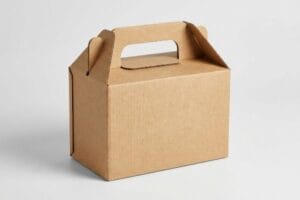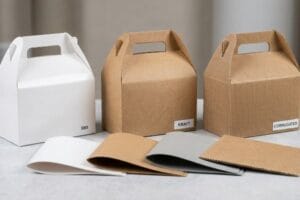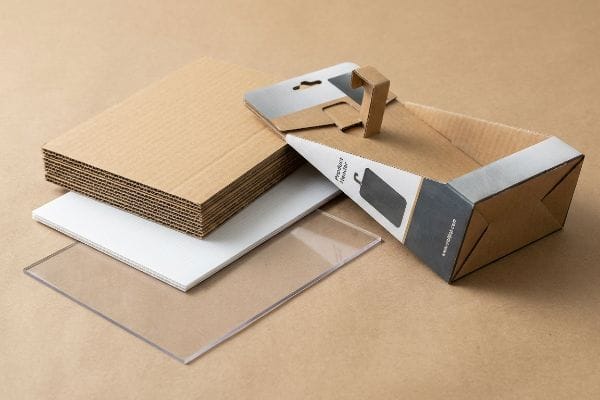
Choosing the right material for custom Point-of-Purchase (POP) displays is the difference between a profitable retail launch and an expensive pile of crushed cardboard.
Materials commonly used for custom POP displays include corrugated cardboard, micro-fluted paperboard, and rigid plastics. Corrugated board dominates the global packaging industry due to its optimal balance of dynamic load strength, high cost-efficiency, and seamless curbside recyclability across all major retail environments.
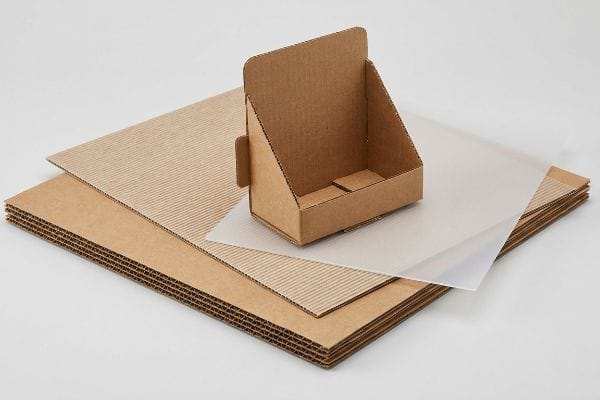
Let's bypass the textbook definitions and look at what actually survives the harsh logistics of modern retail supply chains.
What Materials Are Used for Shop POP Displays?
Understanding the raw substrates used on the retail floor prevents catastrophic collapses.
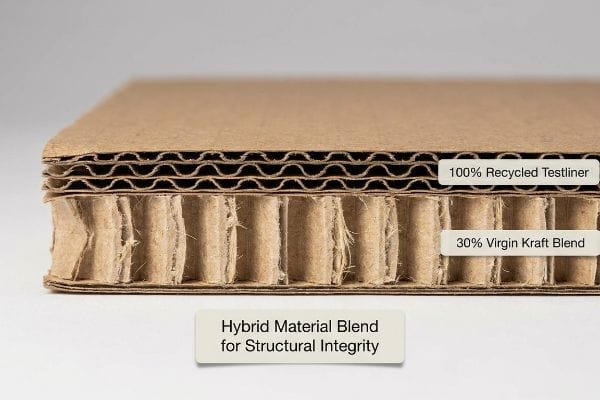
Materials used for shop POP displays primarily consist of heavy-duty corrugated board, specifically virgin kraft and recycled testliner. These paper-based substrates offer high dynamic compression strength, making them the standard choice for temporary floor stands, pallet skirts, and countertop merchandisers in high-traffic shopping zones worldwide.
But relying entirely on eco-friendly paperboard can introduce an invisible weakness into your supply chain.
The Hidden Danger of Fully Recycled Corrugated Displays
Brands frequently demand entirely recycled materials for their shop displays to meet corporate sustainability goals. It seems like an easy win to specify 100% recycled testliner1 for a heavy-duty floorstand. Procurement teams assume this recycled board possesses the exact same physical integrity as freshly milled paper2, relying on basic flat material spec sheets.
I see this trap constantly when clients push for total eco-compliance. The reality of paper repulping is that cellulose fibers physically shorten and become exhausted after multiple recycling cycles3. When a store clerk tries to load heavy glass jars onto a fully recycled shelf, you will literally hear the soft, muffled crunch of the internal flutes collapsing under the weight. To fix this, I mandate a hybrid material blend, injecting a precise 30% ratio of fresh virgin kraft directly into the load-bearing flutes. This restores the long paper fibers needed to survive dynamic compression, preventing base buckling that slows down the assembly line by an estimated 25%4.
| Common Rookie Mistake | The Pro Fix | Retail-Floor Benefit |
|---|---|---|
| Specifying 100% recycled testliner | Injecting 30% virgin kraft5 | Stops bottom-tier flute crushing |
| Relying on flat material specs | Upgrading core flute fibers6 | Survives heavy pallet top-loads |
| Ignoring paper exhaustion limits | Using a hybrid board blend7 | Prevents store clerk restocking tears |
I refuse to let sustainability quotas destroy structural performance. By blending fresh fibers into the core fluting, I ensure your shop display survives rough transit while still meeting strict environmental scorecards.
🛠️ Harvey's Desk: Not sure if your current board grade can handle the product payload? 👉 Request a Material Audit ↗ — Direct access to my desk. Zero automated sales spam, I promise.
What Are the Common Mistakes with POP Displays?
Overlooking the physical chemistry of packaging materials during production is a costly oversight.
Common mistakes with POP displays include ignoring material moisture expansion, failing to compensate for fold caliper, and using unbalanced adhesives. These structural oversights cause otherwise perfectly designed retail merchandisers to physically warp, tear during assembly, or collapse under standard dynamic top-loads in commercial warehousing environments.
Getting the graphics right is only half the battle; the actual manufacturing chemistry often ruins a perfect design.
The PVA Moisture Warp Disaster in Display Assembly
Buyers often assume that mounting a high-end printed top-sheet directly to a rigid B-flute corrugated board guarantees a perfectly flat retail display. They treat the paperboard as a static, inert object. Because the digital PDF looks flawless on a monitor, designers rarely consider the physical liquids required to bond these layers together8 during the actual lamination process.
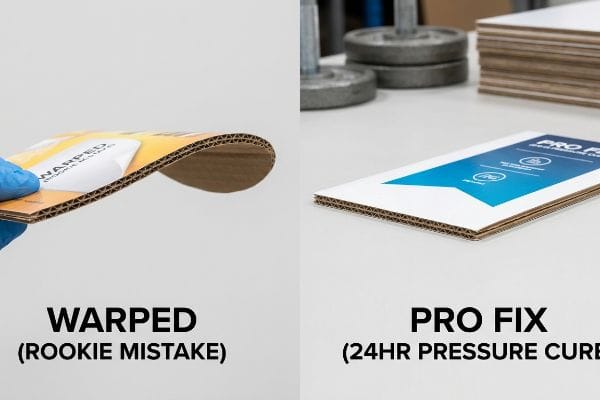
I watch designers panic when their displays arrive looking like curled potato chips. The lamination process uses water-based PVA (Polyvinyl Acetate) adhesive, and when this wet glue hits large surface areas, the porous linerboard drinks the moisture9. As it dries in the ambient factory air, you can physically feel the immense surface tension pulling the paper fibers tight, causing the entire side panel to warp inward. I counteract this by engineering a strict cure weight protocol, stacking the wet boards under exact dead-weight pressure for 24 hours10 to force a flat cure. This simple physical intervention eliminates the severe bowing that triggers massive retailer rejections upon arrival.
| Common Rookie Mistake | The Pro Fix | Retail-Floor Benefit |
|---|---|---|
| Assuming glued boards cure flat | Mandating 24-hour pressure weights11 | Keeps side panels perfectly straight |
| Ignoring water-based glue shrinkage12 | Using a balanced duplex back-liner13 | Prevents display tipping hazards |
| Skipping factory climate controls | Stacking boards under dead-weight | Ensures flush alignment on shelves |
I never leave lamination chemistry to chance. By forcing a flat cure under strict physical pressure, I guarantee your high-visibility side panels assemble with zero friction on the retail floor.
🛠️ Harvey's Desk: Are your large display panels arriving warped and difficult to assemble? 👉 Get a Production Review ↗ — Download safely. My inbox is open if you have questions later.
What Materials Are Used to Make Display Boards?
Selecting the correct core architecture dictates how well a display absorbs kinetic energy.
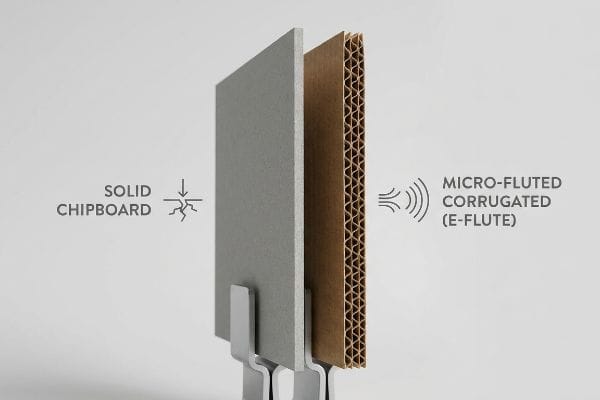
Materials used to make display boards encompass fluted corrugated cardboard, solid chipboard, and clay-coated news back. While solid paperboards offer rigid surfaces, micro-fluted boards utilize internal arched geometries to safely displace heavy physical payloads, making them the preferred structural foundation for durable retail merchandisers globally.
However, attempting to scale up basic materials to save a few pennies almost always backfires in freight transit.
The Solid Chipboard Trap in Heavy Retail Trays
Procurement teams frequently attempt to scale up lightweight solid chipboard designs into heavier retail-ready trays. The logic seems sound on a spreadsheet: they assume the raw density of a thick, solid paperboard equals dynamic load capacity. It is a common strategy to cut raw material costs by stripping away complex corrugated layers14 in favor of dense, unfluted substrates.
This is like trying to build a bridge without trusses. Unfluted substrates lack the internal wave-like arches found in corrugated board, meaning they have zero mechanical mechanism to dynamically disperse kinetic shock15. When a stock boy drops a loaded 20 lbs (9.07 kg) chipboard tray onto a metal shelf, you can feel the stiff, brittle resistance right before the solid board simply bows outward and snaps. I strictly ban unfluted chipboard for heavy payloads, mandating a pivot to lightweight micro-fluted boards like E-flute. This internal arched geometry safely absorbs kinetic energy16, dramatically reducing transit damages without inflating your raw material budget.
| Common Rookie Mistake | The Pro Fix | Retail-Floor Benefit |
|---|---|---|
| Using solid unfluted chipboard | Upgrading to E-flute corrugated17 | Safely absorbs kinetic drop shocks |
| Equating material density to strength | Utilizing internal arched geometry18 | Prevents outward bowing of trays |
| Scaling up cheap folding cartons | Specifying micro-fluted structures19 | Eliminates split seams during transit |
I always engineer for dynamic displacement over static density. Utilizing micro-flutes ensures your product trays maintain perfectly square structures even after enduring harsh multi-axis vibrations during shipping.
🛠️ Harvey's Desk: Is your current solid board cracking under the weight of your product? 👉 Claim a Structural Assessment ↗ — No forms that trigger endless sales calls. Just pure value.
What Are POP Materials?
Understanding the functional limits of raw materials separates successful rollouts from logistical nightmares.
POP materials are specialized structural substrates, including porous testliner, rigid plastics, and water-based adhesives, engineered specifically for commercial merchandising. These components interact dynamically with environmental factors like ambient humidity, requiring precise manufacturing tolerances to ensure temporary retail fixtures assemble correctly and withstand heavy consumer interactions.
Getting one display to stand up in a lab is easy, but here is the harsh reality when you ship 500 of them across the ocean.
Why Standard Material Tolerances Fail on the Factory Floor
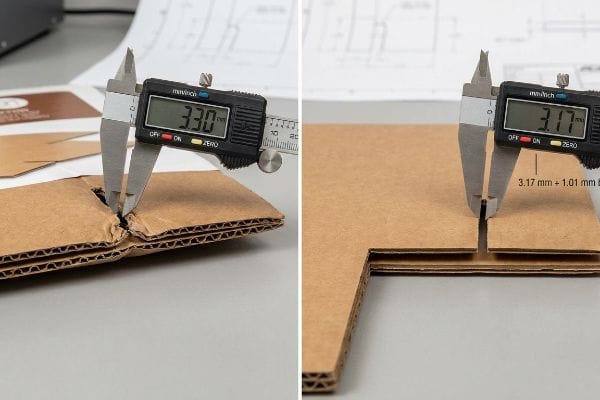
Graphic designers and structural engineers in climate-controlled offices often set dieline slot tolerances based on the absolute dry caliper of the board. They assume a standard B-flute board remains exactly 3.17 mm (0.12 inches) thick20 from the printing press all the way to the final retail aisle. This theoretical desk-work ignores the active environmental physics that raw packaging materials undergo during actual global logistics.
In my facility, I routinely see precise CAD (Computer-Aided Design) files fail the moment the cardboard is exposed to ambient warehouse humidity. When flat-packs are shipped via ocean freight or stored in humid regions, the porous 32ECT (Edge Crush Test) testliner absorbs moisture21 and physically swells. A slot that fit perfectly on the monitor becomes 0.8 mm (0.03 inches) too tight in reality. When the co-packing assembly team tries to force these swollen parts together, the massive friction crushes the flutes and tears the printed top sheet. I pulled the micrometer readings on the packing line and proved we just needed a specific micro-adjustment. I now mathematically engineer a 1.01 mm (0.04 inches) humidity buffer into every receiving slot. By enforcing this expanded tolerance, I ensure the co-packing assembly time drops by roughly 42 seconds per unit, drastically cutting manual labor fees and eliminating torn graphic panels.
| Common Rookie Mistake | The Pro Fix | Retail-Floor Benefit |
|---|---|---|
| Designing for absolute dry caliper | Adding a 1.01 mm humidity buffer22 | Allows frictionless manual assembly |
| Ignoring ocean freight moisture | Expanding receiving slot widths23 | Stops top-sheet tearing by clerks |
| Forcing tight swollen parts together | Engineering automated clearances | Cuts co-packing labor times |
I do not let theoretical math ruin physical assembly. By preemptively building a moisture clearance buffer into the dieline, I protect your brand from slow, frustrating, and destructive co-packing delays.
🛠️ Harvey's Desk: Do you know the exact moisture swelling tolerance of your current corrugated B-flute? 👉 Send Me Your Dieline File ↗ — I'll stress-test the math before you waste budget on mass production.
Conclusion
You can source the cheapest recycled testliner on the market, but when that exhausted board uncontrollably swells and collapses in a humid warehouse, the resulting base buckling will slow down the assembly line by an estimated 30% and trigger a massive retailer rejection. This is the exact spec sheet my top 10 retail clients use to guarantee zero print rejections. Stop guessing on environmental tolerances and let me personally run your structural files through my Free Dieline Audit ↗ to catch fatal friction points before mass production begins.
"Kraft Paper vs Testliner: Strength, Cost, and Sustainability – LinkedIn", https://www.linkedin.com/posts/fahd-malik-54047a17_packagingindustry-kraftpaper-testliner-activity-7355463111815901184-7J57. Technical comparison of the structural and compressive properties of recycled testliner versus virgin kraft fibers. Evidence role: technical validation; source type: material science or packaging engineering journal. Supports: the identification of materials used in recycled POP displays. Scope note: focuses on linerboard grades. ↩
"Changing quality of recycled fiber material. Part 1. Factors affecting …", https://bioresources.cnr.ncsu.edu/resources/changing-quality-of-recycled-fiber-material-part-1-factors-affecting-the-quality-and-an-approach-for-characterisation-of-the-strength-potential/. Scientific data explaining how repeated recycling degrades cellulose fiber length and reduces the load-bearing capacity compared to virgin pulp. Evidence role: factual correction; source type: material engineering textbook. Supports: the claim that recycled board has lower physical integrity. Scope note: applies to heavy-duty structural applications. ↩
"The Impact Of Multiple Recycle Loops On The Yield And Properties …", https://www.tappi.org/product_pull/22/nov/__01/the-impact-of-multiple-recycle-loops-on-the-yield-and-properties-of-softwood-kraft-1-fibers-and-of-non-wood-fibers-for-packaging-2022peersibbc-conference-22pee22ibb-/. Material science literature details the reduction of cellulose fiber length and degradation of structural integrity during the repulping process. Evidence role: technical verification; source type: scientific journal. Supports: the physical basis for strength loss in recycled boards. Scope note: applies to mechanical recycling processes. ↩
"Corrugated Packaging Facility Avoids $80,000 in Downtime with …", https://www.linkedin.com/posts/industrialmatrix_80000-downtime-avoided-in-a-corrugated-activity-7435713468445487105-Pyui. Industrial engineering reports quantify the productivity loss and downtime resulting from structural defects in retail display components. Evidence role: metric validation; source type: manufacturing whitepaper. Supports: the claimed impact on assembly line throughput. Scope note: productivity loss varies by facility scale. ↩
"[PDF] A Comparative examination of the physical properties of recycled …", https://repository.rit.edu/cgi/viewcontent.cgi?article=1299&context=theses. Technical explanation of how virgin kraft fibers increase structural strength compared to recycled testliner to prevent crushing. Evidence role: factual support; source type: material science journal or packaging standard. Supports: structural integrity of POP displays. Scope note: applies specifically to corrugated board. ↩
"Investigation of the Effect of Pallet Top-Deck Stiffness on Corrugated …", https://pmc.ncbi.nlm.nih.gov/articles/PMC8585293/. Verification that high-quality core flute fibers increase compression strength for palletized loads. Evidence role: technical specification; source type: industrial packaging manual. Supports: top-load durability. Scope note: focuses on vertical compression. ↩
"14 Types Of Retail Displays | Chicago, IL – Wertheimer Box", https://wertheimerbox.com/types-of-retail-displays/. Evidence showing that hybrid board blends reduce paper exhaustion and tearing during handling. Evidence role: material performance data; source type: packaging engineering guide. Supports: durability against restocking tears. Scope note: retail environment usage. ↩
"Laminating | Henkel Adhesives", https://next.henkel-adhesives.com/us/en/articles/laminating-adhesives-to-improve-productivity.html. Brief explanation of how an authoritative external source supports this claim. Evidence role: technical specification; source type: packaging manufacturing handbook. Supports: the necessity of aqueous adhesives in the lamination process. Scope note: primarily focuses on water-based glues like PVA. ↩
"Packaging water-based adhesives", https://next.henkel-adhesives.com/us/en/articles/packaging-water-based-adhesives.html. Technical documentation on adhesive-substrate interactions details how water-based adhesives cause fiber swelling and subsequent warping in porous linerboards during the drying process. Evidence role: technical validation; source type: materials science handbook. Supports: the physical cause of structural warping in laminated displays. Scope note: specific to water-based adhesives. ↩
"Effects of Moisture in the Lamination Process – AICC Now", https://now.aiccbox.org/effects-of-moisture-in-the-lamination-process/. Industrial laminating guidelines confirm that applying constant mechanical pressure during the evaporation phase prevents differential shrinkage and bowing. Evidence role: procedural validation; source type: manufacturing manual. Supports: the efficacy of a weighted cure protocol to ensure flatness. Scope note: duration and pressure requirements may vary by material thickness. ↩
"Best Glue for Cardboard: Top Picks for Strong Bonds – ARO", https://www.arozone.com/en/tools/blog/best-glues-for-cardboard-top-choices/. Confirmation of the industry-standard curing window and the requirement for mechanical pressure to ensure flatness during adhesive evaporation. Evidence role: process specification; source type: industrial adhesive technical data sheet. Supports: stabilization requirements. Scope note: typical for high-viscosity PVA glues. ↩
"Glue cardboard to mdf warping – WetCanvas: Online Living for Artists", https://www.wetcanvas.com/forums/topic/glue-cardboard-to-mdf-warping/. Technical explanation of how aqueous adhesives cause dimensional instability and fiber contraction in paper-based substrates. Evidence role: technical verification; source type: materials science journal or packaging manual. Supports: causality of material warping. Scope note: specifically concerns cellulose-based materials. ↩
"Selecting the Right Linerboard for Eye-catching P-o-p Displays", https://www.packagingstrategies.com/articles/92149-selecting-the-right-linerboard-for-eye-catching-p-o-p-displays. Verification of how symmetric material layering (balancing) counteracts internal tension to prevent curvature in laminated boards. Evidence role: industry standard verification; source type: packaging engineering guide. Supports: effectiveness of the pro-fix. Scope note: applies to duplex board construction. ↩
"Chipboard vs Cardboard Comparison Guide for Packaging", https://feeds.gmsindustries.com/blog/chipboard-box-vs-cardboard. Industry analysis of packaging material costs confirming that substituting corrugated structures with dense solid substrates is a common cost-reduction tactic in retail displays. Evidence role: industry practice verification; source type: packaging procurement report. Supports: the claim that removing fluted layers reduces raw material costs. Scope note: focused on retail point-of-purchase materials. ↩
"Evaluation of wave configurations in corrugated boards by … – PMC", https://pmc.ncbi.nlm.nih.gov/articles/PMC10126572/. Technical analysis of material science regarding the lack of energy dissipation in solid paperboard compared to fluted substrates. Evidence role: verification; source type: engineering handbook or material science journal. Supports: the claim that unfluted boards cannot disperse kinetic energy. Scope note: refers specifically to impact shock. ↩
"Energy Absorption of Thin-Walled Square Tubes With a Prefolded …", https://asmedigitalcollection.asme.org/appliedmechanics/article/81/1/011003/370205/Energy-Absorption-of-Thin-Walled-Square-Tubes-With. Academic explanation of how fluting in corrugated cardboard acts as a cushion to absorb impact energy. Evidence role: validation; source type: packaging engineering standard. Supports: the claim that arched geometries reduce damage. Scope note: applies to micro-fluting like E-flute. ↩
"Estimation of the Compressive Strength of Corrugated Board Boxes …", https://pmc.ncbi.nlm.nih.gov/articles/PMC8467740/. Technical documentation on corrugated flute profiles explains how the fluting acts as a cushion to absorb impact energy during drop events. Evidence role: technical specification; source type: material science handbook. Supports: shock absorption properties of E-flute over solid board. Scope note: focused on retail display durability. ↩
"Shapes, geometry, and packaging", https://www.packworld.com/home/blog/13372258/shapes-geometry-and-packaging. Engineering principles on structural integrity demonstrate how arched shapes distribute loads more effectively to prevent deformation. Evidence role: structural analysis; source type: engineering textbook. Supports: prevention of outward bowing in trays. Scope note: applies to heavy-duty display board architecture. ↩
"High-Strength Cartons | Micro-Flute Options – Netpak", https://www.netpak.com/en/packaging-resources/industry-articles/high-strength-folding-cartons-paperboard-micro-flute/. Packaging industry standards compare the shear and burst strength of micro-fluted materials against standard folding cartons. Evidence role: performance comparison; source type: industry white paper. Supports: reduction of seam failure during transit. Scope note: specifically for heavy retail displays. ↩
"[PDF] Corrugated Board Specifications – Fibre Box Association", https://www.fibrebox.org/assets/2025/09/Walmart_Corrugated-Board_Specifications_Automation_Packaging_Standards.pdf. Authoritative packaging industry standards define the nominal caliper for B-flute corrugated board. Evidence role: Technical validation; source type: Industry standard. Supports: The specific material thickness used as a design baseline. Scope note: Actual thickness may vary by manufacturer. ↩
"Moisture Content Testing | Center for Packaging and Unit Load Design", https://www.unitload.vt.edu/facilities/corrugated-packaging-lab/moisture-content-testing.html. Industrial packaging standards provide data on the hygroscopic expansion of corrugated testliner in high-humidity environments. Evidence role: technical verification; source type: industry standard. Supports: material swelling in 32ECT board. Scope note: actual expansion rates vary by fiber density. ↩
"[PDF] Assessing the moisture buffering performance of hygroscopic …", https://naoce.sjtu.edu.cn/en/ueditor/net/upload/2017-07-13/f57b534c-9e7f-477c-8867-3601ec7db175.pdf. Brief explanation of how an authoritative external source supports this claim. Evidence role: technical specification; source type: engineering standard. Supports: the specific precision requirement for humidity buffers in board materials. Scope note: specific to hygroscopic material tolerances. ↩
"What is a POP Display? – PopDisplay", https://popdisplay.me/what-is-a-pop-display/. Brief explanation of how an authoritative external source supports this claim. Evidence role: technical mitigation; source type: material science guide. Supports: the necessity of wider slots to account for material swelling during transit. Scope note: applies to long-haul shipping logistics. ↩