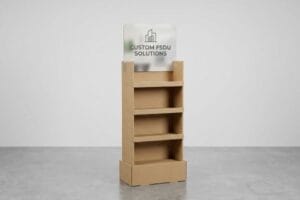
You have seconds to capture a shopper's attention, but executing that vision requires flawless engineering. Merchandising success isn't just graphics; it's structural survival on the retail floor.
Making display packaging effective requires balancing structural integrity, brand visibility, and supply chain efficiency. A successful retail merchandiser leverages precise corrugated engineering to withstand heavy pallet loads while utilizing high-contrast spot colors and strategic product placement to capture consumer attention within seconds on the store floor.

Knowing the foundational elements of a strong unit is just the beginning. The real challenge is translating that concept into a physical structure that won't collapse under pressure.
How do you make a good retail display?
Building a stable merchandiser starts long before the printing press. It begins with raw mathematics and anticipating how rigid paperboard behaves when folded.
Making a good retail display demands precise structural engineering and material selection. Manufacturers must mathematically calculate board caliper compensation for every fold, ensuring that heavy-duty corrugated components interlock seamlessly without tearing, creating a perfectly square foundation that supports heavy consumer goods safely in high traffic environments.

Many design teams create beautiful flat artwork, completely forgetting that physical cardboard has volume.
The Hidden Math Behind Cardboard Structural Tolerances
Standard graphic software allows designers to draw interlocking tabs perfectly flush with receiving slots. On a flat screen, a three-millimeter tab slides effortlessly into a three-millimeter gap. This digital idealism leads brands to approve dielines based solely on visual aesthetics, assuming physical assembly will easily match the digital render1.
But paperboard has actual physical volume that drastically impacts retail execution. When brands ignore basic cardboard thickness, store clerks struggle to assemble the units quickly in the aisle, causing massive frustration and wasted time. The secret to making a good retail display is simple caliper compensation2. By mathematically adding a precise bend allowance to the CAD (Computer-Aided Design) file3, the receiving slot is widened slightly. This micro-adjustment ensures frictionless assembly, allowing retail teams to set up the promotion rapidly and ensuring the final structure sits completely square on the floor.
| Common Rookie Mistake | The Pro Fix | Retail-Floor Benefit |
|---|---|---|
| Drawing slots perfectly flush | Applying automated bend allowances4 | Frictionless assembly |
| Ignoring board thickness | Adding precise material clearance5 | Prevents setup frustration |
| Relying on flat visual files | Engineering structural tolerances6 | Speeds up in-store packing |
Building a flawless structure means respecting the physical thickness of the substrate long before ink touches paper, preventing complete assembly failure in the store.
🛠️ Harvey's Desk: Not sure if your interlocking tabs have the correct bend allowance? 👉 Get A Dieline Review ↗ — Direct access to my desk. Zero automated sales spam, I promise.
Why is product display important in retail store?
Placing products blindly onto a shelf drastically reduces sales potential. Strategic merchandising physically interrupts the shopper's journey, forcing them to engage with your brand.
Product display is important because it physically guides consumer attention and drives impulse purchases. By placing high-margin items within the optimal ergonomic strike zone, merchandisers maximize visual disruption, converting passive foot traffic into measurable retail sales through calculated spatial positioning and strategic inventory placement.

Grabbing attention sounds simple in a boardroom, but executing it requires strict adherence to human ergonomics.
Leveraging the Human Height Heat Map for Visibility
Even experienced marketing teams often assume that maximizing the physical size of a corrugated unit automatically guarantees better visibility. They design towering merchandisers and fill every square inch with boxes, believing that sheer volume will overpower competitors in the aisle.
That massive footprint means nothing if the most profitable items are placed below the shopper's knee. I frequently see beautifully printed units fail because the brand ignored the physiological reality of how humans shop. Shoppers simply won't bend down for low-priority items. The fix isn't printing louder colors; it is elevating the core inventory into the ergonomic strike zone at 50 to 54 inches7 (127 to 137 cm) from the floor. By engineering an internal false bottom and shifting the focal point upward, merchandisers mathematically force the product into the natural line of sight, creating an immediate qualitative boost in sell-through velocity without increasing the overall manufacturing cost.
| Common Rookie Mistake | The Pro Fix | Retail-Floor Benefit |
|---|---|---|
| Stocking products near the floor | Utilizing the optimal strike zone8 | Captures natural eye level |
| Maximizing overall unit height | Engineering an internal false bottom9 | Boosts impulse engagement |
| Assuming size equals visibility | Concentrating inventory at chest height10 | Eliminates dead inventory |
Ergonomic layout must always take precedence over sheer inventory volume. If the consumer has to physically strain to reach your packaging, a competitor will easily steal the sale.
🛠️ Harvey's Desk: Are your highest-margin items accidentally buried below the natural sightline? 👉 Request A Structural Audit ↗ — Download safely. My inbox is open if you have questions later.
What is display ready packaging?
Retailers demand speed above all else. Brands that force store clerks to manually unpack individual boxes quickly find themselves losing premium aisle placements.
Display ready packaging is a secondary shipper designed to transition directly from the transit pallet to the retail shelf without manual unpacking. These engineered containers feature tear-away panels or open-top structures, allowing store employees to merchandise products rapidly while maintaining strict structural integrity and brand presentation.
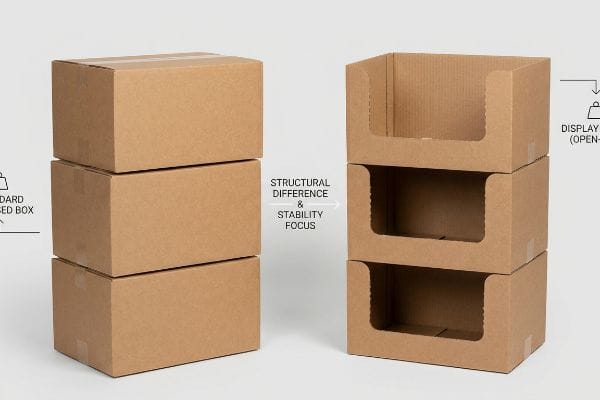
While removing the lid of a box seems like an effortless design choice, it fundamentally changes the physics of the entire container.
The Open-Top Compressive Vulnerability Trap
Transitioning to shelf-ready cartons often involves swapping a standard enclosed box for a HSC (Half Slotted Container)11 to create an instant open bin. Procurement departments love this shift, assuming that trimming away the top flaps will save raw material costs while keeping the retailers happy with easy stocking.
However, removing those top flaps fundamentally reduces the overall top-load strength of the carton, making it highly vulnerable during standard transit. When brands simply chop off the top without adjusting the material, the boxes can easily compress under heavy pallet loads before they ever reach the retail shelf. To solve this without reverting to a completely closed box, brands must upgrade to a heavier liner and ensure proper vertical grain alignment. This basic structural adjustment restores crucial stability, ensuring the display-ready carton arrives at the store intact and perfectly prepared for immediate merchandising.
| Common Rookie Mistake | The Pro Fix | Retail-Floor Benefit |
|---|---|---|
| Simply chopping off box tops | Upgrading to specialized box structures12 | Enables instant shelf stocking |
| Ignoring lost corner stability | Aligning corrugated grain vertically13 | Maintains box integrity |
| Using standard linerboard | Specifying a robust material profile14 | Prevents transit damage |
Sacrificing structural stability to save a few pennies on top flaps is a false economy. An open-top bin is entirely worthless if it arrives at the store heavily creased and damaged.
🛠️ Harvey's Desk: Is your shelf-ready carton losing compressive strength when you remove the lid? 👉 Claim Your Box Assessment ↗ — No forms that trigger endless sales calls. Just pure value.
Why is displaying merchandise important?
Securing space in a high-traffic aisle is the hardest part of merchandising. But once you earn that spot, the physical execution carries your entire brand reputation.
Displaying merchandise is important because it dictates the consumer's physical interaction with the brand. A poorly executed structure directly damages product perceived value, while a mathematically sound merchandiser protects retail relationships, ensures compliance with strict store guidelines, and ultimately accelerates high-volume inventory turnover on the sales floor.

But knowing the theory isn't enough when the machines start running, and chemical reactions begin altering your carefully planned artwork.
Why Standard Moisture Control Fails on the Factory Floor
Brands frequently request massive, seamless graphics to showcase their merchandise on sixty-inch side panels15. They assume that mounting a high-end printed top-sheet onto a thick, rigid corrugated backing16 creates a permanently flat, indestructible billboard.
In my facility, I routinely see how digital assumptions shatter when faced with industrial chemistry. The litho-lamination process relies on liquid water-based PVA (Polyvinyl Acetate) adhesive, and raw paper acts like a sponge. I test this using precision moisture meters right as the boards come off the line. If we just let these massive panels air-dry naturally, the adhesive shrinks as it cures, creating immense surface tension17 that violently warps the testliner. It literally bows inward like a giant potato chip. When I measure the distortion, a panel can curl up to 0.57 inches (14.5 mm)18 off the flat plane, making it impossible to assemble squarely in the store. By enforcing a strict 24-hour dead-weight cure protocol under heavy pressure boards, I neutralize that chemical tension. This ruthless micro-adjustment guarantees perfectly flat panels, preventing massive retailer rejections and ensuring the merchandise is displayed flawlessly without wobbly, distorted walls.
| Common Rookie Mistake | The Pro Fix | Retail-Floor Benefit |
|---|---|---|
| Assuming laminated panels stay flat | Accounting for liquid adhesive shrinkage19 | Prevents bowed side walls |
| Air-drying freshly glued boards | Enforcing a dead-weight cure protocol20 | Keeps the structure perfectly square |
| Ignoring paper moisture limits21 | Utilizing moisture meter testing | Stops retailer rejection notices |
Chemical curing requires the same strict monitoring as the physical printing press. Ignoring the moisture tension of your adhesive guarantees that massive panels will warp long before they ever hold merchandise.
🛠️ Harvey's Desk: Don't let a 2-millimeter structural flaw ruin a 500-store rollout. 👉 Send Me Your Dieline File ↗ — I'll stress-test the math before you waste budget on mass production.
Conclusion
You can hire the cheapest vendor to print your graphics, but when unregulated adhesive moisture causes your massive side panels to violently warp like potato chips, slowing down the assembly line by an estimated 30%, your entire retail campaign collapses. Over 500 brand managers use my prepress checklist to avoid these exact fatal early-stage mistakes. Stop guessing on chemical tolerances and let me personally audit your blueprints through my Free Dieline Pre-Flight Audit ↗ to intercept structural failures before the machines turn on.
"Influence of Analog and Digital Crease Lines on Mechanical … – PMC", https://pmc.ncbi.nlm.nih.gov/articles/PMC9268991/. [Structural engineering standards for corrugated materials explain that board caliper and fold loss prevent a 1:1 translation from digital dielines to physical assembly.] Evidence role: Technical correction; source type: Manufacturing specification. Supports: The claim that 'digital idealism'is a fallacy in structural design. Scope note: Applicable to folded paperboard and corrugated substrates. ↩
"The Thought Behind Managing Caliper – Paper 360", https://paper360.tappi.org/2022/08/12/the-thought-behind-managing-caliper/. [Industry technical manuals define caliper compensation as the adjustment of design dimensions to account for the physical thickness of the board material]. Evidence role: terminological definition; source type: industry handbook. Supports: the necessity of adjusting for board thickness. Scope note: Specific to paperboard and corrugated materials. ↩
"[PDF] The Bending Stiffnesses of Corrugated Board", https://www.fpl.fs.usda.gov/documnts/pdf1992/luo92a.pdf. [Packaging engineering guides demonstrate that calculating a bend allowance in CAD prevents material binding and ensures structural squareness during assembly]. Evidence role: technical process verification; source type: manufacturing manual. Supports: the methodology for achieving frictionless assembly. Scope note: Calculations vary based on board grade and fold radius. ↩
"Cardboard Constructions: Calculating Bend Allowance 1 – YouTube", https://www.youtube.com/watch?v=j1n5ojAbAic. [An industry standard for packaging engineering would explain how bend allowances account for material deformation during folding to ensure precise final dimensions]. Evidence role: technical validation; source type: industry standard; Supports: the necessity of calculating material stretch and compression; Scope note: specific to corrugated board. ↩
"Complete Guide to Corrugated Box Dimension Tolerance – Upack", https://www.upack.in/blog/post/complete-guide-on-corrugated-box-dimension-tolerance?srsltid=AfmBOoqAB4mtGV4DNfjvVSrlLLPliQ7Aqm_8plafZbiUgp1IqqXT0d0Q. [Technical datasheets for corrugated materials define the necessary clearance gaps required between interlocking tabs and slots to account for board thickness variability]. Evidence role: specification verification; source type: technical datasheet; Supports: the prevention of assembly friction due to material thickness; Scope note: depends on flute size and board grade. ↩
"Custom Cardboard Display Stands | USA In-House Manufacturing", https://www.creativedisplaysnow.com/displays/. [Professional structural engineering guides for paperboard detail how specific tolerances prevent deformation and ensure consistent fit across mass-produced units]. Evidence role: theoretical foundation; source type: engineering textbook; Supports: the link between engineering tolerances and assembly speed; Scope note: applies to rigid paperboard and corrugated structures. ↩
"[PDF] Guidelines for Retail Grocery Stores – Ergonomics for the … – OSHA", https://www.osha.gov/sites/default/files/publications/OSHA3192.pdf. [An authoritative source on retail ergonomics or consumer psychology would validate the specific height range that maximizes visual engagement and accessibility for the average adult shopper. Evidence role: technical specification; source type: industry standard or ergonomic study. Supports: the quantitative definition of the optimal focal point for retail displays. Scope note: Heights may vary based on target demographic averages]. ↩
"The Basics of Visual Merchandising", https://www.mauveworx.com/blog/the-basics-of-visual-merchandising. [An authoritative source on retail psychology would define the strike zone as the primary visual area for consumers, correlating this placement with higher conversion rates]. Evidence role: technical definition; source type: retail industry guide. Supports: effectiveness of eye-level placement. Scope note: Variations may exist based on target demographic height. ↩
"How retailers can enhance impulse purchases in-store and online", https://www.foodnavigator-usa.com/Article/2023/05/31/How-retailers-can-enhance-impulse-purchases-in-store-and-online/. [Industry standards for shelf engineering explain how internal false bottoms raise the product's visual center to align with consumer sightlines, thereby increasing impulse engagement]. Evidence role: technical specification; source type: merchandising manual. Supports: link between product elevation and consumer engagement. Scope note: Applicable to physical retail shelving units. ↩
"Cost-Effective Product Placement – LinkedIn", https://www.linkedin.com/top-content/retail-merchandising/cost-efficiency-in-merchandising/cost-effective-product-placement/. [Consumer behavior studies indicate that products placed at chest height experience higher turnover rates, which reduces the accumulation of dead inventory]. Evidence role: causal claim; source type: consumer behavior study. Supports: inventory optimization through visibility. Scope note: Primarily applies to fast-moving consumer goods (FMCG). ↩
"Basic Box Styles | Packaging Corporation of America", https://www.packagingcorp.com/resource-hub/beyond-the-box/basic-box-styles/. [Technical packaging specifications or industry standards for corrugated containers would confirm that an HSC is the primary alternative for creating open-top retail bins. Evidence role: Technical definition; source type: Industry standard/Technical manual. Supports: The specific method of transitioning to shelf-ready cartons. Scope note: Applies to corrugated cardboard shipping and display formats.] ↩
"What Is Shelf Ready Packaging and Why It Matters in Modern Retail", https://www.modpac.com/what-is-shelf-ready-packaging-and-why-it-matters-in-modern-retail/. [Logistics research indicates that specialized structures, such as perforated tear-aways and pre-cut displays, significantly reduce labor time for shelf stocking]. Evidence role: factual claim; source type: retail logistics study. Supports: instant shelf stocking. Scope note: Pertains specifically to Retail Ready Packaging (RRP) designs. ↩
"Estimation of the Compressive Strength of Corrugated Board Boxes …", https://pmc.ncbi.nlm.nih.gov/articles/PMC8467740/. [Engineering guidelines for corrugated packaging explain how vertical orientation of the fluting maximizes the box's compressive strength and vertical load capacity]. Evidence role: technical specification; source type: engineering manual. Supports: box integrity when tops are removed. Scope note: Specific to corrugated cardboard structures. ↩
"[PDF] Damage prevention in the transportation environment", https://nvlpubs.nist.gov/nistpubs/Legacy/SP/nbsspecialpublication652.pdf. [Technical standards for packaging materials describe how increasing the Edge Crush Test (ECT) or burst strength of the linerboard reduces the likelihood of transit-related failure]. Evidence role: technical specification; source type: industry standard. Supports: prevention of transit damage. Scope note: Focuses on linerboard material properties. ↩
"14 Types Of Retail Displays | Chicago, IL – Wertheimer Box", https://wertheimerbox.com/types-of-retail-displays/. [Retail design manuals and industry standard specifications define common sizing for large-format point-of-purchase display panels]. Evidence role: factual verification; source type: industry standard. Supports: The typical size of merchandise side panels. Scope note: Subject to retail environment variations. ↩
"What You Need to Know About the Characteristics of Corrugated …", https://packagingbee.co.uk/blog/characteristics-of-corrugated-cardboard/?srsltid=AfmBOoqfUNtaiSHLsL5cJTJNey6spuIaQepds-DIx3_G-lcwjuH7Wwau. [Materials science data on corrugated cardboard explains the structural rigidity and moisture sensitivity of thick-walled fluting used in retail displays]. Evidence role: technical specification; source type: materials science manual. Supports: The material composition used in large-format graphic mounts. Scope note: Focuses on structural and environmental stability. ↩
"Water-Based Glue, Lamination, and Warping – Woodweb.com", https://woodweb.com/knowledge_base/WaterBased_Glue_Lamination_and_Warping.html. [Technical documentation on material science explains how the evaporation of water from PVA adhesives causes volumetric shrinkage and internal stress on paper substrates]. Evidence role: causal mechanism; source type: material science textbook. Supports: the physical reason for panel warping. Scope note: specific to water-based adhesives. ↩
"Laminating | Henkel Adhesives", https://next.henkel-adhesives.com/us/en/articles/laminating-adhesives-to-improve-productivity.html. [Industry technical standards or manufacturing case studies provide quantitative measurements of curvature in untreated litho-laminated boards]. Evidence role: quantitative verification; source type: industry technical report. Supports: the severity of material distortion. Scope note: measurement may vary by board thickness. ↩
"Wood Adhesives: Bond Formation and Performance", https://www.fpl.fs.usda.gov/documnts/fplgtr/fplgtr282/chapter_10_fpl_gtr282.pdf. [Technical material science documentation explains how the volumetric contraction of adhesives during the curing process induces stress on substrates, leading to warping]. Evidence role: technical specification; source type: material science handbook. Supports: the claim that shrinkage prevents bowed walls. Scope note: primarily applies to solvent-based adhesives. ↩
"Quality Control for Edge Glued Panel Manufacturing", https://sites.cnr.ncsu.edu/wpe/publications/quality-control-for-edge-glued-panel-manufacturing/. [Industrial fabrication standards specify that applying constant vertical pressure during the curing phase prevents internal tension and maintains geometric squareness]. Evidence role: process validation; source type: manufacturing manual. Supports: the effectiveness of weight protocols for structural integrity. Scope note: standard for heavy-duty retail displays. ↩
"Ensure the Paper Moisture Content Level is Not Too High or Too Low", https://www.support.xerox.com/en-us/article/KB0028104. [Industry standards for commercial printing define precise moisture percentage thresholds beyond which paper undergoes dimensional instability and curling]. Evidence role: quality standard; source type: ISO or industry specification. Supports: the need for moisture meter testing to avoid rejection. Scope note: limits vary by paper GSM and coating. ↩