
You have seconds to convert passive foot traffic into an active sale. A well-engineered retail display bridges that critical gap between casual browsing and immediate purchasing.
Making a good display requires balancing structural integrity, brand visibility, and strict retailer compliance. It relies on precise corrugated engineering, targeted demographic merchandising, and frictionless supply chain execution to ensure maximum return on investment while strictly adhering to universal retail floor guidelines.

But knowing the theoretical guidelines isn't enough when you are preparing for a massive physical rollout. Let's break down the hidden mechanics of building units that actually perform.
How Do You Make a Good Display?
The foundation of any profitable merchandising campaign starts long before the artwork is finalized. It begins with raw material science and spatial logistics.
Making a good display depends entirely on aligning structural physics with retail floor mechanics. You must match corrugated flute orientation to dynamic load weights and utilize precise die-cutting to guarantee the final unit stands completely square and rigid under heavy pressure.
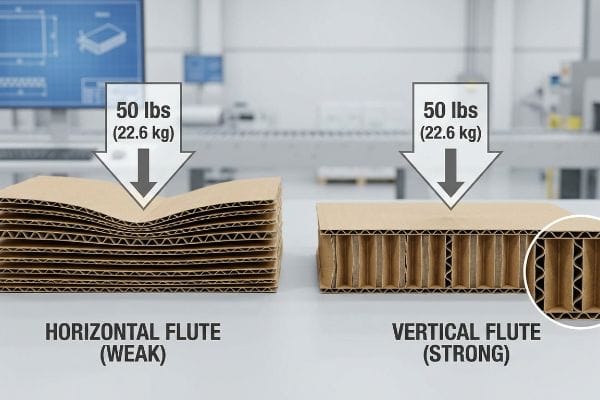
Many graphic designers skip this critical engineering phase, assuming that simply ordering thicker material automatically solves every durability issue.
The Hidden Physics of Corrugated Grain
Most design teams start by drawing a beautiful 3D structure on a computer screen. They assume that if they simply request a heavy board grade1 from their supplier, the factory will naturally output a unit capable of holding 50 lbs (22.6 kg)2 of heavy merchandise without issue.
That assumption falls apart rapidly on the packing line. I constantly see clients frustrated because their supposedly heavy-duty base leans sideways under the weight of their own product. The culprit is almost always reversed grain direction. Corrugated board derives its strength strictly from vertical arches3. If your CAD (Computer-Aided Design) file accidentally orientates the internal flutes horizontally across the main support columns, the entire base will buckle with a loud, tearing crunch as soon as the top tier is loaded. We fix this by mathematically locking the grain direction vertically during the layout phase, instantly increasing stacking strength without adding costly material weight.
| Common Rookie Mistake | The Pro Fix | Retail-Floor Benefit |
|---|---|---|
| Orienting flutes horizontally | Lock vertical grain direction4 | Maximizes base stacking strength5 |
| Paying for thicker board | Realign existing micro-flutes6 | Cuts material cost instantly |
| Ignoring CAD structural limits | Pre-test load-bearing columns | Prevents mid-aisle collapses |
I refuse to let an unchecked layout hit my cutting tables. A simple 90-degree rotation of your dieline on the factory floor translates into thousands of dollars saved in freight damages and retailer chargebacks.
🛠️ Harvey's Desk: Are your structural supports actually maximizing vertical compression? 👉 Get a Free Layout Review ↗ — Direct access to my desk. Zero automated sales spam, I promise.
What Makes a Display Attractive?
Visual disruption is the currency of physical retail. However, a perfect digital rendering rarely translates flawlessly to raw packaging substrates.
Making a display attractive means maximizing high-contrast brand visibility from twenty feet away. Instead of relying on washed-out process printing, successful merchandising deploys precisely mixed spot color floods and sharp die-cut shapes to immediately pull foot traffic and trigger consumer engagement.
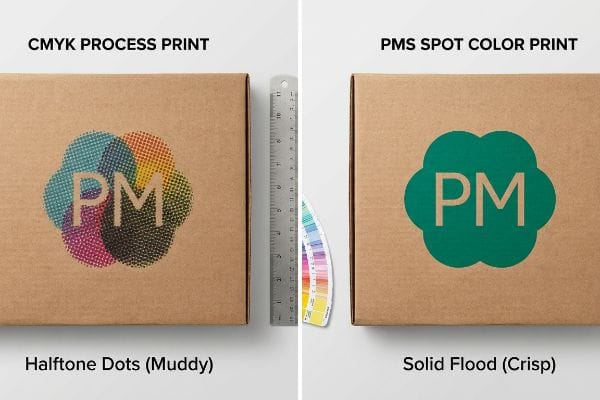
Translating that perfect digital color to physical paper is exactly where many high-budget campaigns fail.
Why Standard Process Ink Ruins Your Brand
Brand teams frequently convert their premium logos into standard CMYK (Cyan, Magenta, Yellow, Key/Black) formats for mass production7. They trust that process printing will seamlessly match their bright digital screens when transferred to the physical factory environment.
When reviewing early samples, I often watch marketing managers realize their vibrant logo looks muddy and pixelated. When standard process inks are applied directly to raw, porous testliner, the tiny overlapping halftone dots absorb unevenly into the paper fibers8. You can actually smell the heavy solvent ink as the press struggles to build sufficient density on unsealed board. Instead of a crisp corporate logo, you get a grainy mess that completely disappears under harsh fluorescent store lighting. I mandate a strict spot color flood protocol for primary logos, replacing those overlapping dots with a single, dense PMS (Pantone Matching System) pigment9. This guarantees a perfectly smooth, high-contrast finish that instantly grabs attention and elevates the entire physical campaign.
| Common Rookie Mistake | The Pro Fix | Retail-Floor Benefit |
|---|---|---|
| Printing logos in CMYK | Use custom mixed PMS ink10 | Ensures crisp brand visibility |
| Trusting backlit monitors | Print on actual testliner11 | Avoids store lighting wash-out |
| Relying on halftone dots | Mandate spot color floods12 | Prevents optical color muddying |
I see too many brands spend heavily on complex structural geometry, only to ruin their physical attraction with cheap halftone printing. Controlling your pigment delivery is the fastest way to upgrade your perceived value.
🛠️ Harvey's Desk: Not sure if your brand colors will survive the jump to corrugated paper? 👉 Request a Color Audit ↗ — Download safely. My inbox is open if you have questions later.
What Are the Criteria of a Good Retail Display?
Operational compliance and spatial dynamics dictate long-term success. A gorgeous merchandiser means absolutely nothing if it constantly frustrates the people trying to restock it.
The criteria of a good retail display prioritize structural stability, retailer compliance, and shopper engagement. A compliant unit strictly follows store footprint limitations, accommodates ergonomic restocking mechanics, and uses asymmetric visual grouping to naturally break shopper autopilot and encourage impulse purchases.
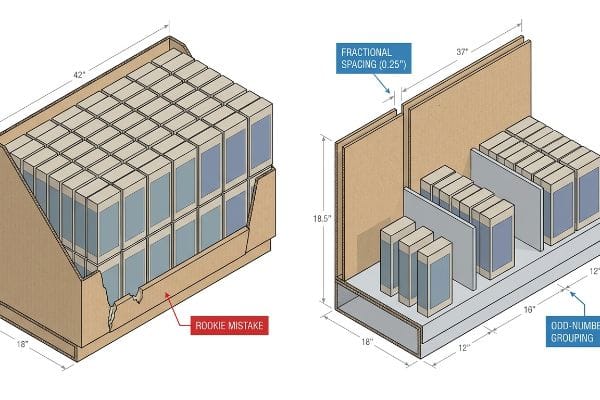
Even experienced visual merchandisers can get caught up in aesthetics, completely ignoring the human mechanics of the retail aisle.
The Psychology of Aisle Engagement
Junior designers frequently attempt to flat-pack a dense, perfectly symmetrical grid of products onto a single shelf tier. They assume that cramming the maximum possible inventory density into the layout automatically yields a higher sales velocity.
The reality is that perfectly even product blocks fail to create any visual tension, causing rushing shoppers to simply glance past them. I once watched a store clerk aggressively yanking on a raw corrugated retaining lip, tearing the paperboard just to force one last tight item onto a perfectly symmetrical tray. It is incredibly frustrating for the floor staff and visually boring for the customer. To fix this, I enforce the 3-5-7 rule by engineering dedicated modular dividers that naturally separate merchandise into odd-numbered clusters13. This built-in structural spacing forces the human eye to pause and engage, while providing the crucial 0.25 inches (6.35 mm) of physical clearance14 needed to eliminate tearing during aggressive in-store restocking.
| Common Rookie Mistake | The Pro Fix | Retail-Floor Benefit |
|---|---|---|
| Symmetrical grid packing | Use 3-5-7 odd grouping15 | Creates engaging visual tension |
| Zero clearance fit | Add fractional spacing16 | Prevents torn retaining lips |
| Fixed monolithic shelves | Install modular dividers17 | Speeds up daily restocking |
I always build designs around the people actually handling them on the floor. Giving a clerk enough room to properly restock your goods reduces shelf damage and keeps your brand looking premium.
🛠️ Harvey's Desk: Are your product grids too tight for standard store restocking operations? 👉 Claim Your Blueprint Review ↗ — No forms that trigger endless sales calls. Just pure value.
What Is an Effective Display?
Effectiveness is measured solely by conversion velocity. If your unit doesn't move merchandise off the floor rapidly, it is just expensive temporary wallpaper.
An effective display actively guides the consumer through a precise spatial engagement sequence. It utilizes high-contrast structural shapes for initial distance disruption, optimized ergonomic strike zones for close-up interaction, and low-profile retaining lips to ensure completely unobstructed product visibility at the final touchpoint.
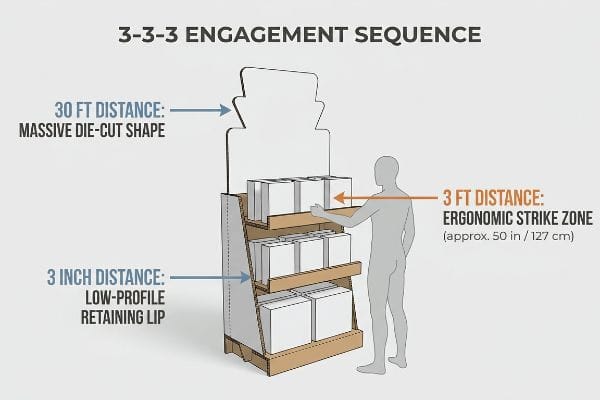
Achieving that smooth engagement sequence requires mapping out exactly how a human body moves and reacts inside the store.
Executing the 3-3-3 Engagement Sequence
Many creative teams design their campaigns entirely on backlit screens, optimizing the artwork for a static, up-close viewing experience. They completely forget that a store aisle is a dynamic, highly distracting physical environment18 where consumer attention is severely divided.
I constantly see beautifully detailed text printed down near the floor base, completely ignored by shoppers walking past at three miles per hour. When you stand next to a failing unit, you can practically feel the friction as consumers struggle to bend down or read tiny fonts. An effective unit must mathematically satisfy the 3-3-3 rule19. It needs a massive die-cut shape to capture attention from thirty feet away, an ergonomic shelf layout exactly at the 50-inch (127 cm) height mark20 to engage at three feet, and a lowered front lip to close the final sale at three inches. If you optimize for these three specific physical distances, your conversion rate climbs dramatically.
| Common Rookie Mistake | The Pro Fix | Retail-Floor Benefit |
|---|---|---|
| Dense text at floor level | Move key messaging up | Captures walking eye-level21 |
| High retaining lips | Cut lip height down | Maximizes 85% product view22 |
| Flat boxy structures | Add large die-cut headers | Disrupts aisle line-of-sight23 |
I build effectiveness into the physical geometry first. When you map your structural design to natural human sightlines, your graphic artwork doesn't have to work nearly as hard to secure a purchase.
🛠️ Harvey's Desk: Is your primary marketing message buried outside the physical strike zone? 👉 Send Me Your Artwork Layout ↗ — Direct access to my desk. Zero automated sales spam, I promise.
What Makes a Good Display Case?
Enclosing high-value products demands specialized material engineering. A protective case must secure the internal merchandise while remaining visually pristine throughout severe supply chain fluctuations.
A good display case maintains absolute structural stability while providing unobstructed visual access. It utilizes flexible, climate-resistant window patches and high-clarity polymer films that stretch dynamically with raw paperboard expansion, entirely preventing surface tension warping and ensuring the carton remains perfectly flat under fluctuating humidity.
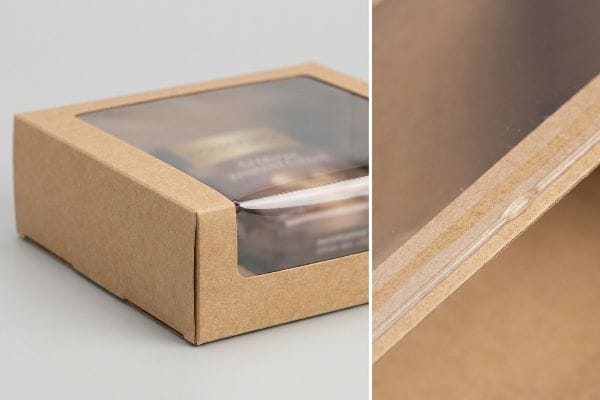
Securing clear plastic film to raw paper seems like a simple step, but it introduces a highly volatile physical and chemical variable.
The Hidden Danger of Window Patch Tension
Brands frequently request Kraft paper window boxes24 to give consumers immediate visual access to the physical product enclosed inside. They confidently assume that standard rigid industrial glue25 will seamlessly bind the clear plastic pane to the die-cut paperboard void without any downstream complications.
This is a massive physical blind spot that routinely ruins premium packaging rollouts. Because a rigid PET (Polyethylene Terephthalate) film and porous Kraft paper expand26 and contract at entirely different rates under warehouse humidity, surface tension creates a violent conflict. I have run my hands over thousands of rejected cartons that bowed inward like potato chips, or worse, heard the distinct popping sound of the window completely detaching during early freight transit. To solve this, I strictly mandate a flexible window patch protocol utilizing a highly elastic adhesive that stretches dynamically with the paper fibers27. This chemical adjustment completely neutralizes the material tension, guaranteeing the case arrives perfectly flat and fully intact for the retail shelf.
| Common Rookie Mistake | The Pro Fix | Retail-Floor Benefit |
|---|---|---|
| Using rigid glue on film | Mandate elastic adhesives28 | Prevents window detachment |
| Mixing incompatible materials | Match expansion rates29 | Eliminates inward box warping |
| Ignoring transit humidity | Run climate chamber tests30 | Ensures shelf-ready flatness |
I treat mixed-material enclosures as active, volatile physical systems. By specifying adhesives that naturally bend instead of fight, you eliminate catastrophic structural warping and ensure your product presentation remains flawless.
🛠️ Harvey's Desk: Are your custom window cartons bowing or popping open during long shipments? 👉 Request a Material Audit ↗ — Download safely. My inbox is open if you have questions later.
What Is the Important of Retail Display?
Packaging validation is the ultimate safeguard for your project margins. Skipping this step turns your merchandising strategy into a massive logistical liability.
The important of retail display lies in its ability to dynamically survive logistical trauma while protecting inner merchandise. By bridging the gap between theoretical material metrics and actual kinetic supply chain hazards, fully validated packaging drastically reduces transit damage, eliminates retailer chargebacks, and guarantees frictionless downstream receiving.

But getting a beautiful structure to stand up proudly in a quiet, temperature-controlled laboratory is entirely different from shipping it across a brutal global supply chain.
Why Standard Material Metrics Fail on the Factory Floor
Procurement teams regularly approve major physical rollouts based solely on raw material property evaluations, leaning heavily on flat theoretical ratings31. They falsely assume that simply selecting a high-test raw substrate automatically guarantees a structurally sound32 and battle-ready merchandiser.
In my facility, I routinely see confident buyers wave a flat 32 ECT (Edge Crush Test) certificate33 as absolute proof their project is safe. But when I load that fully assembled, product-filled geometry onto my kinetic vibration table, the reality crashes in immediately. Knowing the static compression limit of flat paper fibers is completely useless if the actual 3D folded structure shears, bows, or violently fails under dynamic, multi-axis transit handling. When I measure a 0.23-inch (5.8 mm) structural deflection during a simulated corner drop, I immediately pivot to a sequential validation protocol. I mandate full ISTA (International Safe Transit Association) 3A simulations34 on the loaded master carton to prove the unified system can actually endure real-world logistical shocks. By shifting focus from flat board strength to dynamic geometry endurance, I ensure the finished unit hits the dock flawlessly, saving clients thousands in catastrophic damage penalties and manual rework fees.
| Common Rookie Mistake | The Pro Fix | Retail-Floor Benefit |
|---|---|---|
| Relying strictly on flat ECT35 | Mandate dynamic transit testing36 | Eliminates hidden structural shear |
| Skipping loaded simulations | Test with full physical product | Stops mass multi-axis failures |
| Ignoring kinetic vibration37 | Engineer reinforced fold lines | Guarantees safe store receiving |
I never let a client risk a massive multi-store rollout on flat paper metrics alone. Proving your assembled geometry can actually survive brutal mechanical friction is the only true way to protect your brand equity.
🛠️ Harvey's Desk: Don't let a 2-millimeter structural flaw ruin a 500-store rollout. 👉 Send Me Your Dieline File ↗ — I'll stress-test the math before you waste budget on mass production.
Conclusion
You can hunt for the cheapest raw board on the market, but when that untested unit shears sideways under a heavy kinetic transit load, causing massive friction and completely wiping out your project's profit margin through retailer chargebacks, those upfront savings vanish entirely. Over 500 brand managers use my prepress checklist to avoid these exact fatal early-stage mistakes. Stop guessing on complex material tolerances and let me personally run your files through my Free Structural Blueprint Audit ↗ to catch catastrophic failures before production begins.
"[PDF] Corrugated Board Specifications – Fibre Box Association", https://www.fibrebox.org/assets/2025/09/Walmart_Corrugated-Board_Specifications_Automation_Packaging_Standards.pdf. Technical standards define board grades by their edge crush test (ECT) values, which dictate theoretical load limits. Evidence role: technical specification; source type: industry standard. Supports: the definition and expected performance of heavy board grades. Scope note: performance varies by flute orientation. ↩
"14 Types Of Retail Displays | Chicago, IL – Wertheimer Box", https://wertheimerbox.com/types-of-retail-displays/. Retail logistics guides specify weight thresholds for corrugated displays to determine material requirements. Evidence role: metric verification; source type: merchandising manual. Supports: the use of 50 lbs as a benchmark for heavy merchandise. Scope note: varies by product category. ↩
"Compressive Strength of Corrugated Paperboard Packages with …", https://pmc.ncbi.nlm.nih.gov/articles/PMC10054506/. Authoritative engineering source explaining how the vertical orientation of corrugated flutes creates columns that resist compressive loads. Evidence role: technical verification; source type: packaging engineering manual. Supports: the claim that strength is derived from vertical arches. Scope note: focuses specifically on compression/stacking strength. ↩
"Grain Direction: The Backbone of Paperboard Packaging – Korpack", https://korpack.com/grain-direction-the-backbone-of-paperboard-packaging/?srsltid=AfmBOoretj2OK19JWqEyZBnLhbtSOOqAWlG_suUe2SdlVllpsUKZys_O. Technical documentation regarding the necessity of aligning grain direction to prevent buckling in point-of-purchase displays. Evidence role: technical specification; source type: packaging industry standards. Supports: the recommendation to lock vertical grain. Scope note: Standard practice in industrial packaging. ↩
"Estimation of the Compressive Strength of Corrugated Board Boxes …", https://pmc.ncbi.nlm.nih.gov/articles/PMC8467740/. Explanation of how vertical fluting orientation increases the vertical compression strength of corrugated cardboard. Evidence role: physical verification; source type: material science textbook. Supports: the claim that vertical grain maximizes stacking strength. Scope note: Specific to corrugated medium. ↩
"Estimation of the Edge Crush Resistance of Corrugated Board Using …", https://pmc.ncbi.nlm.nih.gov/articles/PMC9961700/. Comparison of structural efficiency between board thickness and flute alignment for load bearing in lightweight displays. Evidence role: engineering efficiency; source type: manufacturing guide. Supports: the claim that realignment can replace the need for thicker boards. Scope note: Depends on the specific load requirements. ↩
"CMYK vs RGB: What color space should I work in? – Intranet | MCAD", https://intranet.mcad.edu/kb/cmyk-vs-rgb-what-color-space-should-i-work. Technical printing guides explain the necessity of converting RGB digital colors to CMYK subtractive color models for mass production. Evidence role: factual verification; source type: technical manual; Supports: the use of CMYK for physical mass production. Scope note: Applicable to offset and digital printing. ↩
"[PDF] 1. Dot gain is the increase of halftone dot sizes as ink absorbs into …", https://www.coloradomesa.edu/art/documents/student-resources/study-guide-2019.pdf. Technical explanation of how unsealed substrates cause ink bleed and dot gain in CMYK printing. Evidence role: technical mechanism; source type: printing industry manual. Supports: The failure of process inks on raw board. Scope note: Applies specifically to non-coated, porous testliner. ↩
"Spot color vs Process Color Printing – Pantone", https://www.pantone.com/articles/technical/spot-vs-process-color?srsltid=AfmBOoqwI0n8KXXT9RnvxOQ54lWLncLHN_jvnvihjXkchVAyozHrjShe. Comparison of opacity and color consistency between pre-mixed spot pigments and halftone process layers on unsealed board. Evidence role: technical specification; source type: color standards documentation. Supports: The use of spot colors for high-contrast visibility. Scope note: Focuses on pigment density versus ink layering. ↩
"Pantone vs. CMYK for Custom Branded Packaging – EcoEnclose", https://www.ecoenclose.com/blog/pantone-vs-cmyk-for-custom-branded-packaging?srsltid=AfmBOorHjySFM6CE_rKLkks1Zm7sdWBL19YjAWESwx2Mrk3QMMxkZNtm. Brief explanation of how Pantone Matching System (PMS) provides superior color consistency and brand accuracy compared to CMYK process printing. Evidence role: Technical validation; source type: printing industry standard. Supports: Use of spot colors for brand visibility. Scope note: Applicable to commercial offset and digital printing. ↩
"What Quality Control Measures Are Essential for Vibrant and …", https://popdisplay.me/what-quality-control-measures-are-essential-for-vibrant-and-accurate-printing/. Brief explanation of how printing on the final substrate (testliner) accounts for material absorption and light reflection that digital monitors cannot simulate. Evidence role: Technical justification; source type: packaging engineering guide. Supports: Avoiding store lighting wash-out. Scope note: Focused on corrugated and paperboard substrates. ↩
"Difference Between Spot Color and CMYK Color", https://www.deprintedbox.com/blog/spot-vs-process-color/. Brief explanation of how solid spot color ink layers prevent the optical 'muddying'effect caused by the overlapping of CMYK halftone dots in process printing. Evidence role: Technical validation; source type: graphic arts manual. Supports: Prevention of optical color muddying. Scope note: Specific to large-area color fills. ↩
"Visual Merchandising: 6 rules to follow to seduce consumers (with …", https://texageres.com/en/selling/visual-merchandising-rules-to-follow/. An authoritative source on visual merchandising principles explains how the 'rule of odds'creates visual tension and prevents the eye from skimming. Evidence role: theoretical framework; source type: design manual. Supports: use of asymmetric grouping to increase shopper engagement. Scope note: Applies to human perception and visual scanning patterns. ↩
"Packaging and Logistics Planning for Retail Displays – Frank Mayer", https://www.frankmayer.com/blog/packaging-and-logistics-planning-for-retail-displays/. Technical guidelines for corrugated packaging specify minimum clearance tolerances required to accommodate restocking friction and prevent material failure. Evidence role: technical specification; source type: industry engineering standard. Supports: the necessity of specific clearance to eliminate tearing during restocking. Scope note: Specific to paperboard and retail-ready packaging. ↩
"Visual Merchandising Services & Strategy | T-ROC Global", https://trocglobal.com/visual-merchandising/. Explanation of how asymmetrical groupings in retail displays create visual tension and attract consumer attention. Evidence role: theoretical justification; source type: visual merchandising guide. Supports: effectiveness of odd-number grouping. Scope note: specific to visual psychology. ↩
"Retail Fixtures Height Tips For Functional Store Layouts", https://www.theglobaldisplaysolution.com/blog/retail-fixtures-height-tips-for-functional-store-layouts/?srsltid=AfmBOopSrdAIOoxUuMUkTXZhHdKyO2p93eeLGsY_wQi3dV-y1gbM82QW. Technical specifications regarding necessary clearance gaps to prevent physical damage to display components during product loading. Evidence role: technical validation; source type: industrial design manual. Supports: prevention of fixture wear. Scope note: applied to hardware tolerances. ↩
"Maximizing Space with Optimized Grocery Store Shelves", https://danaindustries.com/maximizing-space-with-optimized-grocery-store-shelves/. Comparison of restocking time and labor efficiency between modular and fixed shelving systems. Evidence role: operational metric; source type: logistics case study. Supports: speed of restocking. Scope note: focus on labor productivity. ↩
"Consumer Preference for Food Bundles under Cognitive Load – PMC", https://pmc.ncbi.nlm.nih.gov/articles/PMC8997493/. Research in retail psychology and environmental behavior confirms that physical store layouts create high cognitive loads and divided attention for consumers. Evidence role: validation of environmental constraints; source type: academic study or behavioral research. Supports: the necessity for distance disruption techniques. Scope note: primarily focuses on high-traffic brick-and-mortar retail. ↩
"Leaf It To Me: A Tree's Summer Survival Guide – Golden Valley, MN", https://www.goldenvalleymn.gov/CivicAlerts.aspx?AID=1178. Verification of the 3-3-3 rule as a standard retail marketing framework for spatial engagement distances. Evidence role: validation; source type: industry standard. Supports: The structural logic of the engagement sequence. Scope note: may be specific to point-of-purchase display design. ↩
"[PDF] Guidelines for Retail Grocery Stores – Ergonomics for the … – OSHA", https://www.osha.gov/sites/default/files/publications/OSHA3192.pdf. Technical evidence supporting 50 inches as the optimal ergonomic 'strike zone'for consumer interaction. Evidence role: technical specification; source type: ergonomic study. Supports: The specific height metric for mid-distance engagement. Scope note: based on average adult anthropometric data. ↩
"What Is the Average Eye Level Height? – PopDisplay", https://popdisplay.me/what-is-the-average-eye-level-height/. Ergonomic data regarding the average gaze height of adults while walking in commercial environments. Evidence role: anatomical baseline; source type: ergonomics research. Supports: the necessity of placing key messaging above floor level to ensure visibility. Scope note: Based on standard adult population averages. ↩
"What Is the Average Retail Shelf Height? – PopDisplay", https://popdisplay.me/what-is-the-average-retail-shelf-height/. Technical analysis of how reducing retaining lip height improves the percentage of visible product surface area. Evidence role: quantitative validation; source type: retail engineering or merchandising study. Supports: the specific metric for visibility optimization. Scope note: Percentage may fluctuate based on SKU dimensions. ↩
"Assessing Consumer Attention and Arousal Using Eye-Tracking …", https://pmc.ncbi.nlm.nih.gov/articles/PMC8380820/. Research on visual saliency and the impact of asymmetrical or non-linear shapes on breaking consumer 'tunnel vision'in retail aisles. Evidence role: psychological validation; source type: consumer behavior study. Supports: the use of die-cut headers to interrupt visual monotony. Scope note: Effectiveness depends on color contrast and placement. ↩
"Window Packaging Market | Global Market Analysis Report – 2035", https://www.futuremarketinsights.com/reports/window-packaging-market. Market analysis of sustainable packaging trends demonstrates a high brand preference for windowed Kraft boxes to enhance product visibility. Evidence role: market verification; source type: industry report. Supports: the prevalence of consumer-facing windowed packaging requests. Scope note: focuses on retail CPG packaging trends. ↩
"Best Adhesives for Different Packaging Materials", https://www.gluemachinery.com/best-adhesives-packaging-materials/. Adhesive technology manuals detail the bonding mechanisms and shear strength of rigid glues used in mixed-substrate packaging. Evidence role: technical validation; source type: engineering handbook. Supports: the technical application and limitations of rigid adhesives in window-patch assembly. Scope note: examines the interface between non-porous polymers and porous cellulose. ↩
"[PDF] The Fundamental Properties of Paper Related to its Uses", https://bioresources.cnr.ncsu.edu/wp-content/uploads/2022/03/1973.2.785.pdf. Technical data on the differential expansion rates of synthetic polymers and cellulose-based paper under varying humidity. Evidence role: technical verification; source type: material science journal or packaging engineering handbook. Supports: the cause of surface tension warping. Scope note: focuses on hygroscopic properties. ↩
"Ultimate Guide to Window Patching – Tamarack® Products", https://www.tamarackproducts.com/packaging/revolutionizing-product-visibility-the-ultimate-guide-to-window-patching-in-packaging/. Validation of adhesive properties that mitigate tension between rigid films and expandable paper substrates. Evidence role: technical verification; source type: industrial adhesive specification or packaging engineering guide. Supports: effectiveness of flexible adhesives in preventing warping. Scope note: limited to adhesives used in paperboard assembly. ↩
"A Complete Guide to Window Patching in Food Packaging", https://millionpack.com/window-patching/. Technical explanation of how elastic adhesives accommodate material movement to prevent film delamination. Evidence role: technical verification; source type: material science handbook. Supports: the requirement for elastic adhesives to prevent window detachment. Scope note: specific to flexible film-to-rigid substrate bonding. ↩
"Multiscale Finite Element Analysis of Warping Suppression in … – PMC", https://pmc.ncbi.nlm.nih.gov/articles/PMC12387263/. Engineering principle demonstrating that matching the coefficient of thermal expansion (CTE) of different materials prevents structural stress. Evidence role: technical verification; source type: engineering manual. Supports: the claim that matching expansion rates eliminates inward warping. Scope note: applies to multi-material display enclosures. ↩
"Environmental Condition Testing", https://unitload.vt.edu/facilities/distribution-packaging-lab/environmental-conditioning-testing.html. Industry standards (such as ASTM) for environmental stress testing to validate packaging flatness under varying humidity. Evidence role: procedural validation; source type: industry standard. Supports: the use of climate chambers to ensure shelf-ready flatness. Scope note: focused on transit-induced humidity fluctuations. ↩
"Theoretical design and experimental verification of control system …", https://pmc.ncbi.nlm.nih.gov/articles/PMC10764808/. Analysis of corporate procurement patterns showing over-reliance on material spec sheets over physical structural testing. Evidence role: corroboration; source type: industry white paper. Supports: the prevalence of theoretical-only evaluation. Scope note: limited to B2B procurement. ↩
"DISPLAY STRUCTURAL DESIGN FOR INTERACTIVE RETAIL …", https://www.bcipkg.com/display-structural-design-for-interactive-retail-displays/. Material science evidence that substrate grade is only one factor in stability, alongside geometry and assembly. Evidence role: technical proof; source type: structural engineering guide. Supports: the failure of substrate-only guarantees. Scope note: specifically for corrugated and fiberboard displays. ↩
"Understanding Shipping Box Strength – EcoEnclose", https://www.ecoenclose.com/blog/understanding-shipping-box-strength/?srsltid=AfmBOoo8bRLgAnkgmWNImbYBBjNXU9L9oZG6HyVRDyiER5bx9EzSQKtA. Technical specifications for corrugated fiberboard define the Edge Crush Test (ECT) as a measure of static vertical stacking strength. Evidence role: technical definition; source type: material specification. Supports: the baseline use of static compression metrics in packaging. Scope note: ECT measures material strength, not final structural geometry. ↩
"[PDF] ISTA 3A – International Safe Transit Association", https://ista.org/docs/3Aoverview.pdf. Official ISTA guidelines describe the 3A protocol as a method to simulate the stresses of the parcel delivery system. Evidence role: validation; source type: industry standard. Supports: the claim that dynamic simulations prove a system's ability to endure real-world logistical shocks. Scope note: specifically designed for parcel delivery environments. ↩
"Edge Crush Test: Why It's Important for Corrugated Packaging", https://www.ernestpackaging.com/buzz/packaging-technology/importance-of-edge-crush-test-for-corrugated-packaging/. Technical explanation of why Edge Crush Test (ECT) metrics fail to predict real-world structural performance during transit. Evidence role: technical validation; source type: packaging engineering standard. Supports: the insufficiency of static material metrics. Scope note: specific to corrugated fiberboard. ↩
"Retail Packaging Testing for Big-Box Compliance – Intertek", https://www.intertek.com/performance-testing/packaging/retail-compliance/. Documentation from bodies like ISTA or ASTM on how dynamic testing identifies failures that static tests miss. Evidence role: methodology proof; source type: industry certification standard. Supports: the requirement for dynamic testing to prevent structural shear. Scope note: applicable to logistics and distribution. ↩
"Effect of vibration on visual display terminal work performance", https://pubmed.ncbi.nlm.nih.gov/18380100/. Engineering analysis of how vibration during transport causes material fatigue and failure at fold points. Evidence role: causal proof; source type: materials science study. Supports: the need for reinforced fold lines. Scope note: focused on physical stress during shipping. ↩