Brands bleed profit waiting for traditional printing plates to be manufactured. When retail buyers demand sudden design changes, slow traditional methods guarantee missed launch windows and wasted capital.
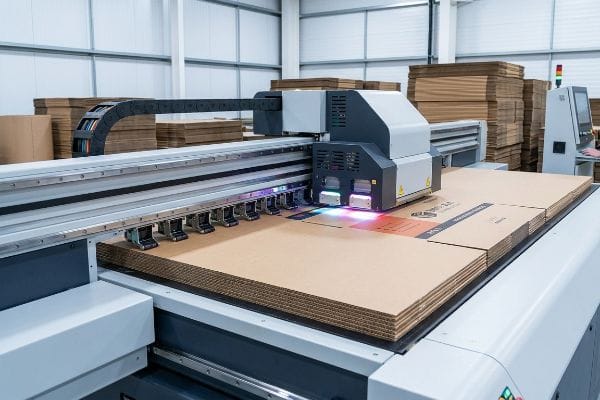
Flatbed digital printing is an industrial manufacturing process where specialized wide-format machines apply and instantly cure ink directly onto rigid substrates like corrugated cardboard. This plate-free technology eliminates extensive setup times, dramatically reducing production bottlenecks for short-run retail campaigns and enabling rapid structural prototyping.
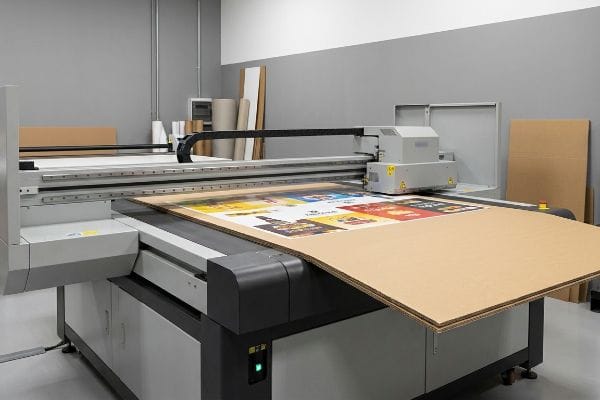
While traditional printing relies on complex rollers and wet adhesives, directly laying ink onto heavy boards changes the entire physical dynamic on the factory floor.
What do flatbed printers do?
To understand their value, you must look past the print head and focus on manufacturing velocity.
Flatbed printers operate by propelling microscopic ink droplets directly onto thick stationary materials without requiring traditional metal plates. This direct-to-board capability completely bypasses lengthy prepress setups, empowering engineers to execute rapid iterations and finalize highly accurate production samples in a fraction of the standard timeframe.
Skipping the plate-making process sounds great for the marketing budget, but its true power lies in how it rescues the physical supply chain.
The "Speed-to-Market" Prototype Lifeline
Procurement teams often rely on traditional offset methods for all corrugated displays, assuming the high setup costs1 are just the unavoidable price of retail quality. They lock in their artwork weeks in advance, completely ignoring the reality that big-box retailers constantly tweak their floor space guidelines at the last minute. When a buyer demands a sudden dimension shift, the entire plate-making pipeline2 grinds to a halt.
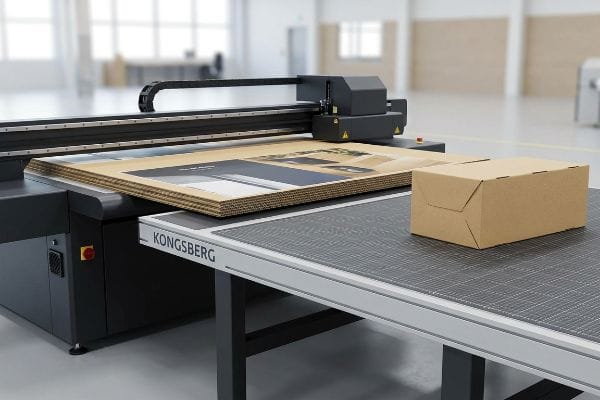
This isn't just theory—I see this happen on the testing floor when clients scramble to adjust their footprints. Traditional methods require days to burn new plates and mount them, stalling the entire facility. In my facility, I intercept these panic requests using industrial flatbed printing paired seamlessly with my Kongsberg digital cutting tables. By applying ink directly to the heavy 32ECT (Edge Crush Test) board3 and cutting the new dieline instantly to within a 0.04 inches (1 mm) tolerance4, I bypass the tooling phase entirely. This plate-free maneuver slashes our turnaround time by an estimated 80%, allowing me to push a fully printed, mathematically accurate structural sample out the door in 24 hours, keeping the retailer's launch window intact while saving thousands in rush logistical fees.
| Production Phase | Traditional Offset | Digital Flatbed |
|---|---|---|
| Prepress Tooling | Expensive metal plates | Zero physical plates5 |
| Iteration Speed | 5-7 days delay6 | 24-hour turnaround |
| Volume Efficiency | High minimum runs | Cost-effective micro-runs7 |
I refuse to let an outdated prepress bottleneck jeopardize a multi-million dollar product launch. By deploying direct-to-board technology, I transform a catastrophic retail design change from a logistical nightmare into a simple digital file swap.
🛠️ Harvey's Desk: Are rigid tooling minimums and slow prepress setups paralyzing your ability to test new retail configurations? 👉 Request a Free Turnaround Audit ↗ — I review every structural file personally within 24 hours.
What is a flat bed print?
The physical output defines how the consumer perceives the brand on the retail floor.
A flat bed print is the physical result of UV-curable inks bonded directly to a rigid surface. Instead of absorbing deeply into porous paper fibers, these specialized inks are instantly polymerized by ultraviolet light, creating a highly durable, vibrant graphic layer perfectly suited for demanding retail environments.
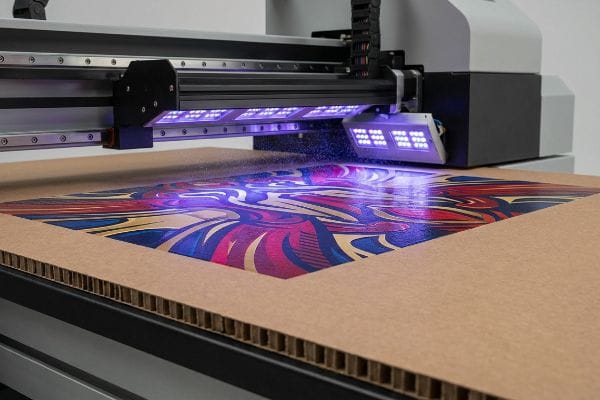
Understanding this curing mechanism is essential before you attempt to map complex graphic designs onto raw industrial substrates.
The Engineering Mechanics behind UV Polymerization
A fundamental challenge in corrugated packaging is the porous nature of raw testliner. Standard liquid inks rely on absorption, which can cause pigments to bleed unpredictably along the microscopic paper fibers8. A flatbed system bypasses this absorption issue entirely by utilizing UV (Ultraviolet) light arrays attached to the moving print carriage. As the droplets hit the board, the light instantly cures the liquid monomer into a solid polymer film9.
This instantaneous phase change prevents the ink from sinking10 into the corrugated flutes. I rely on this exact polymerization process to maintain ultra-crisp line weights and dense color floods on large format merchandisers. Because the ink sits proudly on the surface rather than blending into the kraft background, it inherently resists the visual degradation known as halftone mud11. By understanding this physical interaction, structural engineers can confidently specify high-contrast branding elements, knowing the digital process will deliver exceptional clarity under harsh fluorescent store lighting without compromising the underlying board strength.
| Printing Variable | Absorption Method | UV Flatbed Print |
|---|---|---|
| Ink Phase | Liquid absorption | Instant solid polymer |
| Fiber Bleed | High risk | Zero surface bleed |
| Visual Output | Washed-out colors | High-contrast density |
I always remind product managers that controlling the ink's physical phase change is the secret to visual disruption. Suspending the pigment on top of the substrate guarantees maximum retail visibility from twenty feet down the aisle.
🛠️ Harvey's Desk: Are your high-end brand colors looking muddy and washed out when printed on raw structural cardboard? 👉 Get a Free Color Contrast Analysis ↗ — 100% confidential. Your unreleased retail designs are safe with me.
What is the difference between digital printing and normal printing?
The core distinction lies in the physical chemistry of how the image adheres to the final structure.
The difference between digital printing and normal printing lies primarily in the application mechanics and moisture content. Normal printing involves mounting a pre-printed paper sheet onto corrugated board using wet adhesives, whereas digital printing applies ink directly to the board without requiring secondary lamination or liquid glues.
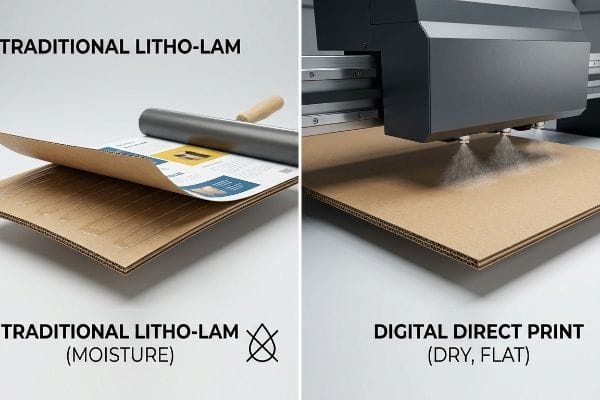
This distinction isn't just about the machinery; it fundamentally alters the physical behavior of the cardboard during manufacturing.
The Engineering Mechanics behind Lamination Moisture Warp
Traditional or "normal" retail printing relies on litho-lamination, where a high-quality top sheet is bonded to the heavy structural base using a water-based PVA (Polyvinyl Acetate) adhesive12. This wet glue introduces significant moisture into the porous corrugated structure. Conversely, flatbed digital systems apply the graphic without any secondary paper or wet adhesive13, radically altering the material's environmental stability.
When that liquid glue dries and cures in ambient factory air, it naturally shrinks. I continuously monitor this chemical reality because the resulting surface tension can cause the entire display panel to warp14 or bow inwards like a potato chip if not properly compressed under heavy dead-weights. Digital printing entirely removes the moisture variable15 from the equation. Because the ink is cured instantly directly onto the dry board, the internal paper fibers never experience that aggressive wet-to-dry contraction. This fundamental difference allows engineers to process and assemble large, flat structural panels with zero bowing risk, drastically improving the dimensional accuracy of the final retail footprint.
| Manufacturing Metric | Normal (Litho-Lam) | Digital Flatbed |
|---|---|---|
| Adhesive Type | Water-based glues16 | No adhesive used |
| Moisture Added | High surface moisture17 | Zero added moisture |
| Warping Risk | Severe without curing18 | Structurally stable |
I approach every structural project by first evaluating the moisture threshold of the selected board. By eliminating wet adhesives through direct digital application, I permanently neutralize the threat of panel warping.
🛠️ Harvey's Desk: Are your large floor display panels bowing inward and ruining the structural integrity of your retail presentation? 👉 Claim a Free Substrate Stability Review ↗ — No account managers in the middle. You talk directly to structural engineers.
What's the difference between a digital print and a screen print?
Both methods offer high durability, but their mechanical application constraints dictate their ideal use cases.
The difference between a digital print and a screen print centers on setup and mechanical contact. Screen printing forces thick ink through physical mesh stencils for each individual color, while digital printing uses contactless, computer-controlled nozzles to spray multiple colors simultaneously with precise mathematical accuracy.
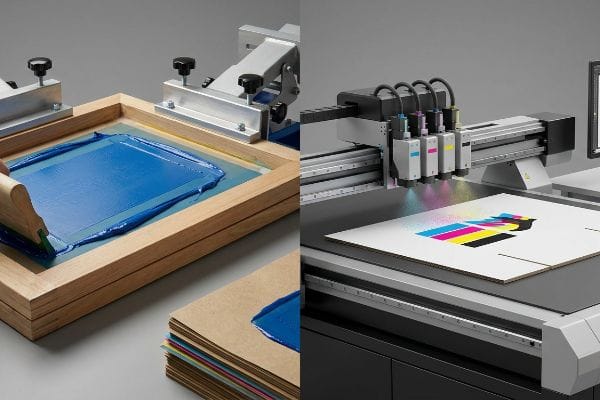
While screen printing delivers unmatched pigment density for specialty finishes, digital technology solves a critical mechanical alignment flaw.
The Engineering Mechanics behind Registration Tolerances
Screen printing is an analog, contact-heavy process requiring massive physical pressure to push high-viscosity ink19 through a mesh frame. Because each color requires its own physical screen and a separate pass through the press, the substrate must be perfectly realigned every single time. Digital printing, however, applies the entire CMYK (Cyan, Magenta, Yellow, Key/Black) spectrum20 in a single, contactless sweep across the board.
This reliance on physical frames introduces a mechanical vulnerability known as registration drift. When I evaluate complex multi-color dielines, I know that pushing a heavy corrugated sheet through multiple screen printing stations can cause the board to shift by fractions of a millimeter21, leading to visible gaps between colors. Digital flatbed systems mathematically eliminate this drift22. Because the substrate remains firmly locked to the vacuum table while the print carriage moves over it, the droplets map to absolute coordinates. This ensures that intricate vector lines and fine typographical details remain perfectly sharp, bypassing the physical alignment limitations of analog mesh stencils.
| Tolerance Metric | Screen Printing | Digital Flatbed |
|---|---|---|
| Ink Application | Physical mesh contact23 | Contactless nozzles24 |
| Color Passes | Sequential multi-pass | Simultaneous application |
| Registration Drift | High vulnerability | Mathematically locked25 |
I view digital flatbed systems as the ultimate solution for tight-tolerance retail graphics. By keeping the corrugated board completely stationary under a moving carriage, I strip the mechanical variance out of the color reproduction entirely.
🛠️ Harvey's Desk: Are overlapping colors on your current packaging creating visible gaps and making your typography look blurry? 👉 Request a Free Print Tolerance Audit ↗ — I review every structural file personally within 24 hours.
Conclusion
Mitigating moisture warp and eliminating prepress bottlenecks directly protects your aggressive retail launch timelines. Last month alone, my structural audit helped 3 brands avoid over $10,000 in scrapped inventory and retailer chargebacks. Let me personally run your structural files through my Free Production Feasibility Audit ↗ to ensure your next flat-packed display mathematically survives the factory floor without succumbing to alignment failures or moisture degradation.
"Digital vs Offset Printing for Packaging: Which One is Right …", https://packwire.com/blog/digital-vs-offset-printing-for-packaging?srsltid=AfmBOoqIFniTpI0orq1Hfq3JN0WY53JGbc_2-1CPUOVbvtuYQzft1ZlK. [Industry data on commercial printing confirms that offset printing requires significant upfront investment for plate creation and press setup]. Evidence role: factual verification; source type: industry report. Supports: High setup costs of offset printing. Scope note: Cost efficiency varies by volume. ↩
"Offset printing – Wikipedia", https://en.wikipedia.org/wiki/Offset_printing. [Technical manuals for offset lithography explain that modifications to artwork or dimensions require the production of entirely new physical plates]. Evidence role: technical verification; source type: printing textbook. Supports: Disruptions to the plate-making pipeline. Scope note: N/A. ↩
"Understanding Corrugated Material | Northborough, MA 01532", https://www.newcorrpackaging.com/understanding-corrugated-material. [An industry standard manual for corrugated packaging provides the technical specifications and load-bearing capacity for 32ECT rated board]. Evidence role: technical definition; source type: industrial standard. Supports: the use of specific high-strength materials in flatbed prototyping. Scope note: ECT values are standard metrics in the packaging industry. ↩
"Kongsberg Precision Cutting Systems: Digital cutters for every …", https://www.kongsbergsystems.com/. [Manufacturer technical specifications for industrial digital cutting tables verify the precision limits and cutting accuracy of the machinery]. Evidence role: technical validation; source type: manufacturer specification. Supports: the claim of mathematical accuracy in structural sampling. Scope note: Accuracy may vary based on calibration and material type. ↩
"The Advantages of UV Direct to Substrate Printing Technology", https://coldesi.com/uv-printers/the-advantages-of-uv-direct-to-substrate-printing-technology/. [Technical specifications for digital flatbed printers would confirm the absence of imaging plates in favor of direct inkjet or toner delivery]. Evidence role: technical specification; source type: manufacturer documentation. Supports: Digital prepress tooling. Scope note: Specific to digital inkjet/toner technologies. ↩
"Understanding Printing Turnaround Time – Bestype Printing NYC", https://www.bestypeimaging.com/understanding-printing-turnaround-time-what-to-expect-when-you-submit-your-printing-order/. [Industry standard production guides would detail the typical timeline for plate creation, curing, and machine setup in offset printing]. Evidence role: factual verification; source type: industry manual. Supports: Offset iteration speed. Scope note: Timelines may vary based on facility scale. ↩
"Digital Printing Vs Offset Printing: Which One is Better?", https://bjsprinting.com/2023/08/13/digital-printing-vs-offset-printing/. [Economic analysis of printing methods would demonstrate that the removal of setup fees makes small-volume digital runs more profitable than offset]. Evidence role: economic verification; source type: industry analysis. Supports: Volume efficiency. Scope note: Validity depends on the threshold between micro and macro runs. ↩
"Liquid Wicking in a Paper Strip: An Experimental and Numerical Study", https://pmc.ncbi.nlm.nih.gov/articles/PMC7495729/. [A technical source on ink rheology or paper science would explain how capillary action in porous substrates causes lateral ink migration or bleeding]. Evidence role: technical explanation; source type: scientific textbook. Supports: the challenges of standard ink absorption on testliner. Scope note: applies to porous cellulose-based materials. ↩
"UV-Curable Bio-Based Polymers Derived from Industrial Pulp and …", https://pmc.ncbi.nlm.nih.gov/articles/PMC8126230/. [A chemistry or printing engineering source would detail the photo-polymerization process where UV radiation triggers rapid cross-linking of monomers into a polymer network]. Evidence role: technical specification; source type: engineering handbook. Supports: the mechanics of UV ink curing. Scope note: specific to UV-curable monomers. ↩
"[PDF] A study of the effect of water-pick up of UV curable offset ink on its …", https://repository.rit.edu/cgi/viewcontent.cgi?article=9461&context=theses. [Technical documentation on UV curing explains how rapid polymerization limits ink penetration compared to solvent-based inks on porous substrates]. Evidence role: Technical verification; source type: Printing chemistry manual. Supports: Mechanics of UV ink bonding. Scope note: Specific to UV-curable inks on corrugated materials. ↩
"UV, Solvent, Eco-Solvent or Latex? Discover 2025 Top Choice", https://arrow-digital.com/uv-solvent-eco-solvent-or-latex-heres-the-real-winner-in-2025/. [Printing industry guides define halftone mud as dot gain caused by ink absorption and explain how surface-curing UV inks mitigate this effect]. Evidence role: Technical definition; source type: Professional printing handbook. Supports: Visual quality claims of UV prints. Scope note: Focuses on dot gain and bleeding on kraft substrates. ↩
"Understanding Litho Laminated Packaging", https://pmpackaging.com/posts/2025/03/understanding-litho-laminated-packaging. [Packaging engineering standards will verify the use of water-based Polyvinyl Acetate as the primary adhesive in litho-lamination]. Evidence role: technical specification; source type: industry manual. Supports: composition of traditional retail printing adhesives. Scope note: refers to standard water-based lamination. ↩
"What Printing Process Is Best for Corrugated Packaging?", https://www.assetliquidity.net/blog/what-printing-process-is-best-for-corrugated-packaging. [Industrial printing specifications will confirm that flatbed digital systems print ink directly onto the substrate]. Evidence role: process verification; source type: technical specification. Supports: the absence of lamination in digital printing. Scope note: specific to direct-to-substrate digital systems. ↩
"Preparation Of Corrugating Adhesives – Pkg Solutions", http://pkgsolutions.co.uk/kb/Corrugating_Adhesives.php. [A technical source on adhesive science or packaging engineering would explain how differential shrinkage and surface tension during the curing of water-based glues create internal stresses that cause substrate warping]. Evidence role: technical verification; source type: engineering textbook. Supports: the physical mechanism of bowing in traditional lamination. Scope note: specific to wet adhesive applications. ↩
"Paper warping | PrintPlanet.com", https://printplanet.com/threads/paper-warping.9757/. [Industry standards for direct-to-substrate digital printing verify that the absence of water-based mounting adhesives eliminates the hygroscopic contraction associated with traditional lamination]. Evidence role: process comparison; source type: printing technology manual. Supports: the dimensional stability advantage of digital printing. Scope note: applicable to direct-to-board inkjet or toner processes. ↩
"Lamination Adhesives for Foil, Film & Paper", https://www.capitaladhesives.com/applications/lamination/. [An authoritative source on commercial printing and lamination would specify the chemistry of adhesives used in litho-lam processes]. Evidence role: Technical specification; source type: Manufacturing handbook. Supports: adhesive composition in traditional lamination. Scope note: Specific to litho-lam processes. ↩
"Litho Lamination – Nissha Metallizing Solutions", https://www.nisshametallizing.com/en/metallized-packaging/litho-lamination. [Technical literature on material science in printing would quantify the amount of moisture introduced by water-based glues during lamination]. Evidence role: Physical metric; source type: Engineering journal. Supports: cause of material expansion in litho-lam. Scope note: Focused on surface moisture. ↩
"[PDF] 7th Pacific Rim Bio-Based Composites Symposium", https://research.fs.usda.gov/download/treesearch/20222.pdf. [Industrial standards for substrate stability would explain the necessity of curing to prevent warping in moisture-heavy lamination]. Evidence role: Engineering risk factor; source type: Industrial standard. Supports: the relationship between curing and structural stability. Scope note: Pertains to warping risk. ↩
"The Rheological Demands of Screen Printing Inks and Pastes", https://www.rheologylab.com/articles/coatings-paints-inks/screen-printing-ink-paste/. [A technical manual on printing engineering would detail the rheology of screen printing inks and the mechanical force required for ink deposition.] Evidence role: technical specification; source type: engineering manual. Supports: mechanical constraints of screen printing. Scope note: Pressure varies based on mesh count and ink type. ↩
"High Speed Single Pass Printer for Packaging Printing Solution", https://www.mtutech.com/OnePassPrinter/A3SinglePassPrinter-1153.html. [Technical documentation on digital inkjet technology would confirm the simultaneous application of CMYK colors via contactless nozzles.] Evidence role: process verification; source type: technical white paper. Supports: digital printing efficiency vs screen printing. Scope note: Specific to drop-on-demand digital systems. ↩
"Registration in Screenprinting – YouTube", https://www.youtube.com/watch?v=HvtMaspE9l8. [An authoritative source on printing engineering would quantify the mechanical tolerances and shifting risks associated with multi-station screen printing on corrugated substrates]. Evidence role: technical specification; source type: printing industry handbook. Supports: the claim that analog screen printing is prone to registration drift. Scope note: focuses on corrugated materials. ↩
"Our Automatic Screen Printing Machine is designed for industrial …", https://www.instagram.com/reel/DVGae9lAPht/. [A technical manual or comparative study on digital wide-format printing would explain how vacuum tables and coordinate-based carriage movement remove the mechanical shift seen in multi-station analog processes]. Evidence role: mechanical comparison; source type: engineering white paper. Supports: the superiority of digital registration over analog. Scope note: refers specifically to flatbed vacuum systems. ↩
"Key Physical Properties of Screen-Printing Mesh Explained", https://microscreen.com/physical-mesh-properties-the-key-to-successful-screen-printing/. [Technical literature on printing processes explains the mechanical requirement of a mesh screen touching the substrate to transfer ink]. Evidence role: technical definition; source type: industrial printing manual. Supports: Screen printing ink application method. Scope note: Applies to traditional screen printing techniques. ↩
"[PDF] A Guide to Industrial Inkjet – Xaar", https://www.xaar.com/media/vhfoylct/xaar-inkjet-guide-eng4.pdf. [Engineering specifications for inkjet flatbed printers detail the use of non-contact print heads that deposit ink droplets from a set distance]. Evidence role: technical specification; source type: hardware whitepaper. Supports: Digital flatbed ink application. Scope note: Specifically relates to piezo or thermal inkjet technology. ↩
"Screen Printing Machine Consistency: 5 Precision Systems Explained", https://www.psi-print.com/How-Does-a-Screen-Printing-Machine-Ensure-Consistent-Print-Quality. [Academic sources on CNC-driven printing systems describe how software-controlled X-Y coordinates eliminate physical registration drift]. Evidence role: engineering principle; source type: academic journal. Supports: Precision of digital registration. Scope note: Refers to the digital coordinate system vs physical jigs. ↩