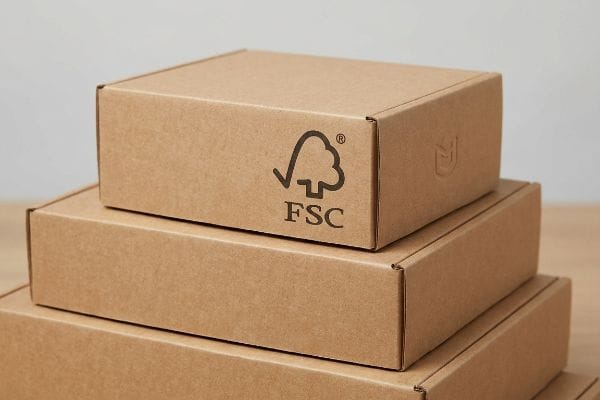
You've seen the little tree logo on packaging and wondered if it actually impacts your bottom line. Brands slap it everywhere, but misunderstanding it can trigger massive retailer compliance failures.
The FSC (Forest Stewardship Council) label stands for an international certification ensuring paper and wood products are sourced from responsibly managed forests. This global environmental standard guarantees ethical harvesting, protects fragile ecosystems, and provides a strict chain of custody from the raw timber to the final manufactured product.

But knowing the textbook definition isn't enough when Walmart's procurement team audits your next major retail rollout.
What does the FSC label mean?
Understanding what the certification means involves far more than just picking a green vector logo for your artwork files.
Meaning the FSC label indicates a product has successfully passed rigorous environmental audits. It confirms that the physical wood fibers used in your corrugated displays or packaging were legally harvested, preventing deforestation while strictly maintaining ecological balance and supporting the local communities surrounding the designated forest sector.

Moving from forest theory to factory reality is where most packaging campaigns completely fall apart.
The Chain of Custody Traceability Trap
Junior brand managers often assume that simply requesting certified cardboard from their supplier automatically guarantees compliance with big-box sustainability mandates1. They slap the logo on their dieline, assuming the factory will intuitively handle the rest. This creates a massive blind spot during vendor selection, treating a strict legal certification like a basic graphic design element.
The rookie mistake is thinking the logo itself is the definitive proof. In my facility, I routinely see clients shocked when their goods are flagged at receiving. Why? Because certified boards can easily be mixed with untraceable, low-grade paperboard on the chaotic blur of a busy production floor, where the sharp, chemical smell of fresh ink meets thousands of identical-looking brown boards. I remember a new client sweating bullets as a major US retailer demanded the paper trail for 10,000 displays, and their previous vendor couldn't provide it. The sheer panic of realizing their entire run was legally unverified is something I never want to see again. To prevent this, I enforce a strict CoC (Chain of Custody) documentation protocol2. I physically segregate raw material and maintain centralized sourcing logs. You must demand the unbroken paper trail from the initial paper mill to the final die-cut unit.
| Common Rookie Mistake | The Pro Fix | Retail-Floor Benefit |
|---|---|---|
| Relying only on a printed logo | Enforcing strict CoC factory documentation | Passes rigid procurement audits |
| Mixing certified and uncertified boards | Physical raw material segregation | Eliminates environmental compliance holds |
| Ignoring the paper mill origin | Centralized sourcing logs tracking | Speeds up big-box store receiving |
I refuse to let a missing factory document ruin your launch. Securing that verified paper trail guarantees your packaging passes rigid retailer procurement audits without triggering immediate rejections.
🛠️ Harvey's Desk: Not sure if your current supplier is secretly mixing untraceable board into your run? 👉 Request A Supply Chain Audit ↗ — Direct access to my desk. Zero automated sales spam, I promise.
Is FSC wood real wood?
When evaluating material specs, many buyers get confused about the actual physical composition of their certified packaging.
Yes. FSC wood is real wood sourced from verified forests, including the virgin kraft fibers and recycled paperboard used in corrugated displays. Whether it is solid timber for pallets or pulped fibers for packaging cartons, the certification strictly tracks the biological material throughout its entire supply chain journey.
But just because your display is made from real, certified paper fibers doesn't mean it performs the same on the floor.
The Structural Reality of Sourcing Standards
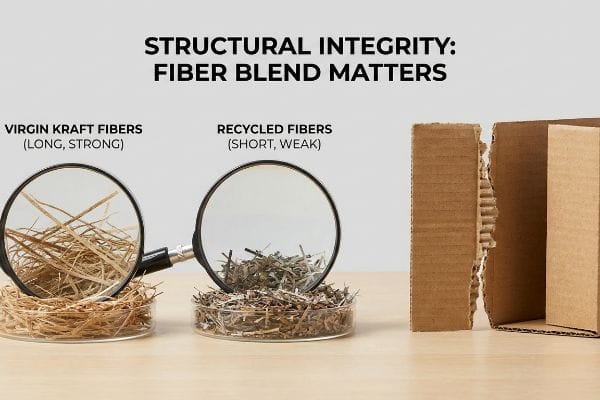
Procurement teams frequently assume all brown boxes are structurally identical as long as they carry the certification. They push for maximum recycled content to boost their eco-friendly messaging, completely ignoring the physical limitations of paper fibers3. This leads to specifying boards that look great on a sustainability report but buckle under the reality of heavy retail merchandise.
The common trap is treating highly recycled testliner and virgin kraft as completely interchangeable. Real wood fibers act as mechanical shock absorbers4, but every time paper is repulped, those microscopic fibers get shorter and weaker5. I once watched a store clerk struggling to build a floor display holding 150 lbs (68 kg) of product because the highly recycled board was so structurally exhausted it kept tearing at the score lines, making a loud, dry ripping sound under pressure. They ended up wrapping the base in ugly clear tape just to keep it upright, ruining the brand image. I mandate a strict balance: utilizing 100% recyclable corrugated board compliant with SFI (Sustainable Forestry Initiative) and FSC, but strategically placing virgin kraft on primary load-bearing walls. This ensures structural integrity while maintaining absolute eco-compliance.
| Common Rookie Mistake | The Pro Fix | Retail-Floor Benefit |
|---|---|---|
| Overusing 100% recycled testliner | Blending virgin kraft for load-bearing walls6 | Prevents base crushing and tearing |
| Assuming all certified board is strong | Specifying exact fiber length requirements7 | Maintains structural rigidity |
| Ignoring fiber fatigue limits | Matching board grade to product weight | Eliminates the need for clear tape8 |
I always optimize the fiber length before mass production. Balancing virgin and recycled layers ensures your displays survive double-stacked freight and saves you from costly retailer chargebacks.
🛠️ Harvey's Desk: Are your current displays tearing during assembly because the paper fibers are too short? 👉 Get A Material Spec Review ↗ — Download safely. My inbox is open if you have questions later.
What does FSC mean on a clothing label?
Walking through the apparel aisles, you will notice an increasing number of garments featuring eco-certifications directly on their physical tags.
Meaning FSC on a clothing label guarantees that the physical paper hang tag or packaging box originates from responsibly managed forestry. This specific certification strictly applies to the paperboard accessories and outer retail cartons, not the actual textile fabrics or cotton garments contained inside the packaging.
Yet, paying a premium for a certified paper tag is completely wasted if you ruin it with the wrong hardware attachments.
The Mono-Material Mandate
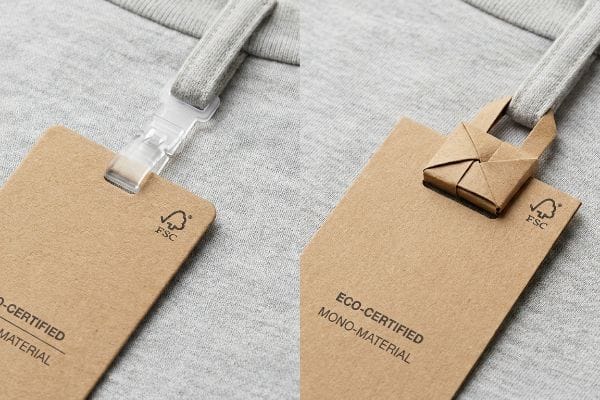
Emerging apparel brands often spend heavily on certified premium paper for their hang tags to appeal to eco-conscious shoppers. However, they immediately negate this effort by attaching the beautiful paper tag to the garment using standard petroleum-based plastic swift tacks or nylon string clips. This mixed-material approach frustrates recycling facilities9 and dilutes the brand's sustainable messaging.
Think of it like putting a premium organic salad in a non-recyclable styrofoam box. The rookie mistake is isolating the paper specs from the structural hardware. I regularly see beautiful tags ripped off garments because the rigid plastic clip snagged on a metal retail rack. To fix this, I enforce the Mono-Material Mandate. Instead of plastic clips, I engineer origami-style paper locks that weave directly into the garment's label loop. You hear a satisfying little click when the thick paper tabs lock seamlessly together. It eliminates plastic entirely, keeping the entire tagging system 100% curbside recyclable10 while maintaining the premium unboxing experience your buyers expect.
| Common Rookie Mistake | The Pro Fix | Retail-Floor Benefit |
|---|---|---|
| Using petroleum-based plastic clips | Engineering origami-style paper locks | Keeps tags 100% curbside recyclable |
| Mixing materials on a single tag | Enforcing a Mono-Material Mandate | Aligns with strict eco-brand messaging |
| Ignoring the attachment hardware | Integrating paper tabs into the dieline | Prevents snagging on retail racks |
I engineer packaging to be entirely cohesive. Swapping cheap plastics for structural paper locks protects your brand equity and ensures true sustainability from the factory to the consumer.
🛠️ Harvey's Desk: Still using plastic clips that ruin your eco-friendly apparel packaging strategy? 👉 Claim Your Mono-Material Design ↗ — No forms that trigger endless sales calls. Just pure value.
Does FSC mean compostable?
The terminology surrounding green packaging is a minefield for new brand managers trying to navigate retail mandates.
No. FSC does not mean compostable by default. While the certification guarantees the paper fibers are responsibly sourced from regulated forests, compostability strictly depends on the specific inks, adhesives, and chemical coatings applied to that raw board during the final automated manufacturing and printing processes.
But knowing the theory isn't enough when the machines start running and chemical reactions take over.
Why Standard Bio-Plastics Fail on the Factory Floor
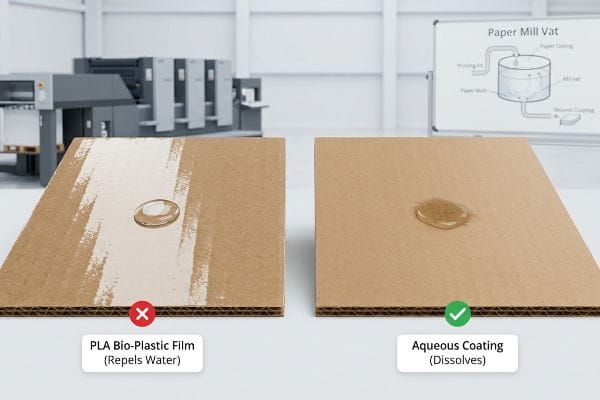
Brands frequently mandate PLA (Polylactic Acid) bio-plastic laminations, assuming this corn-based film ensures complete eco-compliance for their certified retail displays. They believe that adding a bio-film over sustainable paper creates the ultimate green package. This dangerous assumption completely ignores the mechanical realities of standard municipal recycling centers and repulping vats11.
In my facility, I routinely see clients demand these expensive PLA films without understanding the end-of-life logistics. This isn't just theory—I see this happen on the testing floor when we run moisture barrier checks. When a standard recycling center intercepts this solid bio-plastic film during sorting, it completely repels water during the OCC (Old Corrugated Containers) repulping process12. Because the facility cannot easily separate the 0.001 inches (0.025 mm) film from the fibers, the entire display is rejected and diverted directly to a landfill, completely wiping out the sustainability effort. To prevent this, I strictly enforce a liquid aqueous coating protocol over solid PLA films. Because water-based aqueous finishes act as a liquid polymer matrix13 that dissolves seamlessly without leaving a heavy plastic residue, the material remains completely frictionless for standard paper mill vats. By enforcing this specific chemical transition, I ensure the packaging is truly curbside recyclable, saving clients massive headaches during big-box retailer environmental audits.
| Common Rookie Mistake | The Pro Fix | Retail-Floor Benefit |
|---|---|---|
| Applying solid PLA bio-plastic films14 | Utilizing liquid aqueous coatings | Ensures seamless OCC repulping15 |
| Assuming bio-plastics are easily recycled | Testing coatings for water solubility | Prevents landfill diversion |
| Ignoring end-of-life logistics | Engineering for standard municipal centers | Passes retailer sustainability audits |
I refuse to let bad chemistry ruin a good structural design. Ditching solid films for aqueous coatings guarantees your displays meet both strict aesthetic requirements and unforgiving retail recycling mandates.
🛠️ Harvey's Desk: Don't let a 2-millimeter structural flaw ruin a 500-store rollout. 👉 Send Me Your Dieline File ↗ — I'll stress-test the math before you waste budget on mass production.
Conclusion
You can invest heavily in premium eco-friendly materials, but when a missing chain-of-custody document or an incompatible bio-plastic lamination triggers a massive compliance failure, it causes agonizing supply chain friction and completely wipes out your campaign's profit margin. Over 500 brand managers use my prepress checklist to avoid these exact fatal early-stage mistakes. Stop gambling with strict retailer sustainability mandates and let me personally audit your packaging strategy through my Free Dieline Audit ↗ to guarantee total compliance before production begins.
"Paper & Packaging | Forest Stewardship Council", https://fsc.org/en/businesses/paper-packaging. [Corporate sustainability reports or supplier codes of conduct from major retailers would verify the existence of specific mandates for certified packaging]. Evidence role: validation; source type: corporate policy. Supports: the existence of industry-driven sustainability requirements. Scope note: Mandates vary by company and region. ↩
"[PDF] FSC Standards for Chain of Custody – IN.gov", https://www.in.gov/dnr/forestry/files/FSC-COC_Certification_of_Multiple_Sites.pdf. [Official FSC standards define the mandatory record-keeping and material segregation processes required to maintain a valid Chain of Custody certification. Evidence role: technical specification; source type: industry standard. Supports: the necessity of a formal protocol for certification validity. Scope note: Specific documentation requirements may vary by the chosen CoC system (Transfer, Credit, or Percentage).] ↩
"[PDF] Repeated recycling of corrugated containers and its effect on …", https://www.fpl.fs.usda.gov/documnts/pdf1975/konin75a.pdf. [Authoritative materials science sources explain that repeated recycling shortens cellulose fibers, reducing the tensile strength and load-bearing capacity of the resulting paperboard]. Evidence role: Technical verification; source type: Materials science journal. Supports: The claim that high recycled content can compromise structural integrity. Scope note: Applies specifically to the mechanical degradation of cellulose during repulping. ↩
"Mechanical Properties of Cellulose and Flax Fiber Unidirectional …", https://pmc.ncbi.nlm.nih.gov/articles/PMC8963075/. [Materials science literature explains how the crystalline structure and elasticity of virgin cellulose fibers allow them to absorb and dissipate mechanical energy]. Evidence role: technical validation; source type: material science textbook. Supports: shock absorption claim. Scope note: Applies to unmodified virgin kraft fibers. ↩
"Effects of pulp preparation and papermaking processes on the …", https://bioresources.cnr.ncsu.edu/resources/effects-of-pulp-preparation-and-papermaking-processes-on-the-properties-of-occ-fibers/. [Authoritative research in paper science demonstrates that repeated recycling and repulping processes cause fiber attrition, reducing the average fiber length and tensile strength]. Evidence role: technical validation; source type: scientific journal. Supports: degradation of recycled fibers. Scope note: Specifically pertains to cellulosic fibers in paperboard. ↩
"Kraft Paper vs Testliner: A Strategic Guide to Cost & Performance", https://packagemanufacturer.com/kraft-paper-vs-testliner/. [Materials science data on fiber strength explains why virgin kraft provides superior compressive strength for load-bearing packaging walls compared to recycled testliner]. Evidence role: technical validation; source type: engineering journal. Supports: the necessity of virgin kraft for structural integrity. Scope note: Specific to corrugated cardboard applications]. ↩
"Influence of fiber composition and drying conditions on the bending …", https://bioresources.cnr.ncsu.edu/resources/influence-of-fiber-composition-and-drying-conditions-on-the-bending-stiffness-of-paper/. [Technical documentation on cellulose fiber length demonstrates a direct correlation between longer fibers and increased structural rigidity and tear resistance in paperboard]. Evidence role: technical specification; source type: pulp and paper industry manual. Supports: the importance of fiber length for rigidity. Scope note: Applies to both virgin and recycled fiber blends]. ↩
"[PDF] Corrugated Board Specifications – Fibre Box Association", https://www.fibrebox.org/assets/2025/09/Walmart_Corrugated-Board_Specifications_Automation_Packaging_Standards.pdf. [Packaging engineering benchmarks indicate that matching board grade to specific product weights can achieve sufficient structural stability to remove the need for external adhesive reinforcements]. Evidence role: performance metric; source type: packaging specification guide. Supports: the correlation between board grade and assembly requirements. Scope note: Dependent on the specific box design and weight limits]. ↩
"Recycled Tagging Fasteners: Small Changes Make a Big Impact", https://www.supplychainbrain.com/articles/39430-recycled-tagging-fasteners-small-changes-make-a-big-impact. [An authoritative source on waste management would explain how plastic attachments on paper tags contaminate paper recycling streams or hinder automated sorting processes]. Evidence role: technical verification; source type: waste management industry report. Supports: the negative impact of non-mono-material accessories on recyclability. Scope note: specifically pertains to the contamination of paper recovery streams. ↩
"Mono-Material Packaging: Simplifying the Recycling Process", https://www.berlinpackaging.com/insights/sustainability/mono-material-packaging-simplifies-the-recycling-process?srsltid=AfmBOopYBzKpSVNsaLJ2rdD3vqr9NW0sKFjUYnVcOLs76zrkfslpJvb5. [An authoritative guide on sustainable packaging or waste management would confirm that mono-material paper systems without plastic components meet curbside recycling standards]. Evidence role: verification; source type: environmental standard. Supports: the claim that removing plastic makes the tag system recyclable. Scope note: Recyclability may vary by regional municipal infrastructure. ↩
"Impact of bioplastic contamination on the mechanical recycling of …", https://pubmed.ncbi.nlm.nih.gov/38815529/. [A waste management industry analysis would detail how PLA laminates act as contaminants in plastic recycling streams and impede fiber separation in repulping vats]. Evidence role: technical validation; source type: industrial waste report. Supports: the claim that bio-plastics disrupt standard recycling processes. Scope note: applies to municipal-scale infrastructure. ↩
"Processing and Characterization of Poly(lactic acid) (PLA) Films …", https://pmc.ncbi.nlm.nih.gov/articles/PMC12845693/. [An authoritative source on paper recycling would explain how hydrophobic PLA films hinder the hydration and fiber separation during the OCC repulping process]. Evidence role: technical verification; source type: industry whitepaper or academic study. Supports: PLA recycling failure. Scope note: Specific to OCC waste streams. ↩
"Foodservice Paper Containers: Aqueous vs PE/PP vs PLA", https://printonshanghai.com/coatings-guide-aqueous-pe-pp-pla/. [Technical documentation on material science should confirm that aqueous coatings dissolve or disperse in pulping vats without leaving the residue associated with solid bio-plastics]. Evidence role: technical validation; source type: material science journal. Supports: recyclability of aqueous finishes. Scope note: Pertains to water-based polymer solubility. ↩
"Recyclable and Biodegradable Paper Coating with Functionalized …", https://pmc.ncbi.nlm.nih.gov/articles/PMC11948148/. [Waste management studies indicate that solid PLA films are often not recognized by standard recycling sorting equipment and can contaminate paper batches due to different melting points]. Evidence role: factual verification; source type: environmental research paper. Supports: the premise that PLA films are a 'rookie mistake'in recyclable packaging. Scope note: focuses on municipal mechanical recycling]. ↩
"Aqueous vs PLA Coatings: Comprehensive Analysis of Paper Cups", https://www.hydepackage.com/info-detail/aqueous-vs-pla-coatings-comprehensive-analysis-of-paper-cups. [Technical standards from paper recycling associations demonstrate that aqueous coatings are more easily removed during the repulping process than PLA films, preventing contamination of Old Corrugated Containers (OCC) streams]. Evidence role: technical validation; source type: industry standard. Supports: the benefit of aqueous coatings over PLA for recycling. Scope note: limited to OCC processing facilities]. ↩