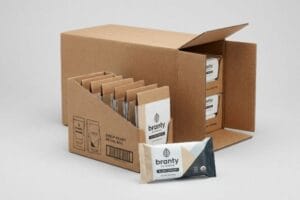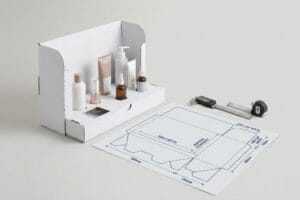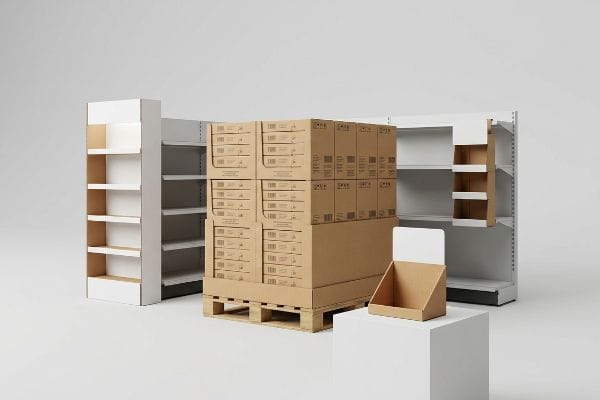
Finding the right unit for the right retailer dictates whether your campaign explodes or dies. You need a structural strategy tailored to specific footprint rules, not just a pretty box.
The best display for a retail store depends on its specific footprint rules and shopper traffic flow. High-volume club stores require heavy-duty pallet structures, while standard grocery aisles rely on compact end-caps, sidekicks, or countertop merchandisers to maximize visibility without violating strict retail compliance guidelines.

Knowing the theory is a start, but understanding how these physical structures perform on the ground is what separates successful rollouts from expensive logistical chargebacks.
What are 5 locations that may be used for a promotional display or stand?
Selecting the perfect merchandising zone is about matching your physical footprint to the retailer's traffic flow. You cannot blindly place a unit wherever there is empty floor space.
Five locations used for promotional displays are end-caps, checkout counters, freestanding aisle pallets, clip-strip sidekicks, and inline shelf trays. Each designated retail zone requires distinct structural engineering to withstand varying shopper interactions, ensure safe traffic flow, and strictly adhere to specific store placement regulations.
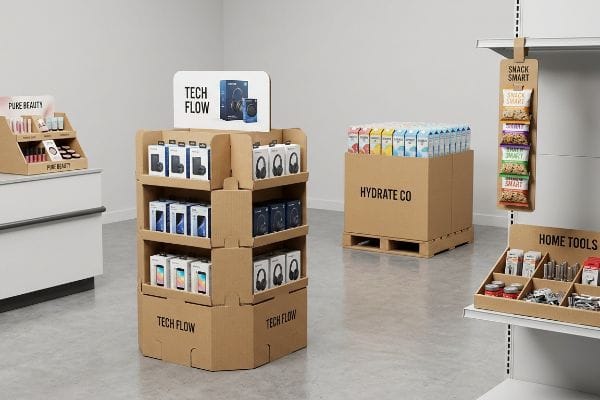
Selecting one of these spots isn't just about paying for premium floor space; it's about surviving the logistical rules governing that exact zone.
Defining Safe Locations for a Promotional Display
Many emerging brands assume they can simply design one universal piece of POP (Point of Purchase) hardware and scale it up or down to fit whatever store location they secure. They sketch out a massive freestanding unit, assuming they can just shrink the artwork by 50% if the buyer only gives them checkout counter space. This "shrink-to-fit" approach completely ignores the strict legal and logistical boundaries dividing these retail zones1.
I see this trap constantly when brands try to force a scaled-down floor unit onto a POS (Point of Sale) checkout counter. They don't realize POS files must be strictly anchored to the ADA (Americans with Disabilities Act) 15-to-48 inch (381-1219 mm) forward reach compliance window2. I once watched a store clerk sweating and struggling to assemble a non-compliant "miniaturized" floor unit on a register belt, eventually ripping the raw paperboard in frustration and tossing the whole thing in the compactor because it blocked the barcode scanner. To fix this, I permanently separate POP and POS engineering pipelines; floor units stay anchored to the 48×40 inch (1219×1016 mm) GMA (Grocery Manufacturers Association) pallet limits3, saving my clients from brutal retailer chargebacks and total campaign rejection.
| Common Rookie Mistake | The Pro Fix | Retail-Floor Benefit |
|---|---|---|
| Shrinking floor units for counters | Separate POS and POP engineering | Prevents ADA compliance chargebacks |
| Ignoring forward reach limits | Anchor to 15-48 inch (381-1219 mm) window | Ensures accessible shopper interaction |
| Guessing pallet boundaries | Strict GMA footprint bounding box | Survives forklift loading intact |
I always tell brands that retail geography dictates structural geometry. If you don't engineer specifically for the exact constraints of the location you've bought, the store manager will simply throw your expensive campaign away.
🛠️ Harvey's Desk: Not sure if your 'universal'design actually violates ADA or GMA spatial constraints? Send me your flat dieline file. I'll flag the sticky friction points before you print. 👉 Request a Dieline Audit ↗ — Direct access to my desk. Zero automated sales spam, I promise.
What job designs displays for retail stores?
Bringing a brand to life in three dimensions requires a highly specific skill set. You need to bridge the gap between creative vision and mathematical physics.
Structural packaging engineers design displays for retail stores, alongside graphic designers who handle the visual artwork. While graphic teams create the surface branding, structural engineers use CAD (Computer-Aided Design) software to mathematically calculate physical load capacities, folding tolerances, and material thicknesses to ensure the unit stands safely.
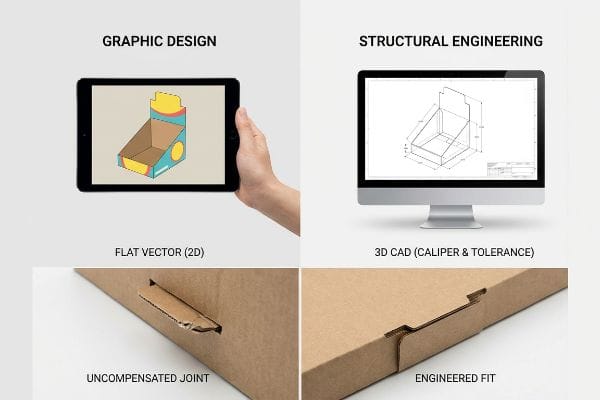
The friction between these two distinct roles is exactly where most high-budget retail campaigns fall apart before they even hit the printing press.
Why Your Graphic Designer Shouldn't Build Displays
A frequent question buyers ask is whether their in-house branding agency can just draw up the display template themselves. They assume that if their graphic designer can make a beautiful flat box layout in standard design software, the factory can simply cut it out and fold it. This ignores the reality that drawing flat lines on a screen does not account for the physical caliper, or thickness, of the actual material being used4.
Even veteran marketing teams often overlook this blind spot, handing me Illustrator files where the interlocking tabs are drawn at the exact same width as the receiving slots. When you take a physical 0.11 inch (3 mm) thick B-flute board and bend it 90 degrees, the material consumes space; if the slot isn't widened to compensate, the joint causes massive friction. I've heard the loud, frustrating 'snap'of raw corrugated fibers tearing as co-packers try to force these tight joints together, slowing down the assembly line by an estimated 30%. By automatically running these flat files through my structural software to add specific bend allowances, I eliminate that friction, saving clients significant labor fees during fulfillment.
| Common Rookie Mistake | The Pro Fix | Retail-Floor Benefit |
|---|---|---|
| Letting graphic designers draw cuts | Use structural engineers for CAD5 | Prevents structural collapse under load |
| Drawing tabs and slots equally | Apply algorithmic caliper compensation6 | Speeds up co-packing assembly |
| Ignoring material thickness | Calculate specific flute bend allowance7 | Eliminates tearing at folded joints |
I never let a two-dimensional drawing dictate a three-dimensional reality without running the math first. Forcing flat graphics onto uncompensated structural joints is the fastest way to ruin your physical rollout.
🛠️ Harvey's Desk: Are your graphic designer's interlocking slots secretly missing the 3-millimeter bend allowance needed to prevent assembly tearing? 👉 Get a Professional Assessment ↗ — Download safely. My inbox is open if you have questions later.
What is the best layout for a retail store?
Securing prime real estate in a big-box store requires an understanding of how humans physically navigate aisles. Placement determines visual impact.
The best layout for a retail store forces shopper traffic to naturally intersect with the "strike zone," positioned 50 to 54 inches from the floor. Strategically placing primary merchandising structures in these high-visibility intersections ensures maximum product engagement without requiring consumers to stoop or stretch uncomfortably.
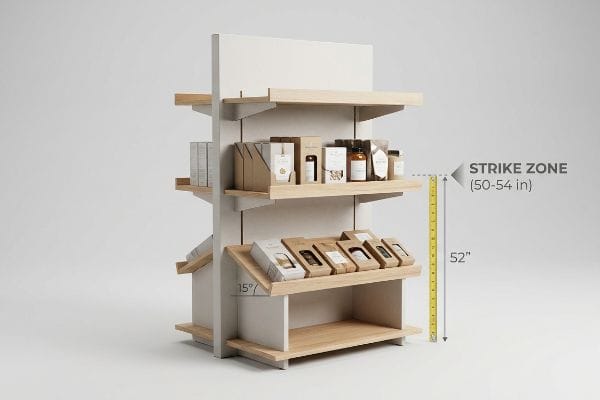
Mapping out this grid is a strong start, but if the physical hardware sitting in that layout isn't engineered for human ergonomics, the premium location is completely wasted.
Mastering Layout Displays and the Strike Zone
Many brand strategists believe that securing a front-of-store layout guarantees explosive sales volume, simply because of the high foot traffic. Think of it like renting a billboard on a busy highway but printing the phone number too small to read; the location is perfect, but the execution fails the user. A quick rule of thumb to avoid this layout error is to ensure your highest-margin items sit exactly at chest height8.
I frequently see brands pay a fortune for prime layout positioning, only to engineer a merchandiser that buries their hero SKU (Stock Keeping Unit) down by the customer's ankles. I remember watching shoppers in a pharmacy completely ignore a beautifully printed bottom shelf, simply because bending down was too much effort—the heavy, glossy header card was drawing the eye, but the product itself was lost in the shadows. To fix this ergonomic failure, I always elevate the primary shelf to that 50-to-54 inch (1270-1371 mm) "Human Height" heat map9 and physically angle the bottom shelves upwards by 15 degrees10. This micro-adjustment dramatically improves sightlines, directly boosting sales lift without needing to pay for a better aisle location.
| Common Rookie Mistake | The Pro Fix | Retail-Floor Benefit |
|---|---|---|
| Hiding hero products near the floor | Focus on the 50-54 inch (1270 mm) zone11 | Maximizes impulse grab-and-go behavior |
| Flat shelves below knee level | Angle bottom shelves up 15 degrees12 | Restores visibility to dead inventory |
| Paying for layout without ergonomics | Match structure to human height | Increases ROI on premium floor space |
I've learned that a store's layout only provides the foot traffic; your structure's ergonomics have to close the sale. Put the product where the shopper's hands naturally want to go.
🛠️ Harvey's Desk: Are your most profitable items accidentally hidden in the retail shadow zone? Send me your shelf schematic. I'll flag the ergonomic friction points. 👉 Claim Your Layout Audit ↗ — No forms that trigger endless sales calls. Just pure value.
What is display in a retail store?
A successful in-store campaign is not just a marketing concept; it is an active physical asset. You are deploying temporary architecture into a harsh environment.
A display in a retail store is a highly engineered, temporary merchandising structure designed to house, protect, and promote consumer products. These physical marketing vehicles are typically manufactured from corrugated paperboard and must mathematically balance load-bearing capacity, strict retailer compliance rules, and high-fidelity brand graphics.
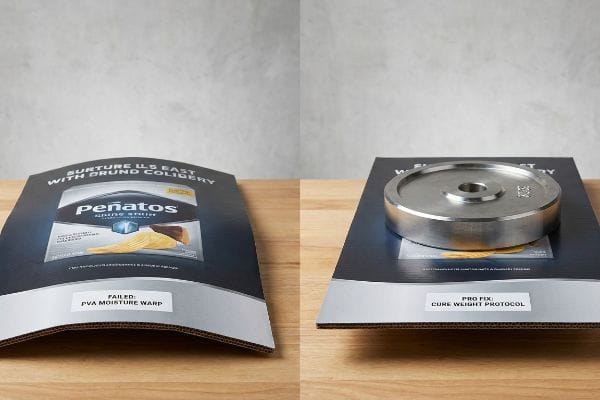
But knowing the theory isn't enough when the machines start running and the raw materials physically react to the reality of the factory environment.
Why Standard Retail Displays Fail on the Factory Floor
Most buyers assume that a retail unit is just a massive printed sticker slapped onto a piece of thick cardboard. They view the manufacturing process as a simple, dry assembly of parts, expecting that mounting a high-quality printed top-sheet to a rigid corrugated base will naturally result in a perfectly flat structural panel.
Getting one prototype to stand up straight in a climate-controlled lab is easy, but here is the harsh reality when you ship 500 of them into the wild. In my facility, I routinely see the systemic trap of ignoring the chemical physics of litho-lamination—a process utilizing water-based PVA (Polyvinyl Acetate) adhesive13. Buyers don't realize that as this wet glue cures in ambient factory air across a large 60-inch (1524 mm) side panel, it shrinks, creating immense surface tension that causes the entire 32 ECT (Edge Crush Test) board to severely warp14 inwards like a potato chip. When I measure this distortion on the testing floor, a bow of just 0.45 inches (11.4 mm) completely misaligns the interlocking tabs, causing wobbly shelves and massive assembly delays. To combat this, I enforce a ruthless "Cure Weight Protocol," physically clamping the wet boards under exact dead-weight pressure for 24 hours. By neutralizing this PVA moisture warp, I ensure the co-packing assembly time drops by 42 seconds per unit, saving clients thousands in fulfillment labor fees and preventing leaning towers on the shop floor.
| Common Rookie Mistake | The Pro Fix | Retail-Floor Benefit |
|---|---|---|
| Assuming litho-lamination stays flat | Implement 24-hour weighted curing15 | Ensures panels stand 100% straight |
| Ignoring PVA adhesive shrinkage | Use balanced duplex board structures16 | Stops parts from bowing like chips |
| Rushing wet boards to die-cutting | Control ambient moisture before cutting17 | Guarantees tabs align perfectly |
I engineer for chemical reality, not just visual appeal. If you don't control the moisture and tension during lamination, your beautiful design will physically buckle before the shopper even sees it.
🛠️ Harvey's Desk: Do you know if your factory uses a dead-weight curing protocol to prevent PVA moisture warp on your large side panels? 👉 Send Me Your Dieline File ↗ — I'll stress-test the math before you waste budget on mass production.
Conclusion
You can hunt for the cheapest vendor, but when that water-based PVA adhesive shrinks and causes your 32 ECT boards to bow like potato chips, the resulting wobbly shelves will trigger an immediate retailer rejection and wipe out your entire campaign margin. Over 500 brand managers use my prepress checklist to avoid these exact fatal early-stage mistakes. Stop guessing on chemical tolerances and let me personally audit your blueprints through my Free Dieline Pre-Flight Audit ↗ to catch warping risks before you pay for mass production.
"Retail premises design for effective displays and customer flow", https://www.business.qld.gov.au/industries/manufacturing-retail/retail-wholesale/retail-displays. [An authoritative source on retail merchandising standards or store safety regulations would detail the specific zoning laws, fire codes, and ADA compliance requirements that differentiate floor displays from counter displays]. Evidence role: technical validation; source type: industry standards/regulations. Supports: the claim that different retail zones have distinct regulatory constraints. Scope note: Focuses on commercial safety and compliance standards. ↩
"Chapter 3: Operable Parts – Access-Board.gov", https://www.access-board.gov/ada/guides/chapter-3-operable-parts/. [An authoritative ADA guidelines document specifies the maximum and minimum reach ranges for accessible surfaces]. Evidence role: verification of technical specification; source type: government regulation. Supports: ADA compliance for POS displays. Scope note: applies to accessible design standards. ↩
"Heat Treated Wood GMA Pallet – 48 x 40" H-1260 – ULINE", https://www.uline.com/Product/Detail/H-1260/Pallets/Heat-Treated-Wood-GMA-Pallet-48-x-40. [The Grocery Manufacturers Association standards define the universal footprint for logistics pallets used in retail]. Evidence role: verification of industry standard; source type: industry trade association. Supports: floor unit sizing. Scope note: standard for North American logistics. ↩
"Structural Packaging Design: Importance, Elements, Process …", https://packhit.co.uk/packaging/design/structural/. [Technical manuals on packaging engineering detail how material thickness, or caliper, alters the dimensions of folded parts and final assembly fit]. Evidence role: technical validation; source type: structural engineering guide. Supports: The claim that 2D drawings alone cannot account for material volume. Scope note: Specific to folding materials like corrugated cardboard. ↩
"Point of Purchase Display Solutions – GEODIS", https://geodis.com/us-en/warehousing-and-value-added-logistics/customized-and-value-added-services/retail-display-packaging. [Professional guidelines for point-of-purchase displays emphasize the necessity of structural engineering in CAD to ensure load-bearing capacity and safety]. Evidence role: professional standard; source type: technical guide. Supports: prevention of structural collapse. Scope note: focuses on load-bearing retail fixtures.] ↩
"A Wafer Pre-Alignment Algorithm Based on Weighted Fourier …", https://pmc.ncbi.nlm.nih.gov/articles/PMC10223695/. [An authoritative source on packaging engineering explains how adjusting for material thickness variance via algorithmic compensation improves slot-and-tab fit]. Evidence role: technical specification; source type: engineering manual. Supports: speed of co-packing assembly. Scope note: primarily applicable to corrugated materials.] ↩
"The Bending Stiffnesses of Corrugated Board", https://www.fpl.fs.usda.gov/documnts/pdf1992/luo92a.pdf. [Industry standards for structural packaging detail the formulas used to calculate bend allowance based on flute size to prevent material failure]. Evidence role: technical specification; source type: industry standard. Supports: elimination of tearing at folded joints. Scope note: dependent on specific flute grades.] ↩
"CH 17 MKTG 4600 Flashcards – Quizlet", https://quizlet.com/753853912/ch-17-mktg-4600-flash-cards/. [Authoritative guides on visual merchandising confirm that placing high-margin products at the 'strike zone'or chest level maximizes visibility and conversion rates]. Evidence role: technical validation; source type: retail management textbook. Supports: optimal placement for revenue growth. Scope note: Exact height varies by target demographic. ↩
"Consumer Behavior in Shopping Streets: The Importance of … – PMC", https://pmc.ncbi.nlm.nih.gov/articles/PMC4748058/. [Research on retail ergonomics and shopper eye-level heat maps would verify this specific height range as the optimal 'strike zone'for product visibility.] Evidence role: factual verification; source type: industry study. Supports: optimal product placement height. Scope note: based on average adult eye levels. ↩
"The 4-Tier Angled Stand is the ultimate retail workhorse … – Instagram", https://www.instagram.com/reel/DWwHB3OFHnF/. [Visual merchandising standards or retail design guides would validate that a 15-degree upward tilt improves sightlines for lower-tier shelving.] Evidence role: technical specification; source type: design manual. Supports: ergonomic improvement of bottom shelves. Scope note: applies specifically to bottom-shelf visibility. ↩
"Typical product placement by zone on the retail shelf and its impact …", https://www.bpc.works/en/news/typical-product-placement-by-zone-on-the-retail-shelf-and-its-impact-on-packaging-design/. Industry standards for visual merchandising identify the 50-54 inch range as the primary 'strike zone'for maximum consumer eye-level impact. Evidence role: validation of technical specification; source type: retail design manual. Supports: optimal placement for impulse buys. Scope note: Applies to average adult heights. ↩
"MAXIMIZING YOUR RETAIL SHELF SPACE – QPSI", https://qpsiusa.com/2019/12/26/maximizing-your-retail-shelf-space/. Visual merchandising research indicates that tilting lower shelves upwards improves the line-of-sight for products located below the natural gaze level. Evidence role: technical verification; source type: visual merchandising handbook. Supports: visibility of dead inventory. Scope note: Effectiveness depends on shelf depth and product profile. ↩
"pva adhesive Archives", https://cattieadhesives.com/tag/pva-adhesive. [Industry guidelines for corrugated packaging describe litho-lamination as the process of adhering printed paper to corrugated media using PVA adhesives]. Evidence role: technical definition; source type: industry handbook. Supports: The chemical composition of display materials. Scope note: Specific to the lithographic lamination method. ↩
"Perfect Glue for Papercrafting | GLUE GUIDE – YouTube", https://www.youtube.com/watch?v=8_MB0G3a_js. [Materials science research indicates that the evaporation of water from PVA glues creates tensile stress that causes dimensional instability and warping in corrugated substrates]. Evidence role: mechanical explanation; source type: academic paper. Supports: The physical cause of board warping. Scope note: Effect varies based on board thickness and ambient humidity. ↩
"Excessive part warpage during curing – Form 3L – Formlabs Forum", https://forum.formlabs.com/t/excessive-part-warpage-during-curing/35670. [Industry standards for commercial printing and packaging specify weighted curing durations to ensure planar stability in litho-laminated sheets]. Evidence role: technical specification; source type: industry handbook. Supports: the necessity of curing to prevent panel warping. Scope note: specifically applies to laminated board substrates. ↩
"[PDF] A study of on-demand books made by PVA cold emulsion adhesive", https://repository.rit.edu/cgi/viewcontent.cgi?article=4857&context=theses. [Technical guides on board construction describe how balanced duplexing offsets internal tension and warping caused by PVA adhesive shrinkage]. Evidence role: material science; source type: packaging engineering guide. Supports: the use of structural balance to stop bowing. Scope note: focused on PVA adhesive properties. ↩
"Moisture effect on polyether and polyvinylsiloxane …", https://pubmed.ncbi.nlm.nih.gov/16336232/. [Manufacturing standards for paperboard processing explain how moisture levels influence dimensional stability and the precision of die-cut registration]. Evidence role: process control; source type: manufacturing manual. Supports: the link between moisture control and tab alignment. Scope note: refers to die-cutting stages. ↩