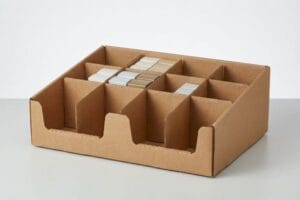
Walking into a big-box store, you see hundreds of paperboard structures driving impulse sales, but figuring out the exact industry terminology to order them can be confusing.
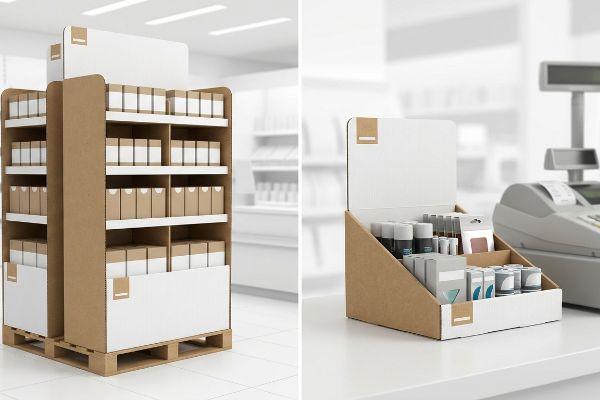
Cardboard displays are called POP (Point of Purchase) or POS (Point of Sale) merchandisers. These temporary retail fixtures include floor stands, counter units, and pallet skirts designed to hold inventory, increase visual product visibility, and drive immediate consumer engagement within high-traffic global retail store aisles.

Knowing the basic jargon is just the first step. To survive the factory floor and the retail aisle, you need to understand how these names translate into structural physics.
What is a cardboard display called?
Let me clarify the two major structural categories that dictate every engineering decision in the packaging industry.
A cardboard display is called a POP (Point of Purchase) or POS (Point of Sale) fixture. While often used interchangeably, industry professionals categorize them strictly by their physical store location, separating bulk aisle floor merchandisers from compact register-adjacent countertop tray impulse units designed for high visibility.
However, calling it by the right name won't stop it from collapsing under a heavy product load if the environment is ignored.
Why POP vs. POS Dictates Your Spatial Footprint
Beginners often assume a successful packaging design can simply be scaled up or down in a CAD (Computer-Aided Design) software. I frequently see brand managers ask to shrink a massive freestanding aisle unit by 50% to create a quick register unit. They treat these acronyms as mere marketing terms, ignoring the strict logistical frameworks governing different store zones1.
This "shrink-to-fit" mindset completely ignores the physical reality of American retail constraints. A store clerk will immediately reject a scaled-down POP unit at the checkout because it violates strict ADA (Americans with Disabilities Act) forward reach limits. I remember a client who forced a scaled-down floor layout onto a crowded counter; I could physically hear the harsh scraping of the corrugated base against the register belt as the cashier angrily shoved the non-compliant, 18-inch (45.7 cm) deep unit into the trash. To fix this, I permanently anchor POS files strictly to the 15-48 inch (38.1-121.9 cm) ADA reach window2, while POP floor units are mathematically locked to the 48×40 inch (121.9×101.6 cm) GMA (Grocery Manufacturers Association) wood base standard3.
| Common Rookie Mistake | The Pro Fix | Retail-Floor Benefit |
|---|---|---|
| Shrinking floor units for counters | Separating ADA and GMA engineering paths4 | Prevents manager rejection at checkout |
| Ignoring forward reach limits5 | Capping register footprint depth | Keeps impulse buyers engaged comfortably |
| Blurring POS and POP specs | Strict spatial boundary anchoring | Stops costly structural design rework |
I strictly separate these two pipelines to prevent retail chaos. Respecting the spatial math behind these industry acronyms guarantees your unit hits the sales floor instead of the checkout dumpster.
🛠️ Harvey's Desk: Are your scaled-down counter files accidentally violating checkout accessibility rules? 👉 Send Me Your Dieline File ↗ — Direct access to my desk. Zero automated sales spam, I promise.
What are retail displays called?
Moving beyond basic paperboard terms, big-box buyers use specific terminology to describe how a unit claims valuable real estate.
Retail displays are called merchandisers, end-caps, or freestanding units. These industry terms describe structural fixtures designed to hold bulk product directly on the sales floor. Buyers categorize them by their geometric footprint, utilizing specific sizing strategies to allocate premium high-traffic aisle space for maximum promotional brand visibility.
Getting the terminology right during your buyer pitch is essential, but failing to understand the spatial geometry behind those words will stall your product launch.
The Fractional Pallet Secret for Merchandisers
When pitching to buyers, newer brands often refer to their campaign simply as a "floor display" and immediately request a full standard wooden base. They assume that taking over an entire end-cap or center-aisle intersection is the only way to generate a measurable sales lift and grab consumer attention.
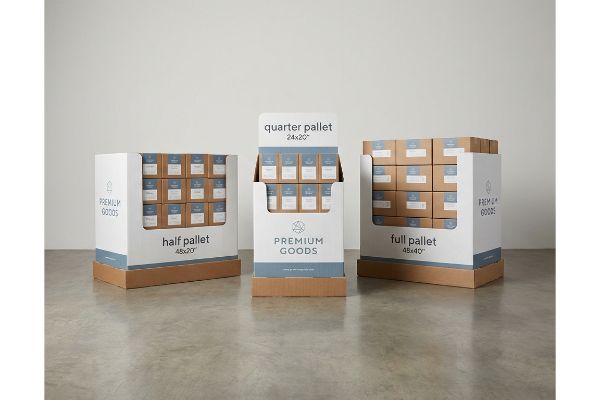
The problem is that floor space is aggressively rationed, and buyers will flat-out deny a massive 48×40 inch (121.9×101.6 cm) footprint6 from an unproven brand. I constantly see inexperienced teams present these giant, hollow merchandisers, only to watch the buyer reject them due to wasted void space. To bypass this, I engineer bulk merchandisers precisely into fractional dimensions—specifically Half (48×20 inches / 121.9×50.8 cm) or Quarter (24×20 inches / 60.9×50.8 cm) geometries7. When you slide a perfectly mathematical quarter-unit onto a shared deck, feeling the solid, heavy thud of the corrugated base locking flush against a non-competing brand's unit, you instantly solve the buyer's density problem and secure your placement.
| Common Rookie Mistake | The Pro Fix | Retail-Floor Benefit |
|---|---|---|
| Demanding a full wood base | Engineering fractional dimensions8 | Secures premium shared aisle placement |
| Pitching empty spatial voids | Maximizing SKU density per inch9 | Increases promotional revenue per foot |
| Ignoring shared store logistics | Standardizing to quarter configurations10 | Lowers overall freight shipping costs |
You do not need a massive footprint to dominate a retail aisle. By dividing the standard base into shared mathematical blocks, I give retailers the product density they crave, instantly increasing your chances of an approved rollout.
🛠️ Harvey's Desk: Is your massive floor footprint getting rejected by big-box retail buyers? 👉 Let's Audit Your Footprint ↗ — Download safely. My inbox is open if you have questions later.
What are the different types of displays used in retail stores?
Knowing the categories helps you strategize, but executing the specific formats requires strict adherence to universal retailer sizing.
The different types of displays include floor stands, countertop units, pallet skirts, and sidekicks. Each format serves a distinct purpose, from bulk aisle merchandising to driving impulse purchases at the checkout. Selecting the exact right type depends entirely on your product volume, logistics, and store physical layout.

It is easy to pick a format off a visual menu, but standardizing that format across different store chains is where structural chaos usually begins.
Standardizing the "Sidekick" Power Wing
A brand will often choose a hanging "sidekick" (or power wing) format11 because it cheaply leverages existing store infrastructure. They usually let their graphic designer dictate the outer dimensions based purely on aesthetic proportions, completely ignoring the physical hardware of the retail shelving systems.
Designing a hanging unit without universal hardware specs is a guaranteed disaster. I remember watching a rep struggle to mount an oversized power wing; the cardboard violently tore away from its metal hook with a loud, sickening rip, spilling heavy shampoo bottles across the aisle. Instead of guessing, I strictly standardize all sidekick files to a maximum of 48 inches (121.9 cm) in height12 and 14 inches (35.5 cm) in width13. This universal fit, combined with a reinforced corrugated backing, ensures the fixture effortlessly hangs on standard pegboard wiring without buckling under the gravitational pull of heavy merchandise.
| Common Rookie Mistake | The Pro Fix | Retail-Floor Benefit |
|---|---|---|
| Guessing hanging dimensions | Standardizing to 48×14 profiles14 | Fits any standard end-cap wire perfectly |
| Using single-wall backings | Reinforcing the hardware anchor zone | Prevents tearing under heavy weight |
| Relying on aesthetic sizing | Designing for universal metal brackets15 | Speeds up the store mounting process |
I strip the guesswork out of hanging formats to protect your product from hitting the floor. By engineering for universal hardware constraints, I ensure your sidekick campaign deploys flawlessly across multiple competing retail chains.
🛠️ Harvey's Desk: Are your hanging merchandisers tearing at the structural anchor points? 👉 Request a Hardware Review ↗ — No forms that trigger endless sales calls. Just pure value.
What are the four basic types of displays?
Condensing the vast landscape of merchandising into its core pillars allows brands to focus their engineering budgets effectively.
The four basic types of displays are floor merchandisers, countertop units, shelf trays, and pallet skirts. These foundational formats cover every primary shopping zone, seamlessly guiding consumer purchasing behavior from initial warehouse club aisle visual disruption down to the final tactile impulse interaction at the checkout.
But knowing the four primary formats in a conference room won't save you when the factory machinery physically degrades your chosen material.
The Inward Deboss Mandate for Shelf Trays
Out of the four basic formats, the shelf tray is often treated as an engineering afterthought. Procurement teams frequently mandate expensive cosmetic finishes, like heavy outward embossing on the front retaining lip, assuming this texture will elevate the brand's premium feel without affecting the underlying cardboard structure.
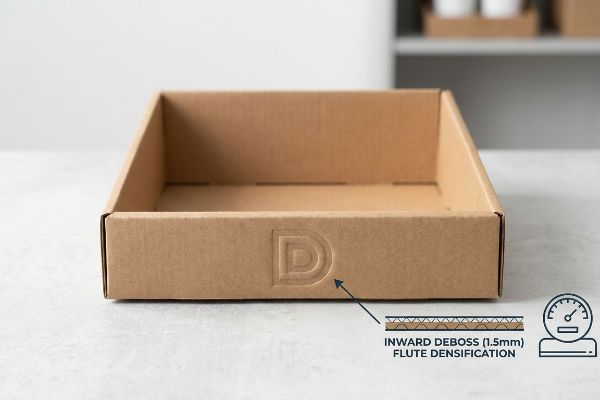
In my facility, I routinely see this outward embossing completely destroy the structural integrity of the ECT (Edge Crush Test) rated corrugated board. Pushing a metal die outward to create a raised peak aggressively stretches and thins the virgin kraft liner. When I run this over-stretched board through the Mullen Tester, it snaps under a mere 45 lbs (20.4 kg) of pressure16. To fix this, I mandate a strict inward deboss protocol on all load-bearing tray lips. By driving the metal die downward by precisely 1.5mm17, I physically densify the internal flutes into a solid structural block without exhausting the outer paper fiber's elasticity. This micro-adjustment preserves 100 percent of the board's compressive strength, effectively eliminating base buckling and saving my clients thousands in retailer rejection chargebacks.
| Common Rookie Mistake | The Pro Fix | Retail-Floor Benefit |
|---|---|---|
| Outward embossing on lips | Mandating inward deboss tooling | Preserves core material elasticity18 |
| Stretching outer kraft paper | Densifying internal board flutes | Prevents front-lip structural blowout19 |
| Sacrificing ECT for cosmetics | Aligning texture with physical physics | Eliminates costly store chargebacks20 |
I refuse to let aesthetic choices compromise raw compressive strength. By simply flipping the tooling direction, I guarantee your shelf trays deliver a premium tactile experience while effortlessly surviving brutal warehouse top-loads.
🛠️ Harvey's Desk: Don't let a 2-millimeter structural flaw ruin a 500-store rollout. 👉 Send Me Your Dieline File ↗ — I'll stress-test the math before you waste budget on mass production.
Conclusion
Outwardly embossing the front lip of a heavy shelf tray is a cosmetic gamble that physically stretches the kraft paper, triggering catastrophic base buckling and an immediate retailer rejection. Over 500 brand managers use my prepress checklist to avoid these exact fatal early-stage mistakes. Stop guessing on structural tolerances and let me personally run your files through my Free Dieline Audit ↗ to catch these invisible friction points before you fund a doomed production run.
"[PDF] N/A – Village of Grafton", https://www.villageofgraftonwi.gov/DocumentCenter/View/11151. [An authoritative retail management or packaging engineering guide would detail the specific spatial, weight, and accessibility constraints that vary by store zone]. Evidence role: factual support; source type: industry manual. Supports: The claim that retail zones have distinct logistical requirements. Scope note: Applies specifically to physical retail environments. ↩
"Chapter 9: Built-In Elements – Access-Board.gov", https://www.access-board.gov/ada/chapter/ch09/. [Official ADA standards define the permissible height and depth ranges for forward reach at accessible counters to ensure wheelchair access]. Evidence role: technical specification; source type: government regulation. Supports: POS unit spatial constraints. Scope note: Specifically refers to forward reach for side-approach maneuvers. ↩
"48×40" GMA Pallets | Largest Pallet Manufacturer & Supplier", https://www.palletone.com/products/gma-pallets/. [Industry guidelines from the Grocery Manufacturers Association establish the 48×40 inch footprint as the universal standard for retail palletization and floor displays]. Evidence role: industry standard; source type: trade association guideline. Supports: POP floor unit sizing. Scope note: Standard applies primarily to North American logistics. ↩
"ADA Standards for Accessible Design", https://www.ada.gov/law-and-regs/design-standards/. [Authoritative industry guides on ADA accessibility and GMA packaging standards would validate the need for distinct engineering requirements for floor and counter units]. Evidence role: technical validation; source type: industry standard. Supports: separation of engineering paths. Scope note: primarily applicable to US retail environments. ↩
"[PDF] Point of Sale (POS) Machines: Best Practices – Oklahoma.gov", https://oklahoma.gov/content/dam/ok/en/odc/documents/ada-info/sales/ADA_POS_Paper.pdf. [Ergonomic studies and accessibility guidelines define the maximum comfortable reach for consumers to interact with displays without strain]. Evidence role: technical specification; source type: ergonomic research. Supports: capping register footprint depth. Scope note: focuses on human factors engineering. ↩
"Standard Pallet Sizes | With Chart – Kamps Pallets", https://www.kampspallets.com/standard-pallet-sizes-with-chart/. [An industry logistics manual or GMA standard guide would confirm that 48×40 inches is the standard pallet size for North American retail]. Evidence role: factual verification; source type: industry standard. Supports: standard retail footprint size. Scope note: Primarily applicable to North American markets. ↩
"Small Pallets Can Carry Huge Benefits – Nature's Packaging", https://naturespackaging.org/small-pallets-can-carry-huge-benefits/. [Point-of-purchase display specifications or retail merchandising manuals would verify these as the standard mathematical divisions of a full GMA pallet]. Evidence role: technical specification; source type: trade manual. Supports: fractional unit sizing strategies. Scope note: specific to modular corrugated displays. ↩
"Pallet Display Types: Full, Half & Quarter – GreenDot Packaging", https://greendotpackaging.com/understanding-pallet-display-types-full-half-and-quarter-pallet-displays/. [Industry standards on retail space allocation explain how utilizing fractional pallet footprints enables merchandisers to secure placement in shared high-traffic aisles]. Evidence role: factual support; source type: retail merchandising guide. Supports: The strategic benefit of fractional sizing. Scope note: Specific to big-box retail environments.] ↩
"Malte Karstan – Revenue per Square Foot – LinkedIn", https://www.linkedin.com/posts/malte-karstan_revenue-per-square-foot-the-retail-metric-activity-7398834526119968768-Y8Yw. [Retail analytics research demonstrates that increasing the number of stock-keeping units (SKUs) per linear inch of display space correlates with higher promotional revenue per foot]. Evidence role: quantitative support; source type: retail analytics report. Supports: The link between SKU density and revenue. Scope note: Effects may vary based on product category.] ↩
"How to ship using pallets – FedEx", https://www.fedex.com/en-us/shipping/freight/resources/packing-guide/pallets.html. [Logistics and supply chain manuals specify how standardizing display footprints to quarter-pallet increments optimizes truckload cube utilization and reduces freight costs]. Evidence role: technical support; source type: logistics manual. Supports: Freight cost reduction through standardization. Scope note: Based on standard GMA pallet dimensions.] ↩
"Retail Power Wing/Sidekick Displays | USA Custom Manufacturer", https://www.greatnortherninstore.com/power-wing-displays/. [Industry merchandising guides describe power wings as displays that attach to existing gondola shelving to maximize vertical space and reduce footprint costs]. Evidence role: technical definition; source type: industry manual. Supports: the utility of sidekicks in leveraging store infrastructure. Scope note: limited to standard retail shelving systems. ↩
"Sidekicks + Power Wings: The Complete Guide – Bennett Packaging", https://bpkc.com/blogs/blog/sidekicks-power-wings-the-complete-guide. [An authoritative retail display manufacturer guide would specify maximum height limits for sidekick power wings to ensure safety and compatibility]. Evidence role: technical specification; source type: industry guide. Supports: Universal sizing for retail fixtures. Scope note: Applicable to standard cardboard power wings. ↩
"Custom Cardobard Sidekick Display, Powerwing Display, Endcap …", https://grandfly.com/cardboard-display/sidekick-powerwing-display/. [Industry specifications for sidekick displays would validate the standard maximum width to prevent interference with neighboring store fixtures]. Evidence role: technical specification; source type: industry guide. Supports: Universal sizing for retail fixtures. Scope note: Applicable to standard cardboard power wings. ↩
"Powerwing / Sidekick Display", https://popimpactdisplay.com/displays/powerwing-sidekick-display/. [Industry standards for point-of-purchase displays confirm that 48×14 inches is a common profile for sidekick power wings to ensure compatibility across various retail environments]. Evidence role: technical specification; source type: industry standard; Supports: standardized dimensions; Scope note: Specifics may vary slightly by individual retailer requirements. ↩
"PDQ Sidekick Hardware and Safety – Custom Cardboard …", https://popdisplay.me/pdq-sidekick-hardware-and-safety/. [Retail fixture catalogs define universal metal brackets as the standard hardware used to secure power wing displays to standard gondola end-cap wiring]. Evidence role: technical specification; source type: manufacturer catalog; Supports: mounting hardware standards; Scope note: Focuses on generic shelving system compatibility. ↩
"Testing Corrugated Strength: Mullen Burst Test vs Edge Crush Test", https://www.reidpkg.com/2020/01/06/testing-corrugated-strength-mullen-burst-test-vs-edge-crush-test/. [Industry standards for Mullen bursting tests quantify the pressure thresholds at which compromised corrugated liners fail]. Evidence role: empirical data; source type: technical standard. Supports: the claim that outward embossing reduces structural integrity. Scope note: Specific pressure values depend on the initial ECT rating. ↩
"Estimation of the Compressive Strength of Corrugated Board Boxes …", https://pmc.ncbi.nlm.nih.gov/articles/PMC8467740/. [Packaging engineering specifications define the optimal depth for debossing to densify flutes without compromising fiber elasticity]. Evidence role: technical specification; source type: engineering handbook. Supports: the methodology of the inward deboss protocol. Scope note: Applicable primarily to standard B or C flute corrugated board. ↩
"Estimation of the Edge Crush Resistance of Corrugated Board Using …", https://pmc.ncbi.nlm.nih.gov/articles/PMC9961700/. [A technical engineering guide explaining how inward debossing prevents fiber over-extension to maintain the elasticity of the core material]. Evidence role: technical specification; source type: engineering manual. Supports: the benefit of inward deboss tooling. Scope note: specific to corrugated cardboard. ↩
"Corrugated Shipping Box Thickness Options Guide – GMS Industries", https://feeds.gmsindustries.com/blog/corrugated-shipping-box-cardboard-thickness-options. [Documentation on corrugated board physics demonstrating how increased flute density prevents rupture at high-stress points like the front lip]. Evidence role: technical specification; source type: packaging industry standard. Supports: the efficacy of densifying internal flutes. Scope note: specific to shelf tray construction. ↩
"Why Unit-Price Thinking Fails: The Hidden Impact of Corrugated Box …", https://www.paperindex.com/academy/why-unit-price-thinking-fails-the-hidden-impact-of-corrugated-box-structural-integrity/. [Retailer compliance manuals outlining the financial penalties and chargebacks imposed on vendors for structurally deficient displays]. Evidence role: operational fact; source type: retail compliance guide. Supports: the economic benefit of prioritizing ECT over cosmetics. Scope note: varies by retail chain. ↩