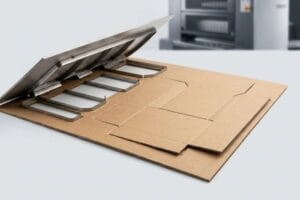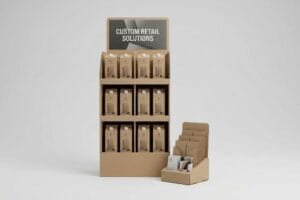
If you are launching a new consumer product, your outer packaging serves as your silent salesperson on the crowded retail floor.
Common uses for printed boxes include housing primary retail products, protecting fragile components during shipping, and acting as point-of-purchase displays. These engineered structures also serve as vital marketing tools, utilizing custom graphics to ensure high visibility and immediate brand recognition across competitive big-box store aisles globally.

But knowing the theory isn't enough when you transition from a digital design to physical manufacturing.
What are cardboard boxes used for?
Standard corrugated containers are engineered to transport goods safely, but in the retail sector, their primary function shifts to aggressive merchandising.
Cardboard boxes are primarily used for physical product protection, bulk logistics, and converting shipping containers directly into retail-ready floor displays. High-strength corrugated board ensures heavy merchandise survives complex supply chains while maintaining strict structural integrity on the store floor from warehouse delivery to final sale.
Moving from simple storage to active retail selling requires strict adherence to physical spatial limits.
The Fractional Geometry Behind Merchandising Boxes
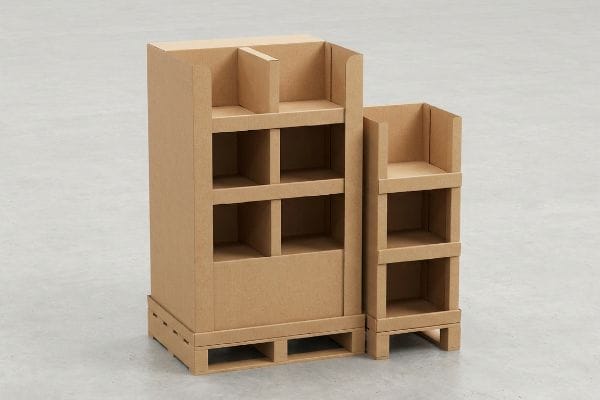
Standard practice dictates that brand teams often pitch massive 48×40 inches (121.9×101.6 cm) floor displays1 to major retailers, assuming bigger visibility guarantees better sales. They treat the corrugated structure solely as a giant billboard, completely ignoring how valuable aisle space is strictly rationed by store managers.
In my facility, I constantly see veteran marketing teams face swift retailer rejections because they monopolize an entire wood base. Think of aisle space like expensive real estate; you cannot build a mansion on a studio lot. A common trap is designing a massive display that is simply too wide, leading to store clerks aggressively dragging the unit into the backroom—you can hear the loud scraping of the corrugated base tearing against the concrete floor. My rule of thumb is to engineer bulk merchandisers into fractional dimensions: Half Pallets at 48×20 inches (121.9×50.8 cm)2. This mathematical subdivision allows two separate campaigns to perfectly share a single GMA (Grocery Manufacturers Association) pallet3. This drastically improves your chances of floor approval, seamlessly maximizing retail density and securing premium placement without irritating the buyer.
| Common Rookie Mistake | The Pro Fix | Retail-Floor Benefit |
|---|---|---|
| Pitching full-size only | Use half-pallet dimensions | Halves retailer space pushback |
| Ignoring base friction | Fractional footprint sharing | Prevents dragging and tearing |
| Treating box as ad only | Mathematical aisle sizing | Secures high-traffic approvals |
I always divide standard footprints into strict fractional units before touching any graphic design. This spatial discipline ensures your marketing campaign actually survives the loading dock and makes it onto the crowded sales floor.
🛠️ Harvey's Desk: Are your current floor displays failing to get approved by big-box buyers? 👉 Request A Spatial Audit ↗ — Direct access to my desk. Zero automated sales spam, I promise.
What are the benefits of custom boxes?
Tailored packaging goes beyond aesthetics; it mathematically calibrates the physical structure to your specific product weight, ensuring peak performance during distribution.
The benefits of custom boxes include optimized material usage, reduced shipping volumes, and mathematically engineered structural tolerances. By tailoring the specific dimensions and board thickness to the exact product, customized packaging eliminates internal void space, minimizes transit damage, and significantly lowers overall supply chain logistics costs.
However, precise structural customization often collides with unpredictable environmental physics.
How Custom Boxes Combat Moisture Swelling
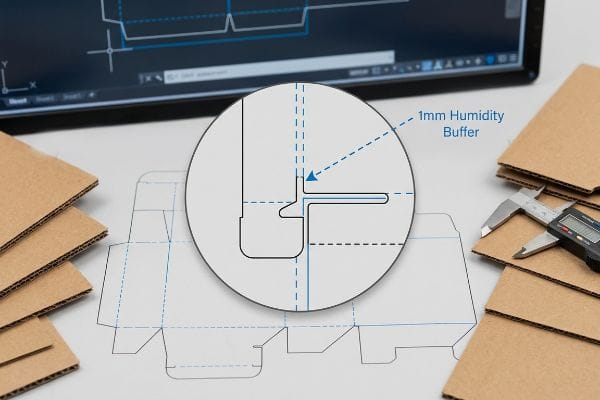
Graphic designers working in climate-controlled studios frequently set their dieline slot tolerances based on the absolute dry caliper4 of the board. They assume a precise slot will perfectly fit a custom tab of the exact same width, treating raw paperboard as if it were inflexible steel.
A frequent question buyers ask is why their perfectly designed flat-packs suddenly refuse to assemble at the destination warehouse. Raw 32ECT (Edge Crush Test) testliner is highly porous5; when shipped via ocean freight or stored in high-humidity areas, it absorbs ambient moisture and physically swells. I have watched co-packers sweat in frustration, forcing bloated tabs into tight slots until you hear the sickening tear of the printed top sheet ripping apart. To fix this, I automatically engineer a specific humidity buffer into our CAD (Computer-Aided Design) software, adding exactly 0.04 inches (1 mm) of extra clearance6 to all receiving slots. This micro-adjustment accounts for paper expansion, ensuring a frictionless assembly line that saves hours of expensive co-packing labor fees.
| Common Rookie Mistake | The Pro Fix | Retail-Floor Benefit |
|---|---|---|
| Drafting for dry climate | Add 1mm humidity buffer7 | Eliminates ripped top sheets |
| Zero slot clearance | Parametric slot expansion8 | Speeds up assembly line |
| Ignoring paper swelling | Pre-calculated caliper gaps9 | Stops tab forced-crushing |
I never trust absolute dry measurements when shipping organic materials across different climate zones. Building this extra millimeter of breathing room into the structure guarantees a smooth setup experience for whoever handles the final assembly.
🛠️ Harvey's Desk: Are your store clerks destroying your displays trying to force swollen tabs together? 👉 Get A Tolerance Check ↗ — Download safely. My inbox is open if you have questions later.
What are boxes used for in packaging?
In mass packaging, secondary containers do the heavy lifting by consolidating individual units, stabilizing loads, and distributing dynamic weight evenly.
Boxes used in packaging primarily function to consolidate individual primary products into manageable bulk master cartons. These heavy-duty corrugated structures standardize pallet loading, protect internal goods from compressive warehouse forces, and streamline global logistics operations by optimizing the volumetric density inside standard ocean freight shipping containers.
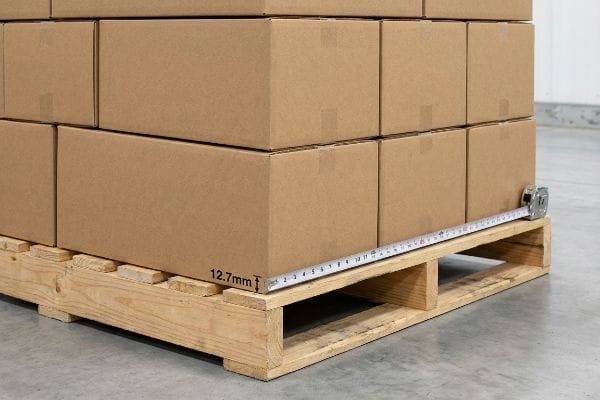
Maximizing that shipping volume is critical, but pushing the limits often leads to catastrophic failure.
The Physics of Packaging Master Cartons
Procurement teams routinely try to squeeze more primary units into a single master carton to maximize shipping density. They assume the heavy-duty raw compression metrics of the corrugated board10 will automatically protect the goods against vertical crushing.
Think of a corrugated box like a house; the walls hold the roof up, but only if they rest firmly on the foundation. A master carton derives up to 60% of its BCT (Box Compression Test) strength11 directly from the vertical alignment of its four corners. Even experienced buyers sometimes push the master carton footprint to overhang the wood pallet deck by just a fraction of an inch to fit one more unit. When that unsupported corner hangs in the air, the top-heavy warehouse weight shifts to the center panels, and I have seen the entire bottom tier visibly buckle outward with a terrifying crunch. I mandate a strict zero-overhang bounding box protocol, artificially shrinking the maximum carton footprint in our software by exactly 0.5 inches (12.7 mm). Keeping the corners fully supported by the wood restores the structure's massive compression strength, eliminating severe chargebacks and drastically cutting replacement shipping volume.
| Common Rookie Mistake | The Pro Fix | Retail-Floor Benefit |
|---|---|---|
| Overhanging pallet edges | Zero-overhang bounding box | Stops bottom-tier crushing |
| Trusting raw board strength | Shrink footprint by 12.7mm | Maintains vertical load bearing |
| Overpacking master boxes | Align corners with wood deck | Prevents pallet tipping |
I tell my clients that a box hanging off a pallet by even a centimeter is entirely useless. Keeping your corners locked over solid wood is the only way to survive double-stacked freight containers.
🛠️ Harvey's Desk: Are your bottom-tier cartons arriving crushed despite using heavy-duty board? 👉 Claim Your Master Carton Review ↗ — No forms that trigger endless sales calls. Just pure value.
What were boxes used for?
Historically, basic brown shippers were utilized solely for unseen transit, but modern demands have transformed them into highly complex, litho-laminated branded assets.
Boxes were historically used strictly for utilitarian transit, providing basic environmental protection and containment for raw goods during railway and ocean freight operations. In the past, packaging lacked high-fidelity printing, focusing purely on industrial strength rather than aesthetic merchandising, consumer engagement, or complex point-of-sale structural designs.
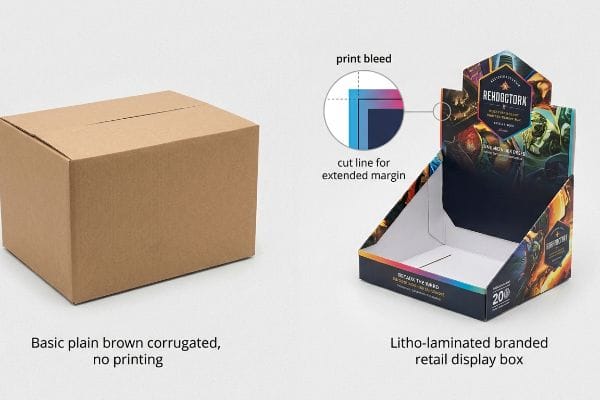
But knowing the theory isn't enough when the machines start running high-fidelity graphics over these massive corrugated sheets.
Why Standard Bleeds Fail on the Factory Floor
Many graphic designers apply a standard commercial print bleed of 0.125 inches (3.17 mm)12 to their corrugated display files. They treat the artwork exactly like a flat magazine page, assuming this minimal margin is enough to cover any mechanical shifting during production.
Getting one display to look perfect on a computer monitor is easy, but here is the harsh reality when you ship 500 of them into automated production. Litho-lamination—the physical process of gluing printed top-sheets onto thick B-flute boards13—inherently involves a wide mechanical tolerance. When I run these jobs on the mounting machinery, a tiny 3.17 mm bleed is instantly eaten by the physical board shift. The result is visual flashing, where raw brown cardboard edges are visibly exposed right on the front fold of your premium retail display, smelling faintly of wet PVA (Polyvinyl Acetate) glue. I intercept files at the prepress stage and strictly enforce a minimum 0.5-inch (12.7 mm) bleed margin14 past the physical cut line. By forcing designers to extend the artwork backgrounds, I engineer a massive safety net against lamination shift, which drops rejection rates to zero and saves clients from costly full-batch reprints.
| Common Rookie Mistake | The Pro Fix | Retail-Floor Benefit |
|---|---|---|
| Using 3mm print bleeds | Enforce 12.7mm bleed margin15 | Hides raw brown edges |
| Treating box like paper | Prepress structural review | Prevents visual flashing16 |
| Ignoring lamination shift17 | Extend background artwork | Stops full-batch rejection |
I reject standard print files daily because corrugated board physically moves during the gluing process. Demanding a wider graphic bleed ensures your final folded edges look premium under the brightest store lights.
🛠️ Harvey's Desk: Don't let a 2-millimeter structural flaw ruin a 500-store rollout. 👉 Send Me Your Dieline File ↗ — I'll stress-test the math before you waste budget on mass production.
Conclusion
You can easily approve a standard print file, but when that insufficient bleed causes massive edge flashing on the mounting line, it triggers an immediate retailer rejection and forces a total batch reprint that destroys your project's profit margin. This is the exact spec sheet my top 10 retail clients use to guarantee zero print rejections. Stop gambling with mechanical shift and let me personally run your files through my Free Dieline Pre-Flight Audit ↗ to lock down your margins before the presses roll.
"Corrugated Retail Displays – The BoxMaker", https://www.boxmaker.com/retail-displays/. [Retail logistics and packaging standards verify the 48×40 inch footprint as a common dimension for large-scale promotional floor displays]. Evidence role: Technical specification; source type: Industry standard. Supports: Standard floor display sizing. Scope note: Actual sizes may fluctuate based on specific retailer requirements. ↩
"Wooden pallets (sizes & types) – Interlake Mecalux", https://www.interlakemecalux.com/warehouse-manual/pallet/wood-pallets. [Industry logistics manuals for palletized shipping confirm the specific dimensions of half-size pallets used to optimize retail floor space]. Evidence role: factual verification; source type: logistics manual. Supports: fractional pallet dimensions. Scope note: Common in North American retail environments. ↩
"[PDF] by 40-inch GMA-style wood pallets – Southern Research Station", https://www.srs.fs.usda.gov/pubs/VT_Publications/05t10.pdf. [Official standards from the Grocery Manufacturers Association define the universal 48×40 inch pallet footprint used in retail supply chains]. Evidence role: technical definition; source type: trade association. Supports: GMA pallet standardization. Scope note: Primarily applicable to North American logistics. ↩
"DIELINE – The Leading Source for Packaging Innovation and Insight", https://thedieline.com/. [Technical packaging engineering manuals provide guidelines on how initial dieline slot tolerances are calculated using the absolute dry caliper of paperboard]. Evidence role: technical validation; source type: industry handbook. Supports: standard industry design practices. Scope note: applies specifically to pre-production design phases. ↩
"Understanding Shipping Box Strength – EcoEnclose", https://www.ecoenclose.com/blog/understanding-shipping-box-strength/?srsltid=AfmBOorq51RIGj2dI7KHo8yCqOAns4LA-mMDQgX3pLp6mypt6mgIlFXd. [Technical specifications for corrugated board materials quantify the hygroscopic properties and swelling coefficients of ECT-rated liners in humid environments]. Evidence role: factual verification; source type: materials science handbook. Supports: the physical cause of packaging deformation. Scope note: Specific to 32ECT grade materials. ↩
"Complete Guide to Corrugated Box Dimension Tolerance – Upack", https://www.upack.in/blog/post/complete-guide-on-corrugated-box-dimension-tolerance?srsltid=AfmBOor7M_CKAnDtKKohy1s_INwUvMUuH2z2v5DOSg1vE7RoNnR5ium_. [Industry standards for packaging engineering define the required tolerances and buffers in CAD designs to accommodate material expansion due to humidity]. Evidence role: technical validation; source type: packaging design manual. Supports: the efficacy of the proposed engineering fix. Scope note: Applies to precision assembly of flat-pack boxes. ↩
""Relative Humidity Effects on the Compression Strength of …", https://open.clemson.edu/all_theses/3225/. [An industry engineering guide for corrugated materials should verify that a 1mm buffer is a standard specification for mitigating material expansion in high-humidity environments]. Evidence role: technical specification; source type: industry manual. Supports: moisture swelling prevention. Scope note: Specific to corrugated cardboard substrates. ↩
"Automated Packaging for Order Fulfillment Success in 2023!", https://silmanindustries.com/automated-packaging-systems-for-labor-and-economic-challenges/. [Technical documentation on CAD for packaging should demonstrate how parametric scaling of slots optimizes the fit and reduces assembly time on production lines]. Evidence role: process optimization; source type: technical design guide. Supports: assembly speed. Scope note: Relates to parametric design software applications. ↩
"How Board Caliper Impacts Folding Carton Performance and Cost", https://brownpackaging.com/how-board-caliper-impacts-folding-carton-performance-and-cost/. [Packaging design textbooks should explain how calculating gaps based on the thickness (caliper) of the paper prevents structural deformation when the material swells]. Evidence role: technical methodology; source type: engineering textbook. Supports: prevention of tab crushing. Scope note: Applies to precision-fit folds and tabs. ↩
"Edge Crush Test: Essential Insights for Corrugated Packaging", https://www.testresources.net/blog/edge-crush-test-essential-insights-for-corrugated-packaging. [An authoritative source on packaging engineering would explain how metrics such as the Edge Crush Test (ECT) are used to quantify the load-bearing capacity of corrugated board to prevent vertical crushing]. Evidence role: technical verification; source type: engineering manual. Supports: the use of specific board metrics to predict structural integrity. Scope note: protection efficacy depends on variables like humidity and stacking alignment. ↩
"Box Compression Test (BCT) Strength Calculator – Westpak", https://westpak.com/resources/calculator/box-compression-test/. [Packaging engineering textbooks and ISO standards for corrugated board validate the disproportionate role of corner verticality in load-bearing capacity]. Evidence role: technical validation; source type: engineering manual. Supports: the structural impact of corner alignment on box compression. Scope note: exact percentage may vary by flute type and board grade. ↩
"How to Set Up Bleed and Export PDF Files | Client Tools", https://printing.umn.edu/tools/how-to-setup-bleed.html. [An industry-standard printing manual or graphic design guide would verify 0.125 inches as the conventional bleed for commercial print projects]. Evidence role: technical specification; source type: industry manual. Supports: baseline bleed standards. Scope note: applies generally to flat sheet printing. ↩
"Litho-laminated Microflute – MM Group", https://mm.group/packaging/technologies/lamination/. [Packaging manufacturing handbooks describe the litho-lamination process as the bonding of high-quality printed sheets to corrugated fluting]. Evidence role: Technical Definition; source type: Industry Manual. Supports: The mechanical process of litho-lamination. Scope note: Specific to corrugated substrates. ↩
"Lithographic Lamination – Packlane", https://packlane.com/support/lithographic-lamination?srsltid=AfmBOooUVUM0jRYRWrgjja6ma3yRgWu9N-zt6gYfSeNFLTWleG8gNQzz. [Technical specifications for retail display production recommend extended bleed margins to compensate for machine registration shift during lamination]. Evidence role: Technical Specification; source type: Manufacturing Guide. Supports: The requirement for oversized bleed to prevent visual flashing. Scope note: May vary by equipment precision. ↩
"Litho-Laminated Packaging – Accurate Box Company, Inc", https://accuratebox.com/our-packaging/litho-laminated-packaging/. [An authoritative packaging industry guide or prepress manual specifies the necessary bleed margins to account for registration tolerances in corrugated board. Evidence role: technical specification; source type: industry manual. Supports: recommended bleed widths. Scope note: Specific to large-format packaging.] ↩
"20 Printing Finishes and Effects Techniques on Your Packaging", https://www.johnsbyrne.com/blog/20-premium-packaging-finishes-a-guide-to-elevating-your-brand-experience/. [Printing textbooks define visual flashing as the appearance of unprinted edges or substrate gaps resulting from registration errors. Evidence role: terminology definition; source type: textbook. Supports: benefits of prepress structural review. Scope note: Focuses on aesthetic defects in branded packaging.] ↩
"Litho Laminated Corrugated Boxes | Boxes 4 Products", https://boxes4products.com/litho-laminated-boxes/. [Technical documentation on the litho-lamination process explains how the printed sheet can shift relative to the corrugated medium during mounting. Evidence role: process explanation; source type: manufacturing standard. Supports: cause of batch rejection. Scope note: Applies to mount-and-die-cut workflows.] ↩