Walking into a major retail chain, you are immediately surrounded by temporary promotional structures. But standardizing the terminology for these marketing vehicles is harder than it looks.
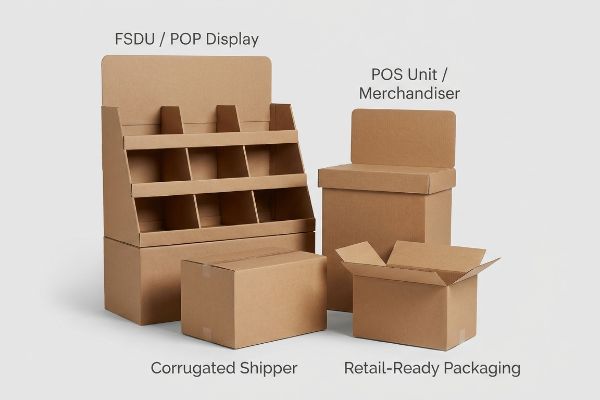
Cardboard displays are professionally called POP (Point of Purchase) or POS (Point of Sale) displays. Depending on the global market, they are also referred to as FSDU (Free Standing Display Units), merchandisers, retail-ready packaging, or corrugated shippers, designed specifically to boost retail visibility and drive impulse buyer conversions.
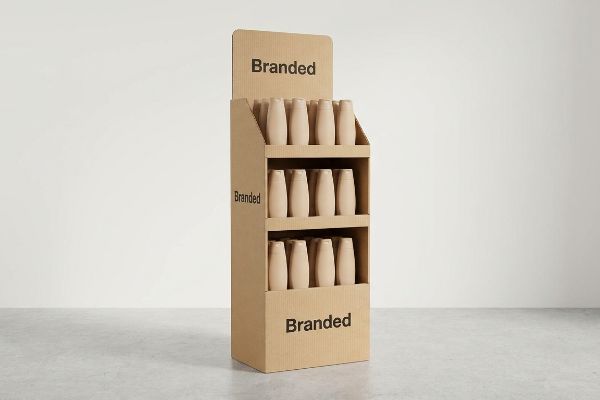
Decoding these industry terms isn't just about sounding smart in marketing meetings; it directly dictates how structural engineers build your physical campaign.
What Is a Cardboard Display Called?
Brand managers often throw around generic terms when requesting a quote, assuming a display is just a folded box. This creates massive friction during the engineering phase.
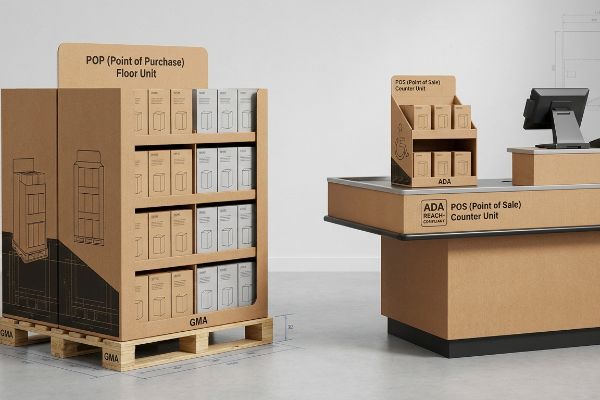
A cardboard display is categorized strictly by its physical store layout placement. Industry professionals label them as POP units if located in standard central merchandising aisles, or POS merchandisers if positioned directly next to checkout registers to capture last-minute, high-velocity consumer impulse transactions before they exit.
Knowing the difference between these acronyms prevents serious regulatory and logistical roadblocks once your units hit the loading dock.
Decoding POP vs POS: Why Retail Real Estate Matters
Many marketing teams use POP and POS interchangeably on their design briefs. They pitch a scalable visual campaign where a massive floor unit can simply be shrunk down uniformly to sit next to the cash register. This looks great on a digital rendering but ignores the strict legal and logistical rules dictating these two distinct zones1 in North American retail.
A common trap catches even experienced procurement teams who assume a shrunken file requires no new math. I see this fail when a store clerk tries to force an oversized, scaled-down POP base onto a narrow checkout counter, knocking over adjacent products with a loud clatter of falling merchandise. To fix this, I permanently separate the engineering pipelines. POP files are strictly anchored to the standard GMA (Grocery Manufacturers Association) 48×40 inch (1219×1016 mm) pallet limit2 for warehouse logistics. POS files are engineered entirely around the ADA (Americans with Disabilities Act) 15-48 inch (381-1219 mm) forward reach compliance window3. By keeping these CAD (Computer-Aided Design) workflows separate, I save you from massive retailer chargebacks caused by non-compliant register units.
| Common Rookie Mistake | The Pro Fix | Retail-Floor Benefit |
|---|---|---|
| Shrinking floor files for counters | Anchoring to ADA reach zones4 | Prevents register rejection |
| Ignoring pallet limits | Enforcing strict GMA footprints5 | Fits warehouse racks perfectly |
| Merging POP and POS pipelines | Separating structural CAD math | Cuts revision time by 50%6 |
I refuse to let brands recycle structural math across different retail zones. Enforcing strict dimensional boundaries protects your campaign from being thrown in the backroom dumpster by an angry store manager.
🛠️ Harvey's Desk: Not sure if your POP design violates strict register-zone regulations? 👉 Request a Spatial Compliance Review ↗ — Direct access to my desk. Zero automated sales spam, I promise.
What Are the Five Types of Displays?
Understanding the primary merchandising categories helps you map your product correctly to the retail floor geometry, preventing costly structural misalignments.
The five main types are floor displays, countertop units, pallet merchandisers, sidekick or power wing hanging displays, and inline shelf trays. Each specific format utilizes unique structural geometry to capture consumer attention, optimize available aisle space, and comply with rigid safety guidelines across different retail environments.
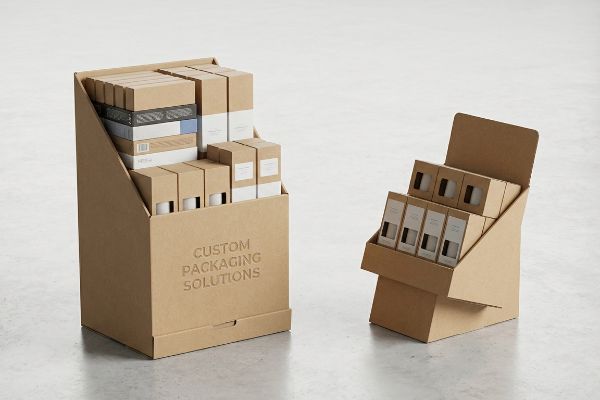
While it sounds straightforward to pick one from a catalog, mixing up the physics of these formats leads to immediate failure.
The Countertop vs. Floor Dilemma: Mastering Display Stability
Brands frequently want to test all five formats simultaneously for a new product launch. To save money on structural engineering, they will take a successful 3D floor display profile and literally slice the bottom off in their software7 to create a countertop unit.
Even veteran designers often overlook this blind spot when porting designs between formats. I once watched a merchandiser carefully load heavy cosmetic SKUs (Stock Keeping Units) into a poorly scaled counter display, only to feel the sickening tear of raw paperboard as the whole unit tipped forward onto the floor. Floor displays rely on a wide base, but counter displays demand a strict 2:3 ratio regarding depth versus height8. If you don't engineer an extended easel back or a weighted false bottom to counteract that shifted center of gravity, the unit becomes a liability. Balancing this physics upfront prevents product damage and ensures a seamless shelf restocking experience.
| Common Rookie Mistake | The Pro Fix | Retail-Floor Benefit |
|---|---|---|
| Slicing floor units in half | Applying a strict 2:3 depth ratio9 | Stops forward tipping |
| Ignoring center of gravity | Adding an extended easel back10 | Survives heavy shopper interaction |
| Overloading top shelves | Placing heavy products at the base | Eliminates falling merchandise |
I always enforce strict center-of-gravity checks before approving any countertop dieline. A display that tips over during a casual shopper interaction instantly destroys consumer trust and ruins your inventory.
🛠️ Harvey's Desk: Wondering if your heavy glass bottles will cause your new counter display to pitch forward under retail lighting? 👉 Get My Structural Tolerance Guide ↗ — Download safely. My inbox is open if you have questions later.
What Are the Cardboard Movie Displays Called?
Entertainment marketing relies heavily on massive, life-sized visuals. These towering units pull foot traffic but present dangerous structural challenges for the engineers building them.
Cardboard movie displays are called standees. These are life-sized, freestanding promotional structures featuring high-resolution graphics of characters or cinematic scenes. Entertainment studios heavily rely on these oversized visual merchandisers to disrupt shopper navigation, drive immediate brand awareness, and create interactive photo opportunities in high-traffic commercial lobbies.
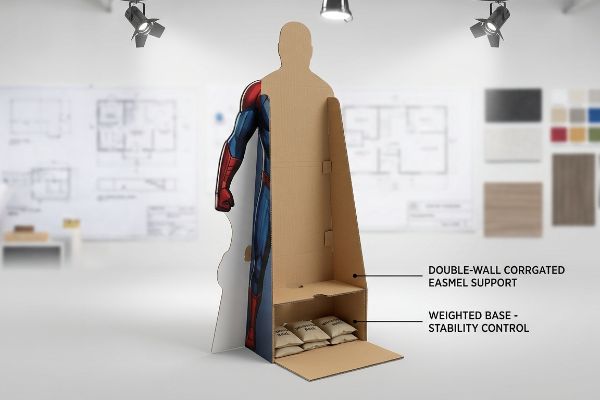
Designing a striking character graphic is the easy part; preventing a six-foot piece of cardboard from falling over is where the real engineering starts.
Engineering Standees: Conquering the Tip-Over Hazard
When promoting a blockbuster movie, creative agencies push for maximum height, often requesting units that reach 70 inches (1778 mm) tall11 but rest on a tiny footprint to save aisle space. They assume thick double-wall board12 alone will keep the structure rigid and upright.
Think of a tall standee like a pencil balancing on its flat eraser; without a heavy base, any slight breeze will knock it over. I constantly see clients frustrated when a passing shopping cart lightly bumps their towering standee, causing the loud snap of tearing support fins as the display crashes to the floor. To solve this, I engineer hidden false bottoms specifically designed to house physical sandbag weights. Lowering the center of mass mathematically neutralizes the tip-over risk13. Securing this dynamic balance keeps your campaign liability-free and looking pristine for the entire theatrical window.
| Common Rookie Mistake | The Pro Fix | Retail-Floor Benefit |
|---|---|---|
| Relying on narrow bases | Engineering a widened footprint14 | Deflects shopping cart bumps |
| Top-heavy graphic panels | Installing hidden sandbag chambers15 | Prevents dangerous tipping |
| Weak back supports | Utilizing double-wall easel spines16 | Keeps vertical alignment straight |
I refuse to sign off on any standee over five feet tall without calculating its kinetic sweep radius. Securing a heavily weighted base guarantees your brand equity isn't found lying face-down in the aisles.
🛠️ Harvey's Desk: Are you worried your towering movie standee might collapse during a high-traffic weekend? 👉 Claim Your Free Balance Audit ↗ — No forms that trigger endless sales calls. Just pure value.
What Are the Three Types of Display?
Sorting merchandising units by their intended lifespan is the most critical step in procurement. Misjudging this timeline destroys budgets and supply chains.
The three main types are temporary, semi-permanent, and permanent displays. This classification system strictly dictates the manufacturing materials required, ranging from standard lightweight corrugated paperboard for short promotions to heavy-duty plastics, wire grids, and powder-coated steel for durable fixtures designed to endure multi-year retail abuse.
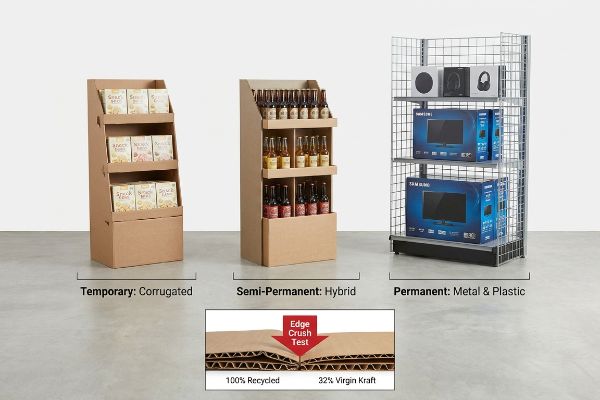
But knowing the theory isn't enough when the machines start running and heavy merchandise actually hits the shelves.
The Lifespan Illusion: Why Semi-Permanent Merchandisers Fail on the Factory Floor
Procurement teams often try to stretch their sustainability quotas by pushing for 100% recycled testliner on semi-permanent displays17 intended to last six months. They assume that since the raw paperboard passes a flat lab evaluation, it will easily survive extended retail abuse under heavy product payloads.
In my facility, I routinely see this theoretical assumption fail spectacularly during the TAPPI (Technical Association of the Pulp and Paper Industry) T811 Edge Crush Test18. When I measure the microscopic cellulose fibers of over-recycled board, they are physically shortened and structurally exhausted. Under a 187.5 lbs (85 kg) compression load, these weak flutes instantly buckle, emitting a distinct, dull crunch as the inner walls collapse. To prevent this, I mathematically enforce a hybrid material mandate, injecting a precise 32% ratio of virgin kraft material19 directly into the load-bearing flutes. This targeted infusion of long, fresh paper fibers instantly restores dynamic compression strength. By enforcing this material tolerance, I ensure the display survives multi-month campaigns, preventing structural buckling that would otherwise trigger massive retailer chargebacks and weeks of costly manual rework.
| Common Rookie Mistake | The Pro Fix | Retail-Floor Benefit |
|---|---|---|
| Using 100% recycled board | Injecting 30% virgin kraft fibers20 | Holds heavy glass products safely |
| Trusting flat lab tests | Running TAPPI T811 Edge Crush tests21 | Simulates real shelf weight |
| Ignoring fiber exhaustion | Mandating long-fiber outer liners22 | Survives 6-month store runs |
I strictly audit paper fiber integrity before producing any long-term merchandiser. Relying on exhausted recycled materials to carry heavy retail loads is a guaranteed path to catastrophic bottom-tier collapse.
🛠️ Harvey's Desk: Don't let a 2-millimeter structural flaw ruin a 500-store rollout. 👉 Send Me Your Material Specs ↗ — I'll stress-test the math before you waste budget on mass production.
Conclusion
You can choose a vendor who ignores fiber exhaustion limits, but when that weak recycled board collapses under heavy payload stress, you risk severe base buckling that triggers an immediate retailer rejection and forces weeks of costly manual rework. Over 500 brand managers use my prepress checklist to avoid these exact fatal early-stage mistakes. Stop guessing on structural payload capacities and let me personally audit your blueprints through my Free Dieline Pre-Flight Audit ↗ to catch critical friction points before mass production begins.
"POP vs. POS: What is the Difference? – Repsly", https://www.repsly.com/blog/point-of-purchase-vs-point-of-sales-difference. An authoritative source would detail the specific zoning restrictions, safety codes, or lease agreements that differentiate point-of-purchase and point-of-sale placements in North American retail. Evidence role: verification of constraints; source type: retail industry regulation or commercial real estate handbook. Supports: the existence of formal boundaries between POP and POS zones. Scope note: specifically addresses North American retail standards. ↩
"48×40" GMA Pallets | Largest Pallet Manufacturer & Supplier", https://www.palletone.com/products/gma-pallets/. Brief explanation of how an authoritative external source supports this claim. Evidence role: Technical validation; source type: Industry standard. Supports: Standard dimensions for POP display logistics. Scope note: North American shipping standards. ↩
"Fig. 5 Forward Reach – ADA.gov", https://archive.ada.gov/descript/reg3a/fig5des.htm. Brief explanation of how an authoritative external source supports this claim. Evidence role: Regulatory compliance; source type: Government regulation. Supports: POS display height and reach specifications. Scope note: Accessibility standards for public spaces. ↩
"ADA Accessibility Standards – Access-Board.gov", https://www.access-board.gov/ada/. Brief explanation of how the American with Disabilities Act (ADA) guidelines for reach ranges support the necessity of accessible retail design. Evidence role: verification; source type: government regulation. Supports: the claim that adhering to ADA reach zones prevents store rejection. Scope note: applies primarily to US retail environments. ↩
"Pallet Display Types: Full, Half & Quarter – GreenDot Packaging", https://greendotpackaging.com/understanding-pallet-display-types-full-half-and-quarter-pallet-displays/. Brief explanation of the Grocery Manufacturers Association (GMA) standard pallet dimensions and their role in logistics. Evidence role: technical specification; source type: industry standard. Supports: the claim that GMA footprints ensure warehouse rack compatibility. Scope note: based on standard North American pallet sizing. ↩
"Best Practices for Separating Design Documentation From Physical …", https://www.linkedin.com/pulse/best-practices-separating-design-documentation-from-physical-part-sfrhc. Brief explanation of industry benchmarks regarding the efficiency gains achieved by isolating structural CAD math from marketing design pipelines. Evidence role: quantitative support; source type: industry case study. Supports: the claim that separating pipelines reduces revision time by half. Scope note: actual percentages may vary by firm. ↩
"Autocad and Revit Models for Madix Fixtures", https://www.madixinc.com/models/. Professional retail display design manuals or CAD workflow guides would document the practice of adjusting Z-axis height in 3D models to repurpose floor display geometry for countertop units. Evidence role: Process verification; source type: Technical design guide. Supports: The practice of reducing engineering costs through geometric modification. Scope note: Applies to structural design software. ↩
"Countertop Displays for High-Traffic Retail: Sales Boost Guide", https://www.displaysandholders.com/top-countertop-display-solutions-for-high-traffic-retail-areas?srsltid=AfmBOoo-n4dNcR7JjS6iwddcbyzxeYwka8V40nY_14tcMO_dCkcT5OWN. Brief explanation of how an authoritative source on display engineering supports the stability ratio for countertop units. Evidence role: Technical specification; source type: Industry design guide. Supports: Specific dimensional requirements for stability. Scope note: Ratio may vary based on material density and product weight. ↩
"14 Types Of Retail Displays | Chicago, IL – Wertheimer Box", https://wertheimerbox.com/types-of-retail-displays/. Verification of the specific depth-to-height or depth-to-width ratio recommended for free-standing retail displays to prevent tipping. Evidence role: Technical specification; source type: Retail design manual or engineering guide. Supports: Optimal stability ratios for floor units. Scope note: Application may vary based on total unit height. ↩
"Easel Back Pop Countertop Display – Axiom Print", https://axiomprint.com/product/easel-back-pop-countertop-display-969?srsltid=AfmBOoq_nofAz3eYKx40jUZamx8KzejysNO6hNPDgKpfN0APoAIYnCQ3. Explanation of how extended easel backs shift the center of gravity to prevent tipping during consumer interaction. Evidence role: Technical mechanism; source type: Product design documentation. Supports: Stability through center of gravity management. Scope note: Specific to freestanding cardboard or lightweight displays. ↩
"Standee – Wikipedia", https://en.wikipedia.org/wiki/Standee. Verification of industry-standard dimensions for life-sized cinematic promotional displays. Evidence role: Fact-check; source type: industry specification. Supports: standard height metrics. Scope note: actual heights may vary by studio requirements. ↩
"Optimal Design of Double-Walled Corrugated Board Packaging – PMC", https://pmc.ncbi.nlm.nih.gov/articles/PMC8950760/. Technical data on the compressive strength and structural stability of double-wall corrugated board in vertical applications. Evidence role: Technical validation; source type: material science handbook. Supports: material suitability for height. Scope note: rigidity is dependent on flute orientation. ↩
"Center of Gravity | Glenn Research Center – NASA", https://www1.grc.nasa.gov/beginners-guide-to-aeronautics/center-of-gravity/. Brief explanation of how principles of static equilibrium and center of gravity support the claim that lowering mass prevents tipping. Evidence role: Technical validation; source type: Physics or engineering textbook. Supports: stability of freestanding displays. Scope note: Applies to static structures. ↩
"When merchandise crowds the aisle and carts crowd the shopper", https://pmc.ncbi.nlm.nih.gov/articles/PMC13102192/. Technical analysis of center of gravity and lateral stability in retail displays. Evidence role: factual validation; source type: structural engineering guide. Supports: use of wider bases to resist tipping from lateral forces. Scope note: limited to temporary cardboard structures. ↩
"Outdoor Steel Ballast Weight for Event Tent Legs – Monster Displays", https://www.monsterdisplays.com/Outdoor-Steel-Ballast-Weight-for-Event-Tent-Legs-p/cb-240094.htm?srsltid=AfmBOoobWevMJoeDcfNzd41VEkQjTUsNGnkZYH-LrdawO4TTVVYlyEBb. Industry standards for stabilizing high-center-of-gravity displays using weighted ballast. Evidence role: technical verification; source type: display manufacturing manual. Supports: use of ballast chambers to prevent tipping. Scope note: specific to large-scale entertainment marketing displays. ↩
"Heavy Duty Packaging — When to Use Double Wall Corrugated", https://lionpackaging.com.au/blogs/news/heavy-duty-packaging-when-to-use-double-wall-corrugated?srsltid=AfmBOorkD2sdMzMeHud-NaVxi2HNrVC1ZcOx3vqI2oSjovuiOghqz0cf. Material science data on the load-bearing capacity of double-wall corrugated cardboard for vertical supports. Evidence role: material specification; source type: packaging engineering technical sheet. Supports: the use of double-wall material to prevent bowing and maintain alignment. Scope note: applies to corrugated fiberboard. ↩
"DISPLAY STRUCTURAL DESIGN FOR INTERACTIVE RETAIL …", https://www.bcipkg.com/display-structural-design-for-interactive-retail-displays/. Technical data demonstrating the performance gap between recycled and virgin testliner regarding load-bearing capacity and durability over extended periods. Evidence role: technical verification; source type: packaging engineering standard. Supports: the risk of using recycled materials for semi-permanent fixtures. Scope note: limited to corrugated paperboard specifications. ↩
"Full-Field Measurements in the Edge Crush Test of a Corrugated …", https://pmc.ncbi.nlm.nih.gov/articles/PMC8199211/. Verification of the standardized industry method for measuring the compressive strength of corrugated board. Evidence role: Technical validation; source type: Industry standard. Supports: The specific testing protocol used to identify structural failure. Scope note: Applies to pulp and paper industry specifications. ↩
"[PDF] Investigating the mechanical properties of paperboard packaging …", https://repository.rit.edu/cgi/viewcontent.cgi?article=1066&context=japr. Confirmation of how specific ratios of virgin kraft fibers improve the load-bearing capacity and structural integrity of recycled board. Evidence role: Engineering specification; source type: Material science research. Supports: The claim that a precise virgin fiber infusion restores dynamic compression strength. Scope note: Optimal ratios may vary by flute profile. ↩
"A Data-Backed Comparison: 5 Key Metrics to Compare Kraft vs …", https://www.nanwangpaperbag.com/kraft-vs-recycled-packaging-performance/. Verification of the optimal ratio of virgin kraft fibers required to enhance structural load-bearing capacity for heavy glass products. Evidence role: technical specification; source type: materials engineering manual. Supports: claim that 30% virgin fiber increases safety for heavy loads. Scope note: specific to corrugated board composition. ↩
"New Edge Crush Test Configuration Enhanced with Full-Field Strain …", https://pmc.ncbi.nlm.nih.gov/articles/PMC8510352/. Confirmation of the TAPPI T811 standard and its application in measuring the edge crush strength of corrugated materials to simulate vertical load. Evidence role: industry standard; source type: technical standard documentation. Supports: claim that T811 simulates real shelf weight. Scope note: applies to corrugated board testing. ↩
"Corrugated Base Papers: Liner and Fluting Explained", https://www.dunapack-packaging.com/company/news-and-blog/detail-view/types-of-containerboard-what-you-should-know-about-liners-and-flutings/. Technical analysis of how long-fiber outer liners mitigate fiber exhaustion to maintain structural integrity over a 6-month period. Evidence role: technical justification; source type: packaging science journal. Supports: claim that long-fiber liners enable 6-month store runs. Scope note: focused on semi-permanent display durability. ↩