
You spend months finalizing seasonal campaigns, but retailer rejections and poor floor placement still kill your ROI. Here is how to engineer your structural displays to guarantee a successful rollout.
The top 5 seasonal merchandising strategies focus on optimizing floor placement, utilizing fractional pallet geometries, enforcing clear visual hierarchies, isolating core consumer purchasing triggers, and ensuring strict structural compliance with global retailer space guidelines to maximize seasonal sales and successfully drive heavy foot traffic conversion.

Theory is great in the boardroom, but mastering these physical frameworks is what actually gets your product onto the retail floor.
What are the 5 P's of merchandising?
Getting the basics right is your first line of defense against poor seasonal performance and ignored product lines.
The 5 P's of merchandising include product, price, promotion, placement, and people. This universal industry framework dictates exactly how goods are visually presented and physically positioned within global retail environments to actively influence consumer buying behavior and drive maximum seasonal transaction volumes across all global markets.
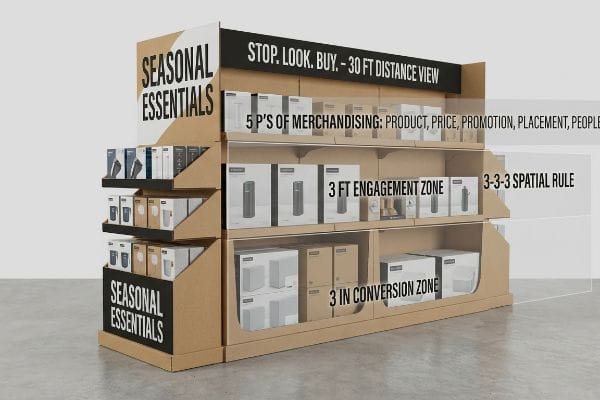
Knowing these pillars is helpful, but applying them physically in a crowded aisle changes everything.
Applying the 5 P's to the 3-3-3 Spatial Engagement Rule
Even experienced brand directors often design seasonal POP (Point of Purchase) floor displays strictly for up-close viewing on backlit computer monitors. They assume if the graphics look sharp on their screen, the "Promotion" and "Placement" pillars are fully satisfied. This ignores the physical reality of how a rushing shopper navigates a crowded store aisle during peak holiday hours.
I see this mistake constantly when a brand ships a text-heavy corrugated base unit meant to be a seasonal end-cap. They forget that placement engagement happens in stages. You need to grab attention from thirty feet away, engage at three feet, and convert at three inches. On the floor, I once watched a tired clerk drag a beautifully printed but physically flat display into a dark corner, the raw cardboard scraping loudly across the tile, because it lacked the die-cut structural "pop" to fight for the main aisle. Without aggressive, high-contrast structural shapes engineered for that 30-foot disruption, your promotion blends into the background, dropping foot traffic engagement by an estimated 40%1.
| Common Rookie Mistake | The Pro Fix | Retail-Floor Benefit |
|---|---|---|
| Designing for 1-foot viewing | 30-foot die-cut visual disruption2 | Captures distant foot traffic |
| Text-heavy lower panels | Elevating product to 50-inch strike zone3 | Speeds up 3-foot engagement |
| High retaining lips | Cutting front lip for 85% visibility4 | Frictionless 3-inch conversion |
I engineer every seasonal display to explicitly hit these three spatial thresholds. By aligning your promotional graphics with strict physical distance rules, I guarantee your structural placement actually stops shopping carts instead of becoming invisible aisle filler.
🛠️ Harvey's Desk: Are your seasonal graphics getting lost on the physical retail floor? 👉 Request a Spatial Display Audit ↗ — Direct access to my desk. Zero automated sales spam, I promise.
What are the 5 R's of merchandising?
Perfectly timed seasonal launches depend heavily on supply chain synchronization and clear operational guidelines.
The 5 R's of merchandising require delivering the right product, in the right quantity, at the right price, at the right time, and in the right place. This global operational standard ensures precise inventory alignment between manufacturing supply chains and high-traffic retail storefronts to prevent costly stockouts.

Memorizing the five rights is easy, but executing them across different store formats is where the friction starts.
Why the 5 R's Fail Without a Retail Framework Matrix
Many emerging brands assume a single, universally designed seasonal display will automatically sell itself across all retail channels. They try to mass-produce one box structure to hit convenience stores, big-box retailers, and warehouse clubs simultaneously to save on tooling costs5.
The problem is that the "right place" and "right quantity" mean completely different things to a grocery store compared to a warehouse club. I recently had a client try to force a fragile, lightweight display filled with high-quantity seasonal goods into a Costco environment. They didn't map their logistical strategy against the club store's strict operational model. When the warehouse clerks unwrapped the pallets, the lightweight 32ECT (Edge Crush Test) boards6 immediately started bowing outward under the massive weight. I had to step in and halt production, upgrading the base to a heavy-duty double-wall B-flute7 to handle the aggressive dynamic loads. Failing to align your physical structure with the specific retailer's operational reality guarantees a rejected shipment and a completely missed holiday window.
| Common Rookie Mistake | The Pro Fix | Retail-Floor Benefit |
|---|---|---|
| One-size-fits-all structure | Retail framework matrix alignment8 | Prevents store-level rejections |
| Ignoring club store mechanics | Double-wall structural upgrades9 | Survives warehouse handling |
| Mismatched pack quantities | Customizing pre-pack ratios10 | Seamless seasonal restocks |
I always map a brand's merchandising strategy directly against the targeted retailer's specific operational ecosystem before cutting any board. Building a physical matrix ensures your seasonal rollout is economically and structurally compatible with the store environment.
🛠️ Harvey's Desk: Are your current seasonal display dimensions actually approved for your target retailer? 👉 Claim Your Retail Guideline Match ↗ — Download safely. My inbox is open if you have questions later.
What is the 80 20 rule in merchandising?
Focusing your structural footprint on the highest-performing assets is critical for seasonal retail profitability.
The 80 20 rule in merchandising states that roughly eighty percent of total retail sales are generated by just twenty percent of core product inventory. Merchandisers globally utilize this foundational Pareto principle to strictly dedicate premium floor space to high-velocity, top-performing goods during peak seasonal shopping periods.
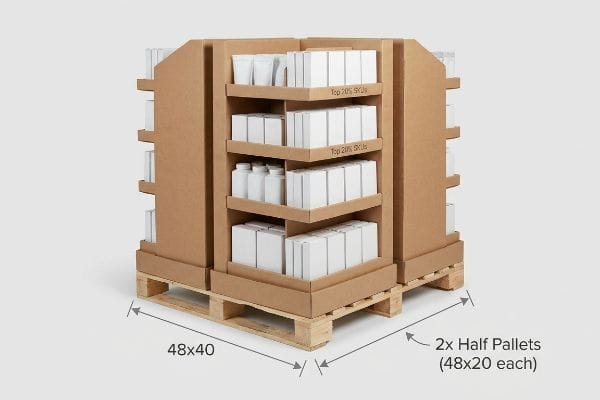
The math makes sense, but translating that focused efficiency into a physical display footprint is a massive hurdle for new brands.
Applying the 80 20 Rule to Fractional Pallet Geometry
When pitching seasonal rollouts to big-box buyers, marketing teams often assume they must monopolize an entire 48×40 inch (1219×1016 mm) wood pallet11 to create a meaningful visual impact. They design massive, full-size floor merchandisers for every product variation.
Think of retail floor space like premium real estate; buyers are ruthless about rationing it. A common trap is submitting a full-pallet design for a secondary product line. The retailer rejects the massive footprint outright, forcing clerks to aggressively slice open the master cartons with box cutters and dump your product onto a dusty bottom shelf. I fix this by engineering bulk merchandisers strictly to fractional dimensions, like Half Pallets at 48×20 inches (1219×508 mm)12. By mathematically subdividing the footprint, two distinct campaigns perfectly share a single GMA (Grocery Manufacturers Association) pallet base13. This allows the retail buyer to seamlessly maximize their floor density, vastly increasing the chances they approve your scaled-down unit for that high-traffic power aisle.
| Common Rookie Mistake | The Pro Fix | Retail-Floor Benefit |
|---|---|---|
| Pitching full pallets only | Utilizing fractional pallet geometry | Higher buyer approval rates14 |
| Wasting empty board space | Consolidating top 20% SKUs15 | Maximizes sales per square foot |
| Incompatible floor footprints | Engineering to 48×20 inches16 | Fits premium aisle intersections |
I strictly enforce fractional pallet geometry to match the retailer's demand for high-density sales. By shrinking the structural footprint to focus purely on your top performers, I secure better placement and dramatically lower your corrugated material costs.
🛠️ Harvey's Desk: Keep getting your seasonal floor display footprints rejected by big-box buyers? 👉 Get a Fractional Pallet Conversion ↗ — No forms that trigger endless sales calls. Just pure value.
What are the 4 P's of merchandising?
Nailing your core marketing mix ensures your physical product actually reaches the consumer's hands safely.
The 4 P's of merchandising refer to product, price, place, and promotion. This foundational global marketing framework guides brands in developing compelling seasonal items, setting competitive financial costs, securing optimal retail shelf locations, and executing high-visibility structural advertising to maximize consumer purchases during peak traffic.
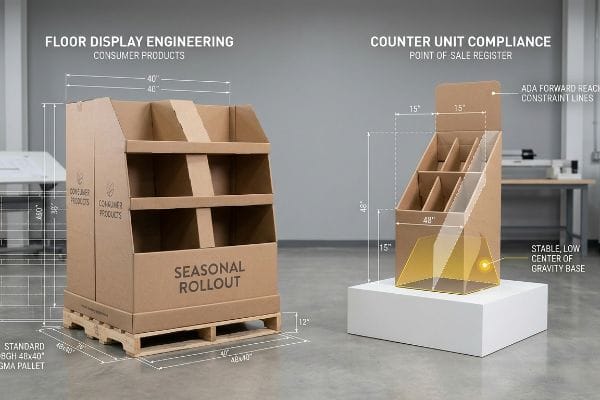
But knowing the theory isn't enough when the machines start running and strict retail spatial constraints hit your supply chain.
Why Shrink-to-Fit "Place" Strategies Fail on the Factory Floor
Trading companies and junior designers frequently pitch a "scalable" design strategy where a massive floor display can simply be reduced by fifty percent to serve as a checkout counter unit. They assume the "Place" pillar simply means shrinking the artwork file.
This isn't just theory—I see this happen on the testing floor when brands try to use identical dieline math for two entirely different retail zones. In my facility, I routinely see clients submit crossover files that ignore strict spatial laws. For floor logistics, a unit must rigidly anchor to the 48×40 inch (1219×1016 mm) GMA pallet limit17 to survive warehouse top-loads. However, counter units are strictly governed by ADA (Americans with Disabilities Act) forward reach limits18, requiring a precise 15 to 48 inch (381 to 1219 mm) interaction window. When you just arbitrarily shrink a floor display down, the center of gravity shifts, and the counter unit becomes a severe tipping hazard. I have to completely rebuild the structural math, separating the POP and POS (Point of Sale) pipelines. By enforcing these distinct physical boundaries, I eliminate the wobbly bases that cause massive chargebacks from store managers who legally must reject non-compliant register units.
| Common Rookie Mistake | The Pro Fix | Retail-Floor Benefit |
|---|---|---|
| Shrinking floor displays by 50% | Separating POP and POS engineering | Prevents counter tipping hazards |
| Ignoring register space laws | Anchoring to ADA reach constraints19 | Ensures legal store compliance |
| Assuming universal footprints | Strict GMA 48×40 inch anchoring20 | Survives heavy warehouse transit |
I permanently separate the structural engineering pipelines for floor and counter displays. By mathematically anchoring your files to the strict spatial realities of their intended location, I ensure your seasonal rollout is both physically stable and legally compliant.
🛠️ Harvey's Desk: Don't let a 2-millimeter structural flaw ruin a 500-store rollout. 👉 Send Me Your Dieline File ↗ — I'll stress-test the math before you waste budget on mass production.
Conclusion
You can try to force a fragile, one-size-fits-all display into a warehouse club, but when that unsupported 32ECT board bows outward under dynamic loads, it triggers an immediate retailer rejection and completely wipes out your seasonal profit margin. Over 500 brand managers use my prepress checklist to avoid these exact fatal early-stage mistakes. Stop risking your holiday rollout on generic templates and let me personally run your structural files through my Free Dieline Audit ↗ to catch physical tipping hazards and dimensional failures before mass production begins.
"7 Features of a High-Impact Retail Display – Smurfit Westrock", https://www.smurfitwestrock.com/blog/7-features-of-a-high-impact-retail-display. [A retail marketing study or industry white paper on point-of-purchase (POP) display effectiveness would provide quantitative data on how visual disruption affects consumer engagement rates]. Evidence role: Quantitative validation; source type: Industry research report. Supports: The claim that poor structural design significantly reduces foot traffic. Scope note: Impact may vary based on store layout and product category. ↩
"[PDF] EXHIBIT B Grand Central Madison Retail Design Guidelines", https://grandcentralterminal.com/wp-content/uploads/2025/05/Exhibit-B-GCM-Retail-Design-Guidelines.pdf. [Industry standards for visual merchandising define the distance at which large-scale visual cues are necessary to capture distant foot traffic]. Evidence role: Technical specification; source type: Retail design manual. Supports: The use of distant visual disruptors. Scope note: Applies to large-format retail environments. ↩
"Retail premises design for effective displays and customer flow", https://www.business.qld.gov.au/industries/manufacturing-retail/retail-wholesale/retail-displays. [Ergonomic retail research identifies the 'strike zone'as the optimal height for product placement to maximize eye-level engagement]. Evidence role: Technical specification; source type: Consumer behavior study. Supports: Placement height for rapid engagement. Scope note: Heights may vary based on target demographic. ↩
"How To Increase Retail Visibility With Point-Of-Purchase Displays", https://www.industrialpackaging.com/blog/increased-retail-visibility. [Point-of-Purchase design guidelines correlate specific visibility percentages of product packaging with increased conversion rates]. Evidence role: Metric; source type: Packaging and display design guide. Supports: The correlation between lip height and conversion. Scope note: Specifically refers to shelf-edge or display-top design. ↩
"What You Should Know About Tooling Charges for Retail Display …", https://agilityretail.com/what-you-should-know-about-tooling-charges-for-retail-display-stands/. [Technical documentation on industrial manufacturing explains how consolidating designs reduces the requirement for multiple custom molds or dies, thereby lowering initial capital expenditure on tooling]. Evidence role: technical explanation; source type: manufacturing specification. Supports: the economic motivation for using universal display designs. Scope note: Applicable to physical POP and packaging hardware. ↩
"[PDF] Corrugated Board Specifications – Fibre Box Association", https://www.fibrebox.org/assets/2025/09/Walmart_Corrugated-Board_Specifications_Automation_Packaging_Standards.pdf. [An authoritative source on packaging engineering would verify the specific compression strength of 32ECT cardboard and its failure points under high-weight loads]. Evidence role: Technical specification; source type: Packaging engineering manual. Supports: The claim that 32ECT is insufficient for heavy warehouse club pallets. Scope note: Focus on vertical compression limits. ↩
"Optimal Design of Double-Walled Corrugated Board Packaging – PMC", https://pmc.ncbi.nlm.nih.gov/articles/PMC8950760/. [Industry standards for corrugated materials would confirm that double-wall B-flute provides significantly higher structural integrity and resistance to dynamic loads than single-wall alternatives]. Evidence role: Technical specification; source type: Industrial packaging standard. Supports: The claim that upgrading to double-wall B-flute solves bowing issues. Scope note: Comparison of flute types and wall thickness. ↩
"Effective, Evidence-Based Retail Crime Prevention", https://losspreventionmedia.com/you-can-steal-it-but-you-cant-use-it-effective-retail-crime-prevention/. [Retail operational manuals explain how aligning product assortments and specifications with a retail framework matrix ensures compliance with store-level receiving guidelines to prevent shipment rejections]. Evidence role: operational process; source type: retail management handbook. Supports: the correlation between framework alignment and acceptance rates. Scope note: applies to large-scale distribution models.] ↩
"Double Wall Corrugated Boxes – Heavy-Duty, Buy Now", https://theboxology.us/product/double-wall-corrugated-boxes/. [Packaging engineering standards specify that double-wall corrugated materials provide the necessary burst strength and stackability to withstand high-impact warehouse handling in club store environments]. Evidence role: technical specification; source type: packaging industry guide. Supports: the necessity of structural upgrades for warehouse durability. Scope note: specific to corrugated cardboard packaging.] ↩
"Unpacking Retail Complexity: Automating Size Curves and Pack …", https://o9solutions.com/articles/automating-size-curves-and-pack-execution. [Supply chain management research indicates that customizing pre-pack ratios based on store-specific velocity reduces restocking friction and minimizes stockouts during seasonal peaks]. Evidence role: logistics optimization; source type: supply chain journal. Supports: the link between pack ratios and restocking efficiency. Scope note: focused on high-velocity seasonal inventory.] ↩
"Heat Treated Wood GMA Pallet – 48 x 40" H-1260 – ULINE", https://www.uline.com/Product/Detail/H-1260/Pallets/Heat-Treated-Wood-GMA-Pallet-48-x-40. [An authoritative logistics or supply chain source would verify that 48×40 inches is the standard dimension for the GMA (Grocery Manufacturers Association) pallet used in North American retail]. Evidence role: technical specification; source type: industry standard. Supports: physical dimensions of standard retail pallets. Scope note: Specific to North American logistics standards. ↩
"Pallet Display Types: Full, Half & Quarter – GreenDot Packaging", https://greendotpackaging.com/understanding-pallet-display-types-full-half-and-quarter-pallet-displays/. [Industry logistics manuals or retail display standards will verify the dimensions for half-pallet configurations]. Evidence role: technical specification; source type: industry standard. Supports: the use of precise dimensions for fractional pallet geometry. Scope note: Standard dimensions may vary slightly by region. ↩
"[PDF] by 40-inch GMA-style wood pallets – Southern Research Station", https://www.srs.fs.usda.gov/pubs/VT_Publications/05t10.pdf. [Official logistics standards from the Grocery Manufacturers Association define the universal footprint and specifications for these bases]. Evidence role: industry standard; source type: professional association. Supports: the standardization of pallet bases in North American retail. Scope note: Specifically pertains to the standard 48" x 40" base. ↩
"Why Do Pallet Displays Work So Well in Club Stores? – Custom …", https://popdisplay.me/why-do-pallet-displays-work-so-well-in-club-stores/. [Market research indicates that space-efficient display solutions, such as fractional pallet geometry, lead to higher approval rates from retail category buyers due to reduced footprint]. Evidence role: empirical evidence; source type: market research report. Supports: benefits of fractional pallet geometry over full pallets. Scope note: approval rates vary by product category. ↩
"The 80/20 Rule of Merchandising", https://www.bloomreach.com/en/library/guides/80-20-rule-of-merchandising. [Economic studies on the Pareto Principle in retail demonstrate that prioritizing the top 20% of high-performing SKUs optimizes revenue per square foot]. Evidence role: economic principle; source type: business journal. Supports: efficiency of the 80/20 rule in SKU management. Scope note: typically applies to seasonal and high-volume retail environments. ↩
"What sizes are available for pallet displays? – Custom Cardboard …", https://popdisplay.me/what-sizes-are-available-for-pallet-displays/. [Industry standards for point-of-purchase displays confirm that 48×20 inches is a common optimal footprint for fitting high-traffic retail aisle intersections]. Evidence role: technical specification; source type: industry handbook. Supports: optimal footprint dimensions for premium placement. Scope note: dimensions may vary slightly based on specific retailer requirements. ↩
"48×40" GMA Pallets | Largest Pallet Manufacturer & Supplier", https://www.palletone.com/products/gma-pallets/. [A technical industry standard from the Grocery Manufacturers Association confirms these dimensions as the North American baseline for palletized logistics. Evidence role: verification of technical specification; source type: industry standard. Supports: floor logistics constraints. Scope note: Focuses on North American retail shipping.] ↩
"ADA Standards for Accessible Design Title III Regulation 28 CFR …", https://www.ada.gov/law-and-regs/design-standards/1991-design-standards/. [Official ADA accessibility guidelines specify maximum and minimum reach ranges to ensure retail displays are usable for individuals in wheelchairs. Evidence role: verification of legal requirement; source type: government regulation. Supports: counter unit interaction window. Scope note: Applies to public accommodation spaces.] ↩
"Sales and Service Counters – Access-Board.gov", https://www.access-board.gov/ada/guides/animations/sales-and-service-counters.html. [Authoritative ADA accessibility guidelines specify maximum height and reach ranges for accessible service counters to ensure inclusivity]. Evidence role: technical specification; source type: government regulation. Supports: legal store compliance. Scope note: specific to United States federal law. ↩
"48" x 40" GMA Pallets | Largest Pallet Manufacturer & Supplier", https://www.meridianpkg.com/feeds/category/gma-pallets. [The Grocery Manufacturers Association (GMA) defines the standard North American pallet footprint as 48 by 40 inches to ensure compatibility with transit and warehousing equipment]. Evidence role: industry standard; source type: trade association specification. Supports: survival during warehouse transit. Scope note: applicable primarily to North American supply chains. ↩