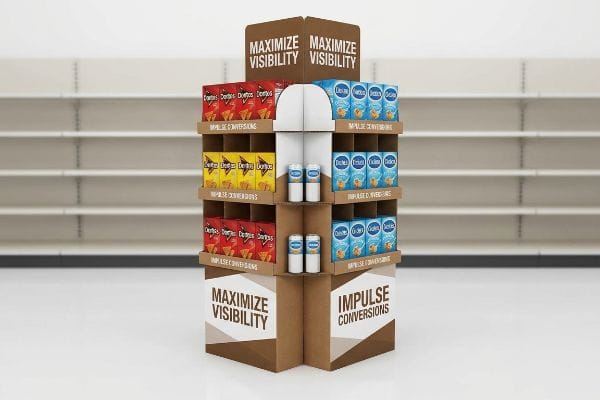
Launching a retail campaign is expensive, and watching your product get lost on standard big-box shelves is frustrating. A custom floor merchandiser gives you total control over the aisle.
The advantages of FSDU displays center on disrupting retail aisles to force immediate impulse conversions. An FSDU (Free Standing Display Unit) isolates products from shelf competitors, maximizes visibility, and uses optimized corrugated architecture to safely hold heavy inventory while ensuring fast, tool-free assembly.
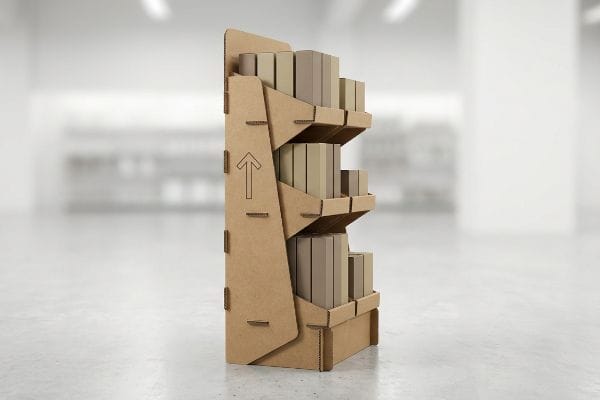
But understanding the marketing theory behind these structures isn't enough when you start calculating freight costs and supply chain survival.
What Is an FSDU in Retail?
Many buyers assume these units are just oversized boxes, but they are actually engineered kinetic structures designed to survive high-traffic store intersections and aggressive restocking.
An FSDU in retail is a completely independent floor merchandiser that houses products away from traditional store shelving. These temporary corrugated structures allow brands to secure premium footprints in big-box aisles while drastically reducing the severe freight costs associated with shipping permanent welded metal hardware displays.
While the definition sounds straightforward, the physical execution often catches new procurement teams off guard.
The Hidden Logistics of Corrugated Architecture
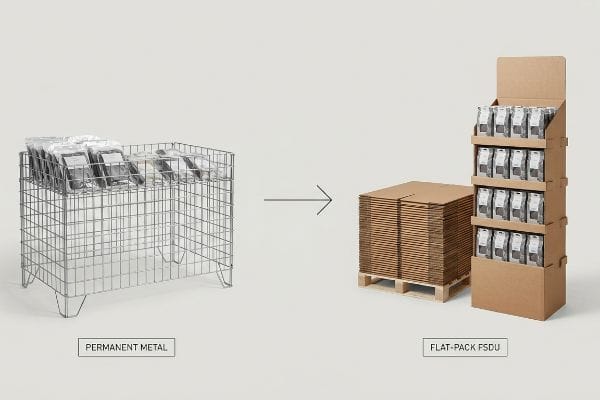
Brands often default to permanent welded metal structures for short-term retail campaigns1, assuming heavy-duty steel automatically guarantees a higher return on investment. They plan their merchandising strategy around these permanent wire racks, thinking the upfront cost is justified by the perceived durability on the sales floor.
I see this trap constantly when reviewing initial campaign budgets. A client will ask for a metal rack, ignoring the punishing logistics of permanent hardware, which must ship fully assembled. A single 40HQ container holds roughly 250 welded wire racks2, meaning you pay a massive freight premium simply to move dead air across the ocean. I once watched a brand blow their margin on freight because they didn't realize we could engineer a flat-pack corrugated floor display to handle the exact same 150 lbs (68 kg) payload. By pivoting to high-performance E-flute temporary structures, I fit up to 1,500 flat-packed units3 into that exact same container. You get the loud, satisfying snap of the interlocking tabs during a 30-second tool-free setup, and we completely eliminate the 300% permanent hardware freight penalty while hitting the retailer's dynamic load requirements.
| Common Rookie Mistake | The Pro Fix | Retail-Floor Benefit |
|---|---|---|
| Shipping empty metal racks | Flat-packing corrugated FSDUs4 | Slashes freight volume significantly |
| Assuming cardboard is weak | Engineering double-wall spines5 | Holds heavy retail payloads safely |
| Using complex screw assembly | Integrating friction-lock tabs6 | Enables 30-second tool-free setup |
Mandating corrugated flat-pack engineering is essential for any retail promotional window lasting under twelve weeks. You preserve your marketing budget for the actual product rather than wasting it on shipping empty metal volume across the supply chain.
🛠️ Harvey's Desk: Are you overpaying for freight because your current floor display doesn't flat-pack efficiently? 👉 Request a Logistics File Audit ↗ — Direct access to my desk. Zero automated sales spam, I promise.
What Are the Advantages of Point of Sale Displays?
Placing a display near the register seems like guaranteed visibility, but physical placement alone won't force a hurried shopper to actually reach out and grab your product.
The advantages of Point of Sale displays include immediate impulse conversion, disrupted visual monotony, and highly targeted spatial engagement. A properly engineered unit captures attention from a distance, guides the shopper's eye toward specific promotions, and creates physical accessibility right at the retail checkout counter.
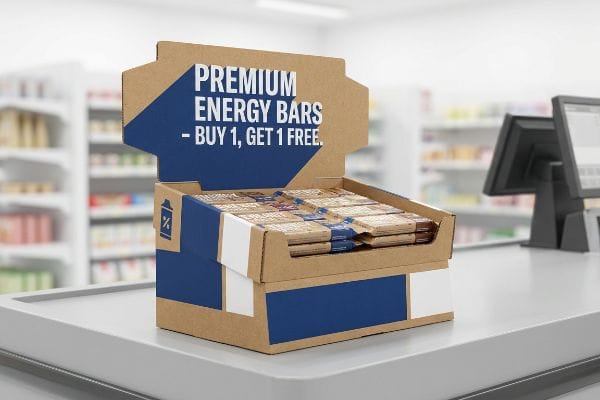
Securing that checkout space is a win, but standard graphics often fail to trigger the psychological response needed to close the sale.
Mastering the 3-3-3 Rule for POS (Point of Sale) Engagement
Marketing teams frequently design retail merchandisers strictly for up-close viewing on backlit computer monitors7, assuming the physical structure will naturally draw a crowd. They plaster the sides with tiny, intricate text and subtle gradient graphics, expecting passing shoppers to stop, lean in, and read every bullet point like a brochure.
In reality, relying on subtle graphics causes the unit to become invisible against the chaotic background of a big-box store. I see this happen constantly; a beautifully printed POS display hits the floor, but because it lacks structural disruption, rushing shoppers glance right past it. You have to follow the 3-3-3 spatial engagement rule8. I evaluate every dieline to ensure it captures visual attention from thirty feet away using aggressive die-cut shapes, engages specific interest at three feet by optimizing the 50-inch (1270 mm) strike zone9, and drives the physical conversion at three inches. When a clerk slides that tray onto the counter, the friction of the front retaining lip shouldn't hide the product. I cut that lip down to guarantee 85% visibility, removing the physical barrier to purchase and directly increasing your impulse conversion rates.
| Common Rookie Mistake | The Pro Fix | Retail-Floor Benefit |
|---|---|---|
| Using tiny text on side panels | Flooding massive spot colors | Grabs attention from 30 feet10 |
| Hiding items behind tall walls | Cutting front lips for 85% visibility11 | Boosts last-second impulse grabs |
| Designing only for digital screens | Engineering physical die-cut headers | Breaks up boring retail aisles |
Checkout merchandisers should never become dense reading materials. By ruthlessly stripping away secondary copy and optimizing physical sightlines, we force the shopper's brain to process the core offer instantly.
🛠️ Harvey's Desk: Does your current counter unit actually disrupt the aisle, or does it just blend into the retailer's background noise? 👉 Get a Structural Visibility Check ↗ — Download safely. My inbox is open if you have questions later.
What Should Effective Point of Purchase Displays Do?
An effective merchandiser has a dual mandate: it must psychologically engage the consumer while physically surviving the aggressive handling of rushed store employees during daily restocking.
Effective Point of Purchase displays should actively organize merchandise to prevent cognitive overload while ensuring frictionless physical restocking. They mathematically separate products into asymmetrical clusters using modular dividers, creating visual tension that pulls shopper attention while protecting raw corrugated edges from tearing during inventory replenishment.
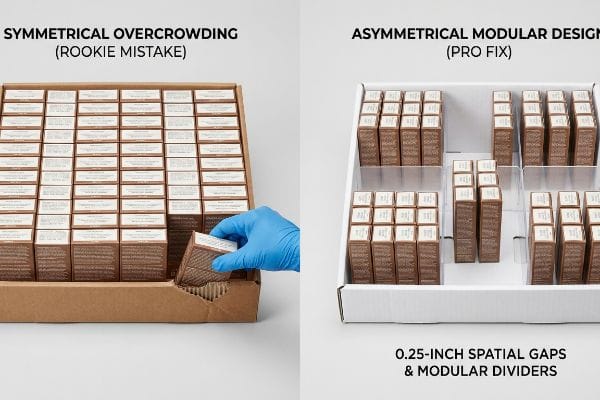
Many packaging files look perfectly symmetrical in CAD (Computer-Aided Design) software, but mathematical perfection often creates operational nightmares in the aisle.
The Asymmetry Rule for POP (Point of Purchase) Merchandising
Junior designers frequently attempt to flat-pack a dense, perfectly symmetrical grid of products onto a single display shelf, assuming maximum density automatically yields higher sales volume. They try to squeeze every possible millimeter of space, building tight matrices that leave absolutely zero physical breathing room between the individual packages.
This symmetrical overcrowding creates massive physical friction during restocking operations. I regularly see store clerks tearing the raw corrugated retaining lips when trying to force tight items onto a fully packed tray. The tearing sound of a 32ECT kraft liner giving way completely ruins the premium brand aesthetic before the customer even sees it. I fix this by strictly mandating the 3-5-7 asymmetry rule12 in our structural engineering. I build dedicated modular dividers that naturally separate merchandise into odd-numbered clusters. This built-in structural spacing creates a psychological visual tension that forces the human eye to engage, while simultaneously providing the precise 0.25-inch (6.35 mm) physical clearance required for frictionless restocking13. You prevent costly retailer chargebacks from damaged units and keep the aisle looking flawless.
| Common Rookie Mistake | The Pro Fix | Retail-Floor Benefit |
|---|---|---|
| Packing items in tight grids | Using asymmetrical odd layouts14 | Pulls shopper visual focus faster |
| Leaving zero clearance for hands | Adding 0.25-inch spatial gaps15 | Stops clerks from tearing cardboard |
| Removing internal dividers | Engineering modular structural walls | Keeps inventory perfectly aligned |
Visual tension sells, but physical tension destroys. Engineering deliberate spatial gaps into your trays ensures your brand presentation remains immaculate through weeks of heavy consumer interaction.
🛠️ Harvey's Desk: Are your store clerks destroying your display lips because the product grid is engineered too tight? 👉 Claim Your Free Divider Blueprint ↗ — No forms that trigger endless sales calls. Just pure value.
Why Are Displays so Important in Any Retail Environment?
Ultimately, these structures are the only physical defense your merchandise has against the brutal kinetic realities of global supply chains and massive warehouse sorting systems.
Displays are so important in any retail environment because they act as precise structural shields, absorbing massive top-load compression to prevent inventory damage. A precisely engineered merchandiser ensures heavy warehouse logistics do not compromise product packaging, guaranteeing your brand arrives on the active floor structurally flawless.
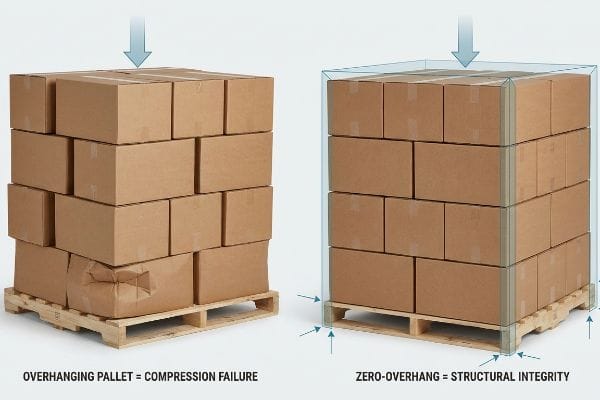
Getting one display to stand up perfectly in a controlled testing lab is easy, but here is the harsh reality when you ship 500 of them across the ocean.
The Kinetic Reality of BCT (Box Compression Test) Failure
Procurement teams often maximize master carton dimensions to fit more units into a container, assuming a heavy-duty board's raw compression metrics will automatically protect the goods. They design the shipping boxes to maximize internal volume, completely ignoring the strict physical perimeter of the standard 48×40 inch (1219×1016 mm) GMA pallet16 they will eventually sit on.
This isn't just theory—I see this systemic trap cause catastrophic buckling on the receiving dock. A buyer will approve a footprint that overhangs the wood pallet by just 0.43 inches (10.9 mm) to squeeze in one more SKU. They don't realize that a corrugated box derives up to 60% of its vertical compression strength17 strictly from the alignment of its four corners. When I load an overhanging carton into a hydraulic compression press, the unsupported bottom tier visibly bows outward and catastrophically crushes under just 187.5 lbs (85 kg) of top-load pressure. The physical fix is ruthless data-driven correction. I strictly enforce a zero-overhang bounding box in the prepress software, artificially shrinking the maximum allowable carton footprint by exactly 0.5 inches (12.7 mm) inside the pallet perimeter. By enforcing this strict tolerance, I ensure the structural corners bear the total compressive force, preventing bottom-tier sag and completely eliminating the transit damages that trigger massive retailer chargebacks.
| Common Rookie Mistake | The Pro Fix | Retail-Floor Benefit |
|---|---|---|
| Overhanging the wood pallet base | Enforcing a zero-overhang boundary | Preserves 60% of corner strength18 |
| Relying on theoretical board stats | Shrinking the footprint by 0.5 inches | Stops bottom tiers from crushing |
| Ignoring dynamic top-weight | Aligning flutes perfectly vertical19 | Survives harsh warehouse stacking |
A procurement team's desire for maximum density must never override basic warehouse physics. If master carton corners aren't locked over solid wood, your theoretical compression stats are entirely worthless when forklifts engage.
🛠️ Harvey's Desk: Do you know if your current master cartons overhang the standard GMA pallet perimeter by even a fraction of an inch? 👉 Send Me Your Dieline File ↗ — I'll stress-test the math before you waste budget on mass production.
Conclusion
You can ignore the geometry of warehouse logistics, but when a 0.5-inch pallet overhang causes bottom-tier displays to crush, resulting transit damages will wipe out your campaign's profit margin through severe retailer chargebacks. Over 500 brand managers use my prepress checklist to avoid these exact fatal early-stage mistakes. Stop guessing on structural tolerances and let me personally audit your packaging geometry through a Free Dieline Pre-Flight Audit ↗ to lock down your payload math before you cut a board.
"Temporary, Semi-Permanent & Permanent Retail Displays", https://www.tphinc.com/custom-point-of-purchase-pop-pos-retail-store-displays-packaging-blog/temporary-semi-permanent-permanent-pallet-displays/. Evidence demonstrating the industry tendency to use permanent fixtures for temporary promotions despite logistical inefficiencies. Evidence role: industry practice; source type: retail marketing analysis. Supports: the prevalence of permanent structures in short-term setups. Scope note: focuses on B2B retail procurement patterns. ↩
"Intermodal container – Wikipedia", https://en.wikipedia.org/wiki/Intermodal_container. Verification of the volumetric shipping capacity of pre-assembled metal retail racks in a standard 40ft High Cube container. Evidence role: technical verification; source type: logistics data; Supports: freight cost comparison. Scope note: Actual count depends on specific rack dimensions. ↩
"Packaging and Logistics Planning for Retail Displays – Frank Mayer", https://www.frankmayer.com/blog/packaging-and-logistics-planning-for-retail-displays/. Evidence of the volumetric density achieved by shipping flat-packed corrugated retail displays compared to assembled hardware. Evidence role: technical verification; source type: packaging industry specification; Supports: logistics efficiency claim. Scope note: Subject to display size and material thickness. ↩
"Flat Pack vs Assembled Cardboard Displays: Cost, Shipping & Setup", https://leader-display.com/flat-pack-vs-assembled-cardboard-display/. Verification of freight cost and volume reduction when using flat-pack corrugated materials compared to pre-assembled metal displays. Evidence role: Quantitative comparison; source type: Logistics whitepaper. Supports: Freight efficiency. Scope note: Comparison depends on unit size. ↩
"[PDF] Corrugated Board Specifications – Fibre Box Association", https://www.fibrebox.org/assets/2025/09/Walmart_Corrugated-Board_Specifications_Automation_Packaging_Standards.pdf. Technical documentation on the structural integrity and weight capacity of double-wall corrugated board in retail architecture. Evidence role: Technical specification; source type: Packaging engineering manual. Supports: Payload safety. Scope note: Load capacity varies by board grade. ↩
"Folding Carton Box Options & Features | The Box Co-op", https://www.boxcoop.com/folding-carton-options. Empirical data or manufacturer specs regarding the reduction in assembly time using friction-lock mechanisms versus traditional fasteners. Evidence role: Performance metric; source type: Industrial design study. Supports: Setup speed. Scope note: Time may vary by user experience. ↩
"The Hidden Risks of Poor POS Display Assembly (And How to Avoid …", https://www.eliteprintingandpackaging.com/blog/the-hidden-risks-of-poor-pos-display-assembly-and-how-to-avoid-them/. Professional retail design guidelines discuss the common failure of optimizing POS layouts for screen-based viewing rather than physical shopper distance. Evidence role: industry practice analysis; source type: retail design guide. Supports: the claim that designers often overlook physical scale. Scope note: applies to general visual merchandising. ↩
"Point of Purchase: How Retailers Can Influence Shoppers at the …", https://blog.intouch.com/posts/points-of-purchase-displays. Verification of the 3-3-3 rule as a recognized industry heuristic for retail visual merchandising and shopper engagement. Evidence role: conceptual validation; source type: retail design manual or marketing study. Supports: The framework for capturing attention at varying distances. Scope note: Application may vary across different retail environments. ↩
"[PDF] Guidelines for Retail Grocery Stores – Ergonomics for the … – OSHA", https://www.osha.gov/sites/default/files/publications/OSHA3192.pdf. Validation of the specific 50-inch measurement as the optimal 'strike zone'for shopper physical interaction and visual engagement. Evidence role: technical specification; source type: industrial design guide or consumer behavior study. Supports: The effectiveness of the three-foot engagement phase. Scope note: Likely refers to ergonomic reach or eye-level placement. ↩
"Complete Guide to Point-of-Purchase Displays for Retail Stores", https://colorreflections.com/digital-printing-news/the-complete-guide-to-point-of-purchase-displays-for-retail-stores/. Evidence regarding the effective distance at which high-contrast spot colors attract consumer attention in a retail environment. Evidence role: quantitative validation; source type: visual merchandising study. Supports: the effectiveness of bold colors for long-range visibility. Scope note: Effectiveness may vary based on store lighting and aisle width. ↩
"14 Types Of Retail Displays | Chicago, IL – Wertheimer Box", https://wertheimerbox.com/types-of-retail-displays/. Industry standards regarding display lip height and the resulting percentage of product visibility to the consumer. Evidence role: technical specification; source type: retail design guideline. Supports: the claim that reduced lip height increases visibility to 85%. Scope note: Result depends on the height of the product being displayed. ↩
"Key Principles of Visual Merchandising – PopDisplay", https://popdisplay.me/key-principles-of-visual-merchandising/. Verification of whether the 3-5-7 asymmetry rule is a recognized industry standard for visual merchandising and structural engineering in POP displays. Evidence role: technical validation; source type: design manual or merchandising handbook. Supports: the claim that odd-numbered clusters increase consumer engagement. Scope note: may be a proprietary or niche design framework. ↩
"Corrugated Retail Displays – The BoxMaker", https://www.boxmaker.com/retail-displays/. Evidence for the specific measurement of physical clearance necessary to prevent corrugated damage and facilitate efficient restocking in PDQ trays. Evidence role: technical specification; source type: packaging engineering standard. Supports: the physical requirement for frictionless restocking. Scope note: specific to corrugated cardboard tolerances. ↩
"Assessing Consumer Attention and Arousal Using Eye-Tracking …", https://pmc.ncbi.nlm.nih.gov/articles/PMC8380820/. Peer-reviewed research on visual merchandising and asymmetry supports how non-linear patterns attract consumer attention faster than symmetric grids. Evidence role: Theoretical validation; source type: Academic journal. Supports: The psychological efficiency of asymmetrical layouts in pulling shopper focus. Scope note: Effectiveness may vary by product category. ↩
"Custom Cardboard Display Boxes | Teal", https://tealpackaging.com/product/display-boxes/?srsltid=AfmBOooU2Gc8mEJnCX3Dv_mrzKmaXuC8nuzD9DgKQ26O2G2Ehq7E6sqF. Industry standards for point-of-purchase packaging engineering specify minimum clearances to prevent structural fatigue and tearing during manual restocking. Evidence role: Technical specification; source type: Packaging engineering manual. Supports: The use of specific spatial gaps to preserve display integrity. Scope note: Exact measurements may vary based on material gauge. ↩
"48×40" GMA Pallets | Largest Pallet Manufacturer & Supplier", https://www.palletone.com/products/gma-pallets/. Verification of the industry-standard dimensions for Grocery Manufacturers Association (GMA) pallets in North America. Evidence role: factual verification; source type: industry standard. Supports: the specific physical perimeter constraints mentioned. Scope note: Standard applies specifically to North American logistics. ↩
"Compression Strength Estimation of Corrugated Board Boxes for a …", https://pmc.ncbi.nlm.nih.gov/articles/PMC9864211/. Authoritative packaging engineering literature or BCT (Box Compression Test) standards verifying the proportion of load-bearing capacity provided by corner walls. Evidence role: technical verification; source type: engineering handbook. Supports: the claim that corner alignment is the primary driver of vertical strength. Scope note: percentages may fluctuate based on flute type and board grade. ↩
"[DOC] Submitted version (672.09 KB) – VTechWorks", https://vtechworks.lib.vt.edu/bitstreams/359cd5e6-7099-48a8-9a3b-60aeee6db278/download. Technical analysis of how eliminating pallet overhang prevents the loss of vertical load-bearing capacity in corrugated containers. Evidence role: technical verification; source type: logistics engineering study. Supports: the specific percentage of structural integrity preserved. Scope note: specific to corrugated fiberboard structures. ↩
"Testing methods and effects of interflute buckling – BioResources", https://bioresources.cnr.ncsu.edu/resources/overview-of-recent-studies-at-ipst-on-corrugated-board-edge-compression-strength-testing-methods-and-effects-of-interflute-buckling/. Material science documentation demonstrating that vertical flute orientation maximizes the BCT (Box Compression Test) value by optimizing axial load paths. Evidence role: scientific principle; source type: packaging engineering manual. Supports: the necessity of vertical alignment for warehouse stacking survival. Scope note: standard for corrugated fiberboard. ↩