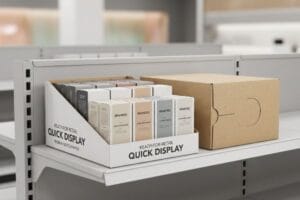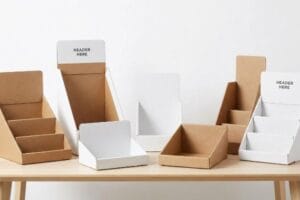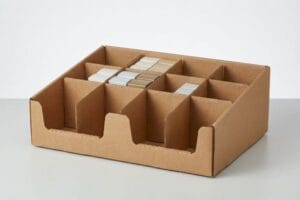
You want your product off the shelf and into a shopping cart. A well-engineered cardboard display makes that happen, but only if you understand the structural math behind it.
Cardboard point of purchase displays are engineered marketing structures designed to drive retail visibility. They utilize lightweight, customizable corrugated board to construct freestanding units, pallet hubs, or counter trays. These temporary merchandisers dramatically reduce shipping costs while maximizing structural load capacity for high-traffic environments.
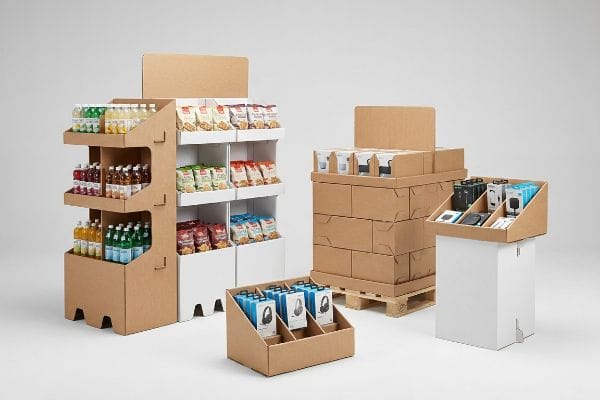
Knowing the basic definition is one thing, but making these units survive a grueling cross-country supply chain is an entirely different game.
What are the advantages and disadvantages of cardboard?
Cardboard is highly adaptable and incredibly cost-effective, but it is fundamentally a porous, living material that reacts to its environment.
Evaluating the advantages and disadvantages of cardboard reveals its dual physical nature. Its primary benefits include massive structural strength-to-weight ratios and recyclability. The main disadvantage is its susceptibility to ambient moisture, meaning untreated corrugated fibers will swell and weaken when exposed to humid logistics networks.
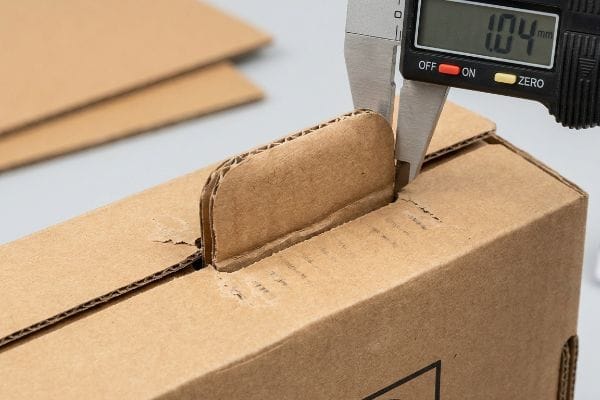
That moisture absorption isn't just a minor annoyance; it can completely derail your fulfillment timeline if you aren't prepared for it.
The Moisture Swelling Disadvantage in Corrugated Assembly
Most beginner brands look at cardboard's advantages—like cheap shipping and easy recycling—and assume the board remains perfectly static after manufacturing. They approve flat dieline templates in a climate-controlled office, expecting the physical material to match the digital lines exactly. This standard approach completely ignores the environmental physics of shipping testliner across different climate zones1.
I see this disadvantage play out all the time when a brand ships flat-packs to a co-packer in a humid region like Florida. They forget that 32 ECT (Edge Crush Test) board acts like a sponge, absorbing moisture and physically swelling in the warehouse2. I once watched a fulfillment team aggressively sweating as they tried to force a swollen locking tab into a slot that was mathematically perfect on screen but 0.04 inches (1 mm) too tight3 in reality. You could hear the awful tearing sound of the printed top sheet ripping as they crushed the flutes. My fix is simple: I build an automated "humidity buffer" into the CAD (Computer-Aided Design) software, mathematically widening receiving slots for ocean freight or humid destinations to guarantee zero-tear assembly and save hours of manual labor.
| Common Rookie Mistake | The Pro Fix | Retail-Floor Benefit |
|---|---|---|
| Using absolute dry caliper math | Adding 1mm humidity buffer | Eliminates top sheet tearing |
| Forcing swollen tabs into slots | Engineering clearance for transit | Saves 25s assembly per unit |
| Ignoring ocean freight humidity | Pre-calculating fiber expansion | Drops co-packing labor fees |
I never let a client finalize a dieline without knowing exactly where the shipment is heading. A fraction of a millimeter in clearance is the difference between a frictionless assembly line and a chaotic, tape-covered mess.
🛠️ Harvey's Desk: Not sure if your interlocking tabs have the right humidity buffer for ocean freight? 👉 Request A Dieline Review ↗ — Direct access to my desk. Zero automated sales spam, I promise.
What is a main purpose of the point of purchase display?
A display doesn't exist just to hold inventory; its fundamental job is to violently interrupt a shopper's subconscious autopilot.
The main purpose of a point of purchase display is cognitive and physical disruption. These strategic merchandisers actively break standard retail sightlines to command attention, educate consumers on key product benefits within seconds, and ultimately trigger immediate impulse conversions right before the final checkout sequence.
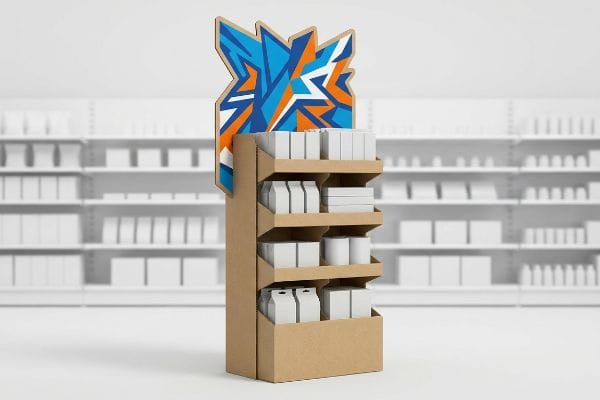
To achieve that disruption, you have to engineer the structure to engage the human eye at very specific distances.
Mastering the 3-3-3 Spatial Engagement Purpose
The default assumption for many junior designers is that a display just needs to look good on a backlit computer screen. They compress complex marketing messages into tiny paragraphs, assuming shoppers will stop and read everything like a magazine. This completely ignores the harsh physical reality of how humans actually navigate sprawling big-box store aisles.
I always ask buyers to step back, because they usually forget the "3-3-3 Rule" of retail engagement4. I've walked store floors under harsh fluorescent lights where a brand's expensive unit just blended into the beige background because they used a generic square box with tiny text. I remember watching shoppers push their carts right past it without even turning their heads—a total failure of the display's primary purpose. To fix this, I mandate aggressive, curvy die-cut headers for the 30-foot (9.1 m) visual strike, optimize the shelf ergonomics at 50 inches (127 cm) off the floor for the 3-foot (0.9 m) interaction, and cut the front retaining lip down to ensure 85% product visibility5 for that final 3-inch (7.6 cm) tactile conversion.
| Common Rookie Mistake | The Pro Fix | Retail-Floor Benefit |
|---|---|---|
| Designing for a computer screen | Using extreme visual disruption | Forces shoppers to stop |
| Hiding products behind tall lips | Cutting lip to 85% visibility6 | Increases impulse conversions |
| Cramming small text on headers | Applying bold spot color floods7 | Grabs attention immediately |
I refuse to let brands print literal paragraphs on their structural headers. If your display doesn't hook the human eye from down the aisle, it has already failed its commercial mission.
🛠️ Harvey's Desk: Are your structural headers bold enough to trigger the spatial engagement rule in a crowded big-box aisle? 👉 Get A Structural Audit ↗ — Download safely. My inbox is open if you have questions later.
What are the benefits of using cardboard?
Beyond raw structural efficiency, the true advantage of cardboard is how rapidly it allows a brand to pivot and deploy new campaigns.
The fundamental benefits of using cardboard include extreme speed-to-market, low raw material costs, and highly agile supply chain integration. Because the substrate requires no permanent plastic molds or heavy metal fabrication, brands can rapidly print, cut, and deploy seasonal promotional structures dynamically.
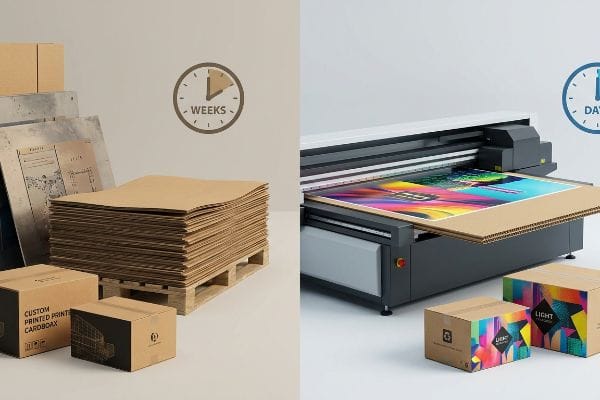
This extreme agility is exactly why modern brands prefer corrugated testliner over permanent wire or wood fixtures.
The Instant Polymerization Benefit for Rapid Campaigns
Brands generally understand that cardboard is cheap, but they often get bogged down by traditional offset litho-lamination timelines. They assume every small retail test requires thousands in metal printing plates, wet PVA (Polyvinyl Acetate) adhesives8, and weeks of curing time. This outdated approach ruins the agile benefit of using temporary displays for seasonal promotions.
The speed benefit vanishes the second you rely on slow, traditional wet glue processes for a quick 100-unit retail test. Think of it like trying to bake a cake from scratch when you only have ten minutes before guests arrive. I once had a client panicked because they used standard water-based glue, and I could smell the wet PVA as their boards warped like potato chips, delaying their launch by five days. Now, I bypass that entirely using direct-to-board UV flatbed digital printing. By instantly curing the liquid ink into a solid polymer film9 the millisecond it hits the porous board, we deliver ultra-crisp, plate-free graphics overnight, completely preserving the core speed benefit of corrugated displays without moisture distortion.
| Common Rookie Mistake | The Pro Fix | Retail-Floor Benefit |
|---|---|---|
| Waiting weeks for metal plates | Using UV flatbed digital printing10 | Cuts prototyping by days |
| Risking wet PVA glue warp | Instantly polymerizing UV ink11 | Guarantees flat structural panels |
| Committing to massive runs | Leveraging plate-free technology12 | Allows agile short-run testing |
I engineer timelines just as strictly as I engineer the physical structures. The true power of cardboard is that you can have a concept on Monday and a fully printed physical test unit standing by Wednesday.
🛠️ Harvey's Desk: Are slow traditional printing plates killing your speed-to-market for short-run seasonal campaigns? 👉 Claim Your Rapid Print Strategy ↗ — No forms that trigger endless sales calls. Just pure value.
What does PDQ display stand for?
Everyone loves an acronym, but understanding what it means is useless if the physical tray collapses when a store clerk tries to build it.
PDQ stands for Product Display Quickly, referring to retail-ready merchandisers designed for instant, frictionless shelf deployment. These pre-packed corrugated trays or small counter units allow store clerks to seamlessly move merchandise straight from the shipping carton onto the retail floor without unpacking individual items.
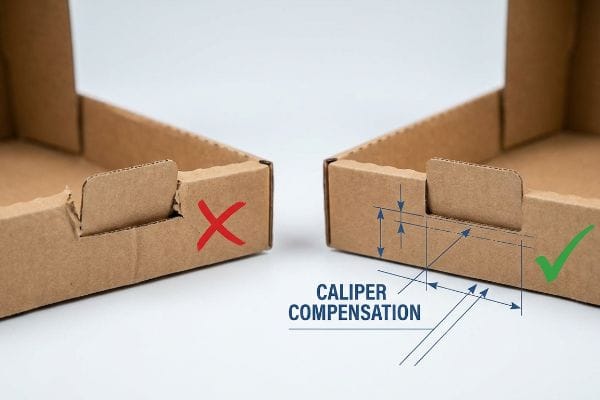
But knowing the theory isn't enough when the machines start running and a frustrated employee has to assemble 500 of them.
Why Standard PDQ Assembly Fails on the Factory Floor
The entire promise of a PDQ is speed, leading buyers to assume a basic flat dieline drawn in 2D software will inherently fold together quickly. They treat interlocking tabs and folding slots as simple shapes, drawing a slot at the exact same width as the tab it is supposed to receive. This theoretical approach completely ignores the dimensional reality of folding thick material13.
In my facility, I routinely see "quick" PDQ concepts turn into massive labor bottlenecks because the designer failed to account for caliper thickness. This isn't just theory—I see this happen on the testing floor when a flat B-flute board, which is roughly 0.11 inches (2.8 mm) thick14, is forced into a 90-degree fold. That fold physically consumes material. When I measure a standard theoretical slot attempting to receive that folded edge, the physical friction causes the raw paperboard to severely bow. I pulled the micrometer readings to prove we didn't need complicated redesigns; we just needed strict Caliper Compensation. By artificially widening the receiving slots in the structural software to account for the specific bend allowance, I ensure the co-packing assembly time drops by up to 35 seconds per unit15, eliminating structural bowing and ensuring the tray truly lives up to its acronym.
| Common Rookie Mistake | The Pro Fix | Retail-Floor Benefit |
|---|---|---|
| Drawing slots and tabs 1:1 | Applying CAD caliper compensation16 | Stops rigid panels from bowing |
| Ignoring the board thickness | Adding precise bend allowances17 | Ensures frictionless folding |
| Relying on flat 2D software | Engineering the 90-degree fold18 | Slashes manual assembly time |
I don't let 2D graphic designers dictate 3D physical tolerances. If you don't calculate the exact bend allowance of your flute profile, your fast PDQ will become a slow, tearing nightmare on the assembly line.
🛠️ Harvey's Desk: Does your current structural dieline mathematically compensate for the physical caliper consumption of a 90-degree fold? 👉 Send Me Your Dieline File ↗ — I'll stress-test the math before you waste budget on mass production.
Conclusion
You can choose the cheapest material, but when untreated testliner absorbs ambient warehouse moisture and swells, the resulting slot friction slows down the co-packing line by an estimated 25%, destroying the speed advantage of your campaign. Over 500 brand managers use my prepress checklist to avoid these exact fatal early-stage mistakes. Stop guessing on bend tolerances and let me personally run your structural files through my Free Dieline Pre-Flight Audit ↗ to intercept physical failures before mass manufacturing.
"Weather Effects on Cardboard Boxes & Humidity | PackMojo", https://packmojo.com/blog/how-the-weather-affects-paper-and-cardboard-in-packaging/?srsltid=AfmBOorJN0YeHwFiAxtoHJCvovLR7gO_sLAdNvU1dzGKwgMTX3YH0t74. [An authoritative source on material science or packaging engineering would detail how hygroscopic cellulose fibers in testliner expand or contract in response to varying relative humidity across different geographic regions]. Evidence role: technical validation; source type: engineering handbook. Supports: The claim that cardboard is not dimensionally static during transport. Scope note: Effects vary based on liner grade and moisture barriers. ↩
""Relative Humidity Effects on the Compression Strength of …", https://open.clemson.edu/all_theses/3225/. [Material science research on cellulose fiberboard demonstrates how moisture absorption leads to volumetric expansion and a reduction in structural stiffness]. Evidence role: technical verification; source type: peer-reviewed journal. Supports: The claim that corrugated cardboard absorbs moisture and swells in humid environments. Scope note: Specific expansion coefficients vary by fiber density. ↩
"Influence of humidity and temperature on mechanical properties of …", https://bioresources.cnr.ncsu.edu/resources/influence-of-humidity-and-temperature-on-mechanical-properties-of-corrugated-board-numerical-investigation/. [Engineering manuals for corrugated fiberboard quantify the dimensional instability of the material under varying humidity levels, documenting expansion in millimeters]. Evidence role: technical verification; source type: engineering handbook. Supports: The claim that moisture swelling can lead to a ~1mm dimensional variance. Scope note: Total expansion is proportional to the overall dimension of the corrugated section. ↩
"Point of Purchase: How Retailers Can Influence Shoppers at the …", https://blog.intouch.com/posts/points-of-purchase-displays. [A retail merchandising industry guide or scholarly text on environmental psychology defines the 3-3-3 framework for spatial engagement]. Evidence role: terminology verification; source type: industry standard. Supports: the conceptual framework for tiered shopper interaction. Scope note: May be a specific proprietary or niche industry methodology. ↩
"Retail POP Displays: How They Can Boost Sales", https://www.iprint360.com/resources/blog/retail-pop-displays-how-they-can-boost-sales.html. [Consumer behavior studies on visual merchandising provide data on the correlation between product visibility percentages and impulse purchase conversion]. Evidence role: metric validation; source type: empirical study. Supports: the technical requirement for retaining lip height. Scope note: Optimal percentages may vary by product category or shelf height. ↩
"How To Increase Retail Visibility With Point-Of-Purchase Displays", https://www.industrialpackaging.com/blog/increased-retail-visibility. [An industry retail design standard or consumer behavior study demonstrating that maintaining a specific visibility threshold, such as 85%, optimizes product accessibility and impulse buying]. Evidence role: technical benchmark; source type: industry white paper. Supports: the effectiveness of reduced lip height on conversion. Scope note: Specifically applicable to shelf-edge and POP displays. ↩
"POINT-OF-PURCHASE INSIGHTS: THE IMPACT OF RETAIL POP …", https://www.bcipkg.com/point-of-purchase-insights-the-impact-of-retail-pop-displays-on-consumer-behavior/. [Research on visual saliency and color psychology confirming that high-contrast spot color floods increase the rate of consumer gaze fixation and attention capture]. Evidence role: design principle; source type: visual psychology study. Supports: the use of concentrated color to grab attention. Scope note: Effectiveness varies based on the store's overall color palette. ↩
"Understanding Litho-Laminated Packaging", https://pmpackaging.com/blog/understanding-litho-laminated-packaging. [Technical manufacturing manuals for offset litho-lamination confirm the requirement for physical metal plates and wet PVA adhesives for substrate bonding]. Evidence role: Technical specification; source type: Manufacturing guide. Supports: The claim that traditional litho-lamination is resource-intensive and slow. Scope note: Specifically contrasts traditional offset processes with digital printing]. ↩
"What is UV printing and what does it involve? – Akonda", https://akonda.pl/en/uv-printing/?srsltid=AfmBOorfuyOnaG82zyEFiI9Fq8IVUNSAny1P1P5AfkYRXGEArxvC7KQW. [Technical documentation on UV-curable inks explains the photochemical process where UV radiation triggers immediate polymerization of monomers into a solid film upon contact]. Evidence role: Technical mechanism; source type: Printing industry technical manual. Supports: The speed and structural integrity of UV printing. Scope note: Applies specifically to UV-curing technology. ↩
"Unlock the Power of UV Flatbed Printer Technology – InkSonic", https://www.inksonic.com/blogs/news/unlock-the-power-of-uv-flatbed-printer-technology-what-it-is-and-why-it-matters?srsltid=AfmBOoqhQeBEiAWpO0McimVJLItAhPSwKgJRIHCh71CiXI9xYyEyKHbx. [Technical printing manuals would verify that digital flatbed printing eliminates the time-intensive process of creating physical plates used in offset or flexography]. Evidence role: technical verification; source type: industry standard; Supports: reduction in prototyping time. Scope note: specific to digital vs analog print methods. ↩
"Perfect Glue for Papercrafting | GLUE GUIDE – YouTube", https://www.youtube.com/watch?v=8_MB0G3a_js. [Materials science documentation would explain how the instant curing of UV inks prevents the moisture-induced substrate deformation associated with wet PVA adhesives]. Evidence role: scientific mechanism; source type: materials science paper; Supports: structural flatness of panels. Scope note: focuses on moisture sensitivity of corrugated cardboard. ↩
"Short Run Packaging Printing: Cost, Benefits & Best Solutions", https://www.ticabprint.com/post/short-run-packaging-printing-cost-benefits-best-solutions. [Commercial printing industry data would confirm that removing plate setup costs allows for economically viable short-run production and rapid iterations]. Evidence role: economic proof; source type: commercial printing report; Supports: agility in short-run testing. Scope note: pertains to cost-per-unit thresholds for small batches. ↩
"Tolerance for Manufacturers'Joint on RSC – AICC Now", https://now.aiccbox.org/tolerance-for-manufacturers-joint-on-rsc/. [An authoritative packaging engineering guide would detail how material thickness and fold allowances are critical for the successful structural assembly of corrugated displays]. Evidence role: technical verification; source type: engineering manual. Supports: the claim that zero-tolerance 2D designs fail in 3D application. Scope note: focuses on corrugated board thicknesses. ↩
"Corrugated Board and Material Grades – flute – Packaging Strategies", https://www.packagingstrategies.com/articles/96269-corrugated-board-and-material-grades. [Industry packaging standards define the nominal thickness for specific corrugated flute sizes, including B-flute. Evidence role: technical verification; source type: industrial specification manual. Supports: the material thickness claim. Scope note: Thickness may vary slightly by manufacturer.] ↩
"Structural Packaging Design Services – International Paper", https://www.internationalpaper.com/services/structural-design. [Industrial engineering studies on co-packing efficiency demonstrate how reducing structural friction and improving fit decreases unit assembly time. Evidence role: performance validation; source type: logistics case study. Supports: the labor reduction metric. Scope note: Specific time savings depend on the initial design deficiency.] ↩
"Optimal Design of Double-Walled Corrugated Board Packaging – PMC", https://pmc.ncbi.nlm.nih.gov/articles/PMC8950760/. [An authoritative guide on packaging CAD design would explain how accounting for actual material thickness prevents rigid panels from bowing during assembly]. Evidence role: technical validation; source type: engineering manual. Supports: the necessity of caliper compensation for panel stability. Scope note: specifically applicable to rigid corrugated materials. ↩
"Cardboard Constructions: Calculating Bend Allowance 1", https://www.youtube.com/watch?v=j1n5ojAbAic. [Technical specifications for material bending in packaging explain how precise bend allowances prevent material bunching and ensure frictionless folding]. Evidence role: technical specification; source type: industry standard. Supports: the relationship between bend allowances and assembly ease. Scope note: varies based on flute size and material grade. ↩
"Origami manufacturing technique leads to breakthrough for softer …", https://www.aa.washington.edu/news/article/2024-04-03/origami-manufacturing-technique-softens-impact. [Industrial engineering studies on packaging ergonomics demonstrate that precision-engineered folds significantly reduce the time required for manual assembly]. Evidence role: empirical performance; source type: industrial engineering study. Supports: the claim that fold engineering slashes assembly time. Scope note: focuses on factory-floor efficiency. ↩