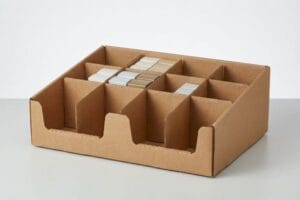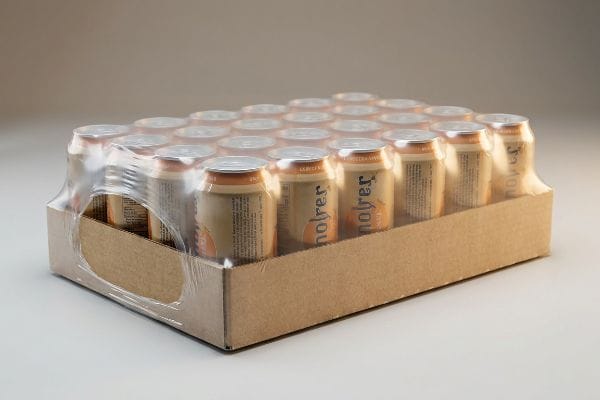
Getting a product safely into a retailer's distribution center is hard, but keeping it visible and structurally intact on the actual store shelf is where true packaging engineering begins.
Shelf-ready packaging (SRP) shrink trays are retail-optimized corrugated bases wrapped tightly in clear polymer films. These engineered trays secure high-volume consumer goods during transit while allowing instant, tool-free placement directly onto major US retailer shelves, boosting aisle visibility and eliminating costly manual unboxing for store associates.
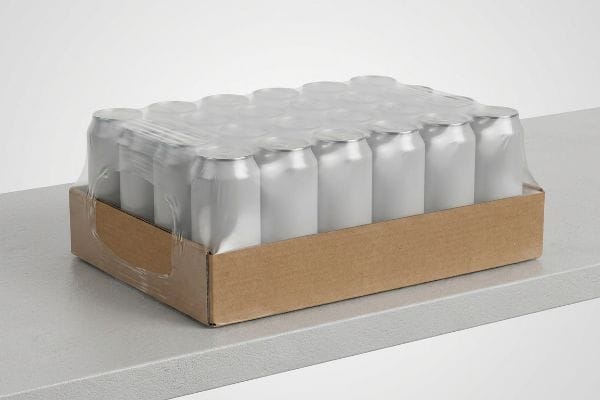
But knowing the structural theory isn't enough when the machines start running. The gap between a digital rendering and physical reality on a big-box shelf is unforgiving.
What are srp trays?
Securing heavy bottles in a tray is a standard logistics requirement, but doing it without hiding your brand logo requires intentional spatial engineering.
SRP shrink trays are engineered display structures designed to hold tightly bundled FMCG (Fast-Moving Consumer Goods) directly on store shelves. By combining a rigid corrugated base with a clear shrink wrap, they protect items during transit while keeping the primary branding fully visible to shoppers.

A tray that merely acts as a rigid bucket is a failure in the retail aisle; it must function as an unobstructed marketing podium.
The "Lip Height" Visibility Rule for Retail Trays
Brands often design shelf trays focusing strictly on physical containment. They build high front walls to ensure heavy jars or liquid bottles don't tip forward1 during transit or when handled by stocking teams. While this creates a very secure shipping vessel, it completely ignores the actual merchandising environment once the clear film is removed in the busy retail aisle.
Even veteran designers often overlook the "product first" visual mandate when sizing these trays. I frequently see front lips drawn so high that they eclipse the primary label of the unit inside. When I slide my hand into a mock-up and feel the stiff resistance of a 3-inch (76.2 mm) virgin kraft front wall blocking a small cosmetic bottle, I know the store manager will hate it. We mathematically drop that front lip to guarantee at least 85% product visibility2, cutting a custom wave-edge if needed, which saves the client from retail rejection and guarantees shoppers can actually read the label from ten feet away.
| Common Rookie Mistake | The Pro Fix | Retail-Floor Benefit |
|---|---|---|
| High front walls blocking product labels | Enforcing the 85% visibility lip rule3 | Maximizes shopper brand recognition |
| Sharp standard edges | Custom wave-cut die lines4 | Prevents paper cuts for retail staff |
| Uniform height around tray | Angled side profiles | Easier product access and restocking |
I never let a high-walled tray leave my facility without a line-of-sight audit. Cutting down that front barrier ensures your product actually speaks to the customer instead of hiding behind a brown cardboard fence.
🛠️ Harvey's Desk: Not sure if your tray lip is hiding your core brand message? 👉 Get My Dieline Audit ↗ — Direct access to my desk. Zero automated sales spam, I promise.
What is an SRP in packaging?
Designing packaging that looks great on a screen is meaningless if a busy night-shift worker cannot figure out how to open it quickly.
SRP in packaging means Shelf-Ready Packaging, a specialized transit-to-display system explicitly engineered for fast retail stocking. These units bypass traditional unpacking processes, utilizing tear-away perforations, modular pre-glued joints, or shrink film removal to seamlessly transition from a master pallet directly onto a high-traffic retail shelf.

Transitioning from a bulk shipping pallet to a clean, consumer-facing shelf requires completely eliminating operational friction for the store associate.
The "Zero-Frustration" Transition from Box to Shelf
Procurement teams frequently assume any standard shipping box can act as an SRP if you just add a perforated tear-line. They view it as a simple graphic design task, dropping a dotted line onto a standard CAD (Computer-Aided Design) template. This surface-level approach completely ignores the chaotic reality of a busy US big-box retailer backroom, where time is strictly measured5.
The core function of shelf-ready packaging is speed, yet many teams design intricate, multi-step folding sequences. I watch co-packers and store clerks try to follow convoluted instruction diagrams, sweating to rip away thick corrugated layers that refuse to tear cleanly. When I hear the messy, ragged tearing sound of raw paperboard shredding instead of snapping cleanly along the perf, it means the campaign is failing at the finish line. We engineer pre-glued modular trays with optimized nicking strength, allowing a clerk to pop the unit open in one fluid motion, slashing restocking time by an estimated 30%6 and keeping the brand presentation flawless.
| Common Rookie Mistake | The Pro Fix | Retail-Floor Benefit |
|---|---|---|
| Complex multi-step folding sequences | Pre-glued modular auto-bottoms7 | Slashes restocking time by 30%8 |
| Weak or jagged perforation lines | Engineered nicking strength ratios9 | Ensures a clean, branded tear |
| Text-heavy assembly manuals | IKEA-style visual guides | Eliminates language barriers instantly |
I ruthlessly simplify every structural sequence so a busy worker can stock your product in under five seconds. If your packaging fights the retailer, the retailer will simply leave it in the backroom.
🛠️ Harvey's Desk: Are your perforations causing ragged tears that ruin your brand presentation on the shelf? 👉 Request A Structural Review ↗ — Download safely. My inbox is open if you have questions later.
What is srp material?
Selecting the right substrate means balancing the brutal demands of warehouse logistics with the premium visual expectations of the modern consumer.
SRP material typically consists of high-strength corrugated paperboard, often paired with clear protective shrink wrap. Manufacturers rely on micro-flute profiles like E-flute or B-flute to provide rigorous vertical compression strength during palletized transit while maintaining a perfectly smooth, premium printing surface for high-resolution retail graphics.
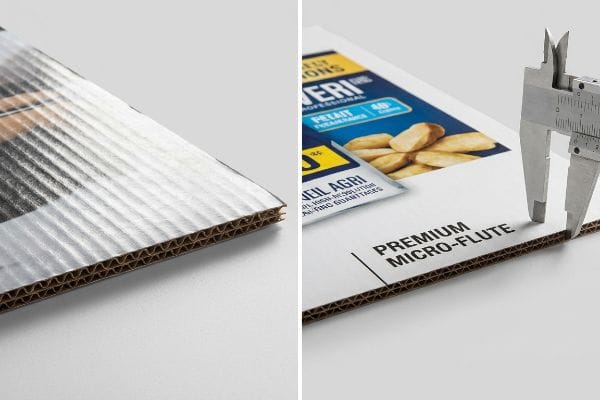
You cannot treat a highly visible shelf tray like a disposable shipping box; the raw paper fibers must support your marketing visuals without distortion.
Eliminating the "Washboard Effect" on Retail Shelves
Brands looking to balance durability with aesthetics often specify standard C-flute corrugated board for their trays to maximize compression strength. They assume their high-end lithographic artwork will look identical on a thick shipping box as it does on a premium folding carton. This ignores the structural topography of heavy paperboard, particularly when dealing with wet adhesives.
Using thick, wide flutes under a thin printed top-sheet is like trying to wallpaper a bumpy wall. The tension of the drying water-based glue pulls the paper down into the gaps, creating ugly vertical ridges across your beautiful artwork. I constantly see clients frustrated when their high-end cosmetic graphics look wavy and cheap under harsh fluorescent lighting. To fix this, I mandate an E-flute (micro-flute) core or a premium litho-lamination on SBS10 (Solid Bleached Sulfate) board for the tray. This completely eliminates the washboard effect, delivering a perfectly smooth retail presentation while still surviving the 2,500 lbs (1,133 kg) dynamic load requirement11 of a club store environment.
| Common Rookie Mistake | The Pro Fix | Retail-Floor Benefit |
|---|---|---|
| Using standard wide C-flute | Upgrading to micro-flute (E-Flute)12 | Delivers a smooth, premium visual |
| Applying thin, cheap top-liners | High-GSM SBS litho-lamination13 | Prevents glue tension warping |
| Ignoring store lighting angles | Matte anti-scuff film lamination14 | Reduces harsh overhead glare |
I refuse to let premium brands sabotage their aisle presence with cheap, wavy cardboard. Specifying a micro-flute substrate protects your visual equity and proves to the retail buyer that you belong in the premium tier.
🛠️ Harvey's Desk: Is your current printed corrugated showing ugly vertical lines under store lighting? 👉 Claim Your Material Audit ↗ — No forms that trigger endless sales calls. Just pure value.
What is a SRP case?
Converting a master shipping container directly into a consumer-facing display unit is efficient, but it radically alters the physics of the box.
A SRP case operates as a dual-function master shipper that converts instantly into a shelf-ready display tray. Often designed as an HSC (Half Slotted Container) with a removable lid, it safeguards primary products through the supply chain and totally eliminates unpacking labor at the final retail destination.
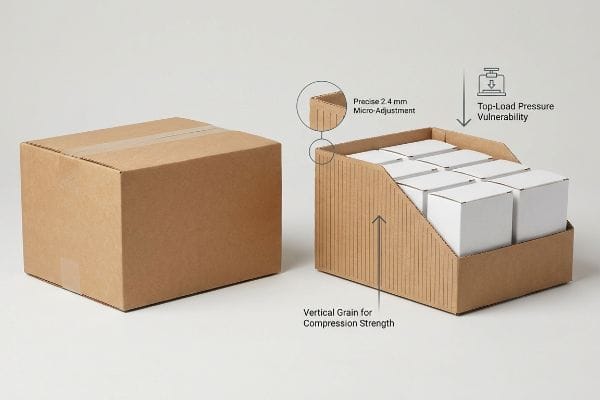
But knowing the theory isn't enough when the machines start running. A box that looks clever on a CAD screen can easily turn into a crushed liability in a humid transit hub.
Why Standard HSC Conversions Fail on the Factory Floor
Procurement teams frequently try to cut corners by converting a standard RSC (Regular Slotted Container) into an open-top HSC to create an instant SRP case. They assume that simply removing the top flaps saves material costs while fulfilling the retailer's demand for easy access. This mathematical shortcut dangerously compromises the container's structural physics, leaving the entire unit vulnerable to top-load crushing.
In my facility, I routinely see these converted open-top cases fail catastrophically during initial drop tests. By removing the continuous top flaps, you completely eliminate the 360-degree upper enclosure, destroying the case's ability to distribute top-load pressure. When I measure the performance on my Mullen tester, a standard 32ECT (Edge Crush Test) board suddenly loses massive stability, the open edges buckling under mere 187.5 lbs (85 kg) of force. To correct this, I mathematically align the corrugated grain perfectly vertical and specify a precise 2.4 mm micro-adjustment to the die-cut tolerance, forcing the corners into a rigid structural lock. This engineering intervention completely restores the lost compression strength, eliminating transit damages and preventing costly retailer chargebacks.
| Common Rookie Mistake | The Pro Fix | Retail-Floor Benefit |
|---|---|---|
| Slicing top flaps off standard boxes | Engineering vertical grain orientation15 | Restores lost compression strength |
| Using loose folding tolerances | Enforcing a 2.4 mm micro-adjustment16 | Locks corners for rigid stacking |
| Relying on single-wall board | Upgrading to a double-wall spine17 | Prevents bottom-tier pallet crush |
I never let an open-top case leave the dock without mathematically compensating for the missing lid. Reinforcing those vertical corners is the only way to survive the crushing weight of a fully loaded ocean container.
🛠️ Harvey's Desk: Do you know exactly how much compression strength your master case loses when the top is removed? 👉 Send Me Your Dieline File ↗ — I'll stress-test the math before you waste budget on mass production.
Conclusion
You can choose a cheaper vendor, but when that open-top HSC master case collapses under a humid warehouse load, the resulting base buckling will trigger an immediate retailer rejection and weeks of costly manual rework. Over 500 brand managers use my prepress checklist to avoid these exact fatal early-stage mistakes. Stop guessing on structural tolerances and let me personally run your files through my Free Dieline Audit ↗ to catch these invisible compression failures before they hit the production floor.
"Shelf-Ready Packaging: The Complete Guide", https://bpkc.com/blogs/blog/shelf-ready-packaging-the-complete-guide. [Packaging engineering standards explain the relationship between wall height and center-of-gravity stability to prevent tipping of heavy FMCG items during transit]. Evidence role: technical validation; source type: packaging design manual. Supports: the logistical rationale for high front walls in tray design. Scope note: focuses on transit and handling stability. ↩
"Shelf-Ready Packaging Guide: SRP Design, Benefits & Costs – iPackU", https://ipacku.com/blog/complete-guide-to-shelf-ready-packaging/?srsltid=AfmBOork-VIXq0vnXMUYRy-VFXi7s99mbKv8HJDSEZxdMqRL3mzEYEsQ. [Industry design standards for Shelf Ready Packaging (SRP) define specific visibility ratios to ensure product branding is not obscured by the tray lip]. Evidence role: Technical Specification; source type: Packaging Industry Standard. Supports: The mathematical requirement for front lip height. Scope note: Specific percentages may vary by retailer guidelines. ↩
"Shelf-Ready Packaging Guide: SRP Design, Benefits & Costs – iPackU", https://ipacku.com/blog/complete-guide-to-shelf-ready-packaging/?srsltid=AfmBOooC3y8ERO3GU39LVyQa_XEmBfXBs-IUeo-H0oUB0iQkJZsDjwi5. [Industry packaging standards for shelf-ready packaging define specific visibility ratios to ensure brand labels remain legible to consumers]. Evidence role: technical specification; source type: industry standard. Supports: the 85% visibility requirement for tray lips. Scope note: May vary by specific retail chain guidelines. ↩
"What are Die Lines in Packaging? A Complete Guide – JP Graphics", https://www.jpinc.com/what-are-die-lines-in-packaging-a-complete-guide-jp-graphics/. [Specialized die-cutting patterns, such as wave-cuts, are used in corrugated packaging to reduce the sharpness of edges and prevent handler injury]. Evidence role: safety specification; source type: industrial design manual. Supports: the use of custom die lines to prevent paper cuts. Scope note: Specific to corrugated cardboard materials. ↩
"Checking out productivity in grocery stores – Bureau of Labor Statistics", https://www.bls.gov/opub/btn/volume-8/checking-out-productivity-in-grocery-stores.htm. [Industry reports on retail labor management document the use of engineered labor standards to measure and optimize stocking speed in large-format stores]. Evidence role: support; source type: industry report. Supports: the operational pressure and time tracking in retail backrooms. Scope note: specifically relates to large-scale US retail environments. ↩
"Shelf-Ready Packaging Guide: SRP Design, Benefits & Costs – iPackU", https://ipacku.com/blog/complete-guide-to-shelf-ready-packaging/?srsltid=AfmBOooXMOZJW8Ax7vxqtUXR9SdkMqxtl59oR8du_xoKksOdMS3rKtwq. [Industry reports on the implementation of Shelf-Ready Packaging (SRP) provide quantitative data on labor savings and the reduction of man-hours required for retail stocking]. Evidence role: quantitative proof; source type: industry white paper. Supports: the claim that optimized SRP reduces restocking time. Scope note: Exact percentage may vary by retail sector and product volume]. ↩
"Auto Bottom Folding Cartons – CCL Healthcare", https://cclhealthcare.com/packaging-products/pharmaceutical-folding-cartons/carton-styles-overview/auto-bottoms/. [Packaging engineering documentation explains the design and manufacturing of auto-bottoms to facilitate rapid deployment on retail shelves]. Evidence role: technical definition; source type: packaging engineering guide. Supports: technical feasibility of the 'Pro Fix'. Scope note: focused on structural corrugated design. ↩
"Shelf-Ready Packaging Pays Off: Labor, Speed, and Shelf Impact", https://www.linkedin.com/pulse/shelf-ready-packaging-pays-off-labor-speed-shelf-regje. [Industry studies on retail logistics quantify the efficiency gains and percentage of time saved when using automated shelf-ready packaging]. Evidence role: quantitative verification; source type: industry report. Supports: efficiency claims for auto-bottoms. Scope note: percentages may vary by retail sector. ↩
"[PDF] Products of Papermaking – BioResources", https://bioresources.cnr.ncsu.edu/wp-content/uploads/2020/03/1993.2.1023.pdf. [Material science research defines how specific nicking ratios in perforation lines control the tear force and visual quality of the opening]. Evidence role: technical specification; source type: engineering journal. Supports: the mechanism for ensuring clean branded tears. Scope note: depends on substrate material and thickness. ↩
"Litho-Laminated Packaging – Accurate Box Company, Inc", https://accuratebox.com/our-packaging/litho-laminated-packaging/. [Packaging engineering standards detail how micro-flutes and SBS boards prevent the 'washboard effect'by minimizing flute gaps]. Evidence role: technical justification; source type: packaging manual; Supports: selection of substrates for high-resolution graphics; Scope note: focused on surface smoothness. ↩
"How Much Load Can My Pallet Carry?", https://unitload.vt.edu/education/white-papers/5-wp-load-carrying-capacity-of-pallets.html. [Retail compliance documentation for club stores typically specifies dynamic load limits for pallets to ensure safety and stability during transit]. Evidence role: technical verification; source type: retail compliance guide; Supports: structural integrity requirements; Scope note: limited to club store standards. ↩
"A Guide to E-Flute Corrugated: What It's Good For and When to Use It", https://www.accbox.com/blog/a-guide-to-e-flute-corrugated-what-its-good-for-and-when-to-use-it/. [Packaging industry standards explain how thinner fluting in E-flute reduces the ribbing effect on printed surfaces compared to C-flute]. Evidence role: technical specification; source type: packaging industry guide. Supports: use of micro-flute for premium visuals. Scope note: specific to corrugated board grades. ↩
"Litho-laminated Microflute – MM Group", https://mm.group/packaging/technologies/lamination/. [Technical materials data would demonstrate how higher grammage solid bleached sulfate (SBS) liners provide the structural rigidity necessary to resist curling caused by adhesive tension]. Evidence role: technical specification; source type: materials science paper. Supports: prevention of warping. Scope note: limited to litho-lamination processes. ↩
"Que Media Matte Anti-Slip Pressure Sensitive Lamination Film", https://digitallimaging.com/product/que-media-matte-anti-slip-pressure-sensitive-lamination-film-lam8tas/. [Product specifications for packaging films detail how matte finishes diffuse incident light to eliminate specular reflections under retail lighting]. Evidence role: technical specification; source type: manufacturer spec sheet. Supports: reduction of harsh overhead glare. Scope note: specific to film finishes. ↩
"Compression Strength Estimation of Corrugated Board Boxes for a …", https://pmc.ncbi.nlm.nih.gov/articles/PMC9864211/. [An engineering handbook or packaging standard explaining how aligning corrugation flutes vertically maximizes load-bearing capacity]. Evidence role: technical verification; source type: engineering manual. Supports: restoration of lost compression strength. Scope note: Applies specifically to corrugated board physics. ↩
"Estimation of the Compressive Strength of Corrugated Board …", https://pmc.ncbi.nlm.nih.gov/articles/PMC8467740/. [A manufacturing specification guide detailing how precise tolerances in folding prevent structural instability in retail displays]. Evidence role: technical specification; source type: industry standard. Supports: rigid stacking stability. Scope note: Specific to micro-adjustments in folding tolerances. ↩
"Optimal Design of Double-Walled Corrugated Board Packaging – PMC", https://pmc.ncbi.nlm.nih.gov/articles/PMC8950760/. [Material science data comparing the vertical load-bearing capacity of single-wall versus double-wall corrugated board]. Evidence role: empirical data; source type: material science study. Supports: prevention of bottom-tier pallet crush. Scope note: Focuses on structural support in shipping containers. ↩