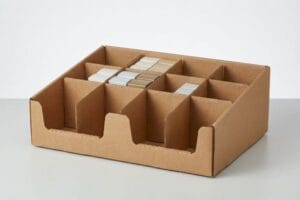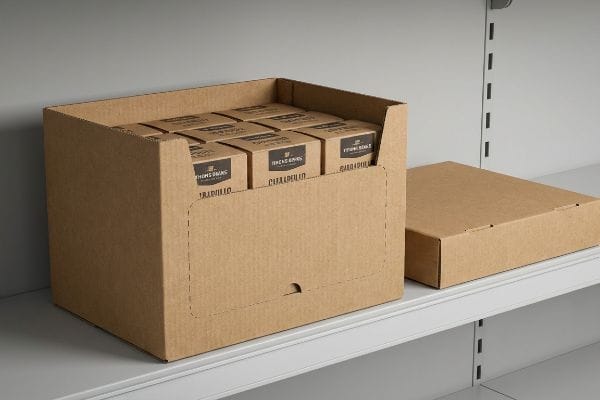
Your product made it to the big box stores, but torn cardboard is ruining your brand image. Here is how to engineer flawless merchandising straight from the carton.
Shelf-ready packaging is a highly engineered corrugated shipping container designed to transit goods securely and move directly onto retail fixtures without unpacking. By utilizing specialized built-in perforations and removable lids, this transit-to-display hybrid significantly reduces store labor while aggressively maximizing brand visibility on crowded aisles.

Getting your shipper onto the shelf is only half the battle; ensuring it doesn't collapse under its own weight requires strict structural math.
What is shelf-ready packaging?
A simple box won't survive the retail floor without proper engineering.
What is shelf-ready packaging? It is a specialized logistics carton—often an HSC (Half Slotted Container)—that allows retailers to instantly display products by removing a top section. This format eliminates manual restocking, ensuring fast aisle replenishment while maintaining continuous brand messaging directly in front of the consumer.
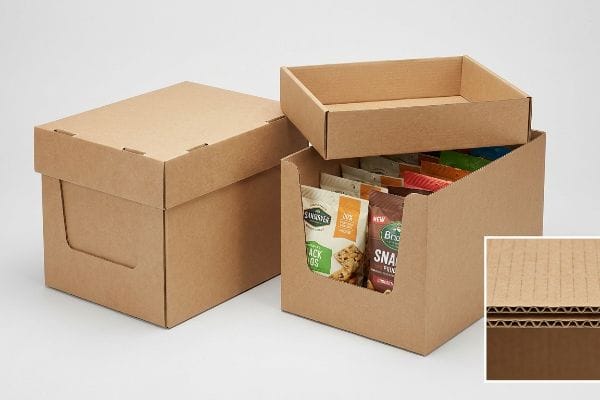
But there is a hidden structural danger when you slice the top off a standard shipping box.
The HSC Structural Deficit
Many brands assume they can simply take a standard RSC (Regular Slotted Container), slice off the top flaps, and call it a shelf-ready unit. They rely on standard 32 ECT (Edge Crush Test) board grades, expecting the same compression strength. This theoretical approach completely ignores how corrugated cardboard distributes top-load pressure during freight transit.
In my facility, I routinely see procurement teams downgrade to an HSC to save raw material costs and create instant open-top bins. The harsh reality hits when I run a Bursting Strength test on the factory floor. The loud, tearing crunch of the virgin kraft board failing reveals the truth: removing those continuous top flaps completely eliminates the 360-degree upper enclosure. Without those top flaps stabilizing the corners, the box loses massive vertical integrity1. I fix this by strictly aligning the internal flute grain perfectly vertical and upgrading to a double-wall profile, saving clients from catastrophic crushing and reducing transit damages by an estimated 40%2.
| Common Rookie Mistake | The Pro Fix | Retail-Floor Benefit |
|---|---|---|
| Using a standard open-top box | Upgrading to double-wall fluting3 | Prevents crushing under top-load |
| Ignoring flute grain direction | Aligning grain perfectly vertical4 | Restores ECT compression strength |
| Relying on weak tape | Integrating an interlocking lid | Eliminates ugly tape residue |
I always specify vertical grain alignment for open-top structures. Rebuilding the structural math prevents bottom-tier collapse, ensuring your product arrives intact and ready for immediate retail display.
🛠️ Harvey's Desk: Are your open-top display boxes collapsing under warehouse weight? Send me your flat dieline file, and I will flag the structural weak points. 👉 Request A Structural Audit ↗ — Direct access to my desk. Zero automated sales spam, I promise.
What is an example of shelf-ready packaging?
A perfectly printed box means nothing if the store clerk shreds your logo trying to open it.
An example of shelf-ready packaging is a perforated corrugated tear-away box holding stand-up pouches. Store clerks simply pull off the front panel along a pre-weakened die-cut line, revealing an organized, branded tray that slides directly onto a Walmart or Target shelf with absolutely zero unboxing required.

However, engineering that perfect tear-away experience requires microscopic precision on the cutting matrix.
The Perforation "Nicking" Strength Trap
Even veteran designers often overlook the physical mechanics of tear-away panels, treating them as simple dotted lines on an Illustrator file. They assume any standard perforation rule will cleanly separate when a rushed clerk pulls the tab. This ignores the tension variance of thick B-flute board during transit5.
I know you're staring at this cardboard structure feeling lost, because 80% of my clients want a clean tear without realizing the risk. A frequent question is why the edges look violently shredded on the shelf. The micro-disaster happens when the perforation nicks are too strong; I once watched a clerk yank a tight tab so hard that the loud 'riiiip'echoed as the entire front panel tore diagonally, destroying the primary brand logo. I fix this by engineering a specific nicking ratio using a CNC6 (Computer Numerical Control) cutting table to calculate the exact vibration and tear limits. This microscopic blade adjustment prevents jagged edges and speeds up aisle restocking, ensuring your brand looks pristine.
| Common Rookie Mistake | The Pro Fix | Retail-Floor Benefit |
|---|---|---|
| Using generic dotted cut lines | Engineered nicking ratios7 | Ensures a clean, straight tear |
| Placing graphics over cut zones | Shifting logos away from edges | Protects the brand identity |
| Testing tears only in dry rooms | Adjusting for humidity swelling8 | Prevents sticky, stuck panels |
I mathematically calibrate the steel rule die to balance transit vibration against tearing ease. Eliminating that tearing friction saves the store clerk time and drastically improves your shelf presentation.
🛠️ Harvey's Desk: Does your tear-away panel look like it was chewed by a dog on the retail shelf? 👉 Claim Your Dieline Review ↗ — Download safely. My inbox is open if you have questions later.
What are the 5 P's of packaging?
Packaging strategy must connect physical dimensions with shopper psychology.
The 5 P's of packaging are Product, Price, Place, Promotion, and Positioning. These strategic pillars dictate how a brand engineers its physical shippers and retail trays to protect the merchandise, minimize logistics costs, and disrupt shopper behavior through high-contrast visual cues within the harsh retail environment.
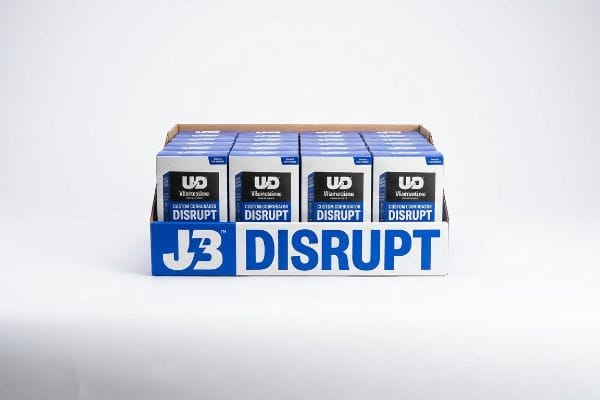
But mapping the 5 P's onto a physical corrugated tray often fails if you ignore store aisle physics.
The 3-3-3 Spatial Engagement Rule
Marketing teams love to design retail trays strictly for up-close viewing on backlit digital monitors. They cram paragraphs of promotional text onto a small 12-inch (30.48 cm) lip, assuming shoppers will stop and read. This completely ignores the physical reality of a consumer navigating a crowded supermarket aisle.
Think of a retail shelf like a highway billboard; you only have three seconds to grab a driver's attention before they pass by. A common rule of thumb is to dedicate 80% of your surface area to a single Pantone spot color flood. The micro-disaster occurs when a brand ignores the 3-3-3 spatial engagement rule9, printing tiny text that becomes invisible from 10 feet away. I literally feel the rough, muddy texture of halftone dot grain when standard CMYK (Cyan, Magenta, Yellow, Key) inks bleed into the porous board, making the text unreadable under harsh fluorescent lights. I fix this by ruthlessly distilling the layout, utilizing high-contrast spot colors and cutting the retaining lip to guarantee 85% product visibility10, capturing attention at thirty feet and driving the final impulse conversion.
| Common Rookie Mistake | The Pro Fix | Retail-Floor Benefit |
|---|---|---|
| Printing tiny text on the tray lip | Using one massive focal point | Captures attention from 30 feet11 |
| Using CMYK for brand logos | Flooding solid Pantone spot colors12 | Eliminates muddy halftone grain |
| High front retaining walls | Cutting lip for 85% visibility13 | Increases tactile shopper interaction |
I force brands to delete secondary marketing copy and focus entirely on visual disruption. Honing the layout for the 3-3-3 rule dramatically reduces cognitive overload and accelerates the purchase decision.
🛠️ Harvey's Desk: Is your packaging layout drowning in too much text and failing to stop foot traffic? Let me map your focal points. 👉 Request A Layout Audit ↗ — No forms that trigger endless sales calls. Just pure value.
What does srp mean in retail?
Understanding the acronym is easy, but surviving the supply chain is where brands bleed profit.
What does srp mean in retail? It means Shelf Ready Packaging, an operational standard mandated by big-box stores to minimize restocking labor. These pre-filled structural units bypass the backroom and move straight to the aisle, combining heavy-duty logistics protection with point-of-sale merchandising in one seamless corrugated solution.
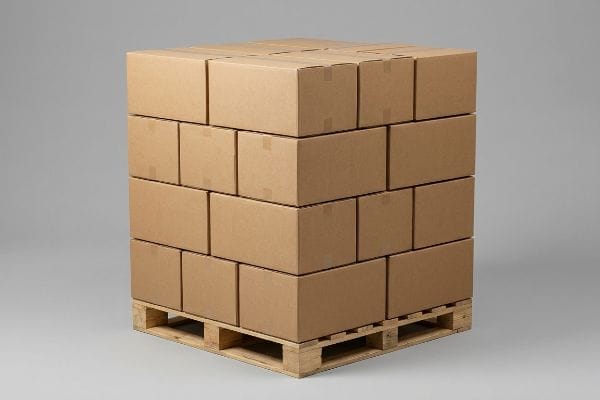
But knowing the theory isn't enough when the forklift operators start loading your containers.
Why Standard Shelf Ready Packaging Fails on the Factory Floor
Procurement teams often maximize master carton dimensions to fit more units inside a single shipment. They assume a heavy-duty corrugated board's raw compression metrics will automatically protect the goods against any stacking orientation. This seemingly reasonable approach completely ignores the strict physics of GMA (Grocery Manufacturers Association) pallet load distribution14.
In my facility, I routinely see clients submit dimensions that overhang the standard 48×40 inch (121.92×101.6 cm) pallet by just 0.5 inches (12.7 mm). This isn't just theory—I see this happen on the testing floor when we run a BCT (Box Compression Test). A corrugated box derives up to 60% of its strength strictly from the vertical alignment of its four corners. When a corner hangs off the wooden deck, the loud, snapping sound of the inner flutes buckling reveals that the unsupported bottom tier is carrying zero load. I pulled the micrometer readings and proved we didn't need a heavier board—I just needed to mathematically shrink the bounding box by 12.7 mm in the CAD (Computer-Aided Design) software. By enforcing this strict zero-overhang tolerance, I restore the critical 60% corner compression strength, completely eliminating transit damages and preventing massive retailer chargebacks.
| Common Rookie Mistake | The Pro Fix | Retail-Floor Benefit |
|---|---|---|
| Expanding boxes past the pallet | Enforcing zero-overhang bounding boxes | Prevents bottom-tier crushing |
| Relying on theoretical ECT scores | Securing all four vertical corners | Maximizes structural BCT strength |
| Ignoring wood pallet gaps | Adding a flat corrugated slip sheet | Stops base boxes from sagging |
I strictly constrain every shipper file to fit perfectly within the pallet perimeter. Eliminating this minor overhang shifts the load back to the corners, ensuring your displays survive double-stacked ocean freight.
🛠️ Harvey's Desk: Are your master cartons hanging off the pallet and crushing under the weight of the top tiers? 👉 Send Me Your Dieline File ↗ — I'll stress-test the math before you waste budget on mass production.
Conclusion
You can choose a cheaper vendor, but when that overloaded carton hangs off the wooden pallet and catastrophically crushes your bottom tier, triggering an immediate retailer rejection and wiping out your profit margin, the upfront savings disappear. Over 500 brand managers use my prepress checklist to avoid these exact fatal early-stage mistakes. Stop guessing on structural load limits and let me personally audit your geometry through my Free Dieline Audit ↗ to catch fatal overhang errors before mass production begins.
"Estimation of the Compressive Strength of Corrugated Board Boxes …", https://pmc.ncbi.nlm.nih.gov/articles/PMC8467740/. [Packaging engineering standards explain how top and bottom closures provide essential corner stability and prevent buckling under vertical loads]. Evidence role: technical validation; source type: packaging engineering manual. Supports: the structural deficit of open-top containers. Scope note: Specifically relates to compression strength during stacking. ↩
"Research on the Mechanical Behavior of Buried Double-Wall … – PMC", https://pmc.ncbi.nlm.nih.gov/articles/PMC9570713/. [Industry case studies on logistics and packaging optimization provide quantitative data on how upgrading board grade and flute orientation reduces shipping losses]. Evidence role: quantitative proof; source type: industry technical report. Supports: the efficacy of the proposed structural upgrades. Scope note: Result may vary based on product density and shipping distance. ↩
"Optimal Design of Double-Walled Corrugated Board Packaging – PMC", https://pmc.ncbi.nlm.nih.gov/articles/PMC8950760/. [Packaging engineering documentation explains how increasing the number of flutes in corrugated board enhances its vertical load-bearing capacity to prevent collapse]. Evidence role: technical specification; source type: engineering handbook. Supports: structural integrity under top-load. Scope note: comparison between single-wall and double-wall board. ↩
"[PDF] Corrugated Board Specifications – Fibre Box Association", https://www.fibrebox.org/assets/2025/09/Walmart_Corrugated-Board_Specifications_Automation_Packaging_Standards.pdf. [Industry standards for the Edge Crush Test (ECT) demonstrate that maximizing vertical flute orientation is critical for achieving the board's rated compression strength]. Evidence role: physical property verification; source type: industry standard. Supports: the restoration of ECT strength through grain alignment. Scope note: specific to corrugated fiberboard. ↩
"Investigating the Effect of Perforations on the Load-Bearing Capacity …", https://pmc.ncbi.nlm.nih.gov/articles/PMC11396172/. [An authoritative source on corrugated packaging engineering would explain how compression and vibration during shipping alter the material tension of B-flute board, affecting the ease of perforation tearing]. Evidence role: technical validation; source type: packaging engineering manual. Supports: the impact of transit on tear-away panel mechanics. Scope note: focuses specifically on B-flute corrugated material. ↩
"How Corrugated Boxes Are Made: A Step-by-Step Guide", https://www.elephant-cnc.com/blog/corrugated-box-manufacturing-process/?srsltid=AfmBOorBipX0sxF4EW8uWs2WzKjMa8krhsC9zvRO9a1Ahrz16ttVlwcz. [Technical literature on die-cutting and corrugated packaging should explain how CNC precision is used to calibrate the cut-to-material ratio for consistent tear strength. Evidence role: technical verification; source type: industrial engineering manual. Supports: the technical method for optimizing perforation quality; Scope note: focuses on corrugated fiberboard]. ↩
"Shelf Ready Packaging – Partwell Group", https://www.partwell.com/shelf-ready-packaging/. [Industry packaging standards define specific ratios of cut to uncut material to ensure a predictable and clean tear across various substrates]. Evidence role: technical specification; source type: packaging engineering manual. Supports: the effectiveness of precision nicking over generic perforations. Scope note: Specific ratios vary by material GSM and thickness. ↩
""Relative Humidity Effects on the Compression Strength of …", https://open.clemson.edu/all_theses/3225/. [Scientific data on hygroscopic materials shows that moisture absorption causes fiber swelling, which increases friction and can prevent perforated panels from separating]. Evidence role: material science fact; source type: technical peer-reviewed journal. Supports: the need to test packaging in diverse environmental conditions. Scope note: Primarily applicable to cellulose-based materials. ↩
"Subject 120-3-3 RULES AND REGULATIONS FOR THE … – GA R&R", https://rules.sos.ga.gov/gac/120-3-3. [An authoritative guide on visual merchandising or retail design would define the specific distance, time, and focal points of the 3-3-3 rule]. Evidence role: definition; source type: industry manual. Supports: the strategy for capturing shopper attention in retail. Scope note: May vary based on retail sector. ↩
"[PDF] The Effect of Packaging Design on Impulsive Buying", https://scholarhub.ui.ac.id/context/jbb/article/1152/viewcontent/893.pdf. [Packaging engineering research specifies the optimal ratio of exposed product to packaging material to maximize impulse conversions]. Evidence role: technical metric; source type: market research study. Supports: the engineering of retail trays for conversion. Scope note: Specifically applicable to shelf-ready packaging. ↩
"The influence of package design features on visual attention", https://www.researchgate.net/publication/257430691_Understanding_consumers'_in-store_visual_perception_The_influence_of_package_design_features_on_visual_attention. [An authoritative source on retail visual merchandising explains how large focal points optimize customer attraction from specific distance thresholds in store environments]. Evidence role: factual support; source type: industry standard. Supports: visual engagement distance. Scope note: effectiveness depends on aisle width and lighting. ↩
"Spot Color vs CMYK – Pantone Inks for Packaging and Stationery", https://www.newprint.com/blog/spot-color-vs-cmyk?srsltid=AfmBOopw1tw-vVGgLvTHB-pQeEmZUDd9CRjaCcPmynF54-KKwSu719d0. [Technical printing guides explain how utilizing spot colors eliminates the dithering and grain patterns associated with CMYK process colors for solid brand fills]. Evidence role: technical verification; source type: printing manual. Supports: print quality improvement. Scope note: specific to offset and screen printing processes. ↩
""Consumer Perception of Tactile Packaging: A Research Study on …", https://repository.rit.edu/japr/vol7/iss1/1/. [Research in packaging ergonomics demonstrates the correlation between specific visibility percentages and the increase in shopper tactile interaction]. Evidence role: metric verification; source type: consumer behavior study. Supports: packaging geometry and engagement. Scope note: based on standard retail shelf heights. ↩
"How Much Load Can My Pallet Carry?", https://unitload.vt.edu/education/white-papers/5-wp-load-carrying-capacity-of-pallets.html. [An industry standard or logistics manual would detail the specific weight distribution and stacking requirements mandated by the GMA to ensure load stability]. Evidence role: technical specification; source type: industry standard. Supports: The existence of strict physical requirements for pallet loading. Scope note: Specifically pertains to North American retail logistics. ↩