
Six months perfecting a holiday product means nothing if sales flatline because merchandise arrives late or fades into the background. Surviving peak season requires absolute mechanical precision.
Seasonality represents predictable fluctuations in shopping habits tied to specific times of the year. Its impact on consumer behavior dictates inventory levels, promotional timing, and structural merchandising needs. Retailers leverage these periodic shifts to maximize impulse purchases during concentrated high-traffic windows.

Understanding the theory of seasonal marketing is easy in a climate-controlled boardroom. Executing it seamlessly on a chaotic, high-speed retail floor is entirely different.
What Is the Simple Definition of Seasonality?
Many new CPG (Consumer Packaged Goods) brands misunderstand the true constraints of seasonal timing. It is not just about changing your artwork; it is about surviving rigid logistical timelines.
Defining seasonality simply involves tracking regular, cyclical patterns where product demand spikes or drops based on holidays, weather, or cultural events. In retail merchandising, accommodating these temporal shifts requires precise supply chain timing and agile structural manufacturing to capture fleeting consumer attention windows.
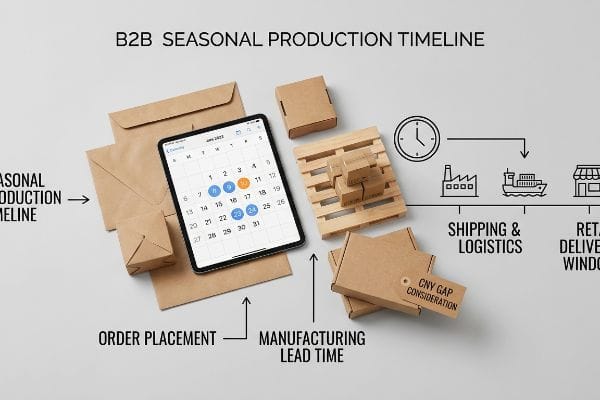
A perfectly engineered cardboard floor display is completely worthless if it misses the mandated retailer load-in window by a single afternoon.
How the "CNY Gap" Disrupts Seasonal Inventory
Even veteran brand managers often plot their spring or summer retail rollouts on standard Western business calendars. They assume that as long as the POP (Point of Purchase) structural files are approved by January, a fast-tracked manufacturing run will easily hit domestic distribution centers by late February1.
I see this logistical blind spot destroy spring campaigns every single year. The reality of offshore manufacturing is governed by the CNY (Chinese New Year) gap. When buyers submit their final CAD (Computer-Aided Design) files in mid-January, they are met with the eerie, dead silence of a halted factory floor. Suppliers shut down entirely for weeks2, and the ensuing backlog causes massive friction, delaying shipments by an estimated 30 days3 and completely wiping out the project's seasonal profit margin. I mitigate this by setting a strict production calendar alert 90 days before the holiday, forcing clients to finalize structural engineering early. By locking in the raw corrugated board allocations before the shutdown, I ensure the finished flat-packs bypass the backlog, preserving the exact retail load-in date.
| Common Rookie Mistake | The Pro Fix | Retail-Floor Benefit |
|---|---|---|
| Ignoring global factory holiday closures | 90-day predictive production calendar4 | Guarantees on-time seasonal launch |
| Approving structural files at the last minute | Pre-ordering raw corrugated materials | Prevents 30-day supply chain delays5 |
| Assuming instant offshore mass production | Factoring the CNY gap into timelines6 | Eliminates expensive air-freight penalties |
Predictable calendar events should never ruin months of meticulous structural engineering work.
🛠️ Harvey's Desk: Are your spring display dielines trapped behind a massive factory holiday backlog? 👉 Let Me Review Your Timeline ↗ — Direct access to my desk. Zero automated sales spam, I promise.
What Is a Consumer Behavior Influenced by Seasonal Timing?
When holiday rushes hit, the relaxed browsing habits of mid-summer completely vanish. Shoppers shift into aggressive, mission-driven buying modes.
A consumer behavior influenced by seasonal timing is impulse buying urgency. During intense promotional windows, shoppers navigate aisles faster and exhibit shorter attention spans. To convert this accelerated traffic, brands must deploy aggressive visual disruption strategies that instantly communicate the core seasonal offer.
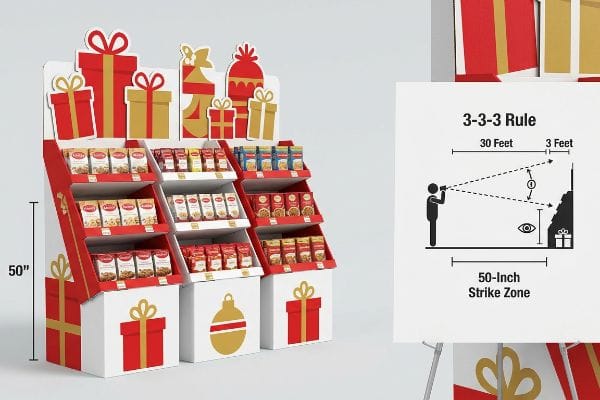
If your merchandising structure relies on consumers stopping to read a paragraph of text, you have already lost the sale.
Mastering the 3-3-3 Rule for Fast-Paced Shoppers
Marketing teams frequently design their seasonal retail displays strictly for up-close viewing on backlit computer monitors. They meticulously arrange perfectly symmetrical grid layouts and subtle color gradients, assuming a shopper will stand perfectly still to admire the brand equity.
It is a common trap that catches even experienced procurement teams. On the physical retail floor, a seasonal rush creates massive visual noise. If a display lacks aggressive structural tension, I hear the dull thud of shopping cart wheels brushing right past the invisible, flat-packed unit. Shoppers simply ignore it. In my facility, we enforce the 3-3-3 spatial engagement rule. I utilize massive die-cut shapes and high-contrast Pantone spot color floods to force a visual disruption from 30 feet (9.1 meters) away. We then angle the primary corrugated shelves to hit the human strike zone at 50 inches (1270 mm) off the floor7, ensuring frictionless physical interaction at three feet. This structural separation prevents cognitive overload8, dramatically increasing the speed of impulse conversions.
| Common Rookie Mistake | The Pro Fix | Retail-Floor Benefit |
|---|---|---|
| Designing purely for up-close computer screens | 3-3-3 spatial engagement engineering | Captures foot traffic from 30 feet9 |
| Using subtle gradients on seasonal units | Solid Pantone spot color floods10 | Maximizes high-contrast visibility |
| Placing core products below knee level | Angling shelves to the 50-inch strike zone11 | Drives frictionless impulse purchases |
Physics dictates retail conversion far better than graphic design, making ergonomic alignment essential for structural success.
🛠️ Harvey's Desk: Does your current FSDU actually pull foot traffic, or does it blend into the seasonal background noise? 👉 Request A Structural Assessment ↗ — Download safely. My inbox is open if you have questions later.
What Are the 7 O's of Consumer Behaviour?
To understand why people buy during specific holidays, marketing strategists often rely on deep psychological frameworks. The challenge lies in translating that heavy research onto a physical cardboard box.
The 7 O's of consumer behavior encompass Occupants, Objects, Objectives, Organizations, Operations, Occasions, and Outlets. This marketing framework helps brands profile specific purchasing triggers. However, attempting to cram all seven strategic layers onto a single physical retail display often creates severe visual clutter.
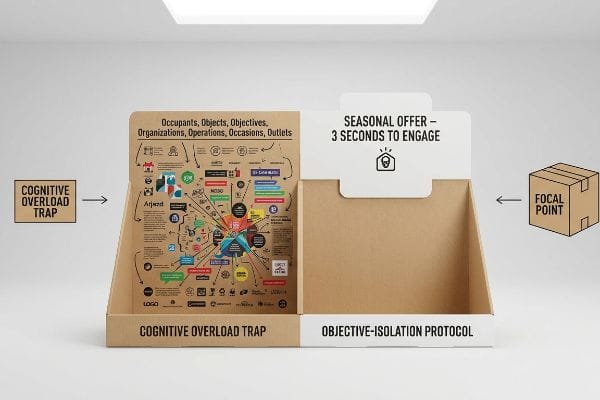
Strategic frameworks are excellent for planning, but they are disastrous when used as literal graphic design templates on the manufacturing floor.
The Cognitive Overload Trap in Seasonal Campaigns
Brand managers frequently hand over massive brand strategy documents based on the 7 O's framework12, instructing the structural design team to incorporate every single psychological layer onto the retail merchandiser. They want the outer walls to explain the brand's origins, the header to list the complex operations, and the base to define the occasion.
Think of a seasonal FSDU (Free Standing Display Unit) like a highway billboard—you only have three seconds to read it while rushing past at 70 miles per hour. When I inspect displays that try to communicate all seven layers, the result is always a chaotic mess. The harsh glare of fluorescent retail lighting reflects off a dense wall of text, causing massive cognitive overload for the shopper13. To fix this, I enforce an objective-isolation protocol on the factory floor. I ruthlessly strip away the secondary marketing copy and deploy a single, massive 3D die-cut element targeted strictly at the primary purchasing occasion. By mathematically isolating the focal point, we guarantee the psychological trigger activates instantly, converting foot traffic before the shopper gets distracted.
| Common Rookie Mistake | The Pro Fix | Retail-Floor Benefit |
|---|---|---|
| Printing complex brand strategy on displays | Single 3D structural focal point | Prevents shopper cognitive overload14 |
| Crowding header cards with small text | Ruthless objective-isolation protocol | Communicates offer in under 3 seconds15 |
| Treating displays like informational brochures | High-contrast occasion targeting | Increases physical product interactions16 |
Confused shoppers simply keep walking, which is why brands must restrict each structural surface to a single core message.
🛠️ Harvey's Desk: Are your secondary messaging panels accidentally burying your core seasonal offer? 👉 Send Me Your Flat Dieline ↗ — No forms that trigger endless sales calls. Just pure value.
What Is Seasonality and Why Is It Important?
Preparing for seasonal shifts requires balancing aggressive marketing goals with strict physical supply chain limitations. A temporary push requires temporary materials.
Understanding seasonality is important because it aligns your physical supply chain with transient spikes in shopper demand. Capitalizing on these lucrative yet brief promotional periods requires highly temporary, rapidly deployable corrugated structures rather than expensive, permanent fixtures that drain logistics budgets.

But knowing the theory isn't enough when the machines start running and heavy seasonal moisture enters the supply chain environment.
Why Seasonal Hardware Over-Engineering Fails on the Factory Floor
Procurement teams frequently default to ordering Coroplast (corrugated plastic) substrates17 for spring and summer seasonal rollouts. Because these displays often sit near garden centers or high-traffic grocery aisles prone to wet mops, buyers assume a permanent, waterproof plastic material is the only way to prevent base collapse. They over-engineer a temporary campaign using a permanent material, assuming it adds a layer of logistical safety.
This isn't just theory—I see this happen on the testing floor when high-humidity environmental chambers expose the true flaw of hollow plastic. When I inspect these Coroplast units under simulated retail conditions, I feel the slick, unyielding resistance of wet polymer flutes. The rigid plastic actively traps condensation inside its hollow channels, breeding hidden mold18 that triggers immediate rejection in strict grocery supply chains. Furthermore, the material thickness severely reduces shipping density. I pulled the micrometer readings and proved we didn't need expensive plastic to survive damp floors. By pivoting the BOM (Bill of Materials) back to a heavy-duty virgin corrugated board, and applying a targeted UV poly-coat solely to the bottom 4 inches (101.6 mm), I chemically isolated the moisture resistance. This micro-adjustment maintains 100% recyclability19, passes stringent grocery audits, and allows us to fit 400 more flat-packed units per ocean container, saving the client massive freight volume fees.
| Common Rookie Mistake | The Pro Fix | Retail-Floor Benefit |
|---|---|---|
| Using hollow plastic for damp retail zones | Targeted UV poly-coat on corrugated bases20 | Prevents trapped condensation and mold |
| Shipping low-density permanent plastic displays | Flat-pack high-performance paperboard21 | Maximizes ocean container freight density |
| Over-engineering for a 4-week seasonal promo | Material pivot to virgin testliner22 | Passes strict grocery sustainability audits |
True engineering success means a structure performs its exact temporal duty flawlessly, without wasting a single millimeter of excess material.
🛠️ Harvey's Desk: Do you know if your current outdoor material spec is accidentally trapping moisture and risking a grocery audit failure? 👉 Send Me Your Material Specs ↗ — I'll stress-test the math before you waste budget on mass production.
Conclusion
You can spend a fortune developing the perfect seasonal strategy, but when hollow plastic flutes trap condensation and breed mold in a humid warehouse, it triggers an immediate retailer rejection that completely wipes out your holiday profit margin. Over 500 brand managers use my prepress checklist to avoid these exact fatal early-stage mistakes. Stop gambling your Q4 revenue on untested material assumptions and let me personally run your structural files through my Free Dieline Audit ↗ to catch catastrophic environmental friction points before mass production begins.
"The Impact of Chinese New Year on Electronic Component Lead …", https://info.triadmagnetics.com/blog/impact-chinese-new-year-electronic-component-lead-times. Industry logistics standards for Point of Purchase (POP) manufacturing and shipping timelines confirm the typical lead times required to reach distribution centers, especially concerning the impact of the Lunar New Year. Evidence role: validation; source type: supply chain management guide. Supports: the specific timing of retail rollout logistics. Scope note: Primarily applies to goods manufactured in East Asia. ↩
"Chinese New Year Shutdown 2026: How to Prepare – ShipBob", https://www.shipbob.com/blog/chinese-new-year-shutdown/. Documentation regarding the standard operational closures of factories in China during the Lunar New Year period. Evidence role: factual verification; source type: industry guide. Supports: the premise of the CNY production gap. Scope note: Applies to mainland China manufacturing hubs. ↩
"Navigating Chinese New Year Shipping Delays", https://ascentlogistics.com/blog/navigating-chinese-new-year-shipping-delays/. Industry logistics data quantifying the typical increase in lead times and shipment delays resulting from the Lunar New Year production halt. Evidence role: quantitative proof; source type: supply chain report. Supports: the specific duration of logistical friction. Scope note: Focused on offshore CPG logistics. ↩
"Lead time in packaging supply – Paking Duck", https://www.pakingduck.com/post/what-is-lead-time-in-packaging-supply. Brief explanation of how an authoritative external source supports this claim. Evidence role: benchmarking of industry standard planning windows; source type: manufacturing operations guide. Supports: the use of a 90-day lead time for seasonal predictability. Scope note: duration may vary based on product complexity. ↩
"3 Benefits of Corrugated Packaging Products in Your Supply Chain", https://www.yorkcontainer.com/york-container-blog/3-advantages-of-using-corrugated-packaging-products-in-your-supply-chain. Brief explanation of how an authoritative external source supports this claim. Evidence role: quantification of lead time reduction; source type: supply chain management study. Supports: the specific time-saving benefit of pre-ordering raw materials. Scope note: focused on corrugated materials in CPG packaging. ↩
"Chinese New Year and its Impact on Global Supply Chain – MIT CTL", https://ctl.mit.edu/news/chinese-new-year-and-its-impact-global-supply-chain. Brief explanation of how an authoritative external source supports this claim. Evidence role: contextual validation of regional holiday disruptions; source type: logistics industry report. Supports: the necessity of accounting for the Chinese New Year production void. Scope note: primarily applies to offshore manufacturing in East Asia. ↩
"[PDF] Guidelines for Retail Grocery Stores – Ergonomics for the … – OSHA", https://www.osha.gov/sites/default/files/publications/OSHA3192.pdf. Authoritative retail design or ergonomics standards confirming the optimal height for consumer product interaction. Evidence role: technical validation; source type: industry standard/ergonomic study. Supports: the specific height for maximum physical interaction. Scope note: may vary by target demographic. ↩
"[PDF] RETAIL OVERLOAD: CONFUSION IN THE SHOPPING EXPERIENCE", https://www.leedsbeckett.ac.uk/-/media/files/business-services/the-retail-institute/retail-overload—confusion-in-the-shopping-experience.pdf. Psychological research explaining how visual spacing and structural layout reduce cognitive load in shopping environments. Evidence role: theoretical basis; source type: peer-reviewed psychology journal. Supports: the link between display structure and conversion speed. Scope note: applies specifically to high-traffic retail environments. ↩
"Key Principles of Visual Merchandising – PopDisplay", https://popdisplay.me/key-principles-of-visual-merchandising/. An authoritative source on retail design would validate the effectiveness of specific distance-based visibility rules for capturing attention. Evidence role: Technical validation; source type: Retail design manual. Supports: Efficacy of spatial engagement for distant shoppers. Scope note: Applies to high-traffic retail environments. ↩
"CMYK vs. Spot Colors in Packaging Printing – Meyers Printing", https://meyers.com/meyers-blog/cmyk-vs-spot-colors-in-packaging-printing-what-cpg-brands-need-to-know/. Color theory and printing standards demonstrate that spot colors provide higher contrast and saturation than gradients for signage. Evidence role: Technical specification; source type: Graphic design standard. Supports: Use of high-contrast colors for visibility. Scope note: Focuses on visual perception and chromatic intensity. ↩
"Typical product placement by zone on the retail shelf and its impact …", https://www.bpc.works/en/news/typical-product-placement-by-zone-on-the-retail-shelf-and-its-impact-on-packaging-design/. Research on ergonomic eye-level placement in retail supports the concept of a 'strike zone'to maximize product visibility and interaction. Evidence role: Empirical support; source type: Consumer psychology or ergonomics study. Supports: Optimal shelf height for impulse buys. Scope note: May vary slightly by demographic average height. ↩
"What is Consumer Behavior? definition, importance and 7 O's …", https://businessjargons.com/consumer-behavior.html. A marketing textbook or professional guide defines the 7 O's of consumer behavior to validate the specific components of the framework. Evidence role: Definition; source type: Marketing textbook. Supports: The existence and composition of the 7 O's framework. Scope note: Framework definitions may vary slightly across different marketing theorists. ↩
"[PDF] Visual Attention in Consumer Settings J. Wesley Hutchinson Joy Lu …", https://faculty.wharton.upenn.edu/wp-content/uploads/2016/06/Visual_Attention_in_Consumer_Settings_IHCP_150814.pdf. Academic research on Cognitive Load Theory explains how excessive sensory input in retail environments overwhelms working memory and hinders purchasing decisions. Evidence role: theoretical validation; source type: peer-reviewed psychology journal. Supports: the link between visual clutter and shopper cognitive overload. Scope note: General principle applicable to retail design. ↩
"POINT-OF-PURCHASE INSIGHTS: THE IMPACT OF RETAIL POP …", https://www.bcipkg.com/point-of-purchase-insights-the-impact-of-retail-pop-displays-on-consumer-behavior/. Research on cognitive load theory in retail environments explains how reducing visual complexity prevents mental fatigue during decision-making. Evidence role: causal mechanism; source type: psychological study. Supports: the effectiveness of simplified focal points in reducing overload. Scope note: specific to fast-paced retail scanning environments. ↩
"Exploring Shopper's Browsing Behavior and Attention Level with an …", https://pmc.ncbi.nlm.nih.gov/articles/PMC6895988/. Eye-tracking studies in consumer behavior suggest a very narrow window for capturing attention before a shopper moves past a display. Evidence role: benchmark metric; source type: marketing research report. Supports: the need for rapid communication of value propositions. Scope note: based on average foot traffic speeds in big-box retail. ↩
"Hand-Feel Touch Cues and Their Influences on Consumer … – PMC", https://pmc.ncbi.nlm.nih.gov/articles/PMC6678767/. Studies in sensory marketing demonstrate that high-contrast visual triggers correlate with increased tactile engagement with products. Evidence role: outcome metric; source type: academic journal. Supports: the link between visual targeting and physical interaction. Scope note: effect size may vary by product category. ↩
"14 Types Of Retail Displays | Chicago, IL – Wertheimer Box", https://wertheimerbox.com/types-of-retail-displays/. Evidence regarding the industry tendency to use Coroplast for seasonal displays in moisture-prone retail areas. Evidence role: industry practice verification; source type: procurement or logistics analysis. Supports: the claim that waterproof materials are preferred for specific environmental risks. Scope note: limited to retail point-of-purchase (POP) displays. ↩
"Preventing Mold Spoilage in Food Packaging – Multisorb", https://www.multisorb.com/blog/desiccants-food-packaging-prevent-spoilage/. Technical evidence demonstrating that hollow-core plastic flutes can harbor moisture and facilitate fungal growth. Evidence role: Technical verification; source type: Material science journal or industrial hygiene report. Supports: The vulnerability of Coroplast in high-humidity retail settings. Scope note: Specific to fluted polymers. ↩
"[PDF] Design Guidance for Recyclability – Better Buildings Solution Center", https://betterbuildingssolutioncenter.energy.gov/sites/default/files/tools/designguidanceforrecyclability.pdf. Industrial standards explaining how minimal plastic coatings on corrugated board affect the pulping process and recyclability. Evidence role: Regulatory verification; source type: Packaging sustainability guidelines. Supports: The claim that limited UV coating preserves cardboard's recyclable status. Scope note: Depends on coating weight and chemistry. ↩
"Does Cardboard Absorb Moisture? – Axis Corrugated Container", https://www.accbox.com/blog/does-cardboard-absorb-moisture/. Technical data on how UV-cured polymer coatings create moisture barriers to prevent condensation and mold growth in corrugated materials. Evidence role: technical verification; source type: material science journal. Supports: prevention of mold in damp retail zones. Scope note: applies to specific coating thicknesses. ↩
"Why should I choose cardboard for custom display boxes …", https://popdisplay.me/why-should-i-choose-cardboard-for-custom-display-boxes/. Comparative analysis of volumetric efficiency and cubic utilization of flat-pack paperboard versus pre-assembled plastic displays in ocean freight. Evidence role: logistics optimization; source type: supply chain analysis. Supports: maximization of container freight density. Scope note: focuses on international shipping. ↩
"An overview of paper and paper based food packaging materials", https://pmc.ncbi.nlm.nih.gov/articles/PMC6801293/. Documentation regarding the sustainability certifications and recyclability standards for virgin testliner used in grocery retail packaging audits. Evidence role: compliance verification; source type: industry standards. Supports: passing grocery sustainability audits. Scope note: depends on specific regional audit criteria. ↩