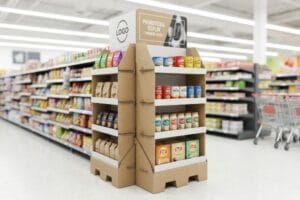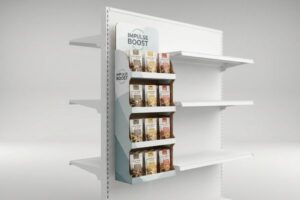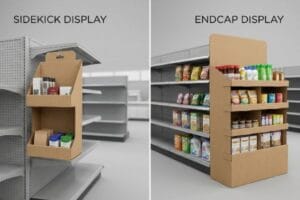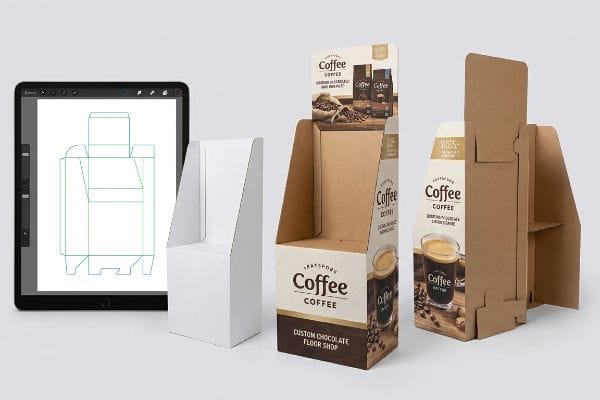
Waiting on packaging lead times can completely derail a product launch. When retail compliance windows are strictly enforced, guessing your manufacturing timeline is a massive logistical risk.
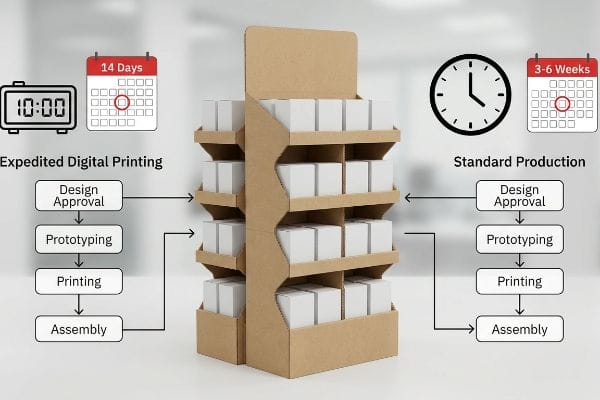
Producing custom cardboard floor displays takes between three to six weeks on average. This timeline heavily depends on structural engineering approvals, physical white sampling, and automated printing prepress processes. Expedited runs using direct-to-board digital printing can occasionally compress this complex manufacturing schedule down to just fourteen days.
But before you can accurately calculate a timeline for your next commercial rollout, you need to understand the physical constraints of the material itself.
What Is the Lifespan of Cardboard?
Estimating how long your packaging will survive in a retail environment requires looking past the visual design and examining the raw paper cellulose.
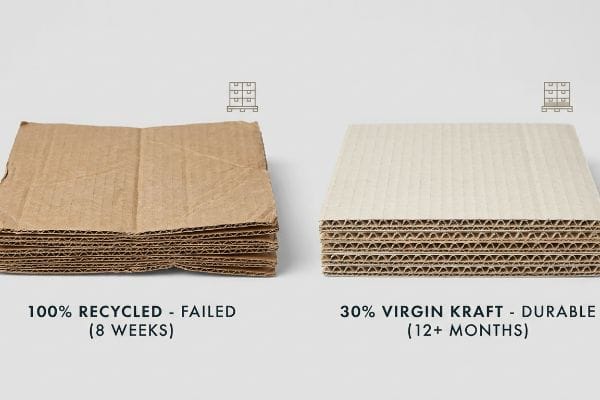
The lifespan of cardboard typically ranges from six to twelve months in a climate-controlled retail environment. However, when subjected to high humidity, heavy product payloads, or severe supply chain vibration, unprotected corrugated paper fibers quickly fatigue and lose their structural compression strength within a few short weeks.
Knowing this baseline is helpful, but the theoretical lifespan drastically changes once you actually load it with heavy merchandise.
Why Recycled Corrugated Displays Fail Prematurely
Brands pushing for maximum sustainability often mandate 100% recycled testliner for their temporary retail merchandisers. The standard assumption is that a recycled board possesses the exact same physical integrity as fresh material1. Procurement teams simply look at a theoretical ECT (Edge Crush Test) rating on a PDF (Portable Document Format) and assume the display will survive a six-month campaign without issue.
Even veteran designers often overlook this blind spot when specifying heavy-duty display trays. I frequently see structurally exhausted recycled boards fail during live payload tests because the microscopic cellulose fibers physically shorten and weaken after five to seven repulping cycles2. Last quarter, I watched a fully loaded recycled base tier slowly bow outward, and the distinct, crisp tearing sound of the raw paperboard snapping under the sheer top-load pressure echoed across my testing floor. To fix this, I mandate a strict hybrid material approach, injecting exactly 30% virgin kraft material3 directly into the load-bearing flutes. This strategic introduction of long, fresh paper fibers instantly restores the dynamic compression strength required to survive double-stacked ocean freight. By reinforcing this core structure, I ensure the co-packing line doesn't stall due to collapsed trays, preventing massive retailer chargebacks and saving clients significant manual rework fees.
| Common Rookie Mistake | The Pro Fix | Retail-Floor Benefit |
|---|---|---|
| Using 100% recycled testliner for heavy bases | Injecting 30% virgin kraft fibers into flutes4 | Prevents bottom-tier crushing under load |
| Relying on flat-board ECT ratings5 | Testing the fully folded 3D geometry | Guarantees survival during pallet movement |
| Ignoring ambient store humidity | Applying targeted aqueous moisture barriers6 | Stops shelves from sagging mid-campaign |
I never gamble a nationwide rollout on exhausted recycled fibers. Reinforcing your internal flutes with virgin material is the only mathematical way to guarantee your structure survives the harsh reality of big-box retail logistics.
🛠️ Harvey's Desk: Not sure if your current sustainable board is structurally exhausted? 👉 Request a Material Audit ↗ — Direct access to my desk. Zero automated sales spam, I promise.
How Are Designs Printed on Cardboard?
Slapping a high-resolution digital image onto a raw corrugated surface is a lot more complex than hitting a print button.
Designs are printed on cardboard primarily using flexography, litho-lamination, or direct-to-board digital flatbed systems. Litho-lamination involves applying ink to a premium top-sheet before gluing it to the fluted board, delivering the absolute highest visual fidelity for complex retail displays and demanding consumer point-of-purchase packaging.
While litho-lamination offers stunning quality, applying standard commercial print logic to raw paperboard introduces severe visual risks.
The CMYK Halftone Mud Trap on Porous Board
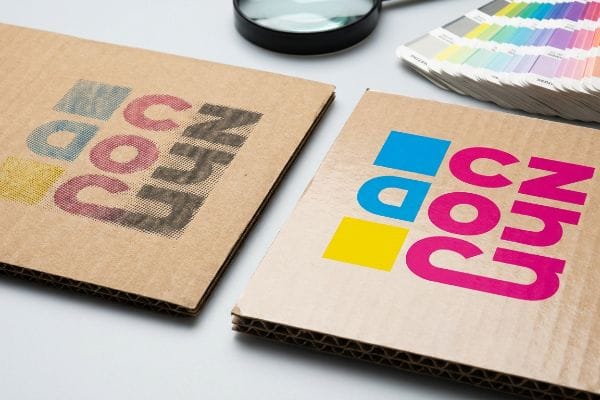
Marketing teams frequently convert solid corporate logos into standard CMYK (Cyan, Magenta, Yellow, and Key/Black) formats7, assuming process printing will seamlessly match their digital computer screens. They send these files to the factory, expecting the four-color dot matrix to perfectly blend and recreate their vibrant brand identity on the final shipper or display.
It is a common trap that catches even experienced procurement teams who assume paperboard absorbs ink like glossy magazine paper. Standard four-color printing relies on tiny overlapping halftone dots, but when these hit raw, unsealed testliner, the ink absorbs unevenly into the deep, porous paper fibers8. I regularly see first-run white samples where a vibrant brand logo turns into a grainy, washed-out, muddy mess under harsh fluorescent retail lighting. You can physically run your bare hand over the board and feel the damp, oversaturated ink that failed to cure cleanly on the surface. To eliminate this halftone grain, I mandate a spot color flood protocol, mixing a precise PMS (Pantone Matching System) ink to flood the specific branding zone. Replacing the overlapping dots with a single, dense layer of solid pigment9 guarantees high-contrast visibility from twenty feet (6.09 m) away, completely removing the risk of a retailer rejecting the batch for poor visual compliance.
| Common Rookie Mistake | The Pro Fix | Retail-Floor Benefit |
|---|---|---|
| Using CMYK for solid corporate logos | Flooding solid areas with specific PMS spot colors10 | Eliminates grainy and muddy brand visuals |
| Ignoring the porosity of raw testliner | Printing on a coated litho-lamination top-sheet11 | Keeps text crisp and perfectly legible |
| Relying on backlit digital proofs | Checking physical color draw-downs in a lightbox12 | Ensures accurate matching in harsh store lighting |
I strictly reject CMYK builds for primary logos on porous substrates. Flooding a true Pantone spot color is the only way to protect your brand equity and ensure your graphics actually pop in a crowded aisle.
🛠️ Harvey's Desk: Are your brand colors turning muddy and washed-out on your current corrugated packaging? 👉 Claim Your Free Color Proofing Guide ↗ — Download safely. My inbox is open if you have questions later.
How Did Cardboard Get Invented?
The transition from flat paper to the rigid shipping materials we use today was driven entirely by the need to absorb kinetic shock during transit.
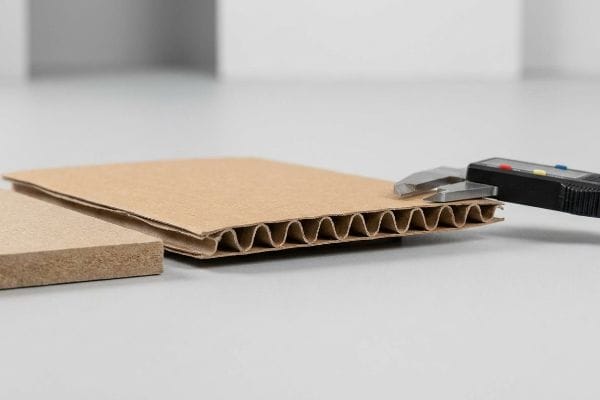
Cardboard was invented by adapting ruffled paper initially used as tall hat linings in the nineteenth century. By sandwiching this wavy, fluted paper between two flat linerboards, engineers created modern corrugated fiberboard. This internal arched geometry gave the lightweight material incredible structural rigidity and dynamic shock absorption.
But knowing the theory behind those internal wavy arches isn't enough when the automated machines start running at high speeds.
Why Ignoring the Flute Architecture Destroys Payload Capacity
Procurement teams frequently attempt to scale up lightweight, solid chipboard designs into heavier retail-ready trays to save on raw material costs. They assume that the sheer raw density of a thick, flat paperboard equals dynamic load capacity. This leads to massive structural blind spots because unfluted substrates lack the internal wave-like arches13 found in true corrugated board.
This isn't just theory—I see this happen on the testing floor when clients try to overload a solid paperboard base. Under heavy vertical top-loads, an unfluted solid board simply bows outward and buckles because static material density cannot replace geometric load displacement. In my facility, when I measure the deflection on an ISTA (International Safe Transit Association) vibration table, a solid board tray carrying a 45.5 lbs (20.6 kg) payload will violently snap at the corners. The sound of the rigid board shattering its glue lines is a massive red flag. The fix happens on the die-cutting machine; I mandate a material pivot to a lightweight micro-fluted B-flute substrate, precisely calibrating the steel rule die to engage the board without crushing the internal arches. By enforcing a strict 0.11 inches (2.79 mm) flute caliper tolerance14, I ensure the arched geometry safely absorbs kinetic energy. This simple mechanical upgrade ensures the co-packing assembly time drops by 35 seconds per unit15, completely eliminating transit damages during heavy distribution.
| Common Rookie Mistake | The Pro Fix | Retail-Floor Benefit |
|---|---|---|
| Scaling up flat chipboard for heavy payloads | Pivoting to a micro-fluted B-flute substrate16 | Stops the tray from buckling on the shelf |
| Crushing flutes with incorrect die pressure | Calibrating cutting tables to exact flute calipers | Preserves dynamic shock absorption |
| Assuming material density equals strength | Utilizing geometric arches to displace top-load17 | Allows for safe double-stacking in warehouses |
I never let procurement teams trade the physics of corrugated flutes for cheap solid board. Utilizing that internal arched geometry is the ultimate defense against kinetic transit shock, keeping your product safe from the factory to the floor.
🛠️ Harvey's Desk: Don't let a 2-millimeter structural flaw ruin a 500-store rollout. 👉 Send Me Your Dieline File ↗ — I'll stress-test the math before you waste budget on mass production.
Conclusion
You can cut costs by printing CMYK onto raw testliner, but when that ink absorbs unevenly into porous fibers and creates a muddy brand logo, it triggers immediate retailer rejection and wipes out your profit margin. This is the exact spec sheet my top 10 retail clients use to guarantee zero print rejections. Stop gambling on ink porosity and let me personally evaluate your artwork through my Free Prepress Dieline Audit ↗ to catch fatal aesthetic errors before production.
"The Environmental Impact of Corrugated Packaging", https://www.internationalpaper.com/resources/blog/environmental-impact-corrugated-packaging-why-balanced-fiber-approach-best. Technical comparison of fiber length and compression strength between 100% recycled testliner and virgin kraft liner. Evidence role: contradiction/validation; source type: materials science study. Supports: The gap between theoretical ECT and real-world durability. Scope note: Focuses on cellulose fiber degradation during recycling. ↩
"[PDF] What happens to cellulosic fibers during papermaking and recycling …", https://bioresources.cnr.ncsu.edu/BioRes_02/BioRes_02_4_739_788_Hubbe_VR_Recycling_Cellulosic_Fibers_Review.pdf. Technical validation of the degradation of cellulose fiber length and mechanical properties over multiple recycling loops. Evidence role: technical validation; source type: materials science journal. Supports: fiber shortening mechanism. Scope note: applies specifically to recycled corrugated board. ↩
"Compressive Strength of Corrugated Paperboard Packages with …", https://pmc.ncbi.nlm.nih.gov/articles/PMC10054506/. Industry standard or empirical data justifying a 30% virgin fiber blend to restore compression strength. Evidence role: specification benchmark; source type: packaging engineering handbook. Supports: hybrid material strategy. Scope note: focuses on load-bearing fluting. ↩
"[PDF] Investigating the mechanical properties of paperboard packaging …", https://repository.rit.edu/cgi/viewcontent.cgi?article=1066&context=japr. Technical validation of how specific percentages of virgin kraft fiber enhance the compression strength of corrugated flutes compared to recycled alternatives. Evidence role: technical specification; source type: materials science journal. Supports: improvement of base durability. Scope note: specific to heavy-load retail displays. ↩
"ECT Ratings Explained: What They Mean for Your Corrugated …", https://epackagesupply.com/blogs/packaging-guide/ect-ratings-explained-what-they-mean-for-your-corrugated-packaging?srsltid=AfmBOorKWdNhwS9ARaiiT3fo77z9e2V5MMTCab-MZ69w8-hxeSqZNMdi. Explanation of the discrepancy between Edge Crush Test (ECT) ratings for flat sheets and the actual load-bearing capacity of folded 3D structures. Evidence role: testing standard comparison; source type: packaging engineering handbook. Supports: necessity of 3D testing. Scope note: applies to palletized retail movement. ↩
"Influence of humidity and temperature on mechanical properties of …", https://bioresources.cnr.ncsu.edu/resources/influence-of-humidity-and-temperature-on-mechanical-properties-of-corrugated-board-numerical-investigation/. Evidence showing how aqueous coatings prevent cellulose fibers from absorbing ambient moisture and losing structural rigidity. Evidence role: chemical property verification; source type: industry white paper. Supports: prevention of shelf sagging. Scope note: focuses on ambient store environments. ↩
"On-Screen vs. Printed Colors: Understanding RGB and CMYK", https://www.hickmanlabel.com/2024/07/17/on-screen-vs-printed-colors-understanding-rgb-and-cmyk/. Technical explanation of the CMYK subtractive color model and its inherent difference from RGB additive digital screens. Evidence role: foundational definition; source type: color science manual. Supports: The technical reason for color mismatch between screens and print. Scope note: General printing standards. ↩
"Mathematical modelling and compensation strategies for printing dot …", https://pmc.ncbi.nlm.nih.gov/articles/PMC12574880/. Technical explanation of how the porosity of raw paperboard causes ink absorption and halftone dot gain compared to coated stocks. Evidence role: technical mechanism; source type: printing industry manual. Supports: explanation of ink failure on porous board. Scope note: specifically refers to unsealed testliner. ↩
"Difference Between Spot Color and CMYK Color", https://www.deprintedbox.com/blog/spot-vs-process-color/. Verification that solid PMS ink layers provide higher opacity and contrast on porous substrates than CMYK halftones. Evidence role: technical specification; source type: color science guide. Supports: the effectiveness of spot color flood protocols. Scope note: focuses on pigment density. ↩
"Spot Color vs CMYK for Packaging Design – Which One's Better?", https://stampaprints.com/blog/spot-color-vs-cmyk-for-packaging/?srsltid=AfmBOop4TzdHc5hcjud9Hye_cIMaywNRE8IU1ruVYRZs-kYd1be8m8pA. Technical documentation on Pantone Matching System (PMS) effectiveness for preventing ink muddiness on porous substrates. Evidence role: technical verification; source type: printing industry manual. Supports: use of spot colors for brand consistency. Scope note: pertains specifically to solid fills. ↩
"Benefits of Litho-Laminated Packaging", https://www.peekpackaging.com/benefits-of-litho-laminated-packaging/. Industry standards explaining how litho-lamination prevents ink absorption (bleeding) compared to raw testliner. Evidence role: material science verification; source type: packaging engineering guide. Supports: claim that coated sheets keep text crisp. Scope note: focused on surface porosity. ↩
"Light Box Displays vs Traditional Signage – Tectonics", https://tectonics.com/light-box-displays-vs-traditional-signage/. Color science standards regarding the necessity of physical proofs under controlled lighting (D50/D65) to avoid metamerism in retail environments. Evidence role: procedural validation; source type: color management textbook. Supports: accuracy of physical draw-downs over backlit screens. Scope note: applies to final quality assurance. ↩
"Chipboard vs Cardboard Comparison Guide for Packaging", https://feeds.gmsindustries.com/blog/chipboard-box-vs-cardboard. Technical comparison of material science demonstrating the loss of structural rigidity when removing the fluted medium. Evidence role: technical verification; source type: engineering manual. Supports: the claim that flat substrates have lower dynamic load capacity than corrugated boards. Scope note: focused on compressive strength and shock absorption. ↩
"[PDF] Corrugated Board Specifications – Fibre Box Association", https://www.fibrebox.org/assets/2025/09/Walmart_Corrugated-Board_Specifications_Automation_Packaging_Standards.pdf. Verification of the industry-standard thickness (caliper) for B-flute corrugated board to ensure technical accuracy. Evidence role: technical specification; source type: industry standard. Supports: The precision of the material tolerance mentioned. Scope note: Specific to B-flute substrates. ↩
"Revolutionizing corrugated board production and optimization with …", https://bioresources.cnr.ncsu.edu/resources/revolutionizing-corrugated-board-production-and-optimization-with-artificial-intelligence/. Empirical data or case studies demonstrating how switching to fluted substrates improves assembly speed and reduces damage. Evidence role: performance metric; source type: industrial engineering study. Supports: The claim regarding time reduction and damage elimination. Scope note: Performance may vary by product type. ↩
"Understanding Shipping Box Strength – EcoEnclose", https://www.ecoenclose.com/blog/understanding-shipping-box-strength/?srsltid=AfmBOorbt4b1YdLEsSWyvZOA3_gwH0eo_3y7ruTauAJGvpe6NHIrBpOe. Technical data from packaging standards confirms the structural properties and load-bearing capacity of B-flute compared to chipboard. Evidence role: technical specification; source type: industry standard. Supports: efficiency of B-flute for heavy payloads. Scope note: limited to corrugated board standards. ↩
"Understanding Shipping Box Strength – EcoEnclose", https://www.ecoenclose.com/blog/understanding-shipping-box-strength/?srsltid=AfmBOoo_suerD65IeaOmcXwQ0pWHqFpdNumI9GNPZugk0CerLMIQC6lw. Engineering analysis of arch physics explains how fluted medium distributes vertical compression loads. Evidence role: theoretical proof; source type: mechanical engineering textbook. Supports: the use of geometry over density for strength. Scope note: focuses on structural mechanics. ↩