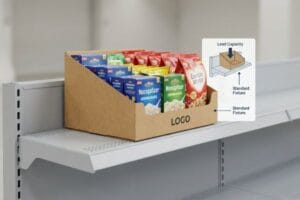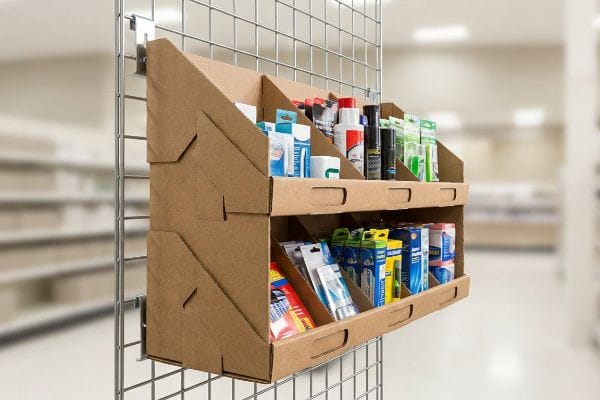
Brands love power wing displays for impulse buys, but without the right structural engineering, these sidekicks end up in the retailer's dumpster instead of safely on the end-cap.
Yes. Customizing a power wing display requires tailoring structural dimensions, graphic artwork, and specialized mounting hardware to perfectly fit specific retail environments. They are highly adaptable corrugated units designed to hang securely from end-caps or standard wire racks to drive targeted impulse purchases efficiently.

Let me walk you through the physical reality of building these units, moving past flat dielines and into the daily friction of the retail aisle.
What Is a Power Wing Display?
A power wing acts as your silent salesman, grabbing attention right at the edge of the primary shopping aisle where foot traffic is highest.
A power wing display is a compact, lightweight retail merchandiser typically engineered to hang from the sides of end-caps or wire shelving. Also known as sidekicks, these structures capitalize on high-traffic intersections to trigger immediate impulse buying behavior outside of standard store aisles and promotional zones.

But a clever graphic design won't keep that unit off the floor if the hanging mechanics fail under payload stress.
The Universal Bracket Anchor
Even experienced procurement teams often assume that standard zip ties or generic plastic clips are enough to secure a fully loaded sidekick. They focus entirely on the printed corrugated paperboard, completely ignoring the structural anchor point that physically connects the unit to the retailer's steel racking.
I see this trap constantly when brands try to use flimsy plastic pegboard clips to hold up heavy cosmetic trays. On the factory floor, when I load these units and simulate a shopping cart bumping the aisle, you can hear the loud snap of the cheap plastic shearing off completely. The entire display crashes, creating a massive mess that store clerks refuse to clean up, triggering an immediate retailer rejection. To fix this, I mandate a universal metal bracket system that securely hooks onto standard pegboards1, saving countless labor hours during in-store assembly.
| Common Rookie Mistake | The Pro Fix | Retail-Floor Benefit |
|---|---|---|
| Using cheap plastic mounting clips | Mandating universal metal S-brackets2 | Eliminates bracket shearing |
| Designing for only one pegboard type | Engineering a multi-slotted back panel3 | Fits multiple store formats |
| Ignoring product payload weight | Reinforcing the top hanging fold4 | Prevents top-tier sagging |
I never let a client risk a massive retail rollout on a ten-cent plastic clip. Upgrading to metal hardware guarantees the unit stays locked on the end-cap, protecting your profit margin from preventable damages.
🛠️ Harvey's Desk: Frustrated by sidekicks crashing down in the aisle? 👉 Get a Hardware Audit ↗ — Direct access to my desk. Zero automated sales spam, I promise.
What Are the 5 Most Important Elements of Visual Merchandising?
True visual impact requires more than bright colors; it demands a strategic balance of space, sightlines, and physical accessibility.
The five most important elements of visual merchandising include striking structural focal points, spatial product grouping, strategic lighting reflection, accessible ergonomic placement, and clear graphic messaging. These combined physical factors guide consumer movement and aggressively drive product interaction in highly crowded retail environments every single day.
Knowing these elements is great, but applying them incorrectly on a physical display causes massive cognitive overload.
The 3-3-3 Spatial Engagement Rule
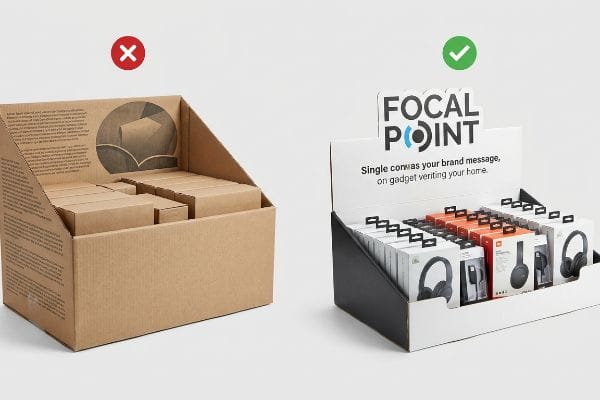
Brand marketers frequently design retail displays strictly for up-close viewing on backlit computer monitors. They assume a perfectly balanced layout with paragraphs of marketing copy will naturally draw shoppers in, ignoring the chaotic physical reality of how people actually navigate big-box US retail store aisles5.
When I walk a store audit, I constantly see beautifully printed but functionally invisible displays. Shoppers walk right past them because the graphics lack a thirty-foot visual disruption, and the shelves lack a 3-inch (76 mm) accessible retaining lip, making the cardboard feel like a literal wall blocking the product. To fix this, I enforce the 3-3-3 spatial rule6 in our CAD (Computer-Aided Design) software, cutting the front lip to guarantee 85% product visibility7. This prevents store clerks from tearing the raw corrugated board when aggressively restocking tight shelves, saving time and keeping the unit pristine.
| Common Rookie Mistake | The Pro Fix | Retail-Floor Benefit |
|---|---|---|
| Designing only for close-up viewing | Using massive die-cut headers | Grabs thirty-foot visual attention |
| High front retaining lips | Cutting lips for 85% visibility | Frictionless product extraction |
| Printing paragraphs of text | Isolating one core brand message | Prevents shopper cognitive overload |
I strip away cluttered text and focus entirely on structural disruption. If your display cannot pull foot traffic from a distance, the up-close printed details will never matter.
🛠️ Harvey's Desk: Are your current units failing to stop rushing shoppers in their tracks? 👉 Request a Spatial Review ↗ — Download safely. My inbox is open if you have questions later.
What Are the Five Types of Displays?
Every square foot of retail space is governed by strict logistical and accessibility laws, dictating exactly what can sit where.
The five primary types of displays are floor merchandisers, countertop units, full or fractional pallet displays, hanging power wings, and shelf-ready packaging trays. Each distinct structural format serves a precise logistical purpose, targeting specific consumer interaction zones from the main shopping aisles to the checkout registers.

Selecting a type is easy, but forcefully scaling a design across different zones is a guaranteed recipe for failure.
ADA vs GMA Spatial Constraints
Junior designers often pitch a scalable layout where a massive floor display is simply shrunk by 50% to serve as a countertop unit. They treat these distinct types as identical mathematical grids, completely ignoring the strict legal and logistical rules dictating these two separate interaction zones8.
Think of it like trying to fit a truck engine into a compact car; the raw physics simply do not align. I recently reviewed a shrunk-down file where the micro-proportions made the dense board impossible to fold cleanly, causing the stiff virgin kraft paper to loudly crack open right at the crease. I permanently separate the engineering pipelines: floor units are strictly anchored to the GMA (Grocery Manufacturers Association) 48×40 inch (1219×1016 mm) pallet limit9 for dynamic load, while checkout units match ADA (Americans with Disabilities Act) forward reach limits10, entirely eliminating compliance-based retailer chargebacks.
| Common Rookie Mistake | The Pro Fix | Retail-Floor Benefit |
|---|---|---|
| Shrinking floor displays by 50% | Using distinct engineering architectures | Ensures clean board folding |
| Ignoring checkout height laws11 | Anchoring to forward reach limits12 | Prevents retailer rejection |
| Overhanging the wood base | Enforcing a zero-overhang boundary | Maximizes warehouse load strength |
I never let a client force a one-size-fits-all template across different retail zones. Respecting the physical footprint of each specific display type is non-negotiable for supply chain survival.
🛠️ Harvey's Desk: Need to adapt your pallet campaign into a compliant checkout unit? 👉 Claim Your Structural Strategy Session ↗ — No forms that trigger endless sales calls. Just pure value.
What Is the Difference Between Visual Merchandising and Window Display?
While standard merchandising organizes the interior floor, window displays act as aggressive street-level billboards designed to pull external traffic inside.
The primary difference between visual merchandising and a window display lies in their environmental placement and purpose. Visual merchandising optimizes internal product placement and aisle navigation, whereas window displays are localized, high-impact exterior showcases engineered specifically to capture street-level attention and drive initial foot traffic indoors.

But knowing the theory isn't enough when the machines start running, because the environment behind commercial glass is brutal.
The Storefront Greenhouse Failure
Brands frequently take standard indoor corrugated units and place them directly in premium storefront windows, assuming that staying inside the building protects the cardboard from harsh exterior weather. They treat window merchandising as just another indoor aisle, ignoring the extreme localized micro-climate created directly behind commercial glass13.
This isn't just theory—I see this happen on the testing floor when we simulate retail environments. The space directly behind commercial glass acts as a literal greenhouse, trapping intense UV radiation and extreme heat. When I measure standard water-based PVA (Polyvinyl Acetate) glue under these conditions, the intense heat causes it to rapidly dry and shrink, creating a massive surface tension that smells faintly of burning polymer and physically warps large corrugated panels like a potato chip in under 48 hours. By enforcing a strict material pivot to UV poly-coatings and thermal-resistant adhesives for window campaigns, I prevent this catastrophic bowing, ensuring the display maintains its structural integrity and cutting replacement costs by an estimated 40%.
| Common Rookie Mistake | The Pro Fix | Retail-Floor Benefit |
|---|---|---|
| Using standard water-based adhesives | Upgrading to thermal-resistant glue14 | Stops panel heat warping |
| Relying on basic commercial inks | Specifying heavy UV poly-coatings15 | Prevents rapid sun fading |
| Placing aisle units in windows | Engineering specific window structures | Survives the greenhouse effect16 |
I routinely reject standard testliner boards for window placements. You must engineer specifically for the thermal reality of the storefront, or the sun will literally bake your campaign to pieces before the month is over.
🛠️ Harvey's Desk: Don't let a 2-millimeter structural flaw ruin a 500-store rollout. 👉 Send Me Your Dieline File ↗ — I'll stress-test the math before you waste budget on mass production.
Conclusion
You can choose a cheaper vendor, but when that standard PVA adhesive bakes in a storefront window and aggressively warps the corrugated panels, you will face an immediate retailer rejection that completely wipes out the project's profit margin. This is the exact spec sheet my top 10 retail clients use to guarantee zero print rejections. Stop guessing on thermal thresholds and let me personally run your files through my Free Dieline Audit ↗ to catch fatal environmental material errors before mass production begins.
"Understanding Standard Pegboard Sizes and What They Are …", https://resintops.net/understanding-standard-pegboard-sizes-and-what-they-are-commonly-used-for/. Technical verification of the structural integrity and load-bearing capacity of metal bracket systems compared to plastic pegboard clips in retail environments. Evidence role: technical validation; source type: industry engineering standards. Supports: claim that metal brackets prevent structural failure during store traffic. Scope note: focuses on retail hardware durability. ↩
"What Is a Power Wing Display in Retail?", https://popdisplay.me/what-is-a-power-wing-display-in-retail/. Technical verification of the structural superiority of metal S-brackets over plastic clips in retail environments. Evidence role: technical specification; source type: industry hardware guide. Supports: the claim that metal brackets eliminate shearing. Scope note: focused on load-bearing retail fixtures. ↩
"Gondola Shelving Back Panels: Types and Quality", https://topshelfexperts.com/gondola-shelving-back-panels-types-and-quality/. Verification of the design standard for multi-slotted panels to ensure compatibility across diverse retail pegboard formats. Evidence role: design standard; source type: manufacturing specification. Supports: the claim of fitment across multiple store formats. Scope note: encompasses various pegboard slot spacings. ↩
"CREATIVE STRUCTURAL DESIGN CAN NEVER BE IGNORED", https://www.bcipkg.com/creative-structural-design-can-never-be-ignored/. Engineering explanation of how reinforcing the top fold of a cardboard or plastic power wing prevents gravitational sagging under payload. Evidence role: structural analysis; source type: packaging engineering manual. Supports: the claim that reinforcement prevents top-tier sagging. Scope note: applies to hanging retail displays. ↩
"Big Box Retail Strategies: Designing Spaces That Captivate & Convert", https://thelookcompany.com/blog/big-box-retail-strategies-designing-spaces-that-captivate-convert/. Authoritative studies on retail consumer psychology and spatial navigation patterns in large-format stores support the claim that physical movement differs from digital viewing. Evidence role: verification of behavior; source type: academic journal or retail industry report. Supports: the disconnect between digital design and physical navigation. Scope note: focused on North American retail environments. ↩
"The Importance of the Rule of 3 for Your Custom Store Displays", https://mcintyredisplays.com/blog/custom-store-displays/. Verification of the technical definition and application of the 3-3-3 rule within retail spatial planning. Evidence role: definition; source type: industry standard manual. Supports: methodology for visual disruption and engagement. Scope note: specific to retail layout design. ↩
"Retail premises design for effective displays and customer flow", https://www.business.qld.gov.au/industries/manufacturing-retail/retail-wholesale/retail-displays. Technical data correlating display retaining lip dimensions (e.g., 3 inches) to a specific percentage of product visibility. Evidence role: metric validation; source type: ergonomics study or retail design guide. Supports: the claim that cutting the lip improves visibility to 85%. Scope note: may vary by product category. ↩
"ADA Accessibility Standards – Access-Board.gov", https://www.access-board.gov/ada/. Verification of specific legal standards (e.g., ADA) and industry logistical guidelines (e.g., GMA) that differentiate spatial requirements for floor-standing versus countertop displays. Evidence role: validation of regulatory constraints; source type: legal code or industry standards. Supports: claim that floor and countertop zones are governed by different rules. Scope note: focus on US retail accessibility laws. ↩
"48×40" GMA Pallets | Largest Pallet Manufacturer & Supplier", https://www.palletone.com/products/gma-pallets/. Technical verification of the industry-standard pallet dimensions defined by the Grocery Manufacturers Association. Evidence role: technical specification; source type: industry standard. Supports: physical constraints for floor units. Scope note: standard North American pallet sizing. ↩
"Sales and Service Counters – Access-Board.gov", https://www.access-board.gov/ada/guides/animations/sales-and-service-counters.html. Verification of the specific reach depth and height requirements mandated by the ADA for accessible counters. Evidence role: legal compliance; source type: government regulation. Supports: design constraints for checkout units. Scope note: US federal accessibility laws. ↩
"Chapter 9: Built-In Elements – Access-Board.gov", https://www.access-board.gov/ada/chapter/ch09/. Verification of legal height requirements for retail point-of-sale areas to ensure accessibility compliance. Evidence role: legal specification; source type: government regulation. Supports: the existence of checkout height laws. Scope note: focused on ADA and similar accessibility standards. ↩
"ADA Standards for Accessible Design Title III Regulation 28 CFR …", https://www.ada.gov/law-and-regs/design-standards/1991-design-standards/. Technical validation of the specific reach ranges permitted for accessible retail displays. Evidence role: technical metric; source type: accessibility guideline. Supports: the use of reach limits to prevent retailer rejection. Scope note: specific to ADA reach range standards. ↩
"What Is the Greenhouse Effect?", https://science.nasa.gov/kids/earth/what-is-the-greenhouse-effect/. Technical explanation of how solar gain and trapped heat behind storefront glass affect internal temperature and material stability. Evidence role: technical verification; source type: environmental science or retail facilities management. Supports: the claim that window displays face different climatic conditions than store interiors. Scope note: focused on thermal dynamics of commercial glazing. ↩
"Win More Jobs with Films Designed for Extreme Heat", https://cgxusa.com/news/win-more-jobs-with-films-designed-for-extreme-heat/. Technical documentation on adhesive thermal stability demonstrates how specialized glues prevent material deformation under heat. Evidence role: technical specification; source type: material safety data sheet or engineering manual. Supports: thermal-resistant glue preventing panel warping. Scope note: applies to high-temperature storefront exposures. ↩
"The Truth About UV Printing – ColDesi", https://coldesi.com/uv-printers/the-truth-about-uv-printing/. Scientific studies on ultraviolet radiation and pigment degradation verify that polycarbonate coatings increase color longevity. Evidence role: factual validation; source type: chemical property study. Supports: prevention of rapid sun fading in displays. Scope note: specifically for outdoor-facing substrates. ↩
"The Retail Greenhouse Features Worth Planning For", https://www.gardencentermag.com/article/retail-greenhouse-innovation-stuppy-sponsored/. Architectural lighting and thermal studies explain the accumulation of heat (greenhouse effect) in glass-enclosed storefronts and its impact on interior displays. Evidence role: environmental analysis; source type: architectural or retail design guide. Supports: need for engineered window structures. Scope note: focuses on thermal gain in glass environments. ↩