
Getting a product onto a retail shelf is only half the battle; capturing consumer attention before they walk past requires strategic physical marketing.
Industries benefiting from POP (Point of Purchase) displays include FMCG (Fast-Moving Consumer Goods), cosmetics, electronics, and food and beverage brands. These competitive sectors rely heavily on highly visible, strategically placed merchandising units to drive impulse purchases, educate daily shoppers, and disrupt standard aisle navigation across massive global retail environments.

But knowing which sectors use these merchandisers is just scratching the surface.
Who Usually Provides POP Displays?
Finding the right vendor to engineer and assemble your retail structures can make or break your entire campaign margin.
Packaging manufacturers and specialized co-packers usually provide POP displays for global brands. Companies typically source these complex structures from full-service turnkey display manufacturers who handle the required structural engineering, high-volume commercial printing, precise die-cutting, and final physical assembly, ensuring flawless global retail execution.
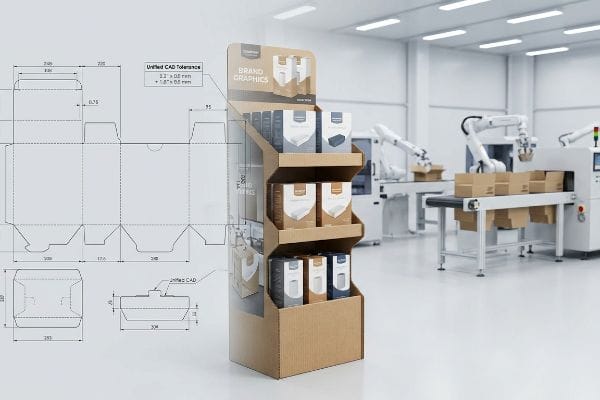
Selecting the provider seems simple on paper, but the reality of supply chain coordination is often a brutal wake-up call for new brands.
Avoiding the Fragmented Sourcing Trap
Brands often try to save raw material costs by using a tolling model1, sourcing the printed top-sheets, corrugated bases, and plastic clips from different cheap suppliers. They then ship all these disconnected parts to a local contract packager for final assembly. On a spreadsheet, this fragmented procurement strategy looks incredibly profitable for a new rollout.
I see this trap catch even experienced procurement teams every season. You assume a generic paperboard sheet from one vendor will seamlessly fit the CNC (Computer Numerical Control) cut slots from another. But when I stand on a co-packing line and watch a worker try to force a mismatched 32ECT (Edge Crush Test) virgin kraft2 tab into a slot that's 2 millimeters (0.07 inches) too tight, the resulting friction literally tears the raw paperboard. You can hear the loud, dull rip of the flutes crushing under pressure. Instead of saving money, the automated machinery jams, the tolling co-packer halts the line, and you get hit with massive hourly downtime penalties that completely wipe out your projected ROI. You need a centralized turnkey partner who takes full liability for cross-component compatibility.
| Common Rookie Mistake | The Pro Fix | Retail-Floor Benefit |
|---|---|---|
| Sourcing parts from multiple vendors | Centralized turnkey manufacturing | Prevents assembly line jams |
| Ignoring component thickness limits | Unified CAD (Computer-Aided Design) tolerance testing3 | Saves 30s per unit in setup4 |
| Treating co-packers as just labor | Shifting structural liability to the factory5 | Eliminates machine downtime fees |
I refuse to let brands piece-meal their components just to shave a few pennies off the initial quote. When one unified factory controls the die-lines, printing, and assembly, you guarantee absolute structural harmony and protect your profit margins.
🛠️ Harvey's Desk: Are your sourced components actually engineered to fit together on a high-speed line? 👉 Request a Turnkey Audit ↗ — Direct access to my desk. Zero automated sales spam, I promise.
What Industry Uses Marketing the Most?
High-velocity sectors pour massive budgets into physical retail visibility, but this aggressive merchandising often collides with strict federal regulations.
FMCG industries use marketing the most aggressively in physical spaces. Specifically, the food, beverage, and cosmetics sectors rely heavily on continuous, high-volume retail promotions and point-of-purchase displays to capture immediate shopper attention, differentiate from fierce competitors, and rapidly drive daily impulse conversions across global storefronts.

Pouring money into beautiful graphics is standard practice, but neglecting the legal realities of that artwork is a fatal flaw.
The Beverage Sector's Compliance Dilemma
Premium wine and beverage brands invest heavily in seasonal marketing, designing beautiful corrugated RRP (Retail-Ready Packaging) to dominate big-box aisles. Designers focus entirely on the aesthetics, crafting large lifestyle graphics and bold logos to draw the eye. They frequently treat the secondary cardboard housing as a purely creative canvas, assuming the legal compliance text only belongs on the primary glass bottle6 inside.
It breaks campaigns instantly when buyers ignore the strict TTB (Alcohol and Tobacco Tax and Trade Bureau) 75-85-95 labeling rules7. I recently had a client submit a stunning file for a wine end-cap, completely omitting the vintage and origin data on the outer base. When I run my fingers over the physical proof, the glossy finish feels premium, but the missing data means the entire pallet is legally un-receivable. Big-box receiving docks will physically reject these beautiful, expensive units the moment they arrive, triggering a massive logistical nightmare. You have to isolate and mirror that critical compliance data directly onto the outer corrugated surface using high-contrast spot colors before we ever fire up the printing press.
| Common Rookie Mistake | The Pro Fix | Retail-Floor Benefit |
|---|---|---|
| Omitting legal data on outer boxes | The TTB Data Mirror protocol8 | Passes strict receiving audits |
| Hiding varietal text behind retaining lips | Custom die-cut front swoops | Guarantees 100% legal visibility |
| Treating secondary packaging as exempt | Cross-referencing federal labeling laws | Prevents massive retailer chargebacks9 |
Map precise legal clearance zones on your structural dieline before approving any ink. A massive marketing budget is useless if your displays sit quarantined on a receiving dock due to basic federal compliance failures.
🛠️ Harvey's Desk: Are you positive your outer retail packaging mirrors the mandatory federal compliance data printed on your primary product? 👉 Verify Your Compliance Layout ↗ — Download safely. My inbox is open if you have questions later.
What Is the Point of Purchase POP Display?
A physical display is not just a cardboard shelf holding products; it is an engineered tool designed to physically interrupt shopper autopilot.
The point of a POP display is to intercept consumers at their primary moment of buying decision. These temporary or permanent physical retail structures are strategically engineered to elevate product visibility, organize specific merchandise, disrupt standard aisle traffic, and ultimately trigger immediate impulse purchases in crowded commercial environments.
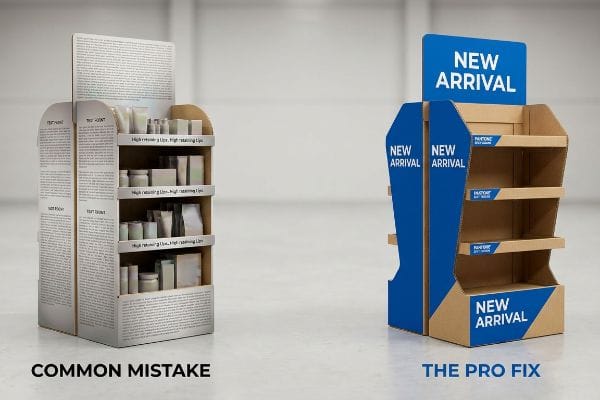
However, simply placing a bright box in an aisle does not guarantee a shopper will actually stop their cart and interact with it.
Mastering the 3-3-3 Spatial Engagement Reality
Junior marketing teams often design their retail displays on backlit, high-definition computer monitors. They zoom in closely to perfect tiny text and subtle gradients, assuming the final physical unit will be viewed in exactly the same intimate manner. This creates visually dense, text-heavy structures that look amazing in a digital PDF presentation but fail completely in the chaotic environment of a live store10.
Think of your display like a billboard on a fast-moving highway; nobody has time to read a novel while driving. I see this blind spot constantly when brands ignore the 3-3-3 Rule of retail engagement11. If you don't use aggressive die-cut shapes and solid PMS (Pantone Matching System) ink floods to capture attention from 30 feet (9.1 meters) away, the shopper just pushes their squeaky metal cart right past it. By the time they are 3 feet (0.9 meters) away, if the structural retaining lip is too high and blocks the actual product, they won't reach in for that final 3-inch (7.6 cm) conversion. You have to mathematically engineer the shelves to the 50-inch (127 cm) human strike zone12 to eliminate physical friction.
| Common Rookie Mistake | The Pro Fix | Retail-Floor Benefit |
|---|---|---|
| Designing purely for up-close viewing | 30-foot high-contrast visual disruption13 | Stops fast-moving aisle traffic |
| Writing long paragraphs of text | Objective-isolation with bold spot colors | Prevents shopper cognitive overload14 |
| Using high retaining lips on shelves | Cutting front lips for 85% visibility15 | Removes friction for product grabbing |
Never approve a digital file without simulating a 30-foot physical viewing distance. Aligning your structural geometry with human ergonomics transforms your retail display from invisible background noise into an aggressive, high-converting sales tool.
🛠️ Harvey's Desk: Is your current display design suffering from cognitive overload that repels rushing shoppers? 👉 Get a Visual Disruption Check ↗ — No forms that trigger endless sales calls. Just pure value.
What Is POP in the Retail Industry?
Understanding the overarching commercial ecosystem is critical, because retail floors are governed by strict spatial laws and unyielding logistical geometry.
POP in the retail industry refers to point-of-purchase merchandising. It represents the broader floor space where consumers navigate aisles and discover products, distinct from the immediate cash register zone. Retailers regulate these designated promotional areas using strict pallet footprint dimensions and rigid height limitations to ensure safe spatial compliance.
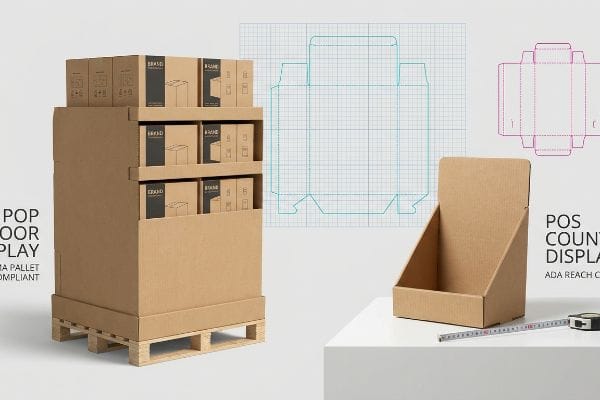
But knowing the theory isn't enough when the machines start running and massive retailers enforce their physical footprint laws.
Why Shrink-to-Fit Floor Plans Fail the Factory Test
Trading companies frequently pitch a seemingly scalable design strategy, suggesting that a massive POP floor display can simply be mathematically reduced by 50% to serve as a countertop POS16 (Point of Sale) unit. They treat physical retail space like a vector graphic that can be dragged and resized at will. This theoretical approach assumes that if the graphics look identical, the structural integrity and retailer compliance will naturally transfer to the smaller footprint.
Getting one display to stand up in a lab is easy, but here is the harsh reality when you ship 500 of them into a heavily regulated big-box environment. In my facility, I routinely see clients attempt to blur the lines between a POP floor unit and a POS checkout unit. When I measure these shrink-to-fit designs against strict US retail laws, they completely fail. You cannot ignore that POP files must be strictly anchored to the rigid 48×40 inch (121.9×101.6 cm) GMA (Grocery Manufacturers Association) wood pallet limit17 for dynamic top-load capacity, while checkout POS files must explicitly conform to the ADA (Americans with Disabilities Act) 15-48 inch (38.1-121.9 cm) forward reach window18. If you force a scaled-down floor structure onto a small E-flute counter base, the fold radiuses shatter, creating massive friction, slowing down the assembly line by an estimated 30%, and completely wiping out the project's profit margin. I mathematically separate the engineering pipelines entirely, completely redesigning the structural tolerances for each specific retail zone to prevent store managers from outright rejecting your non-compliant displays.
| Common Rookie Mistake | The Pro Fix | Retail-Floor Benefit |
|---|---|---|
| Scaling floor displays mathematically | Engineering separate POS and POP pipelines | Prevents retailer space rejections |
| Ignoring checkout reach laws | ADA 15-48 inch forward reach compliance19 | Avoids legal liability on the floor |
| Using floor board grades on counters | Stepping down to precise E-flute structures20 | Guarantees clean, tear-free folding |
I completely refuse to reuse floor dielines for countertop environments. When you anchor your structural math to the exact logistical realities of the targeted store zone, you eliminate transit damages and secure premium retail placements without friction.
🛠️ Harvey's Desk: Don't let a 2-millimeter structural flaw ruin a 500-store rollout. 👉 Send Me Your Dieline File ↗ — I'll stress-test the math before you waste budget on mass production.
Conclusion
You can try to recycle a massive floor display design for the checkout counter, but when that mathematically shrunken structure shatters during folding, slowing down the assembly line by an estimated 30%, it triggers immediate retailer rejections. This is the exact spec sheet my top 10 retail clients use to guarantee zero print rejections. Stop guessing on complex spatial regulations and let me personally run your structural files through my Free Dieline Audit ↗ to catch fatal compliance errors before mass production begins.
"Point-of-Purchase Display Effectiveness: What are the benefits of …", https://www.vanguardpkg.com/point-of-purchase-display-effectiveness-what-are-the-benefits-of-pop-displays/. Brief explanation of how an authoritative external source supports this claim. Evidence role: factual verification; source type: supply chain management report or industry whitepaper. Supports: the use of tolling models in packaging to reduce material overhead. Scope note: focuses on fragmented procurement strategies. ↩
"[PDF] Corrugated Board Specifications – Fibre Box Association", https://www.fibrebox.org/assets/2025/09/Walmart_Corrugated-Board_Specifications_Automation_Packaging_Standards.pdf. Industry standards for corrugated packaging define ECT ratings to measure vertical compression strength. Evidence role: factual verification; source type: technical standard. Supports: the use of 32ECT virgin kraft as a specific material grade for retail structures. Scope note: Limited to corrugated fiberboard specifications. ↩
"The Benefits of Integrating Tolerance Analysis in Product Design …", https://www.sigmetrix.com/blog/benefits-integrating-tolerance-analysis-product-design-software. Technical explanation of how integrated CAD tolerance analysis prevents component misfit in mass-produced retail structures. Evidence role: technical validation; source type: engineering manual. Supports: method for avoiding thickness limit errors. Scope note: focuses on mechanical design standards. ↩
"Stack-Up Tolerance: The Invisible Design Killer | Alvaro Pardo", https://www.linkedin.com/posts/alvaropardo_mechanicalengineering-designvalidation-activity-7366536442715566080-ryw8. Industry benchmarks providing quantitative data on time saved per unit when using precision-engineered components versus manual adjustments. Evidence role: quantitative verification; source type: industry performance report. Supports: efficiency gains in retail setup. Scope note: results may vary based on display complexity. ↩
"DISPLAY STRUCTURAL DESIGN FOR INTERACTIVE RETAIL …", https://www.bcipkg.com/display-structural-design-for-interactive-retail-displays/. Analysis of risk transfer and quality assurance agreements in turnkey retail sourcing to reduce downstream operational costs. Evidence role: process validation; source type: supply chain whitepaper. Supports: elimination of machine downtime fees. Scope note: depends on specific service level agreements. ↩
"Packaging and labelling – Food Standards Agency", https://www.food.gov.uk/business-guidance/packaging-and-labelling. Regulatory guidelines from agencies such as the TTB or FDA specify whether mandatory labeling and health warnings must appear on both primary containers and outer retail-ready packaging. Evidence role: verification; source type: government regulation. Supports: the identification of common compliance gaps in beverage RRP design. Scope note: focus on beverage industry laws. ↩
"Home | TTB: Alcohol and Tobacco Tax and Trade Bureau", https://www.ttb.gov/. Official government documentation from the TTB outlines mandatory labeling and compliance requirements for alcoholic beverage packaging. Evidence role: technical verification; source type: government regulation. Supports: The claim that specific regulatory standards govern the legality of product labeling. Scope note: Applies to US federal law. ↩
"Alcohol Beverage Labeling – TTB", https://www.ttb.gov/regulated-commodities/beverage-alcohol/wine/labeling-wine/alcohol-beverage-labeling. Brief explanation of the TTB's requirements regarding the duplication of legal information on outer shipping containers to ensure compliance. Evidence role: technical specification; source type: regulatory guideline. Supports: the use of mirror-imaging data for receiving audits. Scope note: Applicable to TTB-regulated alcohol products. ↩
"What Contract Packaging Mistakes Trigger Retailer Chargebacks?", https://www.industrialpackaging.com/blog/copacker-mistakes-retailer-chargebacks. Documentation of the financial penalties (chargebacks) imposed by large-scale retailers when secondary packaging fails to meet federal labeling standards. Evidence role: financial impact; source type: industry trade report. Supports: the risk associated with neglecting secondary packaging laws. Scope note: Specific penalty amounts vary by vendor agreement. ↩
"Which Visual Elements Have the Highest Impact on Retail Sales?", https://onedoor.com/resource/visual-merchandising-elements-retail-sales/. Research in environmental psychology and retail design explains how visual noise and excessive information density reduce consumer attention and decision-making speed in high-traffic areas. Evidence role: verification of behavioral principle; source type: academic study or retail industry whitepaper. Supports: the claim that text-heavy designs are ineffective in live retail settings. Scope note: effect may vary based on the shopper's intent (planned vs. impulse). ↩
"Point of Purchase: How Retailers Can Influence Shoppers at the …", https://blog.intouch.com/posts/points-of-purchase-displays. Verification of the 3-3-3 rule as a standard heuristic for retail spatial engagement (30ft, 3ft, 3in). Evidence role: conceptual validation; source type: retail marketing handbook; Supports: distance-based engagement thresholds; Scope note: industry-specific terminology. ↩
"[PDF] Guidelines for Retail Grocery Stores – Ergonomics for the … – OSHA", https://www.osha.gov/sites/default/files/publications/OSHA3192.pdf. Technical data regarding the optimal vertical reach and eye-level interaction for adult shoppers in retail environments. Evidence role: empirical specification; source type: ergonomic design standard; Supports: the 50-inch strike zone claim; Scope note: based on average human anthropometrics. ↩
"Event-Driven POP Displays Create Memorable Retail Moments", https://popdisplay.me/event-driven-pop-displays-create-memorable-retail-moments/. Authoritative retail design standards or consumer behavior studies demonstrating the effective distance for attracting fast-moving aisle traffic. Evidence role: technical validation; source type: retail design guide. Supports: the efficacy of 30-foot visibility for disruption. Scope note: may vary by store layout and aisle width. ↩
"Behavioral Science Insights for more Effective Signage Design", https://explorerresearch.com/effective-signage-design/. Cognitive psychology research on information processing in high-stimulus retail environments regarding text density and visual cues. Evidence role: theoretical grounding; source type: academic study. Supports: the claim that objective-isolation reduces cognitive load. Scope note: applies to general human-computer and human-environment interaction. ↩
"What Is the Average Retail Shelf Height? – PopDisplay", https://popdisplay.me/what-is-the-average-retail-shelf-height/. Industry data or ergonomic studies quantifying the increase in product visibility and accessibility when shelf retaining lips are reduced. Evidence role: metric validation; source type: industry white paper. Supports: the specific 85% visibility metric. Scope note: depends on product packaging dimensions. ↩
"Easy Pop Display Ideas to Maximize Your Counter Space", https://www.premier-packaging-products.com/non-classe/pop-display-ideas/. Professional retail design guidelines or merchandising case studies explaining the common but flawed practice of linear scaling from floor displays to countertop units. Evidence role: corroboration; source type: industry manual. Supports: the prevalence of the 50% reduction design pitch. Scope note: focuses on the discrepancy between graphic scaling and structural viability. ↩
"48×40" GMA Pallets | Largest Pallet Manufacturer & Supplier", https://www.palletone.com/products/gma-pallets/. Verification of the Grocery Manufacturers Association standard pallet dimensions and their role in retail logistics. Evidence role: Technical standard; source type: Industry guideline. Supports: The requirement for POP units to fit a specific footprint. Scope note: Standard North American shipping pallet sizes. ↩
"Chapter 3: Operable Parts – Access-Board.gov", https://www.access-board.gov/ada/guides/chapter-3-operable-parts/. Confirmation of ADA accessibility standards regarding the reach range for commercial checkout counters. Evidence role: Legal compliance; source type: Federal regulation. Supports: The mandatory reach window for POS units. Scope note: US federal accessibility laws. ↩
"ADA Accessibility Standards – Access-Board.gov", https://www.access-board.gov/ada/. Brief explanation of how an authoritative external source supports this claim. Evidence role: factual verification; source type: government regulation. Supports: legal reach requirements for accessible retail counters. Scope note: specific to ADA standards for forward reach. ↩
"Micro-Flute Packaging | E F N-Flute Cartons – Netpak", https://www.netpak.com/en/packaging-resources/industry-articles/micro-flute-packaging-e-f-n-flute/. Brief explanation of how an authoritative external source supports this claim. Evidence role: technical specification; source type: industry material standard. Supports: the use of E-flute for clean, tear-free folding in POP displays. Scope note: pertains to packaging engineering and board grades. ↩