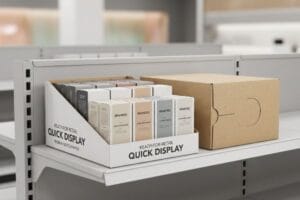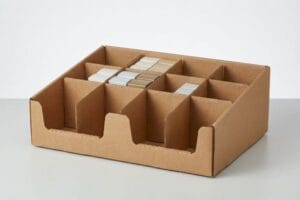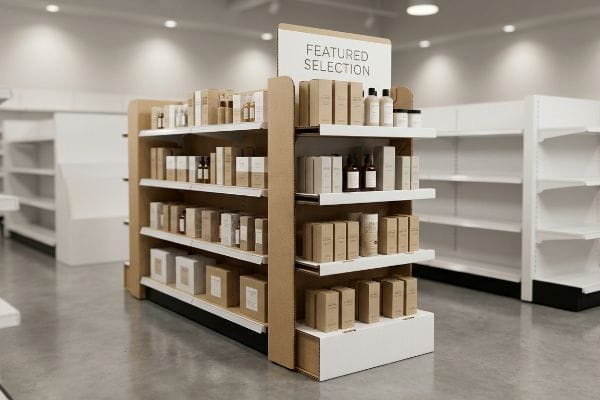
To dominate retail aisles, you need more than just great packaging. You must deploy a structural strategy that stops shoppers dead in their tracks before they walk past.
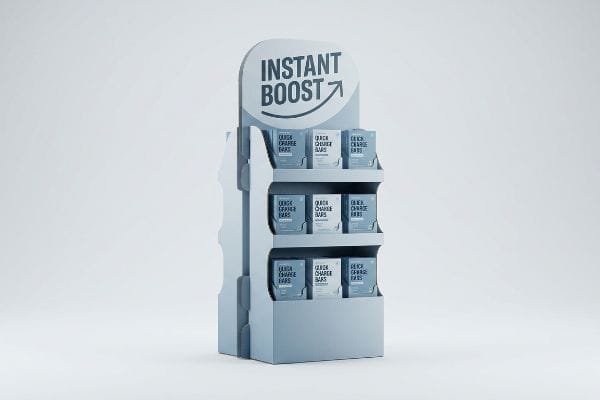
An endcap display is a high-visibility retail merchandiser positioned strategically at the end of a store aisle. Engineered to maximize impulse purchases, these freestanding corrugated units leverage prime real estate to boost brand awareness and significantly accelerate product sell-through rates during targeted promotional campaigns.
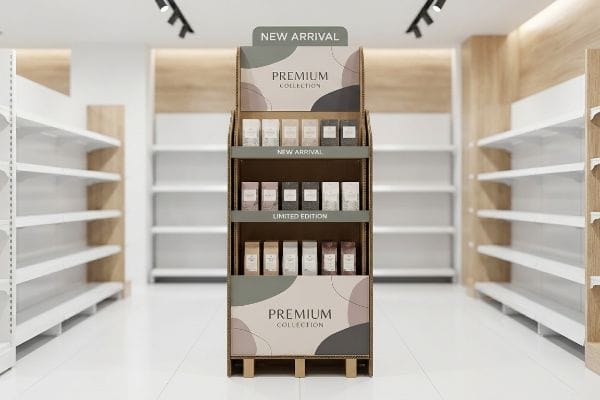
Securing that premium aisle real estate is a massive win, but maximizing its potential requires strict execution.
Are end of aisle displays worth it?
Securing prime real estate in a big-box store demands a hefty investment, making many brand managers question if the placement actually justifies the upfront manufacturing costs.
Yes. End of aisle displays are highly profitable investments because they capture undivided shopper attention outside of crowded inline shelves. By intercepting foot traffic at primary intersections, these dedicated merchandisers routinely generate massive sales lifts, making the structural engineering and printing costs highly justifiable for most brands.
But knowing they can generate revenue is very different from actually engineering a unit that survives the store environment.
The "3-Second Lift" Reality Check
Most marketing teams assume that simply placing their product at the aisle perimeter guarantees immediate sales. They spend thousands on high-end graphics but completely ignore the physical speed at which consumers navigate big-box stores like Target or CVS.
I see this trap constantly when reviewing flat artwork files. Designers love microscopic text detailing every product benefit. But on the floor, shoppers push carts past your display in literally three seconds1. If they have to lean in to read a tiny font, they just keep walking. I always force my clients to strip the text down to a massive, single-message hook and focus on structural curves. A simple, curvy visual disruption stops the eye instantly2, translating directly into a faster ROI (Return on Investment) without adding a single penny to your material costs. Large-scale retail success is about instantly communicating value from ten feet away, rather than relying on dense text.
| Common Rookie Mistake | The Pro Fix | Retail-Floor Benefit |
|---|---|---|
| Microscopic body text | Single massive visual hook | Stops passing carts instantly |
| Standard square headers | Die-cut curvy profile shapes3 | Forces visual disruption |
| Ignoring walk-by speed | Designing for the 3-second window4 | Accelerates impulse buys |
Displays that function like dense textbooks are guaranteed to fail. If your structural silhouette doesn't communicate the core offer before the customer enters the aisle, you are wasting your promotional budget.
🛠️ Harvey's Desk: Not sure if your header shape will actually stop foot traffic? 👉 Get a Free Silhouette Audit ↗ — Direct access to my desk. Zero automated sales spam, I promise.
What makes a good endcap display?
A brilliant graphic design won't save a display that fundamentally hides the product or fails to fit within strict retailer compliance guidelines.
A good endcap display prioritizes product visibility above all else. Effective designs incorporate precise shelf lip heights that expose the primary merchandise, combined with robust corrugated construction that safely holds heavy inventory while strictly adhering to retailer-mandated dimensions for seamless store integration and continuous shoppability.
It sounds simple in theory, but balancing structural strength with maximum product visibility is where most designs completely fall apart.
Engineering the "Lip Height" Visibility Rule
When brands design their shelving tiers, they naturally want thick, tall front lips to prevent products from falling out. They mistakenly prioritize extreme security over actual visual merchandising, treating the retail shelf like a fortress rather than a stage.
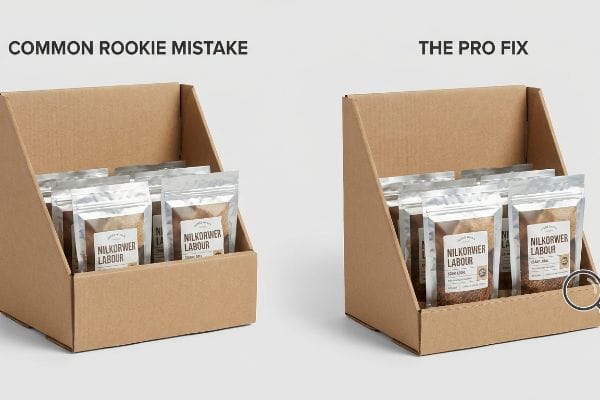
I see this mistake consistently when evaluating physical mock-ups. Brands engineer a massive front lip for a product that barely stands tall enough to clear it, completely swallowing the bottom half of expensive foil packaging. The immediate result is a loss of brand recognition in the aisle. We enforce a strict 'Product First'retail rule: the shelving lip must securely hold the items while guaranteeing at least 85% of the primary label remains entirely visible5 to passing foot traffic. Trimming that front barrier by just a fraction maximizes brand exposure, ensures shoppers see your logo from ten feet away, and ultimately accelerates the path to purchase.
| Common Rookie Mistake | The Pro Fix | Retail-Floor Benefit |
|---|---|---|
| Oversized shelf lips | 85% visibility height rule6 | Maximizes brand exposure |
| Hiding the primary label | Trimming the front barrier | Increases visual recognition |
| Over-engineered material | Precise product retention fit7 | Reduces raw material waste |
Locking in final shelf dimensions without testing a physical product sample is a massive risk. A display that hides the merchandise is nothing more than expensive, branded camouflage.
🛠️ Harvey's Desk: Are your current shelf lips secretly hiding your most critical packaging details? 👉 Request a Visibility Check ↗ — Download safely. My inbox is open if you have questions later.
Where would you find an end cap display?
Location dictates strategy. You cannot design a highly effective merchandiser without fully understanding exactly where the physical unit will live on the retail floor.
An end cap display is positioned exactly at the high-traffic intersections where store aisles terminate. These premium zones face main perimeter walkways, explicitly engineered to intercept consumers as they navigate between different retail departments and seamlessly transition from one product category to the next.
Knowing exactly where the unit sits is step one, but understanding how shoppers interact with that specific physical space is what actually drives revenue.
Mastering the "Human Height" Heat Map
Brands frequently treat the entire vertical surface of their merchandiser as equal-value advertising space8. They scatter key product benefits from the very bottom base all the way up to the top header, assuming shoppers will actively scan the entire unit from floor to ceiling.
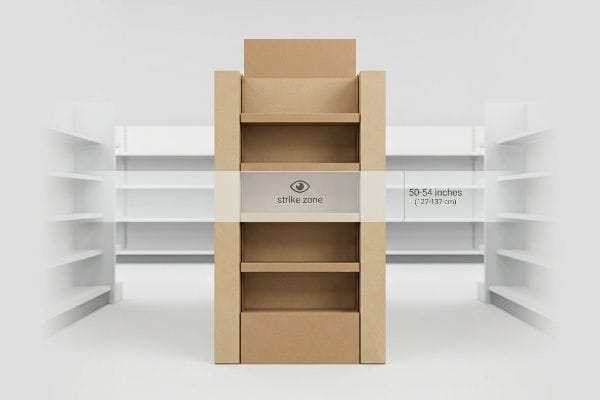
I constantly intercept flat artwork files where crucial buying triggers are placed mere inches from the retail floor. If a shopper has to crouch down to read your core promotional message, that display is a massive functional failure. I always enforce the 'Strike Zone'retail rule: all primary hero products and critical text must sit precisely 50 to 54 inches9 (1270 to 1371.6 mm) from the ground. Moving the heavy hitters directly into the shopper's natural sightline prevents line-of-sight drop-off, respects their shopping habits, and significantly accelerates the decision-making process.
| Common Rookie Mistake | The Pro Fix | Retail-Floor Benefit |
|---|---|---|
| Key info on base panels | 50-54 inch Strike Zone placement10 | Meets natural human eye line |
| Treating all tiers equally | Hero products on middle shelves11 | Accelerates purchase decisions |
| Forcing shoppers to crouch | Anchoring heavy text at the top | Eliminates reading friction |
Core branding elements must be mathematically restricted to the vertical sweet spot. If a customer has to physically bend over to understand your promotion, you have already lost the sale.
🛠️ Harvey's Desk: Is your most expensive product accidentally sitting in the retail blind spot? 👉 Claim a Graphic Heat-Map Review ↗ — No forms that trigger endless sales calls. Just pure value.
What is the purpose of an endcap display in retail?
Beyond simply holding inventory, these prime structures must flawlessly execute a silent sales pitch while bearing the brutal physical abuse of a bustling big-box environment.
An endcap display serves the primary purpose of aggressively driving impulse sales by physically separating promotional merchandise from standard competitors. These robust structures are precisely engineered to hold massive product weight, maximize bold brand visibility, and withstand heavy cart traffic during high-volume retail rollouts.
Getting one display to stand up perfectly in a climate-controlled lab is easy, but here is the harsh reality when you ship 500 of them packed with heavy liquid goods…
Why Standard Tiered Shelves Fail on the Factory Floor
Procurement teams love to spec standard corrugated shelving to save on manufacturing costs12. They assume that if a shelf holds up a few boxes of cereal during a 10-minute office presentation, it will naturally survive a three-month promotional lifecycle13 loaded with heavy shampoos or canned goods.
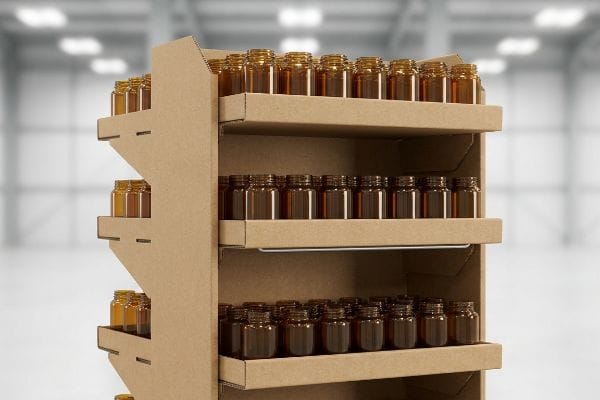
This isn't just theory—I see this happen on the testing floor when we push standard board to its breaking point. In my facility, I routinely see beautifully printed displays buckle under real-world retail loads. The trap is relying solely on the ECT (Edge Crush Test) of the paperboard for horizontal support. When I load a standard 34.5-inch (876.3 mm) wide shelf with 187.5 lbs (85 kg) of glass jars, the center immediately begins to warp, creating a terrifying shelf sag. The dry, cracking sound of the inner flutes compressing under the stress is unmistakable. I fix this by integrating a hidden metal support bar—usually thin steel tubing—directly beneath the front lip. By enforcing this strict reinforcement protocol, I eliminate the catastrophic sag entirely. This prevents massive product spills, saving clients thousands in liability chargebacks and keeping the assembly lines moving smoothly without over-engineering the rest of the display.
| Common Rookie Mistake | The Pro Fix | Retail-Floor Benefit |
|---|---|---|
| Relying strictly on paperboard | Hidden steel tubing support14 | Eliminates center shelf bowing |
| Ignoring long-term sag | Reinforcing the front lip15 | Survives heavy liquid loads |
| Over-specifying board grade | Targeted metal reinforcement16 | Lowers overall material cost |
Raw paper alone cannot defeat gravity on a three-foot span. Anchoring the critical load-bearing zones with hidden steel tubing is absolutely non-negotiable for high-weight liquid campaigns.
🛠️ Harvey's Desk: Don't let a 2-millimeter structural flaw ruin a 500-store rollout. 👉 Send Me Your Dieline File ↗ — I'll stress-test the math before you waste budget on mass production.
Conclusion
You can choose a cheaper vendor, but when that unsupported 32ECT shelf buckles under the weight of glass jars, resulting in severe base collapse that triggers an immediate retailer rejection, your entire promotional margin is wiped out. Over 500 brand managers use my prepress checklist to avoid these exact fatal early-stage mistakes. Stop guessing on weight capacities and let me personally audit your blueprints through my Free Dieline Audit ↗ to catch hidden structural failures before they hit the retail floor.
"Retail Dwell Time – the Route to Higher Spending – Metrics to Measure", https://www.retailsensing.com/people-counting/retail-dwell-time-metric/. [Consumer eye-tracking studies in retail environments provide empirical data on the limited window of attention shoppers grant to end-of-aisle displays. Evidence role: factual validation; source type: market research study. Supports: the argument for minimal text. Scope note: Timing may vary based on product category.] ↩
"Curved Appeal: The Visual Merchandising Future Is Round", https://www.retaildoc.com/blog/visual-merchandising-fixtures-retail-future-in-the-round. [Research in visual psychology demonstrates that organic or curved shapes create higher contrast against the linear grid of retail aisles, increasing shopper stop rates. Evidence role: technical support; source type: design psychology journal. Supports: the effectiveness of structural curves for ROI. Scope note: Most applicable to big-box store environments.] ↩
"Tiny Trends #1: Non-Rectangular Headers | by Jon Moore – Medium", https://medium.com/ux-power-tools/tiny-trends-1-non-rectangular-headers-e8d2d4ee578f. [Studies on visual perception and 'pattern interrupts'demonstrate that non-standard geometric shapes attract more visual attention than traditional rectangles in retail settings]. Evidence role: technical support; source type: design or neuromarketing journal. Supports: the claim that irregular shapes force visual disruption. Scope note: Focuses on gaze duration and attentional capture. ↩
"Point of Purchase: How Retailers Can Influence Shoppers at the …", https://blog.intouch.com/posts/points-of-purchase-displays. [Research on consumer behavior in retail environments identifies the critical timeframe a shopper takes to decide whether to engage with an end-of-aisle display]. Evidence role: factual support; source type: consumer psychology study. Supports: the necessity of rapid visual communication for impulse buys. Scope note: Applicable to high-traffic big-box retail settings. ↩
"A Retailer's Guide to Winning Point of Purchase (POP) Displays – WSI", https://www.wsinc.com/blog/point-of-purchase-displays/. [Industry standards for point-of-purchase (POP) design typically specify minimum label visibility percentages to ensure brand recognition from a distance]. Evidence role: technical benchmark; source type: retail design manual. Supports: the specific visibility requirement for shelf lip engineering. Scope note: Applies to high-traffic retail environments. ↩
"How can endcap displays boost sales? – PopDisplay", https://popdisplay.me/how-can-endcap-displays-boost-sales/. [Industry standards for retail display engineering establish a specific percentage of product visibility to ensure optimal consumer engagement]. Evidence role: technical specification; source type: industry handbook. Supports: optimal lip height. Scope note: may vary based on SKU dimensions. ↩
"Top Pop Display Manufacturers That Boost Your Shopper Impact", https://www.premier-packaging-products.com/non-classe/pop-display-manufacturers/. [Manufacturing guidelines for point-of-purchase displays specify how optimized product fitting minimizes unnecessary structural material usage]. Evidence role: operational efficiency; source type: manufacturing manual. Supports: raw material waste reduction. Scope note: applies to custom-engineered displays. ↩
"(PDF) Seeking attention: An eye tracking study of in-store …", https://www.researchgate.net/publication/279222329_Seeking_attention_An_eye_tracking_study_of_in-store_merchandise_displays. [Research on consumer eye-tracking in retail environments demonstrates that visual attention is concentrated in specific 'strike zones,'challenging the notion of equal-value advertising space. Evidence role: counter-evidence; source type: behavioral study. Supports: the claim that uniform vertical messaging is an ineffective industry practice. Scope note: specific to physical retail end cap displays.] ↩
"[PDF] Guidelines for Retail Grocery Stores – Ergonomics for the … – OSHA", https://www.osha.gov/sites/default/files/publications/OSHA3192.pdf. [A retail industry standard or ergonomic study would verify the optimal 'Strike Zone'height for consumer eye-level visibility]. Evidence role: technical validation; source type: industry standard/ergonomics manual. Supports: the specific height range for high-visibility product placement. Scope note: may vary based on target demographic height. ↩
"Retail premises design for effective displays and customer flow", https://www.business.qld.gov.au/industries/manufacturing-retail/retail-wholesale/retail-displays. [Industry standards for retail ergonomics identify the 50-54 inch range as the optimal eye-level strike zone for the average adult shopper]. Evidence role: technical specification; source type: retail design guide. Supports: the effectiveness of specific vertical placement. Scope note: may vary based on the target consumer demographic. ↩
"BRAND PLACEMENT AND CONSUMER CHOICE: AN IN-STORE …", https://pmc.ncbi.nlm.nih.gov/articles/PMC2741065/. [Consumer behavior research demonstrates that products placed at eye level on middle shelves experience higher conversion rates than those placed on top or bottom shelves]. Evidence role: behavioral evidence; source type: marketing study. Supports: the claim that middle-shelf placement accelerates purchase decisions. Scope note: efficacy can vary by product category. ↩
"Trends in Corrugated Packaging 2026: Adopt These Solutions", https://www.yorkcontainer.com/york-container-blog/trends-in-corrugated-packaging. [Comparative cost analyses of display materials confirm that standard corrugated board is the most economical choice for short-term retail fixtures]. Evidence role: economic justification; source type: manufacturing cost guide. Supports: procurement cost-saving motivations. Scope note: applies to high-volume rollouts. ↩
"How Much Does Point of Purchase Display Assembly Cost?", https://www.industrialpackaging.com/blog/point-of-purchase-display-cost. [Retail merchandising standards typically cite a lifecycle of 8 to 12 weeks for temporary cardboard endcap installations]. Evidence role: industry benchmark; source type: trade publication. Supports: the standard duration of promotional campaigns. Scope note: may vary by retail sector. ↩
"10+ Ways to Restore Sagging Shelves", https://www.youtube.com/watch?v=1QJqUj4zT0E. [An authoritative source on retail display engineering would explain how internal steel supports prevent structural deflection in corrugated cardboard shelving]. Evidence role: Technical verification; source type: Engineering manual. Supports: The use of steel to eliminate center shelf bowing. Scope note: Applies to heavy-duty point-of-purchase displays. ↩
"What is the maximum weight capacity for a table top display rack …", https://popdisplay.me/what-is-the-maximum-weight-capacity-for-a-table-top-display-rack/. [Packaging engineering standards describe how reinforcing the front edge prevents structural failure when supporting concentrated weights like liquid bottles]. Evidence role: Technical verification; source type: Materials science guide. Supports: The ability to survive heavy liquid loads. Scope note: Specific to high-density product categories. ↩
"Exploring the Benefits of Metal in High-End Retail Displays", https://www.samtop.com/metal-benefits-for-high-end-retail-displays/. [Industry cost analyses compare the expense of high-grade paperboard across an entire structure versus strategic metal integration for localized strength]. Evidence role: Economic validation; source type: Manufacturing cost analysis. Supports: The claim that targeted reinforcement lowers overall material cost. Scope note: Dependent on current material market rates. ↩