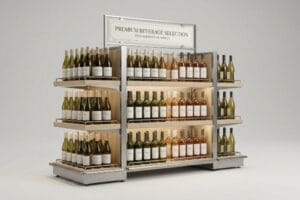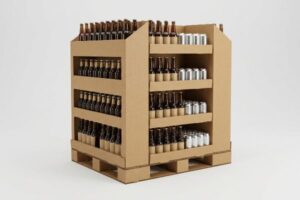
Dump bins are retail powerhouses for driving impulse buys, but randomly tossing items into a cardboard box guarantees a disorganized mess and damaged inventory.
Products working best in a dump bin display are lightweight, durable, and universally appealing impulse items. Ideal categories include travel-sized cosmetics, wrapped confectionery, and small seasonal novelties. Avoid heavy, fragile, or high-value merchandise that requires strict facing, as unstructured bulk merchandising naturally causes bottom-tier crushing.

To maximize sales without sacrificing structural integrity, you need to understand the physics and psychology behind bulk merchandising.
What Makes a Good Product Display?
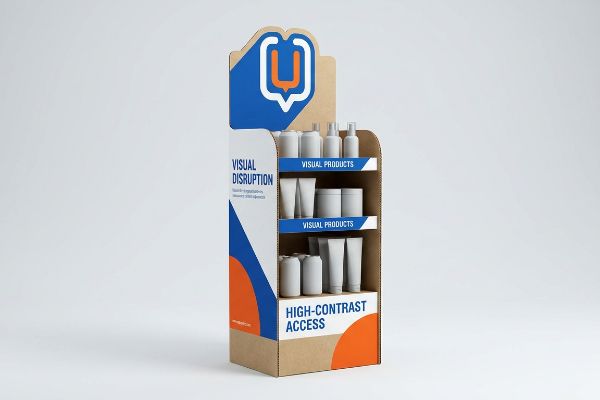
A truly effective fixture does more than just hold inventory; it acts as a silent salesperson that actively disrupts the shopper's autopilot walking pattern.
A good product display consistently commands visual attention while providing frictionless consumer access. It utilizes high-contrast colors, maintains strict structural stability, and ensures the merchandise remains fully visible. Effective units balance aesthetic disruption with practical retail functionality to convert passive foot traffic into immediate active sales.
Understanding this visual theory is helpful, but translating it onto the retail floor requires specific spatial math.
The 3-3-3 Rule for Visual Disruption
Many marketing teams design their retail fixtures while staring at up-close, backlit computer monitors. They assume a beautifully detailed, text-heavy graphic will naturally pull foot traffic in a massive big-box store. This fundamentally ignores the physical reality of how rushed consumers navigate crowded aisles1.
I constantly see this trap when clients try to print their entire brand story on the header. I once watched a busy shopper walk straight past a meticulously designed display because the tiny pastel font completely blended into the store's background noise. To fix this, I always enforce the 3-3-3 spatial engagement rule2. Your unit must grab attention from thirty feet away using aggressive die-cut shapes, engage interest at three feet with the strike zone3, and drive the conversion at 3 inches (76.2 mm). When you hear the loud tearing sound of a frustrated clerk ripping off a complicated, text-heavy brochure holder that shopping carts keep clipping, you quickly realize that simple, high-contrast structural disruption wins every time.
| Common Rookie Mistake | The Pro Fix | Retail-Floor Benefit |
|---|---|---|
| Printing tiny, text-heavy brand stories | High-contrast spot color flood4 | Captures rushing shopper attention |
| Placing key info near the floor | Focusing artwork in the 50-inch (1270 mm) strike zone5 | Aligns with natural eye level |
| Symmetrical, boring box shapes | Using curved, custom die-cut headers | Breaks visual aisle monotony |
I never let clients waste budget on detailed paragraphs that no one reads. By engineering bold shapes and distinct visual thresholds, I ensure your campaign physically stops shopping carts in their tracks.
🛠️ Harvey's Desk: Are your display graphics actually visible from thirty feet down a crowded aisle? 👉 Get a Free 3D Visual Rendering ↗ — Direct access to my desk. Zero automated sales spam, I promise.
How to Merchandise a Multi-Shelf Display?
Stocking multiple tiers efficiently requires a strategic balance between maximizing inventory density and preventing visual cognitive overload.
Merchandising a multi-shelf display requires grouping products into deliberate, easily accessible clusters. You must prioritize heavier items on the bottom tiers for stability while placing high-margin or visually striking merchandise at eye level. Utilizing distinct modular dividers prevents disorganization and simplifies the restocking process for store employees.

While dense packing seems logical on a spreadsheet, the physical reality of retail restocking tells a very different story.
Implementing the 3-5-7 Asymmetry Protocol
Junior designers frequently attempt to flat-pack a dense, perfectly symmetrical grid of products onto every single tier. They assume that maximizing the unit count mathematically yields the highest possible return on investment. This approach ignores the psychological reality of visual merchandising6 and the physical mechanics of store operations7.
When items are jammed together in a tight, symmetrical block, they create zero visual tension, causing rushed shoppers to simply glaze over the layout. I see this fail constantly when store clerks restock these tight grids. I remember feeling the stiff resistance of virgin kraft board as a clerk aggressively forced a slightly oversized shampoo bottle into a perfectly flush layout, instantly buckling the front retaining lip. To prevent this, I mandate the 3-5-7 rule using modular dividers. By engineering deliberate gaps to group items into odd-numbered clusters8, we create psychological visual interest while giving the clerk the exact 0.25-inch (6.35 mm) physical clearance9 needed to load inventory smoothly without destroying the tray.
| Common Rookie Mistake | The Pro Fix | Retail-Floor Benefit |
|---|---|---|
| 100% flush, grid-locked inventory | 3-5-7 asymmetrical SKU grouping10 | Creates psychological visual tension |
| Zero finger clearance for products | Engineering a 0.25-inch (6.35 mm) divider gap11 | Prevents retaining lip tearing |
| Heavy items on top shelves | Anchoring weight to the bottom tier12 | Eliminates display tipping hazards |
I refuse to build densely packed grids that look great on a screen but fail in a real store. Building in strategic negative space speeds up restocking and dramatically extends the lifespan of your unit.
🛠️ Harvey's Desk: Is your current shelf layout causing store clerks to tear your packaging during restocking? 👉 Request a Shelf Clearance Audit ↗ — Download safely. My inbox is open if you have questions later.
What Is the Best Way to Display Merchandise?
The absolute best merchandising strategy removes every possible visual barrier between the consumer and your primary product packaging.
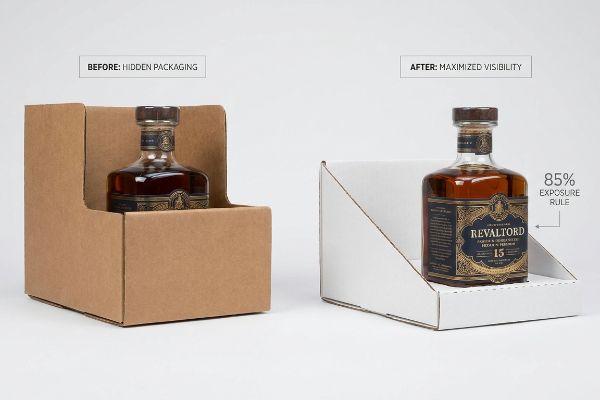
The best way to display merchandise is by strictly utilizing the product-first visibility rule. You must engineer structural retaining walls that expose at least eighty-five percent of the primary packaging. This unobstructed presentation allows the brand's own marketing graphics to drive impulse decisions without physical cardboard interference.
Securing the product is necessary, but over-engineering the protective barriers will instantly kill your sales velocity.
Mastering the Lip Height Visibility Rule
Packaging buyers often prioritize maximum transit security by designing deep shelf trays13 with excessively high front retaining lips. They assume that wrapping the merchandise in deep corrugated armor is the safest way to survive the supply chain journey. Unfortunately, this defensive mindset actively sabotages the brand's primary marketing equity in the aisle14.
Think of it like a beautiful painting hidden behind a massive, thick frame. I constantly encounter premium brands whose beautiful, expensive primary labels are completely buried behind 3 inches (76.2 mm) of generic brown cardboard. I once slid a premium wine bottle into a poorly designed tray, and the dull thud of the bottle seating perfectly coincided with the realization that the primary vintage year was entirely obscured. To fix this, I enforce a strict product visibility protocol. We mathematically cut down the front profile of the PDQ (Product Display Quarter-pallet) tray to guarantee at least 85% exposure15, ensuring your primary graphic does the selling while the base merely acts as a silent structural anchor.
| Common Rookie Mistake | The Pro Fix | Retail-Floor Benefit |
|---|---|---|
| High, straight retaining walls | Custom die-cut sweeping front lips | Maximizes primary label visibility |
| Obscuring vital product details | 85% minimum product exposure rule16 | Drives faster impulse conversions |
| Flimsy, low-cut raw edges | Folded double-wall front lip17 | Maintains strength with lower height |
I constantly remind brands that consumers buy your product, not my cardboard. Trimming back the structural barriers ensures your expensive primary packaging takes center stage right at the critical moment of purchase.
🛠️ Harvey's Desk: Is your current shelf tray physically hiding your most important product features? 👉 Claim Your Free Structural Review ↗ — No forms that trigger endless sales calls. Just pure value.
What Makes a Good Retail Display?
True retail excellence requires a structure that survives the punishing, uncontrolled variables of the global supply chain, not just the pristine conditions of a design studio.
A good retail display consistently survives severe supply chain friction while maintaining perfect structural geometry. It requires highly engineered moisture tolerances, precise board caliper compensations, and rigorous kinetic testing. This dynamic durability ensures the fixture arrives completely intact and fully functional across any unpredictable retail environment.
But knowing the theory isn't enough when the machines start running and your cargo hits a humid port.
Why Standard CAD Math Fails on the Factory Floor
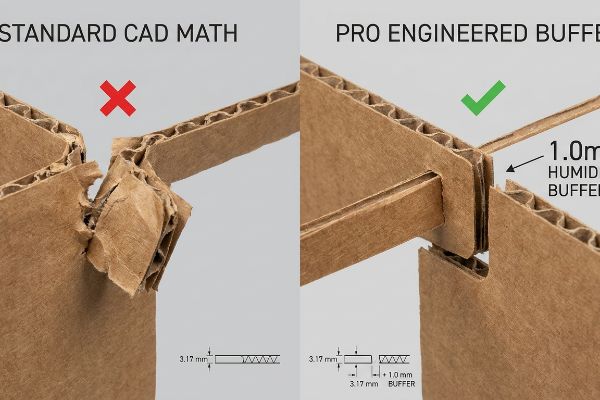
Procurement teams often approve flat dieline files based on absolute, perfectly dry dimensions, assuming the exact measurements on the screen will perfectly match the final product. They trust that a 3.17 mm slot drawn in a vector program will effortlessly accept a 3.17 mm tab on the co-packing line. This theoretical assumption completely ignores the environmental physics of porous paper18.
In my facility, I routinely see perfectly drafted files become absolute nightmares because the designer forgot that paper is a living sponge. When we ship 32 ECT (Edge Crush Test) flat-packs across the ocean or store them in humid warehouses, the raw testliner absorbs ambient moisture and physically swells19. A slot that perfectly fit the tab in the CAD (Computer-Aided Design) software suddenly becomes 0.8 mm too tight. I test this using digital micrometers, and when co-packers try to force these swollen parts together, the friction crushes the flutes and ruins the top sheet. By simply programming a 1.0 mm humidity clearance buffer into the receiving slots during the initial engineering phase, I ensure the assembly team experiences zero-tear, frictionless construction, saving clients an estimated 30% in manual labor delays20.
| Common Rookie Mistake | The Pro Fix | Retail-Floor Benefit |
|---|---|---|
| Drafting 1:1 dry slot tolerances | Engineering a 1.0 mm humidity buffer21 | Prevents tabs from tearing during assembly |
| Ignoring ocean freight humidity | Pre-calculating board moisture swell22 | Ensures frictionless co-packing speed |
| Relying on flat digital vectors | Physical climate chamber testing23 | Eliminates costly warehouse rework delays |
I refuse to let perfect digital math ruin a physical production run. Engineering proactive climate tolerances into the structural design guarantees your unit assembles perfectly, regardless of the warehouse weather.
🛠️ Harvey's Desk: Do you know the exact moisture content of your current corrugated supplier's board before they die-cut your slots? 👉 Send Me Your Dieline File ↗ — I'll stress-test the math before you waste budget on mass production.
Conclusion
You can choose a cheaper vendor, but when that raw testliner absorbs ambient humidity and swells out of tolerance, you will face severe flute crushing, slowing down the assembly line by an estimated 30% and wiping out your margins. Over 500 brand managers use my prepress checklist to avoid these exact fatal early-stage mistakes. Stop guessing on environmental physics and let me personally test your files with my Free Dieline Audit ↗ to eliminate hidden friction points before mass production begins.
"Assessing Consumer Attention and Arousal Using Eye-Tracking …", https://pmc.ncbi.nlm.nih.gov/articles/PMC8380820/. Authoritative sources on retail environmental psychology document how shopper cognitive load and speed affect visual perception and navigation in high-traffic aisles. Evidence role: supporting factual claim; source type: behavioral study. Supports: The claim that detailed graphics are ineffective for rushed shoppers. Scope note: Applicable to large-scale retail formats. ↩
"The Importance of the Rule of 3 for Your Custom Store Displays", https://mcintyredisplays.com/blog/custom-store-displays/. Professional retail merchandising standards would validate this specific framework for staggered shopper engagement distances. Evidence role: technical specification; source type: industry design guide. Supports: The effectiveness of 30ft, 3ft, and 3in engagement zones. Scope note: Applicability depends on store layout. ↩
"The Basics of Visual Merchandising – Mauveworx", https://www.mauveworx.com/blog/the-basics-of-visual-merchandising. Industry standards for visual merchandising define the strike zone as the most visible and accessible area of a product display. Evidence role: terminology verification; source type: retail design manual. Supports: The identification of a high-conversion interaction area. Scope note: Specific height varies by demographic. ↩
"Effects of color and lighting on retail impression and identity", https://www.sciencedirect.com/science/article/abs/pii/S0272494416300342?utm_source=chatgpt.com. Research regarding the psychological impact of high-contrast color blocking on disrupting shopper autopilot behavior. Evidence role: psychological validation; source type: consumer behavior study. Supports: the effectiveness of spot colors in capturing attention. Scope note: Effectiveness is contingent upon the surrounding color environment. ↩
"What Is the Average Eye Level Height? – PopDisplay", https://popdisplay.me/what-is-the-average-eye-level-height/. Verification of industry-standard ergonomic heights for consumer eye-level visibility in retail environments. Evidence role: technical specification; source type: retail design manual or ergonomic study. Supports: the claim that 50 inches is the optimal strike zone for visual attention. Scope note: May vary based on target demographic height. ↩
"Is consumer neural response to visual merchandising types different …", https://pmc.ncbi.nlm.nih.gov/articles/PMC7757867/. Research demonstrating how over-saturation of products leads to cognitive overload and decreased consumer conversion rates. Evidence role: supporting evidence; source type: peer-reviewed psychology study. Supports: the assertion that maximizing unit count is psychologically counterproductive. Scope note: focused on retail shelf layouts. ↩
"Optimizing Secondary Packaging for Retail Shelf Impact", https://www.pdachain.com/2025/06/02/optimizing-secondary-packaging-for-retail-shelf-impact/. Industry standards detailing how overly dense product placement hinders restocking speed and inventory accuracy. Evidence role: supporting evidence; source type: retail operations manual. Supports: the claim that dense grids impede operational efficiency. Scope note: specifically regarding restocking labor. ↩
"Photography Composition :: Rule of Odds – YouTube", https://www.youtube.com/watch?v=n-1tq0FEBV4. Explanation of the 'Rule of Odds'in visual design and its effect on consumer attention and perceived naturalness. Evidence role: theoretical support; source type: design psychology study. Supports: the claim that odd-numbered groupings create visual interest. Scope note: general principle of composition. ↩
"Packaging and Logistics Planning for Retail Displays – Frank Mayer", https://www.frankmayer.com/blog/packaging-and-logistics-planning-for-retail-displays/. Technical specifications for manufacturing tolerances in corrugated retail displays to prevent material failure during inventory loading. Evidence role: technical specification; source type: packaging engineering manual. Supports: the specific clearance measurement needed to prevent buckling. Scope note: applies to virgin kraft board displays. ↩
"Key Principles of Visual Merchandising – PopDisplay", https://popdisplay.me/key-principles-of-visual-merchandising/. Evidence regarding the psychological impact of odd-numbered grouping and visual tension in retail merchandising. Evidence role: validation; source type: consumer psychology study. Supports: the effectiveness of the 3-5-7 protocol. Scope note: specific to visual arrangement of SKUs. ↩
"Optimal shelf arrangement in the retail trade | POS TUNING", https://postuning.com/products/shelf-arrangement/. Technical specifications for minimum clearance gaps to prevent packaging damage and facilitate product removal. Evidence role: verification; source type: industrial design or retail fixture standard. Supports: the 0.25-inch clearance metric. Scope note: applicable to rigid dividers. ↩
"Safety Standard for Clothing Storage Units – Federal Register", https://www.federalregister.gov/documents/2022/11/25/2022-24587/safety-standard-for-clothing-storage-units. Physics principles regarding the center of gravity and tipping point stability for multi-tiered shelving units. Evidence role: corroboration; source type: safety engineering manual. Supports: the claim that bottom-loading weight eliminates tipping hazards. Scope note: applies to free-standing display units. ↩
"Corrugated Trays for Food & Beverage Packaging", https://www.internationalpaper.com/packaging/corrugated-packaging/trays. Brief explanation of how packaging engineering standards link deep trays and high lips to increased product stability during transit. Evidence role: technical validation; source type: logistics engineering manual. Supports: the industry practice of prioritizing transit security in tray design. Scope note: focused on shipping durability. ↩
"Package design as a branding tool in the cosmetic industry – PMC", https://pmc.ncbi.nlm.nih.gov/articles/PMC9123395/. Brief explanation of how visual obstructions in retail displays reduce brand recognition and consumer impulse purchase rates. Evidence role: empirical evidence; source type: consumer behavior study. Supports: the assertion that high lips hinder brand marketing. Scope note: specific to point-of-purchase environments. ↩
"Corrugated PDQ Displays Built for Fast Setup and Retail Impact", https://www.abbottaction.com/packaging/corrugated-pdq-displays/. Brief explanation of how an authoritative external source supports the 85% visibility threshold as a standard for maximizing consumer impulse purchases. Evidence role: technical benchmark; source type: retail merchandising manual. Supports: the specific metric for packaging exposure. Scope note: applies specifically to point-of-purchase PDQ displays. ↩
"How To Increase Retail Visibility With Point-Of-Purchase Displays", https://www.industrialpackaging.com/blog/increased-retail-visibility. Industry guideline specifying the minimum percentage of product packaging visibility required to optimize consumer engagement and impulse purchases. Evidence role: technical benchmark; source type: retail merchandising manual. Supports: the effectiveness of high visibility rules for conversion. Scope note: Standard may vary by product category. ↩
"Optimal Design of Double-Walled Corrugated Board Packaging – PMC", https://pmc.ncbi.nlm.nih.gov/articles/PMC8950760/. Packaging engineering principle where doubling the wall thickness via folding increases vertical load capacity and structural rigidity of the display edge. Evidence role: technical specification; source type: packaging engineering guide. Supports: the claim that double-walling maintains strength at lower heights. Scope note: Specifically applicable to corrugated cardboard or heavy-stock materials. ↩
"Influence of humidity and temperature on mechanical properties of …", https://bioresources.cnr.ncsu.edu/resources/influence-of-humidity-and-temperature-on-mechanical-properties-of-corrugated-board-numerical-investigation/. An authoritative source on material science or packaging engineering would explain how hygroscopy causes porous paper to expand or contract based on ambient humidity, altering physical dimensions. Evidence role: Technical validation; source type: Materials science handbook. Supports: The claim that nominal CAD dimensions fail due to environmental moisture. Scope note: Specifically applicable to fiber-based retail substrates. ↩
"[PDF] Effects of Moisture content on Box Compression Strength : FBA BCT …", https://renewablebioproducts.gatech.edu/sites/default/files/2025-12/4effects-of-moisture-content-on-box-compression-strength.pdf. Authoritative material science data on the hygroscopic nature of paper-based liners and their dimensional expansion in high humidity. Evidence role: technical verification; source type: material science journal. Supports: claim that testliner swells due to moisture. Scope note: expansion rates depend on fiber composition. ↩
"How to reduce operational costs with packaging – Smurfit Westrock", https://www.smurfitwestrock.com/blog/how-to-reduce-operational-costs-with-packaging. Industry benchmarks on how engineering tolerance buffers reduce assembly errors and associated labor overhead in retail fixtures. Evidence role: quantitative validation; source type: logistics/manufacturing efficiency report. Supports: claim of labor savings via precision buffers. Scope note: estimated value based on average co-packing efficiency. ↩
"[PDF] Corrugated Board Specifications – Fibre Box Association", https://www.fibrebox.org/assets/2025/09/Walmart_Corrugated-Board_Specifications_Automation_Packaging_Standards.pdf. Verification of the specific 1.0 mm tolerance as a standard engineering practice to mitigate material expansion and contraction in cardboard. Evidence role: technical specification; source type: manufacturing manual. Supports: prevention of tab tearing during assembly. Scope note: Applies primarily to corrugated fiberboard. ↩
"Estimation of the Compressive Strength of Corrugated Board Boxes …", https://pmc.ncbi.nlm.nih.gov/articles/PMC8467740/. Technical documentation explaining how hygroscopic expansion in cardboard is calculated to maintain dimensional stability during sea transit. Evidence role: engineering principle; source type: materials science journal. Supports: efficiency of co-packing speed. Scope note: Focuses on high-humidity maritime environments. ↩
"Environmental Condition Testing", https://unitload.vt.edu/facilities/distribution-packaging-lab/environmental-conditioning-testing.html. Comparative evidence showing that environmental chamber testing is superior to digital vector simulations for predicting material failure. Evidence role: methodology validation; source type: industry whitepaper. Supports: reduction in warehouse rework delays. Scope note: Compares CAD modeling vs physical stress testing. ↩