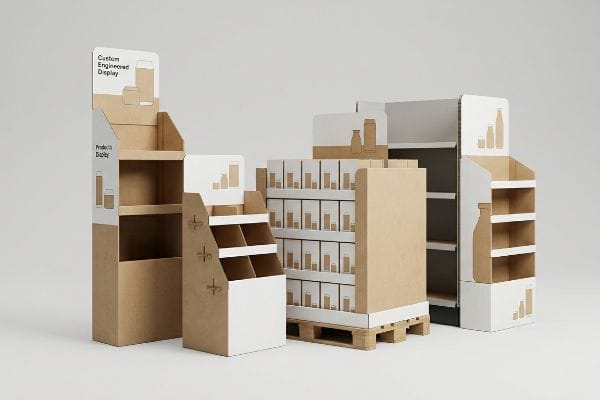
Escolher a estratégia de marketing de varejo certa pode determinar o sucesso ou o fracasso de uma campanha. Vamos explorar as estruturas fundamentais que impulsionam vendas em grande volume.
Os principais tipos de displays de ponto de venda incluem unidades de chão independentes, expositores de balcão, displays de ponta de gôndola e estruturas de paletes. Essas soluções para o varejo são projetadas globalmente usando papelão ondulado ou materiais mistos para interromper estrategicamente o fluxo de clientes e maximizar a visibilidade do produto em lojas de diversos tamanhos.

Mas identificar essas categorias é apenas o primeiro passo antes que a engenharia propriamente dita comece.
Quais são os tipos de displays de ponto de venda?
Os materiais de ponto de venda (PDV) variam drasticamente dependendo de sua localização física no ambiente de varejo.
Os tipos mais comuns de displays de ponto de venda (PDV) incluem expositores de chão independentes, quiosques interativos, expositores de produtos avulsos e balcões de caixa. Eles são categorizados principalmente por sua localização física na loja, dividindo-os estritamente em estruturas de corredor de ponto de compra e expositores de caixa de ponto de venda em todo o mundo.

Entender essas categorias é simples no papel, mas a execução prática muitas vezes confunde até mesmo os compradores mais experientes.
Navegando pela divisão espacial entre a ADA e a GMA
As marcas frequentemente tentam projetar um expositor universal, de tamanho único, que possa ser usado em qualquer lugar, desde o corredor principal do supermercado até o caixa. É uma estratégia comum para maximizar os investimentos em ferramentas, simplesmente dimensionando um projeto¹para se adequar a qualquer espaço que o varejista lhes conceda.
Sei que você está olhando para essa estrutura de papelão se sentindo perdido, porque 80% dos meus clientes presumem que um expositor de chão para ponto de venda (PDV) pode simplesmente ser reduzido para servir como um expositor de balcão para ponto de venda (PDV). Na minha empresa, vejo constantemente compradores ignorando as rígidas normas legais: os expositores de PDV devem ser fixados no limite de palete de 48×40 polegadas (1219×1016 mm) da GMA (Associação de Fabricantes de Alimentos) ² , enquanto os expositores de PDV são fixados na janela de alcance frontal de 15 a 48 polegadas (381 a 1219 mm) da ADA (Lei dos Americanos com Deficiências) ³ . Quando um cliente me pediu para "reduzir para encaixar" um expositor de chão no mês passado, o protótipo de balcão resultante tinha uma borda de retenção tão alta que bloqueava completamente o produto. Eu podia literalmente sentir a resistência rígida do grosso papelão kraft virgem 32ECT enquanto tentávamos forçar pequenas abas em ranhuras feitas para uma base de palete maciça . Tivemos que separar permanentemente os fluxos de trabalho de engenharia para evitar estornos massivos por parte dos gerentes de loja que rejeitavam unidades de caixa registradoras não conformes.
| Erro comum de iniciantes | A solução profissional | Benefício do piso de vendas |
|---|---|---|
| Unidades de piso redutoras para caixas registradoras | Separar os fluxos de trabalho de ponto de venda (POP) e ponto de venda (POS) | Impede a rejeição por parte do varejista |
| Ignorando os limites de alcance legal | Garantir janelas ADA de 15 a 48 polegadas (381 a 1219 mm)4 | Garante a conformidade com a acessibilidade |
| Utilizando matemática de paletes em balcões | Ancore o sistema de ponto de venda (PDV) a limites de caixa específicos | Acelera o reabastecimento diário |
Recuso-me a permitir que as marcas reutilizem cálculos estruturais em zonas de varejo completamente diferentes. Impor parâmetros rigorosos de acessibilidade (ADA) e de gestão de mercadorias (GMA) desde o primeiro dia garante que o seu expositor seja realmente adequado ao espaço onde foi colocado.
🛠️ Mesa do Harvey: Não tem certeza se seu novo expositor de balcão viola os limites de alcance do varejista? 👉 Faça uma auditoria do seu molde ↗ — Acesso direto à minha mesa. Zero spam de vendas automatizado, prometo.
Quais são os quatro tipos básicos de monitores?
Embora os ambientes de varejo evoluam, as estruturas fundamentais usadas para comercializar produtos permanecem notavelmente consistentes.
Os quatro tipos básicos de expositores são: expositores de chão, expositores de balcão, saias para paletes e bandejas prontas para prateleira. Essas estruturas fundamentais acomodam desde itens volumosos e pesados até compras por impulso de produtos leves, proporcionando às cadeias de suprimentos globais formatos padronizados para transporte eficiente e montagem rápida na loja.
Classificá-los é simples, mas a transição entre esses quatro tipos de projeto é onde as falhas estruturais se multiplicam.
Falha na microaba "encolhível"
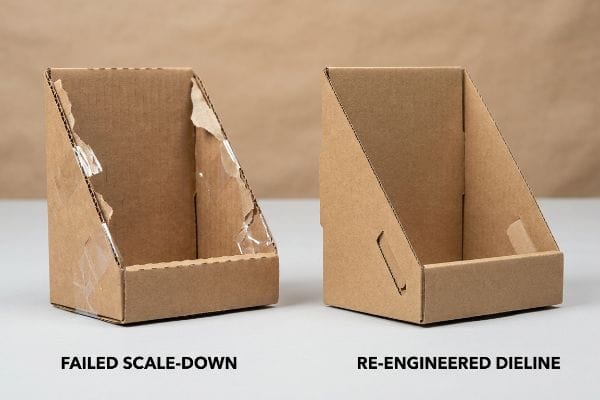
Ao lançar uma campanha com vários níveis, as equipes de marketing naturalmente desejam consistência visual em todas as quatro categorias de exibição. Para economizar tempo e orçamento de ferramentas, os designers costumam pegar uma estrutura de piso resistente bem-sucedida e reduzir matematicamente o arquivo CAD (Desenho Auxiliado por Computador) em 50%para criar a versão correspondente para bancada.
Mesmo equipes de compras experientes muitas vezes ignoram esse ponto cego, presumindo que a geometria seja universalmente escalável. Mas o papelão ondulado grosso não encolhe. Quando você reduz os raios de dobra e as abas de encaixe a microproporções em um substrato denso de ondulação B, as ondulações simplesmente não conseguem dobrar de forma limpa6.No último trimestre, observei um copacker frustrado tentando montar uma dessas matrizes reduzidas; o estalo alto do revestimento de papel superior rasgando sob tensão ecoou por toda a linha. Eles acabaram usando fita adesiva transparente de forma desleixada apenas para manter a base unida, arruinando completamente a estética premium da marca. Para corrigir isso, exijo uma redução gradual do material para uma ondulação E fina para unidades menores7, reestruturando completamente as travas de fricção para garantir uma montagem suave e evitar reparos com excesso de fita adesiva no ponto de venda.
| Erro comum de iniciantes | A solução profissional | Benefício do piso de vendas |
|---|---|---|
| Redimensionar arquivos CAD de piso para 50% | Redesenhe as linhas de corte para tamanhos específicos8 | Garante que as abas realmente travem |
| Utilizando madeira canelada tipo B espessa para os balcões | Desça até a flauta transversal em Mi fino9 | Impede que o revestimento de papel se rompa |
| Utilizando fita adesiva transparente para reparos | Projete fechaduras de fricção de precisão10 | Mantém uma estética de alta qualidade |
Sempre digo aos meus clientes que dimensionar um monitor matematicamente é uma receita para o desastre físico. A transição entre tipos de monitor exige uma reformulação completa dos materiais e da estrutura.
🛠️ Harvey's Desk: Será que suas abas de encaixe em escala reduzida estão se rompendo secretamente durante a embalagem conjunta? 👉 Consulte o Guia de Materiais ↗ — Faça o download com segurança. Minha caixa de entrada está aberta caso tenha alguma dúvida posteriormente.
Qual é um exemplo de display de ponto de venda?
Visualizar uma vitrine em contexto ajuda a preencher a lacuna entre a engenharia estrutural abstrata e o desempenho real do varejo.
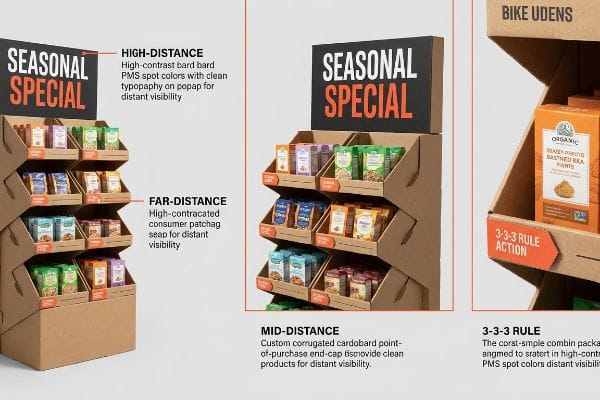
Um exemplo típico de expositor de ponto de venda é uma ponteira de papelão ondulado encaixável, posicionada no final de um corredor de supermercado. Essas unidades geralmente apresentam prateleiras de vários níveis, cabeçalhos de marca vibrantes e divisórias modulares projetadas para maximizar as compras por impulso exatamente onde o fluxo de clientes naturalmente para.
No entanto, simplesmente colocar uma caixa com a marca no final de um corredor não garante que os consumidores realmente a olhem.
Dominando a Regra de Engajamento Espacial 3-3-3
Designers juniores frequentemente criam layouts de lojas pensando estritamente na visualização de perto em monitores de computador retroiluminados. Eles se concentram obsessivamente em textos de alta resolução e na disposição simétrica dos produtos, partindo do pressuposto de que, se o gráfico tiver boa aparência na altura dos olhos em uma tela, naturalmente chamará a atenção em uma loja lotada.
É uma armadilha comum que pega até mesmo gerentes de marca experientes, principalmente porque ignoram a realidade física de como os consumidores percorrem os corredores. Pense em um outdoor na estrada; você não lê as letras miúdas a 110 km/h. No varejo, usamos a "Regra 3-3-3". Uma vitrine deve causar impacto visual a 9,1 metros de distância, despertar interesse a 0,9 metros e garantir a conversão física final a 7,6 centímetros. Recentemente, auditei uma ponta de gôndola que parecia linda de perto, mas a 9,1 metros de distância, os gráficos complexos em CMYK (ciano, magenta, amarelo e preto) se transformavam em um borrão indistinto. Corrigimos o problema removendo o texto secundário e preenchendo o cabeçalho com uma cor sólida e de alto contraste, a cor PMS (Pantone Matching System)12, o que aumentou imediatamente o fluxo de clientes e atraiu mais compradores.
| Erro comum de iniciantes | A solução profissional | Benefício do piso de vendas |
|---|---|---|
| Projetado apenas para visualização a 90 cm (3 pés) | Aplique a regra espacial 3-3-313 | Captura o tráfego distante nos corredores |
| Utilizando texto minúsculo para os títulos principais | Isolar um elemento 3D de grandes dimensões | Previne a sobrecarga cognitiva do comprador14 |
| Layouts de prateleiras simétricos e planos | Incline as prateleiras em direção aos olhos15 | Impulsiona conversões táteis mais rápidas |
Eu construo displays para serem obstáculos visuais, não folhetos informativos. Se o seu produto não chamar a atenção do comprador de forma impactante a dez metros de distância, os detalhes em close-up não farão diferença.
🛠️ Harvey's Desk: Seu ponto de venda atual está se misturando com o cenário caótico do supermercado? 👉 Solicite uma Análise Espacial ↗ — Sem formulários que geram ligações intermináveis de vendedores. Apenas valor puro.
Quais são os 4 Ps do Merchandising?
O sucesso no merchandising não se resume a embalagens bonitas; depende de uma matriz de negócios fundamental e rigorosa.
Os 4 Ps do merchandising são Produto, Preço, Praça (ou Distribuição) e Promoção. Esses quatro pilares fundamentais ditam como as vitrines são projetadas, garantindo que o produto certo esteja posicionado no corredor correto, com visibilidade estrutural otimizada, para influenciar de forma eficaz as decisões de compra do consumidor em ambientes de varejo de grande movimento.
Mas conhecer a teoria não basta quando as máquinas começam a funcionar e os materiais físicos colidem com sua estratégia de marketing.
Por que as promoções padrão falham no chão de fábrica
As marcas naturalmente se preocupam excessivamente com seu "Produto" e "Promoção", investindo pesadamente em rótulos premium e fornecimento agrícola dealta qualidade. Elas presumem que, contanto que os gráficos da embalagem reflitam perfeitamente esses investimentos, a exibição resultante comunicará o valor ao consumidor de forma impecável no momento em que chegar ao ponto de venda.
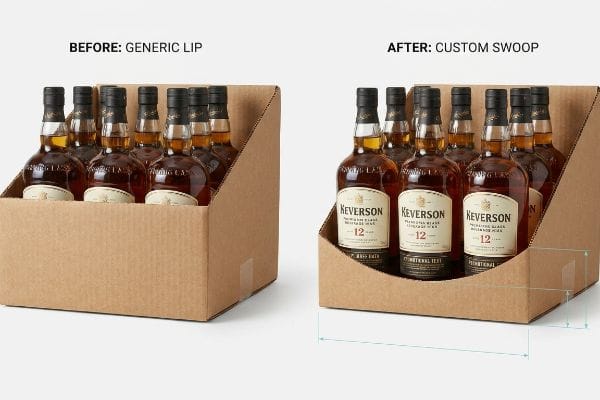
Na minha empresa, vejo rotineiramente esse alinhamento teórico se desfazer diante das limitações físicas das bandejas de exibição. Quando uma marca de bebidas me enviou um molde para destacar o rótulo de sua nova e cara variedade, eles ignoraram completamente a profundidade estrutural da borda de retenção. Testei isso usando nossa linha de protótipos interna; no momento em que carregamos as garrafas, a borda frontal ondulada de 69,8 mm (2,75 polegadas) cobriu fisicamente o texto promocional exato que eles levaram meses para desenvolver. Isso não era apenas um incômodo estético —obscurecer esses dados obrigatórios de conformidade causaria rejeição imediata por parte das grandes redes varejistas.Fiz as medições com o micrômetro e provei que não precisávamos reconstruir toda a base. Ao projetar um recorte personalizado preciso de 28,4 mm (1,12 polegadas) diretamente na borda de retenção, garantimos matematicamente a visibilidade 100% desobstruída da informação promocional. Esse microajuste preciso garante que o tempo de montagem da embalagem conjunta seja reduzido em 18 segundos por unidade, economizando aos clientes custos significativos de mão de obra e, ao mesmo tempo, alinhando perfeitamente a exibição física com sua estratégia promocional geral.
| Erro comum de iniciantes | A solução profissional | Benefício do piso de vendas |
|---|---|---|
| Lábios genéricos e retos que retêm a umidade | Projete um recorte personalizado em formato de curva | Expõe 100% do rótulo do produto18 |
| Texto que oculta a conformidade legal | Mapear as linhas de corte das garrafas para o CAD da bandeja | Evita rejeições em massa por parte dos varejistas19 |
| Ignorando a proporção produto-lábio | profundidade do lábio inferior matematicamente | Aumenta a visibilidade das compras por impulso20 |
Recuso-me a deixar que uma má engenharia estrutural comprometa o principal ativo de marketing de uma marca. Alinhar o design físico da sua bandeja com a sua mensagem promocional garante que o produto se venda sozinho.
🛠️ Mesa do Harvey: Não deixe que uma falha estrutural de 2 milímetros arruine o lançamento em 500 lojas. 👉 Envie-me seu arquivo de corte ↗ — Vou testar os cálculos antes que você desperdice seu orçamento com produção em massa.
Conclusão
Você pode escolher um fornecedor mais barato, mas quando aquela placa de papelão ondulado grosso quebra em uma bancada de tamanho reduzido durante a embalagem conjunta, os reparos com fita adesiva resultantes irão atrasar sua linha de montagem em cerca de 35% e eliminar completamente a margem de lucro do projeto. Mais de 500 gerentes de marca usam meu checklist de pré-impressão para evitar exatamente esses erros fatais no estágio inicial. Pare de adivinhar o dimensionamento estrutural e deixe-me analisar seus arquivos pessoalmente com minha Auditoria de Corte e Vinco gratuita ↗ para identificar pontos críticos de atrito antes do início da produção em massa.
"Embalagens e PDV no Desenvolvimento de Produtos – TyTek Industries", https://tytekindustries.com/turnkey-product-development/packaging-pos/. Análise do setor sobre custos de merchandising no varejo, demonstrando como ferramentas modulares ou escaláveis reduzem os custos de fabricação por unidade. Papel da evidência: verificação econômica; tipo de fonte: estudo de caso de manufatura. Apoia: a estratégia de escalonamento de projetos para maximizar os investimentos em ferramentas. Observação sobre o escopo: aplica-se principalmente a displays moldados em plástico ou metal .
Paletes GMA "48×40" | Maior fabricante e fornecedor de paletes, https://www.palletone.com/products/gma-pallets/. Verificação do padrão da Grocery Manufacturers Association para dimensões de paletes na América do Norte. Função da evidência: especificação técnica; tipo de fonte: padrão da indústria. Suportes: dimensões de ancoragem necessárias para displays de ponto de venda (PDV) no chão. Observação sobre o escopo: Aplica-se principalmente à logística de varejo na América do Norte .
"Fig. 5 Alcance Frontal – ADA.gov", https://archive.ada.gov/descript/reg3a/fig5des.htm. Verificação das Normas da ADA para Design Acessível referentes aos alcances máximo e mínimo para alcance frontal desobstruído. Função da evidência: conformidade legal; tipo de fonte: regulamentação governamental. Suportes: restrições de altura para balcões de ponto de venda. Nota de escopo: Refere-se especificamente à acessibilidade para pessoas em cadeiras de rodas .
"Normas da ADA para Design Acessível, Título III, Regulamento 28 CFR…", https://www.ada.gov/law-and-regs/design-standards/1991-design-standards/ . Verificação dos alcances acessíveis padrão para elementos operados pelo usuário, conforme definido pelas diretrizes de acessibilidade da ADA. Papel da evidência: validação factual; tipo de fonte: regulamentação governamental. Apoia: a conformidade com os limites de acessibilidade física para materiais de ponto de venda (POSM). Nota de escopo: aplica-se aos alcances para frente ou para os lados.
"Como Desenhar Projetos de Marcenaria RAPIDAMENTE | Armários de Cozinha", https://www.youtube.com/watch?v=f3Lpk1IUvtk. Padrões profissionais de design para o varejo ou guias de engenharia documentariam práticas comuns referentes ao dimensionamento de arquivos CAD estruturais para expositores de vários níveis. Papel da evidência: verificação do fluxo de trabalho da indústria; tipo de fonte: manual de projeto técnico. Apoia: a prática de reduzir a escala de projetos estruturais para unidades menores. Observação sobre o escopo: limitado ao projeto estrutural de embalagens. ↩
"Determinação Analítica da Rigidez à Flexão de uma Estrutura de Cinco Camadas…", https://pmc.ncbi.nlm.nih.gov/articles/PMC8777652/ . As especificações técnicas para papelão ondulado demonstram que a espessura da ondulação tipo B impede dobras perfeitas em raios muito pequenos, levando à falha do material. Papel da evidência: validação técnica; tipo de fonte: manual de ciência dos materiais. Argumenta: a limitação física da redução de escala de projetos com ondulação tipo B. Nota de escopo: Específico para a geometria do papelão ondulado.
"Tipos de Ondas de Papelão Ondulado Explicados: A, B, C, E e F", https://www.onyxpackaging.com/blog/corrugated-box-flute-types.php. Os padrões da indústria de embalagens recomendam a onda E para displays menores e detalhados devido ao seu perfil mais fino e capacidade de dobragem superior em comparação com a onda B. Papel da evidência: melhores práticas da indústria; tipo de fonte: guia de engenharia de embalagens. Apoia: a transição para a onda E para montagem em microescala. Nota de escopo: Foca na integridade estrutural de displays de varejo .
"Guia de Modelos de Caixa: Como Projetar Linhas de Corte Precisas para Embalagens", https://gentlever.com/what-is-box-template-and-how-to-design/. Os padrões de design de embalagens indicam que o redimensionamento de arquivos CAD pode distorcer a espessura e as tolerâncias das linhas, exigindo a criação de linhas de corte redesenhadas para manter a precisão necessária para o travamento das abas. Papel da evidência: Boa prática técnica; tipo de fonte: Guia de design industrial. Suporte: Criação adequada de linhas de corte. Observação sobre o escopo: Foca nas tolerâncias do software CAD .
"Entendendo a Resistência das Caixas de Envio – EcoEnclose", https://www.ecoenclose.com/blog/understanding-shipping-box-strength/?srsltid=AfmBOooZ4iSCUTLA2EKgbwFUhDh5C-9gUtMex_UmeEj_aUMOfj4sTLFb. As especificações técnicas dos tipos de papelão ondulado demonstram que o papelão ondulado tipo E proporciona uma dobra mais firme e melhor integridade do revestimento para balcões de varejo de pequeno porte do que o papelão ondulado tipo B. Papel da evidência: Especificação técnica; tipo de fonte: Manual de engenharia de embalagens. Suporte: Seleção de materiais para balcões. Nota de escopo: Aplica-se especificamente a displays de papelão ondulado. ↩
"Exibição e Fixação de Produtos em Expositores de Varejo", https://www.frankmayer.com/blog/showcasing-and-securing-products-on-your-retail-display/ . A literatura sobre embalagens estruturais explica que travas de fricção integradas eliminam a necessidade de adesivos visíveis, um requisito padrão para manter uma aparência profissional no varejo. Papel da evidência: Padrão de design; tipo de fonte: Manual de design industrial. Fundamentos: Uso de travas de fricção para fins estéticos. Nota de escopo: Refere-se à montagem de expositores de varejo de alto padrão.
"[PDF] Cronograma Detalhado do SRCC – Pesquisa de Graduação – Buffalo State", https://undergraduateresearch.buffalostate.edu/sites/undergraduateresearch/files/documents/SRCC%20preliminary%20program_3.pdf. Verificação do padrão da indústria para engajamento espacial no varejo e regras de visibilidade baseadas na distância. Papel da evidência: Definição técnica; tipo de fonte: Manual de merchandising visual. Fundamentos: Os intervalos de distância para engajamento do consumidor. Observação sobre o escopo: A aplicação pode variar de acordo com o setor varejista. ↩
"CMYK vs. Cores Especiais na Impressão de Embalagens – Meyers Printing", https://meyers.com/meyers-blog/cmyk-vs-spot-colors-in-packaging-printing-what-cpg-brands-need-to-know/. Explicação técnica de como as cores especiais proporcionam maior saturação e contraste do que as cores de processo para visibilidade a longa distância. Papel da evidência: Especificação técnica; tipo de fonte: Guia de produção gráfica. Aplica-se a: O uso do sistema Pantone (PMS) para cabeçalhos de alta visibilidade no varejo. Observação sobre o escopo: Limitado a mídias impressas físicas .
"Ponto de Venda: Como os Varejistas Podem Influenciar os Consumidores no…", https://blog.intouch.com/posts/points-of-purchase-displays. Verificação da metodologia específica do setor para engajamento espacial em merchandising no varejo. Papel da evidência: definição técnica; tipo de fonte: manual de design de varejo. Fundamentos: o uso de uma regra espacial padronizada para capturar o fluxo de clientes à distância. Nota de escopo: aplica-se a padrões de merchandising visual. ↩
"Explorando o comportamento de navegação e o nível de atenção do consumidor com um...", https://pmc.ncbi.nlm.nih.gov/articles/PMC6895988/. Evidências psicológicas sobre como hierarquias visuais simplificadas em displays de varejo reduzem a carga cognitiva dos consumidores. Papel da evidência: mecanismo causal; tipo de fonte: estudo comportamental revisado por pares. Apoia: a afirmação de que isolar um único elemento 3D melhora o processamento. Nota de escopo: psicologia geral do consumidor .
"Convertendo Prateleiras de Varejo em Displays de Produtos Iluminados – Luxx Lighting", https://luxx.com/lit-shelving/. Dados ergonômicos sobre como a inclinação das prateleiras afeta a visibilidade do produto e as taxas de interação física. Papel da evidência: métrica de desempenho; tipo de fonte: estudo de caso da indústria. Apoia: a afirmação de que prateleiras inclinadas impulsionam conversões táteis mais rápidas. Nota de escopo: específico para engenharia estrutural de PDV (Ponto de Venda) .
"Tendências de Sustentabilidade em Bens de Consumo Embalados | Ardent Mills", https://www.ardentmills.com/news/cpg-sustainability-trends-regenerative-agriculture/. Pesquisa de mercado do setor de bens de consumo embalados (CPG) demonstra uma mudança estratégica em direção à premiumização por meio do fornecimento e da embalagem. Papel da evidência: verificação factual; tipo de fonte: relatório do setor. Apoia: prioridades de investimento da marca em produto e promoção. Nota de escopo: concentra-se em setores de bens de consumo de alto valor. ↩
"Guia de Conformidade e Legislação de Embalagens – EcoEnclose", https://www.ecoenclose.com/resources/packaging-compliance?srsltid=AfmBOopPMVucI-lqz5xXV0Nr–ULdSy7rNK-1Ff7hJEgfnORzgkNJ1Z7. Manuais externos de fornecedores varejistas geralmente detalham requisitos rigorosos para a visibilidade de códigos de barras e dados regulatórios. Papel da evidência: validação de padrões da indústria; tipo de fonte: manual de conformidade do varejista. Fundamenta: a alegação de que dados obrigatórios ocultos levam à rejeição da remessa. Observação sobre o escopo: os requisitos variam de acordo com o varejista específico .
"Etiquetas personalizadas com corte especial que elevam o apelo visual nas prateleiras e a identidade da marca", https://inovarpackaging.com/custom-die-cut-labels-that-elevate-shelf-appeal-and-brand-identity/. Breve explicação de como designs com corte especial de precisão eliminam obstruções visuais para maximizar a exposição da marca. Papel da evidência: verificação; tipo de fonte: guia de engenharia de embalagens. Apoia: eficácia de rótulos personalizados em comparação com rótulos genéricos. Observação sobre o escopo: aplica-se ao design de bandejas para varejo .
"Um Guia Abrangente para Conformidade de Exibição | SafetyCulture", https://safetyculture.com/topics/visual-merchandising/display-compliance . Breve explicação dos padrões da indústria em relação à visibilidade do texto de conformidade legal para evitar rejeições no envio. Função da evidência: validação; tipo de fonte: manual de conformidade do varejo. Apoio: importância do mapeamento de gabaritos para CAD. Nota de escopo: específico para redes de varejo de mercado de massa.
"Design de embalagens como ferramenta de branding na indústria cosmética – PMC", https://pmc.ncbi.nlm.nih.gov/articles/PMC9123395/. Breve explicação da correlação entre visibilidade/acessibilidade do produto e comportamento de compra por impulso do consumidor. Papel da evidência: correlação; tipo de fonte: estudo de psicologia do consumidor. Fundamentos: benefícios da otimização da proporção produto-lábios. Nota de escopo: foca-se em merchandising no ponto de venda .