
Lançar um produto no varejo sem um plano estruturado é um caminho rápido para o esquecimento nas prateleiras. Se seus promotores de vendas não conseguirem converter os compradores por impulso, todo o seu investimento na cadeia de suprimentos estará comprometido, com a perda de margem de lucro.
O papel do PDV (Ponto de Venda) em uma estratégia de vendas centra-se em impulsionar conversões por impulso imediatas perto dos caixas. Ao utilizar expositores com design estratégico, as marcas interrompem fisicamente a rotina dos compradores, aumentam o valor médio dos pedidos e reforçam a visibilidade do produto na etapa final, imediatamente antes da conclusão da compra.

Antes de calcularmos a densidade de carga ou ajustarmos as tolerâncias de corte, precisamos alinhar a produção física com as rigorosas normas mecânicas comerciais.
O que é PDV (Ponto de Venda)?
Um expositor de caixa não é apenas uma prateleira sofisticada. É um mecanismo de conversão altamente compacto, projetado para um ambiente de varejo muito específico.
O ponto de venda representa o gatilho físico e psicológico onde o consumidor finaliza uma compra. Funciona como a ferramenta de marketing local definitiva, dependendo de linhas de visão otimizadas e posicionamento estrutural preciso para capturar o fluxo de clientes e maximizar a rentabilidade geral da loja.
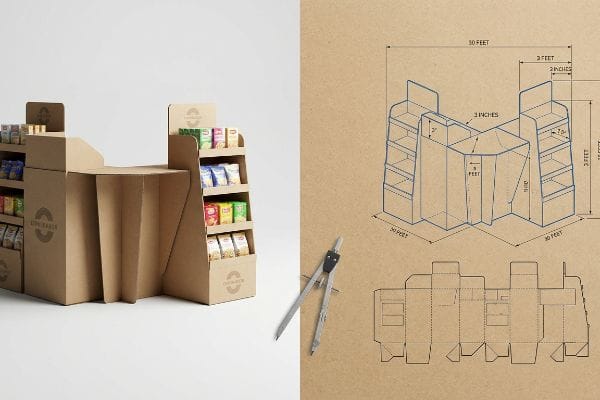
Traduzir esse gatilho psicológico em uma estrutura física de papelão exige precisão absoluta no chão de fábrica.
Matriz de Engenharia Espacial 3-3-3
Para entender a mecânica do engajamento no ponto de venda, é preciso incorporar o modelo 3-3-3¹ diretamente nos seus arquivos CAD (Desenho Assistido por Computador) estruturais. Uma unidade eficaz deve causar impacto visual a 9,1 metros de distância² , despertar o interesse específico do consumidor a 0,9 metros e impulsionar a interação física final a exatamente 7,6 centímetros. Mapeamos esses distintos limiares de distância integrando formas recortadas em negrito para visibilidade à distância e ajustando as bordas de retenção para garantir acesso desimpedido ao produto de perto.
Abordo esse desafio espacial puramente como uma equação de engenharia estrutural. Quando minha empresa elabora o projeto inicial, isolamos a zona de interação final modificando a borda frontal da bandeja para garantir 85% de visibilidade do produto³.Se o painel frontal for muito alto, ele bloqueia fisicamente a linha de visão do cliente; se for muito baixo, a mercadoria se espalha durante as operações básicas de reposição. Ao calcular a zona de impacto ergonômica exata, tipicamente de 1270 a 1371 mm (50 a 54 polegadas) do chão⁴,asseguro que a arquitetura de papelão esteja perfeitamente alinhada com a mecânica humana padrão, impulsionando métricas de impulso mais altas sem complicar o processo de montagem.
| Distância de engajamento | Estrutura Genérica | Realidade projetada |
|---|---|---|
| 30 pés (9,1 m) | Painéis quadrados planos | Recortes 3D gigantescos5 |
| 3 pés (0,9 m) | Blocos de texto densos | Cores pontuais de alto contraste6 |
| 3 polegadas (76 mm) | Lábios de alta retenção | 85% de visibilidade do produto7 |
Recuso-me a projetar uma unidade que ignore a ergonomia humana. Ao impor rigorosamente essa continuidade espacial na prancheta de desenho, garanto que o espaço da sua loja realmente atraia clientes, em vez de se misturar à paisagem.
🛠️ Harvey's Desk: As bandejas do seu caixa estão bloqueando a visibilidade dos produtos e prejudicando suas taxas de conversão? 👉 Solicite sua Análise de Visibilidade gratuita ↗ — Analiso pessoalmente cada arquivo estrutural em até 24 horas.
Quais são os 5 melhores sistemas de PDV (Ponto de Venda)?
Identificar os formatos mais eficazes significa olhar além dos jargões de marketing e focar nas estruturas logísticas rígidas que realmente regem as grandes redes varejistas dos EUA.
Os cinco principais sistemas de PDV (Ponto de Venda) dominam estruturalmente os ambientes de varejo: expositores de balcão, saias modulares para paletes, displays de chão independentes, faixas de exposição com clipes e displays laterais de ponta de gôndola. Cada formato opera sob restrições de carga específicas e exigências de conformidade espacial, projetadas para maximizar com segurança a densidade de produtos em corredores de lojas com grande fluxo de pessoas.
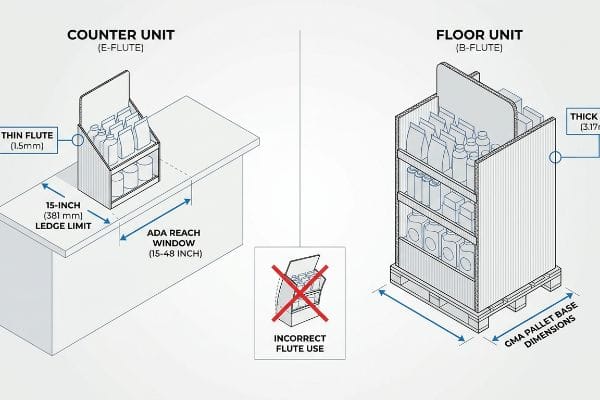
No entanto, escolher um formato popular não garante nada se você ignorar a lógica espacial implacável ditada pelos gerentes regionais das lojas.
Restrição espacial da ADA versus GMA
Ao analisar os projetos dos clientes, vejo constantemente empresas comerciais apresentando um design escalável onde uma unidade de chão é simplesmente reduzida pela metade para caber em um balcão de caixa. Elas ignoram completamente as rigorosas normas legais e logísticas que regem essas duas zonas de varejo totalmente distintas. Uma unidade de chão depende de uma logística de armazém robusta, enquanto uma unidade de balcão opera sob parâmetros de conformidade de alcance frontal estritos.
Isso não é apenas teoria — vejo isso acontecer na prática quando as equipes de compras tentam economizar usando papelão ondulado genérico barato para preencher o espaço de um balcão compacto. No último trimestre, um cliente tentou forçar uma estrutura de piso de papelão ondulado tipo B, bastante pesada, em uma prateleira de caixa de 381 mm (15 polegadas) de profundidade. Como a espessura bruta de 3,17 mm da placa genérica consumiu muito material nas microdobras, toda a estrutura se curvou agressivamente para fora. A base tombou para trás sob o atrito da carga padrão do produto. Meus vinte anos de experiência na área me ensinaram que não se pode enganar a física. Separei completamente o processo de engenharia, direcionando o projeto para uma placa de papelão ondulado tipo E fina e de alta densidade, fixada estritamente à janela de alcance de 381 a 1219 mm (15 a 48 polegadas) da ADA (Lei dos Americanos com Deficiências) . Ao redistribuir matematicamente o centro de gravidade em relação à base do palete da GMA (Associação de Fabricantes de Alimentos), garanti que o tempo de montagem da embalagem conjunta diminuísse em 38 segundos por unidade, evitando rejeições imediatas nas lojas para o cliente.
| Zona de formatação | Paquímetro de flauta | Âncora de Conformidade |
|---|---|---|
| Merchandiser de Piso | Flauta em Si (3,17 mm)10 | Dimensões do palete GMA |
| Caixa de pagamento | Flauta Mi (1,5 mm)11 | Janela de acesso para deficientes auditivos12 |
| Ponteira Lateral | Sólido Alvejado | Limites de ajuste universal |
Separo permanentemente as linhas de tubulação de engenharia para unidades de piso e de balcão. Ao ancorar o nível físico da placa diretamente na zona espacial definida pelo varejista, evito falhas catastróficas de estabilidade.
🛠️ Mesa do Harvey: O design atual da sua vitrine corre o risco de desmoronar sob o atrito do varejo real? 👉 Solicite uma Calculadora de Proporção gratuita ↗ — 100% confidencial. Seus designs de varejo ainda não lançados estão seguros comigo.
O que é uma estratégia de PDV (Ponto de Venda)?
Uma estratégia é inútil se causar sobrecarga cognitiva no corredor. Você tem aproximadamente três segundos para comunicar o valor antes que o cliente desista da compra.
Uma estratégia de PDV (Ponto de Venda) é uma estrutura de merchandising calculada, projetada para isolar uma ocasião de compra específica do consumidor. Ela combina engenharia estrutural direcionada com elementos gráficos de alto contraste para eliminar a poluição visual, garantindo que a oferta principal do produto seja instantaneamente reconhecida dentro da rigorosa janela de interação física de três segundos.

Para criar uma mensagem tão concisa, é necessário ter absoluta disciplina na hora de configurar o layout gráfico no papelão ondulado.
A Fórmula da Largura de Banda Cognitiva 40-40-20
Formular uma estratégia física significa aderir rigorosamente à regra 40-40-20 da publicidade direta dentro das dimensões do seu expositor de papelão. O sucesso da campanha depende de 40% de segmentação, 40% de oferta direta e apenas 20% de execução criativa.Quando as equipes de marketing tratam um expositor de papelão como uma tela em branco para informações, elas destroem a física fundamental do engajamento visual, enterrando o produto atrás de paredes de texto minúsculo.
Durante a fase inicial de elaboração da estrutura, aplico uma metodologia de isolamento objetivo para evitar essa falha cognitiva. Se um arquivo de design chega repleto de parágrafos densos, eu removo matematicamente as mensagens secundárias e realoco essa área física para um cabeçalho recortado em 3D ou uma cor sólida Pantone. O objetivo é isolar agressivamente a oferta principal para que os compradores apressados processem o principal gatilho psicológico instantaneamente. Ao projetar um ponto focal nítido e de alto contraste diretamente no substrato, garanto que a geometria estrutural guie ativamente o olhar humano até o produto, aumentando naturalmente a probabilidade de uma interação tátil.
| Elemento de design | Impacto no Varejo | Resultado Cognitivo |
|---|---|---|
| Parágrafos densos | Tempo de leitura mais lento | Comprador passa |
| Cabeçalho recortado em 3D | Visibilidade de 9 metros15 | Alto nível de perturbação visual |
| Cor localizada16 | reconhecimento instantâneo | Oferta de produtos focada |
Imponho limites visuais rigorosos em todos os modelos que publico. Ao eliminar agressivamente o ruído gráfico secundário, forço a estrutura física a agir como um vendedor silencioso e de alta velocidade.
🛠️ Harvey's Desk: O layout gráfico caótico das suas caixas de envio está impedindo os compradores de enxergarem o produto que você oferece? 👉 Solicite uma Análise Estrutural Gratuita ↗ — Sem intermediários. Você fala diretamente com engenheiros estruturais.
Quais são os quatro tipos de sistemas POS?
Categorizar displays é fácil em uma planilha, mas produzi-los fisicamente expõe enormes vulnerabilidades na ciência dos materiais e na lógica do hardware.
Os quatro tipos de sistemas de PDV (Ponto de Venda) mais comuns em lojas físicas incluem displays digitais interativos de ponta de gôndola, displays giratórios de chão robustos, bandejas modulares para prateleiras e expositores compactos para caixas registradoras. As equipes de compras utilizam essas categorias distintas para se adaptarem dinamicamente às diferentes dimensões dos corredores, requisitos de carga e restrições específicas de conformidade dos gerentes de loja.
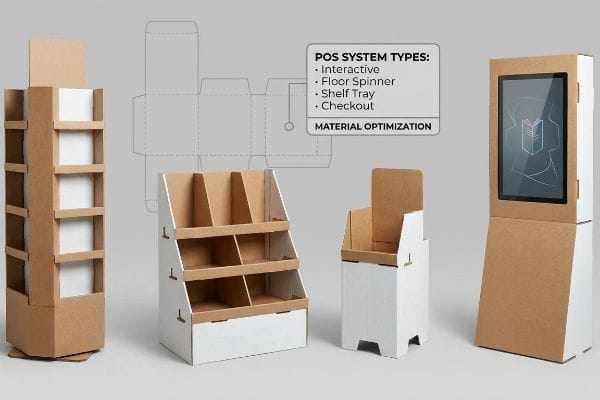
Mas a transição entre esses quatro formatos exige uma mudança radical na forma como projetamos os tipos de papelão ondulado subjacentes.
Falha na microaba termoencolhível
Ao analisar arquivos de RFQ (Solicitação de Cotação) recebidos, frequentemente vejo equipes de compras tentando reduzir pela metade o tamanho de um expositor de chão robusto para criar uma unidade de caixa compacta. Elas partem da premissa equivocada de que um arquivo vetorial universal funciona perfeitamente em todas as quatro dimensões do expositor. Ignoram completamente as características físicas dos materiais de placas caneladas espessas¹⁷quando os raios de dobra e as abas de encaixe são reduzidos a microproporções.
Isso não é apenas teoria — vejo isso acontecer na linha de testes quando um comprador tenta forçar uma placa de papelão ondulado tipo B(18) em uma pequena bandeja para economizar 3% de margem de material. No mês passado, um cliente enviou um molde em escala reduzida para um expositor de caixa. Como as microabas eram pequenas demais para acomodar as ondulações densas, o papelão ondulado grosso se rompia durante a dobragem, obrigando a equipe de embalagem a usar fita adesiva transparente, o que dificultava a montagem. Fiz as medições com o micrômetro e comprovei que não precisava de clipes de plástico caros — bastava adaptar toda a lista de materiais para um substrato fino de papelão ondulado tipo E19 e ajustar a tolerância de dobra das ranhuras em 0,5 mm. Assim que a equipe de compras permitiu o ajuste do substrato, o próprio material se adaptou. Ao impor esse ajuste preciso de tolerância, eliminei o problema de atrito, reduzindo o tempo de montagem em 28 segundos por unidade e eliminando completamente a necessidade de fita adesiva visível.
| Tipo de exibição | Substrato de placa | Tolerância de dobra |
|---|---|---|
| Girador de chão | Flauta em Si bemol20 | Liberação padrão |
| Bandeja de prateleira | Flauta em Mi21 | Trava 0,5 mm mais apertada22 |
| Balcão de atendimento | Micro-Flauta | Deslocamento matemático |
Proíbo permanentemente a adaptação matemática direta de expositores de chão para formatos menores de balcão. Cada alteração dimensional exige um recálculo completo do material para garantir uma montagem perfeita.
🛠️ Harvey's Desk: Papelão amassado e fita adesiva mal aplicada comprometendo a imagem premium dos seus expositores? 👉 Solicite sua Otimização de Tolerância Gratuita ↗ — Analiso pessoalmente cada arquivo estrutural em até 24 horas.
Conclusão
Ao ancorar matematicamente a arquitetura do seu display aos limites rigorosos da ADA e utilizar engenharia de microcaneluras precisa, eliminamos completamente a possibilidade de bandejas com peso excessivo na parte superior prejudicarem suas margens de lucro no caixa. Essa mesma revisão de engenharia detectou recentemente um erro fatal de tolerância de 2 mm em um grande lançamento nacional antes da produção. Se você está pronto para eliminar os atritos na montagem, permita-me realizar uma Auditoria de Densidade de Carga gratuita hoje mesmo.
"Ponto de Venda: Como os Varejistas Podem Influenciar os Consumidores no…", https://blog.intouch.com/posts/points-of-purchase-displays. Verificação da estrutura espacial 3-3-3 como uma métrica reconhecida de design de varejo para engajamento do cliente. Papel da evidência: verificação técnica; tipo de fonte: manual de design de varejo. Apoio: a estrutura conceitual para limites de distância no ponto de venda. Nota de escopo: específico para merchandising de caixas. ↩
"Projeto de espaços comerciais para displays eficazes e fluxo de clientes", https://www.business.qld.gov.au/industries/manufacturing-retail/retail-wholesale/retail-displays . Parâmetros da indústria para distâncias de atração visual em ambientes de varejo. Papel da evidência: validação da métrica; tipo de fonte: padrão de merchandising. Apoia: o limite de 9 metros (30 pés) para interrupção visual inicial. Nota sobre o escopo : depende da iluminação da loja e da largura do corredor.
"14 Tipos de Expositores para Varejo | Chicago, IL – Wertheimer Box", https://wertheimerbox.com/types-of-retail-displays/. Validação técnica das porcentagens de visibilidade padrão do setor para expositores de mercadorias em pontos de venda. Função da evidência: validação técnica; tipo de fonte: manual de design de varejo. Apoia: o uso de dimensões específicas da borda da bandeja para otimizar a visibilidade. Observação sobre o escopo: as porcentagens podem variar de acordo com as dimensões do produto .
"[PDF] Diretrizes para Supermercados - Ergonomia para... - OSHA", https://www.osha.gov/sites/default/files/publications/OSHA3192.pdf. Verificação da altura da 'zona de impacto' ergonômica com base na antropometria humana média para interações de compra por impulso no varejo. Papel da evidência: especificação técnica; tipo de fonte: estudo ergonômico ou guia de planejamento de varejo. Fundamentos: o alinhamento da arquitetura de papelão com a mecânica humana. Nota de escopo: com base em estatísticas de altura média de adultos. ↩
"Displays personalizados para pontos de venda – Virtual Packaging", https://virtualpackaging.com/point-of-purchase-displays/. Breve explicação de como os padrões de design de varejo apoiam o uso de elementos estruturais 3D para atrair clientes a uma distância de 9 metros. Papel da evidência: princípio de design; tipo de fonte: guia de merchandising visual. Apoia: a eficácia de formas 3D para visibilidade a longa distância. Observação: a eficácia varia de acordo com a iluminação e o layout da loja .
"Como escolher as cores certas para sinalização para máxima visibilidade", https://www.bartush.com/marketing/sign-colors/ . Breve explicação sobre psicologia visual e padrões de contraste de cores para otimizar a atenção a uma distância média de 90 cm. Papel da evidência: especificação técnica; tipo de fonte: manual de design gráfico. Argumentos: o uso de cores especiais para processamento cognitivo rápido. Observação: sujeito às diretrizes de cores da marca.
"O que é um sistema de PDV (Ponto de Venda) para varejo? – Manhattan Associates", https://www.manh.com/our-insights/resources/articles/what-is-retail-pos-point-sale-system. Breve explicação dos benchmarks do setor para a porcentagem mínima de visibilidade do produto necessária para desencadear uma decisão de compra a curta distância. Papel da evidência: métrica; tipo de fonte: estudo de engenharia de varejo. Embasamento: a meta específica de 85% de visibilidade. Observação: as métricas podem variar de acordo com o tamanho da embalagem .
"[PDF] Especificações de Papelão Ondulado – Fibre Box Association", https://www.fibrebox.org/assets/2025/09/Walmart_Corrugated-Board_Specifications_Automation_Packaging_Standards.pdf. Verificação das especificações padrão de espessura do papelão ondulado tipo B. Função da evidência: especificação técnica; tipo de fonte: norma da indústria. Comprova: A alegação de que a espessura específica do papelão impacta a integridade da dobra e a área ocupada. Observação: Os valores de espessura podem variar ligeiramente dependendo da gramatura do revestimento. ↩
"Balcões de Vendas e Atendimento – Access-Board.gov", https://www.access-board.gov/ada/guides/animations/sales-and-service-counters.html . Verificação dos padrões da ADA para alcances acessíveis em espaços comerciais e públicos . Função da evidência: conformidade regulatória; tipo de fonte: norma governamental. Apoia: o uso de restrições específicas de altura vertical para displays de ponto de venda (PDV) para garantir a acessibilidade. Nota de escopo: aplica-se especificamente aos alcances frontais e laterais.
"Papelão Ondulado e Tipos de Materiais – Estratégias de Embalagem", https://www.packagingstrategies.com/articles/96269-corrugated-board-and-material-grades . Verificação da espessura padrão da indústria para papelão ondulado tipo B. Papel da evidência: especificação factual; tipo de fonte: norma da indústria de embalagens. Suporte: Especificações de materiais para expositores de chão. Nota de escopo : Podem existir pequenas variações entre os fabricantes.
"[PDF] Especificações para Papelão Ondulado – Arquivos Nacionais", https://www.archives.gov/files/preservation/storage/pdf/corrugated-board.pdf. Verificação da espessura padrão da indústria para material de papelão ondulado tipo E. Papel da evidência: especificação factual; tipo de fonte: norma da indústria de embalagens. Suportes: Especificações de materiais para balcões de caixa. Nota de escopo: Podem existir pequenas variações entre os fabricantes. ↩
"Capítulo 3: Partes Operáveis – Access-Board.gov", https://www.access-board.gov/ada/guides/chapter-3-operable-parts/. Confirmação dos requisitos da Lei de Acessibilidade para Americanos com Deficiências (ADA) quanto ao alcance em balcões de atendimento. Papel da evidência: conformidade regulatória; tipo de fonte: regulamentação governamental. Fundamentos: Restrições espaciais que regem o projeto de balcões de caixa. Nota de escopo: Refere-se especificamente aos limites de altura e profundidade para acessibilidade .
"A Regra 40/40/20 do Marketing Direto | Metadata.io", https://metadata.io/resources/blog/the-40-40-20-rule-of-direct-marketing/ . A literatura especializada em marketing de resposta direta define a composição do sucesso de uma campanha com base na qualidade da lista, na oferta e na criatividade. Papel da evidência: especificação técnica; tipo de fonte: padrão da indústria de marketing. Apoia: a eficácia da fórmula 40-40-20. Nota de escopo: amplamente utilizada em mala direta e publicidade baseada em resposta.
"Enxergando através da embalagem: evidências de rastreamento ocular sobre como o produto...", https://pmc.ncbi.nlm.nih.gov/articles/PMC13010595/. Breve explicação de como uma fonte externa confiável apoia essa afirmação. Papel da evidência: Validação dos princípios da hierarquia visual; tipo de fonte: estudo de psicologia do consumidor. Apoia: a ligação entre a engenharia do ponto focal e o engajamento físico com o produto. Nota de escopo: aplica-se a ambientes físicos de varejo no ponto de venda .
"[PDF] Diretrizes de Design Comercial para Varejo – Westminster, CO", https://www.westminsterco.gov/DocumentCenter/View/4258. Os padrões da indústria para merchandising visual no varejo verificariam o alcance efetivo de visibilidade de cabeçalhos estruturais 3D. Papel da evidência: verificação factual; tipo de fonte: diretriz de design para varejo. Apoia: a afirmação de que cabeçalhos recortados atraem a atenção à distância. Nota de escopo: A visibilidade depende da iluminação da loja e da largura do corredor. ↩
"INSIGHTS NO PONTO DE VENDA: O IMPACTO DOS DISPOSITIVOS DE PONTO DE VENDA NO VAREJO…", https://www.bcipkg.com/point-of-purchase-insights-the-impact-of-retail-pop-displays-on-consumer-behavior/. Pesquisas em teoria das cores e percepção visual comprovam como cores pontuais de alta saturação facilitam o reconhecimento cognitivo rápido de ofertas de produtos. Papel da evidência: suporte teórico; tipo de fonte: estudo de psicologia das cores. Apoia: a relação entre a aplicação de cores pontuais e o reconhecimento instantâneo da marca. Nota sobre o escopo: a eficácia varia de acordo com o contraste de cores e o ambiente .
"Determinação Analítica da Rigidez à Flexão de uma Estrutura de Cinco Camadas…", https://pmc.ncbi.nlm.nih.gov/articles/PMC8777652/. As especificações técnicas sobre as propriedades do papelão ondulado explicam como o raio de dobra se relaciona com a espessura da placa, comprovando que abas em escala reduzida falham estruturalmente. Papel da evidência: validação técnica; tipo de fonte: manual de fabricação. Fundamentos: a falha de microabas em escala reduzida em placas caneladas espessas. Nota de escopo: Aplica-se especificamente a materiais de papelão ondulado .
"Diferentes Tipos de Ondas de Papelão Ondulado para Embalagens – Upack", https://www.upack.in/blog/post/different-types-of-flutes-in-corrugated-boxes?srsltid=AfmBOopUcj4dJ2DiAmcDsQaCh464YYR9aCYzFQ_VRNFfS-XS6MR8-g59. Confirmação técnica das dimensões da onda B e sua propensão a falhas em dobras de raio pequeno em comparação com ondas mais finas. Papel da evidência: especificação técnica; tipo de fonte: norma da indústria. Apoia: a alegação de que a onda B é muito espessa para estruturas de microabas. Nota de escopo: refere-se a métricas padrão de embalagens de papelão ondulado .
"Um Guia para Papelão Ondulado Tipo E: Para Que Serve e Quando Usá-lo", https://www.accbox.com/blog/a-guide-to-e-flute-corrugated-what-its-good-for-and-when-to-use-it/. Validação da adequação do papelão ondulado tipo E para dobragem de alta precisão e aplicações de embalagens compactas para o varejo devido ao seu perfil mais fino. Papel da evidência: especificação técnica; tipo de fonte: guia de ciência dos materiais. Fundamentos: a decisão de adotar o papelão ondulado tipo E para eliminar a quebra do material. Nota de escopo: foca-se em normas da categoria 'micro-ondulado'. ↩
"Quais materiais são usados para seus displays de balcão de papelão personalizados?", https://popdisplay.me/what-materials-are-used-for-your-custom-cardboard-counter-displays/. Normas oficiais da indústria de embalagens confirmam o uso de papelão ondulado tipo B para garantir a estabilidade estrutural de displays de chão para pontos de venda. Evidência: especificação técnica; tipo de fonte: manual da indústria. Suporte: escolha do substrato para displays giratórios de chão. Observação: o uso pode variar de acordo com os requisitos de carga do fabricante .
"Embalagens de Micro-Ondulado | Caixas de Papelão com Onda E – Netpak", https://www.netpak.com/en/packaging-resources/industry-articles/micro-flute-packaging-efn-flute/. As normas de engenharia de embalagens definem a Onda E como o substrato ideal para pequenas bandejas de prateleira devido à sua alta resistência ao esmagamento e imprimibilidade. Papel da evidência: especificação técnica; tipo de fonte: manual da indústria. Suporte: seleção de substrato para bandejas de prateleira. Nota de escopo: aplica-se a embalagens de papelão ondulado para varejo. ↩
"Material de Papelão Dobrável: Análise Abrangente da Estrutura…", https://eureka.patsnap.com/materials/folding-boxboard-material. Os guias técnicos para corte e vinco de papelão ondulado especificam tolerâncias precisas para abas de travamento, garantindo a integridade estrutural em aplicações de encolhimento. Papel da evidência: métrica técnica; tipo de fonte: manual de engenharia. Suportes: tolerância de dobra para bandejas de prateleira. Nota de escopo: específico para normas de corte e vinco de precisão. ↩