Colocar os produtos nas prateleiras das lojas é apenas metade da batalha. Se a sua exposição não captar imediatamente a atenção do consumidor, o seu lançamento no mercado de massa desaparecerá no meio de tudo.
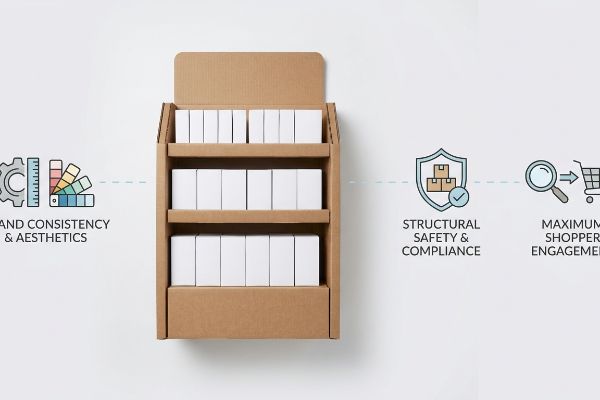
As diretrizes de merchandising visual definem os padrões físicos específicos e a estética estratégica necessários para as exposições no ponto de venda. Essas regras documentadas garantem a consistência da marca, a segurança estrutural e o máximo engajamento do consumidor, transformando embalagens comuns de papelão ondulado em ativos eficazes e de alta conversão que impulsionam compras por impulso em ambientes de grandes lojas com regras rígidas.
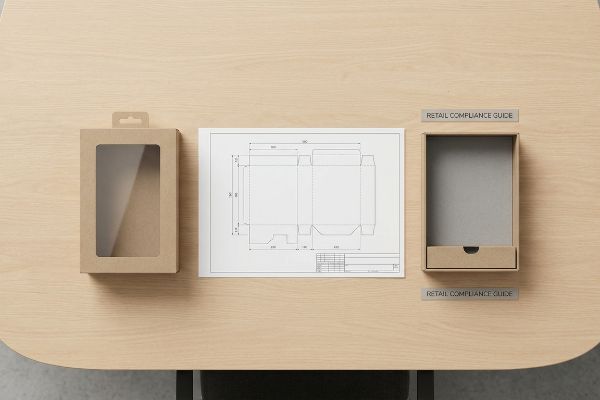
A teoria fica ótima em uma tela digital, mas executar essas diretrizes em um ambiente de produção real exige um projeto estrutural complexo. Vamos analisar como isso funciona na prática.
Quais são os 5 princípios do merchandising visual?
Compreender os conceitos fundamentais de publicidade visual evita que sua campanha se perca em meio à concorrência.
Os cinco princípios do merchandising visual focam em criar impacto visual imediato, estabelecer pontos focais estruturais, equilibrar layouts de produtos assimétricos, priorizar preços claros e garantir acessibilidade física. Seguir essas regras específicas de merchandising no varejo garante que sua vitrine capture a atenção do consumidor e impulsione compras por impulso sem dificuldades na loja.
Passar de um princípio de design abstrato para um pedaço físico de papelão exige mais do que apenas bons gráficos.
Desenvolvendo o Continuum de Engajamento Espacial 3-3-3
Até mesmo designers veteranos muitas vezes ignoram como a distância física afeta o impacto visual¹,criando arquivos estritamente para visualização de perto em monitores de computador retroiluminados. Eles presumem que um gráfico de alta resolução atrairá naturalmente o fluxo de pessoas de toda a loja, ignorando a realidade física de como os compradores apressados percorrem corredores enormes.
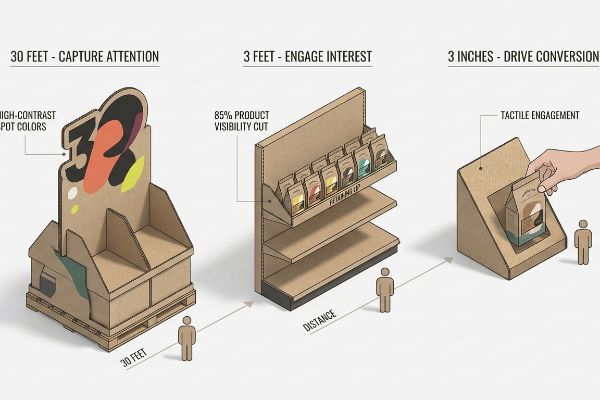
Vejo essa armadilha semanalmente quando as marcas imprimem textos altamente detalhados em seus cabeçalhos superiores, ignorando completamente a regra 3-3-3 do engajamento no varejo².Um display deve capturar a atenção a 9 metros de distância, despertar interesse específico a 90 centímetros e gerar conversão tátil a 7,5 centímetros. Vi um funcionário de loja rasgar a borda de um papelão cru ao tentar repor uma bandeja compactada e visualmente confusa porque o design não considerava a interação física final de 7,5 centímetros. Para corrigir isso, exijo formatos de recorte agressivos e cores Pantone vibrantes para criar impacto visual à distância, enquanto corto a borda frontal para garantir 85% de visibilidade do produto³para esse alcance final crucial. Essa mudança específica aumenta ativamente a interação do consumidor, reduzindo drasticamente o tempo necessário para retirar o estoque da área de vendas e maximizando a velocidade de vendas por metro quadrado.
| Erro comum de iniciantes | A solução profissional | Benefício do piso de vendas |
|---|---|---|
| Texto pequeno nos cabeçalhos | Cores pontuais de alto contraste | Atrai compradores a 9 metros de distância4 |
| Lábios de retenção obstruídos | Redução de 85% na visibilidade do produto5 | Aumenta o envolvimento tátil |
| Grades planas simétricas | Formas agressivas recortadas | Cria uma distração visual instantânea |
Eu nunca permito que um arquivo de arte seja impresso sem que ele matematicamente atenda aos limites de distância específicos. Engajar o consumidor fisicamente exige uma engenharia que respeite a forma como os olhos humanos percorrem um ambiente lotado.
🛠️ Mesa do Harvey: Não tem certeza se sua arte realmente atrapalha a visão do corredor a dez metros de distância? 👉 Envie-me seu arquivo de design ↗ — Acesso direto à minha mesa. Zero spam de vendas automatizado, prometo.
O que são diretrizes de merchandising visual?
Antes de poder vender qualquer coisa, sua vitrine deve estar legal e fisicamente adequada ao ambiente de varejo.
As diretrizes de merchandising visual estabelecem os requisitos dimensionais, estruturais e gráficos exatos que uma marca deve seguir para garantir espaço nas lojas. Essas regras de conformidade padronizadas regem tudo, desde a projeção máxima de paletes e limites de peso dinâmico até alcances específicos de acordo com a Lei de Acessibilidade para Pessoas com Deficiência (ADA), evitando rejeições dispendiosas por parte dos varejistas e falhas na cadeia de suprimentos logística.
Conhecer as regras gerais é bom, mas interpretar mal as restrições espaciais específicas da loja fará com que sua campanha seja banida permanentemente para os fundos da loja.
Como lidar com as restrições físicas da ADA versus a GMA
Um pedido frequente que recebo é para pegar um grande expositor de chão e simplesmente reduzi-lo pela metade para que possa funcionar como uma unidade de balcão. Muitas empresas comerciais aceitam de bom grado esse pedido de redução, ignorando completamente as rigorosas estruturas legais e logísticas que ditam essas duas zonasdistintas.
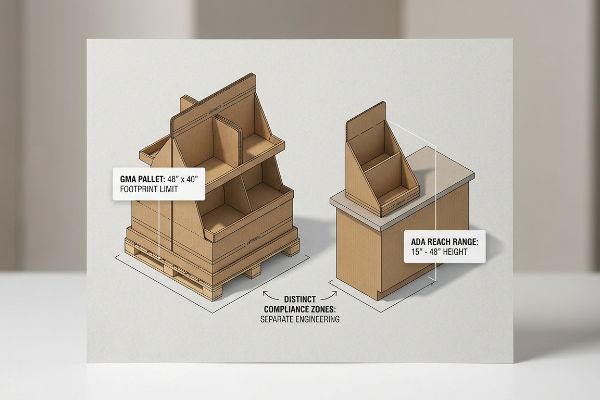
Não basta simplesmente reduzir um arquivo CAD (Desenho Auxiliado por Computador) e esperar que os gerentes de grandes lojas o aceitem. Na minha empresa, separo completamente os processos de engenharia, pois os expositores de chão precisam estar firmemente fixados ao limite padrão de 121,9 x 101,6 cm (48 x 40 polegadas) para paletes de madeira GMA⁷para suportar a logística pesada. Enquanto isso, os terminais de caixa devem seguir rigorosamente a faixa de alcance frontal de 38,1 a 121,9 cm (15 a 48 polegadas) exigida pela ADA⁸.O atrito de um revestimento de papelão ondulado espesso deslizando contra um balcão de caixa é totalmente diferente do atrito de uma base de palete apoiada em concreto. Ao basear meus cálculos nessas métricas exatas de conformidade, garanto que meus displays passem sem problemas pelos centros de distribuição dos varejistas, evitando completamente grandes estornos ou rejeições nas lojas.
| Erro comum de iniciantes | A solução profissional | Benefício do piso de vendas |
|---|---|---|
| Arquivos de chão encolhíveis para PDV (Ponto de Venda) | Engenharia de PDV separada | Evita a rejeição do gerente |
| Ignorando os limites de paletes | Fechadura de pegada 48×409 | Elimina a saliência do trânsito |
| As prateleiras de exposição estão muito altas | Alvo ADA de 15 a 48 polegadas10 | Garante a conformidade legal |
Eu projeto cada estrutura de acordo com os limites exatos de conformidade do varejista alvo. Uma vitrine bonita não significa absolutamente nada se o gerente da loja a jogar no compactador de lixo por violar as normas de organização dos corredores.
🛠️ Mesa do Harvey: Será que suas vitrines atuais estão violando secretamente os limites de alcance da ADA ou as áreas de exposição permitidas pela GMA? 👉 Baixe meu Checklist de Conformidade para Varejo ↗ — Baixe com segurança. Minha caixa de entrada está aberta caso tenha alguma dúvida depois.
Quais são as 7 regras do merchandising?
A forma correta de organizar um expositor é tão importante quanto o seu design estrutural.
As sete regras de merchandising priorizam a visibilidade do produto, níveis de estoque equilibrados, vendas cruzadas estratégicas, tensão visual assimétrica, relevância para o consumidor local, manutenção impecável da exposição e sinalização promocional clara. A implementação eficaz dessas estratégias estruturais reduz o atrito de reposição para os funcionários, ao mesmo tempo que direciona o olhar do consumidor para os principais SKUs de alta margem.

Imagine as prateleiras de uma loja como a construção de uma parede de tijolos; se o espaçamento for perfeitamente uniforme e simétrico, o olho humano simplesmente passa direto por ela.
Quebrando a simetria da grade com a regra 3-5-7
É uma armadilha comum que apanha até mesmo as equipas de compras mais experientes: solicitar uma grelha perfeitamente simétrica e densamente compactada de produtos numa única bandeja, assumindo que a densidade máxima resulta automaticamente numa receita mais elevada11Encaram a prateleira de cartão ondulado como um depósito em vez de uma ferramenta de venda psicológica ativa.
Quando os itens são embalados muito apertados, os blocos de produtos perfeitamente simétricos não criam tensão visual, fazendo com que os compradores apressados simplesmente passem direto sem parar. Lembro-me de ter visto um funcionário forçar agressivamente frascos de xampu em uma grade apertada, resultando no som característico de papelão rasgando quando a aba frontal se rompeu sob a pressão. Para eliminar isso, adotei a regra 3-5-7¹²,projetando divisórias modulares dedicadas que separam naturalmente as mercadorias em grupos assimétricos de número ímpar. Esse espaçamento estrutural integrado cria a folga física necessária de 6,35 mm¹³para eliminar completamente os danos causados pela reposição, enquanto essa sutil irregularidade visual força naturalmente o cérebro humano a parar e interagir, impulsionando uma maior rotatividade de vendas.
| Erro comum de iniciantes | A solução profissional | Benefício do piso de vendas |
|---|---|---|
| Fileiras perfeitamente uniformes | Agrupamento de número ímpar14 | Forças de engajamento visual |
| Espaço zero nas prateleiras | buffers de espaçamento de 0,25 polegadas15 | Previne o rompimento dos lábios |
| Bandejas largas não segmentadas | Divisórias flutuantes modulares16 | Acelera o reabastecimento |
Eu sempre determino matematicamente o espaçamento entre as prateleiras para criar atrito visual. Quando você guia o olhar do comprador usando irregularidades planejadas, você o prende em vez de deixá-lo se misturar ao fundo.
🛠️ Harvey's Desk: Seus funcionários estão destruindo as prateleiras só para repor os produtos em espaços apertados? 👉 Obtenha um Projeto de Divisórias Personalizado ↗ — Sem formulários que geram ligações intermináveis de vendas. Apenas valor agregado.
Quais são os 4 Ps do Visual Merchandising?
Dominar o mix de marketing teórico é inútil se seus displays físicos desmoronarem antes de chegarem ao ponto de venda.
Os quatro Ps do merchandising visual são Produto, Preço, Praça (ou Distribuição) e Promoção. Alinhar esses pilares estratégicos garante que a arquitetura da sua exposição física esteja perfeitamente adequada ao ambiente de varejo alvo, otimizando a logística estrutural, mitigando os riscos da cadeia de suprimentos e maximizando a rentabilidade no ponto de venda durante lançamentos de marcas nacionais altamente competitivos.
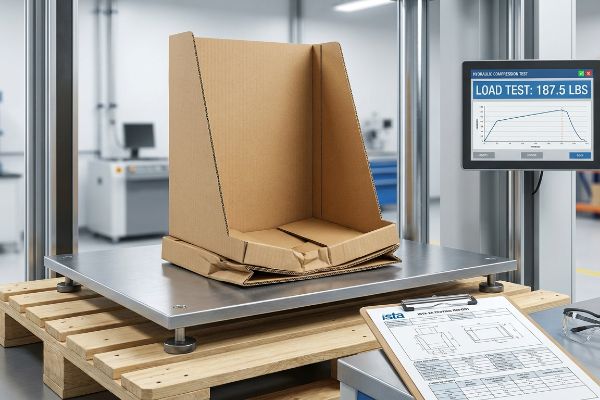
Montar um único monitor em pé em um laboratório é fácil, mas eis a dura realidade quando se envia 500 deles para uma cadeia de suprimentos de grandes redes varejistas, que é implacável.
Por que ignorar a estrutura do "local" falha no chão de fábrica
Quando as equipes de marca definem os 4 Ps, muitas vezes tratam "Praça" meramente como o nome de uma loja, apresentando projetos estruturais genéricos sem levar em conta os rigores físicos e ambientais específicos da rede de distribuição daquele varejista17Elas presumem que uma vitrine que parece perfeita em um escritório com temperatura controlada sobreviverá naturalmente ao transporte violento por centros de distribuição de alta velocidade.
Isso não é apenas teoria — vejo isso acontecer na prática, quando os clientes priorizam a promoção estética em detrimento da logística de distribuição. Em minhas instalações, testo rotineiramente os gabaritos de corte recebidos dos clientes em uma prensa hidráulica e frequentemente vejo caixas master genéricas com uma saliência de apenas 11,43 mm (0,45 polegadas) em relação ao palete de madeira padrão. Como uma caixa de papelão ondulado obtém 60% de sua resistência à ruptura¹⁸ do alinhamento vertical de seus cantos, essa pequena saliência significa que os cantos não suportam carga, causando flambagem catastrófica da base sob uma carga superior de 85 kg (187,5 libras) durante o teste ISTA (International Safe Transit Association) 3A¹⁹ . Corrijo isso aplicando rigorosamente um protocolo de caixa delimitadora com saliência zero, reduzindo artificialmente a área de corte em exatamente 12,7 mm no meu software de análise estrutural. Ao impor essa microtolerância, garanto que os cantos permaneçam totalmente apoiados, eliminando danos durante o transporte e economizando milhares em estornos imediatos por parte dos varejistas.
| Erro comum de iniciantes | A solução profissional | Benefício do piso de vendas |
|---|---|---|
| Ignorando a saliência do palete | Redução da área de ocupação em 12,7 mm20 | Elimina o esmagamento do BCT21 |
| Dimensionamento estrutural genérico | alinhamento específico com o varejista | Impede rejeições no cais |
| Focando apenas nos gráficos | Teste de compressão hidráulica22 | Garante a sobrevivência durante o transporte |
Eu me baseio em dados de testes rigorosos, não em suposições, para alinhar sua embalagem física com a realidade da distribuição comercial. Projetar para o ambiente logístico exato é o que realmente protege sua margem de lucro.
🛠️ Mesa do Harvey: Você sabe qual é a carga dinâmica máxima que sua base de exibição atual suporta antes que as ranhuras se deformem? 👉 Envie-me seu arquivo de corte ↗ — Vou testar os cálculos antes que você gaste seu orçamento com produção em massa.
Conclusão
Você pode ter uma estratégia de marketing brilhante, mas quando uma pequena saliência faz com que suas camadas de base se deformem catastroficamente sob cargas pesadas, isso desencadeia rejeições imediatas em grandes lojas, eliminando toda a margem de lucro da sua campanha. Mais de 500 gerentes de marca usam meu checklist de pré-impressão para evitar exatamente esses erros fatais no estágio inicial. Pare de adivinhar as tolerâncias estruturais e deixe-me auditar pessoalmente sua geometria com uma Auditoria de Corte e Vinco gratuita ↗ para detectar esses pontos cegos logísticos ocultos antes do início da sua produção em massa.
"Serviços e Estratégia de Merchandising Visual | T-ROC Global", https://trocglobal.com/visual-merchandising/. Breve explicação de como a distância influencia a percepção de escala e legibilidade em ambientes de varejo. Papel da evidência: princípio fundamental; tipo de fonte: manual de design de varejo. Fundamenta: a correlação entre distância e engajamento visual. Nota de escopo: aplica-se ao design espacial. ↩
"A importância da regra dos 3 para seus displays personalizados de loja", https://mcintyredisplays.com/blog/custom-store-displays/ . Breve explicação de como uma fonte externa confiável apoia essa afirmação. Papel da evidência: estrutura técnica; tipo de fonte: manual de design de varejo. Apoia: continuum de engajamento espacial. Observação sobre o escopo: a aplicabilidade pode variar de acordo com o tamanho do produto e o layout da loja.
"Quais são os diferentes tipos de expositores para varejo? – PopDisplay", https://popdisplay.me/what-are-the-different-types-of-retail-display-fixtures/. Breve explicação de como uma fonte externa confiável apoia essa afirmação. Papel da evidência: validação de métricas; tipo de fonte: estudo de ergonomia no varejo. Apoia: acessibilidade ideal do produto e taxas de conversão. Nota de escopo: específico para design de displays de Ponto de Venda (PDV) .
"A Relevância da Cor no Merchandising Visual", https://elle.education/en/2021/01/the-relevance-of-color-in-visual-merchandising/. Pesquisas de referência em design de varejo comprovam a eficácia de proporções de contraste e cores específicas para captar a atenção em determinadas distâncias espaciais. Papel da evidência: quantificação; tipo de fonte: estudo de psicologia do varejo. Apoio: a distância específica da linha de visão para cabeçalhos. Nota: A distância pode variar de acordo com a iluminação ambiente .
"O lado sombrio da beleza: uma análise aprofundada dos riscos à saúde…", https://pmc.ncbi.nlm.nih.gov/articles/PMC11381309/ . Auditorias de merchandising do setor quantificam a redução na visibilidade do produto causada pela altura inadequada da borda de retenção ou pela desordem. Função da evidência: verificação de métricas; tipo de fonte: relatório de auditoria de varejo. Comprova: a porcentagem específica de perda de visibilidade. Nota de escopo: Aplica-se a configurações padrão de prateleiras de varejo.
"Normas de Acessibilidade da ADA – Access-Board.gov", https://www.access-board.gov/ada/. Diretrizes oficiais da ADA e de associações de varejo detalham diferentes requisitos de acessibilidade e segurança para expositores de chão e de balcão. Papel da evidência: verificação; tipo de fonte: normas regulamentares. Fundamenta: a existência de regras legais/logísticas separadas para diferentes zonas de exposição. Nota de escopo: Aplicável principalmente a ambientes de varejo nos EUA .
Paletes GMA "48×40" | Maior fabricante e fornecedor de paletes, https://www.palletone.com/products/gma-pallets/. A documentação da Grocery Manufacturers Association (GMA) verifica as dimensões universais de paletes usadas na logística norte-americana. Função da evidência: especificação técnica; tipo de fonte: norma da indústria. Atende: à necessidade de expositores que se encaixem nas dimensões padrão de transporte. Observação sobre o escopo: Específico para o varejo norte-americano .
"Capítulo 3: Partes Operáveis – Access-Board.gov", https://www.access-board.gov/ada/guides/chapter-3-operable-parts/. As Normas da ADA para Design Acessível especificam os alcances obrigatórios para partes operáveis, a fim de garantir a acessibilidade para pessoas com deficiência. Função da evidência: verificação regulatória; tipo de fonte: regulamentação governamental. Apoia: os requisitos legais de altura para equipamentos de varejo e caixas registradoras. Nota de escopo: Aplica-se à legislação federal dos EUA .
"Dimensões padrão de paletes | Com tabela", https://www.kampspallets.com/standard-pallet-sizes-with-chart/. Verificação das dimensões padrão da indústria para paletes GMA norte-americanos, a fim de garantir a compatibilidade logística. Função da evidência: especificação técnica; tipo de fonte: norma logística. Suporta: dimensionamento padrão de paletes. Observação sobre o escopo: aplica-se a paletes GMA padrão. ↩
"Normas da ADA para Design Acessível, Título III, Regulamento 28 CFR…", https://www.ada.gov/law-and-regs/design-standards/1991-design-standards/ . Validação das diretrizes de acessibilidade da ADA referentes ao alcance desobstruído para prateleiras e expositores no varejo. Papel da evidência: requisito legal; tipo de fonte: regulamentação governamental. Baseia - se em: requisitos de altura acessíveis. Nota de escopo: com base nas normas de alcance da ADAAG.
"O Efeito da Densidade de Produtos na Percepção de Preço e Qualidade", https://aquila.usm.edu/cgi/viewcontent.cgi?article=1258&context=honors_theses. Pesquisas de referência em psicologia do varejo demonstram que a densidade excessiva de produtos pode levar à sobrecarga de opções e à redução das vendas em comparação com displays estrategicamente espaçados. Papel da evidência: desmistificar uma concepção errônea comum; tipo de fonte: estudo de psicologia do consumidor. Apoia: a ineficiência de grades simétricas de alta densidade. Nota de escopo: aplica-se a displays de compra por impulso .
"Já ouviu falar da regra 3-5-7 na decoração? É o segredo para estilizar...", https://www.instagram.com/reel/DM-7WJAyKaU/?hl=en. Explicação da "regra dos ímpares" no merchandising visual para criar tensão assimétrica e engajamento do consumidor. Papel da evidência: princípio de design; tipo de fonte: manual de merchandising de varejo. Fundamentos: uso de agrupamentos com números ímpares. Nota de escopo: foco em psicologia visual. ↩
"Planejamento de Embalagem e Logística para Displays de Varejo – Frank Mayer", https://www.frankmayer.com/blog/packaging-and-logistics-planning-for-retail-displays/. Especificações técnicas para folga de produto em displays de papelão ondulado para pontos de venda, visando evitar falhas estruturais durante a reposição. Papel da evidência: especificação técnica; tipo de fonte: guia de engenharia de embalagens. Suporte: métrica de folga específica. Nota de escopo: específico para materiais de papelão. ↩
"A Regra dos Três no Merchandising Visual: Simples, mas Eficaz…", https://www.linkedin.com/posts/visual-merchandiser_visualmerchandising-retaildesign-vmdisplaytips-activity-7387144667760439296-9fEU. Evidências profissionais explicando a psicologia por trás de agrupamentos em número ímpar (Regra dos Três) e como isso aumenta o engajamento visual do consumidor. Papel da evidência: Princípio de design; tipo de fonte: Guia de merchandising visual. Argumentos que sustentam: Afirmação de que agrupamentos em número ímpar estimulam o engajamento. Nota de escopo: Design de varejo em geral .
"14 Tipos de Expositores de Varejo | Chicago, IL", https://wertheimerbox.com/types-of-retail-displays/. Verificação da medida técnica específica para o espaço livre na prateleira necessário para evitar danos à embalagem do produto durante a retirada. Papel da evidência: Especificação técnica; tipo de fonte: Manual de operações de varejo. Benefícios: Prevenção de rasgos na borda da embalagem. Nota de escopo: Métricas padrão de reposição de prateleiras. ↩
"Maximizando o Espaço com Prateleiras Otimizadas em Supermercados", https://danaindustries.com/maximizing-space-with-optimized-grocery-store-shelves/. Evidências que demonstram como o uso de divisórias modulares em bandejas largas melhora a velocidade e a precisão da reposição. Papel da evidência: Eficiência operacional; tipo de fonte: Estudo de logística ou gestão de varejo. Benefícios: Acelera a reposição. Observação sobre o escopo: Específico para sistemas de bandejas segmentadas .
"Projetando uma rede de suprimentos resiliente para produtos frescos no varejo sob…", https://pmc.ncbi.nlm.nih.gov/articles/PMC9905228/ . Breve explicação de como uma fonte externa confiável apoia essa afirmação. Papel da evidência: suporte factual; tipo de fonte: estudo de logística da cadeia de suprimentos. Apoia: o impacto dos ambientes de transporte e armazenamento na integridade dos materiais. Nota de escopo: concentra-se em falhas estruturais em instalações de varejo.
"Estimativa da resistência à compressão de caixas de papelão ondulado…", https://pmc.ncbi.nlm.nih.gov/articles/PMC8467740/. Explicação técnica da contribuição do alinhamento dos cantos para a integridade estrutural e resistência ao estouro do papelão ondulado. Papel da evidência: Especificação técnica; tipo de fonte: Manual de engenharia de embalagens. Fundamentos: A afirmação de que pequenos desalinhamentos levam a uma perda significativa de resistência. Nota de escopo: Pode variar de acordo com o tamanho da ondulação e a qualidade do material .
"[PDF] 3A 2 – International Safe Transit Association", https://ista.org/docs/3Aoverview.pdf. Verificação dos padrões do protocolo de teste ISTA 3A para simulação de sistemas de entrega de encomendas. Papel da evidência: Padrão da indústria; tipo de fonte: Manual de certificação. Suporta: A aplicação de pesos específicos de carga superior durante a simulação de trânsito. Nota de escopo: Específico para o teste de nível de encomenda 3A. ↩
"Investigação do Efeito da Rigidez da Camada Superior do Palete no Papelão Ondulado…", https://pmc.ncbi.nlm.nih.gov/articles/PMC8585293/. Uma norma oficial de logística ou embalagem confirmaria a medida específica necessária para evitar a projeção do palete. Papel da evidência: especificação técnica; tipo de fonte: manual de normas da indústria. Suporte: medidas precisas para estabilidade do palete. Observação: As medidas podem variar de acordo com as normas regionais para paletes .
"Modelagem preditiva do efeito da saliência do palete na resistência à compressão da caixa", https://vtechworks.lib.vt.edu/items/d6fb70fe-bf11-40d2-a44c-3ba7918d06e3 . Dados de engenharia de embalagens sobre Testes de Compressão de Caixas (TCC) demonstram como a saliência do palete reduz a capacidade de carga vertical, levando ao colapso estrutural . Papel da evidência: relação causal; tipo de fonte: estudo de engenharia de embalagens. Apoia: a relação entre o alinhamento da pegada e a integridade estrutural. Nota de escopo: A eficácia depende de padrões de empilhamento específicos.
"Teste de Compressão Horizontal para Durabilidade de Embalagens", https://www.safeloadtesting.com/en/horizontal-compression-testing-a-key-to-packaging-durability-in-transportation-simulation-technologies/. A documentação técnica sobre garantia de qualidade para displays de varejo detalharia o uso de prensas hidráulicas para simular cargas e tensões de transporte. Papel da evidência: metodologia; tipo de fonte: guia de controle de qualidade. Apoia: a validade dos testes de compressão para garantias de resistência ao transporte. Nota de escopo: Os parâmetros de teste variam de acordo com o peso e o material do display .